IJSRD - International Journal for Scientific Research & Development| Vol. 3, Issue 08, 2015 | ISSN (online): 2321-0613
All rights reserved by www.ijsrd.com 130
Convective Thermal Analysis of Rectangular Fins
Kesavulu. P
1V.Gnana Prakash
2A.Asha
3P.Praveen Babu
4V.Govinda Naik
5SIETK, Puttur, AP, India
2SISTK, Puttur, AP, India
Abstract—The object of this study is to analyze the heat exchanging fins and to show the effects of convection in heat transfer model on an electrical motor. Motor running heat transfer in the stainless steel profile was studied. The temperature of surface and the temperature profile of fin can be estimated by simulation using ANSYS. On the other hand, the calculation of natural convection shows similar result to ANSYS result. For the effect of material properties, the material is changed from steel AISI 4340 to aluminium. The temperature at the surface of the aluminium wall is higher than that of steel.
Key words: Rectangular Fins, Convective Thermal Analysis
I. INTRODUCTION
Extended Surface (Fins) is used in a large number of applications to increase the heat transfer from surfaces. Typically, the fin material has a high thermal conductivity. The fin is exposed to a flowing fluid, which cools or heats it, with the high thermal conductivity allowing increased heat being conducted from the wall through the fin. Fins are used to enhance convective heat transfer in a wide range of engineering applications, and offer practical means for achieving a large total heat transfer surface area without the use of an excessive amount of primary surface area.
II. MATERIALS USED FOR FINS
Generally there are two types of materials used for fins aluminium and copper. The thermal conductivity of aluminium is 225 W/mK and that of copper is 385 W/mK. The melting and boiling point of copper are 1084˚ and 2595˚ and that of aluminium are 658˚ and 2057˚.
Pure aluminium has silvery colour and it has greater resistance to corrosion. It is used in deoxidizing molten irons and steel. It is used to prepare to prepare the metals from their oxides by heating a mixture of powdered aluminium and the oxides of the metal to be reduced. Its electrical resistivity is 2.669 micro ohms/cm.
Copper is reddish brown in colour. Refining of the metal is usually considered to begin when the copper is in the blister stage, the surfaces of the cast material being irregular and blistered due to the generation of gases during cooling. This copper is 99% pure and is further refined in the furnace by oxidation process which removes sulphur and other impurities. The excess of oxygen is removed from the metal by operation known as poling.
A. Types of Fins
Fig.1. types of pins
B. Examples of Fins Applications:
Thin rods on the condenser in back of refrigerator.
Honeycomb surface of a car radiator. Corrugated surface of a motorcycle engine. Coolers of PC boards.
III. INTRODUCTION TO ANSYS
ANSYS finite element analysis software enables engineers to perform the following tasks. Build computer models or transfer CAD models structures, products, components or systems. Apply operating loads or other design performance conditions. Study physical responses, such as stress levels, temperature distribution or the impact of electromagnetic fields. Optimize a design early in the development process to reduce production costs. Do prototype testing in environments where it otherwise would be undesirable or impossible.
The ANSYS program has the comprehensive graphical user interface that gives user easy, interactive access to program functions, commands, documentation, and reference material.
The ANSYS program has many finite element analysis capabilities ranging from a simple linear static analysis to a complex non-linear transient dynamic analysis.
A typical ANSYS analysis has the following steps. Defining element types.
Defining element real constants. Defining material properties. Creating the model geometry. Apply loads and obtain the solution. Review the results.
IV. PROBLEM DEFINITION AND MODELLING
A. Dimensions of a Model
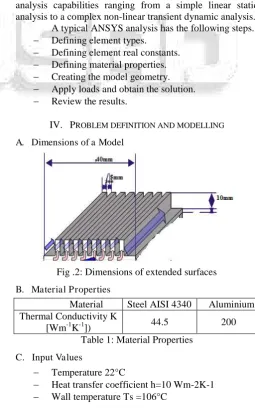
Fig .2: Dimensions of extended surfaces
B. Material Properties
Material Steel AISI 4340 Aluminium Thermal Conductivity K
[Wm-1K-1]) 44.5 200
Table 1: Material Properties
C. Input Values
Temperature 22°C
Convective Thermal Analysis of Rectangular Fins (IJSRD/Vol. 3/Issue 08/2015/032)
All rights reserved by www.ijsrd.com 131 D. 3D Model
E. Meshing of Ansys Modal
V. RESULTS AND DISCUSSION
A. Temperature in the System Using Ansys
1) Stainless Steel
2) Aluminium
B. Heat Flux in the System Using Ansys 1) Stainless Steel
2) Aluminium
VI. CONCLUSION
Heat exchange with fins was examined and we can find convection term is important Factor in calculation of surface temperature. Solution from ANSYS Indicates that the former might get the more exact estimated value than the latter which needs more assumptions.
For the effect of material properties, the material is changed from steel AISI 4340 to aluminum. The temperature at the surface of the aluminum wall is 150K higher than that of steel.The Heat flux of the aluminum wall is higher than that of steel.
Therefore material point of view heat transfer rate of aluminum wall is higher than that of steel.
REFERENCES
[1] Bird, Stewart, lightfoot, “Transport Phenomena”, John Wiley & Sons, p. 265-309
[2] Welty, Wicks, Wilson, “Fundamentals of Momentum, Heat, and Mass Transfer, 3rd edition”, John Wiley & Sons, p.252-295
[3] Sheldon H.D. Lee et al, Hydrogen from natural gas, International Journal of
[4] Hydrogen Energy, 30, 2005, 829-842 Lindon C. Thomas, “Heat Transfer”, Prentice-Hall International, Inc., p.34-256
[5] Erwin Kreyszig, “Advanced Engineering Mathematics, 8th edition”