• Tidak ada hasil yang ditemukan

Measuring Children’s Ethnic Prejudice Ubaya Repository

N/A
N/A
Protected

Academic year: 2018

Membagikan "Measuring Children’s Ethnic Prejudice Ubaya Repository"

Copied!
8
0
0

Teks penuh

(1)
(2)
(3)

ii Editorial

237

Self-confidence and Stress Coping Among Hotel Employees Handling Guests’

Complaints

Desak Nyoman Arista RD, James Waskito Sasongko, and Hasan Oetomo

250

Influence of Sociodrama on the Emotional Intelligence of Preschool Children

Himatul Ulya and Erika Setyanti Kusuma Putri

257

Youth Courtship Sexual Behavior, Exposure to Pornography, and Parental Sexual

Communication

Sri Lestari

265

Parenting in Multicultural Settings: Experiences of the Indonesian Mothers

Yopina G. Pertiwi

and

Nandita Babu

281

Effectivity of Aroma-, Light-, and Al’Quran Therapy to Enhance Driver’s Level of

Awareness in Malaysia

Yohan Kurniawan

289

Measuring Children’s Ethnic Prejudice

Srisiuni Sugoto, Sari Dewi Sutjipto, Ananta Yudiarso, and Aminuddin Mohd. Yusof

294

Cognitive Behavior Therapy: Application of Intervention for Anorexia Nervosa

Christine Santoso

306

Acknowledgement

307 Author’s Index and Subjects Index

ISSN 0215-0158

July 2010

Volume 25, Number 4

Anima Vol. 25 No. 4 pp. 237 – 314 Surabaya

July 2010

(4)

Anima, Indonesian Psychological Journal 2010, Vol. 25, No. 4, 289-293

289

This article has been presentaed at The Seventh Conference of Asian Association of Social Psychology (AASP) Kota Kinabalu, Sabah-Malaysia, July 25-28, 2007.

Correspondence concerning this article should be addressed to Srisiuni Sugoto, PhD, Faculty of Psychology Universitas Surabaya. E-mail: [email protected]

Measuring Children’s Ethnic Prejudice

Srisiuni Sugoto, Sari Dewi Sutjipto,

and Ananta Yudiarso

Faculty of Psychology University of Surabaya Surabaya Indonesia

Aminuddin Mohd. Yusof

School of Psychology and Human Development

Faculty of Social Science and Humanities Universiti Kebangsaan Malaysia

Bangi Malaysia

The validity of Doyle and Aboud ‘s Multi-Response Racial Attitude (MRA) test was examined using Surabaya’s Javanese (SJ) and Chinese (SC) children’s pictures projected in multimedia, including the development of racial prejudice among the participants. MRA(Kline, 2005) uses six children pictures from three different ethnic groups. To encourage children’s responses, their attitude was measured through a computer program. Children from 5-6 years (N = 82) and from 9-11 years (N = 86) from Muslim, Christian, public and private schools were participating in this study. A criterion-related validity was tested by correlating the new MRA test and the Ethnocentrism Scale (E-scale) test of prejudicial attitude. Only the third set of MRA’s test is correlated significantly with E-scale (r = .469, p< .05). Older SJ children seems to develop prejudice more than the younger ones, on the other hand the SC children have much less prejudice towards SJ children.

Key words: children’s prejudice, MRA

Validitas tes Multi-Response Racial Attitude (MRA) dari Doyle and Aboud diteliti dengan memakai gambar anak Jawa (AJ) dan anak Cina (AC) yang diproyeksikan di multimedia, termasuk perkembangan prasangka rasial di antara para partisipan. MRA (Kline, 2005) memakai enam gambar anak dari tiga kelompok etnis berbeda. Untuk menyemangati anak-anak merespons, sikapnya diukur melalui program komputer. Anak-anak berusia antara 5 hingga 6 tahun (N = 82) dan antara 9 hingga 11 tahun (N = 86) berasal dari sekolah Muslim, Kristen, dan swasta berpartisipasi dalam kajian ini. Validitas terkait-kriteria diuji dengan mengorelasikan tes MRA yang baru dengan tes Ethnocentrism Scale (E-scale) sikap berprasangka. Hanya perangkat ketiga dari tes MRA berkorelasi secara bermakna dengan E-scale (r = .469, p< .05). Anak AJ dari kelompok yang lebih tua tampaknya mengembangkan prasangka lebih dari anak dari kelompok yang muda, sebaliknya AC jauh lebih sedikit prasangkanya terhadap AJ.

Kata kunci: prasangka pada anak, MRA

Many of the countries in the Malay Archipelago are inhabited by several ethnic groups. The ethnic origins of Malaysia and Indonesia, for example, are originally Malays. However, it is now well-known that Malaysia is a nation of diverse ethnics. In Indonesia, there are about 300 ethnic groups with their own cultural identities (Koentjara-ningrat 1995). This multi-ethnic nature enriched the cultural diversity of the two countries.

Nevertheless, to live together in harmony is not an easy task. One of the grim histories was the racial riots

(5)

290 SUGOTO, SUTJIPTO, AND YUDIARSO

Malaysia and Malay origin in Peninsular Malaysia who are in the same position but are not regarded as immigrants. In Malaysia, ethnic relations are viewed as 'co-acting rather than interacting' (Yusof, 2006). In Malaysia, all ethnic groups are willing to accept one another but prefer to do their everyday activities within their own ethnic groups, hence the prejudice among various races.

Prejudice, according to Augoustinos, Walker & Donaghue (2006) is a destructively permanent and continuous social problem. Prejudice is a baseless and unreasonable dislike about something, persons or things. A prejudiced person forms his opinion or grade on other persons or things without any experience in relation with those individuals or things.

The definition of prejudice was first proposed by Allport (1954) in his book The Nature of Prejudice. According to him, ‘prejudice is an antipathy based upon a faulty and inflexible generalization. It may be felt or expressed. It may be directed toward a group as a whole or toward an indivi-dual because he is a member of that group” (Allport 1954). Research on prejudice, particularly in Malaysia and Indonesia, has always been made on adult subjects. One of the few researches using children as subjects of the study was conducted by Devi (2003). It was found in the study that there was no difference between children of 6-7 years old and those of 10-12 years old in the development of ethnic awareness and preferences. Social prejudices among children 6-7 years of age are not apparent since they chose groups based on trait orientation. However, children of 10-12 years of age have already acquired social orientation, motive, interest, and are influenced by social prejudice. Piaget’s (cited in Sigelman & Rider, 2003) theory of cognitive development posits that 5 year-old children who are in pre-operational stage are already able to view the world in words and pictures. At the age of 10, they enter concrete operational stage whereby they are able to think logically in specific and concrete examples. Supported by role taking theory of Selman (cited in Dusek 1996), a 5 year-old is still in the egocentric differentiated stage who is not able to differen-tiate between his own perspective and that of others. At 10, the child enters reciprocal perspective taking stage whereby he is able to make conclusion about others' perspectives and is aware of their perspective in relation to others’.

When does racial attitude become negative and how is it formed? Briscoe (2003) is of the view that family is the first environment that forms the basis of biased views. According to him it is the way the children were raised in the family that form sexism and racism. Available psychological evidence does not support the idea that family is the only agent responsible for early formation of prejudice, but family does have role in

increasing or decreasing prejudice (Aboud & Doyle, as cited in Briscoe 2003).

Research on racial issues has been widely studied locally and abroad but recently the focus shifts on racial socialization particularly among parents of minority groups or African-American (Hughes, et al. 2006). The present study is a prelude to a bigger study to examine the extent of parental role in forming racial attitude among Malays and Chinese Surabaya in Malaysia; and Javanese Surabaya and Chinese Surabaya in Indonesia. Studying psychological construct among children poses certain measurement problems. Children are not able to read and express themselves linguistically as do adults, hence the use of questionnaires and test which are language laden is not appropriate. Some tests for children are available but Quintana et al. (2006) suggested that researches should design measurement that is appropriate for local culture. It is, therefore, the aim of the study reported in this paper was to validate a measure of racial prejudice in Malaysian and Indonesian context.

Many studies have been done on prejudice measurement. Clark & Clark (cited in Puskhin & Veness 1973) found that 3 year-old African children are able to distinguish the white dolls from the black ones. However, Stevenson & Stewart (cited in Puskhin & Veness) found that children of the same age could not differentiate between the Africans and the Whites. McKnown (2004) in a recent study found that 6-10 year-old children’s narration contains stereotype, prejudice, discrimination and racial conflict. Nesdale, Durkin, Maass & Griffiths (2004), examining social identity development theory (SIDT) among 5, 7 and 9 years old, found that own group favourableness is not influenced by age or other ethnic groups; however, liking for other groups increases with age and status.

Some tests such as semantic differential test (Kwa 1988) and implicit association test (Greenwald & Farnham, 2000) are administered to adults. In this study, Multiple-response Racial Attitudes (MRA proposed by Doyle & Aboud, cited in Kline, 2005) will be used. MRA is the only instruments measuring racial attitude which has been published with test-retest validity and solid evidence validity. MRA is administered by showing a hand-drawn picture of 8 x 11 inches consisting of portraits of children from different ethnic groups (Whites, Hispanic and Asia) which differ only in hair colour and texture. Children will be given 20 positive and negative traits written on cards which are put beside the portraits. Separate portraits were used for girls and boys.

(6)

ETHNIC PREJUDICE 291

what it is purported to measure (Soehartono 2002). One of the validity measures is congruent validity which is used in designing a new instrument by correlating it with an older instrument. In the present study, the older measurement is Ethnocentrism Scale (E-Scale). Ethnocentrism is the idea that own group is the centre of everything and other groups are compared according to own group (Poerwanti 2006). Ethnocentrism will lead to racial prejudice because of the view that owns culture is better than other cultures.

In conclusion, the question posed in the present study is twofold:

1. Is MRA a valid measure of prejudicial attitude in Malaysia and Indonesian context when E-Scale is employed as a criterion measure?

2. Is there a difference in ethnic prejudice between children at pre-operational stage (5-6 years old) and concrete operational (9-11 years old)?

Method

Participants

As many as 168 children (N= 168) participated in the study. Characteristics of the children are as follows: (a) Children of 5-6 years of age were from four types of kindergartens, i.e. Islamic, Christian, national and private. (b) Children of 9-11 years of age from for several types of primary schools, i.e. Islamic, Christian, national and private. (c) Children of Chinese Surabaya ethnic origin are children of parents from Chinese Surabaya origin with Chinese Surabaya physical characteristics, i.e. yellowish skin and slanted eyes. (d) Children of Javanese Surabaya ethnic are children of Javanese Surabaya parents from Javanese Surabaya origin with Javanese Surabaya physical characteristics such as dark brown or brown skin and wide eyes.

Instruments

The instrument used to measure data is a modified MRA in the form of multimedia to unearth the score of children’s prejudice. MRA consists of four sets. The first set employs the original MRA picture which has been modified with Javanese Surabaya and Chinese Surabaya ethnics. The second set uses paintings. The third and the fourth sets use photographs. Before the real research was conducted, there had been an MRA try-out which was done within seven Javanese Surabaya children and ten Chinese Surabaya children. They were asked to evaluate MRA measuring tool. It was found that most of them like the tool and find it easy to use. After collecting from questionnaires, the researches re-checked the completeness of the subjects’ identities and the answers given. It was found that from 348 questionnaires distributed, there were only 270 questionnaires which had been returned to the researchers in a complete state. Meanwhile, the rest–102 questionnaires–was not returned in a complete condition and thus, ineligible to be further processed. The main cause of it is the subjects do not meet the criteria as desired by the research (their parents are not Javanese Surabaya or Chinese Surabaya) and those who wrote their ethnicities as Indonesian citizens. The total number of the subject employed for this research is 168 subjects. Table 1 shows the intake of the subjects.

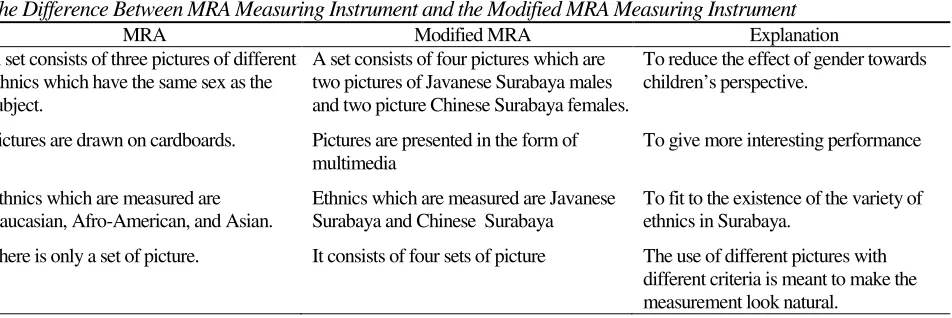
The difference between MRA measuring tool and the modified MRA measuring instrument can be seen in Table 2.

Table 2.

The Difference Between MRA Measuring Instrument and the Modified MRA Measuring Instrument

MRA Modified MRA Explanation

A set consists of three pictures of different ethnics which have the same sex as the subject.

A set consists of four pictures which are two pictures of Javanese Surabaya males and two picture Chinese Surabaya females.

To reduce the effect of gender towards children’s perspective.

Pictures are drawn on cardboards. Pictures are presented in the form of multimedia

To give more interesting performance

Ethnics which are measured are Caucasian, Afro-American, and Asian.

Ethnics which are measured are Javanese Surabaya and Chinese Surabaya

To fit to the existence of the variety of ethnics in Surabaya.

(7)

292 SUGOTO, SUTJIPTO, AND YUDIARSO

Table 3

The Validity Test of MRA Score by Using E-scale

Validity Correlation’s coefficient p(< .05) Explanation

MRA set 1 -.067 .755 Not valid

MRA set 2 .191 .419 Not valid

MRA set 3 .469 .049 Valid

MRA set 4 -.174 .635 Not valid

Table 4

The Distribution of Kindergarten Subjects’ Prejudice Number

The Distribution of Elementary School Subjects’ Prejudice Number a significant correlation with E-scale rate. Then, it can be safely argued that the third set of MRA is valid to be used in the future research. Therefore, the number of kindergartens and elementary schools students used as respondents is only those who are given the third set of MRA.

Table 4 shows us the subjects who are in the pre-operational cognitive developmental stage. 70% Chinese Surabaya subjects showed no prejudice and 30% Chinese Surabaya subjects had prejudice. Meanwhile, 54.55% Javanese Surabaya subjects showed prejudice and 45.45% Javanese Surabaya subjects showed no prejudice.

Table 5 shows us the subjects who are in the concrete operational cognitive developmental stage; 62.5% Chinese Surabaya subjects showed no prejudice and 37.5% Chinese Surabaya subject showed prejudice. Meanwhile, 90% Javanese Surabaya subject showed prejudice and 10% Javanese Surabaya subjects showed no prejudice.

Results and Discussion

This study used a modified MRA. Based on predictive validity test, the third set shows the most significant

corre-lation between the MRA score of elementary school subjects and the score of E-Scale questionnaire. The coefficient of correlation is .469, p < .05. This means that only the third set of modified version of MRA is considered valid. From this result, it can be concluded that it may be easier for subjects to give response to photos than pictures or paintings, compared to the original MRA used in Kline’s or Aboud and Doyle’s study. Therefore, only this set of MRA will be used in the bigger research for this study.

The MRA score showed that 54.55% of Javanese Surabaya children who are in the pre-operational stage (5-6 years old) do have prejudicial attitude towards Chinese Surabaya. In contrast, 70% of Chinese Surabaya children who are in the same stage have no prejudicial attitude towards Javanese Surabaya. On the other hand, 90% of Javanese Surabaya children who are in the concrete operational stage (9-11 years old) show prejudice. Conversely, 62.5% Chinese Surabaya children who are in the same stage do have prejudicial attitude towards Javanese Surabaya. Hence, based on the present findings, this research argues that Javanese Surabaya children tend to have prejudice against Chinese Surabaya while Chinese Surabaya children tend not to have prejudice against Javanese Surabaya. Furthermore, according to Coppel’s (2004) contention that most Indonesian Chinese Surabaya does not speak Mandarin and the fact that Indonesian language has become the mother tongue for many Chinese Surabaya families supports these findings. Chinese Surabaya were not allowed to celebrate Chinese’s New Year during the Soeharto's ruling period and they had to adopt Indonesian names as well as a citizenship certificate (SBKRISurat Bukti Kewarganegaraan Republik Indonesia). At that time, some Chinese Surabaya didn’t have Chinese’s identities so they still confused because they did not receive completely as Indonesian citizens.

(8)

ETHNIC PREJUDICE 293

meso-system environment (Brofenbrenner, as cited in Santrock, 2002), namely, parents and teachers.

It can also be concluded from the findings of this study that Javanese Surabaya children in concrete operational stage are more prejudiced against Chinese Surabaya than Javanese Surabaya children in pre-operational concrete stage. This is in accordance with Piaget’s (cited in Sigelman & Rider, 2003) concept of schema complexity. Hence, the older the children, the more experience they have in social interactions and thus, the more they identify themselves with their ingroups and differentiate themselves from their outgroups.

The findings reported in this paper suggest that MRA is a valid instrument for measuring children’s’ prejudice in the Malaysian and Indonesian contexts. The instrument will, therefore, be used in a proposed research by the present researchers to examine the effects of parental styles of child-rearing practices and parents’ racial socialization on children's racial attitudes.

References

Allport, G.W. (1954). The nature of prejudice. Reading, MA: Addison-Wesley.

Augoustinos, M., Walker, I., & Donaghue, N. (2006).

Social cognition: An integrated introduction (2nd ed.). London: Sage Publication Ltd.

Briscoe, A. M. (2003). The interrelationships among parental racial identity, racial socialization, and children’s prejudice and tolerance. Retrieved from http://wwwlib.umi.com/dissertations/fullcit/3064915. Coppel, C.A. (2004). Historical impediments to the

acceptance of ethnic Chinese Surabaya in a multicultural Indonesia. In L. Suryadinata (Ed.),

Chinese Indonesians: State policy, monoculture and multiculture. Singapore: Marshall Cavendish. Devi, Probowati, Y., & Sugoto, S. (2003). Kesadaran dan

preferensi etnik ditinjau dari tahap perkembangan usia dan etnik. Unpublished thesis, Faculty of Psychology, Universitas Surabaya.

Dusek, B. J. (1996). Adolescent development and behavior

(3ed ed.). New Jersey: Prentice-Hall Upper Saddle River. Greenwald, A. G., & Farnham, S. D. (2000). Using the

Implicit Association Test to measure self-esteem and self-concept. Journal of Personality and Social Psychology, 79, 1022–1038.

Hughes, D., Smith, E. P., Stevenson, H. C., Rodrigues, J., Johnson, D. J. & Spicer, P. (2006). Parents’ ethnic-racial socialization practices: A review of research and

direction for future study. Developmental Psychology, 42(5), 747-770.

Kline, C. (2005). The friendship factor: How interracial friendships benefit elementary school students. Retrieved from http://www.stanford.edu/upckline/thesis.doc Koentjoroningrat (1995). Manusia dan kebudayaan

Indonesia. Jakarta: PT. Djambatan.

Kwa, R. (1988). An extention of the belief congruence theory of prejudice into the cognitive domain. Anima, 13(4), 23-105.

Mc.Kown, C. 2004. Age and ethnic variation in children’s thinking about the nature of racism. Journal of Applied Developmental Psychology,25(5), 597-617.

Tan, M. G. (2004). The social and cultural dimension of gender-biased violence in Indonesia: From labelling to discrimination to violence. In L. Suryadinata (Ed.). Chinese Surabaya Indonesians: State policy, monoculture and multiculture. Singapore: Marshall Cavendish.

Nesdale, D., Durkin, K., Maass, A., & Griffiths, J. (2004). Group status, outgroup ethnicity and children’s ethnic attitudes. Journal of Applied Developmental Psychology, 25(2): 237-251.

Quintana, S. M., Chao, R. K., Cross, W. E. Jr., Hughes, D., Le Gall, S.N., Aboud, F.E., Contreras-Grau, J., ...& Vietze, D.L. (2006). Race, ethnicity, and culture in child development: Contemporary research and future direction. Child Development, 77(5): 1129-1141. Poerwanti, E. (2006). Pemahaman psikologi masyarakat

Indonesia sebagai upaya menjembatani permasalahan silang budaya. Malang: Lembaga Kebudayaan - Universitas Muhammadiyah.

Puskhin, I., & Veness, T. (1973). The developmental of racial awareness and prejudice in children. In P. Watson (Ed.), Psychology and race (pp. 23-42). Aylesbury, Great Britain: Hazell Watson & Viney Ltd.

Santrock, J. W. (2002). Life-span development: Perkembangan masa hidup (5th ed., J. Damanik, & A. Chusairi, Pengalih bhs.). Jakarta: Erlangga.

Sigelman, C. K. & Rider, E. A. (2003). Life-span human development. Belmont: Wadsworth/Thomson Learning, Inc. Soehartono, I. (2002). Metode penelitian sosial: Suatu teknik penelitian bidang kesejahteraan sosial dan ilmu sosial lainnya. Bandung: PT. Remaja Rosdakarya. Yusof, A.M. (2006). Hubungan kaum: Dekat tapi jauh. Kertas

Gambar

Table 2. The Difference Between MRA Measuring Instrument and the Modified MRA Measuring Instrument

Referensi

Dokumen terkait

Meskipun demikian, dalam lintasan sejarahnya, ki­ prah kekaryaan Soegijapranata tidak hanya berdimensi ke­ gerejaan (kekatolikan) tetapi juga sarat dengan dimensi ke­

Dalam hal mewaris menurut menurut undang-undang dibedakan menjadi, yaitu : Mewaris langsung ialah orang itu mewaris dalam kedudukan sebagai ahli waris langsung karena

Berdasarkan hal tersebut maka perlu dilakukan penelitian untuk mengetahui karakteristik ibu bersalin dengan seksio sesarea di Rumah Sakit Umum Pusat Haji Adam Malik

Kebutuhan peralatan dan bahan berdasarkan silabus mata kuliah praktik kayu di Program Studi Pendidikan Teknik Bangunan .... Identitas mata

Sejak ditetapkannya Perpres No. 66/2017 telah dilakukan beberapa kali workshop dan diskusi baik internal Kementerian Pemuda dan Olahraga maupun antar Kementerian dan Lembaga.

Petir adalah gejala alam yang biasanya muncul pada musim hujan di mana di langit muncul kilatan cahaya sesaat yang menyilaukan biasanya disebut kilat yang beberapa saat kemudian

Temuan penelitian ini mengemukakan tentang data yang diperoleh dari hasil penelitian mengenai implementasi dzikir untuk mengurangi kenakalan remaja, anatara lain sebagai

The development of main tasks and function indicator of 4 echelon from research result were give good service to the public interests according to the task and responsibility