www.iosrjournals.org
The Comparative Study Between The Cooperative Learning
Model Of Numbered Heads Together (Nht) And Student Team
Achievement Division (Stad) To The Learning Achievement In
Social Subject
Munawaroh
1Stkip Pgri Jombang
Abstract: This research aims to explain the differences between the cooperative learning model of Numbered Heads Together (NHT) and Student Team Achievement Division (STAD) to the learning achievement of the eighth grade students in social subject at SMP Negeri 5 Jombang. The population in this study was 66 students of the eight grade students in which 33 students from class VIII H. and 33 students from class VIII F. The data were collected by using observation, interviews and tests. This research applied T-test for data analysis. The results showed that there is significantly difference on learning achievement of the eighth grade social studies at SMP Negeri 5 Jombang who are taught by using the cooperative learning model of NHT and STAD. The result showed that tcount was 2.763, it is higher than the coefficient of table 1.998 at the 5% level of
significant (α) on the value of (df) = (33-1)(33-1) is 64. It implied that tcount> tta ble in which 2.763 > 1.998,
therefore, the null hypothesis (Ho) is rejected and the alternative hypothesis (Ha) is accepted. Finally, It can be
concluded that there is significant difference of the cooperative learning Model of Numbered Heads Together (NHT) And Student Team Achievement Division (STAD) to the learning achievement of the Eighth Grade Student in Social Subject at SMP Negeri 5 Jombang
Keywords:The Cooperative Learning Model on Numbered Heads Together (NHT), Student Team Achievement Division (STAD), Learning Achievement.
I. Introduction
The globalization era, science and technology (science and technology) is growing rapidly. It requires qualified human resources, but in the world of education in Indonesia, especially on school education is still not ready because of the low quality of education. This is a challenge for teachers in creating students to have quality resources. Teachers and students are the main components in the learning process. Teachers should be able to guide students in such a way, so that they can develop the knowledge in accordance with the structure of the knowledge learned field of study. Teachers also have to understand the material being taught also demanded to know exactly where the level of students' knowledge at the beginning or before the course. Furthermore, the chosen method by the teacher is expected to assist students in developing knowledge effectively.
In line with the development of social solidarity among students, an individual approach in education needs to be balanced with an approach based on cooperation, solidarity and collaboration to develop students' skills in collaboration, and the ability to negotiate, communicate and ability to make decisions. One approach to the learning process is based cooperative learning groups. Togetherness and cooperation in a collaborative learning among students aim to achieve the learning objectives together. In addition to the common goals to be achieved, togetherness and cooperation in this study also aimed to develop collaboration skills among students. With this approach, teachers do not always give the tasks individually, but as a group. Even the determination final evaluation results using the principles of the group. That is, the results of individual students is not based on the ability of each student, but also based on the achievements of the group. Thus, students who are good will be the tutor to help students who are less intelligent for the sake of achievement of the group as a whole. Each student is not only responsible for the progress and success of himself, but also responsible for the success and progress of the group .
The results of research conducted by Revykawanti, Devi (2008), shows that the cooperative learning model of Numbered Head Together trends can improve critical thinking skills demonstrated by the increase in most of the critical thinking skills of each indicator XD grade students of SMA Negeri 1 Pagak on the subject of economic subjects the form of the market that in the first cycle most of the students got a score of 2, which means improper and conscientious, while in the second cycle most of the students got a score of 3 means rigorous but less precise. Another results indicated by Mufarrihah, Novy. (2008), shows that the type of learning cooperative learning Numbered Head Together can increase students' motivation shown by the increase in the percentage of all aspects of student motivation observed that 58.19% with enough categories in the first cycle increased by 70.30% with a high category in cycle II. With the application of learning cooperative learning model type Numbered Head Together student learning outcomes also increased. Learning outcomes of the average value of 74.23 with both categories in the first cycle increased to 85.38 with excellent category and in the second cycle, an increase of 15.02%.
Some studies have concluded the benefits of cooperative learning. Such as, Robert E. Slavin and Nancy A. Madden, the results of research on "School Practices That improve Race Relations" which was published in the American Educational Research Journal stated that cooperative learning in the learning produces higher than other leaarning models. Cooperative learning for students’ academic achievement gets better ability to conduct social relationshsocial subject, increase self-confidence, and develop mutual trust each other, either individually or in groups. Wheeler (1977) reported that students taught by cooperative learning model is more successful in studying social studies than students taught by a system of competition, with a rate ratio of 74%: 26%. Stahl (1992) found that the use of cooperative learning model STAD encourages growing attitude of solidarity and openness among students; the results of the study also found that the cooperative learning model on STAD encourages achievement, goals and social values in social studies education. Therefore,in order to adjust these developments require creativity and quality of human resources must be increased which can be done through education. To improve the quality of teaching learning through Social Subject Competencies Standard in which the students must be able to Understand economic actors in community activities, teachers are expected to not only understand the social studies disciplines, but also should understand the nature of the learning process that includes three domains of Social Subject capabilities, namely cognitive, affective and psychomotor. Therefore, the learning experience in Social Subjects in order to achieve the Competencies Standard in Understanding Economic Activity in the Community Actors should provide the growth and growing interest of students in every aspect of the ability.
In the era of economic development and globalization based on required knowledge and diversity of skills that students are able to empower themselves to find, interpret, evaluate and use information and delivery of creative ideas. Teaching learning process is a form of organization of education that combines systematic and continuous education activities in schools with educational activities conducted outside the school in the form of the provision of a variety of learning experiences for all learners. Teaching learning process is designed to follow the principles of teaching and learning. Teaching and learning are an active activity of students in constructing meaning or experience.
Curriculum of the social subjects which are stated on the Competence Standard in which the students must be able to understand the activities of economic actors in the community, provides a variety of learning experiences to understand the concepts and processes of social sciences and emphasizes that students become active learners and flexible. This means that the teaching and learning process in junior high social studies is not only based on behavioral learning theory, but also insists on the principle of learning from cognitive theory. Therefore, the task of the teacher in the classroom does not just convey information for the achievement of learning objectives, but also creates a learning experience of students, teachers must strive for the activities in the classroom can provide the widest possible opportunity for the student experience.
Teachers should be able to find a model that can support teaching and learning activities, so that teaching and learning activities can be organized effectively. But the reality in the field of teaching and learning process is still dominated by models or conventional methods. Teachers teaching and learning process should create a lesson plan for one semester. In this plan defined all the concepts developed, and for any specified concept model will be used as well as the skills to be developed. Supriyadi (1995) , to achieve the goal of teaching required the use of optimal learning models. This means that to achieve a high quality of teaching each subject in particular social subject should be organized with appropriate learning models and subsequently delivered to the student with the right model anyway.
Learning activities in the social subject with Standard Competency understanding economic behavior in community activities is an attempt to how students can understand the concepts. The understanding obtained by students in the learning process can be seen from the student achievement as measured by giving the test to the students so that there should be research to find a model that is effective in the learning process in the classroom so that they can provide an alternative model that allows it to be applied in the learning process with the social studies Competency Standard specificity Actors Understanding Economic Activity in the Community. Based on the above, the problem in this research “Is there significant difference in the type of Cooperative Learning Model Numbered Head Together (NHT) and Student Team Achievement Division (STAD) to the Learning Achievement of the eight grade studenst in social subject at SMP N 5 Jombang?” . While the purpose of this study is that explaining the differences of thr Cooperative Learning Model on Numbered Head Together (NHT) and STAD to the learning Achievement of the social subject Class at the eight grade students at SMP N 5 Jombang.
II. Review Of Literature
Definition of Cooperative Learning
Humans have a degree of potential, historical background, as well as future expectations are different. Because of the differences, humans can educate Cooperative learning is consciously creating successive loving each other interactions so learning resources for students not only teachers and textbooks but also fellow students. Human beings are individual, different from each other. Due to the individual nature of the human being in need of other human beings so as a logical consequence of man must be social creatures, creatures that interact with each other. Because one another requires that there must be interaction successive compassion (love each other or love each other). Cooperative learning is learning to consciously and deliberately create a loving interaction between fellow students.
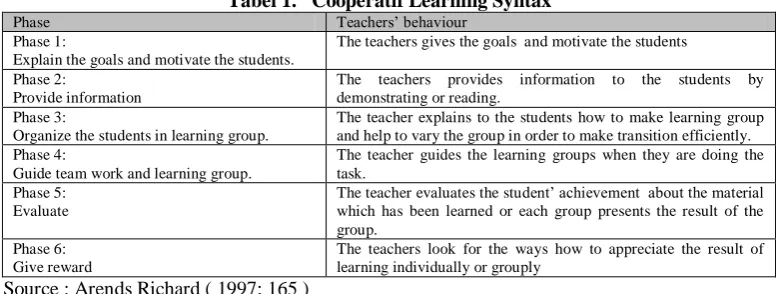
The difference between people who are not properly managed can lead offense and misunderstandings between people. In order to avoid offense and misunderstanding, it is necessary to foster successive interactions (mutual tolerance). Cooperative learning is learning to consciously and deliberately develop successive foster interaction to avoid offense and misunderstandings that can lead to hostility. Succinctly Abdurrahman and Bintoro (2000: 78) says that "cooperative learning is learning consciously and systematically develop interaction penance grindstones, penance compassion, and penance foster among fellow students as live training in the real society." The steps of the teacher's behavior according to cooperative learning model was described by Arends (1997) are as shown in Table1.
Tabel 1. Cooperatif Learning Syntax Phase Teachers’ behaviour
Phase 1:
Explain the goals and motivate the students.
The teachers gives the goals and motivate the students
Phase 2:
The teacher explains to the students how to make learning group and help to vary the group in order to make transition efficiently. Phase 4:
The teacher evaluates the student’ achievement about the material which has been learned or each group presents the result of the
There are six main phases in the cooperative learning (Arends, 1997) in a cooperative learning starts with the teacher informs the goals of learning and motivates students to learn. This phase was followed by the presentation of information, often in the form of text is not verbal. Then followed the steps in which students under the guidance of teachers to work together to accomplish interdependent tasks. The last phase of cooperative learning groups includes the presentation of the final product or test what has been learned by the students and the introduction of group and individual efforts.
Cooperative Learning Elements
Numbered Heads Together (NHT)
Suprijono, (2009: 92) said that learning with Numbered Heads Together (NHT) begins with Numbering. The teacher divides the class into small groups. Each person in the group is numbered. Once the group is formed, teachers ask some questions to be answered by each group. After that, it is given the opportunity for each group to find the answer. The next step is the teacher calls on students who have the same number of each group. They are given the opportunity to provide answers to questions that have been received from the teacher. The work is ongoing until all students with the same number of each group gets a turn exposes answer has been received from the teacher. Kagan (2007) Cooperative Learning model Numbered Heads Together (NHT) indirectly trains students to share information, listen carefully and speak with the full calculation, so that students are more productive in learning. The steps in implementing the type of Numbered Heads Together (NHT) is as follows 1) The numbering; 2) Submissing of Questions; 3) Thinking Together; 4) Providing Answers.
Student Teams Achievement Divisions (STAD)
This type was developed by Robert Slavin and his colleagues from Johns Hopkins University. This type is seen as the simplest and most direct of cooperative learning approach. The teacher uses the STAD to teach new academic information to students every week, either through verbal and written presentation. The students in the class is divided into groups or teams, each consisting of 4 or 5 members of the group. Each team has a heterogeneousmembers, either gender, race, ethnicity, or ability (high, medium, low). Each member of the team uses the worksheet academic; and then helps each other to master the teaching materials through questioning and discussion among members of the team. Individual or team, every week or every two weeks by a teacher evaluation to determine their mastery of academic material that has been studied. Each student and each team are given a score above mastery of teaching materials, and for the individual student or team of high achievement or to obtain a perfect score awarded. Sometimes some or all of the award-winning team if they can reach a certain criteria or standards. The Steps of Cooperative Learning Model STAD type as follows 1) Establish a group whose members are 4-6 people in a heterogeneous (mixed according to achievement, tribe, etc.); 2) The teacher presents a lesson; 3) The teacher gives the task to the group to be done by members of the group. The members know to explain to other members until all members of the group understand; 4) The teacher gives a quiz / questions to all students at the time of answering the quiz should not help each other; 5) Provide evaluation; 6) Conclusion.
III. Research Method
Research procedure
The research design used by researchers is quantitative research with different tests that aims to explain the differences in models of Cooperative Learning on Numbered Heads Together (NHT) and STAD with the following design:
Group Pretest Treatment Postest NHT O1 X1 NHT O2 STAD O1 X2 STAD O2 Note:
NHT : Eksperimental group on NHT STAD : Eksperimental group on STAD X1 : Treatmen by implementing NHT X2 : Treatment by implementing STAD O1 : Giving pretest
O2 : Giving posttest Population dan Sampel
The population in this research was 66 students of the eighth grade students of SMP Negeri 5 While the sample was 33 students in VIIIH and 33 students VIIIF.
Research Variable
Variables in this study consisted of the independent variable (x) is (x1) cooperative learning model on Numbered Heeads Together and (x2) model of Cooperative Learning STAD While the dependent variable (Y) is the learning achievement.
Data Collection Techniques
model of Cooperative Learning on Numbered Heads Together and lSTAD Cooperative takes place. The observation, students enthusiastic and active in working together during the learning process takes place. 2)Interview, In this research interview method is used to obtain information from Social Science teachers at the eight grade of SMP Negeri 5 Jombang. This interview was conducted with a view to determine how much information the students' responses in working together during the learning process takes place in the classroom. 3) The tests conducted in this study is the initial test and final test. Initial tests conducted in order to obtain data on student achievement and final tests conducted to obtain data on student achievement at the end of learning by using cooperative learning model on Numbered Heads togheter (NHT) and the model of Cooperative Learning STAD SMP 5 Jombang for social subject on Understanding Economic Activity in the Community Actors. In this table consists of two parts containing the achievement of learning outcomes using cooperative learning model on Numbered Heads Together (NHT) and learning achievement using cooperative learning model of STAD.
Tabel 2 : The Achievement Social Subjects of the Eight Grade Students of SMP Negeri 5 Jombang
No. Resp. Respondents’ Name Numbered Heads Together (NHT)
Source: The Data obtained by the researcher
Tabel 3 : The Learning Achievement in Social Subject of the Eight Grade Students at SMP Negeri 5 Jombang
No. Resp. Respondents’ Name STAD
Pre Test Post Test
1 AH 80 83
2 AD 65 80
3 AG 82 85
4 AR 87 91
5 AR 60 85
6 CC 82 83
7 DA 78 92
8 DL 80 83
9 DF 78 91
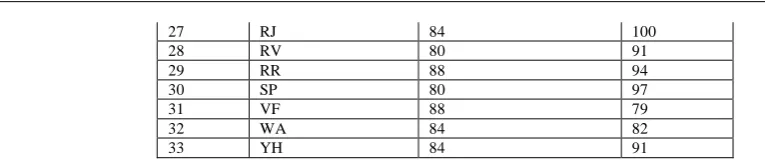
10 DC 75 96 11 DM 82 85 12 DN 78 87 13 EN 80 90 14 ED 82 85 15 ES 80 83 16 GN 82 94 17 HH 82 89 18 ID 80 83 19 IR 82 94 20 JH 78 87 21 LY 87 94 22 MA 78 83 23 NA 78 81 24 NM 78 85 25 NN 80 87 26 RS 70 78 27 RN 78 85 28 SA 65 94 29 SS 78 94 30 SB 80 90 31 TW 70 87 32 TA 80 90 33 UA 78 86 Source : Data analyzed by the Researcher
Data Analysis
Tabel 4. : T-Test Paired Samples Numbered Heads Together (NHT)
Mean N Std. Deviation
Std. Error Mean Pair 1 Pre-Test 79.7576 33 9.10711 1.58534 Post-Test 91.7273 33 7.99716 1.39213
The first part is summary statistics, which is an average performance has not been treated coopertive Learning models of type Numbered Heads Together (NHT) is equal to 79.76 while the average achievements that have been treated with cooperative learning models Numbered Heads Together (NHT) is equal to 91.73. Mathematically seen that the average achievement between the social subject subjects not treated with cooperative learning model of type Numbered Heads Together (NHT) and post-treated model of cooperative learning type Numbered Heads Together (NHT) is different, but whether these differences are real or do not then need to be tested statistically.
Tabel 5. Paired Samples Correlations
N Correlation Sig. Pair 1 Pre-Test & Post-Test 33 .068 .708
27 RJ 84 100
28 RV 80 91
29 RR 88 94
30 SP 80 97
31 VF 88 79
32 WA 84 82
The correlation between before and after being given treatment by cooperative learning model on Numbered Heads Together (NHT), which generates a number 0.068 to 0.708 probability value far above 0.05. This means that the relationship between pre- and post-treated Cooperative Learning model of Numbered Heads Together (NHT) is very weak.
Tabel 6. Paired Samples Test
Mean Std. Deviation T Df Sig. (2tailed) Pair 1 Pre-Test – Post-Test -11.96970 11.70599 -5.874 32 .000
Tabel 7. : T-Test Paired Samples STAD
Mean N Std. Deviation Std. Error Mean Pair 1 Pre-Test 77.9697 33 5.87625 1.02292 Post-Test 87.2727 33 4.67221 .81333
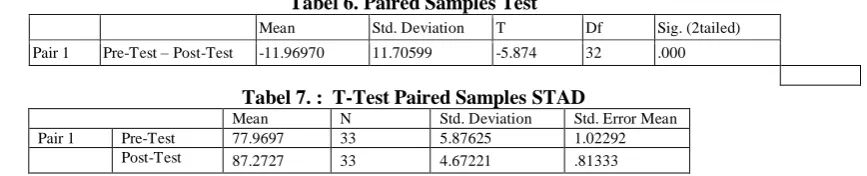
The first part is summary statistics, which is an average performance has not been treated with cooperative learning model of STAD was at 77.97 while the average achievements that have been treated with cooperative learning model of STAD is at 87.27. Mathematically seen that the average achievement social subject subjects between before treated cooperative learning model of STAD and after treated with cooperative learning model of STAD is different, but whether these differences are real or not it needs to be tested statistically.
Tabel 8. Paired Samples Correlations
N Correlation Sig. Pair 1 Pre-Test & Post-Test 33 .217 .226
The second part of the output is the result of the correlation between before treatment and after being given a treatment model of Cooperative Learning STAD, which generates a number 0.217 to 0.226 probability value far above 0.05. This means that the relationship between pre-treated and post-treated model of Cooperative Learning STAD is very weak.
Tabel 9. Paired Samples Test
Mean Std. Deviation T Df Sig. (2tailed) Pair 1 Pre-Test - Post-Test -9.30303 6.66842 -8.014 32 .000
Cooperative Learning Model on STAD.
The third output is Paired Samples Test table. In this table shows that the mean of -9.303 with a standard deviation of 6668. T-test value of -8.014. While the Sig (2-tailed) of 0.000 <0.05 so it can be concluded that Ha is accepted, and it can be said that there is a significant difference from the average pre-treated model of learning and after treated with cooperative learning model of STAD.
Tabel 10. T- test Independent
Metode N Mean Std. Deviation
Std. Error Mean Nilai Post-Test NHT 33 91.7273 7.99716 1.39213 STAD 33 87.2727 4.67221 .81333
Table 11. Independent Samples Test
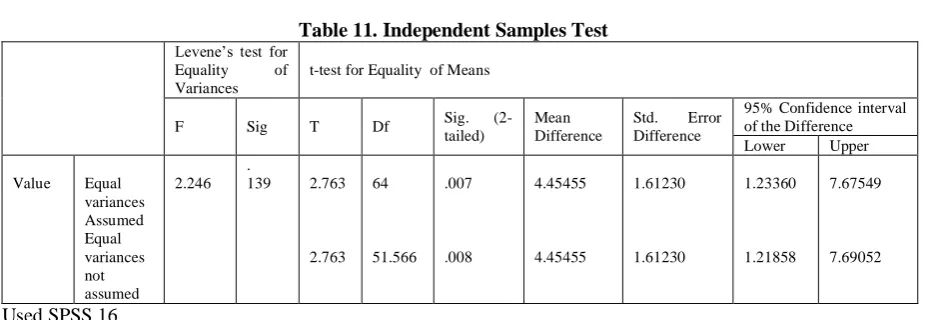
Based on the statistical test known coefficient p = 0.007 smaller than the error level α = 0.05 was used
(p <α). Thus Ha accepted. This means that there are differences in the type of cooperative learning model of
Numbered Heads Together (NHT) model of STAD cooperative learning on student achievement.
V. Discussion
After the results of the research data is analyzed and concluded, the next step is to interpret or present the results of data analysis, of the various steps of the research presented earlier can be interpreted as follows: a) the highest value of student achievement in cooperative learning model of type Numbered Heads Together (NHT) is 100 and the lowest value is 60. the highest grade student achievement in cooperative learning model of STAD is 96 and the lowest value is 83.b) the average value of student achievement that the applied model of cooperative learning type Numbered Heads Together (NHT) is 91.73. While the average value of student achievement that is applied to a model of Cooperative Learning STAD is 87.23. So that the average difference of the two is 4.50. c) based on the results of statistical analysis using SPSS 16.00 for applications Windows by t Independent Samples Test on Mean values or can mean learning achievement applied cooperative learning model of type Numbered Heads Together (NHT) of 91.73 and a mean or the average applied learning achievement with STAD cooperative learning model of 87.23. While t-count is at 2.763.
If this value is consulted on the list of t-table with significance level (α) of 5% and degrees of freedom (degree of freedom) df = (n1-1) + (n2-1) values obtained df = (33-1) + (33 -1) = 64 then got the t-table is 1.988. So tcount> ttable = 2.763> 1.988.
Results of statistical analysis using SPSS 16.00 for application windows also obtained probability value of 0.00 for the probability value < significance level (α) set and tcount> ttable, with a description
of figure 0.00 <0.05 and 2.763> 1.988, the null hypothesis (Ho) is rejected and the alternative hypothesis (Ha) is
accepted.
Thus the alternative hypothesis (Ha) has been proven that it can also be stated that, There are different
models of Cooperative Learning Type Numbered Heads Together (NHT) and the model of Cooperative Learning STAD type on student achievement eighth grade social subject at SMP Negeri 5 Jombang in other words that efforts to improve learning achievement of social studies in the eighth grade students of SMP Negeri 5 Jombang can be reached through the implementation of cooperative learning model of Numbered Heads Together (NHT) as an alternative choice of various learning models that exist at the moment, but that does not mean the model of Cooperative Learning STAD not good, but seen from the results that have been known to show a model of Cooperative Learning type Numbered Heads Together (NHT) is better than the model of Cooperative Learning STAD. Because of the type of cooperative learning model Numbered Heads Together (NHT) is able to improve student achievement.
It has been proven when the application of cooperative learning model of Numbered Heads Together (NHT) social studies in class VIII shows the participation and involvement of the student during the learning process takes place. In addition, it is proven to increase achievement, because the students are more able to be a resource for students who are underprivileged. Students are also willing to accept his friends who have various differences: both differences in ethnicity, religion, academic ability, and social levels. And students are also able to develop social skills. Social skills is like, share tasks, actively ask, respect the opinions of others, would argue, to work in groups.
Human beings are individual, different from each other. Due to the individual nature of the human being in need of another human being so that as a logical consequence of man must be social creatures, creatures that interact with each other. Because one another requires that there must be interaction love each other. Cooperative learning is learning to consciously and deliberately create a loving interaction between fellow students. The difference between people who are not managed properly can cause offense and misunderstanding between people. In order to avoid offense and misunderstanding will require mutual interaction tolerance. Cooperative learning leraning is consciously and deliberately develop mutual interaction tolerance to avoid offense and misunderstandings that can lead to hostility.
Cooperative Learning Model type Numbered Heads Together (NHT) is a variation of the characteristic of group discussion is to appoint a teacher of students who represent the group without telling in advance who will represent the group. So that this way quarantees that all students was involved. This way consides a very good effort to increase individual responsibility in a group discussion of this model provides an opportunity for students to exchange ideas and consider the most appropriate answer. It also encourages students to improve their cooperative spirit.
STAD is one of the many models that can be used teacher learning in achieving learning goals. This model is a teaching and learning activities with the teacher split into several groups or teams, each consisting of 4 or 5 members of the group. Each team has a heterogeneous members, either gender, race, ethnicity, or ability (high, medium, low). Each member of the team using the worksheet academic; and then help each other to master the teaching materials through questioning and discussion among fellow team members. Therefore the given type of cooperative learning learning model Numbered Heads Together (NHT) and learning model STAD Cooperative Learning will be able to improve student achievement.
Based on the analysis of data that researchers did by using SPSS version 16 for windows, so this research can be concluded that There are different model of cooperative learning types of Numbered Heads Together (NHT) and the model of Cooperative Learning STAD on student achievement eighth grade social subject at SMP Negeri 5 Jombang.
It can be seen from the result of Independent Samples t - Test on Mean values or can mean learning achievement with applied learning models Cooperative Learning type Numbered Heads Together (NHT) at 91.73 and the mean or average of the applied model of learning achievement learning Cooperative Learning STAD at 87.23. While tcount obtained at 2.763. If this value is consulted on the list of ttable with significance level
(α) of 5% and degrees of freedom (degree of freedom) df = (n1-1) + (n2-1). In this research, the value of df = (33-1) + (33-1) = 64 then got the ttable is 1.988. So tcount> ttable = 2,763> 1,988
The results of statistical analysis using SPSS 16.00 for applications Windows obtained probability value of 0.00 for the probability value <significance level (α) set and tcount> ttable, with a figure caption 0.000
<0.05 and 2.763> 1.988 then the null hypothesis (Ho) is rejected and the alternative hypothesis (Ha) is accepted,
which means there is a difference models Coopertaive Learning type Numbered Heads Together (NHT) and the model Coopertaive Learning STAD type on Student Achievement.
VI. Closing
Conclusion
After this research , the description of data, the data analysis in order to obtain evidence against the hypothesis, then the final step of the study is to provide a conclusion. The conclusions can the researcher in this study is that there are differences in cooperative learning model of NHT and STAD on student achievement of the eight grade in social subject at SMP Negeri 5 Jombang. This can be proved from the probability value of 0.00 for the probability value <significance level (α) set and tcount> ttable, with the description of figure 0.00 <0.05
and 2.763> 1.988, the null hypothesis (Ho) is rejected and the alternative hypothesis (Ha) is accepted.
Suggestion
As for the suggestion that the researcher is for:
1. School and Educational Institution The researcher hopes that the school and the community always be able to modify the curriculum which is always oriented to students. This means that the curriculum can create the students into the Human Resources (HR) is ready and prepared for the development of rapid technological
2. Teachers It should be given the combination of learning models in the classroom. it is intended that students do not feel tired or bored with one form of models and methods of learning
References
[1]. Abdurrahman, M & Bintoro, T. 2000. Memahami dan Menangani Siswa dengan Problem Belajar. Jakarta : Depdiknas. [2]. Arends, Richard, 1997, Class room Intruction and Managamen. New York: Mc Grow hill, Campanies.
[3]. Arikunto, Suharsimi. 2002. Prosedur Penelitian. Jakarta : Rineka Cipta.
[4]. Kagan, Spencer. 2007. Cooperative Learning Resources for Teacher. Jakarta: Intuisi Press. [5]. Lie, Anita. 2007. Cooperatif Learning. Jakarta : PT Grasindo.
[6]. Musrof, M. 2010. Melesatkan Prestasi Akademik Siswa. Yogyakarta : PT Pustaka Insan Madani.
[7]. Mufarrihah, Novy. (2008) Cooperative Learning tipe Numbered Head Together dapat meningkatkan motivasi belajar siswa [8]. Prianto, Agus. 2008. Analisis Data Dengan Program SPSS Versi 15. Setara Press.
[9]. Riduwan. 2003. Skala Pengukuran Variabel-variabel Penelitian. Bandung : CV Alfabeta.
[10]. Revykawanti, Devi (2008 ), Hasil penelitian yang dilakukan oleh Revykawanti, Devi (2008 ), menunjukkan bahwa pembelajaran kooperatif model numbered head together kecenderungan dapat meningkatkan kemampuan berpikir kritis
[11]. Riyanto, Yatim. 2010. Paradigma Baru Pembelajaran. Jakarta : Kencana Prenada Group. [12]. Rusman. 2011. Model-Model Pembelajaran. Jakarta : Rajawali Pers.
[13]. Robert E. Slavin (26 Sep 1994) Cooperative Learning: Theory, Research, and Practice [14]. Suprijono, Agus. 2009. Cooperatif Learning. Yogyakarta : Pustaka pelajar.
[15]. Supriyadi (1995) Pengembangan Pembelajaran Kontekstual Sebagai Upaya Peningkatan Mutu Pembelajaran Di Sekolah [16]. Schaum’s. 2004. Prinsip-Prinsip Ekonomi. Jakarta : PT. Gelora Pratama.
[17]. Slameto. 2003. Belajar dan Faktor-Faktor yang Mempengaruhinya. Jakarta : Rineka Cipta [18]. Undang-Undang Sisdiknas. 2003. Jakarta : Sinar Grafika
[19]. Slavin, R.E. (1983). Cooperative Learning. Maryland : John Hopkins University.
[20]. Stahl, R.J. (1994). Cooperative Learning in Social Studies : Handbook for Teachers. USA : Kane Publishing Service, Inc. [21]. Warsito, Bambang. 2008. Teknologi Pembelajaran Landasan dan Aplikasinya. Jakarta : Rineka Cipta.
[22]. Wheeler (1977 Jurnal MPCL dalam mempelajari SOCIAL SUBJECT
[23]. (http://mcdens13.wordpress.com/2010/03/28/pengertian-pendidikan-teori-pendidikan-perjalanan-kurikulum-pendidikan-nasional-sistem-pendidikan-islam-di-indonesia-reforma pendidikan-indonesia-pentingkah-inovasi-pendidikan-tingkatkan-kua/ diunduh pada tanggal 02 oktober pukul 15).