PEER-REV I EWED PAPER: SPECI AL I SSU E ON LEARN I N G ORGAN I Z AT I ON S
P
ARTNERING
I
S THE
F
OUNDATION OF A
L
EARNING
O
RGANIZATION
By Carl E. DeVilbiss,1
P.E., and Patricia Leonard2
ABSTRACT: A simple model of an implementation strategy for cultivating a Learning Or-ganization culture is ‘‘Transformational Leadership 1Group Process = Learning Organiza-tion.’’ This article presents the four key dimensions of Partnering, the Partnering Effectiveness Model, and Principles of Productive Partnering as the basis, or foundation, for following this implementation strategy. Honoring the structure and operating principles of this scientific understanding of Partnering creates a cultural orientation that fosters individual and team learning. Many organizations and their leaders are well intended, yet lack an understanding of the unconscious beliefs, behaviors, and cultural influences that impede learning. Using the implementation process presented, we take a step-by-step approach to systematically exploring what is actually going on now, and how we want things to be. Then, recognizing the need for developing new skills, and change processes, it is a straightforward approach to execute an improvement plan that ensures success.
WHY BOTHER WITH A LEARNING ORGANIZATION?
A few years ago International Paper studied the con-struction project delivery process by developing a heavy industrial plant model. The same model project was planned for completion in the United States, Europe, and Southeast Asia, using those markets’ respective delivery processes. Scheduled completion, from concept to op-eration, was estimated at 24 months in the United States, 20 months in Europe, and 16 months in Southeast Asia . . . same project, different approaches. Their findings showed that a Japanese construction firm’s approach would be to integrate all design and construction func-tions for a given segment of the plant. Process, facility, construction, and operations representatives all worked shoulder to shoulder in collaboration from the beginning, learning the same things together while they executed.
In July 1994, the Construction Industry Institute News reported results of a project Mobil Oil chose to execute using a formal Partnering approach. This was a storm-water recovery project at a refinery in Beaumont, Tex. Mobil used Bechtel for scope definition and program
1
Pres., Aegis Building Concepts, Inc., P.O. Box 24537, Nashville, TN 37202.
2
Owner, Patricia Leonard & Associates, 807 Hillmeade Dr., Nash-ville, TN 37221.
Note. Discussion open until January 1, 2001. To extend the closing date one month, a written request must be filed with the ASCE Man-ager of Journals. The manuscript for this paper was submitted for review and possible publication on December 14, 1999. This paper is part of the Journal of Management in Engineering, Vol. 16, No. 4, July/August, 2000.qASCE, ISSN 0742-597X/00/0004-0047–0057/ $8.001$.50 per page. Paper No. 22170.
management, and budgeted 2/10 of 1% of the total proj-ect cost for formal Partnering efforts. One of their goals was to achieve a 10% savings compared to detailed cost models from very similar projects at different sites. At the end of the project, they had achieved 15% savings with excellent safety performance, early completion, and high customer satisfaction. That calculates as a 75-to-1 benefit to cost on dollars alone.
Forbes Magazine identified TD Industries, a
mechan-ical contracting firm, as the number two best employer to work for in the United States in 1998. Eligible com-panies had to have at least 500 employees, and selections were based on employee surveys and interviews, plus business performance measures. A group of TD Indus-tries’ employees shared how they got there in a presen-tation at the 1999 Associated Builders and Contractors convention. The two primary contributing factors were reported to be absolute commitment to Servant Leader-ship and high levels of trust throughout the company culture. Employee testimonials came in the last segment of the presentation. Indications were that leadership is cultivated and nurtured at every level of the organiza-tion, that senior management has repeatedly demon-strated that they highly value and respect every single employee, and that at least 32 h of formal training and development (Learning) is required of everyone every year.
1/3 less time by working together. Third, there are very significant benefits to cost examples that clearly show the good business sense of Partnering. Finally, the two primary contributing factors in the success of a thriving, high employee satisfaction organization are both based in the cultural orientation of its people. These are com-pelling arguments in favor of a Learning Organization.
BACKGROUND
‘‘I think we’re here for each other.’’ —Carol Burnett
The issue addressed in this article is how to be present for another in the truest sense—to be a productive part-ner. We will refer to ‘‘Partnering’’ throughout this text. That word has received much attention in recent years, and almost everyone believes they know what it means. However, if you ask five people to define Partnering, you will likely get at least four different definitions. Before we proceed, it is important for us to define what we mean by Partnering in this application.
When we use the term Partnering we are referring to a scientific process of two or more individuals, groups, or organizations coming together to pursue a collabora-tive venture. By using the term ‘‘scientific,’’ we are em-phasizing that it is a process that can be modeled, just as engineers model physical systems. We are also argu-ing that productive Partnerargu-ing is governed by a set of operating principles that, when honored and followed, always produce positive outcomes. By analogy—follow the laws of physics and a structure stands up under load, break the laws of physics and it will likely fail. In this article we will be presenting models of the scientific na-ture of Partnering and of the operating principles gov-erning its success.
Learning Organizations, by definition, rely on individ-uals learning together, which is called Team Learning. This level of learning can only occur in an environment that is perceived to be emotionally safe and of reason-able organizational risks. Such an environment must be based in core values that recognize individuals, and their interactions with others, as foundational elements of suc-cess. Consequently, we are also arguing that a Learning Organization is best built on the foundation of relation-ships and interactions conducted within the Partnering process we will define and articulate.
Partnering in its true sense is conducting all relation-ships in accordance with universal principles, rather than in patterns of behavior that do not honor ourselves, oth-ers, and purposeful action. By focusing on productive Partnering, you are focusing on the causal aspects of a Learning Organization culture. By comparison, most businesses measure performance in terms of effectual pa-rameters, such as profit, on time delivery, product qual-ity, customer satisfaction, etc. Causal aspects of business function produce positive results that compound throughout the organization, whereas effectual aspects are in large part the result of other things happening first. We begin by telling a story about an actual group of people who developed into a Learning Organization
be-fore the term was even coined. With this as a reference, we define a Learning Organization and introduce an im-plementation model for creating one. Models of the na-ture of Partnering are presented. Then, we share an ap-proach to using these Partnering models to actually create a Learning Organization. The key to this approach is our implementation model: Transformational Leader-ship 1 Group Process = Learning Organization. Part-nering, as we present it, is the foundation upon which this implementation model is constructed.
THE CROSSHEAD LINE STORY
A Fortune 500 manufacturing company facing down-sizing of a union seniority-based workforce chose to pur-sue innovation and learning. A production line with a demanding schedule and a fluctuating workforce took action. Their goals were to meet present production re-quirements and to establish a training and orientation plan for new employees hired or transferred to the cross-head line.
After an initial exploration meeting, a plan was set in place and agreed to by every operator on the line. This Partnering agreement was necessary across all three shifts of operation. Representatives from all shifts were selected. Their responsibilities were to participate in de-sign meetings, and keep coworkers covering line pro-duction updated on progress. Those operating the line would ensure production requirements were met. A new energy and commitment emerged. A result of the first planning meeting was agreement that they needed an orientation process for each new employee coming to the line. Orientation would consist of a video film brief-ing followed with an ‘‘on-the-job, hands-on’’ trainbrief-ing and application session.
Outcomes of this planning meeting were shared with supervisors and coworkers. Agreement was reached to proceed. This Partnering agreement was very critical in the following weeks as the realities of production de-mands and new employee orientations continued from ongoing layoffs.
Finally, it was time to produce the video. None of the operators had any experience in script writing or creating a training video. This entire process was a ‘‘learn-as-we-go’’ approach. Training was conducted on filmmaking and script writing. Day-by-day scripts and process doc-umentation were developed and completed for each ma-chining operation.
The eyes of plant management and union personnel were on this group, which had half of their line people in meetings and the other half producing their product. This kind of committed effort from workers was new and skepticism lingered. However, production quotas were consistently met.
would get an opportunity to be filmed with their ma-chine. Enthusiasm was contagious.
Filming was complete, editing had been done, and a showing date was established. All members of the line attended, and each felt he or she was an integral part of the final product. Pride was the overriding emotion in everyone; including supervisors. Teamwork had pro-duced a film that all members of the crosshead line had helped complete. Workers who had rarely participated in any activity other than running their machine were tell-ing other line personnel in the plant about ‘‘their’’ ori-entation film.
Word of the accomplishment spread, and the group was asked to make a presentation at upper management’s quarterly meeting. Supervisors and operators brain-stormed presentation contents and consensus was reached. Next a presenter needed to be selected. This step was a real surprise! A machine operator volunteered to make the presentation. He shared with the group that he had always wanted to do something important and had felt he would never get the chance because he had only an eighth-grade education. With teary eyes, all members readily agreed that Danny would be the senter. Line operators offered to let Danny make the pre-sentation to them as practice.
The day of the presentation to management a repre-sentative group from the crosshead line was sitting on the front row projecting positive energy to support Danny. Danny made a perfect presentation exhibiting pride in his team, their product, and, most of all, in him-self for such a long desired accomplishment. Team mem-bers on the front row cheered loudly for Danny’s display of professionalism and then answered questions from the 100 or so present in the audience.
The crosshead line was never the same. There were no problems with production quotas, and selected em-ployees from elsewhere in the plant were glad to go to a line that was dedicated to improving their quality of life.
There had been tremendous learning not only by line operators, but also by management through getting peo-ple involved in improvement and learning. The cross-head line was a sort of celebrity unit for many months to come.
Learning, and feeling the power of making a differ-ence, can shift attitudes and resolve work environment barriers and inefficiencies. Outcomes of this effort show that if people are given the chance to learn and get in-volved they will go beyond management’s expectations to contribute and improve. A learning culture has a vi-sion, operating principles, boundaries, and expectations. All of these, with a coaching and facilitative leadership approach, can provide the environment that is necessary for work to happen productively.
WHAT IS A LEARNING ORGANIZATION?
‘‘In times of change, learners inherit the earth, while the learned are beautifully equipped to deal with a world that no longer exists!’’ —Roland Barth
In Ten Steps To A Learning Organization, Kline and Saunders (1993) reflected on how we have approached the introduction of a Learning Organization. ‘‘Scientific management,’’ as developed by Frederick Taylor, served the production lines of the first half of the twentieth cen-tury. But the old school of thought has become increas-ingly outmoded as workers cease to be passive exten-sions of production line machinery and are required to become thinkers and problem solvers, whose creative ability is a major factor in their usefulness to their com-pany. Managers can no longer rely on military styles of management and instead must move in the direction of becoming teachers, coaches, and facilitators. A new era of human freedom, responsibility, and intelligence in the workplace has arrived.
‘‘The stage is clearly set for the Learning Organiza-tion. The old style of management, with its pyramid of power ascending to a single, all-powerful CEO, is yield-ing to the very dynamics of shared power, teamwork, flattened organizations, and peer review.’’
So what is a Learning Organization? Senge (1990), in his book The Fifth Discipline, stated that it is ‘‘an or-ganization that is continually expanding its capacity to create its future. For such an organization, it is not enough merely to survive, survival learning or what is more often termed adaptive learning is important—in-deed it is necessary. But for a learning organization, adaptive learning must be joined by generative learning, learning that enhances our capacity to create.’’
Kline and Saunders (1993) stated ‘‘In a Learning Or-ganization, leaders need to be willing to take the risk to model continuous learning and improvement themselves. How can they expect anyone else to be willing to take the risk of learning something new unless they’re willing to take it first?’’ This modeling style of leadership is what we refer to as ‘‘Transformational Leadership.’’
Senge (1990) pointed out that ‘‘the new view of lead-ership in Learning Organizations centers on subtler and more important tasks. In a Learning Organization, lead-ers are designlead-ers, stewards, and teachlead-ers. They are re-sponsible for building organizations where people con-tinually expand their capabilities to understand complexity, clarify vision, and improve shared mental models—that is, they are responsible for learning.’’
We believe that a Learning Organization is established by creating a culture that nurtures and encourages lead-ership, creativity, empowerment and participation, con-tinuous improvement, and learning. To get there requires an operating philosophy involving Transformational Leadership plus Group Process.
Transformational Leaders are described by Hendricks and Ludeman (1996) in The Corporate Mystic as ‘‘peo-ple who want to spawn more leaders.’’ Transformational Leaders believe it is their responsibility to operate from a Stretch, Support, and Connect model. By adopting these leadership roles and by viewing each individual as part of leadership, we are establishing a cultural focus necessary for a Learning Organization. A brief descrip-tion of these three roles is in order.
As a leader, one stretches when he or she is constantly testing their own limits, growing, learning more about themselves, developing new skills and processes. It also means inspiring others to stretch and grow in all they do. Plus from an organizational perspective, the stretch role includes always testing limits, policies, routines, processes, systems, etc. —is this what we need to be do-ing to move toward our vision?
‘‘Support’’ is a key role for leaders in building the Learning Organization because it has to do with being there for others. A leader gives support in the form of resources—financial, equipment, time, facilities, mate-rial, manpower, etc., as well as interpersonal support in the form of encouragement, motivation, advocacy, em-pathy, etc. Another key aspect of support is in granting individuals and teams authority to take risks within rea-sonable limits without fear of negative consequences for their mistakes or failures.
The ‘‘Connect’’ role has to do with leaders knowing when and how to link appropriate entities. A leader may connect individuals who can help each other solve a problem. It could be connecting two cross-functional groups that can share expertise, or connecting one’s own organization with an outside organization. It can even be as simple as connecting an individual or team with a source of information they need to be completely aware of all the factors influencing their work.
‘‘Group Process’’ is the second critical aspect of the Learning Organization culture. Hendricks and Ludeman (1996) state that ‘‘inside each of us there are two strong pulls. One is toward complete independence—becoming our own person through and through. But there is also a strong pull to commit ourselves in something larger: communion with other people, a company or family, the universe itself. Both pulls must be honored and devel-oped fully.’’ Group Process is a vehicle to tap that in-trinsic need and a way to take advantage of the power of synergy and tap into a collective consciousness of several people’s awareness focused on a common issue. The Group Process to which we refer here is not just getting together in a group to talk things over. There has been significant organizational and behavioral science research devoted to Group Process over the last 40 or so years. It is beyond the scope of this article to delve into the details of these findings; however, it is important to realize that three Core Values and 16 Suggested Ground Rules have come out of this research. Furthermore, there is a keen appreciation of the value of having an expe-rienced Developmental Facilitator as a guide in adopting Group Process operating norms. Schwarz (1994), in his book The Skilled Facilitator, provided a deeper under-standing of both Group Process and facilitation.
Also, groups must be positioned to understand their roles in this new organization. Supportive processes must be designed, and employees must develop the skills that are critical to effectively operate in an environment where every employee is a leader and has something to contribute.
As Senge (1990) said, ‘‘This new view is vital. When all is said and done, learning organizations will remain
a ‘‘good idea,’’ and intriguing but distant vision until people take a stand for building such organizations. Tak-ing this stand is the first leadership act, the start of in-spiring (literally ‘‘to breathe life into’’) the vision of learning organizations.’’
Through Transformational Leadership plus Group Pro-cess, the ‘‘Learning Organization’’ (TL1GP = LO) can become a reality. A commitment and focus on these causal elements can create businesses that will survive and prosper in the twenty-first century. We will now ex-amine fundamental concepts, the key dimensions, and two contextual models of Partnering that allow it to be recognized as a process for building the foundation for constructing this simple equation.
WHAT IS PARTNERING?
Knowledge versus Awareness
The knowledge that win/win solutions are best is ob-vious. But most of us have been raised in an environ-ment that treats interactions with others in a much more competitive vein. In other words, we are emotionally conditioned from our experiences to expect win/lose in-teractions. This applies to competition for limited busi-ness opportunities, or to two people wanting the same position in a company, or to power struggles between two people in a romantic relationship. Our awareness from past experiences tells us that we live in a risky, competitive world. What is referred to here is a poverty consciousness, or competitive mindset, ‘‘I must struggle to get my share of a limited pot.’’
This means the real challenge in Partnering turns out to be changing people’s awareness. We can tell you Part-nering is the most practical, beneficial, expedient, co-operative, cost-effective approach to any work challenge. Plus, if you trust us, you might actually believe it. In that case, we have shared knowledge that Partnering is a positive approach that produces superior results. But, until you have had enough experiences to realign your awareness, you will likely still be practicing your inter-actions from a competitive orientation. Something like, ‘‘This approach makes sense, but I don’t really trust that I am safe from loss.’’ The reason so many of us feel this way is that we have not taken time to clearly model the Partnering process and define the operating principles that govern its effectiveness. Consequently, in all prob-ability we are routinely breaking the principles and re-turning to competitive strategies without recognizing it. We will now define Partnering in order to set the stage for using its structure and operating principles as the foundation for deploying our implementation model: Transformational Leadership1Group Process = Learn-ing Organization.
Partnering
struc-tural nature of the Partnering process. Partnering is a scientific process governed by a straightforward, practi-cal set of principles. By studying these principles and the structure of the process, we can recognize what ac-tions can be taken to support Partnering effectively. ‘‘Partnering is as exact a science as the physics of grav-ity.’’
Before getting into the actual models, we first intro-duce the key dimensions that must be operating for Part-nering success. Recognizing these dimensions and how we allow ourselves to not operate productively within them is the basis for understanding the significance and validity of the models.
‘‘Dependability’’ is the first dimension. Inevitably, people associate trust with Partnering. Trust is an inter-esting quality. We choose to trust and many factors in-fluence that choice, including our past experiences, our emotional orientations, others’ behaviors, how well ex-pectations have been expressed, etc. One thing is certain: we are not likely to continue to choose to trust if the object of our trust performs consistently in an unde-pendable manner. Consequently, we can see that De-pendability is a causal dimension that allows us to build trusting relationships.
‘‘Responsiveness’’ is the dimension that represents fo-cusing our attention outward. Responsiveness calls for us to proactively seek to understand and meet our part-ners’ needs, which may include helping them recognize their needs. Being very clear in defining all partners’ needs and then taking action to help each other get their needs met is what Responsiveness is all about.
‘‘Ability to Resolve Conflict’’ is third. Incumbent in this dimension are two requisite actions. First is ac-knowledging that a conflict exists, and second is having the ability to engage in the conflict constructively with-out blaming and shaming one another, or trying to make someone ‘‘wrong.’’ Full resolution of conflict only oc-curs when partners are committed to working together in an open atmosphere. Each expresses his or her inter-ests in the issue, and then both work together to design a solution that allows each partner to get as many of their interests met as possible. This is a true win/win resolution where everyone can walk away feeling as good as possible.
‘‘Faith’’ is the final key dimension. Here we actually find three levels of Faith operating. There is Faith in yourself that you are committed to doing the right thing and are able to be a good partner. Next is Faith in your partner, that he or she is likewise interested in doing the right thing and has your best interest at heart. Last is Faith in the process of collaboration. When a slipup oc-curs, this calls for us to come together and seek mutually supportive actions to get back on course instead of re-treating to our respective corners and talking about what the other person did wrong.
With these key dimensions of Productive Partnering in mind, we can look at the two models that define a process for creating the kind of culture that supports a Learning Organization.
Partnering Models
Part of what Engineers do is to analyze models. Using knowledge of physical principles and mathematics, they set out to construct graphic and mathematical models of real-world physical systems, and then use those models to predict the behavior of the actual systems.
For instance, by constructing a model of a bridge structure, an Engineer can predict the actual bridge’s be-havior. Selecting specific materials, he can then, know-ing the behavior of the bridge, predict the size and shape of each member so that it is strong enough not to break, or bend too much. This is a scientific process of pre-dicting behavior through model analysis.
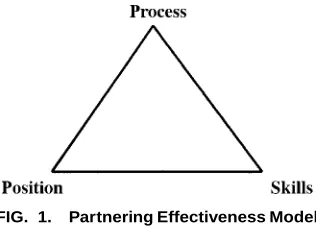
Our first contextual model is the Partnering Effective-ness Model. This model was formulated over many years by trying to bring structure to how people come together in collaborative undertakings. The contextual aspect of this model is that it can be adapted to virtually any ap-plication involving multiple views or interests. It applies to interactions between two or more people, two or more groups, or two or more organizations. It is not a discrete model that has only certain, specific elements, because no two partnerships are exactly alike. By comparison, two steel beams of the same size, shape, and material will inevitably behave the same. Thus a contextual model presents a structural framework within which to relate and interact rather than a definitive statement of how things are.
The second contextual model is Principles of Produc-tive Partnering. This is a group of principles, or rules of conduct, that, when applied, honored, and practiced,
al-ways produce Partnering outcomes. This particular
model is fluid and evolving, but many of the fundamen-tal truths of productive human interaction are captured and presented. You will likely recognize much of what is presented as common sense. This is usually the case with principles founded in fundamental Spiritual Truth.
Partnering Effectiveness Model
The first model is not intended to be some rigorously analyzed and experimentally proven theorem. We are sharing with you a structure of what makes Partnering work, and how we can use forethought to increase the chances for Partnering success. We encourage everyone to look for their own lessons and opportunities to im-prove on the model any chance they get (Fig. 1).
Position
FIG. 1. Partnering Effectiveness Model
have to do with ‘‘who’’ and ‘‘where’’ you are. Some elements of Position are as follows:
Principles
There are skill sets for both functional/technical activ-ities and for organizational activactiv-ities. Having capable people in the right place at the right time is a primary causal aspect of success. Whether or not a person is ca-pable can be measured and documented. First, you have to develop an inventory of the required skills. Next, you devise a practical process for measuring those skills. Fi-nally, you measure the skills actually demonstrated and compare them to those required. So, how many busi-nesses out there conduct an organizational skills assess-ment for each employee? How many personal relation-ships are you in where you sit down with your partner and talk about ways to support each other in getting better at the skills of relating and interacting with each other? Skills that are necessary in Partnering are rarely formally addressed in our education process. Some ele-ments of Skills are as follows:
Knowing how to learn Communication—oral
Total Quality Management has been a popular disci-pline. There are a few people who are generally regarded as having been the originators of the concept, one of the more famous being W. Edward Demming. Dr. Demming was big on developing process models and analyzing them for waste (remember the discussion of models ear-lier?). There are statistical methods of modeling, col-lecting data, and analyzing it to identify types of process variation. By doing thorough modeling, collecting ap-propriate data, and using group problem-solving tech-niques, you can eliminate some kinds of variation and lessen the impact of others. In other words, you can im-prove your processes.
Another concept in quality-oriented philosophies is that of a quality deviation. Quality deviations can be products manufactured outside of acceptable tolerance, or things like missing deadlines. In Total Quality Man-agement practices, it is generally accepted that on the order of 90% of quality deviations can be traced to some process problem rather than human error. We believe the same order of significance holds true for working to-gether. In the Partnering Effectiveness Model, Process is about identifying, documenting, and continuously im-proving the processes used to interact with each other. You will see some words repeated from the skills ele-ments. This is because individuals’ and groups’ capabil-ities are defined with skills, but the group application of those skills shows up in Partnering processes. Some el-ements of Process are as follows:
Team planning Cost and price analysis
Building trust
Cause and effect analysis Trending
The Model as a Guide
general, as suits your purposes. It is a guide for partners to use to develop their own plan.
Principles of Productive Partnering
Our second contextual model is a compilation of op-erating principles that, when honored and practiced,
al-ways produce Partnering results. We have conducted
Partnering workshops in projects where someone later reported that Partnering failed. Upon investigation, we invariably find that participants quit following agreed upon procedures, or fell into unproductive behavior pat-terns, such as blaming each other. What this suggests is that you cannot fail at Partnering as long as you follow the principles. But you can fail to follow the principles, which simply means you have stopped Partnering. Prin-ciples of Productive Partnering, as we have articulated them, fall into five categories: Purpose, Character, Di-rection, Agreement, and Improvement.
‘‘Purpose’’ has to do with what we are doing and why we are doing it. ‘‘I think we’re here for each other,’’ is a statement of purpose. Purpose is the foundation of any undertaking. When we know why we are doing some-thing, it is much more likely we can tolerate challenging times without drifting into doubt or questioning others’ motives. Agreeing up front on the collective purpose in a Partnering relationship is probably the single most im-portant aspect of collaborative efforts.
‘‘Character’’ has to do with knowing who we are and understanding who our partner is. Principles of Character are similar to the Position elements of the Partnering Effectiveness Model. For instance, the writers have sig-nificantly different personalities and styles of behavior. One is primarily rational and analytical, oriented toward collecting data and forming judgments. The other is in-tuitive and perceptive, a big picture thinker. Together we make a powerful partnership, but we have to focus on the value in each other’s contributions or we find our-selves frustrated with our different behavioral styles.
‘‘Direction’’ is the set of principles that we use to form the road map for progress. These principles are the basis for establishing priorities, guidelines for decision making and problem solving, and parameters for measuring progress. Direction calls for us to focus attention on causal aspects first. For instance, going at conflict is very important. Partners address issues early and resolve them before they fester and become bigger problems.
A frequently overlooked group of principles is ‘‘Agreements.’’ An example of how we slip here is agreeing to a deadline when you know rationally that you cannot make it. Another example comes from a company we have worked with. While interviewing hourly employees to help the company inventory its workforce capability needs, we encountered a common complaint of management. The most frequent critical ob-servation was that workers were routinely told some-thing would happen, and then it did not. This is obvi-ously damaging to morale, but worse, it is indicative of an organizational culture that does not recognize the significance of leaders doing what they have agreed to do.
The last set of principles is ‘‘Improvement.’’ The sig-nificance of these principles is that no system (partner-ship, or organization) is static. All systems are always either improving or declining in effectiveness. Principles of Improvement are the guiding structure that keep us focused on knowing how we are doing and looking for ways to continuously get better.
Principles of Productive Partnering
• Purpose —What are we trying to accomplish to-gether and why are we doing it? Clearly define and articulate the common purpose of the under-taking. Identify and acknowledge partners’ subpur-poses that may compete with common purpose. Conduct a comprehensive risk analysis to identify all risks —common and individual. Recognize Partnering is a means to an end; increased profit, reduced cost, growth, continuous improvement, and satisfaction are the desired results. Create new, more productive, less stressful ways of working to-gether that better engage the energies, talents, and motivation of participants. Embrace change at every opportunity. Have faith! Know that there will be setbacks and failures, however, Partnering is the only approach that makes sense in the long run. • Character —What are attributes of a good
part-ner? Respect other people—their rights, privi-leges, property, and private life. Do not encroach on any of these. Tell the truth, be open to hearing other truths, and consider alternative interpretations of your truth. Be courageous; acknowledge and share your fears and insecurities, and help others acknowledge theirs. Know what is right for you, your personal convictions (principles and values), and do not compromise them. Genuinely commit yourself to common purpose and interests, and consensus objectives. Build trust by being com-petent and keeping agreements; behave dependa-bly. Be responsive to your partner’s needs; seek to understand them and be proactive in meeting them. Be strictly honest about material, workmanship, record keeping, etc. —integrity. Be willing to suffer in support of a common purpose. Voluntarily sub-mit to the actions and operating rules necessary to achieve the common purpose—Self-Discipline. Sincerely dedicate yourself to helping your partner win and to learning from your partner every chance you get. Evaluate issues and situations fairly— avoid judgments and blame.
mission accomplishment; known activities, and contingencies. Honestly assess the character of in-dividuals and the culture of organizations to iden-tify possible problems, and then deal with them. Conduct a thorough inventory of all partners’ re-sources —assets and liabilities, strengths and weak-nesses; complement strengths and compensate for weaknesses. Recognize and respect the significance of relationships; plan to build, monitor, and main-tain them. Identify, anticipate, and articulate pos-sible problems that could arise. Face problems early; do whatever it takes to resolve them before they become bigger problems. Define, articulate, and communicate consensus performance param-eters and target levels of effectiveness; measure progress within them.
• Agreements—Who is doing what? Make clear, appropriate, doable agreements; be sure you know what the agreement is. Reinforce agreements when appropriate with fair and equitable written con-tracts. Only make agreements for yourself or your represented organization. Only make agreements you intend to keep. Be willing to renegotiate an agreement if something makes it undoable. Give early warning if you will be unable to keep an agreement for any reason. To the extent you can, fix broken agreements and make amends. Agree in advance on how to handle problems. Know the agreed upon boundaries—personal, organizational, contractual—and respect and enforce them appro-priately. If necessary and appropriate, agree to dis-agree on some things that are not mission critical. Do all you have agreed to do. Be courageous enough to hold your partner accountable for his or her agreements without blame or shame.
• Improvement—How can we get better? Always look for more ways to help your partner win. Doc-ument appropriate processes to monitor them— flowcharts, statistical models, task analyses, etc. Analyze processes to identify sources of waste and eliminate them. Monitor performance within con-sensus parameters. Periodically review targets and change them if appropriate. Periodically poll par-ticipants’ attitudes and opinions; honor and hear them, then take action to improve. Always seek out and eliminate sources of fear. Carefully design, and continuously refine rewards and incentives that support the common purpose. To the maximum ex-tent possible, work with verifiable, repeatable data. Never discount an idea or suggestion until it has been rationally evaluated. When problems arise, perform cause and effect analyses to learn from mistakes and improve processes. Celebrate mis-takes as opportunities to improve. Always seek sources for new and better information and ways —articles, research, programs, training, etc. Honor your partner; constantly seek opportunities to re-inforce your commitment to him or her and affirm his or her value to you.
The Partnering Effectiveness Model and Principles of Productive Partnering define a structural context and guiding principles to create a Learning Organi-zation culture. Our awareness tells us they are good models. Our experience in working with a variety of applications has supported their validity repeatedly. However, the extent to which you personally, or any organization, can benefit from these models is up to you and the organization. Use them as a guide to cul-tivate meaningful interactions among people, groups, and organizations and you will be ‘‘building the foun-dation of a Learning Organization.’’
IMPLEMENTATION
‘‘One of the difficulties in bringing about change in an organization is that you must do so through persons who have been most successful in that organization, no mat-ter how faulty the system or organization is. To such persons, you see, it is the best of all possible organiza-tions, because look who was selected and look who suc-ceeded most within it. Yet these are the very people through whom we must bring about improvements.’’ —from the second inaugural address of George Wash-ington
When it comes time to implement changes to move closer to being a Learning Organization, there is one reality that all organizations share. That is, the need for everyone to get there together. Everyone includes lead-ers, employees, ownlead-ers, clients, supplilead-ers, community, and the global economy in general. All aspects of the business operation must be engaged in productive Part-nering if you are to create a true Learning Organization, because there must be learning garnered from every el-ement, every nook and cranny of business function. This is why ‘‘Partnering is the foundation of a Learning Or-ganization’’—you must Partner across the board: leaders with employees; employees with each other; business with clients, suppliers, regulatory agencies, etc.
When it comes time to put all this into action, it is very important to ‘‘keep it simple, stupid’’ (KISS). How-ever, simple and easy are not synonymous. As is implied in the quote that opens this section, we are dealing with changing habitual patterns that have likely been per-ceived by their owners to be an integral part of success. This is where Transformational Leadership comes into play. Transformational Leaders lead change by changing themselves to model the way. What is important to rec-ognize here is that everyone must become a Transfor-mational Leader in any company that wants to become a Learning Organization. Also, in large part, becoming a Transformational Leader is synonymous with being a productive partner as we are defining it. This is true be-cause productive partners accept responsibility for mod-eling productive behavior and take action to change un-productive behaviors—Principles of Character. And employees throughout must be willing to Partner with each other in order to cultivate Group Process.
is not easy. This is another reason why Partnering is the foundation of a Learning Organization. Partners support each other in their mutually beneficial endeavors. The most productive and expedient way to grow and change as an individual is to do so within the nurturing, sup-portive, and limit challenging environment of a com-munity of like minded, committed people. The Partner-ing Effectiveness Model represents the structural context for creating this culture, and the Principles of Productive Partnering are the operating guidelines for conducting relationships and business productively.
Now, let us revisit our basic equation: Transforma-tional Leadership plus Group Process equals Learning Organization (TL1GP = LO). Transformational Lead-ership has been described and related to everyone in the organization. There are a variety of models of ‘‘leader-ship’’ available in the business section of any bookstore. Each presentation of these models will include examples of how they can be applied to make anyone a good leader. Yet, each person, and each organization, is unique. Anyone can exercise what has been referred to earlier as ‘‘adaptive’’ learning to pick up aspects of lead-ership from one or more models. However, each person has to find his or her own style, and process, for being a leader. Also, while there is extensive research and guidance available on developing Group Process, each group, or organization, must honor the need to invest the time and effort into developing Group Process for itself. This is where the Partnering models come in.
Our implementation process for creating a Learning Organization must include focusing on creating a culture that operates effectively within the key dimensions of Partnering. Such a culture motivates both individuals and groups to be effective alone, and together with oth-ers. Each organization must develop its own plan, be-cause unless it comes from within, it it unlikely that everyone will be fully committed to executing the plan successfully. Formation of the plan is based in devel-oping steps to create Transformational Leadership and Group Process, the causal aspects of a Learning Orga-nization.
A Learning Organization culture is a low (unproduc-tive) stress culture. There is a realization in the health-care fields that rethinking work environments is impor-tant because of stress related illness. A term used in these circles is ‘‘work reconstruction,’’ which refers to the challenge of changing how organizational culture and operating norms impact individuals’ levels of stress. One book on the subject is Healthy Work: Stress, Productivity
and the Reconstruction of Working Life, by Karasek and
Theorell. These authors emphasize the importance of in-volving many people in the planning process: ‘‘While the planning processes are time-consuming, the involve-ment of so many participants in the learning that goes into making the decision means that the employees are prepared to implement the plan much more quickly.’’
Of course, any thinking person is now asking two questions: (1) How do we develop our plan? and (2) What do the Partnering models have to do with this? The answers are: (1) one step at a time; and (2) the
models offer a framework within which to construct your own plan and test results as you proceed.
In the Partnering Effectiveness Model there are three components —Position, Skills, and Process. Take the challenge of developing Transformational Leadership. The first step is to look at Position. Where are we now, and where do we want to be? This may include research-ing books available on leadership, or perhaps takresearch-ing some training on leadership styles and processes. How-ever, the objective here is to realistically assess what is actually going on now and to determine how everyone wants your organization to be operating. Once your Po-sitioning assessment is done, you now have to determine the Skills that are required for each person and group to be capable of operating within the new Position. Skills that are weak or missing must be developed. Finally, we look at Process. What exactly needs to be done to get there, one step at a time? As unexpected conditions emerge, how will we deal with them? How often will we meet to review progress, and what parameters will we measure to know how we are doing? Transforma-tional Leadership is developed by Positioning people and the organization, developing Skills, and designing and monitoring Processes.
Position, Skills, and Process are the three elements we can rely upon at every step in the change initiative. These can be linked to the three roles of the Transfor-mational Leader. Stretch is a Positioning role—Where are we and where do we need to be? Support is a Skill role—What needs help or improvement: listening, meet-ing conduct, teamwork trainmeet-ing, etc.? Connect is a Pro-cess role—Who needs to be involved? What outside re-sources do we need? Do we have all the information we need to be adequately informed?
The same three-phase cycle applies to adopting Prin-ciples of Productive Partnering as your operating cultural guidelines. Take any of the five Principle categories, for instance, Purpose:
• Position—Are we sharing the vision of who we want to be and why we are doing things?
• Skills—Have we effectively communicated this vision to everyone and asked for their feedback on its clarity and their understanding of their roles in it?
• Process—What steps will we take to periodically review our vision and test our approach to problem solving to be sure that any action we take supports our core purpose and moves us closer to the vi-sion?
Using the same three-phase cycle, we can test how well we are performing in the four key dimensions of Partnering:
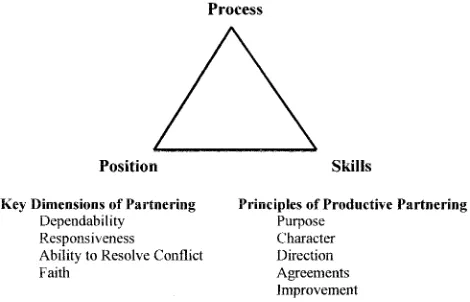
FIG. 2. Transformational Leadership 1Group Process5 Learning Organization
teammates to help me recognize when I have not been as dependable as I want to be?
• Process—When will I share my goal with the group, and how often will I report my progress to them?
To develop Dependability within the organization, we can review the five categories of Principles of Productive Partnering for clues on how to improve:
• Purpose —Is it part of our vision for all employees to be actively involved and informed on all issues that affect them?
• Character —Are we all committed to telling the truth about issues and supporting each other in get-ting better at it?
• Direction —What are our priorities and specific goals for action to move the organization forward? • Agreements —Are we making clear, appropriate agreements and ensuring that every party to the agreement understands the same thing?
• Improvement —How often are we going to conduct staff surveys to anonymously poll everyone’s view of how well we are doing?
People, by their very nature, are learning beings. No one who has ever watched a baby’s remarkable devel-opment process would argue this point. Adults may choose to not learn because of conditioning and envi-ronmental influences. Therefore, the fundamental chal-lenge in creating a Learning Organization lies in creating the social environment where people’s natural desire to learn and grow can emerge. Learning Organizations are not built on a foundation of technology, gimmicks, buzz-words, or hollow promises. They are built on the foun-dation of a learning friendly culture. Any organization can create such a culture.
The implementation strategy for creating this culture is simple: (TL1GP = LO). To develop a plan for adopt-ing this strategy, all any organization needs to do is em-brace the structural context of the Partnering Effective-ness Model and adhere to the guiding Principles of Productive Partnering. Progress can easily be measured along the way by assessing at any point how the four key dimensions of Partnering are working. This is a very simple process of cycling through Position, Skills, and Process repeatedly, one step at a time, one day at a time.
In 1999 the American Productivity and Quality Center published a summary report entitled, ‘‘Organizational Change: Managing the Human Side.’’ This report iden-tifies the five imperative elements common to successful organizational change management. This is particularly relevant because creating a Learning Organization is a commitment to accepting ongoing change as the orga-nizational norm. Let us now look at these five elements and see how the implementation strategy presented in this article serves them:
1. Committed and Active Participation of Leader-ship—Transformational Leadership, by its very definition, embodies this completely.
2. Culture Change—We have repeatedly empha-sized the importance of building a culture founded in Partnering principles and practices.
3. Energetic Involvement of an Empowered and Educated Workforce—Positioning everyone, identifying and developing Skill weaknesses, and executing an orderly change Process are the keys to cultivating enthusiastic buy-in and competence. 4. Effective Communication and Measurement— Dependability and Responsiveness highlight the importance of developing the skills and processes of communication throughout. Principles of Pro-ductive Partnering include measurement.
5. Aligning Human Resources Systems with the Goals and Objectives of Change—It seems to follow that part of creating a Partnering culture in-volves engaging all employees in identifying their human resource needs and jointly designing sys-tems that meet those needs.
Fig. 2 is a graphic representation of the Partnering Effectiveness Model with the major elements discussed in this article superimposed on it.
CONCLUSIONS
ap-proach to relationships and business and as the cultural and organizational orientation necessary to deploy the implementation strategy.
The implementation process we have presented is sim-ple, but we do not expect you to conclude that it is either easy, or of short duration. In the referenced report by the American Productivity and Quality Center (1999), there is an example of an organization that sent 3,000 man-agers through a 4-day leadership program over a 3-year period. It is important to learn from this paper that ‘‘suc-cess is not a destination, it is a journey.’’ We have shared with you a process for creating a Learning Organization that is validated by extensive research done by others. What is more important to us is that we know in our hearts that it works —for us, for clients with whom we have consulted, and for you, if you will do what we
suggest. Partnering is the foundation of a Learning Or-ganization, and we know with absolute Faith that eve-ryone intends to be a good partner, even when they are allowing unconscious patterns of behavior to get in the way.
APPENDIX. REFERENCES
American Productivity and Quality Center/ICF KAISER. (1999). ‘‘Or-ganizational change: managing the human side.’’ Rep., Houston. Hendricks, G., and Ludeman, K. (1996). The corporate mystic,
Ban-tam, New York.
Kline, P., and Saunders, B. (1993). Ten steps to a learning
organi-zation, Great Ocean Publishers, Arlington, Va.
Schwarz, R. M. (1994). The skilled facilitator, Jossey-Bass, San Fran-cisco.
Senge, P. (1990). The fifth discipline, the art and practice of the