THE INFLUENCE OF COUNTRY FINANCIAL RISK
TOWARD FOREIGN DIRECT INVESTMENT
OF MULTINATIONAL CORPORATION IN INDONESIA
SCIENTIFIC ARTICLE
Submitted to Complete the Requirement of
Bachelor’s Degree Program of
Management Department
By :
ADRIAN CHRISTIAN 2009201696
PERBANAS ECONOMIC COLLEGE S U R A B A Y A
VALIDATION OF SCIENTIFIC ARTICLE
N a m e : ADRIAN CHRISTIAN
Place, Date of Birth : Jakarta, January 26th 1990
N.I.M : 2009210696
Department : Management
Program of Study : Bachelor Degree (S1)
Concentration : Financial Management
T i t l e : The Influence of Country Financial Risk Toward Foreign
Direct Investment of Multinational Corporation in Indonesia
Approved and accepted by both :
Advisor,
Date : October 22nd 2014
Lutfi, SE, M.FIN
Head of Management Department
Date : October 22nd 2014
THE INFLUENCE OF COUNTRY FINANCIAL RISK TOWARD FOREIGN DIRECT INVESTMENT OF MULTINATIONAL CORPORATION
IN INDONESIA
Adrian Christian
Perbanas Economic College, Surabaya Email: [email protected] Rungkut Mapan Tengah IV / CD.25
ABSTRACT
Foreign direct investment has become one of the income source for a country. The importance of expanding a business also becomes the main purpose of a multinational corporation. Understanding a risk of a country before deciding to invest is important to avoid a risk. One from many important factors for Multinational Corporation to consider as a risk is country financial risk.
This research aims to analyze the influence of inflation, interest rate and exchange rate volatility toward foreign direct investment. Data used in this research are time series data, namely in period from 1998-2013. The analysis tools used in this research are multiple regression and recusive model with formative indicator
The result in this research concluded that variable of inflation have a positive and not significant impact toward foreign direct investment. Variable interest rates have a negative and significant impact toward foreign direct investment and variable exchanges rate volatility has a negative and not significant impact toward foreign direct investment.
Keywords: inflation, interest rate, exchange rate volatility, foreign direct investment, country financial risk
INTRODUCTION
Economic activity around the world supports by many kinds of industries operated by company that can be divided into two groups, the first one is Domestic Corporation (DC) and the second one is Multinational Corporation (MNC). Many firms have evolved into Multinational Corporations, which are defined as firms that engage in some form of international business (Madura and Fox, 2007:2). These kinds of companies have offices, plants, or subsidiaries in many countries. Multinational Corporation (MNC) usually has a head office. Multinational Corporation (MNC) coordinates a global management. Multinational Corporation (MNC) is a development of international
activity which is trading with exporting goods.
international finance, so it can disturb firms operational (Hamdy Hady, 2012:283). In other words, Country Risk potentially adverse impact of a country’s environment on Multinational Corporation
(MNC’s) cash flows.
One of the aspects of country risk is Financial Risk. One of the most obvious financial factors is the current and
potential state of the country’s economy.
Multinational Corporation (MNC) that exports to a country or develops a subsidiary in a country is highly concerned
about that country’s demand for its
products. This demand is, of course, strongly influenced by the country
economy. Because of a country’s
economic growth depends on several financial factors, Multinational Corporation (MNC) must consider all of these factors. According to Hamdy Hady (2012:284), the most important factors are interest rates, exchange rates volatility, and inflation.
There are many researches examine the influence of country financial risk toward multinational corporation (MNC) foreign direct investment (FDI). Research conducted by Aguiar, Conraria, Gilamhussen and Magalhaes (2012) prove
that the higher a country’s level of risk is significantly associated with the lower level of Multinational Corporation (MNC) Foreign Direct Investment (FDI). Research was also conducted by Haque (2008) over 70 countries. This research reveals that (2008) also reveals that discrete variations in the real exchange rate do not impact FDI. A more or less depreciated real exchange rate does not seem to encourage or discourage FDI.
Based on some previous research, researcher is interested in doing another research related with country risk that is about “The Influence of Country
Financial Risk toward Foreign Direct Investment Of Multinational
Corporation in Indonesia”
THEORETICAL BASIS AND HYPOTHESES
Foreign Direct Investment
MNCs commonly capitalize on foreign business opportunities by engaging in foreign direct investment (FDI), which is investment, in real assets (such as land, buildings, or even existing plant) in foreign countries (Madura and Fox, 2007:463). MNCs engage in joint ventures with foreign firms, acquire foreign firms and from new foreign subsidiaries. Any of these types of FDI can generate high returns when managed properly.
MNCs commonly consider foreign direct investment because it can improve their profitability and enhance shareholder wealth. In most cases, MNCs engage in FDI because they are interested in boosting revenues, reducing cost, or both.
Multinational Corporation
The commonly stated goal of a firm is to maximize its value and thereby maximize shareholders wealth (Madura and Fox, 2007:464). Developing business at an international level is an important means of enhancing value for many firms. Many barriers to entry into foreign markets have been reduced or removed recently, thereby encouraging firms to pursue international business.
Multinational Corporation (MNC) cost of production and pricing policies.
Country Risk
Multinational Corporation (MNC) conducts country risk analysis when assessing whether to continue conducting business in a particular country (Madura: 2003). The analysis can also be used when determining whether to implement new projects in foreign countries. Based on Shapiro (2009:317) country risk is the assessment of the potential risk and reward associated with making investment and doing business in a country. Country risk analysis is not restricted to predicting major crises such as a terrorist attack, the imposition of trade restrictions on import, etc. by necessity; it must also study the political factors that give rise to particular economic policies. This is the subject matter of Political Risk the interaction of politics and economics. Country risk can be divided into several risks such as Political Risk, Financial Risk and Socio-Cultural Risk (Hamdy Hadi, 2012:284).
In general, political factors and financial factor, more dominant and take effect to firms operational. But in certain thing, socio-cultural can be more dominant for example in the case of religion or race. Along with political factors, financial factors should be considered when assessing country risk. In this research, researcher use Financial Risk as variables to assess Multinational Corporation (MNC) Foreign Direct Investment (FDI).
The Influence of Inflation toward FDI of MNC
Inflation is an increase in the average level of prices of goods and services (Schiller, 2006:133) or the annual percentage rate of change in the price level (Madura and Fox, 2007:495). In this case, for make a calculation to measure inflation, we first determine the average prices of all output and then the average price level then look for the changes in that average. A rise in
affect consumer’s purchasing power and
therefore their demand for Multinational
Corporation (MNC’s) goods. It also indirectly affects a country’s financial
condition by influencing the country’s interest rates and currency value. A high level of inflation may also lead to a decline in economic growth (Madura and Fox, 2007:557). The previous study done by Sayek (2009) stated that inflation erodes the purchasing power of individuals, creating distortions in the net returns of investment. An increase in inflation has direct effects on both the domestically and foreign source financed foreign direct investment. Based on this theory and previous study, so the hypotheses can be formulated as follows:
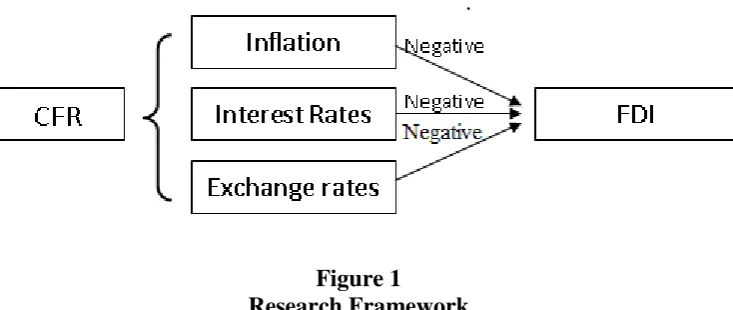
Hypotheses 1 : Inflation has a partial negative and significant impact to Multinational Corporation (MNC) Foreign Direct Investment (FDI) in Indonesia.
The Influence of Interest Rate toward FDI of MNC
Interest rates are the prices paid for borrowing money or the rate at which interest is paid by for the borrower for the use of money that they borrow from a lender (Samuelson and Nordhaus, 2012:190). A small company borrows capital from a bank to but new assets for their business, and in return the lender receives interest at a predetermined interest rate for deferring the use of funds and instead lending it to the borrower. Interest rates are normally expressed as a percentage of principal of a period one year.
cannot restore it financing costs. As the consequences, firms tend to decrease the expansion level if the interest rates in high period.
Madura and Fox (2007:557) stated that higher interest rates tend to slow the growth of an economy and reduce the demand for Multinational Corporation. Samuelson and Nordhaus (2012:194) also stated that interest rate affect financing costs. Some project regarded feasible in low interest rates period may not feasible in high interest rates period. Project maybe cannot restore it financing cost. As the between high interest rate with a low level of Multinational Corporation. Based on this theory and previous study, so the hypotheses can be formulated as follows: Hypotheses 2 : Interest Rate has a partial
negative and significant impact to Multinational Corporation (MNC) Foreign Direct Investment (FDI) in Indonesia.
The Influence of Exchange Rate Volatility toward FDI of MNC
An exchange rates measures the value of
Indonesia Central Bank defines that there have two kind of exchange rate stability. First is the exchange rate stability toward goods and services. Second is the stability against the currencies of other countries. Exchange rate stability is very important to support sustainable economic development. The more stable the exchange rate of a country can foster public confidence and the business world in a variety of economic activities, both
consumption and investment. The more fluctuate a country exchange rate will complicate a planning in business activities, both in production and investment activities as well as the pricing of goods and services produced.
Madura and Fox (2007:557) stated that the more volatility a country currency indicates that the current economic condition of that country is vulnerable. The more stable the exchange rate of a country can foster public confidence and the business world in a variety of economic activities, both consumption and investment. The more volatility a country exchange rate will complicate a planning in business activities, both in production and investment activities as well as the pricing of goods and services produced. Yati Kurniati and Andry Prasmuko (2007) in their article find that there is a significant impact of exchange rate volatility toward foreign direct investment in Indonesia. Investor pays a big attention to the financial stability that can be seen from exchange rate volatility. Ruiz and Pozo (2008) also find that discrete variations in the real exchange rate do not impact foreign direct investment. Based on this theory and previous study, so the hypotheses can be formulated as follows: Hypotheses 3 : Exchange Rate Volatility
has a partial negative and significant impact to Multinational Corporation (MNC) Foreign Direct Investment (FDI) in Indonesia.
.
Figure 1
Research Framework
RESEARCH METHOD Sample Classification
Population used in this research is foreign direct investment in Indonesia. While this study sample are foreign direct investment period 1998-2013.
Research Data
This study use quantitative data. Quantitative data is data that is measured by numeric scale and if we see from the data source, this study use secondary data. Secondary data is data which has been collected by individuals or agencies. This study is also archival research that is a study of written facts (document) or multiple data archive. Documentation done is collecting all the secondary data from inflation, interest rate, exchange rate volatility and foreign direct investment. All the data collected from January 1998 until December 2013. Inflation data obtained from www.bps.go.id, Interest Rate data obtained from www.bi.go.id, Exchange Rate Volatility data obtained from Indonesia Central Bank Website and Foreign Direct Investment Data obtained from UNCTAD.
Research Variables
Variables that used in this study can be divided into two kinds of variables, Dependent variable and independent variable. Dependent variable used in this research is foreign direct investment level
while the independent variables used are inflation, interest rates and exchange rates volatility in the period of 1998-2013.
Variable Operational Definition Foreign Direct Investment
Foreign Direct Investment is investment in real assets (such as land, building, or even existing plants) in foreign country that can be measured by the amount of incoming annually Foreign Direct Investment to Indonesia. This data is secondary data which is taken from UNCTAD statistic data.
Inflation
Inflation is an increase in the average level of prices of goods and services measured by IHK (Indeks Harga Konsumen) in Indonesia. IHK is an index which calculates the average change in price over a period, of a goods and services consumed by the population within a certain time (bps.go.id). Inflation data take from BPS (Badan Pusat Statistik) monthly. This data will be change into annual inflation with:
Interest Rate
monetary policy set by Indonesia Central Bank (BI) and announced to the public. Interest rate used in this study is monthly BI Rate. The data are taken from Indonesia Central Bank. This data will be converting into annual BI Rate with:
Exchange Rate Volatility
Exchange rate is the price of one currency stated in terms of second currency. An exchange rate can be given in one of two ways, either as units of domestic currency per unit of foreign currency. Exchange rate used in this study is the stability of exchange rate. The stability of exchange rate can be measured by the standard deviation of exchange rate data per month in a year. The data take from Indonesia Central Bank daily. This data will be converting into standard deviation with:
Where:
S = Standard Deviation y = Sample of data n = the number of data
Source: SPSS 16.0
Data Analysis Technique
Analysis used in this study includes three forms of analysis. Descriptive analysis, recusive model with formative indicator and regressionRegression analysis used to analyze the relation between one independent variable to one dependent variable.
In this study, researcher use multi linier regression with three predictor. The purpose of the analysis is to find out how far the simultaneous impact between independent variables and dependent variable. Here is the regression model used in this study model:
Where :
FDI = Foreign Direct Investment IF = Inflation
IR = Interest Rate
ER = Exchange Rate Volatility B = Coefficient
ɛ = Error
RESULT AND DISCUSSION Descriptive Analysis
Based on table 4.1 above, the highest FDI is 19,241,000,000 US Dollar occurs in 2010. Good economic growth, low inflation and interest rate make Indonesia has gained confidence in the eyes of the international. The lowest FDI is -4,550,000,000 US Dollar occurs in 2000. The minus sign indicates that many multinational corporations are taking their investment back to their country because the current both of economic and political indication namely economic crisis and government changes did not give a good interest rate so high have an important role that made this happened. The mean of Indonesia, Indonesian Central Bank decide to increase the interest rate to face the interest rate will increase the investment and ease entrepreneur to expand their business. The mean of interest rate is 12.3594 percent and the standard deviation is 0.0590036.
The highest exchange rate volatility is 2188.1155 occur in 1998 as the effect of the economic crisis that hit Indonesia. The lowest exchange rate volatility is 136.9577 occur in 2010. A positive indication in Indonesia economic in 2010 makes Indonesia currency in stable condition. It
shown by Indonesia economic growth, inflation and the interest rate. The mean of exchange rate volatility is 592.235438 and the standard deviation is 518.5852798. Regression Analysis used to analyze the influence of independent variables that are inflation, interest rate and exchange rate toward the dependent variable foreign direct investment. The result of multiple influenced foreign direct investment. It means that every one unit increase in inflation, foreign direct investment will be increase 0.04 with assumptions that another variable is constant.
Coefficient value for interest rate is -0.93 which mean that interest rate influenced foreign direct investment. It means that every one unit increase in interest rate, foreign direct investment will be decrease 0.93 with an assumption that another variable is constant.
The path value for inflation is 0.498. It can be known that inflation have significance for 0.498 more than significance that was set in this study at 0.05 so the result is not significant. With the B value 0.04, it can be conclude that inflation have a positive but not significant impact toward foreign direct investment in Indonesia. The result of this study is not in line with the theory and the previous conducted by Sayek (2009) which stated that inflation erodes the purchasing power of individuals, creating distortions in the net returns of investment. An increase in inflation has direct effects on both the domestically and foreign source financed foreign direct investment.
. The positive values of inflation we can see from the point of view of investors. Inflation can bring more income for the corporation if the income is higher than the increasing of the production cost. Investors tend to invest with the current condition not only because of that, but the inflation in Indonesia after the period of crisis is not hyper inflation, galloping inflation but only light inflation. If the inflation was light, it has a positive effect which means that it can stimulate the economy better, which increases national income, and makes peoples excited to work, saving and investment holding.
The result of not significant happened because inflation is not the only factor that influences the decision of a multinational corporation to invest in Indonesia. The other factors like political stability, the change of leadership and the behavior of Indonesia workers or know as socio-cultural risk also play an important role for multinational corporation decision (Hamdy Hady, 2012:283). The change of economic policy also changes. Even when the inflation is high, but the other factors play a role to make Indonesia gained a trust from the world.
The Influence of Interest Rate toward Foreign Direct Investment
The path value for interest rate is <0.001. It can be seen that interest rate have significance for <0.001 less than significance that was set in this study at 0.05 so the result is significant. With the B value -0.93, it can be conclude that interest rate have a negative and significant impact toward foreign direct investment in Indonesia.
that there is a negative relationship between high interest rate with a low level of Multinational Corporation. The interest rate they charge on the international loans can be adjusted to risk. This result supported or in line with the theory suggested by Madura and Fox (2007:557), Samuelson and Nordhaus (2012:194), and previous study done by Haque (2008).
The Influence of Exchange Rate Volatility toward Foreign Direct Investment
The path value for exchange rate volatility is 0.333. It can be seen that exchange rate volatility have significance for 0.333 more that significance set in this study at 0.05 so the result is not significant. With the B value -0.01, it can be conclude that exchange rate volatility have a negative but not significant impact toward foreign direct investment in Indonesia. In the other word, H0 can be accepted and H1 rejected. The result of this study is not in line with the theory and the previous conducted by Yati Kurniati and Andry Prasmuko (2007) which stated that that there is a significant impact of exchange rate volatility toward foreign direct investment in Indonesia. Investor pays a big attention to the possible that foreign direct investment not influenced by exchange rate volatility but influenced by exchange rate level. The previous study done by Xing and Wan (2006) finds that a highly correlated relationship seems to exist between the two trends specifically as the home currency get depreciated more foreign direct investment went to home country. While an appreciation of the home currency was always associated with the
reduction in foreign direct investment inflows. Devaluation in the currency of the country receiving the foreign direct investment induces a reduction in local production cost in terms of foreign currency, raising the profits of export-oriented foreign investors accordingly. The wealth of foreign investors relative to domestic investor is also raised after devaluation, when all production increase such as labor, land and machines and assets become cheaper for the foreign investors, whose capital is in the foreign currency, encouraging them to acquire more domestic assets. This previous study supported by Madura and Fox (2007:553) that a weak exchange rate tends to increase multinational corporation (MNC) foreign direct investment (FDI). But, strong exchange rates tend to decrease multinational corporation (MNC) foreign direct investment (FDI) in Indonesia. It happen because a weak exchange rates in Indonesia makes multinational corporation (MNC) can get more Indonesia currency with less dollar better than when Indonesia currency in a strong condition.
Coefficient of Determination
Overall, the prediction power of the model is good proved by the value of 0.855 influenced foreign direct investment are political stability and worker behavior known as socio-cultural (Hamdy Hady, 2012:283). Madura and Fox (2007:557) explained that Multinational Corporation
(MNC) must asses’ country risk not only
changes in political environment can provide opportunities as well. As one might expect, many country characteristics related to the political environment can influence Multinational Corporation (MNC). In some cases of expropriation, some compensation is awarded. In other cases, the assets are confiscated and no compensation is provided. Hamdy Hady (2012:283) also explained that socio-cultural such as social group (ethnic, religion, language and social class), Attitude of the population (against time, work, success and change), illiteracy rate, political awareness of the population and social unrest also can be considered by investors as the risk besides political risk and financial risk.
CONCLUSION, LIMITATION AND RECOMMENDATION
Based on the result of first hypothesis it shown that inflation do not have a significant impact toward foreign direct investment. It proved by the significance as 0.498 > 0.05 and the B value is 0.04.
Based on the result of second hypothesis shown that interest rate have a negative and significant impact toward foreign direct investment. It proved by the significance as <0.001 and the B value is -0.93.
Based on the result of third hypothesis shown that exchange rate have a negative but not significant impact toward foreign direct investment. It proved by the significance 0.333 > 0.05 and the B value is -0.01.
This study has some limitation (1) The variables used only inflation, interest rate and exchange rate. The other variables like political stability (government policy, the change of leadership, etc), socio-cultural risk (social group, attitude of the population, etc) are not used in this study. (2) This study samples period only 16 years from 1998 until 2013. (3) There is a scale effect of foreign direct investment in the data used in this study because the data
cannot be converted into log normal Government and Bank Indonesia must pay more attention about the inflation interest rate and exchange rate to increase the foreign direct investment also to decrease the financial risk to attract more investor. Especially interest rate, this study finds that the higher the interest rate will decrease the incoming foreign direct investment into Indonesia. The government and Bank Indonesia must focusing on keep our interest rate lower to attract more investors into Indonesia that can give and provide more job opportunity for Indonesia people.
REFERRENCES
Aguiar, Sandra., Conraria, L. Aguiar., Gulamhussen, M. Azim and Magalhaes, Pedro C. 2012.
“Foreign Direct Investment and
Home Country Risk”. Latin American Research Review. Vol. 47, No. 2.
Frank, Robert H and Bernanke, Ben S. 2007. Principle of Economics. 3rd Edition. USA: McGraw-Hill Gerber, James. 2013. International
Economics. 6th Edition. USA: Pearson Education
Hamdy Hady. 2012. Manajemen Keuangan Internasional hal 283-284. Edisi 3. Jakarta: Penerbit Mitra Wacana Media
Haque, M. Ashraful. 2008. “Country Risk
Assessment: Risk Assessment of
the Developing Country”.
Business Research. Volume 7, Number 1.
Juliansyah Noor. 2013. Metodologi Penelitian. 3rd Edition. Jakarta: Kencana Prenada Media Group Madura, Jeff, and Fox, Roland. 2007.
International Financial Management. USA: Thomson Learning
M. Suparmoko dan Maria R. Suparmoko. Pokok-Pokok Ekonomika. Edisi 1. Jakarta: BPFE Yogyakarta Ruiz, Isabel and Pozo, Susan. 2008
“Exchange Rates and US Direct Investment Into Latin America”.
The Journal of International Trade and Economic Development. Vol. 17, No. 3. Page 411-438
Sadono Sukirno. 2000. Makroekonomi Modern. PT Raja Grafindo Persada: Jakarta
Samuelson, Paul A and Nordhaus, William D. 2012. Macroeconomics. 19th Edition. New York: McGraw-Hill
Sarwedi. 2002. “Investasi Asing Langsung
di Indonesia dan Faktor Yang
Mempengaruhinya”. Jurnal
Akuntansi dan Keuangan. Vol. 4, No. 1. Page 17-35
Sayeq, Selin. 2009. “Foreign Direct
Investment and Inflation”.
Southern Economic Journal. 76(2). Page 419-443
Schiller, Bradley R. 2006. The Economy Today. 10th Edition. USA: McGraw-Hill International Edition
Slavin, Stephen L. 1991. Introduction to Economics. 2nd Edition. USA: Irwin
Srivasta, R.M., 1994. International Strategic Management. Himalaya Publishing House, Bombay India.
Syovian Siregar. 2013. Metode Penelitian Kuantitatif. 1st Edition. Jakarta: Kencana Prenada Media Group
Xing, Yuqing and Wan Guanghua. 2006.
“Exchange Rates and
Competition for FDI in Asia”.
Journal Compilation.
Yati Kurniati, Andry Prasmuko dan
Yanfitri. 2007. “Determinan FDI”. Penelitian dilakukan oleh
Curriculum Vitae
I. Personal Information
Name : Adrian Christian
Gender : Male
DoB : Jakarta, January 26th, 1990
Address : Rungkut Mapan Tengah IV / CD.25 Phone Number : 082232741380
Email : [email protected]
II. Formal Education
Educational Program Year Name of School or University or College College/ Finance 2009-2014 STIE Perbanas Surabaya
University 2008-2009 Univ 17 Agustus 1945 Surabaya Senior High School 2005-2008 Dapena 1 Surabaya
Junior High School 2002-2005 Negeri 2 Manokwari Elementary School 1996-2002 Padma 1 Manokwari
III. Working Experience
No. Description Year
1 PT Melandas Indonesia – SPB (Sales
Promotion Boy) April 2012 – June 2012
2 Universitas Islam Lamongan – English
Debate Coach February 2014 – Until Now
3 STIE Perbanas Surabaya Library – English
Tutor March 2014 – October 2014
IV. Organization Experience
No. Description Year
1 UKM Musik Untag – Member 2008 – 2009
2 Sie Kerohanian Kristen dan Katholik – Head of Routine Division 2009 – 2010
3 English Club – Routine Division 2010 – 2011
4 Surabaya English Debate Community – Founder, Leader and Coach
2011 – Until Now
That’s all the Curriculum Vitae which I can say with truth and to be used as
appropriate
Sincerely,