1 Date Received April 30, 2014, Date Accepted August 14, 2014
2 Department of Forest Products, Faculty of Forestry, Bogor Agricultural University. Kampus IPB Dramaga, Bogor 16680,
Indonesia
3 Department of Plant Protection, Faculty of Agriculture, Bogor Agricultural University. Kampus IPB Dramaga, Bogor 16680,
Indonesia
4 College of Forest & Environmental Sciences, Kangwon National University, Chuncheon 200-701, Korea 5 Department of Forestry, Faculty of Agriculture, Lampung University, Bandar Lampung 35145, Indonesia 6 Department of Forest Products, Korea Forest Research Institute, Seoul 130-712, Korea
†
Corresponding author : Nam-Hun Kim (e-mail: [email protected])
†
Corresponding author : Fauzi Febrianto (e-mail: [email protected])
Termite Resistance of The Less Known Tropical Woods Species Grown in
West Java, Indonesia
1Fauzi Febrianto2,†⋅Andi Zaim Pranata2⋅Dea Septiana2⋅Arinana2⋅Adiyantara Gumilang3⋅
Wahyu Hidayat4,5⋅Jae-Hyuk Jang4⋅Seung-Hwan Lee4⋅Won-Joung Hwang6⋅Nam-Hun Kim4,†
ABSTRACT
This research focused on the natural durability of twenty one lesser known tropical wood species planted in West Java, Indonesia against subterranean termite (Coptotermes curvignathus). It was observed that both heart-wood and sapheart-wood of Kiara payung (Filicium decipiens); heartheart-woods of Nangka (Arthocarpus heterophyllus), Mahoni (Swietenia macrophylla) and Simpur (Dillenia grandifolia); and sapwood of Bungur (Lagerstroemia speciosa) were rated as resistant (natural durability classⅡ) according to Indonesian standard SNI 01.7207.2006 (BSN 2006). Both heartwood and sapwood of Salam (Syzigium polyanthum), Pasang (Lithocarpus sundaicus), Bisbul (Diospyros discolor), Rukam (Flacourtia rukam) and Trembesi (Samanea sa-man); heartwood of Puspa (Schima walichii), Bungur, Tanjung (Mimusops elangi) and Angsana (Pterocarpus indicus) were rated as moderately resistant (natural durability classⅢ). Both heartwood and sapwood of Sungkai (Peronema canescens), Pine (Pinus merkusii), Mangium (Acacia mangium) and Afrika (Maesopsis eminii); sapwoods of Mahoni, Puspa and Tanjung were rated as poorly resistant (natural durability class Ⅳ). Both heartwood and sapwood of Agathis (Agathis dammara), Durian (Durio zibethinus), Ki sampang (Evodia latifolia) and Jabon (Anthocephalus cadamba); sapwoods of Nangka and Angsana were rated as very poorly resistant (natural durability class Ⅴ). This reserach showed that woods with lower resistance against C. cur-vignathus attack (natural durability class Ⅳ and Ⅴ) tend to have lower termite mortality values compared to woods with higher resistance against C. curvignathus attack (natural durability class Ⅱ and Ⅲ). Results of the study will provide some valuable information on termite resistance of twenty one lesser known tropical wood species planted in Indonesia.
1. INTRODUCTION
It was reported that the demand for housing in Indonesia is 2.9 million houses per year and
each house takes around 2.97 m3 of wood
(Supriana et al. 2003). On the other hand,
tim-ber supply from natural rain forest decreased sharply in the last decade due to forest
degradation. In 2007, the production of timber
from natural forest (natural forest con-cessionaires and license for timber utilization),
plantation forest (state own enterprise and
plan-tation forest concessionaires) and other sources is around 32.20 million m3 and increased to
be-come 47.43 million m3 in 2011. Contribution of
timber from natural forest at the same period
decreased from 10.83 million m3 to 5.69 m3. At the same time, contribution of timber supplied
from plantation forest more or less constant
around 19.95-20.65 million m3 (Indonesia Ministry of Forestry 2012). This indicates that
now and in the near future timber supply for
wood industry in Indonesia will be dominated by timber supplied from plantation forest.
Furthermore, total areas of industrial forest
plantation in Indonesia also increased year by
year. In 2007, the accumulation of plantation area was recorded around 4.01 million hectares
and increased to become 5.38 million hectares
in 2011. However, there is no exact data re-garding areas of community forest in Indonesia.
It was informed that in 2011 total areas of
community forest is around 3.5 million hectares (Indonesia Ministry of Forestry 2012).
In general the quality of timber harvested
from industrial forest plantation and community
forest was lower compared to timber harvested
from natural forest due to its lower density,
smaller diameter, contains more juvenile wood, lower dimensional stability, lower natural
dura-bility and contain more defects (Febrianto et al.
2010). On the other hand, the price of sawn timber harvested from industrial forest
planta-tion and community forest was much cheaper
compared to sawn timber harvested from natu-ral forest which made this timber an interesting
choice for most people in Indonesia to use it as
housing material.
Knowledge about basic properties including natural durability of timber harvesting from
in-dustrial forest plantation is very important for
timber user to optimize its utilization. The natu-ral durability of timber may be defined as the
inherent resistance of timber to attack by wood
destroying organisms such as fungi, marine bor-ers, insects and bacteria (Bowyer et al. 1982;
Hunt and Garrat 1986; Kim et al. 1996; Lee
2004; Kim 2013; Yu and Cao 2009). The
natu-ral durability of wood related to toxic ex-tractives substance in wood particularly in
heartwood part (Sjöström 1995). Up to now,
there is no comprehensive information about natural durability of wood harvesting from
in-dustrial forest plantation and community forest
in Indonesia. Therfore the resistance of twenty one lesser known tropical wood species planted
in West Java Indonesia, against subterranean
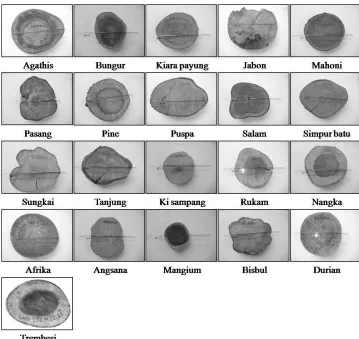
Fig. 1. Discs of wood samples used in this experiment.
2. MATERIALS and METHODS
2.1. Materials
2.1.1. Test wood blocks
Twenty one lesser known tropical wood
spe-cies were harvested from two plantation sites in
West Java, Indonesia, i.e: Mount Walat Education Forest in District of Sukabumi and
Campus Forest at Bogor Agricultural University
in District of Bogor. The wood species were
in-cluding Agathis (Agathis dammara), Bungur
(Lagerstroemia speciosa), Kiara payung
(Filicium decipiens), Jabon (Anthocephalus
ca-damba), Mahoni (Swietenia macrophylla), Puspa (Schima walichii), Pasang (Lithocarpus
sundai-cus), Pine (Pinus merkusii), Salam (Syzigium
polyanthum), Simpur (Dillenia grandifolia),
Sungkai (Peronema canescens), Tanjung (Mimusops elangi), Mangium (Acacia mangium),
Durian (Durio zibethinus), Nangka (Arthocarpus
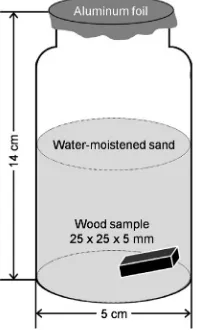
Fig. 2. Diagram of the SNI 01.7207-2006 test method with termites.
Afrika (Maesopsis eminii), Rukam (Flacourtia
rukam), Trembesi (Samanea saman), Bisbul
(Diospyros discolor) and Ki sampang (Evodia
latifolia) as shown in Fig. 1. The age of trees
were more than ten years with diameter ranging
between 13-30 cm. Wood discs were obtained from the bottom part of trunk. Three replicates
of heartwood and sapwood samples were
ob-tained from wood disc of each species.
2.1.2. Test termite
Workers termites of subterranean termites
(Coptotermes curvignathus) were gift from
Wood Quality Improvement Laboratory, Bogor
Agricultural University, Indonesia. Termite re-sistance of twenty one lesser known tropical
wood species was performed in accordance to
Indonesia standard SNI 01.7207.2006 as a standard test to determine the resistance of
wood and wood products against wood
destroy-ing organism attacks (BSN 2006) in the
labo-ratory of Wood Science of Bogor Agricultural
University, Indonesia.
2.2. Methods
2.2.1. Natural durability to termites
Indonesian standard SNI 01.7207.2006 de-scribes a 4-week, no-choice laboratory test
us-ing 200 g of sand matrix, 50 mL of distilled
water and 200 workers of C. curvignathus. Test specimens (25 × 25 × 5 mm) were placed
up-right position within a glass jar. We performed
this research in three replicates. Full details of
the test method are given in SNI 01.7207-2006 (BSN 2006). A diagram of the test method
ac-cording to SNI 01.7207-2006 is provided in
Fig. 2. Weight loss of wood sample and termite mortality were calculated using the following
formulas:
×
WL: weight loss (%), W1: oven dried sample before baited
to termites (g), W2: oven dried sample after baited to
termites (g)
×
MR: termite mortality (%), D: number of termite died, 200: initial number of termite
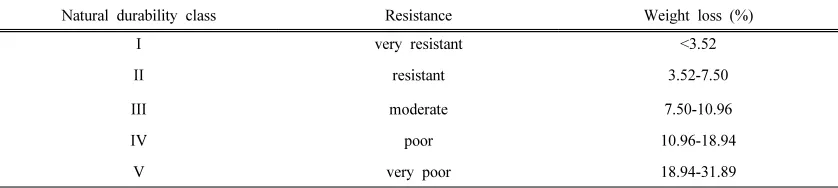
Natural durability classification of wood
against subterranean termite based on weight
loss was presented in Table 1.
2.2.2. Data analysis
To assess natural durability properties (weight loss and termite mortality parameters), all
mul-tiple comparisons were subjected to an analysis
Natural durability class Resistance Weight loss (%)
Table 1. Natural durability classification of wood against subterranean termites according to SNI 01.7202.2006
≤ 0.01) and significant (α ≤ 0.05)
differ-ences between the mean values of the untreated and treated specimens were determined using
Duncan’s multiple range tests.
3. RESULTS and DISCUSSIONS
3.1. Weight loss
Every wood has its own specific natural
du-rability against subterranean termite attacked. It
is due to the toxic extractives deposited in the wood, particularly in heartwood part. After
bait-ed to C. curvignathus for 4 weeks, the average
value of weight loss of the twenty one lesser known tropical wood species grown in
planta-tion forest in West Java province, Indonesia,
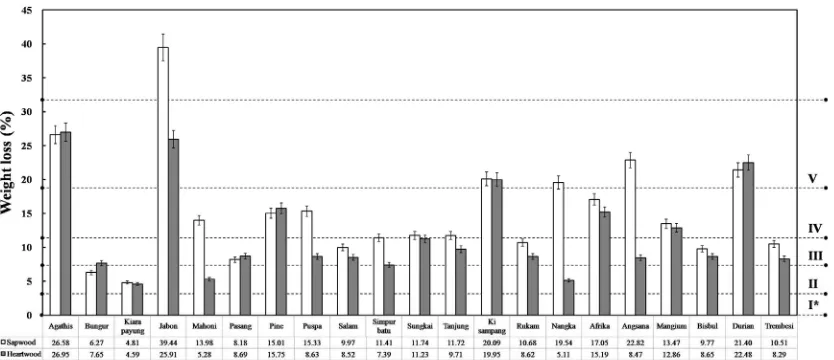
ranged between 4.85-39.44% and 4.59-26.95%, respectively, for sapwood and heartwood
samples. The highest and the lowest weight loss
of sapwood samples were achieved on Jabon
and Kiara payung. On the other hand, the high-est and the lowhigh-est weight loss of heartwood
samples were achieved on Agathis and Kiara
payung (Fig. 3).
Overall, the heartwood samples tend to have
lower weight losses value compared to sapwood
samples. The weight loss of wood after baited
to C. curvignathus was much affected by wood
species and wood part. Based on weight loss
parameter presented in Fig 3, it was observed
that among twenty one lesser known tropical
wood species evaluated in this experiment none of them were rated as very resistant to C.
curvignathus attack (natural durability classⅠ)
according to Indonesian Standard SNI 01.7207.2006 (BSN 2006). Both heartwood and
sapwood of Kiara payung, heartwoods of
Nangka, Mahoni and Simpur, and sapwood of Bungur were rated as resistant to C.
curvigna-thus attack (natural durability classⅡ). Both
heartwood and sapwood of Salam, Pasang,
Bisbul, Rukam and Trembesi, heartwoods of Puspa, Bungur, Tanjung and Angsana were
rat-ed as moderately resistant against C.
curvigna-thus attack (natural durability classⅢ). Both
heartwood and sapwood of Sungkai, Pine,
Mangium and Afrika, and sapwood of Mahoni,
Puspa and Tanjung were rated as poorly re-sistant to C. curvignathus attack (natural
dura-bility classⅣ). Both heartwood and sapwood
of Agathis, Durian, Ki sampang and Jabon, and
(*Natural durability class by Indonesian standard SNI 01.7207.2006 : see in Table 1)
Fig. 3. Weight loss of woods after baited to C. curvignathus for 4 weeks.
(natural durability classⅤ).
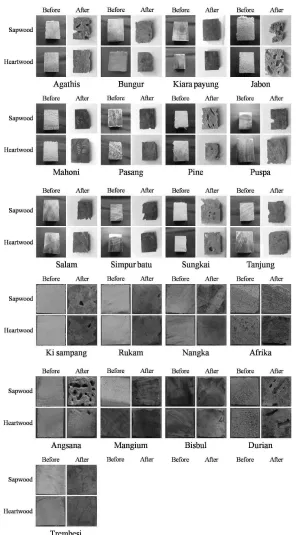
Fig. 4 showed sapwood and heartwood
sam-ples before and after baited to C. curvignathus
for 4 weeks. It is obvious that the weight loss
of heartwood samples of Jabon, Mahoni, Puspa,
Nangka and Angsana were much higher com-pared to their sapwood as shown in Fig. 3.
However both heartwood and sapwood of Jabon
were categorized as very poorly resistant against
C. curvignathus attack. Natural durability
against C. curvignathus attack of heartwood of
Nangka wood was more than 3 times higher
compared to its sapwood. Natural durability against C. curvignathus attack of heartwood of
Angsana, Mahoni and Puspa were 2 times
higher compared to their sapwood. In general, natural durability of heartwood is higher than
sapwood due to most of extractives deposited in
heartwood. The degree of natural resistance against biological agents by heartwood depend
largely upon the nature and amount of toxic
extractives in the species. The amount of
ex-tractives varies considerably within a species, location in the tree, age and rate of growth
(Bowyer et al. 2003). However, not all
chem-ical compounds in extractives have anti termite properties. It was reported that there are four
major chemical compounds in extractives, i.e.
aliphatic, fat, fatty acid, and terpene and terpe-neoid compound (Sjöström 1995). Terpene and
terpenenoid compounds belonged to toxic
extractives. Presumably, extractives in heartwood
of Jabon, Mahoni, Puspa, Nangka and Angsana belong to toxic components. Kininmonth and
Whitehouse (1991) reported that the
concen-tration of terpenes was found to be highest in samples of heartwood and decreased in samples
nearer the outside of the radiata pine trees bole.
Fig. 5. Termites mortality at the end of test.
of loblolly pine. As a result, average percent
terpenes of heartwood (2.3%) was higher than sapwood (0.35∼0.77%).
It is interesting to note that the weight losses
from heartwoods of Pasang, Agathis, Bungur
and Durian were found slightly higher than those from their sapwoods. However, these
val-ues are not significantly different. Probably,
ex-tractives compounds in Pasang, Agathis, Bungur and Durian are not varied within sapwood and
heartwood. The highest weight loss was
ach-ieved in Jabon. Jabon is a fast growing species. Rapidly grown second-growth timber often has
a lower extractives content and thus lower
natu-ral resistance than older and slow-growth wood
materials (Bowyer et al. 2003).
3.2. Termite mortality
Fig. 5 showed mortality of C. curvignathus.
The average values of C. curvignathus mortality
were varied from 33.83-88.33% and 45.33- 92.17%, respectively, for sapwood and
heart-wood samples. The highest and the lowest
ter-mite mortality of both sapwood and heartwood
samples were achieved on Trembesi and Ki sampang. The value of termite mortality was
affected by wood species. It was observed that
the value of the termite mortality in the heart-wood tend to have higher values compared to
sapwood. The highest the termite mortality
tends to result in the lower the weight loss val-ues, vice versa. Woods with lower resistance
against C. curvignathus attack (natural
dura-bility class Ⅳ and Ⅴ) tend to have lower
ter-mite mortality values compare to woods with higher resistance against C. curvignathus attack
4. CONCLUSION
Natural durability of twenty one lesser known tropical wood species observed was affected by
wood species and wood part. Both heartwood
and sapwood of Kiara payung, heartwood of
Nangka, Mahoni and Simpur, and sapwood of Bungur belonged to natural durability class Ⅱ.
Both heartwood and sapwood of Salam, Pasang,
Bisbul, Rukam and Trembesi, heartwood of Puspa, Bungur, Tanjung and Angsana were
categorized to natural durability class Ⅲ. Both
heartwood and sapwood of Sungkai, Pine, Mangium and Afrika, and sapwood of Mahoni,
Puspa and Tanjung were classified into natural
durability class Ⅳ. Both heartwood and
sap-wood of Agathis, Durian, Ki sampang and Jabon, and sapwood of Nangka and Angsana
wood belonged to natural durability class Ⅴ.
Woods with lower resistance against C.
cur-vignathus attack tend to have lower termite
mortality value compared to woods with higher
resistance against C. curvignathus attack.
ACKNOWLEDGEMENT
This study was carried out with the support
of Forest Science & Technology Projects
(Project No. S121213L150100) provided by
Korea Forest Service.
REFERENCES
BSN (Badan Standarisasi Nasional). 2006. Test of
the resistance of wood and wood products
against wood destroying organism attacks.
Jakarta (ID): National Standardization Agency.
Bowyer, J.L., Shmulsky, R., Haygreen, J.G. 1982.
Forest products and Wood Science an
Introduction 4th edition. Iowa: Iowa State Press.
Febrianto, F., Iswanto, A.H., Purwawangsa, H. 2010.
Development of high performance of structural
OSB from community forest wood: Optimum
usage of adhesive and quality improvement of
OSB using environmentally friendly treatment,
Final report. National priority competitive
grant research batch IV. Contract No:
189/SP2H/PP/DP2M/III/2010.
Hunt, G.M., Garrat, G.A. 1986. Wood preservation
(translated) by Yusuf M. Jakarta: Akademika
Pressindo.
Indonesia Ministry of Forestry. 2012. Indonesia
Forestry statistic. Statistika Kehutanan Indonesia.
Indonesia Ministry of Forestry. Jakarta.
Kim, G.H., Jee, W.K., Ra, J.B. 1996. Reduction in
mechanical properties of Radiata pine wood
as-sociated with incipient brown-rot decay. Journal
of the Korean Wood Science and Technology.
24(1): 81∼86.
Kim, Y.S. 2013. Current research trends in wood
preservatives for enhancing durability- A
liter-ature review on non-copper wood preservatives-.
Journal of the Korean Wood Science and
Technology. 41(3): 187∼200.
Kininmonth, J. Whitehouse, L. eds. 1991 Properties
and uses of New Zealand radiata pine (Ⅰ). New
Zealand Forest Research Institute, Rotorua, New
Zealand. pp. 216.
Lee, J.S. 2004. Characteristics of fluoride-based
an-ti-stain chemicals made from industrial
by-prod-uct(Ι)- Anti-mold effectiveness, iron corrosivity
and hygroscopicity-. Journal of the Korean
Wood Science and Technology. 32(2): 73∼81.
Sjöstrom, E. 1995. Wood chemistry, fundamental
Press.
Supriana, N., Abdurrohim, S., Barly, Jasni,
Djarwanto, Malik, J., Muslich, M., Martono, D.,
Permadi, P. 2003. Study on the Function of
Wood Preservation for Building in Relation to
Sustainable Forest Management. Bogor: Research
and Development Centre for Forest Products
Technology.
Thompson, A., Cooper, J., Ingram, L.L. 2006.
Distribution of terpenes in heartwood and
sap-wood of loblolly pine. Forest Products Journal.
56: 46∼48.
Yu, L., Cao, J. 2009. Leaching performance, decay
and termite resistance of wood treated with
bor-on compounds incorporated with
phenol-form-aldehyde resin. The International Research