EFFECTIVENESS OF MONETARY POLICY
TRANSMISSION OF FUNDING OF ISLAMIC
ECONOMIC SECTOR IN ISLAMIC BANKING IN
INDONESIA 2011M01-2014M02
Imamudin Yuliadi, P.hd.
Lecturer at the Faculty of Economics, University of Muhammadiyah Yogyakarta Indonesia
Email : [email protected]
ABSTRACT
Bank Indonesia has made Bank Indonesia Certificates Sharia (SBIS) as one of the Islamic monetary policy instrument in addition to Bank Indonesia Certificates (SBI), which became conventional monetary instruments. Both of these instruments have a role in transmitting monetary policy to the real sector. Monetary transmission can occur through a line of credit, namely by channeling funds from banks including through credit and financing the economic sector. This study aimed to analyze the influence of Islamic monetary instrument to the channeling of funds to sectors of the economy (agriculture, trade and industry). The data used in this study comes from the Financial Services Authority (FSA) and the CPM of the year 2011: 01 to 2014: 12.
Analysis of data using Vector Auto Regression models. R-squared results showed that 96 percent of SBIS variables affect the economic sector financing while 4 percent are affected by variables outside the model.
A. INTRODUCTION
Monetary policy in the monetary authority or central bank intended to affect real economic activity and prices. So that the mechanism pathways called as the transmission mechanism of monetary policy. Monetary policy transmission mechanism can work through multiple channels, namely, such as interest rates, exchange rates, credit, asset prices, monetary aggregates, and expectations (Warjiyo and Court, 2002). Therefore, an understanding of the transmission of monetary policy can influence the direction of development of the real economy and prices in the future. Problems in monetary policy, namely the effectiveness of monetary transmission to reach the real economy. Some indicators that can be used to measure the effectiveness of monetary policy transmission are: a) how much speed or deadline (time lag) and the power transmission line affecting the real economy and inflation; and b) how these variables influence the transmission of monetary policy to the real economy variables of interest and inflation.
The Regulations of Bank Indonesia in 1999, Indonesia was given the mandate as a dual monetary authorities to conduct monetary policy both conventional and Islamic. As a country that embraces the dual monetary system, Bank Indonesia issued Bank Indonesia Certificates Sharia (SBIS) as an Islamic monetary instrument adjacent to Bank Indonesia Certificates (SBI) which has been used as a conventional monetary instruments. It is therefore not only an issue of conventional monetary policy transmission mechanism are important, but the issue of Islamic monetary policy transmission mechanism also becomes very important. Since that time the growth of Islamic banking in Indonesia is very rapid.
B. LITERATURE
Theoretical basis
1. Monetary Policy in Islam
Monetary policy is an attempt to control the macro economic situation in order to run as desired by regulating the amount of money circulating in the economy. Targets to be achieved is to maintain the stability of the money both to internal and external factors. Stability of price stability reflects the value for money that will ultimately affect the realization of the development goals of a country, such as the fulfillment of basic needs, equitable distribution, expansion of employment opportunities, real economic growth is optimum and economic stability.
In principle, the objective of monetary policy with the goal of Islam is not different from conventional monetary policy is to maintain the stability of the currency (either internally or externally) so as to achieve equitable economic growth. Stability in the value of money can not be separated from the purpose of sincerity and openness in dealing with humans. It is mentioned in the Qur'an QS.Al.An'am: 152…………ِِط ْسِقْلاِبَناَزيِمْلا َوَلْيَكْلاْاوُف ْوَأ َو…….
"... Give full measure and weight with justice. ... " Regarding the stability of the currency is also confirmed by M. Umar Chapra (Al Quran Towards a Just Monetary System), a framework of monetary policy in the Islamic economy is the stock of money, the goal should ensure that the development of monetary overkill but enough to fully exploit the capacity of the economy to offer goods and services for the General Social welfare. Implementation of monetary policy (monetary operations) conducted monetary authorities in control money supply to achieve the goal of monetary policy is conducted by setting targets to be achieved and with what instruments these targets will be achieved.
2. Monetary Policy Transmission Islam
Transmission of monetary policy emerged since the advent of monetary authority that is separate from the fiscal authorities. The monetary authority evolved in tandem with the development of the central bank of circulation bank (issuing paper money or fiat money) that is marked by the Bank of England (BOE) in 1694 (Capie, 1994). Because the nature of inflationary paper money (because it has no intrinsic value) then the task of developing central banks including regulating the money supply to control the value of the currency or inflation. This is not is required when the currency used is intrinsic money, such as gold dinar and silver dirham in the persistence of the Islamic caliphate. Last Caliphate, the Ottoman dynasty in Turkey, collapsed in 1924 (Islahi, 2004).
contemporary Islam is Muhammad Umer Chapra in his book «Towards a Just Monetary System» (1985).
Setting the contemporary Islamic financial institutions are not much different from the conventional setting of financial institutions that have been established, so that the instruments of monetary policy Islam too many instruments similar to conventional monetary policy. However, because the way the monetary policy instrument Islam have similarities and differences in principle with the workings of conventional monetary policy instruments, the monetary policy transmission Islam can be the same or different from the conventional monetary policy transmission. Chapra (1985) did not discuss specific issues of monetary policy transmission Islam. Islam further development of monetary theory is also no offensive on Islamic monetary policy transmission, including pass-through or jalurjalurnya (see Siddiqui, 2007).
Additionally, Ayuniyyah, et al. (2010) examined the dual monetary policy transmission in Indonesia in order to achieve economic growth, which can be defined simply as follows.
IPI = f (nIFIN, nCCRD, iIFIN, iCCRD, nIDEP, nCDEP, iIDEP, iCDEP, SBIS, SBI)
Where IPI is the industrial production index as a proxy for economic growth or output, nIFIN is the amount of financing Islamic banking, nCCRD is a credit amount of conventional banking, iIFIN is the yield financing Islamic banking, iCCRD is bank lending rates of conventional, nIDEP is the amount of funding or party funds third / banking deposits Sharia, nCDEP is the amount of funding or bank deposits of conventional, iIDEP is yielding bank deposits Sharia, iCDEP is yielding bank deposits of conventional, SBIS is the yield of Bank Indonesia Certificates Sharia as an indicator of monetary policy Sharia, and SBI interest rate certificate of Bank Indonesia as conventional monetary policy indicators.
Meanwhile, the policy rate pass-through Sharia has never been studied theoretically and empirically, to see the effectiveness of monetary policy Sharia. With this fact, the effectiveness of policy rate pass-through Sharia, to temporarily adopt the conventional theory of interest rate pass-through, with similar modifications.
3. Study Empiris
to reduce inflation. But the financing channel of sale more effectively reduce inflation compared to a profit-sharing financing.
Meanwhile Ning (2013), examines the Islamic Banking Financing Line in Monetary Policy Transmission Mechanism in Indonesia. Variables used are SBIS, SATISFIED, DPK, OUTPUT, OUTPUT GAP, working capital financing, investment financing and consumer financing. The method used is the Vector Auto Regression (VAR) / Vector Error Correction Model (VECM). Based on the analysis Impulse Response Function (IRF) is known that in transmitting monetary policy, the variable output and the output gap is more responsive in responding to changes in consumer financing compared with working capital financing and investment. Meanwhile, based on the analysis of Variance Decomposition note that output is explained largely by nvestment financing compared with working capital financing and consumption. In addition, Variance Decomposition analysis indicates that inflation is explained largely by financing consumption rather than to finance working capital and investment. Meanwhile, Granger causality test results indicate that the instruments of monetary control Sharia (SBIS) is an instrument that is affected, compared with instruments that influence, although it SBIS not give effect to inflation.
Other research on the transmission mechanism of monetary policy through the Islamic bank financing has been committed by Ascarya (2010b). In that study, there are two models that used the model output (IPI) and inflation (CPI), which can be formulated as follows:
IPI = f (IFI:, IDEP, PUAS, SBIS), and
CPI = f (IFI:, IDEP, PUAS, SBIS)
Both models are used to determine the transmission mechanism of monetary policy through the Islamic bank financing with the ultimate goal of economic growth and the stability of the currency.
Image: Framework Research
C. Analysis method
This study used the approach Vector Auto-Regression (VAR) to determine the effects of monetary policy on the economic sector financing variables. However, if there is cointegration, Vector Error Correction Model
SBIS
PT
PD
(VECM) to be used. Furthermore, Granger Causality Test was conducted to determine the flow of the transmission mechanism of monetary policy through the Islamic bank financing. In this method of analysis of data is processed through a secondary data processor using the program Eviews 7. VAR models are mathematically can be written (Pasaribu, 2003):
With:
Zt : vector of variables - the endogenous variables as m
Xt : vector of variables-exogenous variables as d includes a constant (intercept)
A1, ..., Ap and B: a matrix - matrix coefficients to be estimated ɛt: vector of residuals - contemporary residuals are correlated but do not correlate with the value - the value of lag on their own and did not correlate with the variables in the right side of the equation above. Vector Error Correction Model done if there is a variable that is not stationary at level. VECM is a VAR that terekstriksi form. This additional restriction
To determine the effectiveness of monetary policy transmission to finance the economic sector in 2011: 01 to 2014: 12, then tested as follows:
1. Test stationary
One of the procedures to be followed in the estimation of the economic model with time series data is to test whether the series data is stationary or not. Data is stationary time series of data that does not contain the roots unit (unit roots) otherwise the data is not stationary if the mean, variance and covariance data is constant over time (Thomas, 1997: 374). If the result of the test stationary Dickey-Fuller test based on the data obtained are not stationary at the data level integration degrees or zero (0), the conditions of the economic model of stationary time series can be obtained by differencing the data, which is to reduce the data with the data earlier period. Thus through the first differencing (first difference) data showed the difference or delta. After finding out that the data is not stationary at the current level, then the next step is to test the unit root at the level of the first difference. And the results of the unit root test all variables unit root test passes at the level of the first difference or stationary on the first differrence.
2. Test the determination of lag
not explain the dynamism of the model as a whole. Naumn, optimal lag is too long will produce an estimated inefficient due to the reduced degree of freedom (especially models with a small sample). Therefore it is necessary to know the optimal lag before making estimates VAR.
3. Stability Test VAR
Var stability needs to be tested to determine the level of stability of data, if the results of the stability of the VAR estimation is not stable then the analysis of IRF and FEVD become invalid. Based on the test results of a VAR system is stable if the entire root or roots have the value of modulus smaller than one.
4. Test cointegration
Based on the lag length has been tested before, then proceed with the cointegration test to determine whether there will be a balance in the long term, that there are similarities between the movements of stability variables in the study or not. Cointegration test is performed to determine the existence of the relationship between variables, especially in the long term. If there is cointegration in variables used in the model means it can be ensured long-term relationship between the variables. In the study, cointegration tests are usually based using Johansen's Cointegration Test.
5. Granger Causality Test
Granger causality test is performed to determine whether an endogenous variable can be treated as an exogenous variable. This stems from ignorance keterpengaruhan between variables. If there are two variables y and z, then what causes the z or z y cause y means how much the value of z in the current period can be explained by the z value in the previous period and the value of y in the previous period.
6. Test Model VAR / VECM
VAR or VECM model test was conducted to determine the effect of long-term and short-term data from both independent and dependent. Whether there is a relationship in the short or long term of the independent variable on the dependent variable. If the results show more than plus or minus 2 it can be said that the independent variables have an effect on the dependent variable.
7. Test IRF (impulse response function)
8. Test Variance Decomposition
Variance decomposition aims to measure the magnitude of the contribution or influence the composition of each independent variable on the dependent variable. FEVD or forecast error variance decomposition innovation outlines a variable to components of other variables in the VAR or VECM. The information presented in FEVD are sequentially proportions movement caused by the shock itself an other variables.
D. Analysis of Testing Results
1. Test Stationary
Table 1. Results of the test root test on 1st degree difference
Variabel ADF T-statistic
Nilai kritis Prob
1 % 5 % 10%
D(SBIS) -5.033576 -3.581152 -2.926622 -2.601424 0.0001
D(PT) -5.501912 -3.581152 -2.926622 -2.601424 0.0000
D(PR) -5.766695 -3.581152 -2.926622 -2.601424 0.0000
D(PD) -5.377328 -3.581152 -2.926622 -2.601424 0.0000
2. Test Determination of Optimal Lag
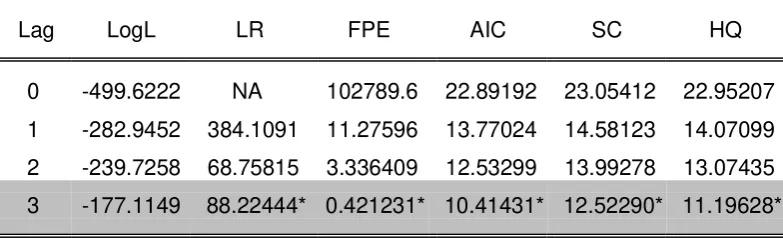
Table 2. Results of testing the optimal lag
Lag LogL LR FPE AIC SC HQ
0 -499.6222 NA 102789.6 22.89192 23.05412 22.95207
1 -282.9452 384.1091 11.27596 13.77024 14.58123 14.07099
2 -239.7258 68.75815 3.336409 12.53299 13.99278 13.07435
3 -177.1149 88.22444* 0.421231* 10.41431* 12.52290* 11.19628*
The test results concluded that the optimal lag length of test results lag based on the criteria sequential modified LR test statistic (LR) shows the optimal lag length is 3.
Election results above optimal lag is expressed with a lag of three (3) based on the value of LR and FPE which coincides with the referenced value AIC. And the lag 2 is recommended with more stars than lag 1 and lag 2
3. Test Cointegration
Table 3. Cointegration Test Results
Hypothesized Trace 0.05
No. of CE(s) Eigenvalue Statistic Critical Value Prob.**
None * 0.839729 108.7496 47.85613 0.0000
At most 1 * 0.273440 30.02129 29.79707 0.0471
At most 2 * 0.234507 16.28563 15.49471 0.0379
At most 3 * 0.105508 4.794486 3.841466 0.0285
AGRICULTURE, INDUSTRY AND TRADE relationship stability / balance and equality movement in the long term.
SBIS :
D(SBIS) = C(1)*D(SBIS(-1)) + C(2)*D(SBIS(-2)) + C(3)*D(SBIS(-3)) + C(4)*D(PT(-1)) + C(5)*D(PT(-2)) + C(6)*D(PT(-3)) + C(7)*D(PR(-1)) + C(8)*D(PR(-2)) + C(9)*D(PR(-3)) + C(10)*D(PD(-1)) + C(11)*D(PD(-2)) + C(12)*D(PD(-3)) + C(13)
Observations: 44
R-squared 0.965948 Mean dependent var -1.224520 Adjusted R-squared 0.952766 S.D. dependent var 42.43102 S.E. of regression 9.221676 Sum squared resid 2636.219 Durbin-Watson stat
PT (AGRICUKTURE) :
D(PT) = C(14)*D(SBIS(-1)) + C(15)*D(SBIS(-2)) + C(16)*D(SBIS(-3)) + C(17)*D(PT(-1)) + C(18)*D(PT(-2)) + C(19)*D(PT(-3)) + C(20)*D(PR(-1)) + C(21)*D(PR(-2)) + C(22)*D(PR(-3)) + C(23)*D(PD(-1)) + C(24)*D(PD(-2)) + C(25)*D(PD(-3)) + C(26)
Observations: 44
R-squared 0.488113 Mean dependent var 3.169564 Adjusted R-squared 0.289963 S.D. dependent var 2.215794 S.E. of regression 1.867110 Sum squared resid 108.0691 Durbin-Watson stat
PR (INDUSTRY) :
D(PR) = C(27)*D(SBIS(-1)) + C(28)*D(SBIS(-2)) + C(29)*D(SBIS(-3)) + C(30)*D(PT(-1)) + C(31)*D(PT(-2)) + C(32)*D(PT(-3)) + C(33)*D(PR(-1)) + C(34)*D(PR(-2)) + C(35)*D(PR(-3)) + C(36)*D(PD(-1)) + C(37)*D(PD(-2)) + C(38)*D(PD(-3)) + C(39)
Observations: 44
PD (TRADING) :
D(PD) = C(40)*D(SBIS(-1)) + C(41)*D(SBIS(-2)) + C(42)*D(SBIS(-3)) + C(43)*D(PT(-1)) + C(44)*D(PT(-2)) + C(45)*D(PT(-3)) + C(46)*D(PR(-1)) + C(47)*D(PR(-2)) + C(48)*D(PR(-3)) + C(49)*D(PD(-1)) + C(50)*D(PD(-2)) + C(51)*D(PD(-3)) + C(52)
Observations: 44
R-squared 0.978059 Mean dependent var 15.20420 Adjusted R-squared 0.969565 S.D. dependent var 8.061417 S.E. of regression 1.406357 Sum squared resid 61.31301 Durbin-Watson stat
4. Granger Causality Test
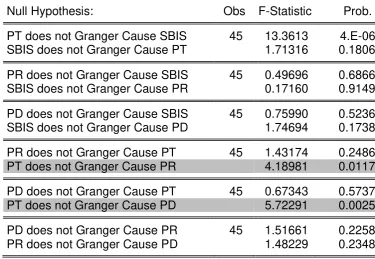
Table 4. Granger Causality Test Results
Pairwise Granger Causality Tests Date: 01/05/16 Time: 21:05 Sample: 2011M01 2014M12 Lags: 3
Null Hypothesis: Obs F-Statistic Prob.
PT does not Granger Cause SBIS 45 13.3613 4.E-06 SBIS does not Granger Cause PT 1.71316 0.1806
PR does not Granger Cause SBIS 45 0.49696 0.6866 SBIS does not Granger Cause PR 0.17160 0.9149
PD does not Granger Cause SBIS 45 0.75990 0.5236 SBIS does not Granger Cause PD 1.74694 0.1738
PR does not Granger Cause PT 45 1.43174 0.2486 PT does not Granger Cause PR 4.18981 0.0117
PD does not Granger Cause PT 45 0.67343 0.5737 PT does not Granger Cause PD 5.72291 0.0025
PD does not Granger Cause PR 45 1.51661 0.2258 PR does not Granger Cause PD 1.48229 0.2348
b) Variable PT significantly affect PD variables (Trade Financing) with prob. 0.0025, while the PD variables were not statistically significantly affect the variable PT (0.5737).
c) Variable PT was not statistically significant variable affecting SBIS (4.E-06), and vice versa SBIS variables did not significantly affect the variable PT (0.1806).
d) Variable PR was not statistically significant variable affecting SBIS (0.6866), and vice versa SBIS variables did not significantly affect the variable PR (0.9149).
e) PD variables were not statistically significantly affect SBIS variable (0.5236), and vice versa SBIS variables did not significantly affect the variable PD (0.1738).
f) PD variables were not statistically significantly affect the variable PR (0.2258), and vice versa PR variables did not significantly affect the variable PD (0.2348).
5. Regression Test VAR Model
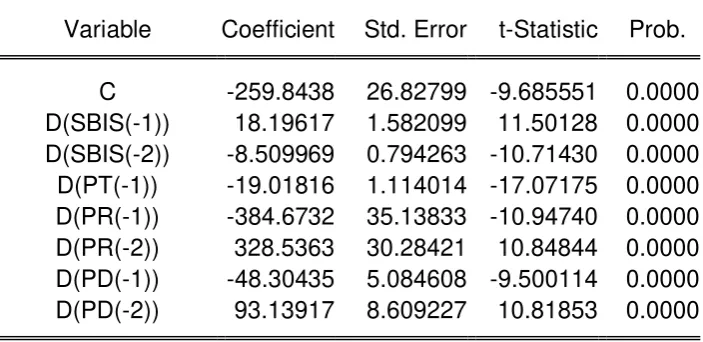
Table 5. Results of Regression
Dependent Variable: D(SBIS) Method: Least Squares Date: 01/05/16 Time: 21:09
Sample (adjusted): 2011M04 2014M12 Included observations: 45 after adjustments
Variable Coefficient Std. Error t-Statistic Prob.
Result :
D(SBIS) = -259.8438 + 18.19617*D(SBIS(-1))
-8.509969*D(SBIS(-2))-19.01816*D(PT(-1))-384.6732*D(PR(-1)) +
328.5363*D(PR(-2))-48.30435*D(PD(-1)) + 93.13917*D(PD(-2))
E. CONCLUSION
Based on this study, it can be concluded that the analysis of data using Vector Auto Regression models R-squared results showed that 96 percent of SBIS variables affect the economic sector financing while 4 percent are affected by variables outside the model.
Kebijakanmoneter transmission mechanism sharia represented by Bank Indonesia Certificates Sharia (SBIS), on grenger causality test does not significantly affect the financing of the economic sector in both the agricultural finance, financing of industry and trade financing. While agricultural finance variable significant effect on the variable of industry and trade financing. This means that agriculture has an important role in the development of other economic sectors.
F. Suggestion
REFERENCES
Agus Tri Basuki & Nano Prawoto, 2016, Analisis Regresi dalam Penelitian Ekonomi dan Bisnis, Penerbit RajaGrafido, Jakarta.
Ascarya. 2010a.Alur Transmisi dan Efektifitas Kebijakan Moneter Ganda di Indonesia. PPSKWorking Paper Series No: WP/10/03. Bank Indonesia
Al-Hashfi, Risqi Umar.Analisis Transmisi Kebijakan Moneter Syariah Terhadap Pembiayaan Bagi-Hasil Perbankan Syariah di Indonesia Tahun 2007-2012 (Fakultas Syari`ah Universitas Islam Negeri Sunan Kalijaga Yogyakarta, 2014)
Basuki, Agus Tri-Yuliadi, Imamudin.2014.Ekonometrika-Teori dan aplikasi.Yogyakarta:Mitra Pustaka Nurani
Gujarati, Damodar N. 2003. Basic Econometrics. 4th Edition. McGraw-Hill, New York, USA.
Gujarati, Damodar, 1995. Ekonometrika Dasar. Penerbit Erlangga, Jakarta
Kurnia, Ningsih.Pembiayaan Bank Syariah Dalam Mekanisme Transmisi Kebijakan Moneter di Indonesia, Jurnal Ilmiah (Fakultas Ekonomi dan Bisnis Universitas Brawijaya Malang, 2013)
Masyitha, Mutiara Ramadhan.Analisis Pengaruh Instrumen Moneter Syariah dan Konvensional Terhadap Penyaluran Dana ke Sektor Usaha Kecil Mikro dan Menengah (UMKM) di Indonesi, skripsi
(Fakultas Ekonomi dan Manajemen Institut Pertanian Bogor, 2012)
Sadono Sukirno, 1994. Pengantar Teori Ekonomi Makro. Penerbit RajaGrafindo, Jakarta
Sukirno, 2007. Ekonomi Pembangunan: Proses, Masalah, dan Dasar Kebijakan. Penerbit Kencana Prenada Media Group; Jakarta.
ATTACHMENT
YEAR SBIS AGRICULTURAL FINANCING
TRADING FINANCING
INDUSTRY FINANCING