ISSN 1818-4952
© IDOSI Publications, 2013
DOI: 10.5829/idosi.wasj.2013.22.12.378
Corresponding Author: Hassan Masoumi, Department of Sporting Management, Faculty of Physical Education and Sports Sciences, Central Tehran Branch, Islamic Azad University, Tehran, Iran
Presentation of an Entropy Decision Making Pattern to
Develop a Comprehensive External Evaluation Model of
Sporting Federations’ Performance Using Fuzzy Approach
Hassan Masoumi, Farideh Ashrafe Ghanjouei, Khodabakhshe Dashgarzade and Shahram Javadi
1 1 2 2
Department of Sporting Management, Faculty of Physical Education and Sports Sciences, 1
Central Tehran Branch, Islamic Azad University, Tehran, Iran Central Tehran Branch, Islamic Azad University, Tehran, Iran 2
Abstract: The aim of the present research is to develop a comprehensive external evaluation model of sport federations’ performance in Iran using Fuzzy-Entropy decision making pattern in the year 2012. Nowadays, the role of evaluation systems and effective monitoring of organizations is completely known. Studies show that the evaluation system of sport federations’ performance does not enjoy a comprehensive and up to date model. This research is descriptive and follows a survey method. The population includes the Youth and Sport Ministry and sport federations which are 234 people. The measurement tool is a researcher-made questionnaire. The validity of the questionnaire (face and content) was confirmed by expert review and the reliability was approved by applying Cronbach (p < % 5). To develop the model, first, the dimensions were determined based on Scott’s view and current evaluation models, particularly logic model, next, the components were given weights and were prioritized using mathematical method of fuzzy – entropy while taking care of performance evaluation variables (ambiguousness and uncertainty), at the end the final performance evaluation model for sport federations was designed. Based on the research findings, in participants’ views the dimensions and components of the model were: in the case of context [current situation, organizational priorities], input: [human resources (having the heaviest weight), financial resources], process [championship and professional sport, (having the heaviest weight), managerial duties, educational activities, relationships and sharing, talent identification, public sport, commercialization, sport training, information and communication technology, research, medicine sport, sport law, welfare facilities, cultural-sport activities (having the heaviest weight)], output and the outcome and impacts. The model can help sport ministry’s managers and evaluators to externally evaluate the quality of sport federations’ performance applying a systematic and comprehensive attitude.
Key words: External evaluation Performance evaluation Sport federation Fuzzy-Entropy
INTRODUCTION Today, federations on one hand, face with increasing
In most countries in order to manage every type of and downfall financial supports and on the other hand, a sport, an organization called sport federation was there is a necessity for this system to be responsible to established and a written charter compatible with the society. In this case making an appropriate and useful International Federations charter was codified for it. system is one of the acceptable alternatives to evaluate Sport Federations which are the main branches of performance which is compatible with the properties, physical education in the country gained a special conditions and the specific background for understanding position to realize multi-dimensional development providing and promoting the situation.
programs of the country based on its goals, missions and Performance evaluation is a process to measure value
functions. and judge about performance during a certain period of
time [1]. In other words, performance evaluation measures and programs realization model (goal-based model) 2. the performance comparing present situation with A model based on management approach 3. Project desirable situations based on predetermined indicators [2] evaluation model 4. Free objective model 5. A model External evaluation is also performed by foreign experts based on performance [4]. Among the current models in after performing internal evaluation to ensure accuracy organization performance evaluation, Logic model and use the comments of professional experts outside of generally emphasizes on evaluation of content (situation the institute. External evaluation is a complement for and priorities), input, output (activities and participants) internal evaluation and it is used for final purposes and impacts (short term, medium term, long term) in an studies, financial issues and a response to credit organization and its programs [7]. CIPP model provides allocation. The purpose of external evaluation at the data for four kinds of decision-making, using system organizational level is to ensure quality, accountability metaphor and four parameters (content, input, process and absorbing the trust of beneficiaries of the and product) [3]. The most important models of organization [3]. One of the most important functions of performance enhancement which are based on self-evaluating the organizations is to lead them correctly evaluation consist of: Deming prize model which is aimed towards major national goals and development of the at creating motivation for innovation in design and using country. Performance evaluation system is unique and statistical methods to control the quality in producing specific in every organization and should be designed in companies. Malcolm Baldrige model aimed at presenting accordance the with organization conditions. But, it is basic criteria for organization self-evaluation and complicated to design a performance evaluation model upgrading their performance. Criteria of this model which can accurately reflect the different levels of include seven areas “leadership, strategic planning, organization performance and its success depends on customer - centeredness, information, human resources being aligned with the performance indicators and development, managing processes and official results”. organization strategies [4]. Continuous improvement of European Fundamental Quality Management (EFQM) or organization performance will create a synergetic force European model of Interactive performance tries to which can support development application and create generalize the organizations’ attention to the issue of opportunities for organization sublimation. In this case, quality of organization operations and promoting their government organizations and institutes make more knowledge. this model is the basis for the National progressive attempts. Continuous performance can’t be Productivity Award, has nine criteria. Five of them are without checking and understanding the rate of progress, Enablers (leadership, policy and strategy, staff, achieving goals, identifying the challenges facing the associations and resources and process) and four of them organization, getting feedback, noticing that how written are results (customer result, individuals, organization and policies perform and understanding the cases which need community). Another model is Balance Score Card (BSC) more improvement. All of the above are not available in which organization is evaluated from four aspects that without measuring and evaluating [2]. Lord Kelvin, an are financial, customer, process, learning and growth [2]. English physicist, said about the necessity of Each one of the designed performance evaluation models measurement: “Every time, we could measure the thing we consists of special evaluation dimensions, components, are talking about and express it in numbers; we can claim criteria and indicators and is edited, reexamined and to know about it, otherwise our knowledge is incomplete updated according to changing conditions and needs and will never reach the maturity” [5]. Management every now and then.
performance and he considered “projects, human organizations. Then, the dimensions, components and resources, training, publications, equipment and finance indicators would be weighed and prioritized using the as evaluation performance indicators [4]. Heidarinejad entropy-fuzzy decision making method and finally a (2005) conducted a research as “performance evaluation comprehensive model of sport federations’ performance indicators of colleges, physical education and sport evaluation would be designed. For achieving these goals, sciences departments” and considered these indicators in the following questions are proposed:
three parts which are training, research and professional
services [9]. Madella and Bayle (2005) designed a model What are the components and indicators of external which is focused on missions and systematic goals to evaluation of sport federations' performance? evaluate organizational performance of athletic institutes. How much is the weight and the rank of every In this model evaluation dimensions include sport dimension and indicator of external evaluation of dimension (professional sport, public sport), customers federations’ performance?
dimension (sport values and services to society, How is the general external evaluation model of sport attracting members), communication and public image federations' performance quality?
dimension, finance dimension (financial resources
management, financial sustenance) and organization MATERIALS AND METHODS
dimension (skills of the staff, internal functioning) [10].
Vinandet al. (2009) evaluated organizational performance In the case of collecting data this study is a of the Olympics sport boards and designed a model to descriptive-survey. The population consists of assistants, evaluate organizational performance considering office managers, heads of sport ministry centers, strategic goals which were investigated in five areas chairmen, deputy chairmen of sport federation committees (sport, customers, communication, public image, financial which were able to express their opinions about the issue and organizational issues) through quantitative because they were in constant contact and relationship performance indicators [11]. Anders Kotsous et al. (2003) with those issues. According to the characteristics of the evaluated Greek sport federations based on Balance Score population, census method was used for collecting data Card (BSC) model [11]. Madellaet al. (2005) evaluated from sport ministry and sport federations. The population organizational performance of national swimming contained 234 participants.
federations in countries around the Mediterranean Sea
satisfaction were obtained according to the ranking which Number, it will be given as follows: they gave to the items to ensure the validity of the
questionnaire. The Cronbach's coefficient was used to estimate the reliability. The value of alpha was calculated by SPSS software and turned out to be 95%. So its reliability was confirmed.
Fuzzy Logic and Entropy: In the present study, due to the nature of many performance evaluation parameters such as ambiguity, uncertainty, inaccuracy in determining the weight, significance rate and ranking of the dimensions, components and performance indicators mathematical fuzzy-entropy method was used. Evaluating the performance in a fuzzy environment may seem to come at a realistic outcome [14]. The main advantage of this methodology, fuzzy reasoning method is its simple reasoning, rapid calculation, applying different weights of indicators, inclusion of quantitative and qualitative indicators and a high accuracy [15]. Given the above, the entropy method and fuzzy logic are introduced and their implementation processes for weighting dimensions, components and indicators of federations’ performance evaluation model are given.
Fuzzy Logic: Fuzzy logic is a simple way to reach a definitive conclusion based on incomplete, erroneous and ambiguous input data. The dictionary meaning of the term fuzzy is imprecise, vague and uncertain and the second meaning refers to reasoning with fuzzy sets. Fuzzy Sets Theory is a theory of action under uncertainty.
Fuzzy Data: In the present study, using a fuzzy logic, qualitative data from the questionnaires was converted into quantitative data. Fuzzfication of the data was carried out in four steps:
Step One: According to Table 1 for fuzzfication of the data, the qualitative data of the questionnaire was converted into fuzzy trigonometric number. To accomplish this, the table of the linguistic variables in a range of 5 indexes "nearly unimportant, less important, moderately important, important, very important, "was designed in a range of 0 to 100 and presented to the experts. Respondents were asked to put each of the five linguistic variables in a range. After collecting the comments, fuzzy trigonometric numbers were calculated for each.
Every fuzzy trigonometric numbers consists of three parts, namely minimum (Min), mean (Average) and maximum (Max) with 0 for the first and third level of membership grade and 1 for the second level of the membership grade. If A is a fuzzy trigonometric.
A = (L, M, U)
A = (min, average, max)
Based on what was stated, according to Table 2 trigonometric fuzzy numbers for each Linguistic variable is as follows:
Step Two: At this stage according to the trigonometric fuzzy numbers (TFN) from the previous stage, the membership function for all the qualitative data of the questionnaire was calculated using the following formula. (1) µ(x)= (x , x , x , x , x )1 2 3 4 5 (2)
Step Three: At this stage, the numbers from the previous step were defuzzicated using the gravity center method which is one of the most common ones. If fuzzy number A is equal to (L, M, U) the a surface center relationship is shown as follows:
A surface center relationship=[(U-L)+(M-L)]/3+L (2) Trigonometric fuzzy numbers membership functions for linguistic variables questionnaire is shown in Figure 1. According to the above formula, the surface center relationship values of fuzzy numbers related to linguistic variables are as follows:
Step Four: At this stage, each of the obtained
membership function options was multiplied by its respective A surface center relationship value and finally all membership function options were added up. Then, all dimensions, components and indicators were weighed according to the entropy method.
1
,
ij
ij m
ij i
r
P i j
r
=
=∀
∑
1
( ( )
m
j ij ij
j
E k P Ln P
=
= −
∑
1 ( )
k m
Ln =
Table 1: Range of linguistic variables
Experts Nearly unimportant Less Important Moderate important Important Very important
Expert 1 0-20 20-40 40-60 60-80 80-100
Expert 2 0-30 30-50 50-60 60-80 80-100
.… …... …. …. …. ….
Expert 3 0-25 25-45 45-70 75-85 85-100
Table 2: Trigonometric fuzzy numbers (TFN) of the linguistic variable
Nearly unimportant Less Important Moderate Important Important Very important
0-9-26 11-29-47 35-50-68 53-73-91 75-92-100
Table 3: A surface center relationship value of the linguistic variable
Experts Nearly Unimportant Less important Moderately important Important Very Important
A surface center relationship 11.74 28.91 50.97 72.22 89.08
Fig. 1: Trigonometric fuzzy numbers (TFN) membership function for linguistic variables
share of every dimension or element. In order to make a respondents, n = number of properties and indicators rational and comprehensive decision to recognize the under study, r = grades of the indicators (index), D M = weight and share of every dimension or component, it is decision making matrix to draw the weight of every necessary to use a scientific method. One of the available index, The symbols used in the first matrix means as methods in decision making is the Entropy method. follows: X = content X = input X = process X = output Therefore, after defuzzification of the qualitative data of X = outcome-impact.
the questionnaire using the fuzzy logic, entropy method
was used to check the weight and to prioritize the Step 2: The data originating from DM matrix was dimensions, components and performance evaluation obtained from different scales of measurement. indicators. In the present research the Entropy method Therefore, the data needed to be normalized for has been used in the following way: comparison. The normalization process was fulfilled by
Step 1: The matrix of decision making elements and indicators was drawn and then the experts weighed the indicators and the elements. The collection of the primary response is called DM [18]. To use the experts and
respondents’ views, a DM matrix table was designed. Step 3: At this stage the Entropy amount was calculated
Matrix 1: The above symbols in the matrix represent: Step 4: Uncertainty or degree of deviation (d ) of the A = every respondent, X = the dimensions, componentsi j
and performance evaluation indicators, m=number of d = 1 – E d =the method of weighing elements. ij
1 2 3 4
5
using the following formula [17].
as follows [18].
j produced information was drawn for index.
In pu t
For finding the answer to this question, the major
Step 6: The researcher could give a grade to each of the research literature and by investigating the performance indexes based on his own field of study and experience. evaluation models and consulting the experts in the field Hitherto, after obtaining the primary weights, the final (Figure 2).
calculation of weights would be fulfilled at the end of the The components of this study were obtained from fifth stage where the researcher inserts his idea by value the Islamic Republic of Iran’s Sport federations’ ratio21. The action is performed using the following statute.
relationship. The result obtained through the entropy
method indicates the weights of each of the indexes. Second Question: What are the weight and the priority of These weights in fact show the significance of each of the each dimension and indicator of external evaluation of indexes from the viewpoint of the experts which are used federation performance?
in the last analysis. In order to answer this essential question, two
dimensions using Entropy-Fuzzy method are separately
Now, according to the step of the aforementioned output dimension has the heaviest Entropy weight steps, the calculated entropy values for the dimensions, (0.2816) and the first priority and outcomes and impacts components and performance evaluation indicators would dimension has the least weight (0.1571) and the fifth rank. be presented in the results of the study. Among minor dimensions of context, organization priority
RESULTS and the least weight and priority respectively. Among the
The data collected from the questionnaire was (0.3831) and long term outcomes and impacts (0.2784) analyzed by using descriptive statistics and entropy-fuzzy show the most and the least weight and priority decision making method to answer the research respectively. Table 5 shows the results of giving weight
questions. to input components.
indicators of external evaluation of sport federations’ performance?.
and minor dimensions for the evaluation of sport federation performance was determined according to the
methods were used; entropy and fuzzy logic. The result of giving weight and priority to the major and minor shown in Table 4.
According to the results presented in table 4, the
(0.67705) and present situation (0.3395) show the most minor dimensions short-term outcomes and impacts
Fig. 2: Dimensions of federation evaluation
Table 4: Weight and priority of the major and minor dimensions
Mat erial resource Financial
resources
Sport Law
Relationships & sharing
Welfare facilities
T alent identification
Commercial Research
Educational Sport for
all Championship&
professional sport Managerial
dut ies
Human resources
ICT Medicine
sport
Cultural -sport
Components of performance evaluation
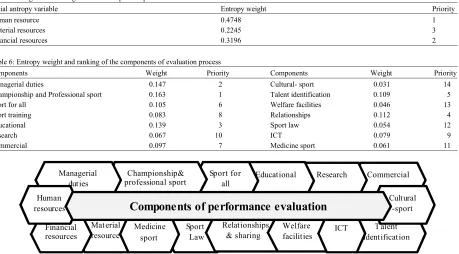
Table 5: Weight and ranking of the main input components
Initial antropy variable Entropy weight Priority
Human resource 0.4748 1
Material resources 0.2245 3
Financial resources 0.3196 2
Table 6: Entropy weight and ranking of the components of evaluation process
Components Weight Priority Components Weight Priority
Managerial duties 0.147 2 Cultural- sport 0.031 14
Championship and Professional sport 0.163 1 Talent identification 0.109 5
Sport for all 0.105 6 Welfare facilities 0.046 13
Sport training 0.083 8 Relationships 0.112 4
Educational 0.139 3 Sport law 0.054 12
Research 0.067 10 ICT 0.079 9
Commercial 0.097 7 Medicine sport 0.061 11
Fig. 3: The components of sport federations’ performance evaluation
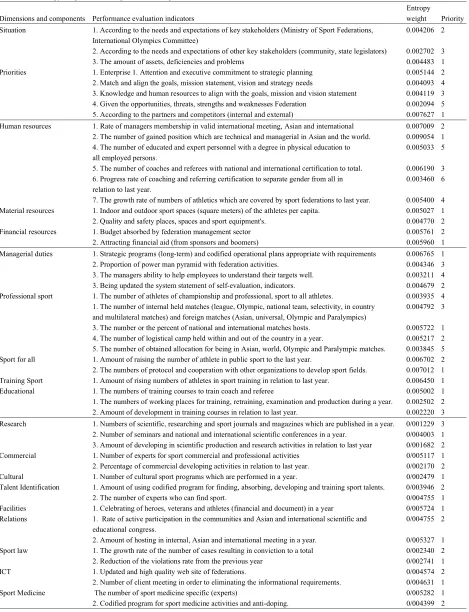
As observed in Table 5, on the participants’ weight (0.147) and take the first place in the ranking opinion in this study the components of human resources and the cultural component with the least weight (6 indicators), financial resources (2 indicators) and stands in the fourteenth place in the ranking. material resources (2 indicators) show the first to third The result of giving weight and priority to sport priority for performance evaluation model respectively. federation performance evaluation components is shown
Among input dimensions, human resources in Table 7. component (0.4748) shows the most weight and priority
and material resources (0.2245) shows the least weight Question Three: What Is the Comprehensive
and priority for external evaluation of sport federations’ External Evaluation Model of Sport Federations’
performance. The result of giving weight and priority to Performance Quality?: In order to design the sport federation process components is shown in research model, first, according to scott's systematic
Table 6. viewpoints and logic evaluation model, its major and
According to the result of table 6 and based on the minor dimensions were organized. Next, the placement, participants’ opinion, among process components, weight and priority of components were determined. championship and professional sport (5 indicators) Then, the final model of sport federation performance management duties (4 indicators) educational activities external evaluation was designed and offered with a (3 indicators), relationship and partnership (2 indicators) systematic and holistic attitude, as is presented in talent identification (2 indicators) public sport (2 Figure 4.
indicators) commercialization (2 indicators), sport training Philosophy and goals of the model The present (2 indicator) information and communication technology study, attempted to help the sport federations and (2 indicators) research activities (2 indicator) sport managers to achieve the following goals:
medicine (2 indicators) sport law (2 indicators) facilities
(1 indicator) cultural activities (1 indicator) occupy the Determining the weak and strong points of sport first to the fourteenth places in ranking. federations.
Table 7: The entropy weights results of sport federations performance evaluation indicators
Entropy
Dimensions and components Performance evaluation indicators weight Priority
Situation 1. According to the needs and expectations of key stakeholders (Ministry of Sport Federations, 0.004206 2 International Olympics Committee)
2. According to the needs and expectations of other key stakeholders (community, state legislators) 0.002702 3 3. The amount of assets, deficiencies and problems 0.004483 1 Priorities 1. Enterprise 1. Attention and executive commitment to strategic planning 0.005144 2 2. Match and align the goals, mission statement, vision and strategy needs 0.004093 4 3. Knowledge and human resources to align with the goals, mission and vision statement 0.004119 3 4. Given the opportunities, threats, strengths and weaknesses Federation 0.002094 5 5. According to the partners and competitors (internal and external) 0.007627 1
Human resources 1. Rate of managers membership in valid international meeting, Asian and international 0.007009 2 2. The number of gained position which are technical and managerial in Asian and the world. 0.009054 1 4. The number of educated and expert personnel with a degree in physical education to 0.005033 5 all employed persons.
5. The number of coaches and referees with national and international certification to total. 0.006190 3 6. Progress rate of coaching and referring certification to separate gender from all in 0.003460 6 relation to last year.
7. The growth rate of numbers of athletics which are covered by sport federations to last year. 0.005400 4 Material resources 1. Indoor and outdoor sport spaces (square meters) of the athletes per capita. 0.005027 1 2. Quality and safety places, spaces and sport equipment's. 0.004770 2 Financial resources 1. Budget absorbed by federation management sector 0.005761 2 2. Attracting financial aid (from sponsors and boomers) 0.005960 1
Managerial duties 1. Strategic programs (long-term) and codified operational plans appropriate with requirements 0.006765 1 2. Proportion of power man pyramid with federation activities. 0.004346 3 3. The managers ability to help employees to understand their targets well. 0.003211 4 3. Being updated the system statement of self-evaluation, indicators. 0.004679 2 Professional sport 1. The number of athletes of championship and professional, sport to all athletes. 0.003935 4 1. The number of internal held matches (league, Olympic, national team, selectivity, in country 0.004792 3 and multilateral matches) and foreign matches (Asian, universal, Olympic and Paralympics)
3. The number or the percent of national and international matches hosts. 0.005722 1 4. The number of logistical camp held within and out of the country in a year. 0.005217 2 5. The number of obtained allocation for being in Asian, world, Olympic and Paralympic matches. 0.003845 5 Sport for all 1. Amount of raising the number of athlete in public sport to the last year. 0.006702 2 2. The numbers of protocol and cooperation with other organizations to develop sport fields. 0.007012 1 Training Sport 1. Amount of rising numbers of athletes in sport training in relation to last year. 0.006450 1 Educational 1. The numbers of training courses to train coach and referee 0.005002 1 1. The numbers of working places for training, retraining, examination and production during a year. 0.002502 2 2. Amount of development in training courses in relation to last year. 0.002220 3
Research 1. Numbers of scientific, researching and sport journals and magazines which are published in a year. 0/001229 3 2. Number of seminars and national and international scientific conferences in a year. 0/004003 1 3. Amount of developing in scientific production and research activities in relation to last year 0/001682 2 Commercial 1. Number of experts for sport commercial and professional activities 0/005117 1 2. Percentage of commercial developing activities in relation to last year. 0/002170 2 Cultural 1. Number of cultural sport programs which are performed in a year. 0/002479 1 Talent Identification 1. Amount of using codified program for finding, absorbing, developing and training sport talents. 0/003946 2
2. The number of experts who can find sport. 0/004755 1
Facilities 1. Celebrating of heroes, veterans and athletes (financial and document) in a year 0/005724 1 Relations 1. Rate of active participation in the communities and Asian and international scientific and 0/004755 2
educational congress.
2. Amount of hosting in internal, Asian and international meeting in a year. 0/005327 1 Sport law 1. The growth rate of the number of cases resulting in conviction to a total 0/002340 2 2. Reduction of the violations rate from the previous year 0/002741 1
ICT 1. Updated and high quality web site of federations. 0/004574 2
Context Short term medium term long term
Output process
Assessment process: 1 - Focus 2 - Data Collection 3 - Analysis and Interpretation 4 – Giving reports Table 7: Continue
Entropy
Dimensions and components Performance evaluation indicators weight Priority
Federation performance 1. Amount of satisfaction of management duties quality and federation performance results. 0/002464 10 results 2. Number of covered athletes in relation to last year. 0/004107 7
3. The number of models and places which are gained in Asia, World and Olympic in 0/004555 4 relation to last year.
4. Amount of promotion in the Asia, world and Olympic rankings in relation to last year. 0/005383 2 5. The number of training certification (Coaching, referring and managing) in a year. 0/004218 6 6. The number of sport research projects, essay, books and journals to the last year. 0/002060 12 7. Amount of increasing federation revenue to the last year. 0/006103 1 8. Reviving and expanding generosity features and heroic dimensions among athletes 0/004334 5 8. Amount of federation success in discovering, absorbing, developing and training the sport talents 0/002334 11 9. Amount of promoting services and social facilities to using knowledge, experience and 0/003948 8 abilities of international assemblies and groups
10. Amount of legal knowledge, prevention and reduction of delinquency and 0/004970 3 solving disagreement in a year.
11. Amount of information given to clients and elimination of information requirements in a year. 0/002625 9 12. Amount of success in increasing knowledge of medicine, prevention and remedial of sport injuries. 00/001801 13
Short term 1. Amount of impartment in (systematic and strategic) attitude toward sport branches. 0.006811 1
results of human 2. Amount of sport knowledge 0.004234 6
3. Amount of improvement in skills (technical human conceptual) 0.004893 4 4. Amount of innovation and invention in federation 0.005993 2 5. Amount of motivation of man power to more activities 0.004708 5 6. Amount of morality and team work between federation human resources. 0.004896 3
Medium term 1. Amount of improvement of management and leadership quality 0.005221 6 corporate results: 2. Amount of Quad sport development (championship, professional, public and training) 0.006159 3 3. Amount of maintaining and promoting of national team position in Asia, world and 0.004663 5 Olympics matches.
4. Amount of development of league and championship and professional clubs. 0.006400 2
5.Amount of national proud and honor 0.005637 4
6. Amount of increasing international validity. 0.006848 1 Long term the results: 1. Amount of success in eliminating needs and expectations and gaining the satisfaction of 0.008928 1
key beneficiaries.
2. Amount of success on eliminating needs and expectations and getting the satisfaction of 0.001028 4 non-key beneficiaries.
3. Amount of effecting federations on health, fitness and happiness developing of community. 0.005694 3 3. Amount of effecting federations on social, economic, cultural and political development in country. 0.007930 2
Presenting a clear and real image of the federation’s et al.[22], Bahrahi et al. [23], Seid Mehrabad and Ehsani real position compared with itself and other [24] Sorayee et al.[25], Koozechian [26], Heidari Nezhad federations. et al. [27], Olia et al. [28] anders Cotsouset al. [29], Madla Stimulating a constructive competition between and Bail [30], Vinand et al. [31].
federations to improve their performance The innovation of this research is using mathematical Using the results of evaluation performance to entropy-fuzzy method to give weight, prioritize and rank improve the quality of management performance. the components, dimensions and indicators of Helping to control the sport federations. performance evaluation. It seems that performance Promoting the responsibility and transparency of evaluation has an ambiguous and uncertain nature. So, federations’ performance toward the society. evaluating it in a fuzzy environment can have more Encouraging successful federations and cautioning realistic results. Some of the advantages of this model are: the federations which have weak and unacceptable It has a systematic and holistic attitude toward
performance. performance evaluation 2. It is comprehensive. It
DISCUSSION AND CONCLUSION performance areas 3. It pays attention to needs evaluation
It seems necessary to develop an efficient It pays attention to strategic program evaluation performance evaluation system which is appropriate with (goals, mission, vision and strategies) of every federation. special conditions of every federation. Also, it is 5. It pays attention to the evaluation of performance necessary to become aware of the current situation and outcomes and impacts on short, medium and long term improve the performance. Among the weaknesses of the periods. 6. It is aligned with the development programs of current sport federations’ performance evaluation system the country (social, commercial, cultural and political are lack of a systematic and comprehensive model, lack of development). The results of this research can be systematic approach, incompatibility of evaluation system available to managers and decision makers of sport and federations’ goals and strategies and inefficiency of ministry and sport federations so that they can evaluate performance evaluation indicators. different sections of sport federations by using a In this study, dimensions, components and indicators comprehensive, strategic and systematic attitude and of evaluation were identified, weighed and prioritized employing new and up-to-date indicators and using entropy-fuzzy method and based on them, sport components. Also, they can use it to promote and federations’ performance evaluation model was designed improve the quality of performance management system.
and presented. It is suggested that sport ministry use the model of this
The research findings show that as far as the research for performance evaluation and ranking the sport participants’ opinions are concerned, for evaluating the federations of the country. It seems that managers and performance of sport federations according to weight and decision makers of Sport Ministry should pay more priority, in the context dimension, needs and expectations attention to the components of strategic plan, human are important. In the input dimension, financial and resources development, championship and professional material resources and in the process dimension, sport development, educational activities improvement, components of championship and professional sport, relationships and sharing development and talent managerial duties, training activities, relationships and identification in order to evaluate and enhance sharing, talent identification, sport for all, performance. The model can help sport ministry’s commercialization, educational sport, information and managers and evaluators to externally evaluate the quality communication technology, research, medicine sport, of sport federations’ performance applying a systematic welfare facilities and cultural-sport activities are important. and comprehensive attitude.
Also, the participants chose strategic programs, human
resources, championship and professional sport from REFERENCES
among sport federations, performance evaluation as
having more weight and priority. The results of this 1. Taheri, Shahnam, 2003. Productivity and Its Analysis research are congruent with the results of Mohamadi in Organizations, Tehran: Havay-e-tazah et al. [19], Saeedi Mehrabad [20], Hadavi et al. [21], Razavi Publications.
2. Seyd Javadin and Seyd Reza, 2004. Investigating the 10. Madella, Alberto, Emmanuel Bayle, 2005. The Standards of Human Power Performance Evaluation generational performance of national swimming using BSC Model. First Scientific Conference on federations in Mediterranean countries: A Standards in Education. comparative approach. European Journal of Sport 3. Rahimi, Ghafour, 2007. Performance Evaluation and Science, 5: 207-220.
Sustained organizational improvement, Tadbir 11. Winand, M. and T. Zintz, 2009. Organizational Monthly, Year 17. pp: 173. performance of Olympic sport governing bodies. 4. Saeedi Mehrabad, Mohammad and Ehsani Rahim, Dealing with measurement and priorities.
2005. Designing an Integrated Model of Performance 12. Kotsovos, A. and A. Kriemadis, 2000. Assessing Evaluation for Research Centers. Elm-o-Sanat balanced scorecard in Greek sport federations.
University. 13. Shibury, D. and K. Moore, 2006. A Study of
5. Rahimi, G., 2007. Performance Evaluation and Organizational Effectiveness for National Olympic Sustained organizational improvement, Tadbir Sporting Organizations. Nonprofit and voluntary monthly, year 17. Vol. 173. Sector quarterly, 35: 5-38.
6. National Bureau of Management and Planning, 2006. 14. Monem, M., M. Khorrami and S. Heydarian, 2005. Manual for Establishing Performance Evaluation Fuzzy Method in Management Performance System in Provincial Centers. Evaluation. 4th Technical Workshop of Performance 7. Ministry of Science, Research and Technology, 2007. Evaluation.
Research Deputy, Research Evaluation and Study 15. Mousa Khani, M., et al. 2007. Presenting a Fuzzy Center. Evaluation Group Code. Methodology to Evaluate Suppliers' Performance in 8. Talebpour, M. and M. Keshtidar, 2010. Designing an Outgiving process, Management Science Journal,
Evaluation and Supervision Model for Sports and year 20, Vol. 77, Summer 2007, pp: 38-123.
Extra Curricular Physical Education in Universities. 16. Asgharpour, M.J., 1998. Multiple Criteria Decision Ministry of Sciences, Research and Technology, Making, Tehran, university of Tehran.
Physical Education Research Center, Research in 17. Macoee, A., 2008. Techniques Decision. Tehran, Physical Education, Vol. 24, 1388. Mehr . & .mah.