MANAGING AND
LEADING SOFTWARE
Chair Linda Shafer
former Director, Software Quality Institute The University of Texas at Austin
Editor-in-Chief Alan Clements
Professor University of Teesside
Board Members
David Anderson, Principal Lecturer, University of Portsmouth Mark J. Christensen, Independent Consultant James Conrad, Associate Professor, UNC Charlotte
Michael G. Hinchey, Director, Software Engineering Laboratory, NASA Goddard Space Flight Center Phillip Laplante, Associate Professor, Software Engineering, Penn State University
Richard Thayer, Professor Emeritus, California State University, Sacramento Donald F. Shafer, Chief Technology Offi cer, Athens Group, Inc.
Evan Butterfi eld, Director of Products and Services Kate Guillemette, Product Development Editor, CS Press
IEEE Computer Society Publications
The world-renowned IEEE Computer Society publishes, promotes, and distributes a wide variety of authoritative computer science and engineering texts. These books are available from most retail outlets. Visit the CS Store at http://computer.org/cspress for a list of products.
IEEE Computer Society / Wiley Partnership
The IEEE Computer Society and Wiley partnership allows the CS Press authored book program to produce a number of exciting new titles in areas of computer science, computing and networking with a special focus on software engineering. IEEE Computer Society members continue to receive a 15% discount on these titles when purchased through Wiley or at wiley.com/ieeecs
MANAGING AND
LEADING SOFTWARE
PROJECTS
RICHARD E. (DICK) FAIRLEY
Published by John Wiley & Sons, Inc., Hoboken, New Jersey. Published simultaneously in Canada.
No part of this publication may be reproduced, stored in a retrieval system, or transmitted in any form or by any means, electronic, mechanical, photocopying, recording, scanning, or otherwise, except as permitted under Section 107 or 108 of the 1976 United States Copyright Act, without either the prior written permission of the Publisher, or authorization through payment of the appropriate per-copy fee to the Copyright Clearance Center, Inc., 222 Rosewood Drive, Danvers, MA 01923, (978) 750-8400, fax (978) 750-4470, or on the web at www.copyright.com. Requests to the Publisher for permission should be addressed to the Permissions Department, John Wiley & Sons, Inc., 111 River Street, Hoboken, NJ 07030, (201) 748-6011, fax (201) 748-6008, or online at http://www.wiley.com/go/permission.
Limit of Liability/Disclaimer of Warranty: While the publisher and author have used their best efforts in preparing this book, they make no representations or warranties with respect to the accuracy or completeness of the contents of this book and specifi cally disclaim any implied warranties of merchantability or fi tness for a particular purpose. No warranty may be created or extended by sales representatives or written sales materials. The advice and strategies contained herein may not be suitable for your situation. You should consult with a professional where appropriate. Neither the publisher nor author shall be liable for any loss of profi t or any other commercial damages, including but not limited to special, incidental, consequential, or other damages.
For general information on our other products and services please contact our Customer Care Department within the United States at (800) 762-2974, outside the United States at (317) 572-3993 or fax (317) 572-4002.
Wiley also publishes its books in a variety of electronic formats. Some content that appears in print may not be available in electronic formats. For more information about Wiley products, visit our web site at www.wiley.com.
Library of Congress Cataloging-in-Publication Data is available. ISBN: 978-0-470-29455-0
v
CONTENTS
Preface xv
1 Introduction 1
1.1 Introduction to Software Project Management, 1
1.2 Objectives of This Chapter, 2
1.3 Why Managing and Leading Software Projects Is
Diffi cult, 2
1.3.1 Software Complexity, 3
1.3.2 Software Conformity, 4
1.3.3 Software Changeability, 4
1.3.4 Software Invisibility, 5
1.3.5 Team-Oriented, Intellect-Intensive Work, 6
1.4 The Nature of Project Constraints, 9
1.5 A Workfl ow Model for Managing Software Projects, 13
1.6 Organizational Structures for Software Projects, 16
1.6.1 Functional Structures, 16
1.6.2 Project Structures, 17
1.6.3 Matrix Structures, 17
1.6.4 Hybrid Structures, 18
1.7 Organizing the Project Team, 19
1.7.1 The System Engineering Team, 19
1.7.2 The Software Engineering Team, 20
1.8 Maintaining the Project Vision and the Product Vision, 21
1.9 Frameworks, Standards, and Guidelines, 22
1.10 Key Points of Chapter 1, 23 1.11 Overview of the Text, 23 References, 24
Appendix 1A: Frameworks, Standards, and Guidelines for Managing Software Projects, 28
1A.1 The CMMI-DEV-v1.2 Process Framework, 28
1A.2 ISO/IEC and IEEE/EIA Standards 12207, 34 1A.3 IEEE/EIA Standard 1058, 36
1A.4 The PMI Body of Knowledge, 37
2 Process Models for Software Development 39
2.1 Introduction to Process Models, 39
2.2 Objectives of This Chapter, 42
2.3 A Development-Process Framework, 42
2.3.1 Users, Customers, and Acquirers, 43
2.3.2 System Requirements and System Design, 46
2.3.3 Software Requirements, Architecture,
and Implementation, 47 2.3.4 Verifi cation and Validation, 50
2.4 Tailoring the System Engineering Framework for
Software-Only Projects, 52
2.5 Traditional Software Development Process Models, 54
2.5.1 Hacking, 54
2.5.2 Requirements-to-Code, 55
2.5.3 The Waterfall Development Model, 55
2.5.4 Guidelines for Planning and Controlling Traditional
Software Projects, 58
2.6 Iterative-Development Process Models, 58
2.6.1 The Incremental-Build Model, 59
2.6.2 The Evolutionary Model, 64
2.6.3 Agile Development Models, 66
2.6.4 The Scrum Model, 68
2.6.5 The Spiral Meta-Model, 69
2.6.6 Guidelines for Planning and Controlling
Iterative-Development Projects, 71
2.7 Designing an Iterative-Development Process, 72
2.8 The Role of Prototyping in Software Development, 74
2.9 Key Points of Chapter 2, 75
References, 76 Exercises, 77
Appendix 2A: Frameworks, Standards, and Guidelines for Software Development Process Models, 79
2A.1 The CMMI-DEV-v1.2Technical Solution
Process Area, 79
2A.2 Development Processes in ISO/IEC and IEEE/EIA Standards 12207, 80
2A.3 Technical Process Plans in IEEE/EIA Standard 1058, 81
CONTENTS vii
Appendix 2B: Considerations for Selecting an Iterative-Development Model, 82
3 Establishing Project Foundations 85
3.1 Introduction to Project Foundations, 85
3.2 Objectives of This Chapter, 86
3.3 Software Acquisition, 87
3.4 Requirements Engineering, 88
3.4.1 Requirements Development, 89
3.4.2 Requirements Analysis, 96
3.4.3 Technical Specifi cations, 98
3.4.4 Requirements Verifi cation, 105
3.4.5 Requirements Management, 106
3.5 Process Foundations, 109
3.5.1 Specifying the Scope of Your Project, 110
3.5.2 The Contractual Agreement, 110
3.6 Key Points of Chapter 3, 112
References, 113 Exercises, 114
Appendix 3A: Frameworks, Standards, and Guidelines for Product Foundations, 116
3A.1 The CMMI-DEV-v1.2 Process Areas for Requirements Development and
Requirements Management, 116 3A.2 Product Foundations in ISO/IEC and
IEEE/EIA Standards 12207, 117 3A.3 IEEE/EIA Standard 1058, 118 3A.4 The PMI Body of Knowledge, 118
4 Plans and Planning 119
4.1 Introduction to the Planning Process, 119
4.2 Objectives of This Chapter, 120
4.3 The Planning Process, 121
4.4 The CMMI-DEV-v1.2 Process Area for Project Planning, 125
4.4.1 Planning Agile Projects, 128
4.4.2 Balancing Agility and Discipline, 129
4.5 A Minimal Project Plan, 129
4.6 A Template for Software Project Management Plans, 130
4.6.1 Front Matter, 130
4.6.2 Project Summary, 132
4.6.3 Evolution, Defi nitions, and References, 134
4.6.4 Project Organization, 136
4.6.5 Managerial Processes, 137
4.6.6 Technical Processes, 143
4.6.7 Supporting Processes, 145
4.7 Techniques for Preparing a Project Plan, 150
4.7.1 Tailoring the Project Plan Template, 150
4.7.2 Including Predefi ned Elements, 152
4.7.3 Using Organizational Support, 152
4.7.4 Leading a Planning Team, 153
4.7.5 Incremental Planning, 153
4.8 Key Points of Chapter 4, 154
References, 154 Exercises, 155
Appendix 4A: Frameworks, Standards, and Guidelines for Project Planning, 156
4A.1 The CMMI-DEV-v1.2Project Planning
Process Area, 156
4A.2 ISO/IEC and IEEE/EIA Standards 12207, 157
4A.3 IEEE/EIA Standard 1058, 158 4A.4 The PMI Body of Knowledge, 158
Appendix 4B: Annotated Outline for Software Project Management Plans, Based on IEEE Standard 1058, 159
4B.1 Purpose, 159
4B.2 Evolution of Plans, 160
4B.3 Overview, 160
4B.4 Format of a Software Project Management Plan, 160
4B.5 Structure and Content of the Plan, 162
5 Project Planning Techniques 173
5.1 Introduction to Project Planning Techniques, 173
5.2 Objectives of This Chapter, 174
5.3 The Scope of Planning, 175
5.4 Rolling-Wave Planning, 175
5.5 Scenarios for Developing a Project Plan, 176
5.6 Developing the Architecture Decomposition View and
the Work Breakdown Structure, 177
5.7 Guidelines for Designing Work Breakdown
Structures, 182
5.8 Developing the Project Schedule, 188
5.8.1 The Critical-Path Method, 190
5.8.2 The PERT Method, 190
5.8.3 Task-Gantt Charts, 193
5.9 Developing Resource Profi les, 193
5.10 Resource-Gantt Charts, 199
5.11 Estimating Project Effort, Cost, and Schedule, 199 5.12 Key Points of Chapter 5, 201
CONTENTS ix
Appendix 5A: Frameworks, Standards, and Guidelines for Project Planning Techniques, 204
A5.1 Specifi c Practices of the CMMI-DEV-v1.2
Project Planning Process Area, 204
5A.2 ISO/IEC and IEEE/EIA Standards 12207, 205 5A.3 IEEE/EIA Standard 1058, 205
5A.4 The PMI Body of Knowledge, 206
6 Estimation Techniques 207
6.1 Introduction to Estimation Techniques, 207
6.2 Objectives of This Chapter, 208
6.3 Fundamental Principles of Estimation, 209
6.4 Designing to Project Constraints, 214
6.5 Estimating Product Size, 216
6.6 Pragmatic Estimation Techniques, 224
6.6.1 Rule of Thumb, 224
6.6.2 Analogy, 226
6.6.3 Expert Judgment, 227
6.6.4 Delphi Estimation, 227
6.6.5 WBS/CPM/PERT, 229
6.7 Theory-Based Estimation Models, 230
6.7.1 System Dynamics, 230
6.7.2 SLIM, 231
6.8 Regression-Based Estimation Models, 234
6.8.1 COCOMO Models, 238
6.8.2 Monte Carlo Estimation, 244
6.8.3 Local Calibration, 244
6.9 Estimation Tools, 249
6.10 Estimating Life Cycle Resources, Effort, and Cost, 249
6.11 An Estimation Procedure, 251
6.12 A Template for Recording Estimates, 256 6.13 Key Points of Chapter 6, 258
References, 258 Exercises, 259
Appendix 6A: Frameworks, Standards, and Guidelines for Estimation, 262
6A.1 Estimation Goals and Practices of the
CMMI-DEV-v1.2Project Planning Process
Area, 262
6A.2 ISO/IEC and IEEE/EIA Standards 12207, 263 6A.3 IEEE/EIA Standard 1058, 263
6A.4 The PMI Body of Knowledge, 263
7 Measuring and Controlling Work Products 265
7.1 Introduction to Measuring and Controlling Work Products, 265
7.3 Why Measure?, 268
7.4 What Should Be Measured?, 269
7.5 Measures and Measurement, 270
7.6 Measuring Product Attributes, 276
7.6.1 Measuring Operational Requirements and Technical
Specifi cations, 276
7.6.2 Measuring and Controlling Changes to Work
Products, 281
7.6.3 Measuring Attributes of Architectural Design
Specifi cations, 285
7.6.4 Measuring Attributes of Software Implementation, 288
7.6.5 Complexity Measures for Software Code, 293
7.6.6 Measuring Integration and Verifi cation of Software
Units, 298
7.6.7 Measuring System Verifi cation and Validation, 299
7.7 Measuring and Analyzing Software Defects, 301
7.8 Choosing Product Measures, 309
7.9 Practical Software Measurement, 311
7.10 Guidelines for Measuring and Controlling Work Products, 311 7.11 Rolling-Wave Adjustments Based on Product Measures and
Measurement, 313
7.12 Key Points of Chapter 7, 313 References, 314
Exercises, 315
Appendix 7A: Frameworks, Standards, and Guidelines for Measuring and Controlling Work Products, 319
7A.1 The CMMI-DEV-v1.2Monitoring and Control
Process Area, 319
7A.2 ISO/IEC and IEEE/EIA Standards 12207, 320 7A.3 IEEE/EIA Standard 1058, 321
7A.4 The PMI Body of Knowledge, 321
7A.5 Practical Software and Systems Measurement (PSM), 321
Appendix 7B: Procedures and Forms for Software Inspections, 322 7B.1 Conducting a Software Inspection, 322 7B.2 The Defect Checklist, 324
7B.3 Conducting an Inspection Meeting, 325
8 Measuring and Controlling Work Processes 333
8.1 Introduction to Measuring and Controlling Work Processes, 333
8.2 Objectives of This Chapter, 336
8.3 Measuring and Analyzing Effort, 336
8.4 Measuring and Analyzing Rework Effort, 339
8.5 Tracking Effort, Schedule, and Cost; Estimating Future
Status, 342
8.5.1 Binary Tracking, 342
CONTENTS xi
8.6 Earned Value Reporting, 347
8.7 Project Control Panel®, 353
8.8 Key Points of Chapter 8, 357
References, 358 Exercises, 358
Appendix 8A: Frameworks, Standards, and Guidelines for Measuring and Controlling Work Processes, 361
9 Managing Project Risk 363
9.1 Introduction to Managing Project Risk, 363
9.2 Objectives of This Chapter, 365
9.3 An Overview of Risk Management for Software
Projects, 366
9.4 Conventional Project Management Techniques, 369
9.5 Risk Identifi cation Techniques, 373
9.5.1 Checklists, 373
9.5.2 Brainstorming, 375
9.5.3 Expert Judgment, 375
9.5.4 SWOT, 375
9.5.5 Analysis of Assumptions and Constraints, 375
9.5.6 Lessons-Learned Files, 376
9.5.7 Cost and Schedule Modeling, 376
9.5.8 Requirements Triage, 379
9.5.9 Assets Inventory, 380
9.5.10 Trade-Off Analysis, 380
9.6 Risk Analysis and Prioritization, 381
9.7 Risk Mitigation Strategies, 382
9.7.1 Risk Avoidance, 382
9.7.2 Risk Transfer, 383
9.7.3 Risk Acceptance, 383
9.7.4 Immediate Action, 384
9.7.5 Contingent Action, 385
9.8 Top-N Risk Tracking and Risk Registers, 388
9.9 Controlling the Risk Management Process, 392
9.10 Crisis Management, 394
9.11 Risk Management at the Organizational Level, 395
9.12 Joint Risk Management, 396
9.13 Key Points of Chapter 9, 396 References, 397
Exercises, 397
Appendix 9A: Frameworks, Standards, and Guidelines for Risk Management, 399
9A.1 The CMMI-DEV-v1.2Risk Management
Process Area, 399
9A.2 ISO/EIC and IEEE/EIA Standards 12207, 400
9A.4 The PMI Body of Knowledge, 401 9A.5 IEEE Standard 1540, 402
Appendix 9B: Software Risk Management Glossary, 404
10 Teams, Teamwork, Motivation, Leadership, and Communication 407
10.1 Introduction, 407
10.2 Objectives of This Chapter, 408
10.3 Managing versus Leading, 408
10.4 Teams and Teamwork, 410
10.5 Maintaining Morale and Motivation, 417
10.6 Can’t versus Won’t, 418
10.7 Personality Styles, 420
10.7.1 Jungian Personality Traits, 420
10.7.2 MBTI Personality Types, 421
10.7.3 Dimensions of Social Styles, 425 10.8 The Five-Layer Behavioral Model, 427 10.9 Key Points of Chapter 10, 430
References, 430 Exercises, 432
Appendix 10A: Frameworks, Standards, and Guidelines for Teamwork and Leadership, 433
10A.1 The CMMI-DEV-v1.2 Framework Processes, 433
10A.2 ISO/IEC and IEEE/EIA Standards 12207, 433
10A.3 IEEE/EIA Standard 1058, 433 10A.4 The PMI Body of Knowledge, 434 10A.5 Other Sources of Information, 434 10A.5.1 The People CMM, 434
10A.5.2 The Personal Software Process, 435 10A.5.3 The Team Software Process, 436
10A.5.4 Peopleware, 436
11 Organizational Issues 439
11.1 Introduction to Organizational Issues, 439 11.2 Objectives of This Chapter, 440
11.3 The Infl uence of Corporate Culture, 441
11.4 Assessing and Nurturing Intellectual Capital, 443
11.5 Key Personnel Roles, 444
11.6 Fifteen Guidelines for Organizing and Leading Software Engineering Teams, 449
11.6.1 Introduction to the Guidelines, 449
11.6.2 The Guidelines, 450
11.6.3 Summary of the Guidelines, 463 11.7 Key Points of Chapter 11, 464
CONTENTS xiii
Exercises, 465
Appendix 11: Frameworks, Standards, and Guidelines for Organizational Issues, 467
A11.1 The CMMI-DEV-v1.2Process
Framework, 467
A11.2 ISO and IEEE Standards 12207, 469 A11.3 IEEE/EIA Standard 1058, 470 A11.4 The PMI Body of Knowledge, 470
Glossary of Terms 471
Guidance for Term Projects 481
xv Too often those who develop and modify software and those who manage software development are like trains traveling different routes to a common destination. The managers want to arrive at the customer ’ s station with an acceptable product, on schedule and within budget. The developers want to deliver to the users a trainload of features and quality attributes; they will delay the time of arrival to do so, if allowed. Sometimes the two trains appear to be on the same schedule, but often one surges ahead only to be sidetracked by traffi c of higher priority while the other chugs onward. One or both may be unexpectedly rerouted, making it diffi cult to rendezvous en route and at the fi nal destination.
Managers traveling on their train often wonder why programmers cannot just write the code that needs to be written, correctly and completely, and deliver it when it is needed. Software developers traveling on their train wonder what their manag-ers do all day. This text provides the insights, methods, tools, and techniques needed to keep both trains moving in unison through their signals and switches and, better yet, shows how they can combine their engines and freight to form a single express train running on a pair of rails, one technical, the other managerial.
By reading this text and working through the exercises, students, software devel-opers, project managers, and prospective managers will learn why
managing a large computer programming project is like managing any other large undertaking — in more ways than most programmers believe. But in many ways it is different — in more ways than most professional managers expect. 1
Readers will learn how software projects differ from other kinds of projects (i.e., construction, agricultural, manufacturing, administrative, and traditional engi-neering projects), and they will learn how the methods and techniques of project management must be modifi ed and adapted for software projects.
xvi PREFACE
Those who are, or will become managers of software projects, will acquire the methods, tools, and techniques needed to effectively manage software projects, both large and small. Software developers, both neophyte student and journeyman/jour-neywoman professional, will gain an increased understanding of what managers do, or should be doing all day and why managers ask them to do the things they ask/ demand. These readers will gain the knowledge they need to become project manag-ers. Those students and software developers who have no desire to become project managers will benefi t by gaining an increased understanding of what those other folks do all day and why the seemingly extraneous things they, the developers, are asked to do are important to the success of their projects.
This text is intended as a textbook for upper division undergraduates and gradu-ate students as well as for software practitioners and current and prospective soft-ware project managers. Exercises are included in each chapter. Practical hints and guidelines are included throughout the text, thus making it suitable for industrial short courses and for self - study by practitioners and managers.
Chapters 1 through 3 provide the context for the remainder of the text: Chapter 1 provides an introduction to software project management; Chapter 2 covers process models for developing software - intensive systems; Chapter 3 is concerned with establishing the product foundations for software projects.
Chapters 4 through 10 cover the four primary activities of software project management:
• Planning and estimating is covered in Chapters 4 through 6 .
• Measuring and controlling is covered in Chapters 7 and 8 .
• Managing risk is covered in Chapter 9 .
• Leading, motivating, and communicating are covered in Chapter 10 .
Chapter 11 covers organizational issues and concludes the text with a summary of 15 guidelines for organizing and leading software engineering teams.
For each topic covered, the approach taken is to present the full scope of activi-ties for the largest and most complex projects and to show how those activiactivi-ties can be tailored, adapted, and scaled to fi t the needs of projects of various sizes and complexities.
Learning objectives are presented at the beginning of each chapter and each concludes with a summary of key points from the chapter. Occasional sidebars elaborate the material at hand. An appendix to each chapter relates the topics covered in that chapter to four leading sources of information concerning manage-ment of software projects:
1. CMMI - DEV - v1.2 process framework 2. ISO/IEC and IEEE/EIA Standards 12207 3. IEEE/EIA Standard 1058
4. PMI ’ s Body of Knowledge (PMBOK ® )
The text is consistent with the guidelines contained in PMBOK and ACM/IEEE curriculum recommendations.
Presentation slides, document templates, and other supporting material for the text and for term projects are available at the following URL:
Terms used throughout this text are defi ned in the Glossary at the end of the text. Topics, schedule, and a template for term projects follow the Glossary and included are some hypothetical projects that can be used as the basis for term proj-ects in a course or as examples that practitioners and managers can use to gain experience in preparing software project management plans. Schedule and tem-plates for deliverables for the hypothetic projects are also provided; electronic copies of templates and some software tools are provided at the URL previously cited. Alternatively, practitioners and managers can apply the templates and tools to a past, present, or future project.
A continued example for planning and conducting a project to build the software element of an automated teller system is presented to motivate and explain the material contained in each chapter.
As is well known, one learns best by doing. I strongly recommended that the exercises at the end of each chapter be completed and that progress through the material be accompanied by an extended exercise (i.e., a term project) to develop some elements a project plan for a real or hypothetical software project. The plan-ning exercise can be based on an actual project that the reader has been, is currently, or will be involve in; or it can be based on one of the hypotheticals at the end of the text; or it can be based on a project assigned by the instructor. A week - by - week schedule for completing the term project on a quarter or semester basis is provided. Completion of the planning exercise will result in a report that contains elements similar to those presented in IEEE/EIA Standard 1058 for software project manage-ment plans.
The material can be presented in reading/lecture/discussion format or by assigned readings followed by classroom or on - line discussions based on the exercises and the term project.
I am indebted to the pioneers who surveyed the terrain, prepared the roadbed, laid down the tracks, and drove the golden spike so that our project trains can proceed to their destinations. Those pioneers include Fred Brooks, the intellectual father of us all; Winston Royce, who showed us systematic approaches to software development and management of software projects; Barry Boehm, who was the fi rst to address issues of software engineering economics, risk management, and so much more; Tom DeMarco, the master tactician of software development, project manage-ment, and peopleware; and the many others who prepared the way for this text. I accept responsibility for any misinterpretations or misstatements of their work. My apologies to those I have failed to credit in the text, either through ignorance or oversight.
Thanks to Mary Jane Fairley, Linda Shafer, and the other reviewers of the manu-script for taking the time to read it and for the many insightful comments they offered. Special thanks to the many students to whom I have presented this material and from whom I have learned as much as they have learned from me.
R ichard E. (D ick ) F airley
Teller County, Colorado
1
1
INTRODUCTION
Managing and Leading Software Projects, by Richard E. Fairley Copyright © 2009 IEEE Computer Society
In many ways, managing a large computer programming project is like managing any other large undertaking — in more ways than most programmers believe. But in many other ways it is different — in more ways than most professional managers expect. 1
— Fred Brooks
1.1 INTRODUCTION TO SOFTWARE PROJECT MANAGEMENT
When you become (or perhaps already are) the manager of a software project you will fi nd that experience to be one of the most challenging and most rewarding endeavors of your career. You, as a project manager, will be (or are) responsible for (1) delivering an acceptable product, (2) on the specifi ed delivery date, and (3) within the constraints of the specifi ed budget, resources, and technology. In return you will have, or should have, authority to use the resources available to you in the ways you think best to achieve the project objectives within the constraints of acceptable product, delivery date, and budget, resources, and technology.
Unfortunately, software projects have the (often deserved) reputation of costing more than estimated, taking longer than planned, and delivering less in quantity and quality of product than expected or required. Avoiding this stereotypical situation is the challenge of managing and leading software projects.
There are four fundamental activities that you must accomplish if you are to be a successful project manager:
1. planning and estimating, 2. measuring and controlling,
3. communicating, coordinating, and leading, and 4. managing risk.
These are the major themes of this text.
1.2 OBJECTIVES OF THIS CHAPTER
After reading this chapter and completing the exercises, you should understand:
• why managing and leading software projects is diffi cult,
• the nature of project constraints,
• a workfl ow model for software projects,
• the work products of software projects,
• the organizational context of software projects,
• organizing a software development team,
• maintaining the project vision and product goals, and
• the nature of process frameworks, software engineering standards, and process
guidelines.
Appendix 1A to this chapter provides an introduction to elements of the following frameworks, standards, and guidelines that are concerned with managing software
projects: the SEI Capability Maturity Model ® Integration CMMI - DEV - v1.2, ISO/
IEC and IEEE/EIA Standards 12207, IEEE/EIA Standard 1058, and the Project
Management Body of Knowledge (PMBOK ® ). Terms used in this chapter and
throughout this text are defi ned in a glossary at the end of the text. Presentation slides for this chapter and other supporting material are available at the URL listed in the Preface.
1.3 WHY MANAGING AND LEADING SOFTWARE PROJECTS IS DIFFICULT
A project is a group of coordinated activities conducted within a specifi c time frame
for the purpose of achieving specifi ed objectives. Some projects are personal in nature, for example, building a dog house or painting a bedroom. Other projects are conducted by organizations. The focus of this text is on projects conducted within software organizations. In a general sense, all organizational projects are similar:
• objectives must be specifi ed,
• a schedule of activities must be planned,
• resources allocated,
1.3 WHY MANAGING AND LEADING SOFTWARE PROJECTS IS DIFFICULT 3
• work activities coordinated,
• progress monitored,
• communication maintained,
• risk factors identifi ed and confronted, and
• corrective actions applied as necessary.
In a specifi c sense, the methods, tools, and techniques used to manage a project depend on the nature of the work to be accomplished and the work products to be produced. Manufacturing projects are different from construction projects, which are different from agricultural projects, which are different from computer hardware projects, which are different from software engineering projects, and so on. Each kind of project, including software projects, adapts and tailors the general proce-dures of project management to accommodate the unique aspects of the develop-ment processes and the nature of the product to be developed.
Fred Brooks has famously observed that four essential properties of software differentiate it from other kinds of engineering artifacts and make software projects diffi cult 2 :
1. complexity, 2. conformity, 3. changeability, and 4. invisibility of software.
1.3.1 Software Complexity
Software is more complex, for the effort and the expense required to construct it, than most artifacts produced by human endeavor. Assuming it costs $ 50 (USD) per line of code to construct a one - million line program (specify, design, implement, verify, validate, and deliver it), the resulting cost will be $ 50,000,000. While this is a large sum of money, it is a small fraction of the cost of constructing a complex spacecraft, a skyscraper, or a naval aircraft carrier.
Brooks says, “ Software entities are more complex for their size [emphasis added]
than perhaps any other human construct, because no two parts are alike (at least
above the statement level). ” 3 It is diffi cult to visualize the size of a software program
because software has no physical attributes; however, if one were to print a one million line program the stack of paper would be about 10 feet (roughly 3 meters) high if the program were printed 50 lines per page. The printout would occupy a volume of about 6.5 cubic feet. Biological entities such as human beings are of similar volume and they are far more complex than computer software, but there are few, if any, human - made artifacts of comparable size that are as complex as software.
The complexity of software arises from the large number of unique, interacting parts in a software system. The parts are unique because, for the most part, they are encapsulated as functions, subroutines, or objects and invoked as needed rather
than being replicated. Software parts have several different kinds of interactions, including serial and concurrent invocations, state transitions, data couplings, and interfaces to databases and external systems. Depiction of a software entity often requires several different representations to portray the numerous static structures, dynamic couplings, and modes of interaction that exist in computer software.
A seemingly “ small ” change in requirements is one of the many ways that com-plexity of the product may affect management of a project. Comcom-plexity within the parts and in the connections among parts may result in a large amount of evolution-ary rework for the “ small ” change in requirements, thus upsetting the ability to make progress according to plan. For this reason many experienced project managers say there are no small requirements changes. Size and complexity can also hide defects that may not be discovered immediately and thus require additional, unplanned corrective rework later.
1.3.2 Software Conformity
Conformity is the second issue cited by Brooks. Software must conform to exacting specifi cations in the representation of each part, in the interfaces to other internal parts, and in the connections to the environment in which it operates. A missing semicolon or other syntactic error can be detected by a compiler but a defect in the program logic, or a timing error caused by failure to conform to the requirements may be diffi cult to detect until encountered in operation. Unlike software, tolerance among the interfaces of physical entities is the foundation of manufacturing and construction; no two physical parts that are joined together have, or are required to have, exact matches. Eli Whitney (of cotton gin fame) realized in 1798 that if musket parts were manufactured to specifi ed tolerances, interchangeability of similar (but not identical) parts could be achieved.
There are no corresponding tolerances in the interfaces among software entities or between software entities and their environments. Interfaces among software parts must agree exactly in numbers and types of parameters and kind of couplings. There are no interface specifi cations for software stating that a parameter can be “ an integer plus or minus 2%. ”
Lack of conformity can cause problems when an existing software component cannot be reused as planned because it does not conform to the needs of the product under development. Lack of conformity might not be discovered until late in a project, thus necessitating development and integration of an acceptable component to replace the one that cannot be reused. This requires unplanned allocation of resources and can delay product completion. Complexity may have made it diffi cult to determine that the reuse component lacked the necessary conformity until the components it would interact with were completed.
1.3.3 Software Changeability
functional-1.3 WHY MANAGING AND LEADING SOFTWARE PROJECTS IS DIFFICULT 5
ity in software - intensive systems. 4 Because software is the most easily changed
element (i.e., the most malleable) in a software - intensive system, it is the most fre-quently changed element, particularly in the late stages of a project. Changes may occur because customers change their minds; competing products change; mission objectives change; laws, regulations, and business practices change; underlying hard-ware and softhard-ware technology changes (processors, operating systems, application packages); and/or the operating environment of the software changes. If an early version of the fi nal product is installed in the operating environment, it will change that environment and result in new requirements that will require changes to the product. Simply stated, now that the new system enables me to do A and B, I would like for it to also allow me to do C, or to do C instead of B.
Each proposed change in product requirements must be accompanied by an analysis of the impact of the change on project work activities:
• what work products will have to be changed?
• how much time and effort will be required?
• who is available to make the changes?
• how will the change affect your plans for schedule, budget, resources,
technol-ogy, other product features, and the quality attributes of the product?
The goal of impact analysis is to determine whether a proposed change is “ in scope ” or “ out of scope. ” In - scope changes to a software product are changes that can be accomplished with little or no disruption to planned work activities. Acceptance of an out - of - scope change to the product requirements must be accompanied by cor-responding adjustments to the budget, resources, and/or schedule; and/or modifi ca-tion or eliminaca-tion of other product requirements. These acca-tions can bring a proposed out - of - scope requirement change into revised scope.
A commonly occurring source of problems in managing software projects is an out - of - scope product change that is not accompanied by corresponding changes to the schedule, resources, budget, and/or technology. The problems thus created include burn - out of personnel from excessive overtime, and reduction in quality because tired people make more mistakes. In addition reviews, testing, and other quality control techniques are often reduced or eliminated because of inadequate time and resources to accomplish the change and maintain these other activities.
1.3.4 Software Invisibility
The fourth of Brooks ’ s factors is invisibility. Software is said to be invisible because it has no physical properties. While the effects of executing software on a digital computer are observable, software itself cannot be seen, tasted, smelled, touched, or heard. Our fi ve human senses are incapable of directly sensing software; software is thus an intangible entity. Work products such as requirements specifi cations, design documents, source code, and object code are representations of software, but
4 Software - intensive systems contain one or more digital devices and may include other kinds of hardware
they are not the software. At the most elemental level, software resides in the mag-netization and current fl ow in an enormous number of electronic elements within a digital device. Because software has no physical presence we use different repre-sentations, at different levels of abstraction, in an attempt to visualize the inherently invisible entity.
Because software cannot be directly observed as can, for example, a building under construction or an agricultural plot being prepared for planting, the tech-niques presented in this text can be used to determine the true state of progress of a software project. An unfortunate result of failing to use these techniques is that software products under development are often reported to be “ almost complete ” for long periods of time with no objective evidence to support or refute the claim; this is the well - known “ 90% complete syndrome ” of software projects. Many soft-ware projects have been canceled after large investments of effort, time, and money because no one could objectively determine the status of the work products or provide a credible estimate of a completion date or the cost to complete the project. Sad but true, this will occur again. You do not want to be the manager of one of those projects.
1.3.5 Team - Oriented, Intellect - Intensive Work
In addition to the essential properties of software (complexity, conformity, change-ability, and invisibility), one additional factor distinguishes software projects from
other kinds of projects: software projects are team - oriented, intellect - intensive
endeav-ors . In contrast, assembly - line manufacturing, construction of buildings and roads,
planting of rice, and harvesting of fruit are labor - intensive activities; the work is arranged so that each person can perform a task with a high degree of autonomy and a small amount of interaction with others. Productivity increases linearly with the number of workers added; the work will proceed roughly twice as fast if the number of workers is doubled. Although labor - saving machines have increased productivity in some of these areas, the roles played by humans in these kinds of projects are predominantly labor - intensive.
Software is developed by teams of individuals who engage in creative problem solving. Teams are necessary because it would take too much time for one person to develop a modern software system and because it is unlikely that one individual would possess the necessary range of skills. Suppose, for example, that the total
effort to develop a software product or system 5 results in a productivity level of
1000 lines of code per staff - month (more on this later). A one million line program would require 1000 staff - months. Because effort (staff - months) is the product of people and time, it would require 1 person 1000 months (about 83 years) to com-plete the project.
A feasible combination of people and time for a 1000 staff - month project might be a team of 50 people working for 20 months but not 1000 people working for 1
month or even 200 people working for 5 months. The later proposals (1000 × 1 and
1.3 WHY MANAGING AND LEADING SOFTWARE PROJECTS IS DIFFICULT 7
200 × 5) are not feasible because scheduling constraints among work activities
dictate that some activities cannot begin before other work activities are completed: you can ’ t design (some part of a system) without some corresponding requirements, you should not write code without a design specifi cation for (that part of) the system, you cannot review or test code until some code has been written, you cannot integrate software modules until they are available for integration, and so on.
Adding people to a software development team does not, as a rule, increase overall productivity in a linear manner because the increased overhead of commu-nicating with and coordinating work activities among the added people decreases the productivity of the existing team. To cite Fred Brooks once again, the number
of communication paths among n workers is n ( n − 1)/2, which is the number of links
in a fully connected graph. Five workers have 20 communication paths, 10 have 45 paths, and 20 have 190. Increasing the size of a programming team from 5 to 10 members might, for example, might increase the production rate of the team from 5000 lines of code per week to 7500 lines of code per week, but not 10,000 lines of
code per week as would occur with linear scaling. In The Mythical Man - Month ,
Brooks described this phenomenon as Brooks ’ s law 6 :
Adding manpower to a late software project makes it later .
Brooks ’ s law is based on three factors:
1. the time required for existing team members to indoctrinate new team
members,
2. the learning curve for the new members, and
3. the increased communication overhead that results from the new and existing members working together.
Brooks ’ s law would not be true if the work assigned to the new members did not invoke any of these three conditions.
A simile that illustrates the issues of team - oriented software development is that of a team of authors writing a book as a collaborative project; a team of authors is very much like a team of software developers. In the beginning, requirements analy-sis must be performed to determine the kind of book to be written and the con-straints that apply to writing it. The number and skills of team members will constrain the kind and size of book that can be written by the available team of authors within a specifi ed time frame. Constraints may include the number of people on the writing team, knowledge and skills of team members, the required completion date, and the word - processing hardware and software available to be used.
Next the structure of the book must be designed: the number of chapters, a brief synopsis of each, and the relationships (interfaces) among chapters must be speci-fi ed. The book may be structured into sections that contain several chapters each (subsystems), or the text may be structured into multiple volumes (a system of systems). The dynamic structure of the text may fl ow linearly in time or it may move backward and forward in time between successive chapters; primary and
secondary plot lines may be interleaved. An important constraint is to develop a design structure that will allow each team member to accomplish some work while other team members are accomplishing their work so that the work activities can proceed in parallel. Some books are cleverly structured to have multiple endings; readers choose the one they like.
Design details to be decided include the format of textual layout, fonts to be used, footnoting and referencing conventions, and stylistic guidelines (use of active and passive voice, use of dialects and idioms). Writing of the text occurs within a prede-termined schedule of production that includes reviews by other team members (peer reviews) and independent reviews by copy editors (independent verifi cation). Revisions determined by the reviews must be accomplished. The goal of the writing team is to produce a seamless text that appears to have been written by one person in a single setting.
A deviation from the planned narrative by one or more team members might produce a ripple effect that would require extensive revision of the text. If the completed book were software, a single punctuation or grammatical error in the text would render the book unreadable until the writers or their copy editor repaired the defect. An editor determines that each iteration of elements of the text satisfy the conditions placed on it by other elements (verifi cation). Finally, reviews by critics and purchases by readers will determine the degree to which the book satisfi es its intended purpose in its intended environment (validation).
The various development phases of writing (analysis, high - level design, detailed design, implementation, peer review, independent verifi cation, revision, and valida-tion) are creative activities and thus rarely occur in linear, sequential fashion. Con-ducting analysis, preparing and revising the design of the text, and production, review, and revision of the various parts may be overlapped, interleaved, and iter-ated. Team members must each do their assigned tasks, coordinate their work with other team members, and communicate ideas, problems, and changes on a continu-ous basis. The narrative above depicts a so - called Plan - driven approach to writing a book and, by analogy, to developing software. An alternative is to pursue an Agile approach by which the team members start with a basic concept and evolve the text in an iterative manner. This approach can be successful:
• if the team is small, say fi ve or six members (to limit the complexity of
communication);
• if all members have in mind a common understanding of the desired structure
of the text (i.e., a “ design metaphor ” );
• if there is a strict page limit and a completion date (the project constraints);
• if each iteration occurs in one or a few days (to facilitate ongoing revisions in
structure; known as “ refactoring ” ); and
• if a knowledgeable reader (known as the “ customer ” ) is available to review
each iteration and provide guidance for the contents of the next iteration.
In some cases, the team members may work in pairs ( “ pair programming ” ) to enhance synergy of effort.
understand the nature of the desired product to be delivered, a design metaphor must be established, and the constraints on schedule, budget, resources, and technol-ogy that must be observed; thus some requirements defi nition, design, and project planning must be done. Those who pursue a plan - driven strategy often pursue an iterative (agile) approach to developing, verifying, and validating the product to be delivered; frequent demonstrations provide tangible evidence of progress and permit incorporation of changes in an incremental manner.
The approach taken in this text is to present a plan - driven strategy, based on iterative development, that is suitable for the largest and most complex projects, and to show how the techniques can be tailored and adapted to suit the needs of small, simple projects as well as large, complex ones. Process models for software development are presented in Chapter 2 .
Over time humans have learned to conduct agricultural, construction, and manufacturing projects that employ teams of workers who accomplish their tasks effi
-ciently and effectively. 7 Because software is characterized by complexity, conformity,
changeability, and invisibility, and because software projects are conducted by teams of individuals engaged in intellect - intensive teamwork, we humans are not always as adept at conducting software projects as we are at conducting traditional kinds of projects in agriculture, construction, and manufacturing. Nevertheless, the tech-niques presented in this text will help you manage software projects effi ciently and effectively, that is, with economical use of time and resources to achieve desired outcomes.
Your role as project manager is to plan and coordinate the work activities of your project team so that the team can accomplish more working in a coordinated manner than could be accomplished by each individual working with total autonomy.
1.4 THE NATURE OF PROJECT CONSTRAINTS
Many of the problems you will encounter, or have encountered, in software projects are caused by diffi culties of management and leadership (i.e., planning, estimating, measuring, controlling, communicating, coordinating, and managing risk) rather than technical issues (i.e., analysis, design, coding, and testing). These diffi culties arise from multiple sources; some you can control as a project manager and some
you can ’ t. Factors you can ’ t control are called constraints , which are limitations
imposed by external agents on some or all of the operational domain, operational requirements, product requirements, project scope, budget, resources, completion date, and platform technology. Table 1.1 lists some typical constraints for software projects and provides brief explanations.
The operational domain is the environment in which the delivered software will
be used. Operational domains include virtually every area of modern society, includ-ing health care, fi nance, transportation, communication, entertainment, business, and manufacturing environments. Understanding the operational domain in which the
software will operate is essential to success. Operational requirements describe the
7 To be effi cient is to accomplish a task without wasting time or resources; to be effective is to obtain the
desired result.
users ’ view (i.e., the external view) of the system to be delivered. Some desired features, as specifi ed in the operational requirements, may be beyond the current
state of scientifi c knowledge, either at large or within your organization. Product
requirements are the developers ’ view (i.e., the internal view) of the system to be built; they include the functional capabilities and quality attributes the delivered product must possess in order to satisfy the operational requirements.
Process standards specify ways of conducting the work activities of software projects. Your organization may have standardized ways of conducting specifi c activities, such as planning and estimating projects, and measuring project factors such as conformance to the schedule, expenditure of resources, and measurement of quality attributes of the evolving product. In some cases the customer may specify standards and guidelines for conducting a project. Four of the most commonly used frameworks for process standards are the Capability Maturity Model Integration (CMMI), ISO/IEEE Standard 12207, IEEE Standard 1058, and the Project Manage-ment Body of Knowledge (PMBOK). EleManage-ments of these standards and guidelines are contained in appendixes to the chapters of this text.
The scope of a project is the set of activities that must be accomplished to deliver
an acceptable product on schedule and within budget. Resources are the assets, both
corporate and external, that can be applied to the project. Resources have both quality and quantity attributes; for example, you may have a suffi cient number of software developers available (quantity of assets), but they may not have the
neces-sary skills (quality of assets). The budget is the money available to acquire and use
resources; the budget for your project may be constrained so that resources
avail-able within the organization cannot be utilized. The completion date is the day on
which the product must be fi nished and ready for delivery. In some cases there may be multiple completion dates on which subsets of the fi nal product must be deliv-ered. The constrained delivery date(s) may be unrealistic.
Platform technology includes the set of methods, tools, and development environ-ments used to produce or modify a software product. Examples include tools to develop and document requirements and designs, compilers and debuggers to TABLE 1.1 Typical constraints on software projects
Constraint Explanation Operational domain Environment of the users Operational requirements Users ’ needs and desires
Product requirements Functional capabilities and quality attributes Scientifi c knowledge Algorithms and data structures
Process standards Ways of conducting work activities Project scope Work activities to be accomplished Resources Assets available to conduct a project Budget Money used to acquire resources Completion date Delivery date for work products
Platform technology Software tools and hardware/software base Business goals Profi t, stability, growth
erate and check the code, version control tools to track evolving versions of a
proj-ect ’ s work products, and testing tools to aid in verify the software. Platform
technology also includes the hardware processors and operating systems on which the software is developed and on which it will operate (which may be the same or different). One or more aspects of the platform technology may be obsolete or otherwise inappropriate for the work to be done.
Business goals may constrain your project to complete the product as soon as possible (to maximize short - term revenue), or to produce the highest possible
quality (to maintain credibility with existing customers). Ethical considerations may
constrain your project from delivering a product with known defects or from incor-porating knowledge of a competitor ’ s product gained by unethical methods.
Some of the most diffi cult problems you will encounter in managing software projects arise from establishing and maintaining a balance among the constraints on project scope, budget, resources, technology, and the scheduled delivery date:
1. scope: the work to be done;
2. budget: the money to acquire resources; 3. resources: the assets to do the job;
4. technology: methods and tools to be used; and
5. delivery date: the date on which the system must be ready for delivery.
The initial balance among these factors is established in your initial project plan. The scope of your project may change during project execution because of changes to product requirements or other factors such as the budget or delivery date. The constraints on your budget, resources, and schedule may change because of internal factors in your organization, changes in the operational environment of the product to be delivered, or competitive pressures. Changes in project scope must always be accompanied by corresponding changes in schedule, budget, resources, and (perhaps) technology.
The constraints listed in Table 1.1 reduce the conceptual space available in which to plan and conduct your project. For example, it may not be possible to deliver a satisfactory product using 10 people for 12 months, but it might be possible if the schedule were extended to 15 months or if the number of people were increased from 10 to 15, or if the requirements for the product were reduced to the functional-ity that can be delivered with acceptable qualfunctional-ity by 10 people in 12 months. In addition to the constraints listed in Table 1.1 , there may be political and sociological factors that you cannot control.
Some of the fi rst things you must do in managing a software project are:
1. establish the success criteria for your project,
2. clarify the constraints on the project and the product, and
3. determine whether there is a reasonable chance of meeting the success criteria within the constraints.
Constraints should be clarifi ed to determine whether there is any fl exibility or possibility of trade - offs among the constraints because fewer or looser constraints
increase the options for planning and executing your project. There may be priori-ties among the success criteria of delivering an acceptable product on schedule and within budget; for example, delivering on schedule may be more important than the number of features delivered, or features delivered may be more important than cost. There may be additional success criteria, such as establishing a working rela-tionship with a new customer, or developing a product architecture that provides a basis for developing future products, that is, developing a product - line architecture that consists of base elements and confi gurable elements.
Factors you will have (or should have) some infl uence over include:
1. establishing the success criteria, 2. negotiating the project constraints,
3. obtaining consensus among project stakeholders on an initial set of opera-tional requirements, and
4. obtaining consensus among project stakeholders on an initial set of product requirements.
Factors you will have responsibility for include:
5. making initial estimates and plans;
6. maintaining a balance among requirements, schedule, and resources as the project evolves;
7. measuring and controlling the progress of the work;
8. leading the project team and coordinating their work activities; 9. communicating with stakeholders; and
10. managing risk factors that might interfere with, or prevent achieving a suc-cessful outcome.
The major activities of project management are planning and estimating, measur-ing and controllmeasur-ing, communicatmeasur-ing and leadmeasur-ing, and managmeasur-ing risk factors. Plannmeasur-ing and estimating are concerned with determining the scope of activities that must be accomplished, estimating effort and schedule for the overall project, and developing estimates and plans for each major work activity. Planning for measurement involves establishing a data collection and reporting system that will be used to determine and report the actual status of work activities and work products on a continuing basis. Controlling involves applying corrective actions when actual status, as indi-cated by the measurements, does not agree with planned status.
Communicating involves establishing and maintaining adequate communication channels among all involved parties so that everyone is aware of progress and problems, and so that they are constantly reminded of the goals and success criteria for the project. Leading is concerned with providing direction to, removing road-blocks for, and maintaining the morale of project personnel.
1.5 A WORKFLOW MODEL FOR MANAGING SOFTWARE PROJECTS
The primary objective of a software project is to develop and deliver one or more acceptable work products within the constraints of required features, quality attri-butes, project scope, budget, resources, completion date, technology, and other factors. The work products to be delivered (e.g., object code, training materials, and installation instructions) result from the fl ow of intermediate work products that are produced by and fl ow through the work processes (requirements, design, source code, and test scenarios).
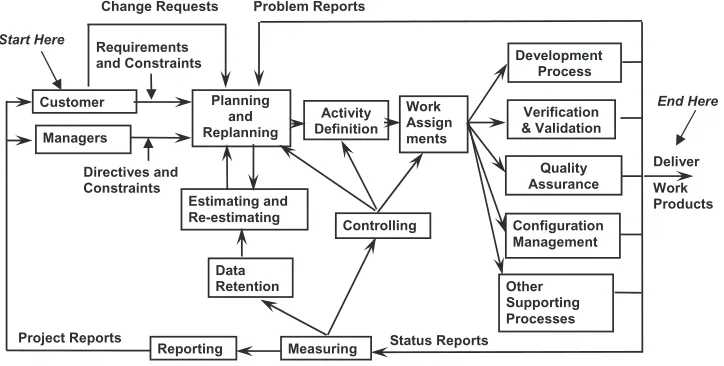
The model of project workfl ow used in this text is presented in Figure 1.1 . All models, including the one in Figure 1.1 , are abstractions of real situations that emphasize some aspects of interest and suppress details that are unimportant to the purposes of the model. Important details may be expressed in subordinate models. Subordinate models to Figure 1.1 are presented throughout this text.
Figure 1.1 indicates some of the processes that support the primary activity of Product Development; they include Verifi cation and Validation (V & V), Quality Assurance of work processes and work products (QA), Confi guration Management (CM), and others. Some supporting processes and their purposes are listed in Table 1.2 . Each supporting process must be accomplished in accordance with a well defi ned model for accomplishing the work activities of that process.
The model in Figure 1.1 is called a process model because it emphasizes work
activities and the fl ow of work products among work activities. Each work activity in a process model produces one or more work products that provide inputs to
subsequent work activities. By work product we mean any document produced by
a software project (including the source code). Some work products are delivered to the customer (called deliverable work products), while others are intermediate
work products developed to advance the creative problem - solving process in
As Michael Jackson has observed, the entire description of a software system or product is usually too complex for the entire description to be written directly in a programming language, so we must prepare different descriptions at different levels of abstraction, and for different purposes [Jack02] . Note that each of the work products listed in Table 1.3 is a document; software developers and software project managers do not produce physical artifacts other than documents, which may exist in printed or electronic form.
As illustrated in the workfl ow model depicted in Figure 1.1 , a software project is
initiated by customer and managers. A customer is the person or organization that
TABLE 1.2 Some supporting processes for software development
Supporting Process Purpose
Confi guration management Change control, baseline management, product audits, product builds
Verifi cation Determining the degree to which work products satisfy the conditions placed on them by other work products and work processes
Validation Determining the degree of fi tness of work products for their intended use in their intended environments Quality Assurance Determining conformance of work processes and work
products to policies, plans, and procedures Documentation Preparation and updating of intermediate and
deliverable work products
Developer training Maintaining adequate and appropriate skills
User and operator training Imparting skills needed to effectively use and operate systems
TABLE 1.3 Some work - product documents produced by software projects
Document Content of Document Project plan Roadmap for conducting the project Status reports State of progress, cost, schedule, and quality Memos and meeting minutes Issues, problems, recommendations, and
resolutions
e - Mail messages Ongoing communications
Operational requirements User needs, desires, and expectations Technical specifi cation Product features and quality attributes Architectural design document Components and interfaces
Detailed design specifi cation Algorithms, data structures, and interface details of individual modules
Source code Product implementation
Test plan Product verifi cation criteria, test scenarios, and facilities
Reference manual Product encyclopedia Help messages Guidance for users
Release notes Known issues, hints, and guidelines Installation instructions Guidance for operators
provides the requirements for and accepts the deliverable work products. Customers may place constraints on a project, such as specifying a required database interface (a product constraint) or the date when the delivered system must be available for use (a process constraint). Managers include your management and you, the project manager. Managers specify constraints and directives. A process constraint from your manager might place a limit on the number of people available to conduct the project; a management directive might require that all software projects in the organization perform a design activity. You, the project manager, might issue direc-tives requiring that the design be documented using UML (the Universal Modeling Language) and that one or more design reviews be held.
Requirements, constraints, and directives provide the inputs to the planning process, which is (or should be) a group activity led by you, the project manager. You should involve the customer, selected members of the development team, and other primary stakeholders in the planning process. Planning involves estimation. Factors to be initially estimated include a schedule for conducting the major work activities; kinds and numbers of resources needed, when they will be needed, and for how long; and the project milestones (points in time when progress is assessed). Estimation is best accomplished by using historical data from a data repository. Data at the completion of your project can be placed in a repository to aid in estimation of future projects. Intermediate data can be retained to assess progress and prepare completion estimates, which may result in replanning.
The output of your planning process will include identifi cation of the roles to be played in conducting the project, which results in assignment of personnel to those roles. During initial planning, the major work activities to be planned include soft-ware development and the various supporting processes such as confi guration man-agement, process and product quality assurance, verifi cation, validation, user training; plus other necessary activities that constitute the scope of your project. Detailed plans for these activities will evolve as the project evolves.
During execution of the project, data are collected and status reports are pre-pared on a periodic basis by you and your staff. The status reports will be used by you (the project manager), your customer, your managers, support groups, and other project stakeholders. Status reports compare planned progress to actual progress; they may cause you and your customer, working together, to revise plans and requirements, or you might, for example, reassign some personnel to different project roles (e.g., a software designer might be moved to the independent valida-tion team). Status data are also used to provide a basis for estimating future progress based on progress to date (which may result in replanning), and is retained to provide a basis of estimation for future projects.
Problem reports are generated to document defects discovered in work products that must be reworked. Status reports, new requirements, and changes to require-ments, constraints, directives, and problem reports provide the data needed to con-tinually update, elaborate, and revise your project plan.
Every organization that develops and maintains software, including yours, should have one or more workfl ow models of software development that depicts the major work activities and fl ow of work products. Each member of the organization should be familiar with the workfl ow model(s) and understand the ways in which their work activities and work products fi t into the model(s). Everyone in your software devel-opment organization should be able to sketch and describe the workfl ow model(s)
![Table 1A.5 ; they indicate the scope of topics addressed by PMBOK [PMI04] . Rele-](https://thumb-ap.123doks.com/thumbv2/123dok/3945413.1888833/55.504.94.413.76.219/table-indicate-scope-topics-addressed-pmbok-pmi-rele.webp)