Determination of
in Vitro
Rumen Fluid Alternative
R. Utomoa,*, M. Soejonoa, B. P. Widyobrotoa, & Sudirmanb aFaculty of Animal Science, Gadjah Mada University
Jln. Fauna No. 3, Kampus UGM Bulaksumur, Yogyakarta 55281, Indonesia bFaculty of Animal Science, Mataram University
Kampus Gomong, Jln. Majapahit 62, Mataram – Nusa Tenggara Barat, Indonesia (Received 29-10-2010; accepted 04-10-2011)
ABSTRAK
Penelitian ini dilakukan untuk membandingkan penggunaan feses yang dilarutkan dalam akuades (P1), NaCl-fi sologis (P2), saliva buatan (P3), dan cairan rumen (rumen fl uid/RF) sebagai sumber inokulan pada penetapan kecernaan in vitro bahan organik (KcIVBO) jerami padi, jerami jagung, rumput gajah, dan rumput pangola. Cairan rumen diambil dari dua ekor sapi peranakan ongole berfi stula rumen dengan bobot badan 306 dan 333 kg. Sapi diberi pakan 3% dari berat badan terdiri atas 70% rumput gajah dan 30% konsentrat komersial selama 30 hari. Koleksi RF dan feses (grab sampling) dari ternak yang sama dilakukan berurutan pada minggu terakhir. Feses segar 350 g dilarutkan dalam 1 l pelarut, dihomogenkan menggunakanblender selama 30 detik, RF diambil langsung melalui fi stula. Setelah disaring menggunakan kain kasa 4 lapis, dicampur dengan saliva buatan, rasio 1 : 4 (v/v). Setiap inokulan diambil 50 ml dimasukkan ke dalam tabung reaksi (100 ml) yang telah berisi 500 mg sampel pakan, kemudian diinkubasi pada suhu 39 oC selama 48 jam. Hasil penelitian menunjukkan bahwa KcIVBO rumput gajah, jerami padi, jerami jagung, maupun rumput pangola, tidak berbeda nyata antar pelarut, tetapi secara nyata (P<0,05) lebih rendah daripada RF. Hasil penetapan KcIVBO menggunakan larutan feses mempunyai tingkat keeratan tinggi dengan cairan rumen yang ditunjukkan oleh koefi sien regresi yang tinggi. Disimpulkan larutan feses menggunakan pelarut akuades (P1) dapat digunakan sebagai inokulan pengganti cairan rumen pada pendugaan penetapan KcIVBO pakan berserat. Namun demikian penggunaan larutan feses sebagai inokulan menghasilkan kecernaan in vitro yang lebih rendah daripada cairan rumen.
Kata kunci: in vitro, kecernaan bahan organik, larutan feses, cairan rumen, koefi sien regresi
ABSTRACT
The research was conducted to compare the ability of faeces dissolved in distilled water (P1), saline solution (P2), artifi cial saliva (P3), and rumen fl uid (RF) as sources of inoculant in in vitro organic
fl uid was collected from two rumen fi stulated Ongole Crossbred Cows of 306 and 333 kg body weight (BW). The cows were fed 3% of BW consisted of 70% napier grass and 30% concentrate. At the end of 30 days feeding, faecal solution was made out of 350 g fresh faeces dissolved in 1 l of each solvent, homogenized using blender for 30 second, while rumen liquor were collected directly from fi stula. After straining with four layers of cheesecloth both faecal solution and rumen liquid were mixed
ml) containing 500 mg sample. The tubes were then incubated at 39oC for 48 h. Value of IVOMD of napier grass, rice straw, corn stover, and pangola grass did not diff er among the faecal solvents, but signifi cantly lower (P<0.05) compared to the RF. The value of IVOMD determined using faecal solvent inoculant highly correlated to the RF. The highest regression coeffi cient was shown by the relation between IVOMD of P1 solvent with RF. It is concluded that faecal dissolved in distilled water could replace rumen fl uid as inoculants source in in vitro
feed determination. However, the faecal solvent as inoculant produced lowerin vitro digestibility than that of rumen fl uid.
* Corresponding author:
E-mail: [email protected]
INTRODUCTION
Stability of ruminant productivity in Indonesia is determined by forage availability throughout the year (Abdullah & Suharlina, 2010). Information of digest-ibility values of each feedstuff is essential as asset feed information. The value could be obtained by in vivo,
in sacco, orin vitro procedures. Even though thein vivo
procedure produce more accurate information, but it is ineffi cient, labor and time consuming, high costs, and labor intensiveness (Adesogan, 2004). Many scholars (Williams, 2000; Mahadevammaet al., 2004; Damiran et al., 2007; Palić & Leeuw, 2009) have developed faster, less cost, and need small quantity of sample to get more numbers of feed usedin vitro method. The method needs shorter time to predict digestibility (Utomo, 2010).
One of the most widely used in vitro digestibility method was developed by Tilley & Terry (Harris, 1970). The method depended on the availability of rumen fl uid as inoculant source for fermentative process of digestibility. For some areas, collecting rumen fl uid was diffi cult work because the need for rumen fi stulated animal, which is not only high operational cost, easy to contaminate by diseases especially in tropical warm cli-mate, hurting animal to made fi stula or using stomach tube for rumen liquor collection, but also against ani-mal welfare (Mauricioet al., 2001; Dhanoaet al., 2004).
The results of some experiments in sub tropic region showed that rumen fl uid inoculants (RF) for determiningin vitro digestibility could be replaced with faecal solution (FS) from some species of animal (Omed
et al., 2000; 1988; Akhteret al., 1999). It has been reported that microbial species found in the faeces as inoculant were infl uenced by the kind of feed consumed by animal donor (Baueret al., 2004). Since, tropical feed are largely diff erent with subtropics ones, the microbial species in ruminant are assumed to be diff erent. Therefore the in
vitro procedure using faecal solution as inoculant which
has been developed in the subtropics might not be used
to predict Indonesia feedstuff value correctly. Artifi cial saliva (buff er) is commonly used as solvent for faeces by previous investigators; the solvent is expensive and less available in some areas. Technology, Department of Animal Nutrition and Feed Science, Faculty of Animal Science, Gadjah Mada University, Yogyakarta. Two fi stulated rumen Ongole crossbred cows, about 5 years old, 333 and 306 kg body weight were kept in concrete fl oor individual stalls. In order to have an optimal and stable rumen ecological condition, the cows were fed 3% of body weight, con-sisted of 70% napier grass and 30% concentrate for 30 days including adaptation period. The concentrate was fed at 07.00 a.m. and 16.00 pm, while napier grass was given after the concentrate was consumed. The cows were off ered water ad libitum. The chemical composi-tions of feedstuff used in the experiment were shown in Table 1, and the chemical compositions of the diet were shown in Table 2.
The rumen fl uid and faeces were taken from both cows after three weeks of the ration feeding. Rumen fl uid was taken using aspirator via rumen fi stula and
been warmed by keeping hot water prior to collection to keep the temperature around 39oC. While faeces was taken directly from the caecum (grab sampling), and kept at 39oC in a thermostatic container.
Rumen fl uid from both donor cows were mixed, strained with 4 layers of cheesecloth and then mixed with artifi cial saliva (McDougall’s Artifi cial Saliva), in an
Note: Feed analysis of Lab. of Feed Technology, Faculty of Animal Science University of Gadjah Mada. CP= Crude protein, CF= Crude fi ber, EE= Ether extract, NFE= nitrogen free extract, NDF= neutral detergent fi ber, ADF= acid detergent fi ber.
Feedstuff s Level (%) CP CF EE NFE Ash NDF ADF
Napier grass 70 7.83 23.64 1.18 26.66 10.69 44.79 25.75
Concentrate 30 4.01 6.37 0.56 16.39 2.68 15.21 8.95
Total 100 11.84 30.01 1.74 43.04 13.36 59.99 34.70
Table 2. Chemical composition of cows diet (%DM)
Note: Feed analysis of Lab. of Feed Technology, Faculty of Animal Science University of Gadjah Mada. CP= Crude protein, CF= Crude fi ber, EE= Ether extract, NFE= nitrogen free extract, NDF= neutral detergent fi ber, ADF= acid detergent fi ber.
Feedstuff s DM CP CF EE NFE Ash NDF ADF
Rice straw 85.48 5.36 29.25 1.59 42.21 21.79 76.88 49.12
Corn stover 68.65 8.57 27.92 2.44 38.93 16.24 72.01 36.92
Napier grass 14.05 11.19 33.77 1.69 42.86 10.49 63.98 36.79
Concentrate 88.46 13.36 21.23 1.87 54.62 8.92 50.69 29.84
Erlenmeyer fl ask at 1 : 4 (v/v) ratio (Harris, 1970). Before pouring into the incubation tubes which were already fi lled with feed sample, the inoculant were pre warmed in incubator at 39oC and fl ushed with CO
2.
The inoculants of fresh faeces from both donor cows were mixed homogeneously, and dissolved in three diff erent solvent (distilled water, saline, and artifi cial saliva) at concentration 35% (w/v) (Akhter et al., 1999; Sudirman, 2007). The mixture was homogenized using a blender for 30 second. The mixtures were strained with 4 layers of cheesecloth and then processed like rumen fl uid.
Four kind of fi brous feed namely rice straw (Oryza sativa), corn stover (Zea mays), napier grass (Pennisetum purpureum), and pangola grass (Digitaria decumbens) as control sample were used to examine the eff ectivity of faecal in comparison to rumen fl uid for determining in vitro digestibility. All feeds were ground using a Wiley mill with 2 mm screen in order to have same particle size. Feeds samples were stored in scaled container in the laboratory at room temperature.
Fifty ml of each inoculant were poured into 100 ml incubation tubes which contained 500 mg of feed sample. Each tube was incubated for 48 h (one step
method) anaerobically at 39 oC waterbath, every 8 h the tubes were shaken by hand. After 48 h incubation, the mixture tubes were strained using predeterminated weight porous crucible (30 ml) with glass wool on it. The crucibles were dried at 105oC until its weight constant to
at 550oC oven temperature for 5 h.In vitro digestibility was calculated using formula of Tilley and Terry method (Harris, 1970).
The experiment was conducted in completely ran-domized design. Four kinds of inoculants types were used as treatments with 5 replications. The means were tested by Duncan multiple range test. While the ability of faecal solvent to replace rumen fl uid was examined using simple linear regression analyses (Gomez & Gomez, 2007). The linear regression equation was Y= a + bX, the kind of faecal solution were X and rumen fl uid inoculant was Y.
RESULTS AND DISCUSSION
The IVOMD values of all feeds digested with faeces dissolved in diff erent solvent (P1-P3) were not
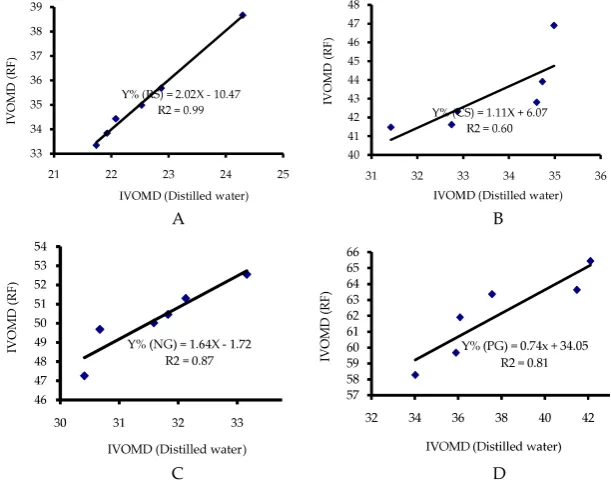
Figure 1. Correlation of feedin vitro
solution (X). A= rice straw(RS), B= corn stover (CS), C= napier grass (NG), D= pangola grass (PG).
Note: P1= faecal inoculant with solvent of distilled water, P2= saline, P3= artifi cial saliva; RF= rumen fl uid.Means in the same row with diff erent super-script diff er signifi cantly (P<0.05).
Feedstuff s
Treatments
P1 P2 P3 RF
Rice straw 22.23±0.46b 21.40±0.58b 20.45±1.36b 28.87±0.92a
Corn stover 33.99±1.88b 32.69±3.19b 32.69±2.34b 35.53±0.99a
Napier grass 31.32±0.75b 28.48±1.36b 29.03±1.31b 50.81±1.15a
Pangola grass 38.63±2.97b 31.73±4.96b 30.82±3.19b 61.37±2.34a
Table 3. Averagein vitro
A B
C D
Figure 3. Correlation of feedin vitro
solution (X). A= rice straw(RS), B= corn stover (CS), C= napier grass (NG), D= pangola grass (PG). signifi cantly diff erent (Table 3). Therefore, since distilled
water was more aff ordable, it could be used to replace the more expensive solvent such as saline and artifi cial saliva. The IVOMD obtained using faecal inoculant were signifi cantly (P<0.05) lower compared to that of rumen fl uid inoculant, due to the lower total number of microbes in faecal solution than in the rumen fl uid. Table 3 also showed that fi brous feeds (rice straw) which contained the highest neutral detergent fi ber (Table 1) resulted in the lowest value of in vitro
digestibility, followed by napier grass, corn stover, and pangola grass.
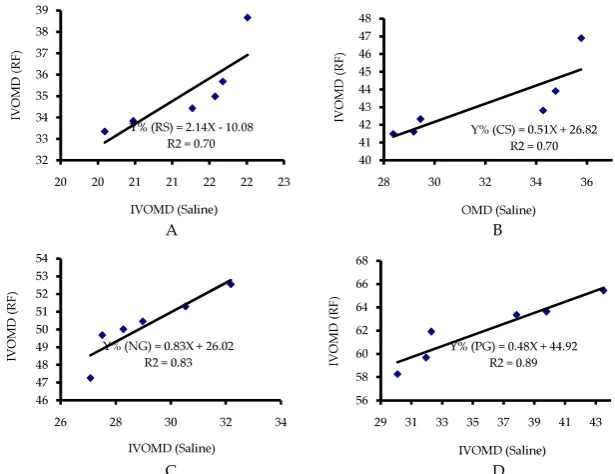
Based on simple linear regression analysis, the regression coeffi cient (R2), there was close correlation between inoculant of faeces and that of rumen fl uid. The equation of feedin vitro between inoculant of RF (Y) with faeces (X) using solvent P1 (distilled water) for rice straw was: Y (%)= - 10.47 + 2.02 X (R2 = 0,99), corn stover was: Y= 6,07 + 1,11X (R2= 0,60), napier grass was Y= - 1,72 + 1,64X (R2= 0,87), and pangola grass was: Y= 0,74X + 34,05 (R2= 0.81), respectively (Figure 1). The equation using solvent P2 (saline) and P3 (artifi cial saliva) were shown in Figure 2 and Figure 3, respectively. The equa-tion and regression coeffi cient value (R2) as shown in
Figure 2. Correlation of feedin vitro
(X). A= rice straw(RS), B= corn stover (CS), C= napier grass (NG), D= pangola grass (PG).
A B
C D
A B
Figure 1, also gave indication that faecal solution could be used as inoculant for replacing rumen fl uid on deter-mining in vitro
by Dhanoaet al. (2004).
There was a close correlation between inoculant of faecal solution (P1-P3) with rumen fl uid (RF). Therefore, based on the results of this research, the use of distilled water as solvent for faeces could be recommended to replace rumen fl uid for predictingin vitro digestibility of feeds. Based on the graph, the correlation of feedin vitro
solvent with rumen fl uid, there were some interesting information, such as tendency of similarity of regres-sion coeffi cient value (R2) between napier and pangola grass, also between rice straw and corn stover. It was assumed to be correlated with the characteristic of the feeds. Napier grass had higher soluble nutrients than rice straw and corn stover. In contrary, both straw (rice straw and corn stover) had higher cell walls or neutral detergent fi ber/NDF (Table 1).
CONCLUSION
Distilled water could replace artifi cial saliva as solvent for faeces and the dilution could be used as inoculant to replace rumen fl uid to predict digestibility of tropical fi brous feeds (in vitro). However the faecal solvent as inoculants produce lowerin vitro digestibility than that of rumen fl uid.
ACKNOWLEDGMENT
We would like to express our thank to the Director of Directorate of Research and Community Services, Department of National Education, for funding the research through Hibah Bersaing XI 2004.
REFERENCES
Abdullah, L. & Suharlina. 2010. Herbage yield and quality of two vegetative parts of indigofera at diff erent times of fi rst regrowth defoliation. Med. Pet. 33: 44-49.
Adesogan, A. T. 2004. Eff ect of bag type on the apparent digest-ibility of feeds in ANKOM DaisyII incubators.Anim. Feed
Sci. and Tech. 119: 333-344.
Akhter, S., E. Owen, M. K. Theodorou, E. A. Butler, & D. J. Minson. 1999. Bovine faeces as a source of micro-organ-isms for thein vitro digestibility assay of forages. Grass Forage Sci. 54: 219-226.
Bauer, E., B. A. Williams, M. W. Bosch, C. Voigt, R. Mosenthin, & M. W. A. Verstegen. 2004. Diff erences in microbial activ-ity of digesta from three section of the porcine large intes-tine according to in-vitro. J. Sci. Food Agric. 84: 2097-2104.
Damiran, D., T. DelCurto , D. W. Bohnert, & S. L. Findholt.
2008. Comparison of techniques and grinding sizeto esti-mate digestibility of forage based ruminant diets. J. Anim. Feed Sci. and Tech. 141:15–35
Dhanoa, M. S., J. France, L. A. Crompton, R. M. Mauricio, E. Kebreab, J. A. N. Mill, R. Sanderson, R. Dijkstra, & S. Lopez.2004. Technical note: A proposed method to deter-mine the extent of degradation of a feed in thein vitro gas production technique using feces as the inoculum. J. Anim Sci. 82: 733-746.
Gomez, A. A. & A. A. Gomez.2007. Prosedur Statistik untuk Penelitian Pertanian. Edisi ke dua. Terjemahan: E. Sjam-suddin & J.S. Baharsjah. Penerbit Universitas Indonesia Press, Jakarta.
Harris, L. E. 1970. Chemical and Biological Methods for Feed analysis. Center For Tropical Agric. Feed Composition Project. Livestock Pavilion, University of Florida. Gaines-ville, Florida.
Mahadevamma, S., T. R. Shamala, & R. N. Tharanathan.2004. Resistant starch derived from processed legumes:in vitro and in vivo fermentation characteristics. Int. J. Food Sci. and Nutr. 55: 399-405.
Mauricio, R. M., E. Owen, F. L. Mould, I. Givens, M. K. The-odorou, J. France, D. R. Davies, & M. S. Dhanoa. 2001. Comparison of bovine rumen liquor and bovine faeces as inoculum for anin vitro gas production technique for eval-uating forages. Anim. Feed Sci. Tech 89: 33-48.
Omed, H. . 2000. Faeses as
a source of microbial enzymes for estimating digestibility. In: D. I. Givens, E. Owen, R. F. E. Axford, & H. M. Omed. (Editors). Forage Evaluation in Ruminant Nutrition. CAB International, pp. 135-154.
Palić, D. V. & Klaas-Jan Leeuw. 2009. Comparison of three in vitro methods for determining and predicting the organic
.Acta Periodica Technologica, APTEFF 40: 79-82.
Sudirman. 2007. Kajian dan validasi faktor-faktor yang mem-pengaruhi efi kasi penggunaan feses kerbau sebagai peng-ganti cairan rumen dalam penetapan kecernaanin vitro pakan di daerah tropik. Disertasi. Universitas Gadjah Mada, Yogyakarta.
Utomo, R. 2010. Modifi kasi metode penetapan kecernaaanin vitro bahan kering atau bahan organik. Buletin Sintesis. Yayasan Dharma Agrika Semarang 5: 1-11.