STUDY
Abstract
Effective Human Resource Management (HRM) plays a major role in the success and profitability of organizations and the construction industry is no exception to this rule. Survival of construction companies in a competitive environment depends on the company’s ability to ensure timely completion of projects, adhering to the stipulated quality norms and estimated costs. Sustenance of a migratory labour force is therefore crucial for timely completion of projects. Exploitation of the economic conditions of labourers is an impediment to the growth and survival of a construction company. Sound HRM practices and a sympathetic handling of the labourers ensures a motivated labour force which enhances productivity, yields tangible and intangible profits and contributes to the growth of the company.
Introduction
S
Scciieennttiiffiicc MMaannaaggeemmeenntt eennddeeaavvoouurrss ttoo iiddeennttiiffyy aanndd aappppllyy tthhee ffaaccttss aanndd llaawwss tthhaatt u
unnddeerrlliiee eeffffiicciieennccyy,, eemmbbrraacciinngg tthhee ffoolllloowwiinngg iinn iittss aannaallyyssiiss11: :
BeBesstt ssiittuuaattiioonn aanndd ccoonnssttrruuccttiioonn ooff wwoorrkk ppllaacceess,,
MoMosstt efefffeeccttiivvee chchaarraacctteerr anandd aarrrraannggeemmeenntt ofof mamacchhiinneess,, totooollss aanndd m
maatteerriiaallss,,
MoMosstt eeffffeeccttiivvee prproodduuccttiivvee pprroocceesssseess,, bbeesstt memetthhooddss ofof seselleeccttiinngg anandd t
trraaiinniinngg mmeenn,, aanndd tthhee nnaattuurree aanndd aammoouunntt ooff wwoorrkk tthhaatt oouugghhtt ttoo bbee ppeerrffoorrmmeedd bbyy e
eaacchh,, aanndd,,
MoMosstt ssuuiittaabbllee mmeetthhoodd ooff ppaayymmeenntt inin tthhee iinntteerreessttss ooff tthhee iinnddiivviidduuaallss aanndd t
thheeiirr eeffffiicciieennccyy.. S
Scciieennttiiffiicc mmaannaaggeemmeenntt,, tthheerreeffoorree aiaimmss atat ccoooorrddiinnaattiinngg ththee efefffoorrttss ofof memenn anandd m
maacchhiinneess aanndd eeffffiicciieenntt uuttiilliissaattiioonn ooff mamatteerriiaall wiwitthh ththee hheellpp ooff anan ororggaanniissaattiioonn.. “
Objectives of the study
The objectives that are intended to be achieved by this study are:-
Examine the feasibility of implementing the principles of HRM in the construction industry.
Evaluate the implementation of HRM principles in selected construction companies.
Assess the advantages of good HRM practices.
Suggest recommendations for improving HRM in the construction industry.
Implementation of HRM Principles in Construction Industry
Though all the principles of HRM as applicable in a conventional and organized industry cannot be applied in the construction industry, there are a few principles that can be applied and followed. They are:-
Planning manpower requirements. With the help of various planning and scheduling techniques like Bar charts, PNA, CPM, PERT and LOB methods, the requirement of manpower at various stages of a construction activity can be accurately planned and forecasted. One of the major pitfalls in this process is the tendency to reduce costs by employing less manpower and attempting to attempting to increase output by stretching working hours.
Employee Remuneration. Wage and salary administration is a very critical activity in the construction industry. In most of the companies labour force is hired through labour contractors, who do not pass on the full wages to the labourers. This has an adverse effect on the productivity levels of the labourers and effects the time schedule of projects.
Under the provisions of The Minimum Wages Act, 1948, the minimum wages to be paid for each category of worker is notified by the Labour
Similarly, under the provisions of The Payment of Wages Act, 1936, it is the responsibility of the Principal Employer to disburse the wages and maintain records of the same, which is seldom done by any Principle Employer.
Incentive Payments. The planning and implementation of incentives for the construction labourers is another aspect which is feasible to achieve the targeted output. Some contractors implement such schemes by linking performance and outputs to incentives. The cost savings which they accrue by saving on the establishment charges is partially passed on to the labourers. Such practices yield better productivity from the labourers.
Employee Benefits, Welfare and Services. There are various statutory regulations, a few of which are listed below, that govern the implementation of various benefits and welfare schemes and services for the labourers. They are:-
- The Contract Labour (Regulation and Abolition) Act, 1970 - Inter State Migrant Workmen (Regulation of Employment and
Conditions of Service) Act, 1979
- The Building and Other Construction Workers (Regulation of Employment & Conditions of Service) Act, 1996
- The Building and Other Construction Workers Cess Act, 1996. - Child Labour (Prohibition and Regulation) Act, 1986
- The Workmen’s Compensation Act, 1923
Unfortunately, there are very few construction companies who comply with the provisions of these regulations. The reasons for the non compliance of these provisions are:-
- Schedule of Rates of published by various agencies does not cater for these costs in the labour component.
- Inclusion of these costs removes the competitiveness from the bids due to the large financial commitments required.
Safety and Health. This is a key area of HRM which the contractors have to concentrate. In government contracts the safety and health conditions that have to be adhered to during the period of the contract form a part of the Contract Agreement, but it is seldom adhered to. Companies which have safety policies also follow it as a ritual than as a procedure that has to be adopted and implemented realistically in accordance with the requirement of the ground conditions.
Motivation. The needs of the labourers in the construction industry is
restricted to the first two levels of the Maslow’s Need Hierarchy, i.e.,
Physiological and Safety needs. To this end, any construction company that can satisfy the aspirations of its labour force in this direction by providing them a fair wage structure and continuous employment will have a reasonably motivated labour force. The advantages of having a motivated labour force are:-
- Better productivity and output. - Improved quality workmanship.
- Reduced wastage of construction material.
- Enhanced goodwill in the market, which is essential for augmentation of manpower for short durations to meet the demands of the task.
- Better labour relations.
Methodology
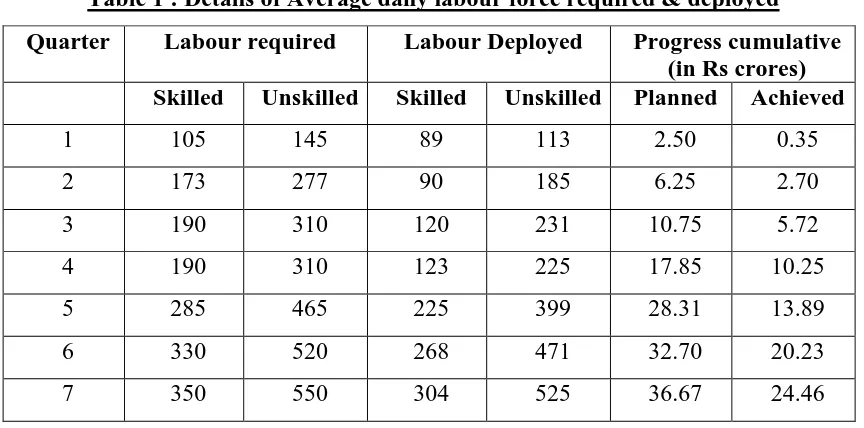
Company 1. A family held company, managed by technocrats and professionals with the help of a core of dedicated administrative staff. The supervisory staff for this project was recruited after the commencement of the project. The duration for completion of the project is 24 months. Table 1 below summarizes the labour force deployed for the work and the progress attained.
Table 1 : Details of Average daily labour force required & deployed
Quarter Labour required Labour Deployed Progress cumulative (in Rs crores) Skilled Unskilled Skilled Unskilled Planned Achieved
1 105 145 89 113 2.50 0.35
2 173 277 90 185 6.25 2.70
3 190 310 120 231 10.75 5.72
4 190 310 123 225 17.85 10.25
5 285 465 225 399 28.31 13.89
6 330 520 268 471 32.70 20.23
7 350 550 304 525 36.67 24.46
The company has attained an overall progress of 60.7% as against a planned progress of 91.2%. The shortcomings of this company from the HRM angle are as under:-
- Plants and machinery considered while planning not provided which reduced productivity, and indicates poor manpower planning.
- Poor wage administration. Wages paid after ten to fifteen days, which increased labour turnover and reduced output.
- Inadequate safety and welfare measures magnified into accidents and reduced productivity.
Table 2 : Details of Average daily labour force required & deployed
Quarter Labour required Labour Deployed Progress cumulative (in Rs crores) Skilled Unskilled Skilled Unskilled Planned Achieved
1 72 175 27 75 0.88 0.49
2 175 430 38 116 3.80 1.61
3 170 410 49 150 7.09 2.46
4 140 340 71 197 10.54 5.35
The company has attained an overall progress of 27.15% as against a planned progress of 53.5%. The shortcomings identified are:-
- Frequent change in supervisory staff leading to poor implementation of the work plan.
- Erratic payment schedules adversely effected availability of labourers for hiring.
- Involvement of labour contractor resulted in reduced productivity due to:-
Reduced wages paid to the labourers.
Non involvement of the company in labour welfare activities leading to unhygienic living conditions and migration of labour force. Inadequate safety precautions led to accidents at site and post accident, poor handling of labor welfare led to labour problems.
Company 3. A Pvt Ltd company, which is active in the Western region of the country, is managed by one man with the help of a core of administrative and supervisor staff. The duration for completion of the project is 24 months. Table 3 summarizes the labour force deployed for the work and the progress attained by this company.
Table 3 : Details of Average daily labour force required & deployed
Quarter Labour required Labour Deployed Progress cumulative (in Rs crores) Skilled Unskilled Skilled Unskilled Planned Achieved
1 50 200 38 214 2.70 1.20
3 100 350 160 267 10.4 14.84
10 100 350 86 181 12.1 16.06
The company has attained an overall progress of 53.15% as against a planned progress of 40.04%. The HRM practices of this company that has given positive results are:-
- Permanent labour force of the company which was augmented with local labourers and inducted in a phased manner commensurate to the work and the plant and machinery mustered.
- Motivated labourers with the following, which has magnified into better productivity even with reduced manpower:-
Performance linked incentives.
Provision of better and hygienic living conditions. Medical facilities at site.
Timely payment schedules.
Payment commensurate with the skill and output of the labourer. - Better working conditions at site which facilitated working around the clock in shifts.
- Excellent leadership of supervisory staff ensured better results.
Company 4 A Delhi based Pvt Ltd company which has been executing group
housing contracts, and managed by a non professional MD with a core of administrative staff and a skeleton supervisory team. The duration for completion of the project is 18 months. Table 4 summarizes the labour force deployed for the work and the progress attained by this company.
Table 4 : Details of Average daily labour force required & deployed
Quarter Labour required Labour Deployed Progress cumulative (in Rs crores) Skilled Unskilled Skilled Unskilled Planned Achieved
1 70 200 30 80 1.5 0.25
2 100 333 90 190 4.7 2.34
3 103 322 100 185 10.1 6.70
The company has attained an overall progress of 31.4% as against a planned progress of 50.1%. The shortcomings in the HRM practices are:-
- Manpower planning not commensurate to the work involved.
- Availability of resources like machinery and building material at appropriate time not coordinated.
- Poor payment schedules and low wages resulted in frequent turnover of labour and reduced output.
- Indiscriminate penalties on labourers resulted in reduced productivity. - Lack of dedicated supervisory staff for planning the task at hand.
Advantages of good HRM practices.
The advantages that a construction company gains due to sound and good HRM practices are:-
Better productivity of labourers. Lesser wastage of building materials. Reduced accidents at site.
Timely completion of projects leads to saving of fixed establishment charges.
Quality workmanship which enhances the reputation of the company. Better labour relations and increased market reputation which ensures supply of labourers to meet varying demand.
Better credibility rating which facilitates material supply on credit. Cordial user interaction.
Suggestions for improving HRM practices in Construction Industry
Some suggestions to ensure better HRM practices in the Construction Industry are:-
Diligent planning of manpower should be done using the planning tools available.
Correct assessment of job requirements and employing the right man for the right job.
Improve wage administration, welfare measures and implement performance linked incentives to motivate the labourers to perform better and also improve the quality of work.
Avoid exploitation of the labourers and adopt a humane approach in the dealings with them.
Ensure increased and direct management participation towards labour welfare issues and avoid/reduce involvement of labour contractors.
Impress on the Government and concerned agencies through a collective forum to:-
o Revalidate the planning parameters of the labour components
given in the various Schedule of Rates to include the financial burden of the numerous statutory requirements of labour welfare.
o Have better transparency in the utilization of the funds collected
for labour welfare to infuse confidence in the contractor community, so as to ensure willing compliance of various statutory requirements.
Conclusion
HRM is a fast growing concept which has gained importance in all spheres of business and the construction industry is no exception. The importance and contribution of HRM in enhancing organizational effectiveness in a highly competitive environment is unquestionable. Aspirations of the labourers can be satisfied with minimum effort and costs by a deliberate and conscious implementation of fairness in wage administration and welfare measures at site. Companies which have good HRM practices tend to benefit in the long run by maintaining a motivated workforce who not only enable them to increase productivity and profits, but also generate additional business. The tendency to increase profits by exploiting labourers due to their poor economic conditions does not pay dividends and can be catastrophic for the construction companies.
(Total word count 2,982)
2. DS Kimball and DS Kimball Jr., Principals of Industrial Organisation, McGraw – Hill Book Co. Inc., Bombay, III Edition, 1967, page 157.
3. Ian Beardwell and Len Holden, Human Resource Management, Macmillan India Ltd., 1996, page 6.
4. Edwin B Flippo, Personnel Management, McGraw Hill, New York, Fourth Edition, 1984, page 5.
5. William B Werther, Jr and Keith Davis, Human Resources and Personnel Management, McGraw Hill, New York, Fourth Edition, 1993, page 11.
6. Prof H S Mejie and others, Strategy to Enhance the Standing of India’s Construction Industry : Review of Strengths and Weaknesses of Existing Systems and Technology, Civil Engineering and Construction Review, New Delhi, Feb 2005, page 27.