Originally published by Roof Books, 1998 ©2007 /ubu editions
Cover image: Dirk Rowntree & Robert Fitterman, from Cedars Estates
(2001). Cedars Estatescan be found in UbuWeb’s Contemporary section.
/ubueditions www.ubu.com
ubu.com
“I am devoted to the idea of burying the avant-garde.” -Rosalind Kraus, critic, at a con-ference at the University of Iowa in April 1981
Preamble The history of most arts is the history of their avant-gardes, of those works and groupings of works which the next gener-ation seizes upon to follow, thus provoking the analogy to the avant-garde of an army (the small group of soldiers which precedes the main body of troups); but those works which are truly avant-garde are by their very nature apt to be a little strange to most viewers at the time of their origin, even to seem unpopular or elitist because they simply do not fit the establishment’s norms. Why are avant-garde works of such critical importance historically? There are two basic reasons: (1) by definition, avant-garde work minimalizes tradi-tional models, and therefore there tends to be an active, dialectical interrelationship between the form which a work assumes and the
materialof which it consists. The materialis not channeled into an existing mode, but, rather, uses whatever uniqueness there is in the material to determine itself. (2) This channeling process, minimizing previous models, uses the experience and moment of existence of its maker, the artist, and therefore reflects the newly unique thing about its moment in history—the
up-to-now-this-wouldn’t-have-been-possible.
spiritually or emotionally.
And, of course, beyond the “avant-pop” there is the deliberately deeply conservative art which most people think of when we say “art”—this would include most figurative art of this moment (includ-ing most, but not all, political art) and most geometrical art
(although that too has its “pop-garde:” Sol LeWitt and Lawrence Poons, for example). The conservative artists tend to use forms which are remembered; these are brought to bear on the materialin remembered ways rather than in ways determined by the material. Thus they often have more to do with memory of art than with the objective World outside their makers, and with the traditions group-ing such memories—classic, romantic, “formal,” “socialist realistic” and so on. Of course as any avant-garde becomes old, its constituent parts will tend to join this newly conservative area; but this process and its phenomenology are not my concern at this time.
One of the things that a bad critic or theorist tends to do is to make sher viewpoint (his or hers) into a Procrustean bed, into which any work at hand or theoretical materialis compelled to fit, regardless of the consequences, either by stretching it beyond recognizability or by lopping off parts of it by ignoring them; such a critic presents only sher own horizon of experience and ignores that of the reader or lis-tener, who may have sher own perspective on the work or on the
material. On the other hand, the good critic tends to point out the implications of the materialand work, developing any theory not a priori but from a dialectical relationship with the materialand by con-textualizing it. Such a critic should be attracted to the avant-garde as a matter of course, because the avant-garde can be viewed at first-hand and free of codifications into what may become its eventual subsumptions of traditions and modes; thus the avant-garde, once identified, is at least for a time not subject to the misinformation that leads to criticism from the false theory or horizon I have described.
moment and its needs, and thus the critic can, by focusing on these, contextualize works which reflect them into their moments of origin. Such a critic can place, to choose extreme examples, both Horace and Monteverdi and Cezanne into their own decades and moments of history, and can also, by doing this, fix them in their relevance to the critic’s own decade in terms of their Zeitgeistand achievements and his or hers, thus establishing what I have called elsewhere a “dialectic of centuries,”[1] describing the work according to its own perceived moments in time, class, culture, and so on, as related to the critic’s or theorist’s own moment in time, class, culture, and so on. The pleasure of reading great criticism is that the reader com-pares sher own horizon with the critic’s and thus develops sher own insights, even when the reader disagrees with those of the critic. In such criticism we get a dialectic not just of time but of class and cul-ture as well. At such a point we can say that great criticism—Hazlitt’s, for example—becomes art, the art of literature. No horizon over-whelms the others, and thus a fusion of these horizons
(Horizontverschmelzungis Hans-Georg Gadamer’s term) becomes the objective. It is the exploration of the processes surrounding horizons which is my concern here, and it is to that to which we will now pro-ceed. However we must note first that for such a fusion of horizons to occur, the reader or listener must have some consciousness of sher own horizons in order to have something to blend with those of the critic. We should also note that a great deal of the criticism—so-called theory—which is in vogue just now, especially that favored by the Mafia of the Rue Jacob (structuralism, poststructuralism, post-poststructuralism, and so on, all of which are Variations on a Theme by Saussure with pretentious toward objective truth which are hard to accept), a great deal of such criticism really is not valuable inas-much as it presents no dialectic with its materialand allows no process of fusion of the horizons of the reader and the critic. Perhaps it is needed by our academic mills for some heuristic pur-pose or other, but it has no significance to people whose object is to
their ongoing existance.
Art as ParadigmOne frequently found variety of avant-garde art today is what I have called “exemplative.”[2] This is art in which the work is not a definitive realization of some kind but is, rather, an example-one possibility, or a sampling of possible realizations.[3] By implying its set of alternatives, the viewer, faced with such a work and seeing these in sher imagination, projects her own horizon and fuses it with that of the artist. The artist’s paradigmatic realization is com-pared by the viewer with sher own.
Nor need such work necessarily be only of the cooler, relatively cere-bral kind. There can also be what I have called an “allusive referen-tial” at work,[4] a displacement between what one expects to see or what one would logically regard as normative and what one does, in fact, see (or hear or read). This displacement factor can generate the entire emotional panoply of which art is capable without any particu-lar reference to the artist’s or viewer’s personal expression. We expect to see or hear A, instead of which we see or hear B, and this points toward a new entity, C. This can only occur when there is an interaction between our own horizons and that of the artist’s, which we then experience as a process of entering the artist’s world and feeling ourselves doing so. This allusive referential process is not, of course, unique to exemplative art or even to avant-garde art. We experience it intuitively when we hear the opening passage of Beethoven’s Fifth Symphony and suddenly sense that the rhythm refers back to an opening silence, beginning with a rest—resulting in a heightened sense of drama on the part of the perceptive listener. Furthermore, we experience it when we listen to Anton von
Webern’s Symphony and we try to second-guess the composer as to the next note we will hear; constantly and consistently we are con-fronted by a displacement process as profound as that in a Bach fugue, and to the extent of our willingness to be involved in von
emotion.
But it is in exemplative art—musical realizations of works by Cage, sound poems and aleotoric works by myself or Jackson Mac Low or many of the current European avant-garde, that this allusive referen-tial is useful to explain why the work does not simply leave even a sophisticated listener “cold” as it were, but continues to engage him or her.
We can also see here why it is valuable to the “receiver;’ as we might call the listener, viewer, or reader collectively, not to be too preoccu-pied with sher own identity or private, personal consciousness in any unique or linear sense. If the receiver allows sher own horizon to overwhelm that of the artist—or, worse yet, if the receiver totally con-centrates on attempting to read such a consciousness into the para-digmatic sampled work at hand, the reader will fail to achieve the fusion of horizons and will thus miss the opportunity to enjoy the work. Such a receiver is involved in a self-cognitive process which does not belong in the fusion process as one finds it in exemplative art. In fact it seems to be very characteristic of our arts since the mid-1950s that such self-cognition is counterproductive to the art experi-ence, both for the receiver and also for the artist. Thus, and for this reason, I have suggested a way of regarding the break of the period since the mid-1950s with its previous period, not according to the recently traditional subsumption of modern/postmodern, with a num-ber of movements and subcategories in that flow, but rather as cogni-tive/postcognitiveusing “cognitive” with the caveat that it is such with regard to the sense of self or personal identity on the part of the artist or receiver.[5] The two approaches are not, of course, contra-dictory by any means. But the usefulness of using the cognitive/postcog-nitive distinction is that
1. it allows for a projection back into like works from the past for
cal justifications—e.g., works by Gertrude Stein, Erik Satie, Marcel Duchamp, James Joyce, and so on, can be put in a neater lineage with the present avant-garde than the modern/postmodern dichoto-my allows.
2. It allows us to deal with the commonality of such artists as I have just listed and those of today without worrying about precisely to what art movement or tendency such-and-such artist belongs. It decentralizes movements in general, reducing them to statistical quantifications of how much the artist does this or that, rather than requiring that the technical practice of the artist be justified by some artificial ideology. Movements, if one accepts the cognitive/postcog-nitive distinction, become a matter for the journalists and public-relations-minded curators and academics, not something that serious people need attach any great significance. Just to focus on recent years, all the recent so-called movements—abstract expressionism, neo-dada, pop art, concrete poetry, fluxus, sound poetry, minimal art, postminimal art, happenings, which are no more movements than, for example, “collage” was a movement [surely if collage began today some bright critic or art history professor would create the ide-ology of “collagism”!],—can be seen as technical trends or tenden-cies, each with works contained within it that justify it as a formal approach. By using my suggested distinction, cognitive/postcogni-tive, we can concentrate instead on classes of psychological models for artist, artwork, and receiver.
The Erotic of Fusion The desire to fuse seems to be a part of our biological nature as living beings. Paramecia “conjugate”—i.e., they fuse, and some of the substance of one passes into the substance of another. People fuse, not just in the act of love, but also in the state of being in love. Perhaps it can even be argued that to some extent they fuse in friendship, with its give and take and deep involvements. But certainly there is an erotic element inherent in the approach to
be permanent than it is to be temporary or “marginal” or “liminal” (from limen, the Latin word for “threshold”), this last a term popular-ized by the anthropologist, Victor Turner. One enters onto a thresh-old experience which, following Turner’s practice, I will call liminal, and one views the world within. One visits the abode of the Gods, or perhaps of Beauty or Love or Form. Or the view is into the world of the nightmare, which warns and possibly purges us. But we do not plan to stay there. We cannot experience, with all our attention, music or theater or philosophical principles or sex or even religion twenty-four hours a day. But we do return from the liminal experi-ence enriched. We return to the everyday world, and the experiexperi-ence becomes marginal with regard to our daily, normative existence; but the liminal experience has refreshed us and can be a source of ener-gy and meaning for us. In our spiritual lives we often, even, praise the lack of desire to hang onto the liminal experience; we commend the attitude of “letting go” afterward. The Buddha comes out from under the bo tree and shares his enlightenment. We attend a gather-ing in the green room after an extraordinary performance, and we see the performer who, a few moments before, seemed nearly out of control—bad, bizarre, transfigured into a being from another world. The performer is smoking a cigarette, chatting with friends and well-wishers, in some degree of dishabille. Far from this transformation detracting from our perceptions of what we have seen, we tend to admire the performer all the more for sher control. The world of the spirits (or the spiritual or the beautiful or the exaggeratedly satyrical or the nightmarish) has been visited, and now it is left behind. Our shamanistic ancestors visited such worlds to bring back magic into daily lives; we lack their belief in such magic, but
nonetheless we experience something of it through our artistic lives. The earliest Christians sought miracles in their saints’ lives; the mod-ern Christians find their miraculous in the dailiness of existence, and the intense experience of the liminal comes, instead, from the rituals of their faith. The art experience carries with it something of the
a closed book or a threat. And to those who follow the avant-garde, the very newness of the new art carries with it some of this liminality; it seems to suggest hope and meaning. One looks to the new for a better future for the arts, for some measure of renewal for ourselves. When our horizons seem tired, we fuse them with the horizons of the new artists, and we hope, at least, that, some of the time, we will experience renewal through this fusion in a way which we cannot get from fusing our horizons with those of artists of the past. Not that this last is in any way less valid, of course—the fusion of our horizons with those of a Goethe, a Mahler, a Li Po, or a Hokusai or
Michelangelo, such fusions are equally profound and renew our sense of our roots. They point to the possibility of greatness in our species in a way that is unlikely with the numerical majority of our avant-garde in our own time. But it is in this avant-garde that we see our own world mirrored and not the worlds of the past or of some other space or culture. Ours is the only time that any of us will ever know at firsthand, uninterpreted through the eyes of historians. So it is in our own avant-garde to which we turn, hoping always for the liminal and transforming miracle. Unfortunately we seldom find it. But once in a great while we do experience it. Through the fusion process we hear, with a shock, our own voice speaking to us, our own age. The liminal magic occurs, and we are renewed, uniquely so.
And ever thereafter we hunger for this magic to recur. Our sense of our own horizons is deepened, and we look on and on through the avant-garde for the liminal fusion. The great works of the past no longer provide us with the experience we are seeking, however won-derful they are. For this, it is not among the perfect voices of the past that we must look but, rather, among the mostly unsatisfactory voices of our present, knowing that these are at least alive. One is not searching out the memory of the perfect lover but, rather, for the warm and living lover.
incomplete, like the lovers in Plato’s Phaedruswho need their other halves to feel complete. We fuse in pleasure as in mind or soul. We fuse our present horizons with our past ones; isn’t that what biogra-phy and autobiograbiogra-phy are really about? We desire, not in the mechanical sense of inexhaustible cravings, to possess (against which, for example, most religions warn us—one need only think, for instance, of the Buddhists’ “Four Vows” on this point: “Desires are inexhaustible; I vow to put an end to them”), but rather we desire for its own sake, because the liminal fusion has, at one time, happened to us and the desire has become a part of our cultural being. The desire is part of the ongoing process of the fusion—its projection onto us and into the future, and through it we come to know ourselves culturally with ever-expanding circles of information and experience. Thus, any art which offers such fusion with new horizons is the only one which can be relied on to offer a new inter-mesh of our horizons with new ones, and at best our experience of them will always have, be it ever so tragical or disturbing, some ele-ment of pleasure, which can be called an erotic.
But thinking along the lines of such nonpersonal fusion we might well come to a sort of hebephrenia, which is the medical term for the pathological state in which one attempts to avoid all personal expression. In fact, for example, that is one of the things that the new arts are often accused of. For example, Theodore Adorno attrib-uted hebephrenia to Stravinsky in his book On Modern Musicback in the 1930s. What ever would he say, then, about the new postcognitive arts, such as those of John Cage, Marcel Duchamp, Robert Smithson, Robert Morris, or Dieter Roth, in which, even more, any personal expression would be an unwarranted intrusion on the part of the artist? But in the new arts, such an intrusion would reduce the hori-zon by overparticularizing it. The horihori-zon would become opaque and would reveal only the face of the artist, thus preventing the view-er from seeing through it to shview-er own horizon in ordview-er to fuse with
critic does not know where to look for the experience which is at its heart. The technique of fusion has not yet been learned by many people—and all erotics mustbe learned, which can be a difficult and even, sometimes, painful or awkward process.
However we can distinguish between the use of expression in the
materialof art work, and the use of expression to reveal the subjective persona of the artist. This last would be the way of the cognitive artist, while the former has its place in the work of the non- or postcognitive artist. In fact very few expressive materials are beyond the pale in the new arts. For example, since screaming is one of the hallmarks of expressionist art in the early part of this century—one can think of the various versions of the Edvard Munch woodcuts and paintings of “The Scream” or of the theater of Antonin Artaud—one might imagine that a scream would be very hard for a new artist to use. But in my fluxus piece, “Danger Music No. 17” (1962) I invite the performer to scream as loud as possible, with no context offered, until the performer is physically near collapse. Traditionally I have done this in the dark, so that each receiver is separated by the dark-ness from each other receiver and from Sher perception of my physi-cal presence (or that of any other performer). What one receives in such an experience is not a personal, specific screamed expression but, rather, an exampleof a scream, so that one directly experiences screams in general and the receiver must deal with Sher own experi-ence of screams. Thus, however expressive the language of this piece, the receiver’s attention is not directed toward the individuality or persona of myself or of any other performer but toward the horizon of the screamed event and toward Sher own experience or horizon of screams. These fuse, hopefully, and, also hopefully, the liminal experience occurs on the emotional level as well as the intellectual one. In the expressionistic model of the artist, where the art exists in order to express the composer or writer or whatever, there is always the danger that the fusion will fail, that the receiver will find the
phrase, “more excited than exciting.” In the postcognitive, exempla-tive model, to which my “Danger Music No. 17” belongs, the receiver is invited to forget the screamer in favor of the scream. The actor becomes an enactor. The horizons, if the performance works, fuse. And in no good performance of the many that I have seen has any-one ever laughed.
Thus, with Sher eye of shemself and onto Sher horizon, the exempla-tive artist finds shemself less involved in the conception of a work than in the perception of it. One examines the materialand does what it seems to suggest. Thus the centrality of found materials in the new arts, from Duchamp’s objets trouvésor the found materials of the dadaists, through to such related modes of using found materials as, in recent American literature, the writings of Charles Olson or Paul Metcalf, although both of these tend toward noncognitivism without ever quite getting there. Thus the centrality too of photogra-phy in the new arts, since photographotogra-phy always has a found element, and making a photograph is at least as much a matter of perceiving it in the materialas of taking it from its old context and, by means of an aparatus, producing a picture from it. One enters into a dialecti-cal relationship with the materials at hand, what I have been dialecti-calling the material. An example would be photographs by Ralph Meatyard, Clarence John Laughlin or by Minor White.
In general, then, the artist discovers what he or she is seeing, hear-ing, considering; the artist does what the materialsuggests, the receiv-er empathizes with it and expreceiv-eriences its principles both physically, intellectually and intuitively; one accepts the experience, one fuses the work with what one knows and the projected horizon with one’s own, and the fusion fulfills the erotic in the process.
But Why Go through All This? Currently in vogue is the structural-ist/poststructuralist nexus of theory and cultural criticism. These
ing a new sense of right and wrong by appeal to scientific validity; yet the approach lacks any real scientific method, since it is in no way inductive. Its practitioners defend their approach on the ground that what they are doing is the science of literary theory; yet they also lack the dialectical ratiocination which we expect from the best scientific papers as a matter of course, so that anything scientific in their work is science-as-metaphor rather than science-qua-science. Thus Claude Levi-Strauss treats anthropology according to linguistic modes and metaphors, producing structuralist anthropology. Thus Jacques Lacan, ever the poet, applies linguistics (mostly in the name of de Saussure) to the psyche, producing structuralist poetic psychology. Thus Roland Barthes, perhaps the subtlest of the structuralists, applies linguistics to criticism, producing the models of structuralist criticism, the most striking of which is perhaps the book S/Z, an incredibly detailed analysis of a short story by Balzac; it is, however, a work based on one single work of literature and that from one single epoch, the nineteenth century (as are all works, of course), and the problem with using this one work as a universal paradigm is that any relevance which it has is based on this one kind of work. Barthes’s theory, then, is drawn from only one kind of work, and it is inade-quate when it comes to the present avant-garde (or, indeed, to many other kinds of work, ancient or non-Western or baroque, for exam-ple). Alas, S/Zand Barthes’s theory that is drawn from it as a univer-sal finds its limits when we try to explain the startling effect of Stein’s aphorism scientifically through linguistics. It simply is not appropri-ate. Semiotics can be defined as “the study of how things mean, and of what signals and conveys meaning,” and it is a perfectly valid sub-ject for literary and cultural inquiry, as it has been since the earliest work of semiotics with which I am familiar, Giordano Bruno’s fasci-nating text from 1591, De Imaginum, Signorum, et idearum Compositione
(On the Composition of Images, Signs, and ideas).[6] The trouble with many recent works of semiotics is that it too is semiotics for its own sake, as if the subject of a work could guarantee its relevance.
lished by the very influential Editions de Seuil at 27 rue Jacob in Paris—hence my reference at the beginning of this essay to the Mafia of that address. One suspects that the recent emergence of “post-structuralism” (the work of Jacques Derrida and his followers, which seems to consist of structuralism enriched by Heidegger, Hegel, Genet, and with a hermetic use of language from pataphysics, for all that it purports to be a successor to structuralism), that the emer-gence of this “movement” is artificial, launched by the publisher’s sales department when sales of structuralist books began to fall off. In any case, poststructuralism seems to serve the needs of academic fashions and the publishing industry more than that of the millions of would-be horizons-users around the world.
An anecdote: one of the most notable theorists in this vein is the Yale University French professor, Paul de Man. Once when he had given an incredibly involuted lecture on the development and nature of structuralism/poststructuralism, I asked him: “What is the erotic of your work?” Had I posed such a question to a Heidegger or even a
Lyotard, either could have answered me; in fact, Lyotard once did, with great gusto. But Paul de Man could not. On the one hand it was clear that I was not looking simply for a part of his lecture which would provide a simple pleasure principle, as in Horace’s formula-tion that “art should delight and instruct.” But instead he tried to jus-tify his lecture—his work—with an appeal to the truth: “it is valuable because it is true.” I then asked him “For what is it true?” This he tried to answer with the usual arguments, in general, against pragmatism and for theoretical researches. But he was totally unable to deal with the inner logic of my question of the teleology of truth. Well, per-haps it is true that all art is capable of being treated as some sort of language—but it is only a metaphor that art is language, and the problem arises when one loses sight of this and proposes to treat a metaphorical truth as an absolute one.
to delineate and explore the underpinnings of its material. The mater-ialof cultural criticism can include horizons, for instance. But it is very hard for an academic critic to be a good theorist, because his eye is not on the nature and teleology of his argument, but rather on its teachability, defensibility, and salability. He or she asks not “what does this mean to me?” of an argument, but “can I teach it and defend it?” A great critic offers us diamonds for our consideration and, if they prove to be faulty, either cuts the diamonds over or toss-es them away. An academic critic has sher job at stake and thus must defend sher diamond, be it ever so faulty, for the sake of sher job. The academic critic tends always to seek to add to the dignity of sher profession; thus the appeal of a formula of another Yale academic, Harold Bloom—and Yale does seem like a colony of the Rue Jacob— ”the meaning of a poem is a poem.” If a critic expounds a meaning and that meaning is a poem, why then the critic is suddenly a poet, and is probably a far more respectable one, one with far fewer rough edges, than a real-life nonacademic poet.
My point is not to attack academia as such but only to criticize its pretentions and limitations in order to explain why structuralism and poststructuralism are as they are, so that the other models I have pro-posed can be seen as possibly more useful. Indeed, the currently fashionable modes practical criticism—movement and descriptive criticism—are equally based on illusion. The journalist critics con-centrate on whatever is most in fashion or at hand and ignore the rest, even when information concerning it is available to them. Such criticism tends, when viewed from the vantage point of an avant-garde, to seem like a gargantuan synechdoche—describing the whole of an art in terms of its most obvious parts. We ask someone to give us a hand, meaning they should help us not only with their hands but with their sense as well. But the journalists speak of the art of today only in terms of what the fashionable galleries promote. We would not think highly of a critic who called a man a “prick” or a
they harp on the details of the art world in the name of the whole thing. Few critics have the arrogance of the New York Times’s Hilton Kramer, who simply denies the existence of an avant-garde (though he sometimes speaks highly of individual avant-garde artists a decade or so after their work has moved into the larger, more predictable world of official art). Most simply invent “movements” to attach to their names—or, in the case of the literary critics, unnecessary cate-gories. Most write about dull subjects—the works given to the world by the art gallery industry, the publishing industry, and so on (works which are easily packaged as commodity rather than works which, by their very nature, pose problems)—so that no matter how well they write, any intelligence they have is somehow wasted. If a critic uses for sher subject merely the materials which are most at hand or fash-ionable, then one’s critiques belong, de facto if not de jure by inten-tion, to the history of fashion more than to the world of valuable culture.
Such critics are wasting their lives (and our time). If a critic is to offer any sort of horizon to posterity, it must be from the perspective that “this is one of the most unique and characteristic works I have encountered, and here is why:” To return to the point I made earlier, an idea which I first heard from the composer Earle Brown, the only art that we will ever know at firsthand is the art of our own time, and by extension, the avant-garde is the part of that art in which the next time originates. Thus for a critic to ignore the avant-garde is to guar-antee sher own irrelevance. Even if one is writing about the arts of the past-Shakespeare or Goya, let’s say—we must have a sense that the writing is taking place from what the critic knows, which is to say, from sher own time. We must have a sense that it comes from a pre-sent, otherwise the horizon is lost and the critique is so much acade-mic masturbation, so much secondhand hearsay.
Emigré Arts: Other Horizons and Fusions Besides the postcognitive
that they are intermedial, that is, they fall conceptually between established or traditional media. Thus, concrete and other visual poetries fall conceptually between visual art and literature.
Intermedia differ from mixed media; an opera is a mixed medium, inasmuch as we know what is the music, what is the text, and what is the mise-en-scène . In an intermedium, on the other hand, there is a conceptual fusion. Concrete and some of the other visual poetries are intermedial; they lie betweenliterature and visual art, and there is fusion between these so that we cannot deal with just one of their origins but must deal with the work as both visual and literary art. An art song has a text and music; it is a mixed medium. But sound poet-ry has music penetrating to the vepoet-ry core of the poem’s being, or lit-erature at the marrow of the heard experience; it is an intermedium. These are other fusions—the fusions within the artist’s own horizons, sher sense of what is on the music horizon fused with what is on the literature horizon for example. We view the work, and our own hori-zons fuse accordingly; this can be satisfying—though we are usually also conscious of the tendency of such intermedia to become, with familiarity, simply new media.
Other kinds of fusion than media are also possible. Postminimal art and fluxus, for example, fuse philosophical principles or structures with their “serious culture” referents; the art/life dichotomy becomes the art-life fusion. Perhaps one could even argue that structuralist criticism at its best, in such works as the Barthes S/Z, is intermedial between art and sociology; but the structuralists seem unconscious of this possibility. And surely happenings are a three-way fusion between theater, music, and visual art; are perhaps art performances, so prevalent just now (1981), a five-way fusion, between theater, litera-ture, music, visual art, and life? In any case, the intermedial nature of a work is certainly no guarantee of its quality or relevance, any more than the novelty element of an avant-garde work guarantees its ongo-ing interest. Stressongo-ing either of these too much would be puttongo-ing the
of the avant-garde are intermedial and allow for fusions on a nonpsy-chological plane, and that many of the interesting works of the avant-garde offer some degree of novelty because of the conditions of their existence. We should not reject the avant-garde work because it does not match our previous notions of art, but we should look to inter-medial works for the new possibilities of fusion which they afford.
What does this mean? To me it means that the areas of our experi-ence have taken on dialectical relationships of their own. Painting has ceased to be a matter of paint staying on the canvas in the world of visual art, but instead painting has come to migrate, abstracting itself from its traditional bases, entering the world outside of itself, interacting and fusing with other media to form visual poetry, visual music, these in turn to become new media capable of migrating yet further. Our sense of music is modified by the penetration from visu-al art. And so, too, with the other arts. Admittedly today we have only ten thousand in the audience for this process, but tomorrow it will be a hundred thousand and later a million more. That is at the very nature of the concept of an avant-garde— it precedes the mass of troops.
The study of these projections, migrations, and fusions will be the semiotics of the fusion of horizons, of the Horizontverschmelzung, the hermeneutics of which is an area of criticism which we desperately need, and of which we have thus far been deprived because of the academics’ subservience to fashion. We need this methodology of interpretation, which is what I take hermeneutics to be, in order to help us all, as participants in our culture, to give us appropriate ways and understandings of our horizons and of the implied horizons of the works which we encounter. We cannot allow any one such migra-tion over the others—applying linguistic approaches to our culture is only one of the many possibilities, and a monodiet is unwholesome for any living organism. Instead we need a pluralistic approach,
moves back and forth. If a horizon is bent, there may be multiple points of intersection and highly complex fusions. Until we have come to deal with this, our criticism remains inadequate.
2 Intermedia
1965 Much of the best work being produced today seems to fall between media. This is no accident. The concept of the separation between media arose in the Renaissance. The idea that a painting is made of paint on canvas or that a sculpture should not be painted seems characteristic of the kind of social thought—categorizing and dividing society into nobility with its various subdivisions, untitled gentry, artisans, serfs and landless workers—which we call the feudal conception of the Great Chain of Being. This essentially mechanistic approach continued to be relevant throughout the first two industri-al revolutions, just concluded, and into the present era of automa-tion, which constitutes, in fact, a third industrial revolution.
However, the social problems that characterize our time, as opposed to the political ones, no longer allow a compartmentalized approach. We are approaching the dawn of a classless society, to which separa-tion into rigid categories is absolutely irrelevant. This shift does not relate more to East than West or vice versa. Castro works in the cane fields. New York’s Mayor Lindsay walks to work during the subway strike. The millionaires eat their lunches at Horn and Hardart’s. This sort of populism is a growing tendency rather than a shrinking one.
We sense this in viewing art which seems to belong unnecessarily rigidly to one or another form. We view paintings. What are they, after all? Expensive, handmade objects, intended to ornament the walls of the rich or, through their (or their government’s)
sense of grandeur. But they do not allow of any sense of dialogue.
Pop art? How could it play a part in the art of the future? It is bland. It is pure. It uses elements of common life without comment, and so, by accepting the misery of this life and its aridity so mutely, it dones them. Pop and op are both dead, however, because they con-fine themselves, through the media which they employ, to the older functions of art, of decorating and suggesting grandeur, whatever their detailed content of their artists’ intentions. None of the inge-nious theories of the Mr. Ivan Geldoway combine can prevent them from being colossally boring and irrelevant. Milord runs his Mad Avenue Gallery, in which he displays his pretty wares. He is protected by a handful of rude footmen who seem to feel that this is the way Life will always be. At his beck and call is Sir Fretful Callous, a mod-erately well—informed high priest, who apparently despises the Flame he is supposed to tend and therefore prefers anything which titillates him. However, Milord needs his services, since he, poor thing, hasn’t the time or the energy to contribute more than his name and perhaps his dollars; getting information and finding out what’s going on are simply toooooo exhausting. So, well protected and advised, he goes blissfully through the streets in proper Louis XIV style.
This scene is not just characteristic of the painting world as an insti-tution, however. It is absolutely natural to (and inevitable in) the concept of the pure medium, the painting or precious object of any kind. That is the way such objects are marketed since that is the world to which they belong and to which they relate. The sense of “I am the state,” however, will shortly be replaced by “After me the del-uge,” and, in fact, if the High Art world were better informed, it would realize that the deluge has already begun.
Who knows when it began? There is no reason for us to go into
cinating while Picasso’s voice is fading is that the Duchamp pieces are truly between media, between sculpture and something else, while a Picasso is readily classifiable as a painted ornament. Similarly, by invading the land between collage and photography, the German John Heartfield produced what are probably the greatest graphics of our century, surely the most powerful political art that has been done to date.
The ready-made or found object, in a sense an intermedium since it was not intended to conform to the pure medium, usually suggests this, and therefore suggests a location in the field between the gener-al area of art media and those of life media. However, at this time, the locations of this sort are relatively unexplored, as compared with media between the arts. I cannot, for example, name work which has consciously been placed in the intermedium between painting and shoes. The closest thing would seem to be the sculpture of Claes Oldenburg, which falls between sculpture and hamburgers or Eskimo Pies, yet it is not the sources of these images themselves. An Oldenburg Eskimo Pie may look something like an Eskimo Pie, yet is neither edible nor cold. There is still a great deal to be done in this direction in the way of opening up aesthetically rewarding
possibilities.
In the middle 1950s many painters began to realize the fundamental irrelevance of abstract expressionism, which was the dominant mode at the time. Such painters as Allan Kaprow and Robert Rauschenberg in the United States and Wolf Vostell in Germany turned to collage or, in the latter’s case, dé-collage, in the sense of making work by adding or removing, replacing and substituting or altering compo-nents of a visual work. They began to include increasingly incongru-ous objects in their work. Rauschenburg called his constructions “combines” and went so far as to place a stuffed goat-spattered with paint and with a rubber tire around its neck—onto one. Kaprow,
spectator and the work. He put mirrors into his things so the specta-tor could feel included in them. That wasn’t physical enough, so he made enveloping collages which surrounded the spectator. These he called “environments.” Finally, in the spring of 1958, he began to include live people as part of the collage, and this he called a “hap-pening.”
The proscenium theater is the outgrowth of seventeenth-century ideals of social order. Yet there is remarkably little structural differ-ence between the dramas of Davenant and those of Edward Albee, certainly nothing comparable to the difference in pump construc-tion or means of mass transportaconstruc-tion. It would seem that the techno-logical and social implications of the first two industrial revolutions have been evaded completely. The drama is still mechanistically divided: there are performers, production people, a separate audi-ence and an explicit script. Once started, like Frankenstein’s mon-ster, the course of affairs is unalterable, perhaps damned by its inabil-ity to reflect its surroundings. With our populistic mentalinabil-ity today, it is difficult to attach importance—other than what we have been taught to attach—to this traditional theater. Nor do minor innova-tions do more than provide dinner conversation: this theater is round instead of square, in that one the stage revolves, here the play is relatively senseless and whimsical (Pinter is, after all, our modern J. M. Barrie—unless the honor belongs more properly to Beckett). Every year fewer attend the professional Broadway theaters. The shows get sillier and sillier, showing the producers’ estimate of our mentality (or is it their own that is revealed?). Even the best of the traditional theater is no longer found on Broadway but at the Judson Memorial Church, some miles away. Yet our theater schools grind out thousands on thousands of performing and production person-nel, for whom jobs will simply not exist in twenty years. Can we blame the unions? Or rents and real estate taxes? Of course not. The subsidized productions, sponsored at such museums as New York’s
recultivating an old one, since the medium of such drama seems weird and artificial in our new social milieu. We need more portabili-ty and flexibiliportabili-ty, and this the traditional theater cannot provide. It was made for Versailles and for the sedentary Milords, not for motor-ized life—demons who travel six hundred miles a week. Versailles no longer speaks very loudly to us, since we think at eighty-five miles an hour.
In the other direction, starting from the idea of theater itself, others such as myself declared war on the script as a set of sequential events. Improvisation was no help; performers merely acted in imitation of a script. So I began to work as if time and sequence could be utterly suspended, not by ignoring them (which would simply be illogical) but by systematically replacing them as structural elements with change. Lack of change would cause my pieces to stop. In 1958 I wrote a piece, Stacked Deck, in which any event can take place at any time, as long as its cue appears. The cues are produced by colored lights. Since the colored lights could be used wherever they were put and audience reactions were also cuing situations, the performance-audience separation was removed and a happening situation was established, though less visually oriented in its use of its environment and imagery. At the same time, AI Hansen moved into the area from graphic notation experiments, and Nam June Paik and Benjamin Patterson (both in Germany at the time) moved in from varieties of music in which specifically musical events were frequently replaced by nonmusical actions.
Thus the happening developed as an intermedium, an uncharted land that lies between collage, music and the theater. It is not gov-erned by rules; each work determines its own medium and form according to its needs. The concept itself is better understood by what it is not, rather than what it is. Approaching it, we are pioneers again, and shall continue to be so as long as there’s plenty of elbow
like this is very disturbing to those whose mentality is compartmen-talized. Time, Life, and the High Priests have been announcing the death of happenings regularly since the form gained momentum in the late fifties, but this says more about the accuracy of their infor-mation than about the liveliness of the form.
We have noted the intermedia in the theater and in the visual arts, the happening, and certain varieties of physical constructions. For reasons of space we cannot take up here the intermedia between other areas. However, I would like to suggest that the use of interme-dia is more or less universal throughout the fine arts, since continu-ity rather than categorization is the hallmark of our new mentalcontinu-ity. There are parallels to the happening in music, for example in the work of such composers as Philip Corner and John Cage, who explore the intermedia between music and philosophy, or Joe Jones, whose self-playing musical instruments fall into the intermedium between music and sculpture. The constructed poems of Emmett Williams and Robert Filliou certainly constitute an intermedium between poetry and sculpture. It is possible to speak of the use of intermedia as a huge and inclusive movement of which dada, futur-ism and surrealfutur-ism are early phases preceding the huge ground swell that is taking place now? Or is it more reasonable to regard the use of intermedia as an irreversible historical innovation, more compara-ble for example, to the development of instrumental music than, for example, to the development of romanticism?
1981 In 1965, when the above words were written, the intention was simply to offer a means of ingress into works which already existed, the unfamiliarity of whose forms was such that many potential view-ers, hearview-ers, or readers were “turned off” by them. The world was filled at that time with concrete poems, happenings, sound poetry, environments, and other more or less novel developments; unless the public had a way of seeing into the work by causing it to stand
missed as “avant-garde: for specialists only.” To any dedicated nonspe-cialist this could be frustrating—one wanted to know well the art of one’s time, since one wanted to hear one’s own voice or self at work, without the interventions of history and historical judgments; this was art whose horizons would closely match one’s own.
The vehicle I chose, the word “intermedia,” appears in the writings of Samuel Taylor Coleridge in 1812 in exactly its contemporary sense—to define works which fall conceptually between media that are already known, and I had been using the term for several years in lectures and discussions before my little essay was written.
Furthermore, as part of my campaign to popularize what was known as “avant-garde: for specialists only,” to demystify it if you will, I had become a publisher of a small press, Something Else Press (1964-74), which brought out editions of many primary sources and materials in the new arts (as well as reissuing works of the past which seemed to merit new attention—works by Gertrude Stein, the dadaists, the com-poser Henry Cowell, etc.). It seemed foolish simply to publish my lit-tle essay in some existing magazine, where it could be shelved or for-gotten. So it was printed as the first Something Else Newsletter and sent to our customers, to all the people on our mailing list, to people to whom I felt the idea would be useful (for example, to artists doing what seemed to me to be intermedial work and to critics who might be in a position to discuss such work). All in all, I gave away some ten thousand copies of the essay, as many as I could afford; and I encour-aged its republication by anyone who asked for permission to do so. It was reprinted seven or eight times that I knew of, and it still lives on in print in various books, not just of mine, but where it has been anthologized along with other texts of the time or as part of surveys.
The term shortly acquired a life of its own, as I had hoped. In no way was it my private property. It was picked up; used and misused, often by confusion with the term “mixed media.” This last is a venerable
one medium, such as oil color and guache. But by extension it is also appropriate to such forms as the opera, where the music, the libret-to, and the mise-en-scène are quite separate: at no time is the opera-goer in doubt as to whether he is seeing the mise-en-scène, the stage spectacle, hearing the music, etc. Many fine works are being done in mixed media: paintings which incorporate poems within their visual fields, for instance. But one knows which is which.
In intermedia, on the other hand, the visual element (painting) is fused conceptually with the words. We may have abstract calligraphy, concrete poetry, “visual poetry” (not anypoem with a strong visual element, but the term is sometimes used to cover visual works in which some poem appears, often as a photography, or in which the photographed visual material is presented as a sequence with a gram-mar of its own, as if each visual element were a word of a sentence, as in certain works by Jean-François Bory or Duane Michaels).
Again, the term is not prescriptive; it does not praise itself or present a model for doing either new or great works. It says only that inter-medial works exist. Failure to understand this would lead to the kind of error of thinking that intermedia are necessarily dated in time by their nature, something rooted in the 1960s, like an art movement of the period. There was and could be no intermedial movement. Intermediality has always been a possibility since the most ancient times, and though some well-meaning commissar might try to legis-late it away as formalistic and therefore antipopular, it remains a pos-sibility wherever the desire to fuse two or more existing media exists. One can avoid it; one can be like Rosalind Krauss, a much respected critic who said in a lecture at Iowa City in 1981, “I am devoted to the idea of trying to bury the avant-garde,” which she does by attacking it, ignoring it and its implications, or, even worse, presenting theory as such an end in itself that any sort of artwork becomes, at best, an unimportant appendage to the theory. But there is always an
something which adds to the possibilities for everybody, and that that large everybody will some day follow this somebody and use whatever innovations were made as part of their workaday craft. “Avant-garde” is merely a conventional metaphor drawn (in the mid-nineteenth century) from the military, in which an avant-garde moves in advance of the main body of troops. “Avant-garde” is relative, not absolute. A conservative poet can be at least morally avant-garde by moving in the direction of ever-greater integrity and purity, of vividness or metaphor and excellence of line. Others seek to follow, even when they cannot; and thus the metaphor retains its relevance.
But when one is thinking of the avant-garde of forms and media, one is often thinking of artists who, for whatever reason, question those forms and media. They can reject some (e.g., Andre Breton’s prede-cessors in French dada rejected the novel, and they were avant-garde, while Andre Breton chose to move toward some kind of novel as a possibility, thus provoking a break between his group, which in due course became the surrealists, and the other—and the new group, too, was avant-garde). They can create others. And often this cre-ation of new media is done by the fusion of old ones; this was very common in the late 1950s and early 1960s, with the formal fusions I have already mentioned. No work was ever good because it was inter-medial; for quality judgments one must look elsewhere. Nor,
arguably, was it even timely because of its intermediality.[*] The intermediality was merely a part of how a work was and is; recogniz-ing it makes the work easier to classify, so that one can understand the work and its significances.
Further, there is a tendency for intermedia to become media with familiarity. The visual novel is a pretty much recognizable form to us now. We have had many of them in the last twenty years. It is harping on an irrelevance to point to its older intermedial status between visual art and text; we want to know what this or that visual novel is
to see these things. Same with visual poetry and sound poetry (or “text-sound,” if one prefers that term). In the performance arts, once there was the happening which was close to “events”; some happen-ings artists did fluxus, and some did not. At least one fluxus artist, Alison Knowles, evolved in her work until she found herself doing what other new artists—many of whom took great pains to distin-guish what they were doing from happenings, events, and fluxus— were calling, variously, “art performance” or “performance art.” Where do we look for to find the continuity of these? To their inter-mediality: they are all the same intermedium, a conceptual fusion of scenario, visuality and, often enough, audio elements. But will the intermediality explain the uniqueness or value of the very best of art performance (or performance art)? I think not. Some works will become landmarks and will define their genre, while the others will be forgotten. At best the intermediality was needed to suggest their historical trajectory, to see their sometimes obscure pedigree (as one might use it, with happenings, to point toward the heritage of hap-penings from dada or futurist manifestations). But if the work is ever to become truly important to large numbers of people, it will be because the new medium allows for great significance, not simply because its formal nature assures it of relevance.
This, then, is the caveat inherent in using the term intermedia: it allows for an ingress to a work which otherwise seems opaque and impenetrable, but once that ingress has been made it is no longer useful to harp upon the intermediality of a work. No reputable artist could be an intermedial artist for long—it would seem like an imped-iment, holding the artist back from fulfilling the needs of the work at hand, of creating horizons in the new era for the next generation of listeners and readers and beholders to match their own horizons too. What was helpful as a beginning would, if maintained, become an obsession which braked the flow into the work and its needs and potentials. One often regrets the adherence of an artist to a set of
teachings of his or her movement, long after these have passed their relevance. There is the “late” futurist, the “late” abstract expression-ist, the “late” pop artist. To be late in that sense is somehow to create a sort of academicism, good for providing examples to a class (“Okay, class, now this week I want each of you to do a pop art painting”), perhaps useful for heuristic purposes but not likely to open up new horizons for the artist or his viewers, listeners, or readers.
And with this I would leave the matter of intermedia. It is today, as it was in 1965, a useful way to approach some new work; one asks one-self, “what that I know does this new work lie between?” But it is more useful at the outset of a critical process than at the later stages of it. Perhaps I did not see that at the time, but it is clear to me now. Perhaps, in all the excitement of what was, for me, a discovery, I over-valued it. I do not wish to compensate with a second error of judg-ment and to undervalue it now. But it would seem that to proceed further in the understanding of any given work, one must look elsewhere—to all the aspects of a work and not just to its formal ori-gins, and at the horizons which the work implies, to find an appro-priate hermeneutic process for seeing the whole of the work in my own relation to it.
3 The Strategy of Visual Poetry: Three Aspects
As soon as the visual aspect of a poem becomes not just incidental but is actually structural, the strategy of a poem is affected in several ways: (1) the momentum of a linear thrust is broken, since the eye must stop and take note of the shape. A static element is thereby introduced. (2) The idea of the work is less exclusively dependent upon the words of the text and can even become somewhat transcen-dent to the verbal text. (3) In the case of visual poems which are
piece—a similar metamorphosis occurs: the verbal aspect becomes transcendent to its visual embodiment, and a kinetic thrust becomes possible in a way that very few visual artworks can have. To make a few beginnings and substantiations of these observations is the pur-pose of this paper.
The Breaking of the Linear Thrust Amongthe traditional thoughts of a poem which a poet tends to keep as a paradigm in his mind is the idea of the poem that “catches you up, and won’t let go of you until you have finished reading the poem.” In our Western culture this is almost the normative view. It is the source of “power” in a poem. There is an element of compulsion which leads ultimately to catharsis, the touchstone criterion which Aristotle attributed to the tragedies of Sophocles. But Aristotle belonged to a time in Greek cul-ture when it was no longer possible to rest content with the earlier civic virtues and the mental and poetic culture of the previous gener-ation. Greek civilization was becoming obliged to conquer or to be conquered: and the linear philosophy which he developed was geared toward proof and demonstration, ultimately toward power. The aim of his rhetoric is to persuade. The goal of our rhetoric today is far less to persuade than to develop the mental or perceptual resource, to share the experience. Applied to rhetoric, this means that our goal is less to persuade (at least by logical means) than to show in such a way what it feels like to think this or that, what hap-pens if one does think this or that way, and to clothe the thought, therefore, in the most vivid and memorable embodiment possiblerather than the most logically defensible one. The linear expression of an Aristotelian logic is apt to be left to lawyers: the artists have other concerns.
But the normative taste has been, in poetry, for the powerful poem. The poems that reject this have been damned as decadent, feeble or impotent. Even our occidental lyricism has been power-oriented. As
about a fighter plane than about a bird. Yet each generation must reinvent its arts in its own image; that is the inner drive toward real-ism, and to go against it can only lead to an art of shallow and hollow gesture. As power is removed from our options, it can be replaced with new criteria that were always there but were undervalued— truth, serenity, harmony. The work which is forced to be only one thing, because serious works are thought to be only one thing, may be logically defensible, but it will tend to be experientially inade-quate. Thus the drive to make works which are conceptually intermedial—whose essence lies between the traditional media— gathers momentum today as part of a great variety of what passes for “movements” on our cultural scene, though without being a move-ment in its own right. Many times in history intermedia have
appeared—in India following the Hindu revival (and again following the Moslem conquest), in Italy at the end of the Renaissance[1]— and in many other times and places as well. But we see some Italian instances of this drive toward intermedia in the literary and emblem-atic painting of the late sixteenth century, the many pattern poems of the period (of which more presently), in the emblematic imagery of such works as Giordano Bruno’s Degli Eroici Furoriand in his almost semiotic ideas of syncretic imagery in such later Latin writings as his De Imaginum, Signorum, et Idearum Compositione(On the compo-sition of images, signs, and ideas) of 1591,[2] and even in the appearance of the opera, which is, however, more of a mixed medi-um than an intermedimedi-um, since there is no conceptual fusion between text, music, and mise-en-scène; the components of a mixed medium remain separate though simultaneous. However, the syn-cretism of the following quotation from Bruno could equally well serve to describe the theoretical underpinnings of many artists’ work since the late 1950s:
Therefore, and in a certain measure, philosophers are painters; poets are painters and philosophers; painters are philosophers and
rightly that to understand is to see imaginary forms and figures; and understanding is fancy, at least it is not deprived of fancy. He is no painter who is not in some degree a poet and thinker, and there can be no poet without a certain measure of thought and
representation.[3]
Thus, returning to the visual poetry of today, it is easy for us to see how the syncretism of a Bruno fits well with the formal syncretism of recent visual poetry and parallel art forms—conceptual art, fluxus performances and happenings, for instance—and indicates the syn-chronic appropriateness of it, given our cultural milieu. Of course the pattern poem of the past tended to be strongly mimetic—to take the shape of a natural object rather than a geometrical or other schematic form. Figure 1, for instance is a very typical pattern poem of this sort.
Figure 1
Bonifacio Baldessare, from
Musarum Libri(1628). This heart-shaped poem has a text which falls quite naturally into its shape: many similar pieces do not, but rather the text seems forced into a visual form, like a Procrustean bed. But many traditional poems, too seem forced to remainnonvisual when the natural thing for them would be to take shape and fly, if only they were to follow their own inner logic.
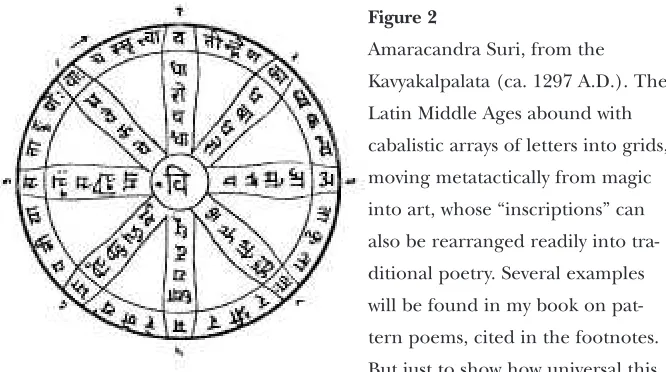
Of the roughly 1,100 pattern poems that I have collected from before 1900, probably 85 percent are representational in the sense of the above example, and only about 15 percent are as schematic as the one given in Figure 2, as an example of the other type.
Figure 2
Amaracandra Suri, from the Kavyakalpalata (ca. 1297 A.D.). The Latin Middle Ages abound with cabalistic arrays of letters into grids, moving metatactically from magic into art, whose “inscriptions” can also be rearranged readily into tra-ditional poetry. Several examples will be found in my book on pat-tern poems, cited in the footnotes. But just to show how universal this phenomenon is, here is an example in Gujarati, an Indian language from the area north of Bombay. This is one of many examples collected by Professor Hiralal R. Kapadia and printed in various issues of the Journal of the University of Bombayin 1954 and 1955 and elsewhere. Professor Kapadia gives written-out versions for this text and others, which would otherwise appear to be simply diagrams.
Modern visual poetry tends, however, to be far less mimetic. The visu-al element is often purely expressive and improvised, in the manner of an abstract expressionist painting. Or it is clean and geometrical. Or its forms are not those of natural objects, but of the ways and processes of nature. Thus the familiar Apollinaire rain calligram shows the words scattered down the page as rain falls, and not spread out into a lattice on the page, as if the falling raindrops could be photographed with a time-stop mechanism. The array of words may be schematic or linguistic; it may resemble the flow charts of a
sort of spatialized method which requires, for the fullest enjoyment of the piece, that we become sensitized to the spatial aspect of the piece. The space is not just a notation, at best a stand-in for time, as is the tendency in traditional poetry. Rather, it is a structural unit which may serve a large variety of purposes.
The Poem Transcends the Verbal Text Perhaps at this point the con-cept of metataxis should be introduced. This is a term used in anthropology to describe the shift in function (which determines a shift in identity) of an object from one situation to another. A horse, once a means of transportation, becomes a symbol of status or leisure. A bow and arrow, formerly an instrument of war or a hunting tool, is metatactically altered into being a child’s toy. Elsewhere I have pointed out how magical and cabalistic devices, originally intended as metaphors for a hidden truth, became instead
metaphors for an aesthetic truth; this explains the art forms of some of the earlier pattern poems.[4] A similar process seems to be involved, as one looks at the role of text in the concrete poems of the 1960s and before, and as one compares them with the poesia visi-vaworks of the 1970s.[5] These former usually consisted of arrays of letters or words, while the latter are for more visual than verbal or textual: many consist of photographs of people carrying words or even letters, others show something happening to the words or letters—a process of erasure, metamorphosis, dissolution, or reconstruction.
For anyone who has followed visual poetry or concrete poetry for any length of time, this distinction which I am making between the more text- or letter-oriented sort and the more purely visual variety will come as no surprise. Most of the works in the two major anthologies of the 1960s, those edited by Emmett Williams (An Anthology of Concrete Poetry, 1967) and by Mary Ellen Solt (Concrete Poetry: A World View, 1968) are of the first sort, while those in more recent books,
Klaus Peter Dencker (Text-Bilder: Visuelle Poesie International, 1972) include many examples of the latter. A number of the informal mag-azines devoted to the most visual sort of work have come out of Italy, and so this sort has come to be known by an Italian term for “visual poetry,” poesia visiva. Some writers such as Klaus Peter Dencker have tried to make a qualitative distinction and a hard line between con-crete poetry and “visual poetry” (by which he means poesia visiva) and Dencker is currently at work on a large anthology of poesia visiva
through the centuries—sculptural poems and object poems from the past, up to the most current sort of photographic poems. A hard-line qualitative distinction is, in my opinion, not possible, but a general quantitative one, based on the degree within the intermedial polarity between text or visual orientation, is useful for taxonomic purposes. Anyone who wants to distinguish and verbalize the differences between the concrete or verbal sort, as in the works of Eugen Gomringer, Mary Ellen Solt, the earlier Ian Hamilton Finlay, or Jonathan Williams, and the new works by Finlay (the sailboats), Alain Arias-Misson, or Thomas Ockerse, will find this distinction useful. For those photographic sequence-works of poesia visivathat are extremely close to some works of concept art, such as some pieces by Robert Smithson, it is almost impossible to get a sense of text when one reads the work. In a piece by Jean-Francois Bory, one sees pho-tographs of a book left on the send, the tide comes in and bears it away—and it sinks. There may have been words in the book. But does it matter what these were? The criteria for evaluating the nature and impact of such a work are those which would be used for photo-journalism or for a performance—in fact, such a work tends to feel like the documentation of a performance which one is to imagine, but which may or may not have taken place. Not only the grammar of the text is gone, but the words as well. Because there is so much of this poesia visivabeing done right now, one is apt to forget that it has been done for a long time. It is nearly twenty years since Emmett Williams’s “Poetry Clock” (1959) was made; it appeared in his
ings of the Swiss school, of the postwar years, which are historically ancestral to the term “concrete poetry,” can be regarded as wordless poems. I mean of course paintings by Richard Löhse, the early Karl Gerstner, and Max Bill, the last of whom called many of his works which appeared to be physical realizations (concretizations?) of an intellectual principle or progression “Konkretionen,” which we would translate as “concretions.” His secretary in the early 1950s was Eugen Gomringer, to whom the term “concrete poetry” is usually attributed, and who used the term by analogy to Bill’s works. Many works by Bill and Lohse and others of that group consist of series and progressions and even permutations, and the progressions of shapes or colors are analogous to the behavior of verbal elements in what are sometimes referred to as “Proteus poems” after a famous poem by Julius Caesar Scaliger. In the paintings, the progression is one of verbal units. Here are two examples, the first from Scaliger’s “Proteus” (ca. 1561):[6]
Perfide sperasti divos to fallere Proteu Perfide to divos sperasti fallere Proteu Perfide to sperasti divos fallere Proteu Perfide to Proteu sperasti fallere divos Perfide sperasti to divos fallere Proteu
And here is a brief passage from Jackson Mac Low’s “Jail Break (for Emmett Williams & John Cage) September 1963. April & August 1966:”[7]
Tear now jails down all. Tear all now down jails. Tear now all jails down. Tear jails now all down. Tear jails now down all.
The relation of such “Proteus poems” to concrete poetry is that what syntax there is is geometric rather than, as in traditional poetry, algebraic—cumulative rather than linear. The elements taken sepa-rately have no particular power or impact. But each line gets nearly
poetry the lines normally make some sense even when isolated. In a geometric painting, shapes get their relevance from their relation to other shapes, and in a “Proteus poem” the pattern of the compo-nents is far more important than just what they happen to be.
In fact, in many cases the pattern is made clearer and more vivid by using elements that relate to words but are not words—numbers, the letters of the alphabet, or visual vocabularies. I made a series of one-of-a-kind (mostly) silk-screen prints using a vocabulary of 300 ele-ments, repeated and juxtaposed in a variety of ways to make almost 900 different works. There is no need for the viewer to see all the works in this series, which is called 7.7.73; there is just enough infor-mation to establish the pattern in a clear and indelible way. Each work in the series is analogous to a line in a poem—and in a
“Proteus poem” there is seldom a need to go through every possible line, every possible permutation. The lines of such a work tend to be synecdochal—the parts of the work can stand for the whole. Many of Emmett Williams’s pieces in his Anthology of Concrete Poetry will serve as examples of the alphabet-poem genre, and the number poems of Richard Kostelanetz or Ladislav Nebesky can illustrate this latter category. Some works of visual art are analogous to these poems—especially certain paintings by Jasper Johns and Robert Indiana. But these latter seem, for the most part, geared to a luxury market and not to the page or the poor connoisseur’s library: for social reasons, one would tend, then, to class these last as paintings more than as poems.
The Transcendent Text In the works which I have discussed up to now, the effect has been seen of the introduction of spatial consider-ations and visual elements into verbal materials, progressively, until their structure is no longer dependent upon any verbal text, though something of a verbal method of experiencing the work remains— the process of reading, of abstracting a sort of verbal pattern from