*corresponding author : [email protected]
The
SLCO1B1
*15 haplotype associated
with lower clinical outcome in Indonesian
tuberculosis patients
Sunarto Ang1*, Akhmad Kharis Nugroho2, Ahmad Hamim Sadewa3, Lukman Hakim4,
Mustofa5
1Department of Internal Medicine, Abdul Wahab Sjahranie General Hospital, Samarinda, 2Department of Pharmaceutics, Faculty of Pharmacy, 3Department of Biochemistry, Faculty of Medicine, 4Department of Pharmacology and Clinical Pharmacy, Faculty of Pharmacy, 5Department of Pharmacology and Therapeutic, Faculty of Medicine, Universitas Gadjah Mada, Yogyakarta, Indonesia
DOI: http://dx.doi.org/10.19106/JMedSci0050012018016
ABSTRACT
Rifampin is one of first-line drugs for the treatment of tuberculosis. In Indonesia nearly all tuberculosis patients show lower rifampin plasma concentrations possibly due to genetics. Rifampin is a substrate of the organic anion-transporting polypeptide 1B1 (OATP 1B1) encoded by the solute carrier organic anion transporter family member 1B1 (SLCO1B1). This study aimed to identify haplotype polymorphisms of tuberculosis drug transporters with an impact on clinical outcome in tuberculosis patients. Thirty-six patients from Abdul Wahab Sjahranie General Hospital, Samarinda, East Kalimantan were involved in the study. Buffy coat from patient blood samples were tested for SLCO1B1 and SLCO1B3
polymorphisms by RFLP and ARMS PCR, whereas the clinical outcome was examined based on the sputum conversion. The frequency of patients with SLCO1B1*15 haplotype was 63.9%. The SLCO1B1*15 haplotype was associated with susceptibility to failure of clinical outcome (p=0.005; RR=4.52; 95% CI: 1.22-16.64). The OATP1B1*15 haplotype revealed that the failure of clinical outcome was markedly increased compared to the three other haplotypes. These results suggest that the SLCO1B1*15 haplotype is an important predisposing factor for lower clinical outcome. Our data indicate that individualized treatment should be considered for Indonesian tuberculosis patients based on genetics characteristics of patients.
ABSTRAK
berhubungan dengan risiko kegagalan pengobatan hasil klinis (p=0,005; RR=4,52; 95% CI: 1,22-16,64). OATP1B1*15 haplotipe mengungkapkan bahwa kegagalan hasil klinis lebih tinggi dibandingkan ketiga haplotipe lainnya. Hasil penelitian ini terbukti
SLCO1B1*15 haplotipe merupakan faktor predisposisi penting untuk memprediksi rendahnya luaran klinis. Disarankan agar pengobatan penderita tuberkulosis secara individu harus dipertimbangkan berdasarkan karakteristik genetik pasien.
Keyword:
INTRODUCTION
Tuberculosis (TB) is one of the major mortality risks in the world and is caused by Mycobacterium tuberculosis, which infects over 2 billion people, or almost one third of the world’s 7 billion population.1 Indonesia has the second ranked largest number of cases in the world. Rifampin (RIF) is a key component in the treatment regimen and due to its eicacy is used as a primary anti-TB drug.1,2 The development of resistance to RIF is found to be related to RIF concentrations.3 Despite this concern, there is limited RIF dosing information to ensure optimal outcome. A number of studies have shown interindividual RIF pharmacokinetic variability4,6 and this genetic diversity may support the need to increase RIF dosage in Indonesian TB patients.7 Recent research has explored a link between genetics and treatment eicacy4,8 and the present study is the irst to assess genetic diversity in Indonesian patients with conirmed diagnosis of pulmonary TB (PTB) and extrapulmonary TB (EPTB). In evaluating clinical outcomes, we examined major single-nucleotide polymorphisms (SNPs) of SLCO1B1 and SLCO1B3. considering genetic aspects potentially inluential on the reduced levels of RIF concentrations.
As a substrate of organic anion transporting polypeptides OATP1B1 (coded by SLCO1B1) and OATP1B3 (coded by SLCO1B3),9,10 SNP research has associated the SLCO1B1 SNP
C463A4 and rs41490328 with reduced RIF exposure. Other recent studies showed that it did not inluence the exposure and involves genetic variability11,12 while presently there are no studies of the major SNPs in Indonesian patients. This study aimed to determine the major SNPs which may inluence eicacy of treatment among Indonesian PTB and EPTB patients and the second objective of the study was to evaluate their potential impact on the clinical outcome. Applying our assessment of genetic variability to clinical outcomes, the data may assist in therapeutic-drug treatment schedules and monitoring in PTB and EPTB patients in Indonesia.
MATERIALS AND METHODS
Participants
ixed-dose combination tablets (4FDC) with 150 mg rifampin, 75 mg isoniazid, 400 mg pyrazinamide and 275 mg ethambutol. Following Indonesian standard tuberculosis treatment guidelines, patients < 38 kg received 2 tablets daily, those weighing 38 to 54 kg received 3 tablets, 55 to 70 kg received 4 tablets daily and patients > 71 kg received 5 tablets once daily.13 All patients received TB drugs from the same manufacturer. The following variables were available: sex, age, BMI, ethnic and clinical outcome, including sputum smear and post-treatment biopsy. The study has been approved by the Medical and Health Research Ethics Committee, Faculty of Medicine, Universitas Gadjah Mada, Yogyakarta.
Genotyping
We extracted blood sample DNA from the bufy coat by using the GeneJET Genomic DNA Puriication Kit #K0722 (Thermo Fisher Scientiic). We used the restriction fragment length polymorphism (RFLP) PCR for allelic discrimination in genotyping [SLCO1B1
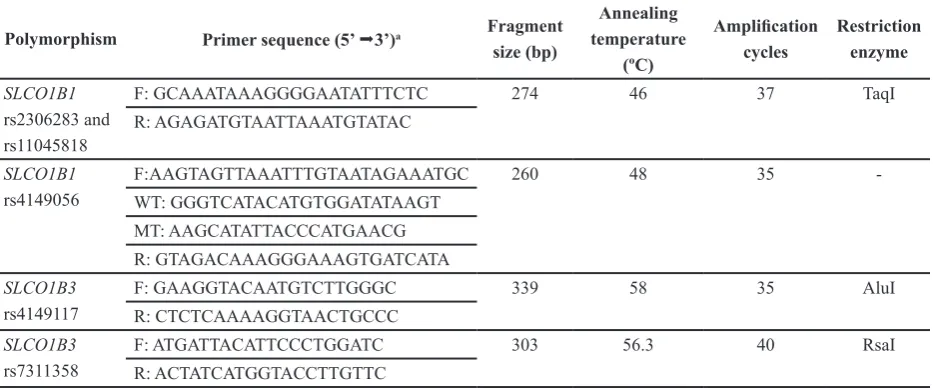
rs2306283 (c.388 A>G), SLCO1B1 rs11045818 (c.411 G>A), SLCO1B3 rs4149117 (c.334 T>G) and rs7311358 (c.699 G>A)] and the ampliication refractory mutation system (ARMS) PCR [SLCO1B1 rs4149056 (c.521T>C)]. Primers were sourced from Integrated DNA Technologies (Coralville, Iowa, USA). Two samplesof each genotype were directly sequenced to conirm and validate our genotyping results with Applied Biosystems 3730 DNA Analyzer. The protocol to prepare the PCR involved an initial denaturation step at 94°C for 5 to 7 min, followed by 35 to 40 cycles of denaturation at 94°C for 30 to 60 s and then annealing temperature for 30 to 60 s and extension at 72°C for 30 to 60 s (TABLE 1). All PCR ampliications were conducted in a PCR-engine apparatus T100TM Thermal Cycler (Bio-Rad Life Science, USA). Restriction enzymes were sourced from Thermo Fisher Scientiic. TABLE 1 below identiies the following SNPs based on allele frequencies previously shown to be involved in drug transport from the blood to the liver.
TABLE 1. Primers and PCR conditions used for genotyping of gene polymorphisms
Polymorphism Primer sequence (5’ 3’)a Fragment
size (bp)
Annealing temperature
(ºC)
Ampliication
cycles
Restriction enzyme
SLCO1B1 rs2306283 and rs11045818
F: GCAAATAAAGGGGAATATTTCTC 274 46 37 TaqI
R: AGAGATGTAATTAAATGTATAC
SLCO1B1 rs4149056
F: AAGTAGTTAAATTTGTAATAGAAATGC 260 48 35
-WT: GGGTCATACATGTGGATATAAGT
MT: AAGCATATTACCCATGAACG
R: GTAGACAAAGGGAAAGTGATCATA
SLCO1B3 rs4149117
F: GAAGGTACAATGTCTTGGGC 339 58 35 AluI
R: CTCTCAAAAGGTAACTGCCC
SLCO1B3 rs7311358
F: ATGATTACATTCCCTGGATC 303 56.3 40 RsaI
R: ACTATCATGGTACCTTGTTC
For SLCO1B1 rs2306283 and rs11045818, the PCR product was digested using 5U of restriction enzyme at 65°C overnight. The products of restriction were placed in 3% agarose gel for electrophoresis and visualized by ethidium bromide staining. The restriction pattern consists of four distinct zones (154, 142, 132 and 119 bp), each representative for 388A>G and 411G>A wild-type and mutant alleles. This pattern in descending order stands for the two polymorphisms as follows: 154 bp for 411A, 142 bp for 388A, 132 bp for 411G and 119 bp for 388G.14
For SLCO1B1 rs4149056, the tetra primer used in ARMS-PCR with slight modiications.15 Because the restriction endonuclease was unnecessary, the PCR products were detected by means of 2% agarose gel with electrophoresis and by ethidium bromide staining. This pattern stands for the polymorphisms as follows: wild-type (260 and 179 bp); heterozygote (260, 123 and 179 bp) and mutant (260 and 123 bp). For SLCO1B3 rs4149117, the PCR product was digested using 5U of restriction enzyme at 37°C overnight. The products of restriction were placed in 2% agarose gel for electrophoresis and visualized by ethidium bromide staining. The restriction pattern consists of two distinct
zones (253 and 213 bp). This pattern stands for the polymorphisms as follows: wild-type (253 bp); heterozygote (253 and 213 bp) and mutant (213 bp).16
For SLCO1B3 rs7311358, the PCR product was digested using 5U of restriction enzyme. The restriction pattern consists of two distinct zones (242 and 275 bp). This pattern stands for the polymorphisms as follows: wild-type (242 bp); heterozygote (242 and 275 bp) and mutant (275 bp).16 In follow-up we assessed the clinical outcome with sputum conversion (PTB) or tissues through ine needle aspiration biopsy (EPTB). We compared the pre and post-treatment results. We categorized success if sputum conversion or lesions typically disappeared and improved histopathologically after the initiation of treatment. The failure of treatment outcome meant sputum conversion or lesions did not disappear and did not improve histopathologically.
Statistical analysis
RESULTS
Thirty-six tuberculosis patients including 24 (66.7%) PTB and 12 (33.3%) EPTB were
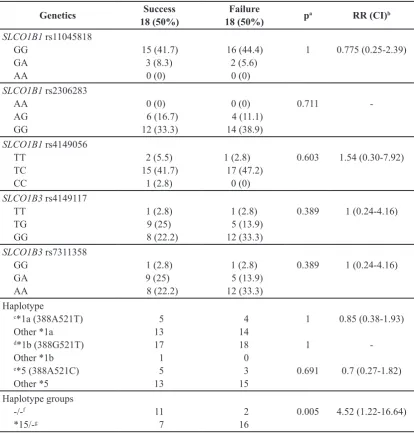
The two most common SLCO1B1 SNPs (c.521T>C and c.388A>G) form four functionally distinct haplotypes: SLCO1B1*1a (c.388A-c.521T, as reference haplotype), *1b (c.388G-c.521T), *5 (c.388A-c.521C), and *15 (c.388G-c.521C).17-19 All polymorphisms
were in Hardy-Weinberg equilibrium. The patients carrying at least one *15 haplotype had a signiicantly increased risk for failure treatment (p=0.005), and subjects carrying the *15 haplotype had a 4.52-fold signiicantly
elevated risk (95% CI: 1.22-16.64) for failure of treatment. The SLCO1B1 rs11045818 was not analyzed due to its insigniicance. The SLCO1B3 rs4149117 and rs7311358 polymorphisms did not have a statistically signiicant association with clinical outcome. We evaluated the diferences in the haplotype-associated efects on clinical outcome, which also were associated with diferences in overall drug exposures (TABLE 3).
involved in this study. The demographics and genetics patients are presented in TABLE 2.
TABLE 2. Demographics and genotype description of cohort
Demographics Median (range) or n (%)
Male 22 (61.11%) Female 14 (38.89%)
Age (years) Body weight (kg) Height (m) BMI (kg/m2)
42 (23-60) 48 (37-65) 1.56 (1.42-1.72)
20.1 (16-27.7)
39 (16-65) 46.5 (35-98) 1.51 (1.4-1.63) 21.4 (15.4-38.3)
Genetics Homozygous wild type,
n (%)
Heterozygous mutant type, n (%)
Homozygous mutant type, n (%)
SLCO1B1 rs11045818 SLCO1B1 rs2306283 SLCO1B1 rs4149056 SLCO1B3 rs4149117 SLCO1B3 rs7311358
31 (86.11) 0 (0) 3 (8.33) 2 (5.55) 2 (5.55)
5 (13.89) 10 (27.78) 32 (88.89) 14 (38.89) 14 (38.89)
0 (0) 26 (72.22)
1 (2.78) 20 (55.56) 20 (55.56)
Haplotype n (%) Male, n (%) Female, n (%)
SLCO1B1 *1a SLCO1B1 *1b SLCO1B1 *5 SLCO1B1 *15
9 (25) 35 (97.2)
8 (22.2) 23 (63.9)
3 (13.6) 22 (100) 3 (13.6)
11 (50)
6 (42.8) 13 (92.3)
5 (35.7) 12 (85.7)
TABLE 3. Response treatment based on genotype of TB patients (n = 36)
aData are calculated using Fisher’s exact test, bRisk ratio (Conidence Interval), c*1a including (*1a/*1a, *1a/*1b, *1a/*15), d*1b including (*1b/*1b, *1a/*1b, *1b/*5, *1b/*15), e*5 including (*1b/*5, *1a/*5, *5/*5, *5/*15), f-/- including (*1a/*1a, *1a/*1b, *1b/*1b), g*15/- indicates at least one *15 allele (*1b/*15, *1a/*15, *5/*15, *15/*15).
DISCUSSION
Our study is the irst in an Indonesian population to demonstrate that the SLCO1B1*15 haplotype can be associated with clinical outcome in patients with PTB and EPTB. Among the TB patients with lower RIF concentrations,20 we found this haplotype in 63.9%, which is consistent with other
of drug transporters and related demographics on clinical outcome. We analyzed factors that could inluence outcome of treatment in Indonesian PTB and EPTB patients. The variable - SLCO1B1*15 haplotype -was found to signiicantly afect the clinical outcome. We identiied a signiicant link between SLCO1B1*15 haplotype and treatment,21-23 which could be explained by decreased hepatocellular uptake due to reduced drug transporter activity mediated by OATP1B1.24
Some studies examining both peak plasma concentration (Cmax) and area under the curve (AUC) of RIF exposure have demonstrated deinite correlation with clinical outcomes.25,26 Related to genetic diversity, advances in genotyping of SLCO1B1 rs11045818 have identiied a synonymous variant (411G>A) (https://www.ncbi.nlm.nih.gov/clinvar/ variation/307936/). For SLCO1B3, we did not observe any signiicant pharmacogenetic efects due to its limited impact. Our indings conirmed there is some efect of the SLCO1B1*15 haplotype on RIF exposure and treatment outcome, but presently it is not well understood. Although c.521T>C and c.388A>G SNPs appear to be insigniicant, the SLCO1B1*15 haplotype (which includes both SNPs) has been consistently associated with reduced OATP1B1 transport activity.21
There were also some limitations in our study. For example, all of our investigated patients were coadministered isoniazid, ethambutol and pyrazinamide with RIF, and thus any confounding efects of medicines could not be fully eliminated in this study. Nonetheless, the present results indicate that OATP1B1 variants may be involved in the failure of clinical outcome and provide a new potential failure risk for patients with this disease.
CONCLUSION
Our inal results show the SLCO1B1*15 haplotype exists in the Indonesian population and is associated with the efect of reducing the clinical outcome. This link was examined in an Indonesian population with PTB and EPTB. Because of high frequency of the SLCO1B1*15 haplotype compared to non-*15 haplotype, our data suggests that this genotype may provide some prediction for clinical outcome and therefore, specialized diagnosis and treatment should be considered for select Indonesian patients discriminatively based on individual genetic assessment. Actual clinical studies are needed to evaluate and conirm the variability of genotypes for the general population.
ACKNOWLEDGMENTS
We are grateful to the volunteers participating in this study. We also thank the staf of the I.A. Moeis District Hospital, Faculty of Medicine and Faculty of Pharmacy, Universitas Gadjah Mada who give us valuable assistance during the study.
REFERENCES
1. Diacon AH, Patientia RF, Venter A, van Helden PD, Smith PJ, McIlleron H, et al. Early bactericidal activity of
high-dose rifampin in patients with pulmonary tuberculosis evidenced by positive sputum smears. Antimicrob Agents Chemother 2007;
51(8):2994-96.
http://dx.doi.org/10.1128/AAC.01474-06 2. Weiner M, Benator D, Burman W, Peloquin
CA, Khan A, Vernon A, et al. Association
between acquired rifamycin resistance and the pharmacokinetics of rifabutin and isoniazid
among patients with HIV and tuberculosis. Clin Infect Dis 2005; 40(10):1481-91.
3. Gumbo T, Louie A, Deziel MR, Liu W,
Parsons LM, Salinger M, et al.
Concentration-dependent mycobacterium tuberculosis killing and prevention of resistance by rifampin. Antimicrob Agents Chemother
2007; 51(11):3781-8.
http://dx.doi.org/10.1128/AAC.01533-06 4. Weiner M, Peloquin C, Burman W, Luo
CC, Engle M, Prihoda TJ, et al. Efects of tuberculosis, race, and human gene SLCO1B1
polymorphisms on rifampin concentrations. Antimicrob Agents Chemother 2010;
54(10):4192-200.
http://dx.doi.org/10.1128/AAC.00353-10 5. Pasipanodya JG, Srivastava S, Gumbo T.
Meta-analysis of clinical studies supports
the pharmacokinetic variability hypothesis for acquired drug resistance and failure of antituberculosis therapy. Clin Infect Dis
2012; 55(2):169-77.
http://dx.doi.org/10.1093/cid/cis353
6. Srivastava S, Pasipanodya JG, Meek C, Lef R, Gumbo T. Multidrug-resistant tuberculosis not due to noncompliance but to between-patient pharmacokinetic variability. J Infect Dis 2011; 204(12):1951-9.
http://dx.doi.org/10.1093/infdis/jir658
7. Ruslami R, Nijland HM, Alisjahbana B, Parwati I, van Crevel R, Aarnoutse RE. Pharmacokinetics and tolerability of a higher
rifampin dose versus the standard dose in pulmonary tuberculosis patients. Antimicrob
Agents Chemother 2007; 51(7):2546-51. http://dx.doi.org/10.1128/AAC.01550-06 8. Chigutsa E, Visser ME, Swart EC, Denti P,
Pushpakom S, Egan D, et al. The SLCO1B1
rs4149032 polymorphism is highly prevalent
in South Africans and is associated with
reduced rifampin concentrations: dosing implications. Antimicrob Agents Chemother
2011; 55(9):4122-7.
http://dx.doi.org/10.1128/AAC.01833-10
9. Vavricka SR, Van Montfoort J, Ha HR, Meier PJ, Fattinger K. Interactions of rifamycin SV
and rifampicin with organic anion uptake systems of human liver. Hepatology 2002;
36(1):164-72.
http://dx.doi.org/10.1053/jhep.2002.34133
10. Tamai I, Nozawa T, Koshida M, Nezu J, Sai Y,
Tsuji A. Functional characterization of human organic anion transporting polypeptide B
(OATP-B) in comparison with liver-speciic OATP-C. Pharm Res 2001; 18(9):1262-9.
http://dx.doi.org/10.1023/A:1013077609227
11. Ramesh K, Hemanth Kumar AK, Kannan T, Vijayalakshmi R, Sudha V, Manohar Nesakumar S, et al. SLCO1B1 gene polymorphisms do not inluence plasma rifampicin concentrations in a South Indian population. Int J Tuberc Lung Dis 2016; 20(9):1231-5.
http://dx.doi.org/10.5588/ijtld.15.1007
12. Seng KY, Hee KH, Soon GH, Chew N, Khoo SH, Lee LS. Population pharmacokinetics of rifampicin and 25-deacetyl-rifampicin in healthy Asian adults. J Antimicrob Chemother 2015; 70(12):3298-306.
http://dx.doi.org/10.1093/jac/dkv268
13. Ministry of Health RoI. Indonesian Tuberculosis Treatment Guidelines [Internet].
2014 [cited 2017 Jan 3]. Available from:
http://www.tbindonesia.or.id/2015/02/11/
buku-bpnptb-2014
14. Giannakopoulou E, Ragia G, Kolovou V, Tavridou A, Tselepis AD, Elisaf M, et al. No impact of SLCO1B1 521T>C, 388A>G and
411G>A polymorphisms on response to statin therapy in the Greek population. Mol Biol
Rep 2014; 41(7):4631-8.
h t t p : / / d x . d o i . o r g / 1 0 . 1111 / j . 1 7 4 5
-7254.2007.00643.x
16. Tsujimoto M, Hirata S, Dan Y, Ohtani H, Sawada Y. Polymorphisms and linkage disequilibrium of the OATP8 (OATP1B3) gene in Japanese subjects. Drug Metab Pharmacokinet 2006; 21(2):165-9.
http://dx.doi.org/10.2133/dmpk.21.165
17. Tirona RG, Leake BF, Merino G, Kim RB. Polymorphisms in OATP-C: identiication
of multiple allelic variants associated with
altered transport activity among European- and African-Americans. J Biol Chem 2001; 276(38):35669-75.
http://dx.doi.org/10.1074/jbc.M103792200
18. Nozawa T, Nakajima M, Tamai I, Noda K, Nezu J, Sai Y, et al. Genetic polymorphisms of human organic anion transporters OATP-C (SLC21A6) and OATP-B (SLC21A9): allele frequencies in the Japanese population and functional analysis. J Pharmacol Exp Ther 2002; 302(2):804-13.
http://dx.doi.org/10.2133/dmpk.21.165
19. Niemi M, Schaefeler E, Lang T, Fromm MF, Neuvonen M, Kyrklund C, et al. High plasma
pravastatin concentrations are associated with single nucleotide polymorphisms and haplotypes of organic anion transporting
polypeptide-C (OATP-C, SLCO1B1).
Pharmacogenetics 2004; 14(7):429-40.
http://dx.doi.org/10.2133/dmpk.21.165 20. van Crevel R, Alisjahbana B, de Lange WC,
Borst F, Danusantoso H, van der Meer JW, et
al. Low plasma concentrations of rifampicin
in tuberculosis patients in Indonesia. Int J Tuberc Lung Dis 2002; 6(6):497-502.
https://doi.org/10.5588/09640569513002
21. Kameyama Y, Yamashita K, Kobayashi K, Hosokawa M, Chiba K. Functional characterization of SLCO1B1 (OATP-C) variants, SLCO1B1*5, SLCO1B1*15 and SLCO1B1*15+C1007G, by using transient
expression systems of HeLa and HEK293 cells. Pharmacogenet Genomics 2005; 15(7):513-22.
h t t p s : / / d o i . o r g / 1 0 . 1 0 9 7 / 0 1 . fpc.0000170913.73780.5f
22. Nozawa T, Minami H, Sugiura S, Tsuji A,
Tamai I. Role of organic anion transporter
OATP1B1 (OATP-C) in hepatic uptake of irinotecan and its active metabolite, 7-ethyl-10-hydroxycamptothecin: in vitro evidence and efect of single nucleotide polymorphisms. Drug Metab Dispos 2005; 33(3):434-9.
http://dx.doi.org/10.1124/dmd.104.001909
23. Iwai M, Suzuki H, Ieiri I, Otsubo K, Sugiyama Y. Functional analysis of single
nucleotide polymorphisms of hepatic organic
anion transporter OATP1B1 (OATP-C). Pharmacogenetics 2004; 14(11):749-57. h t t p s : / / d o i . o rg / 1 0 . 1 0 9 7 / 0 0 0 0 8 5 7 1 -200411000-00006
24. Tirona RG, Leake BF, Wolkof AW, Kim
RB. Human organic anion transporting
polypeptide-C (SLC21A6) is a major determinant of rifampin-mediated pregnane X receptor activation. J Pharmacol Exp Ther 2003; 304(1):223-8.
http://dx.doi.org/10.1124/jpet.102.043026
25. Pasipanodya JG, McIlleron H, Burger A, Wash PA, Smith P, Gumbo T. Serum drug
concentrations predictive of pulmonary
tuberculosis outcomes. J Infect Dis 2013; 208(9):1464-73.
http://dx.doi.org/10.1093/infdis/jit352
26. Jayaram R, Gaonkar S, Kaur P, Suresh BL, Mahesh BN, Jayashree R, et al.
Pharmacokinetics-pharmacodynamics of
rifampin in an aerosol infection model of tuberculosis. Antimicrob Agents Chemother
2003; 47(7):2118-24.