Journal of Physics: Conference Series
PAPER • OPEN ACCESS
Yttria-Stabilized Zirconia Ceramic Deposition on
SS430 Ferritic Steel Grown by PLD - Pulsed Laser
Deposition Method
To cite this article: Abu Khalid Rivai et al 2017 J. Phys.: Conf. Ser. 799 012016
View the article online for updates and enhancements.
Related content
High Temperature Materials; The Controlling Physical Processes S W J Hopkins
-High temperature materials R J E Glenny
-Large-area production of yttria-stabilized zirconia by pulsed laser deposition N Pryds, J Schou and S Linderoth
Yttria-Stabilized Zirconia Ceramic Deposition on SS430
Ferritic Steel Grown by PLD - Pulsed Laser Deposition
Method
Abu Khalid Rivai1,*, Mardiyanto1, Agusutrisno2, Edi Suharyadi2
1Center For Science and Technology of Advanced Materials – National Nuclear
Energy Agency of Indonesia BATAN, Kawasan PUSPIPTEK Gd. 71, Tangerang Selatan, Banten, 15314, Indonesia
2
Dept. of Physics, Faculty of Mathematics and Natural Science, Gadjah Mada University, Bulaksumur, Daerah Istimewa Yogyakarta 55281, Indonesia
Email: [email protected]
Abstract. Development of high temperature materials are one of the key issues for the deployment of advanced nuclear reactors due to higher temperature operation. One of the candidate materials for that purpose is ceramic-coated ferritic steel that one of the functions is to be a thermal barrier coating (TBC). Thin films of YSZ (Ytrria-Stabilized Zirconia) ceramic have been deposited on a SS430 ferritic steel using Pulsed Laser Deposition (PLD) at Center For Science and Technology of Advanced Materials laboratory – National Nuclear Energy Agency of Indonesia (BATAN). The thin film was deposited with the chamber pressure range of 200-225 mTorr, the substrate temperature of 800o
C, and the number of laser shots of 3×10⁴ , 6×10⁴
and 9×10⁴
. Afterward, the samples were analyzed using Scanning Electron Microscope – Energy Dispersive X-ray Spectroscope (SEM-EDS), X-Ray Diffractometer (XRD), Atomic Force Microscope (AFM) and Vickers hardness tester. The results showed that the YSZ could homogeneously and sticky deposited on the surface of the ferritic steel. The surfaces were very smoothly formed with the surface roughness was in the range of 70 nm. Furthermore, thickness, composition of Zr4+
dan Y3+
, the crystallinity, and hardness property was increased with the increasing the number of the shots.
1. Introduction
Development of high temperature materials are one of the key issues for the deployment of systems in many fields such as advanced nuclear reactors due to the need of higher temperature operation. One of the candidate materials for that purpose is ceramic coating on the structural materials [1-5]. The coating is able to protect the substrate materials from corrosion [6]. The techniques of the coating are mostly done by electron beam physical vapor deposition (EB-PVD) [2] and plasma spray coating [4,5,7]. Nevertheless, in order to minimize micro porous the new technique for coating i.e. pulsed laser deposition (PLD) has been reported [1]. It has been reported that the PLD technique is used in many field [8-15] and able to deposit not only ceramic but also polymer material [16].
International Conference on Advances in Nuclear Science and Engineering 2015 IOP Publishing
In this study ceramic-coated ferritic steel that one of the functions is to be a thermal barrier coating (TBC) is reported. YSZ (Ytrria-Stabilized Zirconia, Y2O3 – ZrO2) ceramic was used as the target for
coating using PLD technique. YSZ material has advantages as coating materials to protect the substrate at high temperature [17]. The purpose of the study is to develop high quality of coating layer with smooth roughness of surface and minimizing porosity.
2. Experiment
Thin films of YSZ (Ytrria-Stabilized Zirconia) ceramic have been deposited on a SS430 ferritic steel using Pulsed Laser Deposition (PLD) at laboratory facilities of Center For Science and Technology of Advanced Materials –National Nuclear Energy Agency of Indonesia (BATAN). Figure 1 (a) shows the schematic of the PLD and Figure 1 (b) shows the plume formation during deposition. It can be seen this PLD is able to use multiple target in the carrousel. Furthermore, performance of the plume during deposition is able to be seen and analyzed during deposition through a glass window. The parameter condition of the experiment can be seen in the Table 1. The target was 8YSZ (8%mol Y2O3 – 92%mol
ZrO2) and the substrate was SS430 ferritic steel with the content of chromium is up to 15%. Solid state
laser of Nd:YAG was used in this PLD with the wavelength of 266 nm and the energy of ~100 mJ.
Figure 1. PLD – Pulsed Laser Deposition (a) schematic (b) plume formation during depostion.
Table 1. Parameter of experiment Parameter Condition Laser repetition pulsed 5 ns
2
International Conference on Advances in Nuclear Science and Engineering 2015 IOP Publishing
After deposition of the steel with YSZ target, the samples were analyzed using Scanning Electron Microscope – Energy Dispersive X-ray Spectroscope (SEM-EDS), X-Ray Diffractometer (XRD), Atomic Force Microscope (AFM) and Vickers hardness tester.
3. Results and Discussion
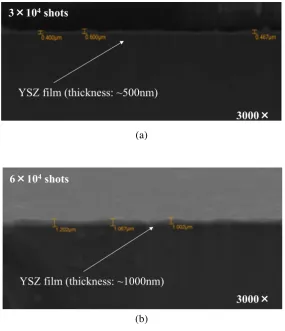
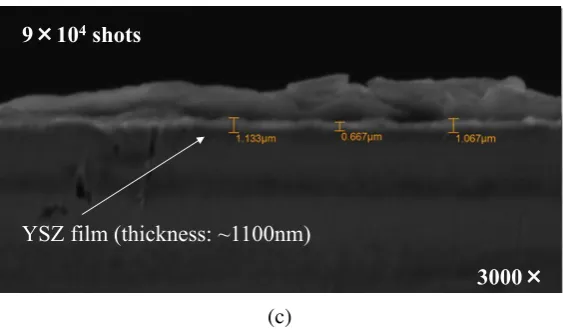
Figure 2 show SEM micrographs of samples cross section to investigate the film deposition on the steel with various shots i.e. 3x10⁴ shots, 6x10⁴ shots and 9x10⁴ shots. It was found that the thickness of
the coating layer were ~0.5, 1, and 1.1 µm for 3x10⁴ shots, 6x10⁴ shots, and 9x10⁴ shots, respectively.
The results showed that the thickness of the coating layer was increase with the increasing of the shots. Figure 3 show SEM micrographs of samples surface with EDS area analyses to investigate the deposition of YSZ on the steel with various shots i.e. 3x10⁴ shots and 9x10⁴ shots. The EDS analyses
of zirconium and yttrium percentages on the steel with various shots are shown in Table 2. The results showed that the percentages of zirconium and yttrium were increased with the increasing of the shots. The percentages analyses mean that the thickness of the layer was increased with the increasing of the shots.
3×10⁴shots
3000×
YSZ film (thickness: ~500nm)
(a)
3000×
YSZ film (thickness: ~1000nm)
6×10⁴shots
(b)
International Conference on Advances in Nuclear Science and Engineering 2015 IOP Publishing
3000× YSZ film (thickness: ~1100nm)
9×10⁴shots
(c)
Figure 2. SEM micrographs of samples cross section to investigate the film deposition on the steel with various shots (a) 3x10⁴ shots (b) 6x10⁴ shots and (c) 9x10⁴ shots
3×10⁴shots 9×10⁴shots
Figure 3. SEM micrographs of samples surface with EDS area analyses to investigate the deposition of YSZ on the steel with various shots (a) 3x10⁴ shots and (b) 9x10⁴ shots
Table 2. EDS analyses of zirconium and yttrium percentages on the steel with various shots
Elements / Parameter
3x10⁴ shots 9x10⁴ shots
% mass % atom % mass % atom Zr 8.33 3.72 34.25 13.85 Y 2.88 1.33 6.74 2.87
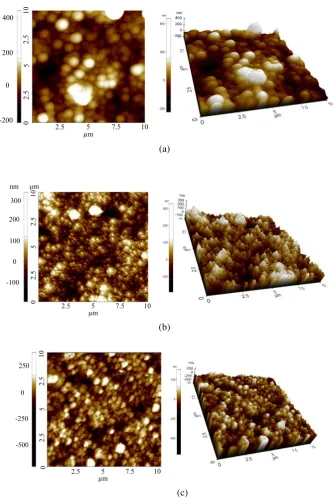
Figure 4 show the AFM - Atomic Force Microscope topography analyses of the samples’s surface (2 and 3 dimensions) for 3x10⁴ number of shots, 6x10⁴ number of shots and 9x10⁴ number of shots.
The results showed that the roughness of the coating layer was in the nano-meter scale i.e. ~70 nm for all the cases. It is found that the PLD technique for ceramic coating could develop very smooth layer and minimize the formation of micro porous. As comparison analysis, it has been reported that using plasma sprayed technique the surface roughness was 10 µm and using EB-PVD technique the surface roughness was 1 µm [18]. Therefore, PLD technique has advantage to develop very smooth surface of coating.
4
International Conference on Advances in Nuclear Science and Engineering 2015 IOP Publishing
400
Figure 4. AFM - Atomic Force Microscope topography analyses of the sample’s surface (2 and 3 dimensions) (a) 3x10⁴ number of shots (b) 6x10⁴ number of shots (c) 9x10⁴ number of
shots
Figure 5 show XRD analyses of the samples for 2 between 20-90˚ and 2 between 20-40˚. The results showed that the ceramic YSZ was deposited on the layer of the substrate with the indication of YSZ peaks. Furthermore, the substrate peaks were decrease with the increasing of the PLD shots and the crystanillity of the YSZ layer was increase with the increasing of the shots. It happen because with the increasing of the shots the thickness of the layer was increase.
International Conference on Advances in Nuclear Science and Engineering 2015 IOP Publishing
(a)
(b)
Figure 5. XRD analyses of the samples: (a) 2 between 20-90˚, and (b) 2 between 20-40˚
Table 3. Surface hardness of the samples
Number of shots Hardness (VHN)
3x10⁴ 167
6x10⁴ 182
9x10⁴ 184
Table 3 show the surface hardness of the samples with the various of the number of shots. The results showed that the hardness property was increased with the increasing the number of the shots. The surface hardness was contributed from the hardness of the thin film and the hardness of the substrate. The increasing of the number of shots increased the thickness of the coating layer therefore it minimized the contribution of the hardness of the substrate. It means that the hardness of YSZ is higher than the steel and finally the hardness is only the property of the YSZ coating layer.
6
International Conference on Advances in Nuclear Science and Engineering 2015 IOP Publishing
4. Conslusions
Thin films of YSZ (Ytrria-Stabilized Zirconia) ceramic have been deposited on a SS430 ferritic steel using Pulsed Laser Deposition (PLD) technique with the chamber pressure range of 200-225 mTorr,
increased with the increasing the number of the shots. The PLD technique is potential to be used for coating of YSZ on the ferritic steel for the development of high temperature materials.
Acknowledgment
Authors would like to express gratitude to Drs. Bambang Sugeng and Dr. Arbi Dimyati for their help in characterization of the samples using XRD and SEM-EDS, respectively, and Head of Center For Science and Technology of Advanced Materials (PSTBM) – BATAN for his support and encouragement. This research is supported by Indonesian Government through DIPA PSTBM-BATAN.
References
[1] Sujaya C, Shashikala H D, Umesh G, and Hegde A C 2011 J.Electrochem. Sci. Eng.1 1.
[2] Movchan B A and K. Yu Yakovchuk 2014 J. Coating Sci. Tech. 1 96.
[3] Dharam K 2015 Intl. J. Innovative Research in Sci. Eng. Tech.4 2811.
[4] Mohamed S M, Soha A A, Madiha. A S, and Khalid F A 2012 Int. J. Electrochem. Sci.7 2811.
[5] Nicholas C, Kent V E, Todd S, and Nicolaie M 2014 Coatings 4 630.
[6] Ibtihal A M, Walaa W J, and Lubna A K 2013 Intl. J. Research in Eng. & Tech. 1 77.
[7] Armelle V, Christian M, Nickolas J. T, and Christophe C 2014 Plasma Chem Plasma Process
DOI 10.1007/s11090-014-9600-y.
[8] Dikovska A Og, Atanasova G B, Avdeev G V, and Strijkova V Y 2016 J. of Physics:
Conference Series700 012024.
[9] Sposito A, May-Smith T C, Stenning G B G, de Groot P A J, and Eason R W Optical Materials
Express3 5.
[10] Juguang H, Huabin T, Xiaodong L, Zhongkuan L, Huiqun C, Qiwen L, Yi L, Jinghua L, and Pei
W 2012 Intl J. Photoenergy2012 1.
[11] Cancea V N, Birjega R, Ion V, Filipescu M, and Dinescu M 2012 Physics AUC22 50.
[12] Agusutrisno, Edi S, Mardiyanto, Abu K R 2015 Spektra: Jurnal Fisika dan Aplikasinya16 34.
[13] Mardiyanto, Abu K R, Agusutrisno, Edi S 2015 Prosiding Seminar Nasional Teknologi Energi
NuklirISSN: 2355-7524 208.
[14] Agusutrisno 2015 Master Thesis Dept. Physics Gadjah Mada University.
[15] Dave H A B, Matthijn D, and Guus R 2014J. Phys. D: Appl. Phys.47 034006.
[16] Caricato A P, Luches A, Leggieri G, Martino M, and Rella R 2012 Vacuum86 661.
[17] Hengbei Z, Fengling Y, Ted D B, Haydn N G W 2006 Acta Materialia54 5195.
[18] Nicholls J R, Lawson K J, Johnstone A, and Rickerby D S 2002 Surface and Coatings Techn.
151-152 383.
International Conference on Advances in Nuclear Science and Engineering 2015 IOP Publishing