Full Terms & Conditions of access and use can be found at
http://www.tandfonline.com/action/journalInformation?journalCode=vjeb20
Download by: [Universitas Maritim Raja Ali Haji] Date: 11 January 2016, At: 20:44
Journal of Education for Business
ISSN: 0883-2323 (Print) 1940-3356 (Online) Journal homepage: http://www.tandfonline.com/loi/vjeb20
The Impact of Prerequisite General Education
Courses on the ETS Major Field Test for Business
(MFT-B)
Charles Michael Ritchie, Linda Carol Rodriguez, David S. Harrison & Kathleen
W. Wates
To cite this article: Charles Michael Ritchie, Linda Carol Rodriguez, David S. Harrison & Kathleen W. Wates (2014) The Impact of Prerequisite General Education Courses on the ETS Major Field Test for Business (MFT-B), Journal of Education for Business, 89:6, 292-299, DOI: 10.1080/08832323.2014.889065
To link to this article: http://dx.doi.org/10.1080/08832323.2014.889065
Published online: 03 Sep 2014.
Submit your article to this journal
Article views: 88
View related articles
The Impact of Prerequisite General Education
Courses on the ETS Major Field Test
for Business (MFT-B)
Charles Michael Ritchie, Linda Carol Rodriguez,
David S. Harrison, and Kathleen W. Wates
University of South Carolina Aiken, Aiken, South Carolina, USAThe authors explore the relationship between general education prerequisite courses, used for schools of business admission, and predicted grade point averages (PGPAs) with the Major Field Test in Business (MFT-B). The MFT-B is designed to assess the general business knowledge of students at the end of their programs. There is no known literature that explores the relationship of prerequisite courses or PGPA with the MFT-B. This study finds that second semester Freshman English 102 and Economics 222, and PGPA influence MFT-B scores.
Keywords: admissions, Major Field Test in Business, MFT-B, prerequisites
We explore how general education course prerequisites, often used by schools of business (SOBs) as admissions criteria (Green, Stone, Zegeye, & Charles, 2007), affect the results of the Educational Testing Service Major Field Test (MFT-B) for Business. We study this relationship because many uni-versities (see for instance Indiana University, 2014; Univer-sity of California–Berkeley, 2014; UniverUniver-sity of California– Riverside, 2014; College of William and Mary, 2014) use various general education courses as criteria for admissions to SOBs. Even though many SOBs require specific courses as admissions criteria, those courses may or may not indi-cate that students possess the skills required to succeed in a SOB program. Conversely, the prerequisites may screen incorrectly for quality students (Green et al., 2007). Our study aims to discover if the required prerequisite general education courses, as well as an institutionally developed predicted grade point average (PGPA), have a relationship with MFT-B scoring. These findings are important to help-ing the SOB under study determine if the chosen prerequi-sites will help students perform better in their business school career as measured by the MFT-B.
We extend existing studies that focus on the determinants of MFT-B success, such as those by Allen and Bycio (1997), Bycio and Allen (2007), and Contreras, Badua, Chen, and
Adrian (2010), by exploring the relationship of MFT-B and preadmissions courses and PGPA for several reasons. We want to know if the PGPA, which is institutionally derived, is a useful relationship for the data understudy. The PGPA is developed at the beginning of a student’s career while the MFT-B occurs at the end. This study asks if the prerequisite courses used for screening potential business students are appropriate to student success on the MFT-B. Because the MFT-B indicates student retention of business knowledge (Contreras et al., 2010), a study of business preadmission courses would help policy makers make decisions that insure admission of students who are well qualified and who may perform highly in a business school program. Increased per-formance and knowledge retention help insure that graduates possess the desirable knowledge, skills, and abilities that will immediately transfer to employers.
In addition to insuring performance and business knowl-edge retention, strong MFT-B performance is used as benchmarking among institutions and helps SOBs maintain their accreditation, in particular the accreditation with the Association for the Advancement of Colleges and Schools of Business (AACSB; Allen & Bycio, 2007; Contreras et al., 2010). Hence, prerequisites that are aligned with business education and the MFT-B could improve overall student performance in business schools, help business schools maintain accreditation, and insure that students are prepared for the general workforce. A review of the litera-ture leads us to conclude that work on general education
Correspondence should be addressed to Linda Carol Rodriguez, Uni-versity of South Carolina Aiken, School of Business, 471 UniUni-versity Park-way, Aiken, SC 29801, USA. E-mail: [email protected]
ISSN: 0883-2323 print / 1940-3356 online DOI: 10.1080/08832323.2014.889065
requirements and business school outcomes are limited. For the most part, the literature describes specific general edu-cation prerequisite courses as they relate to specific busi-ness school courses. We find no studies regarding general education course prerequisites, PGPA, and MFT-B out-comes; therefore, we briefly describe a small sample of work that relates to specific general education courses that influence performance in specific school of business courses.
Marcal and Roberts (2000) looked at the relationship of freshman-writing courses and computer literacy with business communication. They find that the freshman-writ-ing course is more important to business communication outcomes. Von Allmen (1996) found that a one-semester calculus course is as successful as a two-semester calculus course in regards to completing microeconomics. Al-Twaijry (2010) found that mathematics skills affect stu-dent performance in managerial accounting. Green et al. (2007) found that more rigorous math courses improve stu-dent performance in business statistics. Jones, Kouliavtsev, and Ethridge (2013) found that student quality, rather than attendance at a community college versus a 4-year college, influences performance in microeconomics and macroeco-nomics, business statistics and financial accounting I. This study differs from previous general education prerequisite course research by focusing on the value of several general education courses required for admission into one South-eastern business school admission.
We organize the present article by describing the PGPA formula used and presenting a background of the MFT-B along with a review of previous studies that examined pre-dictor variables and their relationship to MFT-B scores. The next section describes the hypotheses and relevant literature. We then describe our method and results, after which, we move the article forward to the Discussion section. In the Discussion section, we summarize our study and address any issues or limitations we encountered, and conclude.
BACKGROUND
We explore the relationship of MFT-B with PGPA and gen-eral education prerequisites at a Southeastern school of business. The university has ranked consistently in the top public regional colleges in the South for over five consecu-tive years by a respected ranking survey. The university maintains a reputation of having high accessibility to instructors because of the low student to teacher ratio. At this particular campus, the student population is about 3,200 with approximately 500 students enrolled in the SOB. The SOB under study implemented the MFT-B in 1997 as a means to assess student business knowledge and meet the requirements for continued AACSB accreditation. The MFT-B, an external standardized exam, assesses the effectiveness of business schools that maintain or seek
AACSB accreditation (Contreras et al., 2010; Terry, Mills, Rosa, & Sollosy, 2009; Terry, Mills, & Sollosy, 2008). Allen and Bycio (2007) suggested that the test may be use-ful to compare across institutions, and according to Wilson (2008), this is the usage intent described by ETS. However, Allen and Bycio stated that the meaning of the score is diffi-cult to interpret when student SAT Profiles and student motivation are not considered.
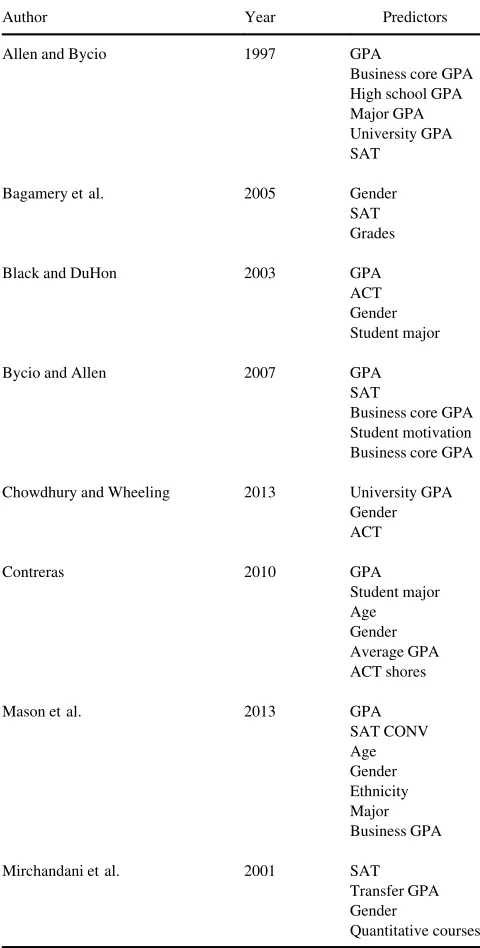
The MFT-B is used to help with benchmarking because the institutions that use the MFT-B do not “proportionally represent the various types of higher education institutions” (Wilson, 2008. p. 34). As to disadvantages, Bycio and Allen (2007) acknowledged that there is little evidence that sup-ports whether there is a correlation between the MFT-B and student business knowledge, yet Contreras et al. (2010) used exploratory data analysis and they find that the MFT-B does measure student’s business knowledge reten-tion. A final drawback to the MFT-B may be content valid-ity because some questions may not be appropriate or they may lack clarity because various subject matter experts write the test questions (Allen & Bycio, 2007). However, they write, after studying student motivation and the rela-tionship to the MFT-B, that the MFT-B “functions as intended” (p. 201). Table 1 summarizes previous research on the variables that predict MFT-B scores.
There is agreement among several authors that student GPAs affect MFT-B outcomes (Allen & Bycio, 1997; Bycio & Allen, 2007; Contreras et al., 2010; Terry et al., 2009; Terry et al., 2008). Beyond agreeing that student GPA affects MFT-B scores, the authors reviewed in this article report a variety of other variables that help predict MFT-B scores. Mirchandani, Lynch, and Hamilton (2001) find that SAT scores, transfer GPA, gender, and grades in quantitative courses affect MFT-B outcomes. Black and Duhon’s (2003) study finds that GPA, ACT scores, gender, and major are determinants of MFT-B performance. Finally, Bagamery, Lasik, and Nixon (2005) find that gen-der, whether students took the SAT, and grades are signifi-cant determinants of MFT-B scores.
In 1997, Allen and Bycio find that the business core GPA correlates significantly with the MFT-B. Additionally, they find a strong association between MFT-B performance and other GPAs such as high school, major, and university. Fur-ther, in their 1997 study, Allen and Bycio found that SAT scores determine MFT-B scores. In 2007, Bycio and Allen chose to investigate issues from their 1997 article as well as assess student motivation on MFT-B performance. In the 2007 study, they find that SAT scores account for 53% of the MFT-B variance, and that the business core GPA improved predictability to 65%. Overall, they find that SAT scores, GPAs, and student motivation account for 68% of the MFT-B variance. Finally, they find that the business GPA is a better predictor than the major GPA. Contrary to the 1997 study, which finds that student major helps predict MFT-B perfor-mance, the 2007 study does not find a similar prediction.
PREREQUISITE COURSES, PGPA, AND MFT-B IMPACT 293
In 2010, Contreras et al. examined the effects of age, gen-der, ethnicity, and academic background on MFT-B perfor-mance. They find that MFT-B performance varies among business majors. Further, they utilize regression analysis to determine how their chosen variables affect MFT-B scores. The overall results of their study show that accounting, man-agement and business majors correlate negatively with MFT-B, even though finance majors create no significant impact, which supports the work of Allen and Bycio (2007). As to other variables in their overall results, age and gender (male), average GPA, and ACT scores positively correlate with the
MFT-B. They tested age, gender (male), race (White, Black), average GPA, and ACT score by business major. Their results indicate that accounting-major-age, marketing-major, gender (male), average GPA scores for accounting major, and for management major, along with finance ACT scores predict MFT-B performance. In sum, GPA is the most common pre-dictor of MFT-B performance. Other dominant prepre-dictors of MFT-B performance include SAT and ACT standardized test scores and student business major. In our study, we examine variables that are similar to previous studies, along with our business school admission prerequisites and PGPA.
The next section contains the relevant literature review that supports this study’s hypotheses.
Prerequisite Courses and Predicted GPA as Predictors of MFT-B Scores
Many professional business schools maintain requirements that students must meet prior to admittance into a business program. This entrance point usually happens after the sophomore year of general study. In general, prerequisite criteria vary from school to school. Overall GPA and suc-cessful completion of certain prerequisite courses are com-mon (Indiana University, 2014; College of William and Mary, 2014). Because preadmission course requirements appear to be a common theme among business schools, we believe that there is general agreement that prerequisites are a predictor of successful completion of the business degree. Although many universities require prerequisite courses prior to admission to the business school, we find that no literature exists that examines the relationship of prerequisite courses for admission to schools of business. Moreover, designated prerequisite courses may appear to be courses that are difficult for the general student popula-tion because they include courses such as math, English, and humanities courses; thus, these courses could preclude the admission of students who would otherwise be success-ful in a SOB program. We contend that the choice of pre-requisite courses is important, and that they should target student success in the SOB.
The SOB under review developed a list of prerequisites that students must successfully complete, with a C or better, to gain admittance to the business school. These six courses include the following: (a) English 101 (Composition), (b) English 102 (Composition and Literature), (c) Math 170 (Finite math), (d) Economics 221 (Macro) or Economics 222 (Micro), (e) Accounting 225 (Principles I), and (f) Business Software 290. Not surprisingly, little pedagogical work existed at the time the SOB under review chose to include these courses as prerequisites for the business pro-gram; hence, the choice of prerequisites may be flawed. In order to be admitted to the SOB program, students must complete English 101 and English 102 with a C or better, complete the other four courses, and they must complete 60 lower division hours (which include Economics as a TABLE 1
Previous Research on Predictors of MFT-B Scores
Author Year Predictors
Allen and Bycio 1997 GPA
Business core GPA High school GPA Major GPA University GPA SAT
Bagamery et al. 2005 Gender
SAT Grades
Black and DuHon 2003 GPA
ACT Gender Student major
Bycio and Allen 2007 GPA
SAT
Business core GPA Student motivation Business core GPA
Chowdhury and Wheeling 2013 University GPA
Gender
Mason et al. 2013 GPA
SAT CONV
Mirchandani et al. 2001 SAT
Transfer GPA Gender
Quantitative courses
humanities alternative). Additionally, they must have two semesters of a foreign language, and they must have a cumulative GPA of at least 2.5 before formal admission to the SOB. As with any policy, exceptions can be made if a student’s GPA is less than 2.5, but only if they show signifi-cant progress in their probationary semester. Transfer stu-dents generally require some exceptions, and stustu-dents may receive conditional exceptions, but they must complete their lower division work usually in the first semester. Regarding prerequisite study of English and mathematics, most would agree that these courses require rigor and are essential to a solid liberal arts education. However, there is little else to suggest that these classes would be a predictor of academic success in a professional business school because the business core and business major or concentra-tion cover different conceptual territory.
In addition, the university under study calculates a PGPA as one of the entrance requirements for applicants to the university with the intent that the score will help deter-mine student success. Universities calculate the PGPA in different ways; however, high school academic perfor-mance, such as a high school GPA, and student SAT scores are among the most common variables used to admit stu-dents to universities (Bridgeman, McCamley-Jenkins, & Ervin, 2000). The university PGPA for the SOB of study is calculated in the following manner:
PGPAD 0:406 C0:751.Core Calculated HS GPA/
C0:948.SAT MathCSAT Verbal/=1000:
This formula, provided by the institution, was in exis-tence from previous administrations, thus, its original time of development and implementation remains unknown. Pre-vious studies indicate a strong relationship exists between MFT-B scores and student SAT scores and MFT-B scores and cumulative student GPA (Allen & Bycio, 1997; Bycio & Allen, 2007; Terry et al., 2009; Terry et al., 2008). While the relationship between PGPA and MFT-B may be intui-tive due to the inclusion of SAT scores, we find no previous research that indicates that PGPA is related to MFT-B scores leading us to the following hypothesis:
Hypothesis 1(H1): Prerequisite courses (for admission to the SOB) and student PGPA would be positively related to MFT-B scores.
PGPA as a Single Predictor of MFT-B
As noted previously, previous studies indicate a strong rela-tionship exists between MFT-B scores and overall student GPA (Allen & Bycio, 1997; Bycio & Allen, 2007; Terry et al., 2009; Terry et al., 2008) and that no known studies find a relationship between PGPA and MFT-B outcomes. We want to know how much PGPA contributes to MFT-B
and confirm its direction; therefore, we formulated the fol-lowing hypothesis:
H2: There would be a positive relationship between the student’s PGPA score and the resulting MFT-B score.
Concentration as a Predictor of MFT-B
Several authors report that student GPA relates to the student overall score on the MFT-B (Contreras et al. 2010, Terry et al. 2009). In addition, Allen and Bycio (1997) find that the student major area of concentration relates to perfor-mance on the MFT-B. This study examines the linkage between the relationship of the student major concentration and MFT-B scores, thus proposing the following hypothesis:
H3:There would be a relationship between students’ major of concentration and the resulting score on the MFT-B.
Verbal and Quantitative Abilities as a Predictor of MFT-B
Research exists that suggests there is a relationship between student SAT verbal scores and the MFT-B (Allen & Bycio, 1997; Bycio & Allen, 2007). Verbal skills remain highly important on most university campuses, so much so that most universities require first year English classes. Given the high degree of importance placed on verbal skills, and the resulting relationship found between SAT verbal scores and the MFT-B, we believe that the required university English classes (101 and 102) influence student MFT-B scores; therefore, we formulated the following hypothesis:
H4:The primary and secondary English courses required of all incoming freshmen would be positively associated with the student’s resulting MFT-B score.
Terry et al. (2009) suggest that there is a positive rela-tionship between individual quantitative skills and success on several standardized tests such as the SAT, ACT, and the MFT-B. Therefore, it seems instinctive to suggest that a student’s success on prerequisite quantitative courses will positively correlate with their resulting MFT-B score. This study examined several student outputs that could be con-sidered measures of quantitative ability such as success in (a) Finite Mathematics 170, (b) Macroeconomics 221, and (c) Microeconomics 222.
This information leads us to the next hypothesis:
H5:The quantitative courses of finite mathematics, macro economics, and micro economics would be positively associated with the student’s resulting MFTB score.
PREREQUISITE COURSES, PGPA, AND MFT-B IMPACT 295
METHODS
Participants and Procedures
This research collected data from 202 undergraduate stu-dents at a small liberal arts university located in the South-east United States. Data collection occurred each semester over a four-year period from 2007 to 2010. We eliminate examining prior years of MFT-B scores because of test score inaccessibility for those years. Students from four majors (accounting, finance, management, and marketing) must sit for the MFT-B exam when they participate in the Senior Capstone course. This study includes 99 men and 102 women who ranged in age from 21 to 57 with an average age of 24 years. Previous studies predominately use multiple regression, t-tests, and analysis of variance (ANOVA) analy-sis as estimation models and just as our predecessors, we defer to regression (linear and stepwise) and ANOVA for our analysis (Allen & Bycio, 1997; Bycio & Allen, 2007; Contreras et al., 2010; Terry et al., 2009; Terry et al., 2008).
Measures
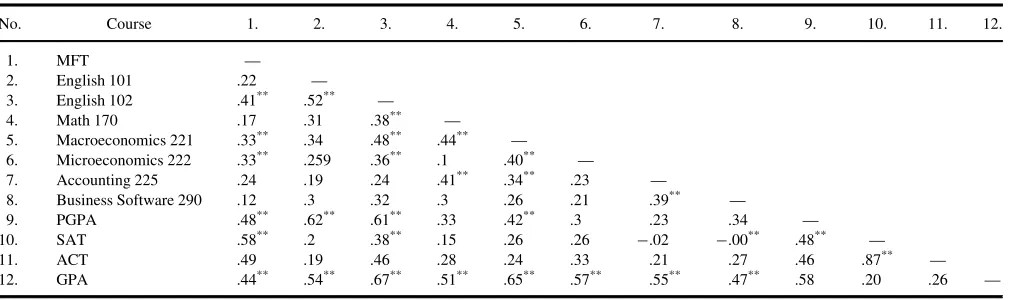
ETS MFT-B. This research includes the results of the ETS MFT-B exam that graduating senior students partici-pated in for a four-year period (2007–2010). The MFT-B in Business is a comprehensive measure of factual knowledge and analytical ability comprised of 120 multiple-choice questions. The exam covers business major areas that include accounting, economics, finance, management, mar-keting, as well as business law. National student score reports for the exam range from 120 to 200, with a national mean of 152 reported in 2010. The variables examined in the study are listed in Table 2, which presents the inter-cor-relation matrix.
The table indicates that English 102, Macroeconomics 221, Microeconomics 222, PGPA, SAT, ACT, and GPA are significantly correlated with MFT-B scores.
Table 2 presents the correlation matrix of all study variables.
Prerequisite courses for acceptance to the school of business. Many professional schools, such as business and education, maintain prerequisite requirements for full-time admission to a particular program. Table 3 provides an overview of student grade distribution of prerequisite course grades. At the university under study, the SOB requires students to successfully complete six courses, with a C or better, and those courses include English 101, English 102, Math 170 (Finite Mathematics), Economics 221 (Macro) or Economics 222 (Micro), Principles of Accounting 225, and Information Systems 290. As noted previously, these courses, along with a student GPA of 2.5, must be accomplished prior to admission to the SOB.
Predicted grade point average. The university under study calculates a PGPA for all incoming freshman. This PGPA, is a formula developed by a faculty committee, that looks at specific high school accomplishments such as GPA, SAT, or ACT scores, accelerated placement classes, as well as state high school ranking. In some instances where universities concern themselves with overall student success, the PGPA is a useful proxy for the university GPA.
RESULTS
Hypothesis 1(MFT-BDSeven Prerequisite CoursesCPGPA)
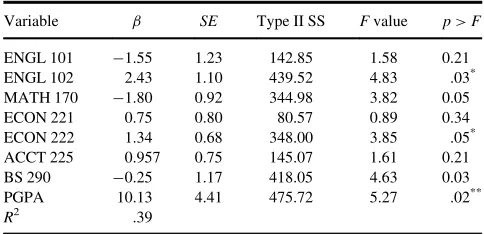
Table 4 shows the summary of results for all testing and outcomes.
For the first hypothesis, a stepwise regression tested the hypothesis that MFT-B scores are a function of student per-formance in seven prerequisite classes (English 101, English 102, Finite Math 170, Macroeconomics 221,
TABLE 2 Intercorrelation Matrix
No. Course 1. 2. 3. 4. 5. 6. 7. 8. 9. 10. 11. 12.
1. MFT —
2. English 101 .22 —
3. English 102 .41** .52** —
4. Math 170 .17 .31 .38** —
5. Macroeconomics 221 .33** .34 .48** .44** —
6. Microeconomics 222 .33** .259 .36** .1 .40** —
7. Accounting 225 .24 .19 .24 .41** .34** .23 —
8. Business Software 290 .12 .3 .32 .3 .26 .21 .39** —
9. PGPA .48** .62** .61** .33 .42** .3 .23 .34 —
10. SAT .58** .2 .38** .15 .26 .26
¡.02 ¡.00** .48** —
11. ACT .49 .19 .46 .28 .24 .33 .21 .27 .46 .87** —
12. GPA .44** .54** .67** .51** .65** .57** .55** .47** .58 .20 .26 —
*
p<.05.**p<.01.
Microeconomics 222, Introduction to Accounting 225, Business Software 290) and PGPA. The results of the step-wise regression provide partial confirmation of the research hypothesis. Overall, MFT-B scores are a linear function of performance in English 102, Economics 222 (Micro Eco-nomics), and PGPA (ModelR D.627,R2D.395). for the eight-variable model,F(8, 65)D4.66,p<.0002. Standard-ized beta weights were 2.43 for English 102, 1.34 for Eco-nomics 222, and 10.13 for PGPA.
Hypothesis 2(MFT-BDPGPA)
Table 5 presents the results of a simple regression proce-dure to predict student MFT-B scores from the student PGPA score results indicate that the PGPA predicts the MFT-B scores,R2D.23,F(1, 114)D35.08,p<.00.
Hypothesis 3(MFT-B Affected by Major Concentration)
A one-way between subjects ANOVA compared the effect of student major concentration: accounting, finance, man-agement, and marketing on MFT-B scores. Table 6 presents the following findings.
There was a significant effect on the MFT-B for the four conditions, F(3, 166) D5.45,p <.01. Post hoc compari-sons using the Tukey HSD test indicated that the mean score for the finance concentration condition (MD161.7, SD D 8.91) was significantly different from the other majors: accounting (M D 153.46, SD D 14.23), manage-ment (M D 149.82, SD D 10.29), and marketing (M D
149.94,SDD10.14). Taken together, these results suggest that a particular major of study, in this example, finance does have an effect on MFT-B scores.
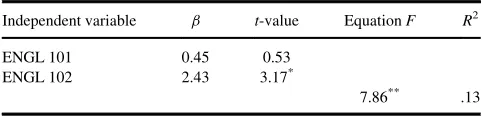
Hypothesis 4(MFT-BDQualitative Courses)
A regression procedure was used to predict student MFT-B score from the student’s performance on their qualitative based classes of English 101 and English 102. This hypoth-esis was partially supported. Regression tests revealed that TABLE 3
Stepwise Regression of Effect of Student Prerequisites on Student MFT-B Scores
Variable b SE Type II SS Fvalue p>F
ENGL 101 ¡1.55 1.23 142.85 1.58 0.21
ENGL 102 2.43 1.10 439.52 4.83 .03*
MATH 170 ¡1.80 0.92 344.98 3.82 0.05
ECON 221 0.75 0.80 80.57 0.89 0.34
ECON 222 1.34 0.68 348.00 3.85 .05*
ACCT 225 0.957 0.75 145.07 1.61 0.21
BS 290 ¡0.25 1.17 418.05 4.63 0.03
PGPA 10.13 4.41 475.72 5.27 .02**
R2 .39
*p
.05.**p<.01.
TABLE 5
Regression Analysis of MFT-B and PGPA
Independent variable b t EquationF R2
PGPA 13.25 5.92** 35.08** .23
**
p<.00.
PREREQUISITE COURSES, PGPA, AND MFT-B IMPACT 297
English 102 predicted the MFT score,R2D.13,F(1, 124)
D7.86,p<.00. Please see Table 7.
Hypothesis 5(MFT-BDQuantitative Courses)
A regression procedure predicted the student’s MFT-B score from the student’s performance on their quantitative based classes of Finite Math 170, Macroeconomics 221, and Microeconomics 222. As presented in Table 8, this hypothesis was partially supported, as the regression tests revealed that Microeconomics 222 predicted the MFT-B score,R2D.13,F(1, 121)D6.36,p<.00.
DISCUSSION
The present study examines a model representing the rela-tionship between prerequisite courses and PGPA (PGPA) required for admission into a Professional School of Busi-ness with student performance on MFT-B scores. This model is based on the assumption that students will success-fully complete a course of undergraduate study in business and that they must possess specific necessary skills, knowl-edge and abilities prior to business school admission.
We find that the PGPA with a correlation to the MFT-B of .48 helped to predict, in our study, only 23% of the variance of the MFT-B predictions which is low when SAT scores are found to add over 50% of the variance to MFT-B scores in other studies (see Allen and Bycio, 2007). While this may seem low when the PGPA formula incorporates SAT scores, it may be that the high school GPA in the PGPA
formula would affect MFT-B outcomes, when combined with SAT scores, and be a less strong predictor of MFT-B scores, than the SAT alone. The correlation of the PGPA is slightly less than that of the SAT score. For instance, Mirch-andani, et al (2001), find a correlation of .595 with the MFT-B. Our own study shows a correlation of .58 between the SAT and MFT-B, which is consistent with Mirchandani et al. (2001) and Bycio and Allen (2007).
We find with stepwise regression, that English 102, Microeconomics 222, and PGPA help predict MFT-B scores. Further, an ANOVA test suggests that MFT-B scores are affected by the student concentration of finance. Additionally, we find that the qualitative course of English 102 and the quantitative course of Microeconomics 222 predict MFT-B scores using linear regression. While this study might statistically suggest that the SOB under study might consider the elimination of several prerequisites for admission into the SOB, we would not recommend nor wish to pursue any kind of course elimination. It would be illogical to remove prerequisite courses based upon the study of one variable, such as the MFT-B. SOBs should review the relationship of admission prerequisites with SAT scores, business common core courses, student life experience, and the like. Further study is required to explore what prerequisites have the largest influence on overall student success—not just the MFT-B. Future researchers should look at business core courses and major areas of study to determine the influence of the pre-requisites for each individual advanced course. We find that the use of the MFT-B as the only variable is the major limitation of this study. In addition to the MFT-B limita-tion, we were not able to include information that provides individual student assessment indicators (indicators reveal how each student scores in each business topic). Having access to that information would help review not only the business core, but also each concentration for appropriate outcomes.
CONCLUSION
We examined the prerequisite courses at a public South-eastern Liberal Arts college used to determine acceptance into the business school. Students must successfully TABLE 6
ANOVA Descriptives and Effect on MFT-B
Major n M SD SE
Accounting 42 153.46 14.23 2.19
Finance 17 161.17** 8.91 2.16
Management 80 149.82 10.29 1.15
Marketing 60 149.94 10.14 1.31
Source df Sum of SQ Mean SQ F Prob.>F
ANOVA: Student concentration effect on MFT-B
Model 3 2031.75 667.25 5.42** .0014
Error 166 20747.59 124.98
Corrected total 169 22779.34
**
p<.01.
TABLE 7
Regression Analysis of Qualitative Courses
Independent variable b t-value EquationF R2
ENGL 101 0.45 0.53
ENGL 102 2.43 3.17*
7.86** .13
**
p<.00.
TABLE 8
Regression Analysis of Quantitative Courses
Independent variable b t EquationF R2
MATH 170 0.07 0.11
ECON 221 1.28 2.06*
ECON 222 1.48 2.58**
6.36** .13
*
p<.05.**p<.01.
complete these courses, and obtain a C or better in English 101 and English 102, and obtain a GPA of 2.5, before they gain admittance to the business school. The findings of this research suggest that the selection and application of pre-requisites must remain highly rigorous to perpetuate contin-ued student success in schools of business. Further, even though we find that only a portion of the studied prerequi-sites (English 102 and Microeconomics 222) and PGPA impact MFT-B scores, other prerequisite courses poten-tially provide students long-term value in their business education and postgraduation pursuits. Finally, we suggest that if schools are interested in student success they must do a good job of picking various predictors of success. Indi-cators other than the MFT-B might include student time to graduation, length of program hours, or possibly choosing general education prerequisites that would help improve the principles courses that are the first milestones in the business core. We believe that some theoretical grounding for the formulation of prerequisites may be helpful in improving the knowledge, skills, and abilities of students. Future researchers should include an exploration of how all business courses are influenced by all prerequisite courses.
REFERENCES
Al-Twaijry, A. A. (2010). Student academic performance in undergraduate managerial accounting courses.Journal of Education for Business,85, 311–322.
Allen, J. S., & Bycio, P. (1997). An evaluation of the educational testing service Major Field Achievement Test in business.Journal of Account-ing Education,15, 503–514. doi:10.1016/s0748-5751(97)00021-3 Bagamery, B. D., Lasik, J. J., & Nixon, D. R. (2005). Determinants of
suc-cess on the ETS Business Major Field Exam for students in an under-graduate multisite regional university business program. Journal of Education for Business,81, 55–63.
Black, H. T., & Duhon, D. L. (2003). Evaluating and improving student achievement in business programs: The effective use of standardized assessment tests.Journal of Education for Business,79, 90–98.
Bycio, P., & Allen, J. S. (2007). Factors associated with performance on the Educational Testing Service (ETS) Major Field Achievement Test in Business (MFAT-B).Journal of Education for Business,82, 196–201. Bridgeman, B., McCamley-Jenkins, L., & Ervin, N. (2000).Predictions of
freshman grade-point average from the revised and recentered SATÒ
I: Reasoning test. Princetion, RI: Educational Testing Service.
College of William and Mary. (2014). Requirements. Retrieved from http://mason.wm.edu/programs/undergraduate/admissions/requirements/ index.php
Contreras, S., Badua, F., Chen, J. S., & Adrian, M. (2010). Documenting and explaining Major Field Test results among undergraduate students. Journal of Education for Business,86, 64–70.
Green, J. J., Stone, C. C., Zegeye, A., & Charles, T. A. (2007). Changes in math prerequisites and student performance in business statistics: Do math prerequisites really matter? Journal of Economics and Finance Education,6, 27–38.
Indiana University. (2014).Basic business requirements. Retrieved from http://kelley.iupui.edu/undergrad/academics/basic.cfm
Jones, C. T., Kouliavtsev, M. S., & Ethridge, J. R. (2013). Lower level pre-requisites and student performance in intermediate business courses: Does it matter where students take their principles courses?Journal of Education for Business, 88, 238–245. doi:10.1080/08832323.2012. 688777
Marcal, L., & Roberts, W. W. (2000). Computer literacy requirements and student performance in business communications.Journal of Education for Business,75, 253–257.
Mirchandani, D., Lynch, R., & Hamilton, D. (2001). Using the ETS Major Field Test in business: Implications for assessment.Journal of Educa-tion for Business,77, 51–56.
Terry, N., Mills, L. V., Rosa, D., & Sollosy, M. (2009). Do online students make the grade on the business Major Field ETS exam?Academy of Educational Leadership Journal,13, 109–118.
Terry, N., Mills, L. V., & Sollosy, M. (2008). Student grade motivation as a determinant of performance on the business Major Field ETS exam. Journal of College Teaching and Learning,5(6), 20–25.
University of California–Berkeley. (2014).Prerequisites. Retrieved from http://www.haas.berkeley.edu/Undergrad/ucb_prereq.html
University of California–Riverside. (2014).Becoming a business adminis-tration major at UCR. Retrieved from http://undergradbusiness.ucr.edu/ major/process.html
Von Allmen, P. (1996). The effect of quantitative prerequisites on perfor-mance in intermediate microeconomics.Journal of Education for Busi-ness,72, 18–22.
Wilson, P. H. (2008). A protocol for analyzing the Major Field Test results. Journal of Business and Behavioral Sciences,19(2), 33–45.
PREREQUISITE COURSES, PGPA, AND MFT-B IMPACT 299