Members
Observers
Bank Indonesia Bank of Thailand
Common Platform Model For Asian Post-trade
Processing Infrastructure
White Paper
Table of contents
1. Executive summary 1
2. The vision of building a pan-Asian post-trade infrastructure 4
2.1. Issues to be addressed by a pan-Asian post-trade infrastructure 4
2.2. A Common Platform Model to improve the post-trade infrastructure in Asia 6
2.3 Joining the Common Platform Model 11
2.4 Starting the Common Platform Model 12
2.5 Introduction of common systems 13
2.6 Benefits of the approach 14
2.7 Organisation 16
1. Executive summary
1. The development of Asian bond markets has not always evolved at the same pace as the local economies. The size of most Asian bond markets represents around 50% or less of GDP (with a few exceptions, including Japan and Korea), compared to around 150% of GDP on average in Europe and the USA. The further development of the Asian bond market is therefore a priority for policymakers in this region: a deep and efficient bond market should bring benefits to regional economies in terms of reduced reliance of corporate issuers on bank financing, diversified and stable funding sources, further development of the capital markets, and greater monetary and financial stability.
2. There are a number of supply and demand limitations that restrict the growth of Asian bond markets. First, lower levels of government bonds compared to other regions. Second, higher reliance by corporations on bank loans and equity markets. Third, foreign access to Asian local bonds is often more complex because there are restrictions to foreign investments, no common way to rate Asian bonds and no yield curve in the region. Finally, inefficiencies in post-trade infrastructure are also a major barrier to enhancing the attractiveness of local bonds. The fragmentation and lack of automation and harmonisation of the post-trade process make it expensive for foreign investors to access local settlement systems, both for international as well as local Asian investors willing to invest on a cross-border basis in Asia.
3. While there are other initiatives in this region, including the Asian Bond Market Initiative (“ABMI”), to identify ways to improve the situation in Asia, both at the level of the supply and demand for local bonds and at the level of the post-trade infrastructure, a Task Force comprising Bank Negara Malaysia, the Hong Kong Monetary Authority, and Euroclear was formed to explore practical actions to address the same issues.
their markets. Both have indicated that they will continue to be part of the Task Force as observers.
5. The Task Force believes that a gradual approach to improve Asian post-trade infrastructure will:
(a) Improve cross-border access, increase issuance of local bonds, reduce post-trade cost and risk, and increase the use of cross-border collateral in Asia.
(b) Improve access to local post-trade infrastructure, in particular with the use of investor central securities depository (“CSD”) services provided by local Asian CSDs. This will increase choice for local investors in Asian countries to access Asian and international markets leveraging their local CSD when alternative options are not possible. This can be implemented gradually to limit upfront investment, starting with a set-up that leverages local infrastructure and existing account relationships.
(c) Allow local bonds under local jurisdiction and in the local CSD to be issued in foreign currencies and settled in the local time zone. For a limited number of foreign currencies, the functionality already exists today in certain Asian markets.
(d) Offer an implementation strategy for Asian CSDs and the international CSD (“ICSD”) to jointly improve cross-border post-trade infrastructure in Asia. This would be done by:
Starting with improvements to interoperability and leveraging existing ICSD and CSD links,
Gradually improving local market practices and local CSD processes (through the introduction of more standardisation and centralisation of processes within local CSDs) as well as CSD and ICSD links in a coordinated manner in a way to enhance service levels and reduce costs and risks for cross-border investors,
more harmonisation of post-trade processes across Asia and a gradual introduction of common systems.
6. The Task Force believes that such a gradual approach is pragmatic and appropriate for Asia. It limits upfront investment, allows a convergence between markets in Asia which experience different stages of development, gives the opportunity to improve the attractiveness of local bonds and facilitates the introduction of common systems when appropriate. It has set out the high level objectives, proposed implementation strategy and organisation in a “Common Platform Model”, which serves as a basis for cooperation among CSDs from different economies and Euroclear.
7. The Task Force is of the opinion that further Asian markets could also benefit from this pragmatic common approach. This White Paper allows other Asian markets to identify the benefits for, and impacts of, such an approach, and provides options to participate. Central banks and CSDs in Asia are invited to comment on the White Paper and to join the Task Force on an equal footing. Central banks and CSDs that support the Common Platform Model in principle but require more time to clarify the practical conditions for their participation (e.g. to define timing, participation of local entities like the CSD, regulators, the national central bank) would be welcomed to join the Task Force as observers.
2. The vision of building a pan-Asian post-trade infrastructure
2.1.Issues to be addressed by a pan-Asian post-trade infrastructure
9. The further development of the Asian bond market is an important subject for policymakers in this region. A deeper Asian bond market would promote diversification and reduce reliance on banks for satisfying the financing needs. A more efficient solution for cross-border settlement would facilitate the usage of cross-border collateral in Asia and allow greater collateralisation of exposures of Asian and international financial institutions active in the region. Finally, a larger and more efficient bond market is important for the development of the financial markets in Asia and for the development of the overall economy in general.
10. The further development of Asian bond markets is dependent on the removal of certain legal, regulatory and other barriers to cross-border investment and on other measures to stimulate supply and demand for Asian bonds. The combination of such measures with a more efficient post-trade infrastructure would create the right environment for the bond markets to grow.
11. Other regions in the world have already made progress in harmonising and consolidating their post-trade infrastructure. In Europe, there has already been a common vision of a single market for securities at the level of the European Union for many years which created a favourable context for more integration of post-trade systems and harmonisation of processes. Relatively speaking, there is less coordination and integration among Asian economies. There are still restrictions to foreign access; a high level of differences between markets in terms of economic and financial development; little harmonisation of processes between markets; and there is no single Asian currency. Finally, there is a different state of readiness to consider opening up markets.
12. The fragmentation and lack of automation and harmonisation of the post-trade process make it expensive for foreign investors to access local settlement systems, both for international as well as local Asian investors willing to invest on a cross-border basis in Asia. There is a general understanding that the current post-trade infrastructure in Asia should evolve in a way to offer:
(a) Better cross-border access to local Asian bonds. Current post-trade
cross-border investment. Greater harmonisation of market practices and procedures as well as more efficient cross-border access to local CSDs are necessary to increase demand from foreign investors in local Asian bonds.
(b) Greater issuance of local bonds in local currencies. A higher demand
for local bonds, resulting from a better cross-border access, should increase funding possibilities for local issuers. This should allow Asian funding costs to be brought down and more into line with those in other large financial markets like Europe and the USA, provided actions are taken to increase the supply and attractiveness of local bonds in parallel of the improvement of the post-trade infrastructure in Asia. Greater flexibility to facilitate local bonds to be issued in foreign currencies may be useful to attract investors who have limitations in terms of foreign exchange risk.
(c) Improved automated processes to manage operational risk. Even if
certain Asian markets have already implemented centralised corporate actions databases, asset servicing (including payment of income and redemption, announcement and processing of corporate actions) is still un-harmonised and often manual, which increases operational risk and reduces the attractiveness of local Asian bonds. An automated corporate actions process which automates information flows and processes between investors and issuers from Asia and other markets will reduce operational risk.
(d) Access to a larger pool of collateral. Collateralisation of exposures
reduces credit risk and, therefore, increases trading opportunities and access to liquidity. Asian bonds are today difficult to mobilise as collateral. Asian central banks generally only accept local bonds as collateral. A more effective cross-border solution will facilitate access to a larger collateral pool, including local bonds from different Asian markets and from other regions. Moreover, it will increase the possibility to collateralise exposures in Asia, including for central banks when managing liquidity in their local banking system.
(e) Reduced costs for post-trade execution. A more efficient access to the
activity in the local CSDs and already create opportunities for some scale economies in each country. Furthermore, harmonisation of processes and, if feasible, the consolidation of systems on a single platform would allow further reduction of the overall post-trade cost across Asia, but would require more time to happen. It would increase back-office savings for cross-border investors and would enable pan-Asian post-trade cost to reach levels comparable with the USA and Europe where more consolidation of post-trade systems has already taken place.
2.2. A Common Platform Model to improve the post-trade infrastructure in Asia
13. A specific approach is necessary for Asia. There is less coordination among Asian economies than in Europe and the level of harmonisation between markets is low. The integration of post-trade systems and the harmonisation of processes may take more time to happen in Asia and a more gradual approach is necessary. Moreover, specific functionality is required for Asia, especially to address the specific needs for cross-border access for Asian investors and issuance in foreign currency.
14. A Common Platform Model for an efficient pan-Asian post-trade service has been defined by using Europe as a benchmark and taking into account Asia-specific requirements:
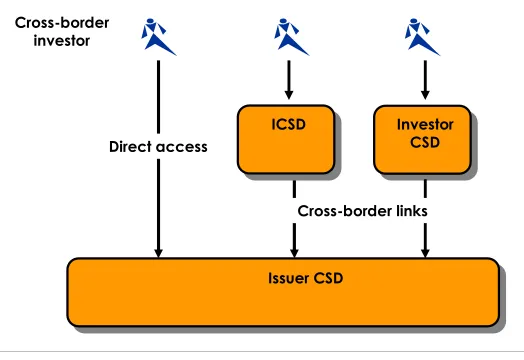
(a) A flexible access to Asian and international markets:
Larger Asian and international investors can opt for a direct
access to the major issuer CSDs (i.e. the CSD holding the local
securities) in Asia if such direct access is allowed. Direct access would be made easier by the automation and harmonisation of asset servicing. It would require connecting to the local CSD directly and, for non-domestic financial institutions, appointing a local cash agent for settlement in the local currency.
International investors and larger Asian investors, when possible, could use their account with the ICSD to hold their Asian securities as well as securities from other regions of the world.
CSD (i.e. the local CSD, or any other local entity other than CSDs that has the right and the capacity to offer settlement and asset servicing on foreign securities to local financial institutions) to hold foreign securities.
Figure 1: Options for cross-border access
(b) A facility for issuers to issue local bonds in foreign currencies:
Local settlement systems in Asian markets should offer the choice between settlement and issuance in the local currency or a foreign currency. This would allow issuers who do not have access to international bond markets to attract investments in their local bonds from investors who are less inclined to take a risk on the local currency. In addition, it may increase liquidity across local bonds.
(c) More automation and harmonisation of market practices for
corporate actions processing:
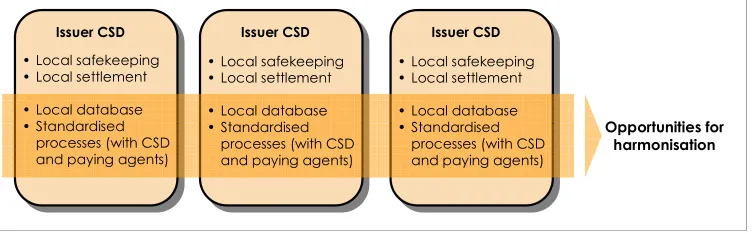
Local CSDs should develop their corporate actions services, including the development of a local database for securities and corporate actions and standardised processes for the announcement and processing of income payments and corporate actions. A certain level of harmonisation, first in the definition of securities and corporate action information but also in the definition and implementation of processes across local markets, would further increase the benefits for cross-border investors.
!
Figure 3: Local developments for corporate actions
!! ! " !!
!!
# ! !
$ !
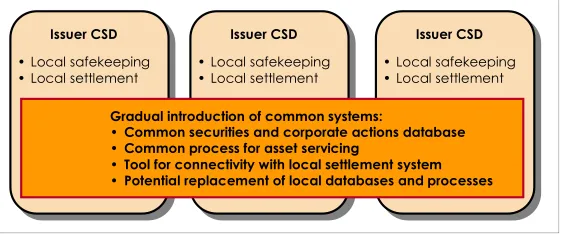
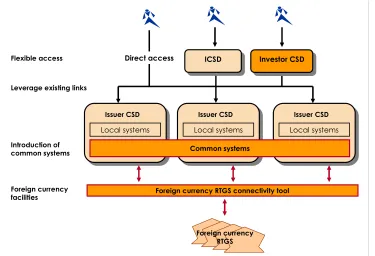
Figure 4: Introduction of common systems in the long term
(d) The use of links, including ICSD and CSD links to provide
cross-border DVP (delivery-versus-payment) settlement, especially if it
takes time to consolidate local settlement systems:
Consolidating local settlement systems (i.e. where issuer CSDs use the same settlement system while retaining responsibility for ownership of local securities and for business operations and direct client relationship) is complex, especially because of the existence of multiple currencies in Asia. Local settlement systems should remain at least until there is a stronger need and willingness to consider consolidation of settlement systems to further increase economies of scale.
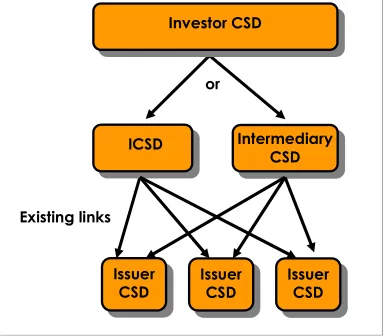
A solution to link issuer CSDs, investor CSDs and ICSDs to cater for DVP settlement of cross-border transactions is therefore necessary for some time. This should however not require all Asian CSDs to implement links with each other, which could be very complex1. It is preferable to use existing links, including CSD and ICSD links, where possible, at least until some common systems are introduced:
1
A CSD link is complex to implement because:
(a) It requires a minimum service level to be delivered by the issuer CSD to the investor CSD especially for corporate events notification and processing and tax services. These services are not offered by most of the issuer CSDs and are complex to develop.
(b) It requires a solution for cross-border DVP settlement between CSDs in central bank money, which even with the single currency in Europe is complex.
CSDs can establish direct links with each other, i.e. “CSD links”, in which case an investor CSD opens an account with an issuer CSD, from which it receives the standard domestic services for settlement and asset servicing. To limit the investment cost and the operational complexity, the service level on CSD links is generally limited (e.g. free-of-payment settlement, limited asset servicing for plain vanilla government securities) and they are only used for specific reasons. CSD links would benefit from the introduction of common systems for asset servicing in the longer term, but the complexities related to un-harmonised settlement processes will remain.
Investor CSDs can also leverage the links of the ICSD. ICSDs have established links, but generally not directly with the local CSD. ICSD links generally involve a local agent which provides additional services especially for asset servicing and cash management in the local currency. Alternatively, investor CSDs can opt for setting up linkage with an intermediary CSD that has already established links with the ICSDs and other Asian CSDs.
!
%&
Figure 5: Investor CSD can leverage existing ICSD or intermediary CSD links to connect to issuer CSDs
&
!! !
&
!! !
Figure 6: The “Common Platform Model” for Asia (elements in orange
background represent new functions or common systems)
2.3.Joining the Common Platform Model
16. To fully benefit from the Common Platform Model, a market should satisfy a series of conditions, including that:
(a) Local regulation allows foreign investments into its market (i.e. foreign investors can buy local bonds);
(b) Local regulation allows access of foreign investors to its local post-trade infrastructure, for cash and securities settlement, either directly or indirectly (including through a local agent, an ICSD or a foreign investor CSD);
(c) Restrictions on foreign access (e.g. issues related to currency convertibility) are reduced in a way, specific to each market, to achieve a certain level of efficiency in cross-border flows into and from the market;
the operational and legal capability to offer services for foreign securities to its local clients; and
(e) The local CSD links to the foreign currency RTGS systems in the region in a way to allow the issuance of local bonds in foreign currencies.
17. As the Common Platform Model will be gradually implemented, markets are not expected nor required to fulfil all conditions before joining the Common Platform Model. Some conditions are already satisfied in many Asian markets and other conditions may be worked on in parallel to their participation to the Common Platform Model.
2.4.Starting the Common Platform Model
18. The Common Platform Model can be gradually implemented, without the need to establish common systems at the outset. Asian markets and the ICSD should cooperate to develop their respective post-trade infrastructure in Asia and improve interoperability, leveraging their own systems, skills and relationships. A series of measures can already be introduced before developing common systems, at the pace that can vary by country:
(a) Measures to remove barriers to cross-border investments and to increase the supply and demand of local Asian bonds;
(b) Measures to implement and/or improve cross-border links, including among others improvement of settlement timings, access to primary market activity in the local CSD by foreign financial institutions, tax procedures, account structure, access to local securities and corporate actions databases;
open an omnibus account with the ICSD or intermediary CSD in which it can hold the assets of all its local clients. This would require further developments to allow the investor CSD to offer dedicated services for foreign securities to its local clients;
(d) Measures taken by central banks to encourage usage of cross-border collateral management services;
(e) Measures to improve the standardisation of information on local securities and corporate actions, including actions to increase the timeliness and quality of information provided by local agents and CSD in the local market, and the possibility to create a centralised corporate action database for the domestic markets;
(f) Measures to introduce common standards across markets and to facilitate cross-market access and utilisation of information on local securities and corporate actions when possible;
(g) Measures to promote DVP settlement for foreign currency denominated bonds in the region by connecting to the foreign currency RTGS systems available locally or in the region and to increase the number of foreign currencies used for local bonds, in a way to increase the size and liquidity of a pan-Asian bond market denominated in foreign currencies.
19. A coordinated approach to improve local market practices, local CSD processes and CSD and ICSD links should allow Asian CSDs to more rapidly and more efficiently increase the service level and reduce costs and risks for cross-border investors. Furthermore, coordination across Asian markets and the ICSD should allow some convergence between Asian markets to take place and a gradual introduction of common practices and standards across Asian markets. These measures will prepare the local markets for more harmonisation of market practices across markets and a gradual introduction of common systems, when applicable.
20. Measures taken to gradually improve the cross-border post-trade infrastructure will facilitate the evolution to a more integrated and harmonised solution in the longer term. To reduce the investment related to common systems, the Task Force is of the opinion that Asian markets should seek to re-use the existing systems, for example the Single Platform project of Euroclear.
21. The approach based on existing systems will already allow Asian markets to implement local improvements to their post-trade. Implementing common systems in Asia will require more coordination among Asian markets to:
(a) Coordinate developments among markets so that they converge with developments in other Asian markets to form a common level of market openness, size and efficiency;
(b) Coordinate actions among markets to remove barriers to cross-border investments and to increase the supply and demand of local Asian bonds in a way to increase the size, depth and attractiveness of a pan-Asian bond market;
(c) Coordinate discussions among economies on the benefits, conditions (including in terms of governance and funding) and timing for the introduction of common post-trade systems and of harmonised processes among markets;
(d) Coordinate actions between markets to define the requirements for such common systems and harmonised processes; and
(e) Assess the possibility and benefits for a gradual introduction of common systems, and the implication of keeping local databases and processes in parallel of common systems for a certain transition period.
22. The issuer CSD can use the common systems to run its business operations, while continuing to maintain the legal records and to be in charge of client relationships.
23. The Task Force recognises that the introduction of harmonised processes and common systems in Asia will require time and effort to build. The gradual approach starting with interoperability delivers benefits early in parallel with actions to develop the local markets. It comprises functionality that is necessary for the long term from the start and ensures that actions taken by the different parties remain usable in the future. It facilitates the introduction of common systems by allowing a gradual convergence between markets.
24. The approach based on the existing systems and gradual improvements will allow CSDs to already benefit before the introduction of common systems in the long term, from:
(a) Opportunities to grow their local bond market, by making it easier to access and more attractive to a larger range of international and Asian investors and creating the opportunity for safekeeping and supporting the issuance and settlement of local bonds denominated in a foreign currency.
(b) Gradual increase of activity in local CSDs, already allowing some economies of scale to be realised before the introduction of common systems.
(c) New investment opportunities for local Asian and international investors from the possibility to more easily access settlement and asset servicing for local Asian bonds.
(d) Improved collateral management opportunities, including the possibility for Asian financial institutions and central banks to access a larger pool of collateral to support multiple exposures as well as the possibility for foreign institutions to increase usage of Asian local bonds as collateral.
25. Asian CSDs have the autonomy and flexibility in the Common Platform Model to introduce new services in line with the evolution of the capital market in their country.
2.7. Organisation
26. The gradual build of the Common Platform Model will require different levels of coordination:
(a) Between investor CSDs and the ICSD/intermediary CSD: to define the initial set-up and potential for evolution.
(b) Between issuer CSD (and local authorities and central bank) and the ICSD/intermediary CSD: to define the right link in line with the market’s objective to develop local issuance, with local constraints, and with the expectation of international investors and investor CSDs.
(c) Between issuer CSDs themselves: to share experience in a way to gradually allow some convergence at the level of interoperability, to introduce common practices to develop issuer CSD databases and processes and introduce local changes, to identify common interest for additional measures to implement harmonisation and market stimulus.
27. A Task Force will be used as the governance structure for Asian economies which have expressed an interest in this initiative and the ICSD to continue working together on the gradual implementation of the Common Platform Model. The Task Force can also be joined by other central banks and CSDs in Asia. Those that support the Common Platform Model in principle but require more time to clarify the practical conditions and timing to participate may join as observers.
Appendix
Bank Negara Malaysia, the Hong Kong Monetary Authority and Euroclear to introduce a Pilot Platform as gradual implementation of the Common Platform
Model
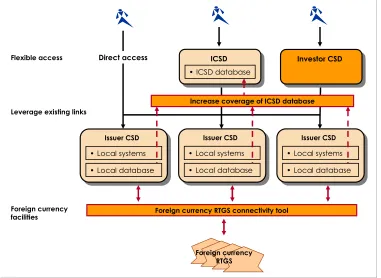
29. Bank Negara Malaysia, the Hong Kong Monetary Authority and Euroclear have decided to introduce a “Pilot Platform” being a first deliverable of the proposed Common Platform Model. It will provide a basis for identifying areas of improvement and will allow sharing this experience with other economies. The Pilot Platform re-uses existing CSD and ICSD links and the connection between local CSD and foreign currency RTGS systems in Asia. It will include new developments to provide Malaysian banks with access to foreign securities through Bank Negara Malaysia’s securities depository as investor CSD, similar to what is offered by the Hong Kong Monetary Authority for Hong Kong banks to access foreign securities today. Moreover, it includes cooperation between Euroclear and local CSDs to improve the coverage by the ICSD securities database of Asian local bonds. The launch of the Pilot Platform is expected in the first half of 2011.
30. It makes use of existing services and systems used by Asian CSDs and the ICSD to offer:
(a) More choice for cross-border access through an investor CSD. Bank Negara Malaysia and the Hong Kong Monetary Authority will both act as investor CSD for their local users. Malaysian and Hong Kong investors can thus leverage their account with their local CSD to also hold foreign securities and settle cross-border transactions on a DVP basis.
(b) More choice for issuers to issue bonds in foreign currencies. Through a connection to the foreign currency RTGS systems in the region, for example, Bank Negara Malaysia and the Hong Kong Monetary
(c) Inclusion of more Malaysian and Hong Kong securities in the ICSD database. Bank Negara Malaysia and the Hong Kong Monetary Authority will work with the ICSD to increase the coverage of the ICSD securities database and improve the visibility of local bonds for cross-border investors.
(d) The investor CSDs will leverage existing ICSD and/or CSD links2 to hold the foreign securities with the issuer CSD.
31. The Pilot Platform is expected to be available in the first half of 2011. The Pilot Platform provides a basis for Bank Negara Malaysia, the Hong Kong Monetary Authority and Euroclear to coordinate further developments and provides an example for experience sharing with other economies.
&
&
Figure 7: The "Pilot Platform" (elements in orange background represent new functions)
2