Sri Rahayu1,2, Cecep Kusmana3, Rochadi Abdulhadi4,
Muhammad Jusuf5 and Suharsono5
ABSTRACT
Hoya multilora is one of the valuable germplasm in Indonesia that has been utilized as ornamental and medicinal plant. his epiphytic plant faces problems in decreasing habitat. As a means for developing a habitat framework for describing the distributions and ecological relations of H. multilora at Gunung Gede Pangrango National Park, Bogor, Indonesia, ecological study of this species was established over the ranges of altitudes and characteristic vegetation structural types (primary and secondary forest, and plantation) present in the Park. Recognizing the fact that such study requires multidisciplinary data, this paper explores the evidences from both herbarium sheets and ield observations. he result of the study showed that the population of this species was only found at the Bodogol Research Station at elevation of 700 - 900 m above sea level (a.s.l.). hus, the facts contradict with the evidence from the herbarium sheets of the Herbarium Bogoriense which have presumed that this species has a wide variation of altitudinal range from 20 to 1500 m a.s.l. (Indonesia) or 200 - 1400 m a.s.l. ( Java). he Bodogol’s population showed the clumped type of dispersion (Morisita’s Index = 1.35), which indicated such environment that was characterized by patchy resources. Direction and speed of wind coupled with the topography are ecological factors that afect to the distribution of this parachute typed seeds of the H. multilora.
Keywords: Gunung Gede Pangrango National Park, Hoya multilora, plant ecology,population distribution
I. INTRODUCTION
Hoya multilora Blume (Asclepiadaceae) is one of the ornamental plants with the medicinal properties (Zachos, 1998). his species has been used traditionally to treat arthritis-rheumatism (Burkill, 2002), and stomach/intestinal ailments (Ambasta, 1986). So far, the active compound of this plant has not been identiied yet, but presumably it contains indomethacin-like compound. It is a common non-steroidal anti-inlammatory drug (NSAID) that has been used for more than 30 years to treat symptomatic pain of arthritis-rheumatism. Recently, this compound has been tested for a new drug as anti
1 Bogor Botanical Gardens, Jl. Ir. H. Juanda 13 Bogor 2 Corresponding Author. Email: [email protected]
3 Department of Silvicultur, Faculty of Forestry, Bogor Agricultural University, Bogor, Indonesia 4 Laboratory of Ecological Science, Research Centre for Biology, Indonesian Institute of Science
(LIPI), Cibinong Science Centre, Bogor, Indonesia
HIV (Bourinbaiar and Lee-Huang, 1995), and it seems to be speciic since no toxicity has been observed at the IC50 dose, and unrelated NSAIDs have not shown the activity at clinical doses.
Hoya multilora is widely distributed throughout India to New Guinea (Schlechter, 1914; haitong, 1994), at the elevation of 200 - 1200 m a.s.l. (Backer and van der Brink, 1965; Rintz, 1980). his species is characterized by its short (non vein) plant, leathery (non succulent) oblong leaves, white coronas lowers and yellow/white relexed corollas (Wanntorp et al., 2006). here can be up to 40 of these rockets like lowers in an umbel and they produce lots of nectar and white latex from all of its part (Goyder, 2008). In Indonesia, as an ornamental plant, this species is highly demanded and commonly sold as cuttings, either rooted or unrooted at IDR 15000 - 30000 (equivalent to USD 1.60) per stick for seedling, and IDR 75000 - 100000 (equivalent to USD 9.50) per pot (Rahayu, 2006). Unfortunately, most of the traded plants have been harvested directly from the wild.
Despite of their high economic importance, little is known about their population ecology, particularly the ecological factors that affect its distribution. Thus, it is imperative to study the population ecology of H. multilora, including those which are present at the Gunung Gede Pangrango National Park (GGPNP), West Java, Indonesia. he objectives of this study was to evaluate the ecological factors that afect the distribution of H. multilora in GGPNP, West Java. It is expected that the result of the study will provide complete information on the status of such species in this National Park.
II. METHODS
he process of data collection was conducted by observing herbarium sheets, ield observations, and plot sampling. Herbarium observation was conducted on the all of herbarium sheets collection of H. multilora from Indonesia’s Islands in the Herbarium Bogoriense. A total of 70 sheets was observed. he information recorded was the collector’s notes, i.e. collection date, location, altitude, longitude (if any), topography and habitat.
he population distribution was observed at the site where H. multilora found (i.e. Bodogol). he ield observations were conducted at the four selected hilly areas with diferent sides/directions. Two of those four hills were facing east and west directions, whereas the other two hills were selected facing north and south sides/directions, and physiographical condition of those hills are characterized by diferent forest and vegetation types. he elevation coverage is between 650 (lowest valley) and 900 m a.s.l. (highest hill), that lies between latitudes 6°45΄51.2˝ S - 6°46΄57.0˝S and longitudes 106°50΄29.6˝E - 106°51΄38.7˝E. he pattern of distribution was measured using Morisita Index
of
dispersion (Krebs, 1989) as follows:Id =
Id = Morisita’s Index of dispersion n = Number of observation x = Number of individual plants
he pattern of distribution was deined by Chi-square test as follows:
Mu =
(
)
1for uniform pattern,
Mc =
(
)
1Mu = Morisita’s Index of dispersion for uniform pattern
Mc = Morisita’s Index of dispersion for agregatif (clumped) pattern
2
Morisita’s Index (Ip) was measured by four formulas as follows:
3. If 1.0>Id>Mu, then:
he pattern was deined by the Ip number as follows:
Ip = 0, random pattern Ip < 0, uniform pattern and Ip > 0, clumped pattern
III. RESULTS AND DISCUSSION
A. Results
1. Herbarium Observations
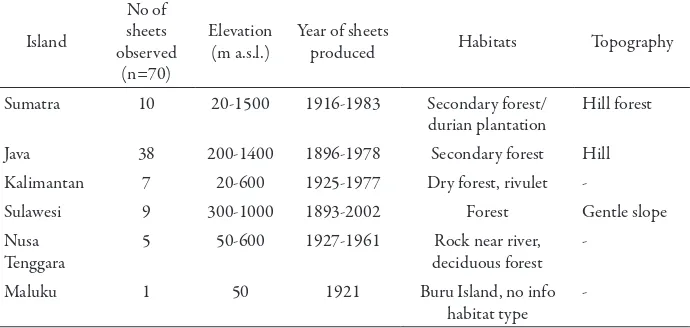
he herbarium observation was done at the 70 sheets which have indicated that H. multilora iswidely distributed. his species was found throughout Sumatra to Maluku, and has broad physiographic division - lowlands, midlands and highlands. he lowland starts at the elevation of 20 m to the high mountain at the elevation of 1500 m (Table 1).
Table 1. he distribution of H. multilora in Indonesia based on the observation of herbarium sheets of Herbarium Bogoriense, Bogor, Indonesia
Island
Year of sheets
produced Habitats Topography
Sumatra 10 20-1500 1916-1983 Secondary forest/
durian plantation
Hill forest
Java 38 200-1400 1896-1978 Secondary forest Hill
Kalimantan 7 20-600 1925-1977 Dry forest, rivulet
-Sulawesi 9 300-1000 1893-2002 Forest Gentle slope
Nusa Tenggara
5 50-600 1927-1961 Rock near river,
deciduous forest
-Maluku 1 50 1921 Buru Island, no info
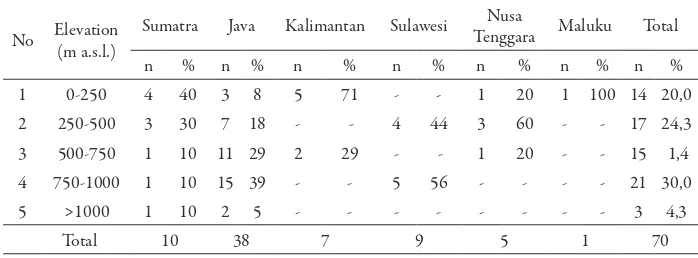
-Results in Table 1 indicate that the species tolerates a wide range of habitat and has high adaptability to the ecological diversities of the region. However, there is no evidence of H. multilora herbarium sheet from GGPNP. he species was not listed in “Flora Taman Nasional Gede Pangrango” of Sunaryo and Rugayah (1992). he elevation range at GGPNP was formerly from 900 to 3,019 m a.s.l. Ater 2003, the area was extended to the lower elevation, from 650 m a.s.l at Bodogol (Balai Taman Nasional Gunung Gede Pangrango oicial, personal communication). Based on the herbarium sheet observations, particularly the 38 herbarium sheets of Java, most of H. multilora
(68 %) are present at the elevation of 500 - 1,000 m a.s.l. (Table 2).
Table 2. Number of H. multilora Blume herbarium sheets according to level of elevation
No Elevation
(m a.s.l.)
Sumatra Java Kalimantan Sulawesi Nusa
Tenggara Maluku Total
n % n % n % n % n % n % n %
1 0-250 4 40 3 8 5 71 - - 1 20 1 100 14 20,0
2 250-500 3 30 7 18 - - 4 44 3 60 - - 17 24,3
3 500-750 1 10 11 29 2 29 - - 1 20 - - 15 1,4
4 750-1000 1 10 15 39 - - 5 56 - - - - 21 30,0
5 >1000 1 10 2 5 - - - 3 4,3
Total 10 38 7 9 5 1 70
2. he Occurrence of H. multilora
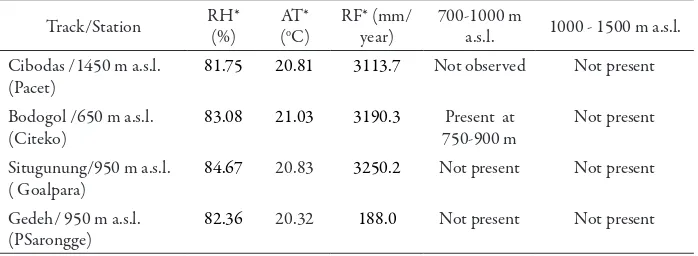
Based on the field observations, the results showed surprising evidences that
Table 3. he occurrence of H. multilora Blume at GGNP
Track/Station RH*
(%)
AT* (oC)
RF* (mm/ year)
700-1000 m
a.s.l. 1000 - 1500 m a.s.l. Cibodas /1450 m a.s.l.
(Pacet)
81.75 20.81 3113.7 Not observed Not present
Bodogol /650 m a.s.l. (Citeko)
83.08 21.03 3190.3 Present at
750-900 m
Not present
Situgunung/950 m a.s.l. ( Goalpara)
84.67 20.83 3250.2 Not present Not present
Gedeh/ 950 m a.s.l. (PSarongge)
82.36 20.32 188.0 Not present Not present
* source: BMKG station (2008): RH=relative humidity; AT= average temperature; RF = rainfall
3. Distribution and Habitat of H. multilora at Bodogol Research Station
As reported by the Indonesian Agency for Meteorology, Climatology and Geophysics (BMKG) of Citeko BMKG station, in the last 5 years (2004-2008) the average annual rainfall was 3041.36 mn year-1 (3190.3 mm in 2008); the relative humidity was 83.21 %
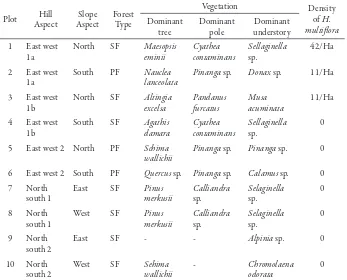
(83.08 % in 2008) and the temperature was 21.09 0C (21.030C in 2008). Table 4 shows
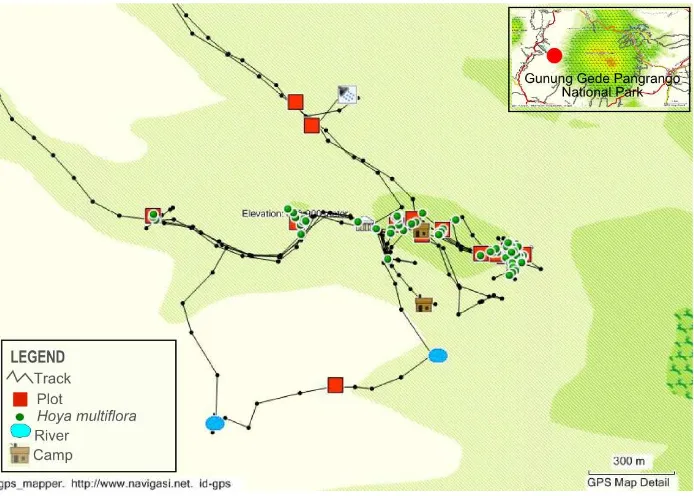
that the population of H. multilora is only found at east-west faced hill (Figure 1) at the elevation of 765 - 872 m a.s.l.; and lies between 106°50΄45.7˝E - 106°51΄36.4˝E, and between 6°46΄32.3˝S - 6°46΄39.8˝S.
Table 4. Population occurrence of H. multilora Blume at Bodogol Research Station
North SF Maesopsis
eminii
South PF Nauclea
lanceolata
Pinanga sp. Donax sp. 11/Ha
3 East west
1b
North SF Altingia
excelsa
South SF Agathis
damara
West SF Sehima
wallichii
- Chromolaena
odorata
0
Forest Type: PF= Primary Forest; SF= Secondary Forest (Formerly planted by PT Perhutani)
It was also noted that the H. multilora only found at the upper areas of the hill and slope, not in the valley area. he seed dispersal strategy by wind and the intensity of sun light are reasons for the site selection.
Figure 1. he distribution of H. multilora Blumepopulation at Bodogol Research Station, Gunung Gede Pangrango National Park, Bogor, Indonesia
B. DISCUSSION
According to the type of distribution, a species can be categorized as cosmopolitan or endemic species. As H. multilora has a wide range of geographic distribution, thus, this species is classiied as cosmopolitan species. However, based on the ield observations at Gunung Gede Pangrango National Park, H. multilora was only present at the Bodogol at the elevation of 750 - 900 m. he three other locations lay at higher elevation above 900 m a.s.l. As the result from the herbarium observation from Java, most of the sheets (68%) were found in elevation between 500 - 1000 m a.s.l.
he dispersal seems to be the key factor to the distribution of H. multilora at GGPNP. Biological dispersal refers to a species movement away from an existing population. hrough simply moving from one habitat patch to another, the dispersal of an individual has consequences not only for individual itness, but also for population dynamics, population genetics, and species distribution (Clobert et al., 2004). Understanding dispersal and the consequences on an ecosystem level requires understanding on the type of dispersal and the dispersal mechanisms involved.
Biologically, H. multilora has follicle type fruits and tiny seeds bearing lots of silky hairs. his characteristic allows the seeds to travel the wind current and gentle breezes of the earth. Wind dispersal of seeds, or anemochory, is one of the more primitive means of dispersal. Wind dispersal can take on one of two primary forms: seeds can loat on the breeze or alternatively, they can lutter to the ground (Irwini and Taylor, 2007). In the case of this species, it has plumose crown of hairs (pappus) above a slender seed. his type of dispersal adopted this typical characteristic of a parachute seed so this plant evolved parachute method of seed dispersal by wind (Armstrong, 1999).
he H. multilora dispersal at the Bodogol Research Station can be said primarily depends on the wind speed and direction at the time of fruit opening. Measurement by using (portable) anemometer at the observation time resulted in the southerly wind with the low speed (1-3 knot/hour). According to the data from the Indonesian Agency for Meteorology, Climatology and Geophysics (BMKG) 2008 (personal communication), wind direction above GGPNP (3000 feet) is southwesterly ( January-March), southerly (April - May and November - December) and southeasterly ( June-October). In areas where there is rugged topography that significantly interrupts the environmental wind low, the wind circulation between mountains and valleys is the most important contributor to the prevailing winds. Hills and valleys substantially distort the airlow by increasing friction between the atmosphere and landmass by acting as a physical block to the low, delecting the wind parallel to the range just upstream of the topography, which is known as a barrier jet. his barrier jet can increase the low level wind by 45 percent (Doyle, 1979). Wind direction also changes due to the contour of the land (ANCAR, 2006).
IV. CONCLUSION
REFERENCES
Ambasta, S.P. 1986. The Useful Plants of India. Publication and Information Directorate, Council of Scientiic and Industrial Research, New Delhi. 918p. [ANCAR] American National Center for Atmospheric Research. 2006. T-REX:
Catching the Sierra’s waves and rotors. University Corporation for Atmospheric Research. Accessed from: http://www.ucar.edu/communications/quarterly/ spring06/trex.jsp. on 2 September 2009.
Armstrong, W.P. 1999. “Blowing in the wind: seed & fruit dispersal by wind.” Wayne’s Word Noteworthy Plants. Accessed from http://waynesword.palomar.edu/ plfeb99.htm on 12 September 2009.
Backer, C.A. and R.C. Bakhuizen van der Brink, Jr. 1965. Flora of Java. Vol II. Groningen, Noordhof. 641p.
Begon, M., C.R. Townsend, and J.L. Harper. 2006. Ecology: From Individuals to Ecosystems (4th ed.). Blackwell, Singapore. 714p.
Bourinbaiar, A.S. and S. Lee-Huang. 1995. he non-steroidal anti-inlammatory drug, Indomethacin, as an inhibitor of HIV replication. FEBS Letters 360 (1): 85-88. Burkill, I.H. 2002. Dictionary of Economic Product of Malay Peninsula. Vol. 2. Ministry
of Agriculture Malaysia, Kuala Lumpur, Malaysia. 2444p.
Clobert, J., R.A. Ims, and F. Rousset. 2004. Causes, mechanisms and consequences of dispersal. In:Hanski, I. and O.E. Gaggiotti (Eds.). Ecology, Genetics and Evolution of Metapopulations. Academic Press, San Diego. Pp. 307-335.
Cox, G.W. 2002. General Ecology Laboratory Manual. Mc Graw Hill, New York. 312p. Cuddington, K. and B. Beisner. 2003. Ecological Paradigms Lost. Routes of heory
Change. Elsevier, Amsterdam. 435p.
Doyle, J.D. 1997. he inluence of mesoscale orography on a coastal jet and rainband.
Monthly Weather Review 125 (7): 1465-1488. Accessed from http://cat.inist.fr/? aModele=aicheN&cpsidt=2721180. on 25 December 2008.
Goyder, D. 2008. Hoya multilora Blume (Asclepiadaceae). Curti’s Bot. Magazine 7 (1): 3-6.
Irwini, A.J. and P.D. Taylor. 2007. Evolution of dispersal in a stepping-stone population with overlapping generations. heoretical Population Biology 58:321-328. Krebs, C.J. 1989. Ecological Methodology. Benjamin Cummings, Menlo Park, CA.
620p.
Rahayu, S. 2006. Hoya multilora Blume. In: Sutarno H., D. Darnaedi and Rugayah (Eds.) Tanaman Hias dalam Ruangan di Indonesia. P2B - LIPI, Bogor. Pp. 80-82. Rintz, R.E. 1980. he biology and cultivation of Hoyas. Asclepiadaceae 19:9-17. Schlechter, F.R.R. 1914. Die Asclepiadaceen von Deutch Neu Guinea. Botaniche
Jahrbűcher fűr Systematik 50: 104-138.
Sunaryo and Rugayah. 1992. Flora Taman Nasional Gede Pangrango. Herbarium Bogoriense, Bogor. 219 p.
haitong, O. 1994. he genus Hoya in hailand. Proceedings of Botany 2000 ASIA Intern. Seminar and Workshop. Melacca, June 1994. Pp.83-94.
Wanntorp, L., A. Koycan, and S. Renner. 2006. Wax plants disentangled: A phylogeny of Hoya (Marsdenieae, Apocynaceae) inferred from nuclear and chloroplast DNA sequences. Molecular Phylogenetics and Evolution 39: 722-733.