Universal social protection for children
Argentina
Since the mid-twentieth century, contributory family allowances have been the main mechanism for providing economic security to children and adolescents in Argentina.
In 2009, the Universal Child Allowance (UCA) was introduced in response to the effects of the global economic crisis, with the aim of consolidating several non-contributory transfer programmes for families with children. This non-contributory cash transfer programme expanded coverage to children under age 18 (and disabled children without any age limit), as well as to unemployed workers, informal workers, domestic workers, temporary workers and social monotributistas.
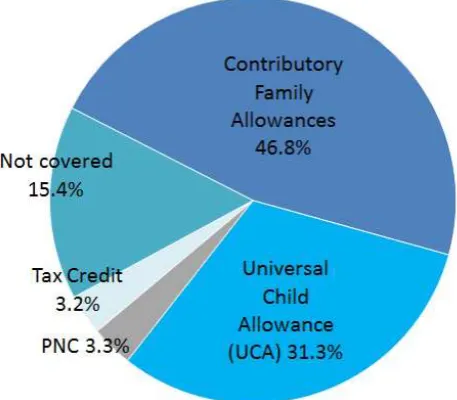
The provision of income insurance for families with children and adolescents is made up of three components: contributory family allowances (CFA), non-contributory family allowances and tax deductions from income (tax on earnings) for higher income workers with children. Together, these three components reach 84,6 per cent of children and adolescents in Argentina. In absolute terms, some 10.6 million children and adolescents are covered by an income transfer mechanism.
Main lessons learned
• The integration of the contributory and non-contributory components is a strategy to guarantee the consolidation of a comprehensive social security system and to ensure the universal protection of children and adolescents, in accordance with the provisions of ILO Social Protection Floors Recommendation, 2012 (No. 202), and the Convention on the Rights of the Child.
• The introduction of the UCA has enabled the development of a system to support the income of families with children, according to the employment status and income earned of the adults responsible for the children and adolescents. The system has three components: contributory component, non-contributory component and tax deductions for higher income workers.
• Studies have shown that the policy to extend social protection through the UCA has had a major impact on reducing extreme poverty and inequality and on increasing school attendance of adolescents aged 16 and 17.
S
o
cia
l P
ro
te
ct
io
n
in
A
ct
io
n
:
B
u
ild
in
g
S
o
cia
l P
ro
te
ct
io
n
F
lo
o
rs
D
e
ce
m
b
e
r 20
1
6
1. Background
Since the late 1990s, several initiatives have been introduced to provide income security for households with children. During the 2000s, social assistance programmes used the presence of children in the household as a reference; programmes for the social protection of children were also implemented at the sub-national level. The UCA was introduced in Argentina as a result of years of intense discussion on proposals designed to universalize protection of children and adolescents. One of the most noteworthy proposals was the extension of family allowances.
[image:2.595.39.268.434.634.2]The almost universal coverage achieved is due to several factors, most notably the implementation of the UCA, the increase in formal employment that expanded contributory coverage levels and the incorporation of monotributistas into the CFA component (April 2016). Monotributistas are mainly low-income, self-employed workers participating in the Simplified Regime for Small-scale Contributors, known as the Monotributo. This is a simplified, integrated tax system that rolls income, value-added and social security taxes into a single monthly payment.
Figure 1: Coverage of children, 2016
Source: Own elaboration on the basis of data from “National Institute of Statistics and Census” (population census), “Statistical bulletin of social security” and “Nationwide Survey on Social Protection and Social Security”.
Also of note is the extension of non-contributory pensions to mothers of seven or more children, which
provides income security to large families (between 2003 and 2016, the number of main beneficiaries increased by 444 per cent).
In legal terms, the UCA was created through a Decree of the National Executive Branch (1.602/09), which modified the Law of Family Allowances (No. 24.714). This decree established the incorporation of a non-contributory sub-system within the General Family Allowance Regime. In other words, both types of benefits are now regulated by this Law.
2. Structure and main characteristics
The provision of income security for children and adolescents in Argentina has three components:
• Contributory family allowances (CFA) composed of the “Family Child Allowance”, which covers the dependents of formal middle- and low-income employees, beneficiaries of certain social security guarantees (unemployment and work injury) and, since April 2016, dependents of workers of the Monotributo regime.
• Non-contributory family allowances is composed of the Universal Child Allowance (UCA), which is a semi-conditional cash transfer for each child and disabled child of unemployed workers, those in the informal economy, social monotributistas, temporary workers and domestic workers.
The cash transfer is semi-conditional: 80 per cent is granted through the usual system of social security payments while the remaining 20 per cent is paid once the main beneficiary confirms health check-ups, immunization records and certification of completion of the school year by their children and/or adolescents, whichever is the case.
The UCA is a component of the non-contributory pillar, along with family allowances for dependents of old-age pension beneficiaries and of certain non-contributory pension beneficiaries (disability and former soldiers in the Falklands War).
• Deduction or tax credit for each child for higher income workers who pay income tax. The tax credit is the component available to higher income workers who pay individual income tax.
Low-income beneficiaries of the CFA and UCA receive the same amount, 1,103 Argentina Pesos (ARS) per
month. In 2015, the automatic indexation of benefits (twice annually) based on the pension mobility index was established by law.
The National Social Security Administration (ANSES) is responsible for managing both contributory and non-contributory family allowances. In other words, the ANSES receives, processes and evaluates programme applications and pays both benefits.
The integration of the contributory and non-contributory components (CFA and UCA) pave the way for the consolidation of a “comprehensive social security system”, as established in the ILO Social Protection Floors Recommendation, 2012 (No. 202).
Nearly six years after the UCA was implemented, evidence indicates that these high-coverage social protection programmes do not negatively impact the labour market. This positive result is largely due to the coordination among programmes that guarantee income and promote active labour market policies.
Several factors explain the fact that approximately 15 per cent of children and adolescents are not covered under any scheme. This group mainly includes children and adolescents whose parents are: i) employees with higher earnings – or slightly lower earnings – than the established ceilings; ii) higher income monotributistas; iii) independent workers; or iv) immigrants residing in the country for less than three years. The situation of children and adolescents not under family care should also be mentioned given that they are not included in any of the current protection components.
Moreover, there are children and adolescents who are eligible for one of the established schemes but do not receive benefits for various reasons, such as problems with family relations, problems associated with their or their parents’ identification documents, and non-compliance with some requirements for access.
3. Financing
The contributory component is financed through employers’ contributions to social security while social security resources cover the cost of the UCA. As a result of the expanded coverage, the resources allocated to cash transfers for children and adolescents have been sharply increased. In 2014, the amount allocated to the protection of this segment of the
population was 1.04 per cent of GDP, where the principal components were the UCA (0.50 per cent), the CFA (0.46 per cent) and the family allowances for people receiving an old age pension (0.08 per cent).
4. Impacts of UCA
Policies to extend social protection have had considerable impacts on reducing extreme poverty and inequality. Studies by Bertranou (2010) and Maurizio and Vázquez (2014) show that UCA reduced poverty rates, especially extreme poverty. There is also empirical evidence from studies by Hintze and Costa (2014) and Curcio and Beccaria (2013) that suggest that UCA contributes to improved income distribution, as measured by the Gini coefficient and income gaps.
Some studies also found that the UCA had a positive impact on school attendance for adolescents between the ages of 16 and 17 (the group with the highest dropout rates), as well as on reducing child labour (Jiménez and Jiménez, 2015). Nevertheless, given the lack of available standardized data, more evidence is needed on the impact of this programme on school attendance, particularly secondary school.
The implementation of this policy also led to a 50 per cent increase in the number of children and a 14 per cent increase in the number of pregnant women enrolled in the SUMAR Plan, which provides guaranteed health benefits (MSAL, 2012).
5. Challenges
The main challenges for policies to guarantee income security for children and adolescents are:
• Despite efforts to increase UCA coverage, the challenge remains to incorporate a large number of eligible children and adolescents who, for different reasons, face barriers to accessing benefits.
• The role of established conditions needs to be redefined to emphasize the “universal right” of children and adolescents to health and education. • Sufficiency of UCA benefits should be assessed, so
children and adolescents can move out of poverty. • A micro-assessment of the UCA should be
conducted to identify bottlenecks and propose reforms that help facilitate implementation and compliance with established conditions.
REFERENCES
Arcidiácono, P.; Carmona Barrenechea, V.; Straschnoy, M. 2011. “La asignación universal por hijo para protección social: Rupturas y continuidades ¿Hacia un esquema universal?”, in Revista Margen, No. 61, pp. 1-16.
Bertranou, F. 2010. Aportes para un piso de protección social en Argentina: El caso de las asignaciones familiares (Buenos Aires, ILO Country Office for Argentina).
Bertranou, F.; Casalí, P.; Schwarzer, H. 2014. La estrategia de desarrollo de los sistemas de seguridad social de la OIT: El papel de los pisos de protección social en América Latina y el Caribe (Lima, ILO Regional Office for Latin America and the Caribbean).
Bertranou, F.; Cetrángolo, O.; Casanova, L.; Beccaria, A; Folgar, J. 2015. Desempeño y financiamiento de la protección social en Argentina (Buenos Aires, ILO Country Office for Argentina).
Casalí, P.; Schwarzer, H. 2010. “Social protection floor: Conceptual development and application in Latin America” in 2010 Labour Overview Latin America and the Caribbean (Lima, ILO Regional Office for Latin America and the Caribbean).
Curcio, J.; Beccaria, A. 2013. “Políticas de protección social y su impacto en la situación de la niñez y de sus familias. El caso de la Asignación Universal por Hijo para Protección Social a tres años de su implementación”, paper presented at XI National Political Science Congress, Paraná.
Hintze, S.; Costa, M. 2014. "Capacidad protectoria de la Asignación Universal por Hijo para Protección Social: Problemas y debates a cuatro años de su implementación", in C. Danani and S. Hintze (eds): Protecciones y desprotecciones II: Problemas y debates de la seguridad social en la Argentina (Buenos Aires, Universidad Nacional de General Sarmiento).
Jiménez, M.; Jiménez, M. 2015. Asistencia escolar y participación laboral de los adolescentes en Argentina: el impacto de la Asignación Universal por Hijo, Working Paper Series No. 11 (Buenos Aires, ILO Country Office for Argentina).
Building Social
Protection Floors
Country Note Series
December 2016
This note was produced by Pablo Casalí, Luis Casanova and Alejandra Beccaria of the ILO with contributions from Sebastián Waisgrais and Javier Curcio of UNICEF. It was reviewed by Isabel Ortiz of the ILO.
The editor of the series is Isabel Ortiz, Director of the
Social Protection Department, International
Labour Organization (ILO).
For more information, contact: [email protected]
www.social-protection.org
INTERNATIONAL LABOUR OFFICE
4, route des Morillons 1211 Genève 22 Switzerland
Follow us on:
www.facebook.com/SPplatform www.linkedin.com/company/4835021 www.twitter.com/soc_protection www.youtube.com/user/ILOTV