A. Background of the Study
Human beings spend almost two third of their time on earning money for life and
one third of their time for entertainment. Watching television, listening to radio
and reading books/newspaper/comics are some examples of leisure activities. As
one of entertainment materials, comic is a mass medium which illustrates the story
with pictures in sequences. It is written by an author who intends to deliver his/her
idea to the readers. By combining words indicating speech inside the balloons
with images, the author presents his/her ideas to be understood by his/her reader.
Devices such as speech balloons and boxes are used to indicate dialogues and to
establish information, while panels, layout, gutters and zip ribbons are more to
facilitate the flow of the story. Today, comics are found in newspapers,
magazines, comic books, graphic novels, and on the web.
As a means of communication, language is very important for the author in
order to present his/her idea, thought, feeling and desire. Searle (1969:24) says
that language is a part of a theory of actions, and speech acts are those verbal acts,
or more precisely illocutionary acts, such as promising, threatening and
requesting, that one performs in speaking. As one of the classifications of
illocutionary acts, directive is the reflection and description of the intention of
verb of directive acts, is the realization of the speaker’s desire in order to make the
hearer do what the speaker wants.
Trosborg (1994:187) states that a request is an illocutionary act whereby a
speaker (requester) conveys to a hearer (requestee) that he/she wants the requestee
to perform an act which is for the benefit of the speaker and, sometimes, for the
hearer. Request may be expressed in two ways; they are verbal and non-verbal
goods and services. The verbal goods and services is a request for information,
whereas the non-verbal is a request for object, an action or some kind of service,
etc. The purpose of a request is to involve the hearer in some future action which
has positive consequences for the speaker and may imply costs to the hearer.
There are many factors influence the effect of speaker’s utterance to the
hearer. Politeness is a phenomenon about something that is considered polite in
one culture can often be quite rude or simply strange in another. Meanwhile the
goal of politeness is to make all of the participants relaxed and comfortable with
one another. An utterance delivered to the hearer must use certain strategies of
politeness depends on the situational and social contexts. Context also affects the
request successfully delivered if the hearer has the same cultural background
knowledge because it is needed in helping revealing context of situation.
In Peanuts, the writer found some interesting phenomenon dealing with the
use of request. There are various types of request strategy expressed by the
characters in Peanuts, as the following examples:
In the Brown’s backyard, Charlie comes to Snoopy’s cage. Snoopy is sleeping on the top of his dog house when Charlie calls him.
independent lately! Don’t forget that I’m the one who takes care of you! (Snoopy ignores Charlie) Look at me when I’m talking to you! (Snoopy pays Charlie attention) Without me, you’d be nothing! Everything you have, you have because of me! (Snoopy ignores Charlie again) Even that collar around your neck… Why, I remember the day I went out and bought that collar with money I had worked for, and had saved and… (Snoopy takes the collar off from his neck and gives it back to Charlie) I hate it when he does that.”
(http:www.snoopy.com, February 23, 2003)
In the conversation above, Charlie expresses his request related to the
performative strategy to Snoopy’s by saying “I asked you to come down from
there!”. Charlie wants to talk to his dog, Snoopy, but when Charlie approaches
his cage, he is sleeping on the rooftop of his dog house. Charlie orders him to get
down from there. As the owner of Snoopy, Charlie has a power to order him and
Snoopy must obey it. The use of performative verb directly states the utterance as
an order that must be carried out by the hearer. The inclusion of a performative
verb which is used in this episode of Peanuts conveying requestive intent, that is
ask. Performative statement with requestive intent is very direct and usually
authoritative. They would normally be impolite outside a formal context. The
choice of performative verb which is used by Charlie makes these statements less
polite.
Meanwhile, based on the politeness strategy, Charlie’s utterance “I asked
you to come down from there!” is categorized into Bald On-Record. This one example of cases of non-minimization of the face threat in which non-redress
occurs when the speaker’s want to satisfy hearer’s face is small, either because
However, Charlie’s power is higher compared to Snoopy because he is the owner
of Snoopy and also the one who takes care of him. Snoopy likes to sleep on the
rooftop of his dog house rather than stays inside of his cage. That is why, she
asked Snoopy to come down from the rooftop of the dog house when he wants to
advise Snoopy.
Considering the phenomena above, the writer is interested in analyzing the
request strategy expressed by the characters in Peanuts for the reason that request
can be delivered in several strategies. Besides, the politeness of request is also
needed for the purpose of the speaker’s desire is granted by the hearer. Thus, the
title of this research is THE POLITENESS OF DIRECTIVE UTTERANCES
IN PEANUTS.
B. Scope of the Study
In this study, the writer describes the context in the story of Peanuts through
connecting the picture on the strips and the utterances existing in the comic strips.
The writer focuses on the analysis of directive utterance in the form of request
utterances and applies the request strategy in Peanuts by using Trosborg’s theory.
The writer also classifies the politeness of directive utterances in Peanuts by
employing Brown and Levinson’s strategies.
C. Purpose of the Study
1. Describing the context in the story of the Peanuts through connecting the
2. Finding out the realization of request strategy in Peanuts,
3. Describing the politeness of strategies used in Peanuts.
D. Research Method
The writer uses a qualitative research that employs descriptive method. Moleong
(2001:3) describes that a qualitative research is a research that presents the
descriptive data in the form of written or oral words of people and behavior which
can be observed. Surakhmad (1994:139) says that a descriptive method is a kind
of research method using technique of searching, collecting, classifying, analyzing
the data, interpreting them and finally drawing the conclusion.
In collecting the data, the writer uses non-participant observation (simak
bebas libat cakap). This involves the documentation method. The writer uses the
utterances taken from Jakarta Post daily newspaper and from www.snooopy.com
as a material of note-taking process.
In analyzing the data, the writer uses an Identity (Padan) Referential
technique. Sudaryanto (1993:13) states that it is a method in which the data are
utterances spoken or produced by the speaker and also based on the referent of the
language.
E. Underlying Theory
As one type of illocutionary acts, a directive act is an illocutionary act whereby a
speaker conveys to a hearer that he/she wants the hearer to perform an act which
by using of request. The purpose of a request is to involve the hearer in some
future action which has positive consequences for the speaker and may imply
costs to the hearer (Trosborg, 1994:15). Specific utterances in Peanuts influences
the choice of types of request strategy considered appropriate.
In showing their feelings, people should express it by uttering words and
also perform actions via those utterances. If the speaker wants the hearer do what
he/she wants, the speaker should use strategies to show the politeness of the
utterance. The politeness of directive utterance, which the writer analyzes in
Peanuts, applies the theory of Brown and Levinson. The response given by the
requestee can show that the request succeeds or fails.
F. ORGANIZATION OF WRITING
This research is divided into five main parts, Chapter One, Chapter Two, Chapter
Three, Chapter Four, and Chapter Five. The writer describes the background of
the study, the problem statement, the purpose of the study, the significance of the
study, the scope and limitation, the definition of the key terms and the
organization of the study early in Chapter One.
In Chapter Two, the writer provides and systematizes the review of related
theories in which differentiates between the related linguistic theories, that is
about speech acts theory, the definition of directive utterances, the politeness of
directive utterances, the definition of comic, context, and giving the detail about
the characters in Peanuts which back the main theories up to directly help the
Furthermore, in chapter three, the writer provides a brief explanation about
the research methodology, in which gives a clear picture about the research type,
data and source of data, population and sample, the technique of collecting data,
as well as the technique of analyzing the data.
Chapter Four is a part where the writer analyzes the data from which could
reveal many significant and meaningful findings of this research. Thus, finally,
the writer could draw the conclusion based on the findings and related theories, in
CHAPTER TWO
REVIEW OF LITERATURE
A. Speech Acts Theory and Directive Utterances 1. Speech Acts Theory
In showing their feelings, people should express it by uttering words and
also perform actions via those utterances. That is why the message can be
delivered to the hearer. Actions that are performed via utterances are generally
speech acts. Speech acts is one of the basic ingredients of pragmatics arranging by words and corresponding to sentences. When Debby says Go anywhere
today?, she does something and what she does is called ‘asking questions’. This
type of act is considered as speech acts. Debby, certainly, expects an answer to
her question from the hearer.
Austin (1962) and Searle (1969) proposed that language has three main
aspects: Locutionary Act, Illocutionary Act and Perlocutionary Act. Searle
describes a speech act, i.e., an act of saying but the Locutionary act has itself
meaningful linguistic expression, such as words, phrase that are arranged into a
good sentence. Illocutionary act is performed via the communicative force of an
utterance. Yet, this must be understood that the speaker has to realize what the
speaker will say and take it a certain sense. Searle in Celce and Olshtain
(2000:25) explains types of illocutionary acts into a limited number of major
categories; they are Declarative, Representatives (Assertives), Directives,
Expressives and Commisives.
2. Directive Utterances
When the speaker asks the hearer to do something, it means that the speaker
performs a speech act. He/she certainly wants his/her action to be understood
and then the hearer will do what the speaker wants. According to Searle
(1969:24), language is a part of a theory of actions, and speech acts are those
verbal acts, or more precisely illocutionary acts, such as promising, threatening
and requesting, that one performs in speaking.
Yule (1996:54) states that in using a directive, the speaker attempts to make
the world fit the words via the hearer. Leech (1993:327&346) gives the detail of
directive verbs that usually occur in the construction sentence “S verb (O) that
X” or “S verb O to Y”, they are request, ask, beg, bid, command, demand,
forbid, recommend, tell, order, advise, suggest, and invite.
A directive act is an illocutionary act whereby a speaker conveys to a hearer
that he/she wants the hearer to perform an act which can be benefit for the
speaker and, sometimes, for the hearer. For an example, request is for the
both speaker and hearer, and if the act is performed, it is exclusively for the
benefit of the hearer. Thus, the directive act can be characterized as pre-event
and the desired act takes place post-utterance, either in the immediate future or
at some later stage. In short, directive verbs demand the cost of the hearer and
the benefit for the speaker.
There are four major categories of request strategies simplified by Anna
Trosborg (1994:192-204) that based on the theories of Austin (1962) and Searle
(19969, 1976) then reformulated by Brown-Levinson (1978, 1987),
House-Kasper (1981), and Blum Kulka-Olshtain (1984). The categories cover:
CATEGORY I ─ Indirect Request
Strategy 1 ─ Hints: A speaker who does not want to state his/her Impositive
intent explicitly has resort to hinting strategies.
Mild : The speaker can leave out the desired action
altogether.
e.g. I have to be at the airport in half an hour
Strong : The speaker can mention his/her wish partially
e.g. My car has broken down. Will you be using your car
tonight?
Hints strategy involves the condition, as follows:
a. Reasonableness
Stating some general condition which indicates the speaker’s reason
impositive intent (of the ‘reasonableness precondition’ referred to by
Haverkate, 1984).
e.g. Would you do the dishes? The kitchen is a total mess
b. Availability
Questioning some condition that would present an obstacle to
compliance (if not fulfilled) is another way of giving a hint.
e.g. Is there any coffee left?
c. Obviousness
Speaker conveys his/her desire obviously.
e.g. Has the letter already been typed?
CATEGORY II ─ Hearer-oriented conditions (Conventionally Indirect)
Strategy 2 Questioning hearer’s ability/willingness
a.Ability
This depends on the hearer’s capacity in performing the act.
e.g. Maybe you could help John dig the garden tomorrow?
b. Willingness
This depends on the hearer’s willingness in performing
the act.
e.g. Would you lend me a copy of your book?
Statements of ability and willingness
Hearer can not give any excuses because speaker has
conveyed that he/she considers this condition is fulfilled
e.g. Mary, you can clear the table now.
Strategy 3 ─ Suggestory formulae
When employing suggestory formulae, speaker has
anticipated the refusal from hearer. But hearer must invent
his/her own reason to refuse because the hearer-based
preparatory condition is questioned.
CATEGORY III ─ Speaker-based conditions
Strategy 4 ─ Statements of speaker’s wishes and desires
e.g. I would like to have some more coffee.
Strategy 5 ─ Statements of speaker’s needs and demands
e.g. I need a pen.
CATEGORY IV ─ Direct Request
Strategy 6 ─ Statements of obligation and necessity
The speaker uses his/her own authority in stating his/her desire.
e.g. You should/ought to leave now.
Strategy 7 ─ Performatives
Performative verb is considered more/less polite (ask vs.
command)
e.g. I ask/request/ order/command you to leave.
Strategy 8 Imperatives
The imperative is the grammatical form directly signaling
that the utterance is an order (this can be also added by
e.g. Open the door, please.
Elliptical Phrases
This is phrases in which only the desired object is mentioned.
e.g. Two coffee, please.
B. The Politeness of Directive Utterances
Politeness is best expressed as the practical application of good manners. In
other words, it is culturally defined as a phenomenon, and what is considered
polite in one culture can often be quite rude or simply strange in another. While
the goal of politeness is to make all of the participants relaxed and comfortable
with one another, these culturally defined standards and may be manipulated to
inflict shame on a designated participant.
Penelope Brown and Stephen C. Levinson (1978,1987:92) states that
Strategies, then, form hierarchies of strategies that will achieve higher-order goals. Where necessary we refer to the four highest-level strategies (bald on record, positive politeness, negative politeness and off record) as ‘super-strategies’, to the strategies that emanate from these as ‘higher-order strategies’, to final choice of linguistic means to realize the highest goals as ‘output strategies’ (identified in the text thus: BE VAGUE).
1. Bald on Record
Brown and Levinson (1978, 1987:94-101) divide bald on record strategy
into two strategies, they are
This is mutually known to both speaker and hearer that face redress is not
necessary. First, in cases of great urgency of desperation, redress would
actually decrease the communicated urgency. E.g. Help! , Watch out!
Second, non-redress occurs when the speaker’s want to satisfy hearer’s
face is small, either because speaker is powerful and does not fear
retaliation or non-cooperation from hearer. E.g. Bring me wine, Jeenes.
Third, in cases where non-minimization likely occurs where doing the
FTA (Face Threatening Act) is primarily in hearer’s interest. Thus,
sympathetic advice or warnings may be baldly on record. E.g. Careful!
He’s a dangerous man. (Warning hearer against someone who could
threaten him/her)
b. Cases of FTA-oriented bald on record
This case illustrates the way in which respect for face involves mutual
orientation, so that each participant attempts to foresee what the other
participant is attempting to foresee. There are three subjects where one
would expect such pre-emptive invitations; First, Welcomings (or
post-greetings), where speaker insists that hearer may impose on his negative
face. e.g. Come in, don’t hesitate, I’m not busy. Second, Farewells, where
speaker insists that hearer may transgress on his positive face by taking his
face. e.g. Go. Third, Offers, where speaker insists that it may impose on
speaker’s negative face. e.g. Don’t bother, I’ll clean it up.
Brown and Levinson (1978, 1987:103-129) reveal the positive politeness
strategy into:
a. Claim common ground
1) Speaker may convey that some want (goal or desired object) of hearer’s
admirable of interesting to speaker too
STRATEGY 1. Notice, attend to hearer (his interests, wants, needs, goods)
e.g. What a beautiful vase this is! Where did it come from?
STRATEGY 2. Exaggerate (Interest, approval, sympathy with hearer)
e.g. What a fantástic gárden you have!
STRATEGY 3. Intensity interest to hearer (‘by making ‘a good story’)
e.g. I come down the stairs, and what do you think I see? ─ a huge mess
all over the place, the phone’s off the hook and clothes are scattered
all over …
2) Claim in-group membership with hearer
STRATEGY 4. Use in-group identify markers
a. Address forms
There is several in-group memberships in English, as Mac, mate,
buddy, pal, honey, dear, duckie, luv, babe, Mom, blondie, brother,
sister, cutie, sweetheart, guys, fellas.
e.g. Come here, buddy.
b. Use of in-group language or dialect
Below is an example that is comparable to the switch within English,
First call : Come here, Johnny.
Second call : John Henry Smith, you come here right away.
c. Use of jargon or slang
e.g. Lend us two bucks then, wouldja Mac?
d. Contraction and Ellipsis
e.g. Mind if I smoke?
3) Claim common (point of view, opinions, attitudes, knowledge, empathy)
STRATEGY 5. Seek Agreement
a. Safe Topics
For an example, if your neighbor comes home with a new car and
you think it hideously huge and pollution-producing; you might still
be able to say sincerely: “Isn’t your new car a beautiful color!”
b. Repetition
Repetition is usually used to stress emotional agreement and those
repeats go back and fourth for several conversational turn.
e.g. A: “John went to London this weekend!”
B: “To Lóndon!”
STRATEGY 6. Avoid disagreement
a. Token Agreement (in order to pretend to agree).
e.g. A: “ Have you got friends?”
B: “I have friends. So-called friends. I had friends. Let me put it
that way.
e.g. I’ll meet you in the front of the theatre just before 8.0, then.
c. White lies
e.g. Yes, I do like your new hat! (c.i. The speaker does not like the
hearer’s new hat)
d. Hedging opinions
Several hedges in English are sort of, kind of, like, in a way.
e.g. It’s really beautiful, in a way.
STRATEGY 7. Presuppose/Raise/Assert common ground
a. Gossip, small talk
This is just as a mark of friendship between speaker and hearer.
b. Point-of-view operations
This is related to deixis.
c. Personal-centre switch: speaker to hearer
Speaker may speak as if hearer was speaker, or hearer’s knowledge
was equal to speaker’s knowledge.
e.g. Oh dear, we’ve lost our little ball, haven’t we, Johnny?
d. Time switch
It refers about the tense that shifts from past to present tense.
e.g. John says he really loves your roses.
e. Place switch
The use of proximal rather than distal demonstratives (here, this)
e.g. (on saying goodbye): This
?That was a lovely party.
g. Presupposition manipulations
h. Presuppose knowledge of hearer’s wants and attitudes
i. Presuppose hearer’s values are the same as speaker’s values
j. Presuppose familiarity in speaker-hearer relationship
k. Presuppose hearer’s knowledge
STRATEGY 8. Joke
Since jokes are based on mutual shared background knowledge and
values, jokes may be used to stress that shared background knowledge or
those shared values. e.g. OK if I tackle those cookies now?
b. Convey that speaker and hearer are cooperators
1) Indicate speaker knows hearer’s wants and is taking them into account
STRATEGY 9. Assert or presuppose speaker’s knowledge of and concern for
hearer’s wants.
e.g. I know you love roses but the florist didn’t have more, so I
brought you geraniums.
2) Claim reflexivity
STRATEGY 10. Offer, promise
e.g. I’ll drop by sometime next week.
STRATEGY 11. Be Optimistic
e.g. I’ve come to borrow a cup of flour.
STRATEGY 12. Include both speaker and hearer in the activity
e.g. Let’s have a cookie, then.
e.g. Why not lend me your cottage for the weekend?
3) Claim reciprocity
STRATEGY 14. Assume or assert reciprocity
e.g. “I’ll do X for you if you do Y for me” or “I did X for you last
week, so you do Y for me this week” (or vice versa).
c. Fulfill hearer’s want for some X
STRATEGY 15. Give gifts to hearer (goods, sympathy, understanding,
cooperation)
Speaker may satisfy hearer’s positive face want by satisfying
some of hearer’s wants.
3. Negative Politeness
Brown and Levinson (1978, 1987: 130-211) distinguish the doing of FTA
into two categories:
a. On record → Be Direct
STRATEGY 1. Be conventionally indirect
1) Politeness and the universality of indirect speech acts
Gordon and Lakoff (1971) drew attention to a systematic way of making
indirect speech acts in English: by stating or questioning a felicity
condition. Yule (1996:50) says that felicity conditions are certain
expected or appropriate circumstances for the performance of a speech
act to be recognized as intended.
a) The more effort a speaker expends in face-preserving work, the more
he will be seen as trying to satisfy hearer’s face wants.
b) The strategic choices will be preferred over other strategies that satisfy
the end to a lesser degree.
b. Redress to hearer’s want to be unimpinged upon
1) Don’t presume/assume
Make minimal assumptions about hearer’s wants, what is relevant to
hearer.
STRATEGY 2. Question, hedge
In literature, a ‘hedge’ is a particle, word, or phrase that modifies the
degree of membership of a predicate or noun phrase in a set. e.g. John is a
true friend.
2) Don’t coerce H. Give hearer option not to do act:
a) Be indirect
b) Don’t assume hearer is able/willing to do action
Hedged on illocutionary force, Hedges encoded in particles,
Adverbial-clause hedges, Hedges addressed to Grice’s Maxims,
Hedges addressed to politeness strategies, and Prosodic and kinesic
hedges.
c) Assume hearer is not likely to do action
STRATEGY 3. Be pessimistic
This strategy gives redress to hearer’s negative face by explicitly
speech act obtain. In order to minimize threat, we should make explicit
Rating of imposition, Power, Distance values. e.g. Could/would/might you
do X?
STRATEGY 4. Minimize the imposition
One way of defusing the Face Threatening Act is to indicate that rating
of imposition, the intrinsic seriousness of the imposition, is not in itself
great, leaving only distance and power as possible weighty factors. e.g. I
just want to ask you if I can borrow a tiny bit of paper.
STRATEGY 5. Give deference
There are two sides to the coin in the realization of deference: one in
which speaker humbles and abases himself and another where speaker
raises hearer (pays him positive face of a particular kind, namely that
which satisfies hearer’s want to be treated as superior). In both cases,
hearer has a higher social status that speaker.
3) Communicate speaker’s want to not impinge on hearer
STRATEGY 6. Apologies
By apologizing for doing an FTA, the speaker can indicate his
reluctance to impinge on hearer’s negative face and thereby partially
redress that impingement. There are four ways to communicate regret or
reluctance to do an FTA:
a) Admit the impingement
e.g. I’m sure you must be very busy, but …
e.g. I normally wouldn’t ask you this, but …
c) Give overwhelming reasons
e.g. I can think of nobody else who could …
d) Beg forgiveness
e.g. Excuse me, but …
STRATEGY 7. Impersonalize speaker and hearer: Avoid the pronouns ‘I’ and
‘you’
a) Performatives; e.g. I tell you that it is so → It is so.
b) Imperatives; e.g. Take that out!
c) Impersonal verbs; e.g. It looks (to me) like…
d) Passive and circumstantial voices; e.g. I expect → It is expected
e) Replacement of the pronouns ‘I’ and ‘you’ by indefinites; e.g. One
shouldn’t do things like that rather than: You shouldn’t do things like that
f) Pluralization of the ‘you’ and ‘I’ pronouns
g) Address terms as ‘you’ avoidance; e.g. Excuse me, sir/miss/’you
h) Reference terms as ‘I’ avoidance; e.g. His majesty is nót amused (in the
majesty)
i) Point-of-view distancing; e.g. I have been/was wondering whether you
could do me a little favor.
STRATEGY 8. State the FTA as some general social rule, regulation or
obligation
e.g. ─ Passengers will please refrain from flushing toilets on the train
STRATEGY 9. Nominalize
e.g. a) You performed well on the examinations and we were favourably
impressed.
b) Your performing well on the examinations impressed us favourably.
c) Your good performance on the examinations impressed us favourably.
Here c) seems more formal, more like a business letter than b), and b) is
more than a). a) seems a spoken sentence while c) is a written one. So, as we
nominalize the subject, the sentence gets more ‘formal’.
4) Redress other wants of hearer’s derivative from negative face
STRATEGY 10. Go on record as incurring a debt, or as not indebting hearer
e.g. for requests → I’d be eternally grateful if you would …
for offers → I could easily do it for you.
4. Off Record
Brown and Levinson (1978, 1987:213:227) classifies the off-record
strategies by the kinds of clues that are presented by the speaker for the
intended inferences to be derived from:
a. Invite conversational implicatures, via hints triggered by violation of
Gricean Maxim.
1) Violate Relevance Maxim
STRATEGY 1. Give hints
a) Motives for doing action
b) Conditions for action
e.g. That window isnt’ open
STRATEGY 2. Give association clues
e.g. Are you going to market tomorrow? … There’s a market tomorrow,
I suppose. (c.i. Give me a ride there)
STRATEGY 3. Presuppose
e.g. I washed the car again today
Based on the example above, speaker presupposes that he has ever
done it before and the use of again forces hearer to think about the relevance
of the presupposed prior event. It is relevant if speaker and hearer count the
times each does the task, and this in turn is relevant because speaker and
hearer have agreed to share the task, then the criticism is implicated.
2) Violate Quantity Maxims
STRATEGY 4. Understate
e.g. A: What do you think of Harry?
B: Nothing wrong with him. (c.i. I don’t like think he’s particularly
like it)
STRATEGY 5. Overstate
e.g. There were a míllion people in the Co-op tonight!
Based on the example of overstatement above could convey an excuse
for being late.
STRATEGY 6. Use tautologies; e.g. Boys will be boys.
STRATEGY 7. Use contradictions
e.g. A: Are you upset about that?
B: Well, yes and no/ I am and I’m not.
STRATEGY 8. Be ironic; e.g. Lovely neighborhood, eh? (in a slum)
STRATEGY 9. Use metaphors; e.g. Harry’s a real fish.
(c.i. He drinks/ swims/ is slimy/ is cold-blooded like a fish)
STRATEGY 10. Use rhetorical question
e.g. How many times do I have to tell you …? (c.i. Too many)
b. Be vague or ambiguous
1) Violate Manner Maxim
STRATEGY 11. Be ambiguous
e.g. John’s a pretty sharp cookie. Smooth
The example above could be either a compliment or an insult,
depending on which of the connotations of sharp or smooth are
latched on to.
STRATEGY 12. Be vague
e.g. in criticism → Perhaps someone did something naughty.
In some euphemism:
I’m going you-know-where.
down the road for a bit. (c.i. to the local pub)
STRATEGY 13. Over-generalize; It relates to the use of proverbs.
e.g. People who live in glass houses shouldn’t throw stones.
Tripp (1972:247) cites an example of this, where one secretary in an
office asks another ─ but with negative politeness ─ to pass the stapler, in
circumstances where a professor is much nearer to the stapler that the
other secretary. His face is not threatened, and he can choose to do it
himself as a bonus ‘free gift’.
STRATEGY 15. Be incomplete, use ellipsis
Elliptical utterances are legitimated by various conversational
contexts.
e.g. Well, if one leaves one’s tea on the wobbly table …
C. Comic
Via Latin, the word of comic is derived from
the Greek "Κωμικός",kōmikos, of or pertaining to "comedy",
from kōmos "revel" that means is a graphic medium in which images are
utilized in order to convey a sequential narrative; the term, derived from
massive early use to convey comic themes, came to be applied to all uses of
this medium including those which are far from comic. Whereas, A. S.
Hornby (2000:239) states that comic is
adj. 1 amusing and making you laugh. 2 [only before noun] connected with comedy
noun 1 an entertainer who makes people laugh by telling jokes or funny stories (comedian) 2 (AmE also comic book) a magazine, especially for children, that tells stories through pictures 3 (the comics) [pl.] (AmE) the section of a newspaper that contains comic strips.
According to Schiffrin (1994:365), context is what speakers and hearers
know, for example about social institutions about others’ wants and needs,
about the nature of human rationality, etc and how that language guides the
use of language and the interpretation of utterances. Halliday in Gerot and
Wignell (1995: 174) reveals context into two group, they are context of culture
and context of situation. In context of situation, they are divided into linguistic
context (verbal) and non linguistic context (non-verbal). Jef Verschueren
(1999:75) reveals the Malinowski’s term of ‘context of situation’
Exactly as in the reality of spoken or written languages, a word without linguistic context is a mere figment and stands for nothing by itself, so in the reality of a spoken living tongue, the utterance has no meaning except in the context of situation. (Malinowski 1923, p. 307)
Firth (1992:11) gives an emphasis of some principles about context of
situation, they are participants, participants’ action, features of another
situation that relevance, and the impacts of verbal action. This framework is
arranged in 1950 and re-improved by Professor T.F. Mitchell. Firth’s concepts
are more abstract, not as a realization of the language event. Dell Hymes
(1967:11) explains the framework of context situation in renewing the Firth’s
one, they are the form and content of message; sets of specific environment
(as time and place); participants; intentions and objectives of communication;
clues; mediator; genre; and norm of interaction.
However, context of situation is only direct environment but there is still
wider knowledge in translating a text, which is context of culture. Here, the
real context of situation, including the arrangement of certain field, tenor, and
(1992:64) states that the clue of cultural background knowledge is needed in
helping revealing context of situation.
E. Peanuts Comic Strips
According to A. S. Hornby (2000:239) describes comic strip as a series of
drawings inside boxes that tell a story and are often printed in
newspapers. Peanuts is the name of a syndicated comic strip written and
drawn by American cartoonist, Charles Schulz, from October 2, 1950 to 2000.
He did not explicitly address racial and gender equality issues so much as he
assumed them to be self-evident in the first place. Peanuts features
a group of children, ranging from infants to eight-year olds, whose
perspectives on the world around them are at once childlike and adult. Charles
Schulz calls them as Peanuts gang, and they are, as follows:
1. Charlie Brown (8½) is the main character in Peanuts. He is known to be
“bald”, though he has a little bit of hair at the front. He commonly wears a
collared shirt with a black zigzag across the middle, black shorts, yellow
socks and brown shoes. He forms the neighborhood baseball team ─ Little
League team ─ and recruits his friends. Charlie Brown is a loveable loser, a
child possessed of endless determination and hope, but who is ultimately
dominated by his insecuritiesand a "permanent case of bad luck," and often
taken advantage of by his peers. He generally fails at anything he attempts
continues playing baseball. He also unable to fly a kite successfully, but
continues trying to fly his kite.
2. Snoopy (Male) is Charlie Brown’s dog and he even more popular than
Charlie because he has a funny character. He sleeps on top of his dog
house. Snoopy is always trying to write the great American novel but he
cannot get beyond the first line of his book. Snoopy was a silent character.
In addition to Snoopy's ability to "speak" his thoughts to the reader, many
of the human characters in Peanuts have the uncanny knack of reading his
thoughts and responding to them.
3. Linus van Pelt (7) has brown hair and he normally wears a red shirt with
stripes on it, black shorts, and tennis shoes. He is Charlie Brown’s best
friend. Sometimes, Linus is seen wearing eyeglasses because he
has myopia. He is unusually smart and acts as the
strip's philosopher and theologian, often quoting the Gospels. Linus
generally plays second base, on the baseball team. He always carries a
blanket to feel secure.
4. Lucy van Pelt (8) is Linus’ older sister. She has a black shoulder-length hair
and wears dresses in any color, usually blue, pink and purple. On Charlie
Brown's baseball team, Lucy plays right field (or occasionally center field),
and is characterized as a bad player, who, when temporarily kicked off the
team, turns to heckling the games. She soon grew into her familiar persona
5. Sally Ann Brown (6) is Charlie’s younger sister. She has flipped blonde hair
with a cluster of curls and sometimes a bow in front, and she wears a polka
dot dress, usually pink or light blue. Sally is in love with Charlie Brown's
best friend, Linus. She is one of the few kids in the neighborhood who has
never played on Charlie Brown's baseball team.
6. Patricia "Peppermint Patty" Reichardt (8) is a tomboy girl with a
freckle-faced brunette and has brown chin-length hair. She almost always wears
pants and sandals. She is one of a small group in the strip who lives across
town from Charlie Brown and his school friends. Patty is also a star athlete,
especially in baseball, where her team regularly trounces Charlie's squad.
She likes Charlie very much and is the only one who calls him “Chuck.”
7. Schroeder (9) has short yellow hair. He almost always wears a striped shirt
of any color, generally purple, and black shorts. Schroeder is also the
catcher on Charlie Brown's baseball team. Schroeder likes to play a small
toy piano.
8. Frieda (7) has red naturally curly hair, of which she is quite proud. She was
the only girl on Charlie Brown's baseball team to not wear a cap because it
would cover up her naturally curly hair and frequently wearing purple
dresses. She also wears tennis shoes and has an upturned nose. She
eventually joined Charlie Brown's baseball team as an outfielder.
9. The Head Beagle is apparently an actual existing entity as he is also known
to humans although he never seen. Head Beagle has a higher authority to
CHAPTER THREE
RESEARCH METHOD
A. Type of Research
The research method is designed based upon the problems analyzed and the main
purpose of the research. In this research, the writer uses a qualitative research that
employs descriptive method. Moleong (2001:3) describes that a qualitative
research is a research that presents the descriptive data in the form of written or
oral words of people and behavior which can be observed.
Meanwhile, the writer also employs a descriptive method in this research.
Surakhmad (1994:139) says that a descriptive method is a kind of research
method using technique of searching, collecting, classifying, analyzing the data,
interpreting them and finally drawing the conclusion.
B. Data and Source of Data
Arikunto (1998:114) states that the source of data refers to subject from which the
data are obtained. The data can be discourse, sentences, clauses, phrases or words.
There are two kinds of data, they are:
1. Primary data
The data are directly taken as a result of collecting the data individually and it
is an original data from the source.
The data are taken from the second person and they are copies of the original
data.
In the research, the primary data are chosen in analyzing the data. The writer
employs some comic strips entitled Peanuts taken from the Jakarta Post daily
newspapers and from http://www.snoopy.com as the source data and here after it
is shortened Peanuts. The data in this research are dialogues containing politeness
in the utterances spoken by the characters in Peanuts. This research uses primary
sources data which requires the writer to take the data directly from the sources by
using documentation method.
C. Population and Sample
Population is the whole research objects (Arikunto, 1998:115). Arikunto
(1993:102) also adds that population is an analysis unit that will be analyzed in
research. The population of this research is the sentences taken from the
utterances used in Peanuts. The writer takes all the utterances containing requests
that represent population. In this research, the writer takes all the utterances from
the conversation of the characters formed in this comic strip.
Arikunto (1992:107) says that if the objects of a research are less than a
hundred, it is better to take all of them into account, so that the research is called
population research. However, if the objects are larger than a hundred, we may
take some of them in a percentage 10-15% or 20%.
Arikunto (1998: 117) states that sample is a part of representation of the data
criteria based on the purpose of the research. In determining the sample, the writer
uses purposive sampling method. Nawawi (1991:157) states that the data were
selected according to particular criteria based on the purpose of the research.
D. Technique of Collecting Data
In collecting the data, Sudaryanto (1993:133) reveals two kinds of method of
collecting data; they are participant observation method (simak libat cakap) and
non-participant observation method (simak bebas libat cakap). In this research,
the writer uses non-participant observation method. This method does not involve
the writer in language production. In this research, the method of collecting data
done is a documentation method. Documentation is a method of collecting data
about certain variable such as notes, transcript, newspaper, magazine, meeting
notes, agenda, etc (Arikunto, 1998:236).
After collecting all the data, the writer takes notes them that relevant with
the purpose of the study. Sudaryanto (1993) also adds that after applying the
method of literature, the writer does note-taking technique. Then, the writer
classifies all collected data based on the using of request strategy and the domain
where the politeness happened.
E. Technique of Analyzing Data
In analyzing the data, the writer uses an Identity (Padan) Referential technique.
or produced by the speaker. This is based on the referent of the language
(Sudaryanto, 1993:13).
There are two ways of presenting data, formal and informal way. In formal
method, the data are presented with signs and symbols such as arrows, plus/minus,
brackets, etc. Meanwhile, in informal method, the data are presented with natural
language (ordinary words) and technical terminology (Sudaryanto, 1993:145). In
this research, the writer uses both of them, formal and informal method to present
the data. Thus, the data in the form of signs and symbols are presented in words in
this thesis.
There are some research procedures to analyze the data, those are:
1. Compiling the comic strips from Jakarta Post daily newspaper and also from
the author website, http://www.snoopy.com.
2. Explaining the content of each sample based on the theories which have been
defined.
3. Describing the context of each comic strips and shorting them based on the
date.
4. Explaining the request strategy used in the utterances based on the theories of
Austin (1962) and Searle (19969, 1976) then reformulated by
Brown-Levinson (1978,1987), House-Kasper (1981), and Blum Kulka-Olshtain
(1984).
5. Explaining those utterances into politeness strategy provided by Brown and
Levinson.
CHAPTER FOUR
DATA ANALYSIS
In this chapter, the writer will categorize and explain the utterance spoken
between the speaker and the hearer in Peanuts of Jakarta Post Daily Newspaper
and www.snoopy.com. The utterances apply the request strategy as shown in the
table 1. Meanwhile, the politeness strategy that is applied in the request utterances
is shown in the table 2.
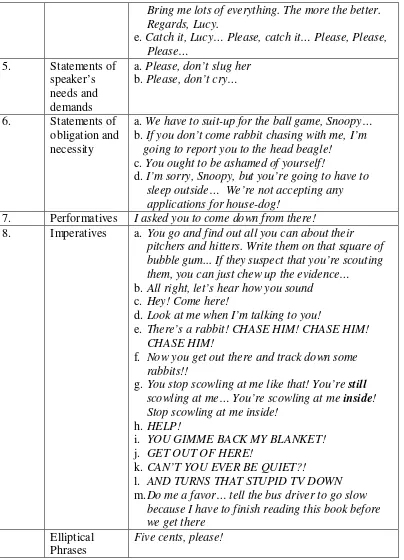
heading this way! You’re the only one in the world who can save us!
won’t have to waste these two free tickets? c. Will you buy me a balloon, Chuck?
d. If you were really liked me, would you give me presents?
Statements of ability and willingness
C’mon, Snoopy… We’re going to Peppermint Patty’s house… She’s invited us over for a game of ‘Ha Ha, Herman’
3. Suggestory formulae
Gramma says that none of her other grandchildren has a blanket
b. She says that if you’ll give up that blanket, she’ll donate ten dollars to your favorite charity c. I wish I had a secret admirer… Someone who
would send me flowers and little notes and things like that… And then, all of a sudden, he would tell me who he was…
Bring me lots of everything. The more the better. Regards, Lucy.
e. Catch it, Lucy… Please, catch it… Please, Please, Please…
a. We have to suit-up for the ball game, Snoopy… b. If you don’t come rabbit chasing with me, I’m
going to report you to the head beagle! c. You ought to be ashamed of yourself!
d. I’m sorry, Snoopy, but you’re going to have to sleep outside… We’re not accepting any applications for house-dog!
7. Performatives I asked you to come down from there!
8. Imperatives a. You go and find out all you can about their pitchers and hitters. Write them on that square of bubble gum... If they suspect that you’re scouting them, you can just chew up the evidence…
b. All right, let’s hear how you sound c. Hey! Come here!
d. Look at me when I’m talking to you!
e. There’s a rabbit! CHASE HIM! CHASE HIM!
CHASE HIM!
f. Now you get out there and track down some rabbits!!
g. You stop scowling at me like that! You’re still scowling at me… You’re scowling at me inside! Stop scowling at me inside!
h. HELP!
i. YOU GIMME BACK MY BLANKET!
j. GET OUT OF HERE!
k. CAN’T YOU EVER BE QUIET?!
l. AND TURNS THAT STUPID TV DOWN
1. Bald On-Record a. Please, don’t cry…
b. I asked you to come down from there! c. You go and find out all you can about their
pitchers and hitters. Write them on that square of bubble gum... If they suspect that you’re scouting them, you can just chew up the evidence…
d. Hey! Come here!
e. Look at me when I’m talking to you!
f. There’s a rabbit! CHASE HIM! CHASE HIM!
CHASE HIM!
g. You stop scowling at me like that! You’re still scowling at me… You’re scowling at me inside! Stop scowling at me inside!
h. HELP!
i. GET OUT OF HERE!
j. CAN’T YOU EVER BE QUIET?!
k. AND TURNS THAT STUPID TV DOWN
2. Positive Politeness
I won’t have to waste these two free tickets?
a. Gramma says that none of her other grandchildren has a blanket
a. I wish I had a secret admirer… Someone who
would send me flowers and little notes and things like that… And then, all of a sudden, he would tell me who he was…
b. Catch it, Lucy… Please, catch it… Please, Please, Please…
STRATEGY 11. Be Optimistic
Dear Santa, I am looking forward to your arrival. Bring me lots of everything. The more the better. Regards, Lucy.
STRATEGY 12. Include both speaker and hearer in the activity
a. C’mon, Snoopy… We’re going to Peppermint
Patty’s house… She’s invited us over for a game of ‘Ha Ha, Herman’
Give reasons b. You ought to be ashamed of yourself!
c. I’m sorry, Snoopy, but you’re going to have to sleep outside… We’re not accepting any applications for house-dog!
d. Now you get out there and track down some rabbits!!
e. Do me a favor… tell the bus driver to go slow because I have to finish reading this book before we get there
STRATEGY 14. Assume or assert reciprocity
a. She says that if you’ll give up that blanket, she’ll donate ten dollars to your favorite charity
b. If you don’t come rabbit chasing with me, I’m going to report you to the head beagle! 3. Negative Politeness
STRATEGY 2. Question, hedge
If you were really liked me, would you give me presents?
STRATEGY 6. Apologize
AWAKE! AWAKE! There’s a herd of rabbits heading this way! You’re the only one in the world who can save us!
a. Linus :” You’ve got this all wrong, Charlie Brown… I can’t help it if your little sister follows me around! What do you want me to do, tell her to go away?! I don’t want her hanging around me! I don’t even like little girls”
Sally Brown (hiding in the tree) : *sigh*
(Jakarta Post daily, Monday August 20, 2007) CONTEXT
On the way home from school where there is a big tree on the side path, a little
always follows him around because she likes him. But unfortunately, he prefers an
adult not a little girl such as her. At that moment when the boy is asking Charlie’s
help, Charlie’s sister, who has been following him around by hiding in the tree,
listens to what he said. She then feels resentful.
REQUEST STRATEGY
Based on the request strategy, Linus’ utterance “What do you want me to do, tell
her to go away?!” belongs to the first strategy, Hints. The hint given is categorized into mild hint. This involves condition of reasonableness. Linus states
his reason in making an implicit request. Linus must be able to motivate and
justify his desire. However, when Sally begins to follow him around and it
becomes obvious that she likes him, Linus is visibly uneasy and managed his best
to get rid of her. He states his desire implicitly and tries to ask Charlie Brown’s
help in solving his problem due to the fact that Charlie is not only Sally’s older
brother but also his best friend. Linus says that he cannot handle Sally by himself
and he really needs somebody’s help and it refers to Charlie Brown. Hearing
Linus’ request to her brother, Sally becomes really frustrated with Linus'
ignorance of her romantic overtures, denoted by sighing.
POLITENESS
Linus’ utterance “What do you want me to do, tell her to go away?!” is
categorized into Off-Record and applying the second strategy, Give association
clues. Linus uses this strategy in order to test Charlie and see if he is cooperative. Linus gives several reasons why he asks Charlie’s help. This is meant to ensure
is might be that Charlie will advise Sally not to get too close to Linus or otherwise
give suggestions to Linus to solve this problem. Charlie is thereby led to see the
reasonableness of Linus’ hopes. In other words, giving reason is a way of
convincing Charlie to help him. It conversationally implicates that Linus needs
Charlie’s help of creating distance between her sister, Sally, and Linus.
b. In Charlie’s backyard, Snoopy is sleeping on the top of his cage while Frieda comes to Snoopy’s cage and asks him for a help.
Frieda : “AWAKE! AWAKE! There’s a herd of rabbits heading this way! (Snoopy awakes and stares to Frieda) You’re the only one in the world who can save us!”
Snoopy (ignores her and sleeping again) : “(We’re in trouble)”
(http:www.snoopy.com, October 10, 2005) CONTEXT
In Charlie’s backyard, Snoopy is sleeping on the top of his cage while Frieda in
frightened comes into Snoopy’s cage. She awakes him and tells him that there is a
herd of rabbits heading in that way. She begs to Snoopy and praises him that he is
the only one in the world who can save them. He ignores her and continues his
sleep on the top of his doghouse instead.
REQUEST STRATEGY
Based on Request Strategy, Frieda’s utterance: “AWAKE! AWAKE! There’s a
herd of rabbits heading this way! You’re the only one in the world who can save
us!” belongs to the first strategy, Hints. The hints given are categorized into strong hints. This involves the condition of Reasonableness. Reasonableness
condition is stating some general conditions which indicate the speaker’s reason
When interpreting a hint, Snoopy should possess intimate knowledge of what
Frieda means. He also should have specific background knowledge in order to be
aware of specific situational features. Frieda does not state her request directly and
just gives several clues to utter her wishes to make Snoopy chase the rabbits. She
even has ever threatened him to chase the rabbits by reporting him to the Head
Beagle. However, this way does not succeed. That is why, she tries another way
by persuading, not threatening, Snoopy in order to get her request is successfully
performed.
POLITENESS
Frieda’s utterance “AWAKE! AWAKE! There’s a herd of rabbits heading this way!
You’re the only one in the world who can save us!” is categorized into negative
politeness and applying the sixth strategy, Apologies, by giving overwhelming reasons. This strategy makes Frieda compel the reasons why she wants Snoopy to
do what she asks. Frieda has an over-reacted to rabbits and she always regards that
the only dog hunter that can help her is Snoopy. She also knows that Snoopy
always feels reluctant in chasing rabbit because that activity is not Snoopy’s
hobby. He prefers to write novels, plays baseball, sleeping on the top of his
doghouse and any other foolish activities instead. So, in order to get his help, she
seduces him in words.
c. Patty and Charlie are walking in the carnival Patty (bored) : “Are we having fun, Chuck?”
Charlie : “I saw a movie on TV once where this girl and boy went to a carnival… They rode all the rides and ate popcorn and had a lot of fun… He even bought her a balloon…”
Charlie : “Here you are… Here’s a balloon…” Patty (smiling) : “We’re having fun, aren’t we, Chuck?”
(http:www.snoopy.com, May 30, 2003) CONTEXT
Patty and Charlie are walking in the carnival. Patty looks bored and she asks
Charlie whether they are having fun. Charlie tells her that when he saw a movie
on TV where there were a girl and a boy going to a carnival and they rode all the
rides and ate popcorn and had a lot of fun and the boy even bought the girl a
balloon. Upon hearing Charlie story, Patty asks a balloon to Charlie and he gives
it to her. After he got the balloon, she looks cherish and enjoy the carnival.
REQUEST STRATEGY
Based on the request strategy, Patty’s utterance “Are we having fun, Chuck?”
belongs to the first strategy, Hints, and involves mild hints condition. This includes condition of obviousness. Questions pertaining to obviousness are relevant in connection with the successful performance of requests. The request
can be felicitously performed only if the desired state of affairs does not already
exist at the time of the utterance. Patty conveys her desire for the act in question to
be performed. She deliberately questions the acts because if it has not been done,
the utterance serves as an attempt on the part of her to make Charlie do so. When
Patty asked Charlie to go to the carnival with her, she expected that she could
have fun with her. But in fact, she does not. So, she questions Charlie whether
they are having fun or not in order to get his attention.
Patty’s utterance “Are we having fun, Chuck?” is categorized into Off-Record and applying the second strategy, Giving association clues. Patty uses this strategy to see if Charlie is cooperative with her or not. She deliberately asks him
to go to the carnival with her in order to have fun with him. Patty is the girl in the
strip who likes Charlie very much. When she feels that the situation is getting
bored, she intentionally asks a question in order to know Charlie’s opinion about
this boring situation. It conversationally implicates that Patty is really bored and
she wants Charlie to do something to make her fun. The direct hint given above is
needed a specific knowledge extrinsic of Charlie to answer it.
B. Category 2 ─ Hearer-oriented conditions (Conventionally Indirect) Strategy 2
a) Questioning hearer’s ability/willingness
1) Patty : “Hello, Chuck? How would you like to go to a carnival with me? I have these two free tickets, and I don’t want to waste them. I asked Roy, and Franklin, and Warren, and Ron, and Tom, and Craig, and Peter, and Don, and Bill, but none of them could go… As a last resort, I’m asking you chuck… Would you like to go to the carnival with me so I won’t have to waste these two free tickets? I’ll bet you’re kind of flattered that I’m asking, huh, Chuck?”
(http:www.snoopy.com, May 26, 2003) CONTEXT
Patty is calling Charlie in order to ask him to go to the carnival with him because
she has two free tickets. She tells him that she asked all of her friends but none of
them could go.
Based on the request strategy, Patty’s utterance “How would you like to go a
carnival with me?” and “Would you like to go to the carnival with me so I won’t
have to waste these two free tickets?” belongs to the second strategy, Questioning
hearer’s willingness. Charlie must infer that a question concerning his willingness to carry out the specified act counts as an attempt on the part of Patty
to make Charlie do so. She uses this strategy because she needs to know Charlie’s
willingness upon her invitation. Besides, Patty needs not to be afraid losing her
face if her invitation is rejected by Charlie. This request is not a binding
agreement that should be obeyed. He has an option to make a choice whether he
should take the invitation or not. In addition, Patty’s utterance “Would you like to
go to the carnival with me so I won’t have to waste these two free tickets?” is the
willingness pre-condition which be enlarged by the intensification of the condition
through lexical marking. It is shown by the marker of like to. This marker is to
emphasize the seriousness of Patty’s question and to polite the utterances.
POLITENESS
Patty’s utterance “How would you like to go a carnival with me?” , “Would you
like to go to the carnival with me so I won’t have to waste these two free tickets?”
is categorized into positive politeness and applying the third strategy, Intensity interest to hearer. Patty is the girl who likes Charlie very much. She tells him that she has asked several friends of hers but none of them could go. It might be
her trick to ask Charlie to go with her because we do not really know the fact
whether Patty has really asked other friends or not. But, by making ‘a good story’,
to go to the carnival with him. This strategy also involves switching back and
forth between past and present tense.
2) Patty and Charlie are walking in the carnival
Patty (bored) : “Are we having fun, Chuck?”
Charlie : “I saw a movie on TV once where this girl and boy went to a carnival… They rode all the rides and ate popcorn and had a lot of fun… He even bought her a balloon…”
Patty : “Will you buy me a balloon, Chuck?” Charlie : “Here you are… Here’s a balloon…” Patty (smiling) : “We’re having fun, aren’t we, Chuck?”
(http:www.snoopy.com, May 30, 2003) CONTEXT
Patty and Charlie are walking in the carnival. Patty looks bored and she asks
Charlie whether they are having fun. Charlie tells her that when he saw a movie
on TV where there were a girl and a boy going to a carnival and they rode all the
rides and ate popcorn and had a lot of fun and the boy even bought the girl a
balloon. Upon hearing Charlie story, Patty asks a balloon to Charlie and he gives
it to her. After he got the balloon, she looks cherish and enjoy the carnival.
REQUEST STRATEGY
Patty’s utterance “Will you buy me a balloon, Chuck?” belongs to the second
strategy, Questioning hearer’s willingness. Concerning about the hearer’s willingness to carry out the desired act, it needs a strategy for the requester so that
her requests can be granted. By questioning, it can be an effective way to make
the hearer do what the speaker wants to do. Upon hearing Charlie’s knowledge
how a girl and a boy can have fun based on the movie which he watched on
fun. Applying this strategy, Patty can save her face in case if Charlie rejects to
grant her request.
POLITENESS
Patty’s utterance “Will you buy me a balloon, Chuck?” is categorized into positive
politeness and applying the fourth strategy, Use in-group identify markers. This
includes in-group usages of address forms. The address form is used to convey
such in-group membership including generic names and terms of address. This
strategy is applied as a proof of the familiarity between speaker and hearer.
Besides, the use of in-group kind of address form indicates that Patty considers
the relative power between herself and Charlie is small. She is the one in the
comic strip who calls Charlie Brown as "Chuck". She tries to get closer to Charlie
Brown because she is the one who likes him very much. Besides, the request tends
to be an imperative and this indicates that it is not a power-backed command. The
use of address form is also to soften the request.
3) Schroeder is playing his toy piano when Lucy visits him in his house. Lucy : “If you were really liked me, would you give me presents?” Schroeder : “Absolutely! I’d give you candy, and flowers, and jewelry, and
books and record albums…” Lucy (stunned) : “…If you really liked me…” Schroeder : “If I really liked you” Lucy : “Rats!”
(http:www.snoopy.com, August 22, 2003) CONTEXT
Lucy is visiting Schroeder when he is playing his toy piano in his room. As the
fans of Beethoven, Schroeder always spends much of his time learning and
responds to her flirting with a sarcastic quote. Lucy questions him whether he
would give her a present if he really liked her. He answers he will give her candy,
flowers, jewelry, books and record albums. Lucy is stunned hearing his answer
and she gives one more question to convince herself, whether he really will do it
for her. Nevertheless, he answers that he will give it if he really liked her. Lucy is
irked hearing his answer.
REQUEST STRATEGY
Based on request strategy, Lucy’s utterance “If you were really liked me, would
you give me presents?” belongs to the second strategy, Questioning hearer’s willingness. Schroeder must infer that a question concerning to his willingness to carry out the specified act counts as an attempt on the part of Lucy to make him
do so. Lucy questions him whether he would give her a present if he really liked
her. She uses this strategy in order to show her desire indirectly that she really
does want presents from Schroeder. By applying this strategy, she will not lose
her face because if he rejects it, she will not be embarrassed because this strategy
is categorized into conventionally indirect requests. In this comic, it can be
figured out that Lucy is stunned for a while hearing what kinds of presents that he
would give. However, the fact turns out to be unwillingness of giving her anything
because he does not like her. We can see the use of conditional sentence applied
when Schroeder states that if he really liked Lucy, it means that he does not like
her at all.