P-ISSN: 2087-1228 E-ISSN: 2476-9053 Binus Business Review, 7(3), November 2016, 247-253
DOI: 10.21512/bbr.v7i3.1499
CORPORATE POINT OF VIEW IN GREEN ACCOUNTING
Setiani P. Hendratno
Student of Economic Science – Accounting Major Doctoral Program, Trisakti University Lt. 1 Jl. Kyai Tapa No.1 Grogol, Jakarta Barat
Accounting and Finance Department, Faculty of Economic and Communication, Bina Nusantara University Jln. K.H. Syahdan No 9, Jakarta Barat, DKI Jakarta, 11480, Indonesia
Received: 1st July 2016/ Revised: 12th October 2016/ Accepted: 27th October 2016
How to Cite: Hendratno, S. P. (2016). Corporate Point of View in Green Accounting. Binus Business Review, 7(3), 247-253. http://dx.doi.org/10.21512/bbr.v7i3.1499
ABSTRACT
The purpose of this research was to find out the influence of view attention, responsibility, reporting accounting
environment, and audit environment to see the importance of green accounting on employees who worked in Tangerang related to the problem of the environment in the company. The research population consisted of all employees of the company. The eligible questionnaires were given to 108 respondents. Data collection was using questionnaires. The data were analyzed using the regression test with analysis tools STATA 12. The result indicates that the variable attention in the environment, responsibility in the environment, and environmental accounting report gives impact on the point of view of the importance of green accounting in a company.
Keywords: corporate, point of view, green accounting
INTRODUCTION
People and other living creatures cannot be separated from the environment substantially. The environment is the residence for all living things that is on the earth. The economic development in the world especially industry can cause the increasing number of exploitation because the industries cannot be separated fromnatural resources that are the support for the industry. Industries grow continuously and are part of the environment. It sometimes is ignored by the humans, especially for industries to preserve the environment around them. In industry, it should not only pay attention to the foods, but also the emission/ pollution.
The environment itself can be the something that should be given attention in the community, particularly the companies. They must pay attention to environmental conditions. There are many companies that do conservation in the environment by arranging Corporate Social Responsibility (CSR). However, the question is to what the extent the company has applied or provided education regarding this matter to the stakeholders, especially employees. Hence, companies
need to inform their employees starting from manager to the staff level to increase their consciousness of the environment, especially with the implementation of green accounting. Green accounting is not only related to a division of the company, but also for many
divisions that are associated with green finance, green
Agustia (2010) said that the manufacturer company in addition to producing products (goods), also produce emission (bad). This is caused by the
inefficiency in the operation of the company. The
concept of environmental management in the company is limited to the waste of management that is produced by the production process without any consideration to change the production process so that the waste can be reduced (Agustia, 2010). This also gets the attention of the company because many companies attend only the goods compared to bads or the waste produced by the company or the industry.
In Japan, May 2000, the environmental agency or environmental board issued a guide environmental
accounting which later was refined in 2002 and
2005. This green accounting obliged all companies to implement green accounting (Astiti, 2014). At that time, the environmental accounting in Japan was as important as the conventional accounting (Kartikasari, 2012). Teoh and Thong (1986) in Jahamani (2003) said that an organization can be categorized as contributor maintaining the environment if it has the attention to the environment (the environmental awareness) and later on is followed by the involvement regarding problems in the environment (the environmental involvement) in the form of responsibility for the environment. This must be followed by reporting (the environmental reporting) especially about organizational performance in overcoming the impact of the activities of the organization to the environment, followed by environment program (environmental auditing) to measure and evaluate the performance of the organization. If it is not done, the company has not performed green accounting yet.
Darwin (2007) explained four reasons that
caused the environment issues to increase significantly.
First of all, the size of the company has grown. The growing company will require higher accountability in the decision making of the produced products and goods. Second, the activists and non-governmental organization in the environment have grown so rapidly throughout the world including Indonesia.They would reveal the negative side of the company related to the environment and will take responsibility for the arising environmental damage or social impacts by the operations of a company. Third, it is the reputation and image of the company. The company realizes that reputation, brand, image and strategic issues are essential and must be protected. The last one, the development of communication technology is very fast day by day. The bad environment and social issues from the company will be accessed easily through information technology, so the stakeholder will judge the company that has not performed in the environment.
With the growth in the environment right now, it has the need to educate the stakeholders about the existence of the impact of the environmental damage
inflicted by companies and need to be presented to
employees until the lower level. This is important because employees of the company are the operational
of the company, whether the company could l apply
green accounting as has been notified to companies
in Indonesia today well or not. Communicating green accounting thoroughly is the interesting issue to be examined deeper in this research.
From the information above, this research is
used to know about the green accounting in the firm
especially about employees who has worked in the
company. Benefits this research for the company
are to see the employees’ point of view on the green accounting and to expect the company to protect the environment and to notice the bad from the company.
Stakeholder theory and legitimacy theory are the theories in applying green accounting. This is because green accounting is about sustainable development that is applied in the company with the stakeholders’ concern. While, legitimacy theory is that stakeholders need to give legitimation to the company and also company can build its image to its stakeholder.
The stakeholder theory stated that the company is not an entity which is only operational for its
benefit but had benefit to its stakeholder (Handriyani, 2013). Agustine (2014) said that the stakeholder’s theory was a theory that explained how company management met or managed the stakeholders’ expectation. The stakeholder theory focuses on the
agency accountability more than simple financial
performance. This theory states that organization will choose to reveal information voluntary about their environment performance, social, and intellectual. This is done to meet the expected rating or recognition of stakeholders.
Companies should maintain their stakeholders by accommodating their want and need, particularly the stakeholders who have the strength of the resources used for the operational activity such as labor, customers, and the owner as explained by Ghozali and Chariri (2007) in Tarigan and Semuel (2014). Hence, the sustainability of the organization relieson the support from the stakeholders that the company
needs to find the support from the stakeholders. This
is because stakeholders are important in a company sustainability. A strategy to keep the relationship with the stakeholders is to give sustainability report which includes the economic aspect, social and environmental relating to the company.
Deegan and Unerman (2011) in Omran and Ramdhony (2015) explained that the legitimacy theory relied on the notion that there was a “social contract” between an organization and the society in which it operated. The legitimacy theory uses motivation to get the endorsement from the community as said by Laan
(2009) in Tarigan and Semuel (2014). That definition
suggests that legitimacy is system management of the companies who stand in the community (society), the government individuals, and community groups. Then, as a system that pro-social, company should be in line with expectations of the society.
activities that have been done by the company, as well
as to give evidence of its influence on the surrounding
community. Company legitimation by stakeholders can be conducted by implementing integrity in business ethicsand improving social responsibility of companies. Wibisono in Handriyani (2013) stated that social responsibility was used by the companies to improve
the reputation, to keep the image and strategy of the firm.
Accounting is a science that is affected and affects its environment (Kusumaningtias, 2013). Accounting intimately connected with science, particularly in the environment since the accounting was used to calculate the cost of a product. Methods in accounting also continue to evolve following the development of the growing business. When the concern of the environment is started to get the
attention of the public, accounting must be settled first
to be ready for internalizing the various externalities. Green accounting is one of the contemporary concepts in accounting that supports the green movement in the company or organization by recognizing, quantifying, measuring and disclosing the contribution of the environment to the business process (Bell & Lehman, 1999 in Arisandi & Frisko, 2011). Aniela (2012) described green accounting as an
accounting science that identified, measured, judged,
and revealed cost that was associated with business activity on the environment. US–Environmental Protection Agency (US-EPA) revealed that the environmental accounting was divided into two main
dimensions. The first one was green accounting which
directly affected the company fully. Secondly, green accounting was the individual cost, so the community and the neighborhood of the company could not be is H0.
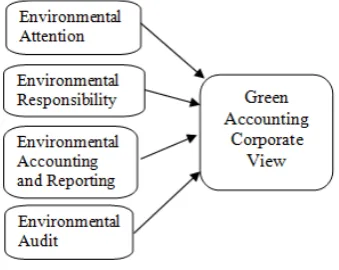
Figure 1 Conceptual Framework
From the conceptual framework shown in Figure 1, it can be taken hypothesis as follows; (1) H1
is whether the environmental attention influences the
green accounting corporate view or not. (2) H2 is that
the environmental accounting and reporting influence
green accounting corporate view or not. (3) H3 is
whether the environmental responsibility influences
green accounting corporate view or not. (4) H4 is that
the environmental audit influences green accounting
corporate view or not.
METHODS
The population of this research is employees who work in the company in Tangerang. This research uses convenience sampling method to collect the data. Data are obtained by using the questionnaires containing questions to the respondents. The assessment uses Likert scales (1-5) with the meaning of the score: 1 = strongly disagree, 2 = disagree, 3 = neutral, 4 = agree, 5 = strongly agree. Respondents in research are the employees who work in Tangerang accounting as their education background. There are 108 respondents who have answered the questions. The method of
analysis data in this research uses the influence to see if there are relation or influence between environment
attention, environmental responsibility, environment accounting reporting, and environmental audit with the point of view about the importance of green accounting. The instrument analysis that is used in this research is STATA 12. The analysis method has included normality test, the F-test, and the T-test of
relation or influence of independent variable to a
dependent variable.
Green accounting is part of accounting science that is adopted by the company for the empowerment of the environment. It is important for nature sustainability and the place the company. It is essential to be highlighted by all parties in the company. An indicator of this variable is taken from research by Kusumaningtias (2013) about green accounting.
Environmental attention is an effort to involve every society in developing and to create the understanding of environment conservation based on environment value with the basic that the community needs to live in peace with nature. The indicators in this variable are eight questions that are developed from the research by Teoh and Thong (1986) in Jahamani (2003).
Environmental responsibility is required by each company in the industry to handle its obligation to reduce waste or bad as the result of company operation in the industry. This must be done so the bad produced by the company can be overcome well. Responsibility in the social environment and nature of a corporation is done as a proactive activities conducted by the company as the people of the implementation of the corporate social responsibility. The indicators that are used to measure environment responsibility are developed from the research by Teoh and Thong (1986) in Jahamani (2003).
self-assessment so it can identify its strength and weakness related to CSR in the company. The indicators that are used to measure environmental accounting and reporting are expanded from the research by Dunk (2002) in Musyarofah (2013).
An environmental audit is an instrument examination in the accounting environmental system to verify efforts of the management in the environment objectively and it can help the company to look for the steps of improvement to increase environmental performance. To ensure the performance of the environmental life program, the
company have run effectively and efficiently. Then it
requires environmental performance audit. With the environmental performance audit, the performance of environmental empowerment behavior can be seen by the company. The indicators which are used to measure environmental audit are elaborated from research by Dunk (2002) in Musyarofah (2013).
RESULTS AND DISCUSSIONS
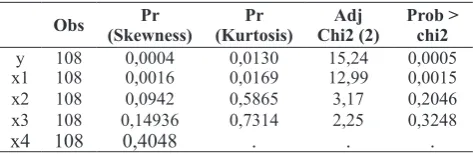
Table 1 Normality Test
Obs Pr (Skewness)
Pr (Kurtosis)
Adj Chi2 (2)
Prob > chi2
y 108 0,0004 0,0130 15,24 0,0005
x1 108 0,0016 0,0169 12,99 0,0015
x2 108 0,0942 0,5865 3,17 0,2046
x3 108 0,14936 0,7314 2,25 0,3248
x4 108 0,4048 . . .
Based on the results of the normality - skewness and kurtosis test, it appears that the data normally has been distributed because it isin the range of 0, so it
does not veer to the left defining that the data is not
normal. To know the normality of the data, it can be seen from the skewness between 0 and kurtosis below the level of 3 as can be seen in Table 1 (see apendix).
F test is done to test the feasibility of the model regression in this research. It can be seen that Prob > F is 0,0000 or lower than 0,05, so it states that the model regression is appropriate to be tested separately. The regression is 0,4327 or 43,27% of the independent variable which impacts on dependent variable or green accounting. While, the rest is the percentage of other variables. Table 2 (see apendix) illustrates the result.
Table 2 F – Test
The t-test is to know the influence of X1
(Environmental Attention) to Y (Green Accounting Corporate View) which indicates that H0 is rejected because Prob > F is 0,0000 or less than 0,05 so it can
be stated that there is significant influence between
environmental attention and green accounting corporate views. Since H0 is rejected, then alternative hypothesis/H1 is accepted. This can happen because the company has already known that the attention to keep the environment by employees as stakeholders
are part of the sustainability of development or the sustainability of the companies. The result is shown in Table 3 (see appendix).
Table 3 T – Test of Environment Attention (X1) to
Green Accounting Corporate View (Y)
Next, T-test is also to find out the influence
of X2 (Environmental Responsibility) to Y (Green
Accounting Corporate View). This is indicated by the result that H0 is rejected because Prob > F is 0,0000 or less than 0,05 so it can be declared that
there is significant influence of the environmental
responsibility to the green accounting corporate view. With H0 is rejected, the alternative hypothesis/H2 is accepted. It happens because the companies have realized that the environment around companies is supposed to be guarded and preserved, and free from company waste although the company maynot be willing to treat the waste until it bankrupt. Table 4 (see appendix) shows the result.
Table 4 T – Test of Environment Responsibility (X2)
and Green Accounting Corporate View (Y)
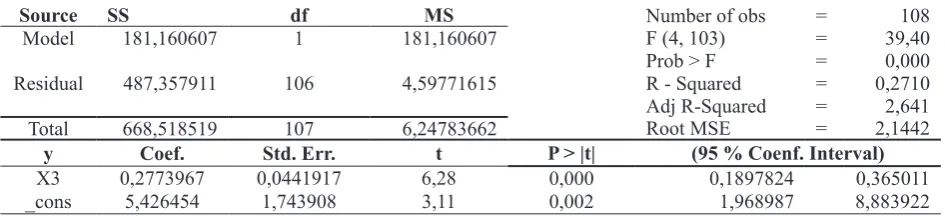
The next T-Test is to see the impact of X3 (Environmental Accounting and Reporting) to Y (Green Accounting Corporate View). It shows that H0 is rejected because Prob > F is 0,0000 or less than 0,05, so there is environment accounting and
reporting influences the green accounting corporate view significantly. Because H0 is rejected, alternative
hypotheses/H3 is accepted. This is because companies have realized that the report of environmental accounting is necessary and important as part of green accounting. If the company has made the environmental conservation, but there is no report about this, the stakeholders will doubt the act of the environmental conservation done by companies and also the legitimacy of the stakeholders will be reduced. The stakeholders should be viewed by companies as important part of green accounting. The companies have realized that report is important in green accounting. The result is shown in Table 5 (see appendix).
Table 5 T – Test of Environment Accounting
and Reporting (X3) to Green Accounting Corporate
View (Y)
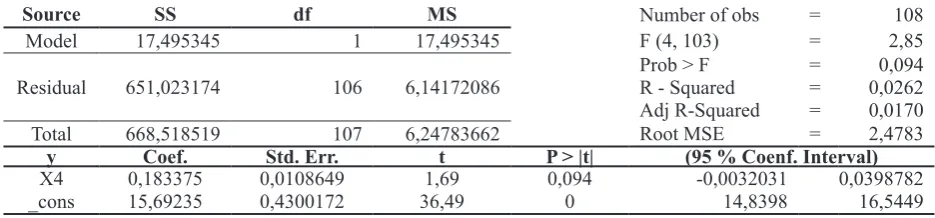
Last, the T test is to know the influence of
X4 (Environmental Audit) to Y (Green Accounting
Corporate View). The result is H0 is accepted because Prob > F is 0,0944 or more than 0,05, so there is no
significant influence of the environmental audit to the
Also, the transparency of environmental audit can be the problem and also felt like being forced to report and by the company. The result is in Table 6 (see appendix).
Table 6 T – Test environment audit (X4) to green
accounting corporate view (Y)
CONCLUSIONS
From the research, it can be concluded that the variables of environmental attention, environmental responsibility, and environment accounting and
reporting have the significant impact on the importance
of green accounting in a company. It is because the company especially employees concern about the environment and also realize that protecting the environment has become the joint responsibility of all parties and part of assessment from the stakeholders. On the contrary, the environmental audit does not
influence the green accounting corporate view because
the company does not pretend that environmental auditis an obligation and burdensome thing.
The implication of this research is that the company is expected to consider that green accounting as an important thing which can be conveyed to the employees. It also expects the company to apply the green accounting better.
For next researchers, they can do research by asking the accounting manager on the company as the respondents are, and add more variables research about corporate cultureand also the other things related to the environment and the company.
REFERENCES
Agustia, D. (2010). Pelaporan biaya lingkungan sebagai alat bantu bagi pengambilan keputusan yang berkaitan dengan pengelolaan lingkungan. AKRUAL, 1(2), 190–214.
Agustine, I. (2014). Pengaruh Corporate Social Responsibility terhadap nilai perusahaan. Finesta, 2(1), 42–47.
Aniela, Y. (2012). Peran akuntansi lingkunagn dalam meningkatkan kinerja lingkungan dan kinerja keuangan perusahaan. Berkala Ilmiah Mahasiswa Akuntansi, 1(1), 15–19.
Arisandi, D., & Frisko, D. (2011). Green rush in accounting
field of Indonesia from different perspectives.
In Society of Interdisciplinary Business Research (SIBR) 2011 Conference on Interdisciplinary Business Research.
Astiti, W. (2014). Implementasi green accounting berbasis University Social Responsibility (USR) di Universitas Negeri Yogyakarta. Jurnal Nominal, 3(2), 134-149.
Burhany, D. I. (2014). Pengaruh implementasi akuntansi lingkungan terhadap kinerja lingkungan dan pengungkapan informasi lingkungan (Studi pada perusahaan pertambangan umum yang mengikuti proper periode 2008-2009). Proceedings SNEB 2014, 1–8.
Darwin, A. (2007). Pentingnya laporan keberlanjutan. Akuntan Indonesia, 3(1), 12-14.
Handriyani, A. N. (2013). Pengaruh Corporate Social Responsibility terhadap nilai perusahaan dengan
profitabilitas sebagai variable moderating. Jurnal
Ilmu & Riset Akuntansi, 2(5), 1-15.
Jahamani, Y. F. (2003). Green accounting in developing countries: The case of U.A.E and Jordan. Managerial Finance, 29(8), 37–45.
Kartikasari, L. (2012). Niat akuntan dan akuntansi lingkungan. In Eco-Entrepreneurship Seminar & Call for Paper “Improving Performance by Improving Environment” 2012.
Kusumaningtias, R. (2013). Green Accounting, Mengapa dan Bagaimana?. Proceeding Seminar Nasional dan Call for Papers Sancall 2013, 137-149.
Musyarofah, S. (2013). Analisis Penerapan Green Accounting di Kota Semarang. Accounting Analysis Journal, 2(3), 352–359.
Omran, M. A., & Ramdhony, D. (2015). Theoretical perspectives on corporate social responsibility disclosure: a critical review. International Journal of Accounting and Financial Reporting, 5(2), 38–55. Tarigan, J., & Semuel, H. (2014). Pengungkapan
APPENDIX
Table 2 F – Test
Source SS df MS Number of obs = 108
Model 289,264897 4 72,3162242 F (4, 103) = 19,64
Prob > F = 0,0000
Residual 379,253622 103 3,682074 R - Squared = 0,4327
Adj R-Squared = 0,4107
Total 668,518519 107 6,2478366 Root MSE = 1,9189
y Coef. Std. Err. t P > |t| (95 % Coenf. Interval)
X1 0,1554444 0,0590786 2,63 0,010 0,0382759 0,2726129
X2 0,2485612 0,592395 4,2 0,000 0,1310735 0,3660488
X3 0,1181264 0,0493458 2,39 0,018 0,0202608 0,2159921
X4 0,0091219 0,0087023 1,05 0,297 -0,0081371 0,263808
_cons 2,286433 1,876092 1,22 0,226 -1,434352 6,007219
Table 3 T – Test of Environment Attention (X1) to Green Accounting Corporate View (Y)
Source SS df MS Number of obs = 108
Model 142,591366 1 142,591366 F (4, 103) = 28,74
Prob > F = 0,0000
Residual 525,927153 106 4,96157691 R - Squared = 0,2133
Adj R-Squared = 0,2059
Total 668,518519 107 6,24783662 Root MSE = 2,2275
y Coef. Std. Err. t P > |t| (95 % Coenf. Interval)
X1 0,3195258 0,0596032 5,36 0,000 0,2013568 0,4376949
_cons 6,183895 1,898468 3,26 0,002 2,149998 9,947792
Table 4 T – Test of Environment Responsibility(X2) and Green Accounting Corporate View (Y)
Source SS df MS Number of obs = 108
Model 201,309818 1 201,309818 F (4, 103) = 45,67
Prob > F = 0,0000
Residual 467,208701 106 4,40762925 R - Squared = 0,3011
Adj R-Squared = 0,2945
Total 668,518519 107 6,24783662 Root MSE = 2,0994
y Coef. Std. Err. t P > |t| (95 % Coenf. Interval)
X2 0,3732824 0,0552341 6,76 0,000 0,2637754 0,4827895
_cons 10,04727 0,9464714 10,62 0 8,170801 11,92374
Table 5 T – Test of Environment Accounting and Reporting (X3) to Green Accounting Corporate View (Y)
Source SS df MS Number of obs = 108
Model 181,160607 1 181,160607 F (4, 103) = 39,40
Prob > F = 0,000
Residual 487,357911 106 4,59771615 R - Squared = 0,2710
Adj R-Squared = 2,641
Total 668,518519 107 6,24783662 Root MSE = 2,1442
y Coef. Std. Err. t P > |t| (95 % Coenf. Interval)
X3 0,2773967 0,0441917 6,28 0,000 0,1897824 0,365011
Table 6 T – Test Environment Audit (X4) to Green Accounting Corporate View (Y)
Source SS df MS Number of obs = 108
Model 17,495345 1 17,495345 F (4, 103) = 2,85
Prob > F = 0,094
Residual 651,023174 106 6,14172086 R - Squared = 0,0262
Adj R-Squared = 0,0170
Total 668,518519 107 6,24783662 Root MSE = 2,4783
y Coef. Std. Err. t P > |t| (95 % Coenf. Interval)
X4 0,183375 0,0108649 1,69 0,094 -0,0032031 0,0398782