Tommy K Darwis
Master of Science in Management, School of Business and Management Institut Teknologi Bandung
Surna Tjahja Djajadiningrat
School of Business and Management Institut Teknologi Bandung
The Relationship of Leadership
Styles and Organizational Culture
Case Study of an Oil and Gas
Company in Indonesia
Abstract
This study explores relationship between leadership styles and organizational culture in an oil and Gas Company in Indonesia. The respondents are employees of an oil and Gas Company in Indonesia. This study use Multifactor leadership questionnaires to define leadership styles and Denison's Organizational Culture Model to measure Organizational Culture. These questionnaires were used to measure leadership styles of immediate or direct supervisor and organizational culture of unit or division. The data were analyzed with descriptive and use correlational analysis.
A relationship exists between the leadership styles of immediate or direct supervisor and organizational culture. In three Leadership styles of Multifactor leadership, Positive correlation was found between Transformational Leadership Style and Organizational Culture. Transformational Leadership found as strong predictor of organizational culture. A positive correlation also found between Transactional Leadership Style and Organizational Culture and conversely, Laissez-Faire Leadership style has negative correlation with organizational culture. Transformational, Transactional Leadership and high level of organizational culture will be make good impact for maintaining and achieving excellent organizational performance for company.
1. Introduction
Nowadays, in rapidly changing world, company or organization faced with turbulence of market, pressure of organizational, high demand of shareholders, and global financial crisis. Those conditions make company to renew their strategy for win challenges. Pressures on company come from many directions: the environment, the discovery of deviations from standards, new desires and visions of future, or the fundamental nature of organizations themselves. Business markets are becoming unstable, customer needs and desires are changing, and information flow is becoming more diverse and complex.
These changes make leaders and organization that are able to respond to continuous change in resource, technology, marketing methods and system distribution. Leaders play a pivotal role in driving the success or failure of organization. In the current organization, market share, employee satisfaction, customer satisfaction and financial performance occupy the top and high priorities of organization's strategic plan. Alignment of the organizational culture with organization's strategic plan is essential in achieving goals and objectives of organization.
Company could be called as an organization that has activities for fulfilling the need of members or employees. The member of company will generate their behavior follow their rules, job description, organizational structure and have specific identity that based on vision and mission. Company will be based on organizational culture that built by member of organization and create values.
The same understanding that applies to societies can be well applied to management science. Organizations or company are quite similar to societies and communities in the sense that they are constituted by a group of people who distinguish themselves by clear boundaries from other work groups. Through working together, people gradually develop their own way - a habitual or sometimes taken for granted way in achieving unitary objectives; and by adapting to, while being adapted by, other people in the organization (Fang, Wang, and Mobley, 2005).
Many organizations or company have competitive advantages that helps organizations differentiate themselves. There are can be cost, quality, technology, product and innovation, customer service and logistics chain, talent or brand. However, there is much less obvious and less tangible factor that also can be determining source of competitive advantage. And that factor is organizational culture.
Performance of company depends on their leader, culture and their strategy to win competition. In order to be a successful leader, one must be able to accurately assess the organization's culture and assist followers in understanding it as well. Knowledge of organizational culture may provide an important vehicle for understanding the beliefs and behaviors of individuals in an organization. When an employee's beliefs agree with the organizational culture, the culture will be perceived as good. When an employee's beliefs conflict with the culture, it will be deemed poor (Mullins, 2007). The success or failure of the culture may be determined by the leader and by the people chosen by the leader to dwell within the system. It is therefore imperative that the leader understand and recognize the complexity and importance of culture (Mullins, 2007).
Over the past several decades, the phenomena of leadership and organizational culture continue to predominate in mainstream business literature. Scholars in various disciplines have defined these phenomena as the driving forces in the success or failure of an organization (Schein, 2004).
Leadership and culture have been recognized as critical concepts related to the effective function of organizations. There are many researches about leadership styles, organizational culture, and relationship among them, conducts in Europe and America, but research in Asia, especially in Indonesia was still rare. Lok and Crawford (1999) conduct research about leadership style and culture in seven larger hospital in Australia, Ogbonna and Harris (2000) studied about organizational culture, leadership style and organizational performance in large firms in United Kingdom, Block (2003) conduct research about Leadership Styles and Organizational Culture in Privately owned Company in United States and Canada, and Cassida and Pinto-Zipp (2008) conduct research about leadership style and organizational culture in Nursing Acute Hospital in New Jersey USA.
The summation of those previous researches indicates that leadership and culture are forces to be reckoned with in relation to their general effects on organizations. According to the literature, leadership can transform cultures from the present to the future and create visions of potential opportunities, instill commitment to change and develop new strategies to focus energy and resources. Quality cultures are conducive to enhancing work environments and may have a positive impact with areas such as worker satisfaction, communication, effectiveness, innovation and creativity (Schein, 2004).
The lack of empirical findings and need clearly understand about leadership styles and organizational culture especially in Indonesian company was address by a research question: Is there any relationship between Leadership Styles and Organizational Culture?
2. Literature Review
Leadership that promotes cultures of quality is important to any organization. With the problems faced by organization today, it is particularly important to have leaders who assist in the creation of cultures of excellence.
Full-Range Leadership Theory
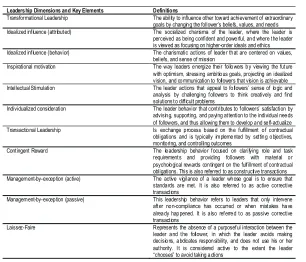
Many researcher (Block, 2003; Cassida and Pinto, 2008; Bass and Avolio., 2004; Emery and Barker, 2007) have used multifaceted leadership theory as a conceptual framework in leadership and administration studies over the past several years. They conduct research in many disciplines in organization and conduct research in America, Europe and Canada. However, the use of a much broader range of multifaceted leadership theory (e.g., the full-range leadership theory) in Asia, espescially in Indonesia, research is still limited.
Table 1. Summary of the Full-Range Leadership Theory
Leadership Dimensions and Key Elements Definitions
Transformational Leadership The ability to influence other toward achievement of extraordinary goals by changing the follower’s beliefs, values, and needs Idealized inf luence (attribut ed) The socialized charisma of the leader, where the leader is
perceived as being confident and powerful, and where t he leader is viewed as focusing on higher-order ideals and ethics Idealized inf luence (behavior) The charismatic actions of leader that are centered on values,
beliefs, and sense of mission
Inspirational motivation The way leaders energize their followers by viewing the fut ure with optimism, stressing ambitious goals, projecting an idealized vision, and communication to followers that vision is achievable Intellectual Stimulation The leader actions that appeal to followers’ sense of logic and
analysis by challenging f ollowers to think creatively and f ind solutions t o diff icult problems
Individualized consideration The leader behavior that cont ributes to f ollowers’ satisfaction by advising, support ing, and paying at tention to t he individual needs of followers, and thus allowing them to develop and self-act ualize Transactional Leadership Is exchange process based on the f ulfillment of contract ual obligations and is typically implemented by set ting objectives, monitoring, and controlling outcomes
Cont ingent Reward The leadership behavior f ocused on clarifying role and task requirement s and providing followers with material or psychological rewards contingent on the fulf illment of contract ual obligations. This is also referred to as constructive transactions Management-by-exception (active) The active vigilance of a leader whose goal is to ensure that
standards are met. It is also referred t o as active corrective transact ions
Management-by-exception (passive) This leadership behavior refers to leaders that only intervene aft er non-compliance has occurred or when mist akes have already happened. It is also ref erred t o as passive corrective transact ions
Laissez-Faire Represents the absence of a purposef ul interaction between the leader and t he follower, in which the leader avoids making decisions, abdicates responsibility, and does not use his or her aut hority. I t is considered active to the extent the leader “chooses” to avoid taking actions
Adapted from Antonakis et.al.,2003; Avolio and Bass, 2004.
Organizational Culture
Culture is a conceptual word that has been discussed for thousands of years by anthropologists, sociologists, historians and philosophers. Each society is underpinned and defined by distinctive culture. Culture is a set of values, beliefs, common understanding, thinking and norms for behavior that are shared by all members of a society (Schein, 2004). Culture cannot precisely define, but it can sense and feel. Culture provides guidance to behaviors in the society, in apparent and sometimes unnoticeable ways, and it profoundly influences decision making process of organization.
During recent years, academics and practitioners in management science have focused on studying how to measure the dimensions of organizational culture and how such measures relate to the effectiveness a competitiveness of the organization. One of the most valid and useful models and measures of organizational culture, it was developed by Dr. Daniel Denison, a famous professor at International Institute of Management Development (IMD).
In the early 1980s, he studied the performance data from 34 firms and found that in those organizations whose work is more sensibly organized and where individuals are more involves in decision-making, Return on Investment (ROI) and Return on Sales (ROS) are two to three times higher. The longer the research lasts (such as 5 years after), the more significant the performance gap between high-end and low-end companies. After the first set of studies, he continued and expanded the range of companies that his research covered; the total number of companies has reached 764 by 1995 and is still growing rapidly year-by-year (Mobley, Wang and Fang, 2005). The Denison Organizational Culture Method
Culture Traits Defini tions
Adaptability This refers to the organization’s ability to translate the demands of business environment into action. It also denotes the organization’s syst em of norms and beliefs, which support the organization’s capacity t o receive, interpret , and translate signals from its operat ional and competitive environment into internal behavior changes that increase its changes for survival, growth, and development. Generally, employees have the sense of creat ing change, customer focus and organizat ional learning Mission This reflects the organization’s ability to define a meaningful
long-term direction that provides employees with a sense of focus and a common vision of the future. It provides a clear direction and goals that serve t o define an appropriate course of act ion for the organization and its members. Generally, employees have the sense of strat egic direct ion and intent, goals and objectives, and vision of the organization
Involvement This is a characteristic of a “highly involved” culture, in which employee involvement is strongly encouraged and creat es a sense of ownership and responsibility. Employees rely on informal, voluntary, and implied control systems, thereby, resulting in greater organizational commitment and an increasing capacit y for aut onomy. Employees, generally, have the sense of empowerment, team orientation, and capability development Consistency Def ines t he values and systems that are basis of a strong culture.
It provides a central source of integrat ion, coordination, and control. Also, it characterized organizations t hat creat e internal systems of governance based on consensual support. Generally, employees have shared core values, and demonstrate agreement, coordination, and integrat ion
Table 2. Summary of The Denison's Organizational Culture Model
Source: Denison, 2005
Clearly, Leaders must have knowledge and understanding of these four culture traits in order to better adapt their leadership style to influence specific changes to drive improved performance. As the concept of leadership has evolved over the past 100 years, the nature its role in relation to organizational performance has received increasing attention among researchers. There is now considerable evidence to support the hypothesis that certain kinds of leadership behavior are associated with superior outcomes from both financial and organizational perspectives (Ogbonna & Harris, 2000; Vigoda, 2007). Bass and Avolio (1999) notion of transformational leadership has highlighted the fact that leadership must be viewed in broader terms than rational and instrumental models suggest; it also comprises emotive and symbolic elements that play a significant role in leading an organization to achieve its fullest potential.
Cost-effective, market share, customer satisfaction, employee satisfaction occupy the top priorities of organization's strategic goals. Alignment of organizational culture with the strategic plan is essential in the achievement of the organization's strategic goals and objectives. This will result in further expansion of the body of knowledge, and thus serve as foundation in developing curricula for educating and training students, aspiring and experienced leaders.
H: There is a relationship between leadership styles and employee perception of organizational culture
This hypothesis was based on the assumption that primary embedding mechanisms described by Schein (2004) are demonstrated by leaders that refer to immediate supervisors on a daily basis and consequently send a strong message to employees concerning the core values and underlying assumptions that represent the essential character of the organization's culture. This include supervisor behaviors such as what they pay attention to, how they react the crisis, how they handle the issue, and the criteria they use to allocate resources and also rewarding employees.
It was also assumed that specific types of leadership behaviors are likely to evoke specific kinds of employee perceptions. This hypothesis was expanded into three sub-hypotheses to further examine the nature of relationship between leadership styles and organizational culture by determining which leadership style (Transformational, Transactional, and Laissez-faire) is associated with organizational culture. And then, the following sub hypotheses were tested.
Ha: Transformational leadership style is positively relationship with employee perception of organizational culture
Hb: Transactional leadership style is positively relationship with employee perception of organizational culture
Hc: Laissez-faire leadership style is negatively relationship with employee perception of organizational culture
The Pearson product-moment correlation coefficient was used to test this hypothesis.
4. Methods
This research use exploratory and descriptive study. Descriptive research study is typically concerned with determining the frequency with which something occurs or the relationship between two or more variables. The descriptive study typically guided by initial hypothesis. Descriptive and exploratory correlational designs were choose to this research to describe the types of leadership styles and organizational culture of the sample, and describe the nature of such a relationship. Block (2003) suggests, the correlational design is an acceptable starting point for exploring the relationship of leadership and organizational culture, and can also be used in the early stage of developing conceptual or theoretical models. A quantitative approach was selected for time and logistical reason. Quantitative methods were used to complete a group level unit of analysis of leadership and organizational dynamics within private-owned Indonesian company in oil and gas company sector.
Sampling
The study was based upon a survey in is an Indonesia-based group of integrated company, engaged in the energy sector with a focus on oil and gas exploration and production, power generation and downstream industries. The participant company hereafter referred to as Company X. The researcher focus on subsidiary of company X, that have activities in Indonesia focus on upstream activity, exploration, development and production crude oil and gas. Convenience sampling was choosing to collect data from the respondent. The respondent of this sample are Alumni of Management Trainee of this corporate from batch year of 2003 until year of 2008.
To assist aspiring and experienced managers in organization to be successful in their roles as leaders and change agents in enhancing efficiency of the organization, they must be trained or retrained about the critical impact or bottom-line of leadership and culture connection, which is organizational effectiveness. Despite the many citations on leadership and organizational culture and their impact on organizational performance, empirical findings are needed to further explain the relationship of leadership and organizational culture. Therefore, the Full-Range Leadership Theory and Denison's Organizational Culture Model are theoretical models that could be used in explicating the connection of leadership and organizational culture in organization in Indonesian Company.
3. Variables
The independent variable in this study is leadership styles as measured by the Multi Factor Leadership Questionnaire (MLQ) Form 5X-Short. The MLQ was used in an effort to capture a broader range of leadership styles including transformational, transactional and laissez-faire leadership (Avolio & Bass, 2004). The MLQ has been used extensively in various organizations and industries, which have demonstrated stable reliability results. Thus, its administration at all levels of organization across production, military, service organizations, were found to be more suitable (Avolio and Bass, 2004). Additionally, the MLQ can be used to assess perceptions of the leadership effectiveness of team members, subordinates, supervisors, managers, and executives from many different levels of an organization.
The dependent variable in this study is organizational culture as measured by the Denison's Organizational Culture Survey (DOCS). The DOCS is one of the most commonly used tools in measuring organizational culture, which was founded on the theoretical framework of the Denison's Organizational Culture Model (Block, 2003). Each cultural trait (mission, involvement, adaptability, and consistency) is measured by three indices (Denison, 2000b). In this research, researcher adopted questionnaire from organizational culture survey from Denison in 24-items questionnaires. Each cultural trait is composed of three indices, and each of which contains two items. The higher score of indices, the stronger the perception among employees that the specific cultural trait is present within the organization (Block, 2003).
This research adopted the questionnaires from the MLQ form 5X-Short in 20 (twenty) question items for measure Leadership styles of immediate supervisor and the Denison's Organizational Culture Model in 24 (twenty four) question items, and use six Likert scales for measure organizational culture in unit or division. The study using six Likert scales rating system (1 = Strongly Disagree; 2 = Disagree; 3 = Slightly Disagree; 4 = Slightly Agree; 5 = Agree; 6 = Strongly Agree).
Hypotheses
A convenient sample of 88 staff participated in this study. For correlational analyses design, this sample size (N=88) is adequate to analyze the data. One underlying assumption of this study was that the sample represents population of a single organization, in which all members of organization share same vision and mission and core values.
Between December 2009 and March 2010, questionnaires are hand out in the office of the respondent and collected directly by researcher. Employees throughout all levels of the corporation completed three surveys. One survey asked employees about their demography profiles. The second surveys asked employees to rate their immediate supervisors' leadership style.
The third survey asked employees to rate their work environment on a variety of cultural dimensions. A numerical coding system was developed in order to ensure employees anonymity. Observation also used to add information about attitude and activities of employees in daily-work hour. Not only observation, to collect data, researcher also interview the employee who knows about the respondents and job description of employees that include in respondents.
Data Analysis Techniques
Based on literature, this research used correlational analyses to explore relationship between two variables. SPSS version 15.0 was used for analyze the data. The Pearson correlation coefficient (r) is the common method used in quantifying the relationship between two variables, which may range from +1.00 through 0.00 to -1.00. A +1.00 indicates a perfect positive relationship, 0.00 indicates no relationship, and -1.00 indicates a perfect negative relationship (Munro, 2001). Then, statistical parametric was used in determining the existing relationship between leadership styles of immediate supervisor (MLQ 5X scores) and organizational culture (DOCS scores) as perceived by the respondents.
Validity and reliability analysis of variables
Reliability of the questionnaire can be obtained from Cronbach's Alpha value from each latent variable. Range of this value is between 0 - 1. The closer Cronbach's alpha is to 1, the higher the internal consistency reliability (Sekaran, 2003).By using SPSS 15.0, it can be stated that all items in the questionnaire are valid and reliable. All items in each variable have Cronbach's Alpha value that is more than 0.7 and value of validity more than 0.3.
5. Results
The respondents of this study are permanent employees of Company X (oil and Gas exploration and production) which graduated from Management Training program that held by company. This management trainee program has one year program, for first six month, the trainee given principal of their knowledge in engineering, management and general information about the company. For the next six month, trainee given on the job training program, this program has purpose to give trainee the actual workload and how to deal with issue in field of work. This management trainee program had been held from 2003 and held from year to year.
The total of 88 employees participates in this study. From 175 population of the sample, 145 consented to participate in this study, and 88 returned surveys. Low response of questionnaire occurs in e-mail questionnaire, about 5 % of e-mail return rate. The sum response yielded a return rate e-mail and direct questionnaire was 61 %. The return of completed surveys was adequate to achieve a strong statistical power and a moderate effect size.
The mean age of respondents is 28,26 years and a standard deviation of 2,38. The respondent's experience on the company is approximately 3 to 4 years. The respondent's experience on the division of company is approximately 3 to 4 years. The majority of respondent had bachelor degrees 96% and 4 % had master degrees. The majority of respondents were male 77 % and the followed by female 23 %, this finding in gender, reflect gender composition of the employees in oil and gas exploration and production company in Indonesia that dominate from male gender.
Result of the test hypotheses
Hypothesis 1: There is relationship between immediate supervisor leadership styles and organizational culture as perceived by employees.
Score of immediate supervisor or manager leadership styles were obtained by calculating the global transformational leadership style (M = 4.28, SD = 0.10), transactional (M = 3.8, SD = 0.12), and laissez-faire (M = 2.6, SD = 0.05) scores on the multifactor leadership questionnaire (MLQ) 5X rated by their employees.
These leadership scores were correlated with the employees rating on their organizational culture, which was obtained by calculating involvement trait (M = 4.27, SD = 0.13), Consistency (M = 3.98, SD = 0.09), Adaptability (M = 3.95, SD = 0.12), and Mission (M = 4.01, SD = 0.08) and the global score for organizational culture (M = 4.05, SD = 0.10) on the Denison Organizational Culture Survey (DOCS) instrument.
Table 3. Correlations of Leadership Styles and Organizational Culture
Leadership_Styles Organizational_Cul ture
Leaders hip_Styles Pearson Correlation 1 ,498(**)
Sig. (2-tailed) ,000
N 88 88
Organizational_Culture Pearson Correlation ,498(**) 1
Sig. (2-tailed) ,000
N 88 88
** Correlation is significant at the 0.01 level (2-tailed).
According to Schein (2004), as long as the actions of leader are viewed as successful, employees will accept his or her definition of the organization's identity and its ultimate mission and function as expressed and reinforced through these primary and secondary mechanisms. However, when changes in environmental demands are no longer solved successfully by the leader, the organization will begin to influence the leader.
Leader is creator of culture, but also product of cultural socialization. Similarly, culture is viewed as a product of leadership as well as an agent of socialization among leaders. The culture affects leadership as much as leadership affects culture. Significant findings from the present study indicate that relationship does exist between the leadership styles of immediate supervisor and organizational culture in company X.
The result of the correlational analyses for three sub-hypotheses is discussed below.
H1a: There is positively relationship between transformational leadership style and organizational culture as perceived by employees.
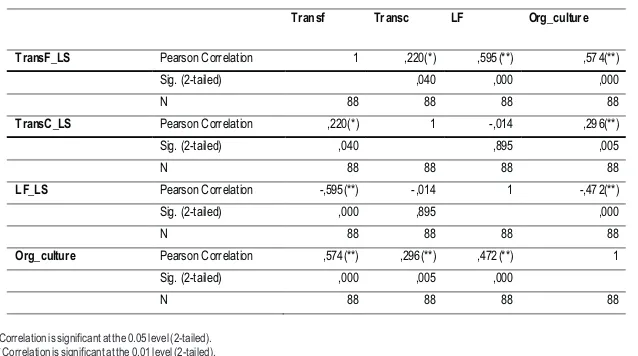
Table 4. Correlations Analysis Types of leadership styles and Organizational Culture
Transf Tr ansc LF Org_cultur e
TransF_LS Pearson Correlat ion 1 ,220(*) ,595(**) ,574(**)
Sig. (2-t ailed) ,040 ,000 ,000
N 88 88 88 88
TransC_LS Pearson Correlat ion ,220(*) 1 -,014 ,296(**)
Sig. (2-t ailed) ,040 ,895 ,005
N 88 88 88 88
LF_LS Pearson Correlat ion -,595(**) -,014 1 -,472(**)
Sig. (2-t ailed) ,000 ,895 ,000
N 88 88 88 88
Org_culture Pearson Correlat ion ,574(**) ,296(**) ,472(**) 1
Sig. (2-t ailed) ,000 ,005 ,000
N 88 88 88 88
* Correlation is significant at the 0.05 level (2-tailed). ** Correlation is significant at the 0.01 level (2-tailed).
Transformational leadership was a leader whom moving follower beyond immediate self-interests through idealized influence, inspiration, intellectual stimulation, or individualizes consideration. It elevates the follower's level of maturity and ideals as well as concerns for achievement, self actualization, and the well being of others, the organization, and the society.
Idealized influence and inspirational leadership are displayed when the leader envisions a desirable future, articulates how it can be reached, sets an example to be followed, sets high standards of performance, and shows determination and confidence. Intellectual stimulation is displayed when the leader helps followers to become more innovative and creative. Individual consideration is displayed when leaders pay attention to developmental needs of followers and support and coach the development of their followers. The leaders delegate assignment or task as opportunity for growth. The mutual obligation between the leaders and the followers facilitates the transformational leader's individualized consideration. Leaders in collectivist culture already have a moral responsibility to take care their subordinates, to help them prepare a career development plan, to attend their birthday parties, funeral ceremonies, and the counsel followers about personal problems (Bass, 1999).
Block (2003) found that employees who rated their immediate supervisor high in transformational leadership behavior were more likely to perceive the culture of their organization as adaptive, involving, integrating, and having a clear mission. Explanation of Block's findings included the significant correlation between transformational leadership style and culture traits. Cassida and Pinto (2008) also found significant correlations between transformational leadership and organizational culture in nursing acute unit. Furthermore, the transformational leadership scale and factors were associated with mission and adaptability of organizational culture traits.
According to Denison (2000b), effective organizations demonstrate high levels of four cultural traits that reflect the ability to balance the dynamic tension between the need for stability and the need for flexibility. Involvement is defined as the organization's ability to develop employee skills, engender ownership and create a team-based workforce that is committed to success. Consistency describes an organization in which employees' behaviors are rooted in a set of core values where leaders and followers are able to reach agreements (even when diverse viewpoints exist) and where business units and functions within company work together. Mission reflects the organization's ability to define a meaningful long-term direction that provides employees with a sense of focus and common vision of future. Adaptability refers to the organization's ability to translate the demands of the business environment into positive action.
H1b: There is positively relationship between transactional leadership style and organizational culture as perceived by employees.
The results of the correlational analyses presented in Table 6 showed that transactional leadership scale and factors were all positively correlated with organizational culture; all correlations were significant at the 0.01 level. In the present study, transactional leadership showed a positive but little weak correlation with the organizational culture (r = 0.29, p = 0.00). This correlation implies that transactional leadership style also in general may be preferred leadership style that immediate supervisor use frequently and related with shaping or creating organizational culture traits that link to organizational effectiveness. The results of the correlational analysis presented in Table 6 showed that transformational leadership
was positively correlated with organizational culture. Transformational leadership style showed a positive, and strong correlation to organizational culture (r = 0.57, p = 0.00); the correlation was significant at the 0.01 level. The correlation between transformational leadership and organizational culture in this research support the findings of a published study in the field of business and company (Block, 2003; Cassida and Pinto, 2008).
This present study supported Bass and Avolio (2004) findings that transactional leadership style is a basic skill of first-line leaders, like immediate supervisor in this research. It is important to take note that transactional leadership style in which contingent reward factor is to clarify the roles and task requirements of the followers or employees and provide the followers with material or psychological rewards contingent on the fulfillment of the job or contractual obligations.
Transactional leaders understand the needs of their employees and how to meet those needs in exchange for appropriate level of effort. Transactional leaders focus on efficiencies, current processes, maintaining the status quo, and meeting contractual agreement.
H1c: There is negatively relationship between laissez-faire leadership style and organizational culture as perceived by employees.
The results of the correlational analyses presented in Table 6 showed that laissez-faire leadership scale and factors were all negatively correlated with organizational culture. Further evaluation of laissez-faire leadership styles showed a negative correlation with organizational culture (r = -0.472, p = 0.00). The negative correlation between laissez-faire leadership and all four culture traits in this study also supports previous researcher finding in the relationship between laissez-faire leadership style and organizational culture (Block, 2003; Cassida and Pinto,2008). These findings suggest that the absence of leadership and avoiding when making decisions, which characteristic of this type of leadership (Avolio and Bass, 2004) does not shape or create any type of organizational culture in organizations.
Limitation
The limitation of this study is the use of sample with convenient sampling. This method can make research more bias than other methods. But, although this research use convenient sampling, researcher tried to minimize bias with choose sample that represent population of a single organization, in which all members of organization share same vision and mission and core values.
Several authors have proposed that qualitative methods are preferred over quantitative methods in order to provide the depth and breadth of the descriptions of the life of the organization. This method was not selected in this study for reason to access larger sample and the research can be generalized.
Implication
This study systematically explored the relationship of leadership and organizational culture in oil and gas exploration and Production Company in Indonesia. Several implications from the findings of the present study provide applications to areas of company practice, education, and research. More importantly, these findings are readily applicable to the company of oil and gas exploration and production, where the study was carried out.
By understanding of the relationship of the above leadership styles and organizational culture, the immediate supervisor will have the added skill and knowledge to lead more effectively, influence and shape an organizational culture that is responsive to external and internal demands of environment and is aligned with the vision, mission, and strategic objectives of the company.
According to Schein (2004), to better understand the organization one must understand the culture. To date, it is essential for first-line leaders' such as immediate supervisors to acquire knowledge and skills on organizational cultural competence. Block (2003) states that: “If we are to succeed in our efforts to build healthy and sustainable organizations, we must continue to invest in the development of cultural leaders who understand and respect the people that are the heart of their success”. Therefore, having a better understanding of the organizational culture allows the immediate supervisor to tailor leadership strategies that will create a positive impact in organizational performance.
Achieving the required competencies on leadership and organizational culture cannot be accomplished through experience alone or by virtue of having leadership characteristics innate to the new or aspiring leader. A novice leader must be taught, coached and mentored on the above leadership strategies supported by findings of this study. As stated by Kouzes and Posner (2002), “Leadership is a learned skill; Therefore, it can be taught and developed.”These findings also have practical implications for training and development of immediate supervisors. Training and development management programs could teach immediate supervisors of the important role that culture plays in order to run an effective organization. Immediate supervisors may potentially be able to increase performance by working on firm or subgroup culture (Adkins and Caldwell, 2004). Leadership must be guided by a realistic vision of what types of culture enhance performance and systematically work towards strengthening or even creating these cultural traits.
Moreover, companies that make leadership program or workshop to their employees must incorporate such topics in their educational programs as well. Collectively, academicians and practitioners should collaborate to assist leaders in achieving leadership competencies essential to improve organizational performance. Academicians have the moral and professional obligations to better prepare first-line leaders in this decades. Leadership course offered in the undergraduate and graduate management school must be place an emphasis on educating students about the evidence presented here and its impact on organizational performance.
6. Conclusion
Transformational leadership styles have strong relationship in developing organizational culture. Similarly, the transactional leadership of immediate supervisor is likely to create and shape certain culture traits essential for the company, which augments the effect of transformational leadership styles of immediate supervisor. Conversely, the laissez-faire leadership style gave negative relationship to organizational culture, because of the absence of purposeful interaction between immediate supervisor and employees, and also avoids to making decision.
In summary, transformational leadership styles and transactional leadership styles are the immediate supervisors' leadership styles that are associated with organizational culture that have the ability to balance the dynamics of flexibility and stability within their division and are essential for maintaining organizational effectiveness.
Future Directions
The conclusions presented here reveal the implicit theoretical understanding of leadership and culture connection in the context of an oil and gas company in Indonesia practice. This findings is expected can bridge the gap between the practical with academic level. The leadership styles of immediate supervisors related with organizational culture.
Future research could be proposed in four ways.
1. Replicate the present study with the same design and methods, but more wide-range sample by increasing the respondent to enhance the generalizability of the findings.
2. Sampling procedure that could be employed in this stage includes randomized, cluster sampling from various companies in Indonesia.
3. It is also important to explore other variables that may mediating, moderating, influence or be associated with the differences in immediate supervisors leadership styles and organizational culture.
4. Make more wide-range sample of respondent and make comparison among public and private company in Indonesia.
References
Adkins, Bryan., and Caldwell, David. (2004). Firm or Subgroup Culture: Where does fitting in matter most? Journal of Organizational Behavior, 25 pp.969-978.
Antonakis, J., Avolio, B.J., and Sivasubramaniam, N. (2003). Context and leadership; an examination of the nine-factor full-range leadership theory using multifactor leadership questionnaire, The Leadership quarterly, 14, 261-295.
Avolio, B., Bass, B., & Jung, D. (1999). Re-examining the components of transformational and transactional leadership using the Multifactor Leadership Questionnaire. Journal of occupational and Organizational Psychology. 72, 441-449.
Avolio, B.J., & Bass, B.M. (2004). Multifactor Leadership Questionnaire Manual and Sampler set (third edition). Redwood City, CA: Mind Garden, Inc.
Block, L. (2003). The leadership-culture connection: An exploratory investigation: Leadership & Organization Development Journal, 24 (6). 318-334.
Bolden, R., Gosling, J., Marturano, A. and Dennison, P. (2003). A Review of Leadership Theory and Competency Frameworks. Centre for Leadership Studies. University of Exeter. United Kingdom.
Cassida, J., & Pinto-Zipp, Genevieve. (2008). Leadership-Organizational Culture Relationship in Nursing Units of Acute Care Hospitals. Nurding Economics, Vol. 26. No.1.
Chodkowski, M. (1999). Relationships between leader characteristics, planned change and organization culture in a dynamic manufacturing environment. Western Michigan University. Denison, D.R. (2000b). Organizational Culture Survey. Retrieved March, 2010. From .
D e n i s o n , D . R . ( 2 0 0 5 ) . T h e D e n i s o n M o d e l . R e t r i e v e d M a r c h , 2 0 1 0 , f r o m http://www.denisonconsulting.com/dc/Research/DenisonModel/tabid/29/Default.aspx. Denison, D.R., Janovics, J., & Young, J. (2005). Diagnosing Organizational cultures; validating a model
and method. Retrieved March, 2010, from .
Denison, D.R., Haaland, Stephanie., Goelzer, Paulo. (2003). Corporate Culture and Organizational Effectiveness. Is there a similar pattern around the world? Global leadership. Elsevier Science Ltd., Volume 3, 205-227.
Emery, R,Charles & Barker, J, Katherine. (2007).The Effect of Transactional and Transformational Leadership Styles on the Organizational Commitment and Job Satisfaction of Customer Contact Personnel. Journal of Organizational Culture, Communication and Conflict, 11 (1). pg 77.
Kouzes, J.M., & Posner, B.Z. (2003). The five practices of exemplary leadership. San Fransisco, CA: Pfeiffer.
Lok, P., & Crawford, J. (1999). The relationship between commitment and organizational culture, subculture, leadership style and job satisfaction in organizational change and development. Leadership and Organization Development Journal, 20 (7), 365-373.
Masood, S.A. (2006). Transformational Leadership and Organizational Culture: The Situational Strength Perspective. Proceedings of the Institution of Mechanical Engineers, Part B: Journal of Engineering Manufacture, 220 (6) pp.941-949.
Ogbonna, E., & Harris, L.C. (2000). Leadership style, organizational culture and performance: Empirical evidence from UK companies. Internationnal Journal of Human Resource Management, 11 (4), 766-788.
Schein, E.H. (2004). Organizational culture and leadership (Third Edition). San Fransisco, CA: Jossey-Bass.
Sekaran, Uma. (2003). Research Methods for Business: A Skill Building Approach. John Wiley and Sons, Inc. New York.
Tucker, B.A., & Russell, R.F. (2004). The influence of the transformational leader. Journal of leadership and organizational studies, 10, 103-111.
Vigoda-Gadot, Eran. (2007). Leadership style, organizational politics, and employees' performance: An empirical examination of two competing models. Personal review. Fanborough. Vol. 36. p.661. W.H. Mobley, L. Wang. K. Fang. (2005). Organizational Culture: Measuring and Developing it in your
organization. Harvard Business Review, China. p.128-139.