The Global Fund to Fight AIDS, Tuberculosis and Malaria
Fourth Replenishment (2014-2016)
The Global Fund’s New Funding Model
Global Fund Fourth Replenishment April 2013
Update on Results and Impact 1
Introduction
1. At the end of 2011, the Global Fund Board embraced an ambitious program to transform operations of the Global Fund. In order to adapt to a new economic reality, new technologies, scientific advances and a better understanding of epidemiological patterns, the Global Fund needed to make changes, and move past emergency solutions toward sustainable programs. Fundamental to the Global Fund’s transformation was the development and implementation of a new funding model, one of the main elements in the Global Fund’s Strategy 2012-2016, adopted by the Board. The ultimate objective is to enhance the Global Fund’s ability to support strategically focused programs that have a greater and more sustainable impact in the fight against AIDS, tuberculosis (TB) and malaria.
The Global Fund Strategy 2012-2016 and the New Funding Model
2. The Global Fund Strategy 2012-2016 sets out ambitious targets and focuses on the highest-impact interventions targeted at the key drivers of the epidemics and at the most vulnerable populations; bases funding on high-quality, country-owned national strategies; and strives to maximize the impact of Global Fund investments by working with all partners to strengthen health systems and improving the health of mothers and children.2Annex 1 provides an overview of the Global Fund Strategy 2012-2016, including its overall goals and the five strategic objectives that guide the Global Fund’s work going forward.
3. The new funding model is critically important to the implementation of the Global Fund strategy. It has been designed to help the Global Fund invest resources more strategically, draw on partnerships to increase the quality of the programs it supports and incorporate lessons learned from the previous rounds-based system of funding. The new funding model enables the Global Fund, among other things, to:
Establish a more cooperative and iterative process in terms of the interactions between the Secretariat and implementers, partners and other donors;
Leverage more effectively the funding and expertise of other organizations;
Create processes that are more flexible, and more aligned with the priorities and strategic direction of those who implement grants;
Allow the Board to re-balance and give strategic direction to the organization’s portfolio of investments;
Focus funding on those countries with the highest needs and least ability to pay, while remaining global, and supporting the highest-impact interventions;
Increase the Global Fund’s ability to support national programs, and continue to accommodate specific circumstances where project support is most appropriate;
2 The Global Fund Strategy 2012-2016: Investing for Impact, The Global Fund, 2011, Geneva.
Provide incentives for both the creation of robust national disease and/or health-sector strategies (national strategies) and investment cases, as well as the full expression of an applicant's quality demand.
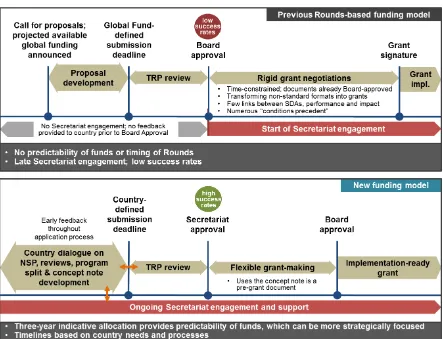
4. The new model represents a shift in the way the Global Fund works and changes the way implementers access funding, turn funding requests into implementation-ready grants and then manage these grants. Figure 1, below, shows the main differences between the “round-based” system and the new funding model process and Table 1 summarizes the key features of the new model.
Global Fund Fourth Replenishment April 2013
Update on Results and Impact 3
5. The foundation of the new approach is the way the Global Fund manages and apportions available resources. In the new model, countries will have access to two streams of funding. The larger and more-predictable one is the indicative funding stream (“indicative funding”) apportioned according to a Board-approved allocation methodology that is based on disease burden and “ability to pay”. Countries will be informed of the indicative funding range early in the process so that they can develop their requests to the Global Fund to meet their prioritized needs. The second one is a competitive stream (“incentive funding”) meant to reward ambitious, high-quality expressions of full demand that go beyond the indicative funding and/or to leverage financing at the country level. Through the two funding streams, the new funding model aims to provide countries with more flexibility around when they apply for funds, as well as more predictability on the level of funding available, while still encouraging countries to clearly express how much funding they need and are able to effectively utilize to treat and prevent AIDS, TB and malaria.
6. The new model also radically changes the way the Global Fund engages with partners and implementers. Through strengthened country dialogue, each country will need to engage a diversity of partners and stakeholders, including the Global Fund, to strengthen national strategies through a holistic, programmatic approach. As part of ongoing strategic dialogue, countries are expected bring together a range of stakeholders, including key affected populations and people living with the diseases, to discuss strategies to combat the main drivers of the diseases, decide on the most appropriate interventions and on the right timing for implementing them. Different to the “rounds-based” system, the new model is predicated on early engagement, feedback and guidance to identify the key epidemic drivers and the appropriate interventions to ensure that donor funds achieve maximum impact. In the new model, the Global Fund and its partners share the responsibility for the successful implementation of programs with implementers. Finally, the new funding model tailors the way grants are managed to specific country needs. Going forward, the Global Fund will adopt a risk-differentiated approach to grant management; implement annual disbursements for most grants; and apply a cross-organizational assurance framework with ongoing monitoring, moving away from the one-size-fits-all approach of the earlier days.
Table 1. Key Features of the New Funding Model
Flexible timeline
Eligible countries may apply whenever desired during the three- year allocation period so that funding can be aligned with national budgeting cycles and country-specific demands.
Simplicity of the funding application process
Eligible countries are encouraged to base their request to the Global Fund on their national strategy or investment case. A streamlined concept note, developed through multipartner consultations, will be used to present the request to the Global Fund.
Predictability of overall process
Early feedback aims to ensure general agreement on the strategic direction of the program/project, to reduce waiting time and to improve the overall success rates of applications. Early discussion of indicative funding provides more predictability.
Improved predictability of level of funding
Instead of the "rounds-based" system where countries competed for funds, applicants know how much funding they reward high-impact, well-performing programs and encourage ambitious requests.
Unfunded quality demand: Countries are strongly encouraged to submit ambitious concept notes. Funding requested through a concept note which is considered technically sound by the Technical Review Panel but above the funding amount available (indicative funding and any additional incentive funding awarded) is registered for possible funding by the Global Fund or other donors if and when new resources become available.
Focus on high disease burden and low
resources
The new model allows the Global Fund to focus on countries with the highest disease burden and least ability to pay while still retaining the Global Fund’s global reach.
Enhanced engagement
Global Fund Fourth Replenishment April 2013
Update on Results and Impact 5
Implementation of the New Funding Model
8. At the end of 2012, the Board approved some of the core elements and decided to launch the new funding model. The Board further decided to invest a portion of currently available uncommitted assets, as determined by the Finance and Operational Performance Committee, to allow some countries to access new funds during a transition phase. During the transition, all eligible recipients of Global Fund grants will start to implement some elements of the new model ahead of its full launch in 2014.
9. The main objective of the transition is to ensure that that the available resources go to the countries that are most in need as rapidly as possible. To this end, the Secretariat selected a number of country disease programs to participate based on the following Board-mandated criteria: countries that are either positioned to achieve rapid impact; face potential service interruptions and/or currently receive less than they would under the new funding model’s allocation principles.3Selected countries will access funding either as “early applicants” or as “interim applicants”. “Early applicants” are eligible for new funding during the transition and will use the full new funding model process, including submitting and developing a concept note, and may apply for incentive funding during the transition. “Interim applicants” will receive funding through existing mechanisms and will therefore experience some elements of the new funding model during the transition, such as country dialogue, but will not write a concept note or create a new grant.
10. At the beginning of 2013, the Secretariat completed the preparation for the transition to the new funding model by training its country teams, developing application and guidance materials for the first steps of the new funding model, and putting in place a monitoring system. On 28 February and 1 March 2013, the Secretariat informed the selected Country Coordinating Mechanisms of the new funding model and of the potential funding available for them. Up to US$ 1.9 billion of funds will be invested in 50 countries and four regional programs during this period, in 2013 and 2014, on top of the existing portfolio of grants. Annex 2 lists the country disease programs and regional initiatives that have been selected to be part of the transition as well as the amount of funding that is allocated to each of them.
11. Three of the “early applicants” - Myanmar, Zimbabwe and El Salvador - are planning to submit concept notes for Technical Review Panel review in April and hope to have grants signed by the June 2013 Board Meeting. The other early applicants - Kazakhstan, the Philippines, the Democratic Republic of Congo and the regional initiatives - have indicated submission dates for concept notes in September with expected grant signature by year’s end. The majority of the “interim applicants” are already in discussions with the Secretariat on the specific mechanisms to use and the appropriate timing of submission of their funding request during the transition. Most “interim applicants” are expected to access the additional
3 As set out in Decision Point GF/B28/DP5, the allocation of funding to countries eligible to access funds during the transition is
funds either as supplements to a grant renewal (at the time of their Phase 2 or periodic review) or as an extension of an ending grant.
12. The rapid implementation of some of the elements of the new model has provided the Secretariat with early lessons learned. Implementers appreciate the increased dialogue and engagement with the Secretariat that allows for a more flexible and responsive management of the grants, including a more proactive approach to reprogramming of funds. The new model also encourages increased involvement of in-country technical partners from the inception of a program. In line with the Global Fund’s commitment to working as a learning institution, this year offers a special opportunity for the Secretariat, countries and partners to learn and adapt. It also offers opportunities for all implementers, not only those that have been invited to access funds in 2013, to strengthen national health and disease strategies, identify programmatic and funding gaps, and cost their full expressions of demand in preparation for funding available from 2014.
The New Funding Model Requires Substantial Levels of Investment
13. In preparation for the Fourth Replenishment, the Global Fund and its partners have worked together to estimate the global funding need for the three diseases and for the associated health and community systems strengthening. If internationally set targets are to be reached and in order to keep countries on a sustainable path towards controlling the three diseases, substantial resources are required. The Global Fund’s new funding model has been designed specifically to allow the Global Fund to efficiently transfer such levels of funding for the three diseases to where it is most needed.
14. The key features of the model should substantially facilitate how countries access and effectively utilize funds, and improve how the Global Fund manages and evaluates the impact of Global Fund programs. However, the level of predictability of funding which is needed for the new funding model to work effectively can only be provided to the extent that traditional and new donors are in a position to commit to providing substantial resources in the most predictable manner possible.
1. Based on impact of provision of ARV, DOTS* and long-lasting insecticidal nets using methodology agreed with partners. 2. Targets refer to service levels to be achieved in low- and middle-income countries.
Note: Goals and targets are based on results from Global Fund-supported programs which may also be funded by other sources; targets are dependent on resource levels.
*the basic package that underpins the Stop TB strategy
Strategic Vision
A world free of the burden of HIV/AIDS, tuberculosis and malaria with better health for all.
Strategic Mission
To attract, manage and disburse additional resources to make a sustainable and significant contribution in the fight against AIDS, tuberculosis and malaria in countries in need, and contributing to poverty reduction as part of the Millennium Development Goals
Guiding Principles
•Being a financing instrument
•Additionality
•Promoting human right to health
•Performance-based funding
•Good value for money
•Effectiveness and efficiency
•Transparency and accountability
Goals 10 million lives saved
1 over 2012-2016
140-180 million new infections prevented over 2012-2016
Global Plan Global Fund Leading
Targets for 2016
Indicators for Other Selected Services
7.3 million people alive on ARVs •Prevention of mother-to-child transmission (PMTCT): ARV prophylaxis and/or treatment
•HIV testing and counseling
•Prevention services for most-at-risk populations
4.6 million DOTS* treatments (annual)
21 million DOTS* treatments over 2012-2016
•HIV co-infected TB patients enrolled on ARVs
•Multidrug-resistant TB treatments
M
ala
ria
Roll Back Malaria Global Malaria Action Plan 2008 and May 2011 updated goals and targets
•Houses sprayed with indoor residual spraying
•Diagnoses with rapid diagnostic tests
•Courses of artemisinin-based
combination therapy (ACT) administered to confirmed malaria cases
The Global Fund Strategy 2012 -2016
Annex 1: Framework of the Global Fund Strategy 2012-2016 – Investing for Impact
I N V E S T I N G F O R I M P A C T
The fight against the three pandemics is at a crucial juncture. The world faces a stark choice between losing momentum or maintaining and accelerating the progress made to date. The Global Fund is an essential partner in this battle. By virtue of its scale and its track record, the focus and priorities the Global Fund decides to adopt for the next five years will make a fundamental difference.
In its 2012 - 2016 Strategy, the Global Fund commits to working with countries and partners, and to transforming itself in order to sustain and accelerate existing gains and contribute to ambitious international goals. In order to achieve this, the Global Fund will invest strategically in areas with high potential for impact and strong value for money. This strategy will transform the Global Fund into the most effective vehicle for investing in impact.
This document presents the framework the Global Fund has committed to; for a copy of the full Global Fund Strategy 2012 - 2016, please visit the website at www.theglobalfund.org.
Strategic
Enhance partnerships to deliver results
Global Fund Fourth Replenishment April 2013
Update on Results and Impact 9
Annex 2: Implementing the Transition to the New Funding Model
The following table shows how funds in the transition to the new funding model have been allocated across the invited participants for the transition period and beyond:
Funding split
Amounts for the transition period
2013-2014 (US$ million)
Additional amounts for the 2015-2016
period (US$ million)
Total
Early applicant
countries 248 288 537
Incentive funding 29 58 87
Early applicant
regional initiatives 116 116
Interim applicants 1,507 1,507
Total 1,900
(As approved by
Finance and Operational Performance Committee,
subject to revision)
346
(Subject to available funding in 2014-2016)
2,246
Countries participating as early applicants that will undergo the full new funding model are listed in the table below.
Disease
Component Country
Indicative funding from uncommitted funds (US$ million)
HIV Congo (Democratic
Republic) 82
HIV El Salvador 7.3
TB Kazakhstan 11
HIV
Myanmar
11
Malaria 11
TB 8
TB Philippines 11
HIV Zimbabwe 107
Regional programs participating as early applicants that will undergo the full new funding model are listed in the table below.
Disease Component Regional Initiative
Total indicative funding (US$
million)
Malaria Regional Artemisinin Resistance
Initiative 100
HIV Eurasian Harm Reduction Network 6
Malaria
Regional Malaria Elimination Initiative in Mesoamerica and Hispaniola
10
Global Fund Fourth Replenishment April 2013
Update on Results and Impact 11
The table below lists interim applicants in the transition to the new funding model.
Country
Interim HIV Programs (US$ millions)
Interim TB Programs (US$ millions)
Interim Malaria Programs (US$ millions)
Total Indicative Funding (US$ millions)
Thailand 3 3
Togo 12 12
Uganda 120 119
Viet Nam 7 7
Yemen 4 4
Zambia 3 2 5
Zimbabwe 5 5
The Global Fund to Fight AIDS, Tuberculosis and Malaria
Chemin de Blandonnet 8 1214 Vernier
Geneva, Switzerland Tel: +41 58 791 1700
All rights reserved. This document may be freely reviewed, quoted, reproduced or translated, in part or in full, provided the source is acknowledged.