PROJECT WORK USED IN A COMPREHENSIVE ASSESSMENT TO MEASURE COMPETENCES OF UNDERGRADUATE
ENGINEERING STUDENTS Sudiyatno, Engineering Faculty YSU
Abstract
Assessment of student learning outcomes is not only based institutional criteria, but also based on professional criteria. Several general criteria of learning outcomes have been in Indonesian Qualification Framework (KKNI) and National Educational Standard of Higher Education (Permendikbud 49/2014). This paper shows an authentic assessment model to measure comprehensively competences of undergraduate engineering students based on the two criteria. The method used to develop the assessment model is mainly based on papers produced by researches in applying various assessment models in engineering education, one
of them was Kano‟s Model of Customer Needs. The comprehensive assessment
model developed has two main parts. One part contains what and how students should work and produce a product. Another part is about what and how lectures should prepare, organize and deliver the instrument during assessment process in classrooms/workplaces. The object used in this assessment model is the final project work which demonstrates the student achievement in mastering the learning objectives (an ability to identify, formulate and solve engineering problems). The final marking of learning outcomes are separated in four categories: exceeds expectations, meets expectations, need improvements and unacceptable. These four categories are then converted into four grades, as stated in the Standard,: A, B,C, and D.
1
PROJECT WORK USED IN A COMPREHENSIVE ASSESSMENT TO MEASURE COMPETENCES OF UNDERGRADUATE
ENGINEERING STUDENTS Sudiyatno, Engineering Faculty YSU
A. Introduction
The question of how to improve our higher education quality is a hot issue
especially after Indonesian Government spent a huge of money to pay incentives
for professional teachers and lecturers. The Government has launched national
standar of higher education (Permendikbud No. 49/2014). In this Standard, it is
stated clearly that learning outcomes of any educational institutions should meet
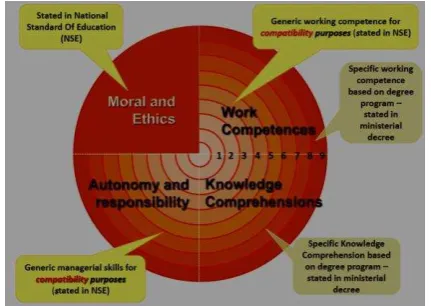
the Indonesian Qualification Framework (IQF) consisting nine levels of
qualification as shown in Figure 1. All the levels have four components: 1). moral
and ethics; 2) work competences; 3) knowledge comprehensions; and 4)
autonomy and responsibility. Therefore higher education institutions should reset
their educational goals which are met the National Standard and IQF.
[image:2.595.219.435.485.638.2]
Figure 1. Indonesian Qualification Framework
Improving the higher education quality, for example in engineering, it
means increasing the graduate (engineer) competences. According to [1] in
2
global engineers who are technically versatile (multi-disciplinary), able to solve
problems from a systems-level perspective, effective communicators, function in
diverse ethnic teams and demonstrate social responsibility. The quality of
graduate competences can be improved by redesigning curricula to provide a
proper learning environment for students to develop their competences. In
addition, improving student‟s competences can be obtained by developing an effective assessment plan but with the flexibility to adapted for a variety of
settings and purposes [2].
Most undergraduate engineering programs uses project works as the final
examination. It is because educational programs for undergraduate engineering
students are put more emphasis on practical abilities. This project-oriented
approach is designed to improve the practical ability of students; to give the
opportunity to explore and solve problems with a real application; to deepen their
understanding of the course; and promote multidisciplinary work [3]. In addition
cooperation with industries is established to get real world applications in
technology.
This paper shows an authentic assessment model to measure
comprehensively competences of undergraduate engineering students based on
Indonesian Qualification Framework (KKNI) and National Standard of Higher
Education. A case study is also presented to illustrate how to use the
project-oriented approach to measure undergraduate engineering student competences. At
the end of this paper, it will be a discussion of the importance of establishing
collaborations among universities, educational researchers and industries.
B. Learning Outcomes and Assessment of Final Project Work
It has been clearly requires in the National Standard that graduates of
undergraduate program demonstrate four components of learning outcomes: 1)
moral and ethics, stated in the National Standard; 2) work competences (generic
working competences for compatibility purposes, stated in the National Standard
and specific working competence based on degree program, stated in ministerial
3
degree program, stated in ministerial decree); and 4) autonomy and responsibility
(generic managerial skills for compatibility purposes, stated in the National
Standard). There are ten criteria in moral and ethics: devoted to God and shows
religious attitude; uphold the human values; contribute to improve quality of
societal-live; nationalist; appreciate to diversity; tolerance; having social empathy;
and having responsibility and entrepreneurship.
The generic working competences for compatibility purposes, stated in the
National Standard, consists of nine criteria: 1) an ability of apply logical, critical,
systematic thinking; 2) an ability to show performance independently, qualified
and measurable; 3) an ability to review application of science and technology; 4)
an ability to construct scientific description as final project; 5) an ability to make
accurate decisions based valid data and information; 6) an ability to develop and
maintain networking; 7) an ability to be responsible for his/her jobs; 8) an ability
to do self evaluation; 9) an ability to compile, store, secure and discover data.
General criteria of student outcomes for baccalaureate level program, stated
in Accreditation Board for Engineering and Technology (ABET) criterion 3,
engineering programs must demonstrate that their graduates have an ability: 1) to
apply knowledge of mathematics, science, and engineering; 2) to design and
conduct experiments, as well as to analyze and interpret data; 3) to design a
system, component, or process to meet desired needs; 4) to function on
multidisciplinary teams; 5) to identify, formulate, and solve engineering
problems; 6) an understanding of professional and ethical responsibility; 7) to
communicate effectively; 8) the broad education necessary to understand the
impact of engineering solution in global and societal context; a recognition of the
need for, and ability to engage in, life-long learning; 9) a knowledge of
contemporary issues; and 10) to use the technique, skills, and modern engineering
tools necessary for engineering practice.
Both above criteria are similar where student performances are not judged in
term of classes passed, but based on outcomes-based assessment. To shift the
4
help students achieve these goals; 3) assess student learning outcomes according
to both institutional and professional criteria, and 4) create a culture of continuous
improvement to better align steps (1) and (2) [4].
To do a such „student outcomes assessment‟, lecturers in engineering study
program are then develop specific measurements to assess how well students
succeeded in demonstrating through their various projects that they meet the
criteria. One step of evaluation at the end of study which represents the
culmination of the student learning process is the final year project work. The
project work is a complex event, where students have to use their previously
knowledge and personal skills, and its assessment has a major influence on
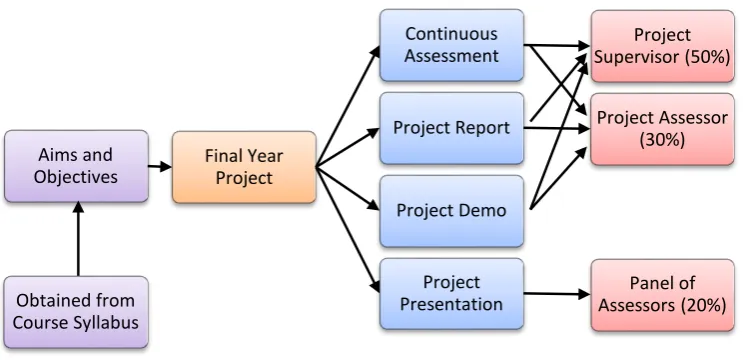
decisions regarding the student‟s readiness to graduate. An overview of how the final year project is assessed form various sources and how the final mark is
[image:5.595.125.497.411.591.2]obtained is shown in Figure 2 [5].
Figure 2. Assessment of Final Year Project
It is seen that in Fig. 2, assessment of the final project consists of four
sources of document: 1) continuous assessment; 2) project report; 3) project
demonstration; and 4) project presentation. The continuous assessment is project
implementation assessment of four general outcomes: 1) formulation of design
problem; 2) utilization of problem solving skills; 3) extension of knowledge; and Obtained from
Course Syllabus Aims and Objectives
Final Year Project
Continuous Assessment
Project Supervisor (50%)
Project Report Project Assessor (30%)
Project Demo
Project Presentation
5
4) project management. Whereas, the project report is graded according to five
general outcomes: 1) organization; 2) content; 3) relevance; 4) writing style and
grammar; and 5) presentation of material.
The project demonstration is a live demonstration of the project to both the
supervisor and the assessor. Students prepare supporting materials, such as
diagrams and manual, to assist with any explanation in answering any questions
that may be asked. The assessment during the project implementation, of the
project report and of the project demonstration are carried out by the project
supervisor and assessor. The amount contributed by the supervisor to the final
mark of the project is 50%, and by the assessor is 30%, respectively.
Students give oral presentations to the panel of assessor. These oral
presentations are a very important part assessment of students competences in
communication skills. In this stage, students demonstrate their ability to transfer
information in a manner that is interesting, informative, accurate and concise.
Five specific learning outcomes are used to grade the presentation: 1) relevance;
2) accuracy; 3) organization, preparation, and effectiveness delivery; 4) style,
pacing and body language; 5) time management. The amount contributed by the
panel of assessors to the final mark of the project is 20%.
To get better quality of outcomes learning assessment in the final project
course, it needs specific descriptions of what students should do and lecturers
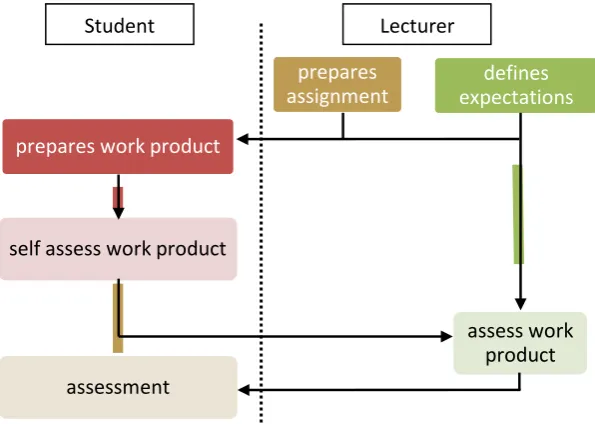
should do. Figure 3 shows deployment flow chart of quality assessment process
[7]. It is seen that prior to the project work, lecturers prepare assignment and
define expectations. Based on these assignment and expectations, students, then,
prepare the project and go through this process, finally ends with assessment.
There are six stages that lecturers must follow to implement assessment
procedure of the final project work [6].
1. Definition of (i) the learning outcomes associated with the final project work
(ii) a set of objective descriptors for each of them;
2. Definition of (i) the moment (milestone) of assessment, (ii) the specific
assessment action that must be performed at each milestone and (iii) the agents
6
3. Assignation of descriptors to each assessment action;
4. Definition of the levels of compliance with each descriptor, clearly and
objectively establishing the level of competence that student must demonstrate
that he/she possesses;
5. Drafting of assessment reports that the assessment agents must complete; and
6. Definition of the marking criteria to be used to assign the final mark for the
final project on the basis of the results reflected in the assessment report.
[image:7.595.143.441.280.492.2]
Figure 3. Flow Chart of Quality Assessment Process
There are several different grading methods used to assess students‟ learning
outcomes in the final project course in engineering. Based on the way of any
customer reacts to a product, i.e. they are either excited, satisfied, or
disappointed. Then, these three categories are expressed into exceeds expectation
(exciting), meets expectations (sufficing), and needs improvement
(disappointing). Converting these three grades of customer reactions into four: 1)
a course grade of A is assigned to students who demonstrate that they consistently
exceed/above expectations; 2) a course grade of B is assigned to students who
demonstrate that they consistently meet expectations; 3) a course grade of C is
assigned to students who fail improve some of work that need improvement; 4) a
prepares work product
self assess work product
assessment
prepares assignment
defines expectations
assess work product Lecturer
7
course grade of D is assigned to students who have a substantial work that was
not complete [7].
C. Conclusion and Recommendation
The final project works are widely used by engineering education programs
to assess student learning outcomes. This project involves students and
lecturers/supervisor to actively work together start from the beginning. First,
lecturers set up assignment and expectations that will be used by students to
prepare and make planning chart for the project implementation. Along with the
student works on the project, supervisor monitor regularly the progress made by
the student in achieving the project objectives. The student submits progress
report to both the supervisor and assessor.
At the end of the work, the student demonstrates the project to the
supervisor and assessor. This live presentation gives opportunity to student to
show his/her knowledge and skills and what have been reached. In case of the
project does not work properly or not reach the original objectives, it is essential
that student provides a good explanation of problems he/she encountered.
Assessment of the final project will reach peak stage at the oral presentation
to panel assessors. This stage is very important part for student achievement,
because at the same time all abilities in personality, knowledge and skills areas
will be assessed. So, assessment of the final project work is a comprehensive
assessment. Contribution of each agent in grading the final project course could be
arrange as follows: 50% comes form the supervisor, 30% comes from the assessor
and 20% comes from the panel of assessors.
There are four grades of the final project course: 1) a course grade of A is
assigned to students who demonstrate that they consistently exceed/above
expectations; 2) a course grade of B is assigned to students who demonstrate that
they consistently meet expectations; 3) a course grade of C is assigned to students
who fail improve some of work that need improvement; 4) a course grade of D is
8
Learning outcomes assessment requires a clear outcome criteria in every
stages. Students, supervisors and assessors should have the same perceptions on to
what extent minimum objectives must reached for each grades of course.
D. References
[1] R. N. Savage, K.C. Chen, and L. Vanasupa, “Integrating Project-based
Learning throughout the Undergraduate Engineering Curriculum,” Journal of STEM Education, vol. 8. Issue 3&4, pp. 15-27, June-Desember 2007.
[2] B.M. Olds, and R. L. Miller, “An assessment matrix for evaluating Engineering Program,” Journal of Engineering Education, 87, 2, pp. 173-178, April 1998.
[3] W. Cheng, X. Wu, Z. Zhang, F. Liu, M. Zang, and P. Guo, “Effective Project Oriented approach for training professional mechanical engineers in
undergraduate education,” International Journal of Mechanical Engineering Education, Vo. 41, Num. 4, pp. 289-296, October 2013.
[4] L. Schachterle, “Outcomes assessment and accreditation in US Engineering Formation,” European Journal of Engineering Education, Vol. 24, No. 2. Pp. 121-131, June 1999.
[5] ---, “A guide to final year project assessment for staff and student. Information for 2009-2010,” Department of Electronic Engineering, Ciity University of Hong Kong.
[6] E. Valderrama, et al., “Guidelines for the final year project assessment in
engineering,” 39th ASEE/IEEE Frontiers in Education Conference, October 18-21, 2009, San Antonio, TX