Lecture I I I
I ntroduction to Mechanics, Heat, and Sound / FI C 318
• Motion in two dimensions
projectile motion
• The Laws of Motion
Forces, Newton’s first law
Inertia, Newton’s second law
Newton’s third law
Application of Newton’s laws
YOGYAKARTA STATE UNI VERSI TY
Lightning Review
Last lecture:
1. Motion in one dimension: displacement, velocity, acceleration…
velocity (magnitude & direction) and speed (magnitude)
“velocity” means “instantaneous velocity”
Review Problem: You are throwing a ball straight up in the air. At the highest point, the ball’s
(1) velocity and acceleration are zero
Problem Solving Strategy
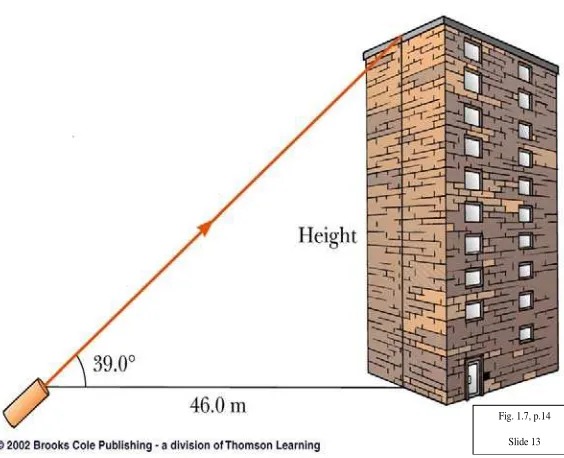
PROBLEM:A firefighter attempts to measure the height of the building by walking out a distance of 46.0 m from its base and shining a flashlight beam towards its top. He finds that when the beam is
elevated at an angle of 39.0 , the beam just strikes the top of the building. Find the
Problem Solving Strategy
[image:4.720.318.600.85.314.2]Slide 13 Fig. 1.7, p.14
Given: angle: distance: Find: Height=? m m dist height dist building of height 3 . 37 ) 0 . 46 )( 0 . 39 (tan tan . , . tan = = × = = α α
Key idea: beam of light, building wall and distance from the building to the firefighter form a right triangle! Know: angle and one side, need to determine
another side. NOTE: tangent is defined via two sides!
m d 46.0
0 . 39 = = θ
Motion in Two Dimensions
►
Using + or – signs is
not
always sufficient to
fully describe motion in more than one
dimension
Vectors
can be used to more fully describe
motion
►
Still interested in displacement, velocity, and
Displacement
►
The position of an
object is described by
its position vector
,
r
►
The
displacement
of
the object is defined as
the ch an g e in it s
p o sit io n
Velocity
►
The
average velocity
is the ratio of the
displacement to the time interval for the
displacement
►
The
instantaneous velocity
is the limit of the
average velocity as
Δt approaches zero
The
direction
of the instantaneous velocity is along a
line
that is tangent to the path
of the particle and in the
direction of motion
Acceleration
►
The
average acceleration
is defined as the
rate at which the velocity changes
►
The
instantaneous acceleration
is the limit
of the average acceleration as
Δt
Ways an Object Might Accelerate
►
The
magnitude of the velocity
(the speed) can change
►
The
direction of the velocity
can change
Even though the magnitude is constant
►
Both the magnitude and the direction
can change
0
lim
t
v
a
t
∆ →
∆
=
∆
Summary of kinematic equations
Example: Projectile Motion
►
An object may
move in both the x and y directions
simultaneously (i.e. in two dimensions)
►
The form of two dimensional motion we will deal
with is called
projectile motion
►
We may:
► ignore air friction
► ignore the rotation of the earth
Notes on Projectile Motion:
►
once released, only
gravity
pulls on the object,
just like in up-and-down motion
►
since gravity pulls on the object downwards:
vertical
acceleration
downwards
Rules of Projectile Motion
►
I ntroduce coordinate frame
: y is up
►
The
x- and y-components
of motion can be
treated independently
►
Velocities
(incl. initial velocity) can be broken
down into its
x- and y-components
►
The
x-direction
is uniform motion
a
x= 0
►
The
y-direction
is
free fall
Some Details About the Rules
►
x-direction
a
x= 0
x = v
xot
►
This is the only operative equation in the
x-direction
since there is
uniform velocity
in that
direction
constant
v
cos
v
More Details About the Rules
►
y-direction
take the positive direction as
upward
then:
free fall problem
►
only then
: a
y= -g (in general, | a
y| = g)
uniformly accelerated motion
, so the
motion equations all hold
o o
y o
v
sin
Velocity of the Projectile
►
The velocity of the projectile at any point of
its motion is the vector sum of its x and y
components at that point
x y 1 2
y 2
x
v
v
tan
and
v
v
Examples of Projectile Motion:
►
An object may be fired
horizontally
►
The initial velocity is all
in the x-direction
v
o= v
xand v
y= 0
Non-Symmetrical Projectile
Motion
►
Follow the general
rules for projectile
motion
►
Break the y-direction
into parts
up and down
Example problem:
An Alaskan rescue plane drops a package of emergency rations to a stranded party of
explorers. The plane is traveling horizontally at 40.0 m/s at a height of 100 m above the ground.
Where does the package strike the ground relative to the point at which it was released?
Given:
velocity: v=40.0 m/s height: h=100 m
Find:
Distance d=?
2. Note: vox= v = + 40 m/s voy= 0 m/s
1. Introduce coordinate frame: Oy: y is directed up
Ox: x is directed right
2
2
1 2
: ,
2
2 ( 100 )
: 4.51
9.8
y Oy y gt so t
g m
or t s m s == − == − m s s m x so t v x
Ox: = x0 , =(40 )(4.51 )=180
ConcepTest 1
Consider t he sit uat ion depict ed here. A gun is accurat ely aim ed at a dangerous crim inal hanging from t he gut t er of a building. The t arget is w ell w it hin t he gun’s range, but t he inst ant t he gun is fired and t he bullet m oves w it h a speed vo, t he crim inal let s go and drops t o t he ground. What happens? The bullet
Please fill your answer as question 7 of General Purpose Answer Sheet
1. hit s t he crim inal regardless of t he value of vo.
2. hit s t he crim inal only if vo is large enough.
ConcepTest 1
Consider t he sit uat ion depict ed here. A gun is accurat ely aim ed at a dangerous crim inal hanging from t he gut t er of a building. The t arget is w ell w it hin t he gun’s range, but t he inst ant t he gun is fired and t he bullet m oves w it h a speed vo, t he crim inal let s go and drops t o t he ground. What happens? The bullet
Please fill your answer as question 8 of General Purpose Answer Sheet
1. hit s t he crim inal regardless of t he value of vo.
2. hit s t he crim inal only if vo is large enough.
ConcepTest 1
Consider t he sit uat ion depict ed here. A gun is accurat ely aim ed at a dangerous crim inal hanging from t he gut t er of a building. The t arget is w ell w it hin t he gun’s range, but t he inst ant t he gun is fired and t he bullet m oves w it h a speed vo, t he crim inal let s go and drops t o t he ground. What happens? The bullet
1. hit s t he crim inal regardless of t he value of vo.
2. hit s t he crim inal only if vo is large enough.
3. m isses t he crim inal.
Note: The downward acceleration of the bullet and the
Classical Mechanics
►
Describes the relationship between the
motion of objects in our everyday world and
the forces acting on them
►
Conditions when Classical Mechanics does
not apply
very tiny objects (< atomic sizes)
Forces
►
Usually think of a force
as a
push or pull
►
Vector
quantity
►
May be
contact
or
Fundamental Forces
►
Types
Strong nuclear force
Electromagnetic force
Weak nuclear force
Gravity
►
Characteristics
All field forces
Listed in order of decreasing strength
Newton’s First Law
Newton’s First Law, cont.
►
External force
any force that results from the interaction
between the object and its environment
►
Alternative
statement of
Newton’s 1st Law
I nertia and Mass
►
I nertia
is the tendency of an object to continue in
its original motion
►
Mass
is a
measure of the inertia
, i.e resistance of
an object to changes in its motion due to a force
►
Recall: mass is a
scalar quantity
Unit s of m ass
SI kilogram s ( kg)
CGS gram s ( g)
I nertia and Mass: Two Examples
Runaway train
►
I nertia
is the tendency
of an object to
continue in its original
motion
►
Mass
is a
measure of
the inertia
, i.e
resistance of an object
to changes in its
I nertia and Mass: Two Examples
Seatbelt
►
I nertia
is the tendency of
an object to continue in
its original motion
Newton’s Second Law
►
The acceleration of an object is directly
proportional to the net force acting on it and
inversely proportional to its mass.
F
and
a
are both vectors
►
Can also be applied three-dimensionally
Newton’s Second Law
►
Note:
represents the vector sum of
all external forces acting on the object.
►
Since N2
ndL is a vector equation, we can
Units of Force
►
SI
unit of force
is a Newton (N)
►
1 N = 10
5dyne = 0.225 lb
2
s
m
kg
1
N
1
≡
Unit s of for ce
SI Newt on ( N= kg m / s2)
CGS Dyne ( dyne= g cm / s2)
Example: force on the bullet
ConcepTest 2
A car rounds a curve w hile m aint aining a const ant
speed. I s t here a net force on t he car as it rounds t he curve?
1. No—it s speed is const ant . 2. Yes.
3. I t depends on t he sharpness of t he curve and t he speed of t he car.
4. I t depends on t he driving experience of t he driver.
ConcepTest 2
A car rounds a curve w hile m aint aining a const ant
speed. I s t here a net force on t he car as it rounds t he curve?
1. No—it s speed is const ant . 2. Yes.
3. I t depends on t he sharpness of t he curve and t he speed of t he car.
4. I t depends on t he driving experience of t he driver.
ConcepTest 2
A car rounds a curve w hile m aint aining a const ant
speed. I s t here a net force on t he car as it rounds t he curve?
1. No—it s speed is const ant . 2. Yes.
3. I t depends on t he sharpness of t he curve and t he speed of t he car.
4. I t depends on t he driving experience of t he driver.
Note: Acceleration is a change in the speed and/or direction
Gravitational Force
►
Mutual force of attraction between any two
objects
►
Expressed by Newton’s Law of Universal
Gravitation:
2 2 1
g
r
m
m
G
Weight
►
The magnitude of the gravitational force
acting on an object of mass
m
near the
Earth’s surface
is called the
weight
w
of the
object
w = m g
is a special case of Newton’s Second
Law
►
g
can also be found from the Law of
More about weight
►
Weight is
not
an inherent property of an object
mass
is
an inherent property
Newton’s Third Law
►
I f two objects interact, the force F
12exerted
by object 1 on object 2 is equal in
magnitude but opposite in direction to the
force F
21exerted by object 2 on object 1.
Example: Newton’s Third Law
►
Consider collision of two
spheres
►
F
12may be called the
action
force and F
21the
reaction
force
Actually, either force can be the action or the
reaction force
►
The action and reaction
forces act on
different
Example 1: Action-Reaction Pairs
►
n and n’
n
is the
normal
force,
the force the table
exerts on the TV
n is always
perpendicular
to the
surface
n’
is the reaction – the
TV on the table
Example 2: Action-Reaction pairs
►
F
gand F
g’
F
gis the force the
Earth exerts on the
object
F
g’
is the force the
object exerts on the
earth
Forces Acting on an Object
►
Newton’s Law uses the
forces acting
on
an
object
►
n and F
gare acting on
the object
ConcepTest 3
Consider a person st anding in an elevat or t hat is accelerat ing upward. The upward norm al force N exert ed by t he elevat or floor on t he person is
1. larger t han 2. ident ical t o 3. sm aller t han
4. equal t o zero, i.e. irrelevant t o
t he dow nward w eight W of t he person.
ConcepTest 3
Consider a person st anding in an elevat or t hat is accelerat ing upward. The upward norm al force N exert ed by t he elevat or floor on t he person is
1. larger t han 2. ident ical t o 3. sm aller t han
4. equal t o zero, i.e. irrelevant t o
t he dow nward w eight W of t he person.
ConcepTest 3
Consider a person st anding in an elevat or t hat is accelerat ing upward. The upward norm al force N exert ed by t he elevat or floor on t he person is
1. larger t han 2. ident ical t o 3. sm aller t han
4. equal t o zero, i.e. irrelevant t o
t he dow nward w eight W of t he person.
Applying Newton’s Laws
►
Assumptions
Objects behave as particles
►
can ignore rotational motion (for now)
Masses of strings or ropes are negligible
I nterested only in the forces acting on the
object
Free Body Diagram
►
Must identify all the forces acting on the
object of interest
►
Choose an appropriate coordinate system
►
I f the free body diagram is incorrect, the
Applying Newton’s Laws
►
Make a sketch of the situation described in the
problem,
introduce a coordinate frame
►
Draw a
free body diagram
for the isolated object
under consideration and label all the forces acting
on it
►
Resolve the forces into x- and y-components
,
using a convenient coordinate system
►
Apply equations
, keeping track of signs
Equilibrium
►
An object either at rest or moving with a
constant velocity is said to be in
equilibrium
►
The
net force
acting on the object is zero
►
Easier to work with the equation in terms of
its components
∑
F
=
0
∑
F
x
=
0
Solving Equilibrium Problems
►
Make a sketch of the situation described in the
problem
►
Draw a free body diagram for the isolated object
under consideration and label all the forces acting
on it
►
Resolve the forces into x- and y-components,
using a convenient coordinate system
►
Apply equations, keeping track of signs
Example 1. Equilibrium problems
Newton’s Second Law Problems
►
Similar to equilibrium except
►
Use components
►
a
xor a
ymay be zero
∑
F
=
m
a
x
x
ma
F
Solving Newton’s Second Law
Problems
Make a sketch of the situation described in
the problem
Draw a free body diagram for the isolated
object under consideration and label all the
forces acting on it
I f more than one object is present, draw free body diagram for each object
Resolve the forces into x- and y-components,
using a convenient coordinate system
Apply equations, keeping track of signs
Forces of Friction
►
When an object is in motion on a surface or
through a viscous medium, there will be a
resistance to the motion
This is due to the interactions between the
object and its environment
►
This is resistance is called the
force of
More About Friction
►
Friction is proportional to the normal force
►
The force of static friction is generally greater than
the force of kinetic friction
►
The coefficient of friction (µ) depends on the
surfaces in contact
►
The direction of the frictional force is opposite the
direction of motion
Static Friction, ƒ
s
►
Static friction acts to keep the
object from moving
►
I f F increases, so does ƒ
s►
I f F decreases, so does ƒ
sKinetic Friction
►
The force of kinetic
friction acts when the
object is in motion
ConcepTest 4
You are pushing a w ooden crat e across t he floor at const ant speed.You decide t o t urn t he crat e on end, reducing by half t he surface area in cont act w it h t he floor. I n t he new orient at ion, t o push t he sam e crat e across t he sam e floor w it h t he sam e speed, t he force t hat you apply m ust be about
1. four t im es as great 2. t w ice as great
3. equally great 4. half as great
5. one- fourt h as great
as t he force required before you changed t he crat e’s orient at ion.
ConcepTest 4
You are pushing a w ooden crat e across t he floor at const ant speed.You decide t o t urn t he crat e on end, reducing by half t he surface area in cont act w it h t he floor. I n t he new orient at ion, t o push t he sam e crat e across t he sam e floor w it h t he sam e speed, t he force t hat you apply m ust be about
1. four t im es as great 2. t w ice as great
3. equally great 4. half as great
5. one- fourt h as great
as t he force required before you changed t he crat e’s orient at ion.
ConcepTest 4
You are pushing a w ooden crat e across t he floor at const ant speed.You decide t o t urn t he crat e on end, reducing by half t he surface area in cont act w it h t he floor. I n t he new orient at ion, t o push t he sam e crat e across t he sam e floor w it h t he sam e speed, t he force t hat you apply m ust be about
1. four t im es as great 2. t w ice as great
3. equally great 4. half as great
5. one- fourt h as great
as t he force required before you changed t he crat e’s orient at ion.
Note: The force is proportional to the coefficient of kinetic friction and the weight of the crate. Neither depends on the size of the surface in contact with the floor.
I nclined Planes
►
Choose the coordinate
system with x along
the incline and y
perpendicular to the
incline
►
Replace the force of
gravity with its
Example: I nclined Planes
Problem:
A child holds a sled at rest on frictionless, snow-covered hill, as shown in figure. I f the sled weights 77.0 N, find the force T
Example: I nclined Planes
► Choose the coordinate system with x along the incline and y perpendicular to the incline
► Replace the force of gravity with its components
Given:
angle: α=30 weight: w=77.0 N
Find:
Tension T=? Normal n=?
1. Introduce coordinate frame:
Oy: y is directed perp. to incline Ox: x is directed right, along incline
Connected Objects
►
Apply Newton’s Laws
separately to each
object
►
The acceleration of both
objects will be the same
►
The tension is the same
in each diagram
More About Connected Objects
►
Treating the system as one object allows an
alternative method or a check
Use only external forces
►
Not the tension – it’s internal
The mass is the mass of the system
►
Doesn’t tell you anything about any internal
Example: Connected Objects
► Apply New t on’s Law s separ at ely t o each obj ect
► The acceler at ion of bot h obj ect s w ill be t he sam e
► The t ension is t he sam e in each diagr am
► Solv e t he sim ult aneous equat ions
Problem:
Two obj ect s m1= 4.00 kg and m2= 7.00 kg ar e connect ed by a light st r ing t hat passes over a fr ict ionless pulley. The
Example: Connected Objects
Given:
mass1: m1=4.00 kg mass2: m2=7.00 kg friction: µ=0.300
Find:
Tensions T=? Acceleration a=?
1. Introduce two coordinate frames: Oy: y’s are directed up
Ox: x’s are directed right
: , k
Note
∑
F ==ma and f µn. 0 : , : : 1 1 1 1 1 = − = = − =
∑
∑
g m n F Oy a m f T F Ox Mass y k x . : :2 Oy2 F m2g T m2a
Mass
∑
y = − =Solving those equations:
a = 5.16 m/s2
Terminal Speed
►
Another type of friction is air resistance
►
Air resistance is proportional to the speed of
the object
►
When the upward force of air resistance
equals the downward force of gravity, the
net force on the object is zero
►
The constant speed of the object is the