The Compromise of
LIBERAL
ENVIRONMENTALISM
COLUMBIA UNIVERSITY PRESS Publishers Since 1893
New York Chichester, West Sussex Copyright © 2001Columbia University Press All rights reserved
Library of Congress Cataloging-in-Publication Data
Bernstein, Steven F.
The compromise of liberal environmentalism / Steven F. Bernstein. p. cm.
Includes bibliographical references and index.
ISBN 0-231-12036-2(cloth : alk. paper) —ISBN 0-231-12037-0(pbk. : alk. paper)
1. Environmental policy. 2. Sustainable development. I. Title. GE170.B47 2002
363.7'05—dc21 2001028016
Casebound editions of Columbia University Press books are printed on permanent and durable acid-free paper.
Printed in the United States of America
c 10 9 8 7 6 5 4 3 2 1
CONTENTS
List of Acronyms vii
Preface and Acknowledgments ix
1 INTRODUCTION 1
The Evolution of International Environmental Governance 4
Explaining the Evolution of Environmental Governance 7
Metatheoretical Issues 22
2 FROM ENVIRONMENTAL PROTECTION TO SUSTAINABLE DEVELOPMENT 28
Identifying Norms 29
United Nations Conference on the Human Environment (UNCHE) 31
From Stockholm to Sustainable Development 49
World Commission on Environment and Development (WCED) 58
3 ENVIRONMENT, DEVELOPMENT, AND LIBERAL ENVIRONMENTALISM 70
From Brundtland to Rio 71
United Nations Conference on Environment and Development (UNCED) 83
Liberal Environmentalism After Rio 110
4 EPISTEMIC COMMUNITIES, SCIENCE, AND INTERNATIONAL ENVIRONMENTAL GOVERNANCE 122
Explaining Norm Creation and Change With Epistemic Communities 125
The Role of Scientists and Scientific Ecology 130
The Influence of Scientists and Scientific Ecology 137
Conclusions 173
5 ECONOMIC IDEAS, SOCIAL STRUCTURE, AND THE EVOLUTION OF INTERNATIONAL ENVIRONMENTAL GOVERNANCE 178
Socio-Evolution and Governance 181
Limited Success: Economic Ideas, the North-South Divide, and Ecodevelopment 191
Sustainable Development and the OECD 196
The “Fit” with Social Structure 202
UNCED Outcomes and Liberal Environmentalism 209
Conclusions 211
6 CONCLUSION 213
Theoretical Implications 215
Empirical and Policy Implications 223
Conclusion 242
Notes 245 Bibliography 271 Index 295
LIST OF ACRONYMS
AGGG Advisory Group on Greenhouse Gases
BCSD Business Council for Sustainable Development
CBD Convention on Biological Diversity
CDM Clean Development Mechanism of the Kyoto Protocol
CFCs Chlorofluorocarbons
CHP Common Heritage Principle
CIDA Canadian International Development Agency
CITES Convention on International Trade in Endangered Species of Wild Fauna and Flora
CTE Committee on Trade and Environment of the WTO
EC European Community
ECOSOC United Nations Economic and Social Council
ENGO Environmental Nongovernmental Organization
EPA Environmental Protection Agency (United States)
EU European Union
FAO United Nations Food and Agricultural Organization
FCCC Framework Convention on Climate Change
FRG Federal Republic of Germany (West Germany)
FSC Forest Stewardship Council
G-7 Group of Seven
G-77 Group of Seventy-Seven
GARP Global Atmospheric Research Programme
GATT General Agreement on Tariffs and Trade (WTOafter 1994)
GCC Global Climate Coalition
GDP Gross Domestic Product
GEF Global Environment Facility
GEMS Global Environmental Monitoring System of the U.N.–sponsored Earthwatch Network
GHG Greenhouse Gas
IBP International Biological Programme
ICC International Chamber of Commerce
ICSU International Council of Scientific Unions
IGBP International Geosphere-Biosphere Programme
IHDP International Human Dimensions Programme
IIASA International Institute for Applied Systems Analysis
IMF International Monetary Fund
IPCC Intergovernmental Panel on Climate Change
IPE International Political Economy
IUCN Word Conservation Union—renamed 1990, formerly International Union for the Conservation of Nature and Natural Resources
JI Joint Implementation—also knows as AIJ: Activities to be Implemented Jointly
LMOs Living Modified Organisms
MAB Man and the Biosphere Programme
NIEO New International Economic Order
NGO Nongovernmental Organization
ODA Official Development Assistance
OECD Organization for Economic Cooperation and Development
PPI Progressive Policy Institute
PPMs Process and Production Methods
PPP Polluter Pays Principle
PRC People’s Republic of China
SCOPE Scientific Committee on Problems of the Environment ofICSU SSTs Supersonic Transports
UNCED United Nations Conference on Environment and Development, 1992
UNCHE United Nations Conference on the Human Environment,1972
UNCLOS III 1982United Nations Convention on the Law of the Sea
UNCSD United Nations Commission on Sustainable Development
UNCTAD United Nations Conference on Trade and Development
UNDP United Nations Development Programme
UNEP United Nations Environment Programme
UNESCO United Nations Educational, Scientific, and Cultural Organization
UNGA United Nations General Assembly
UNGASS United Nations General Assembly Special Session to Review Implementation of Agenda 21
WCED World Commission on Environment and Development (Brundtland Commission)
WCS World Conservation Strategy
WCRP World Climate Research Programme
WMO World Meteorological Organization
WTO World Trade Organization
WWF World Wide Fund for Nature renamed in 1990—formerly World Wildlife Fund
PREFACE AND ACKNOWLEDGMENTS
THE GERM OF THE IDEAthat eventually evolved into this book came on the eve of
the 1992Earth Summit in Rio de Janeiro. It was a time of great hope for people who shared a concern over the fate of the global environment, but tempered by uneasiness over the course the summit set for understanding and addressing these problems. Almost 10years later, the legacy of those ideas and decisions—a legacy I label the “compromise of liberal environ-mentalism”—remains powerfully in place. It can be found in the ideas that undergird many of the most important and far reaching internation-al environmentinternation-al treaties such as on climate change and biodiversity, in the policies and programs of international environment and development organizations ranging from the United Nations Environment Programme to the World Bank and throughout the United Nations system as a whole, and in the way powerful non-environmental organizations such as the World Trade Organization—which increasingly finds itself making deci-sions with potential environmental consequences—try to respond to the demands to accommodate environmental and development concerns in their decisions and policies. Even many nongovernmental organizations rest their proposals for action on this framework, as do many states in their domestic policies.
in-stitutions treat global environmental problems the way they do, and the underlying forces of world politics that pushed global environmental governance in this direction. Only with this knowledge did it seem possi-ble to make informed judgments about the prospects for future action, or provide a basis on which to critically assess and debate whether there is a need for deeper change. This task seems even more important to-day—given the disappointment many feel, despite some notable success-es, over progress on the world’s most severe environmental problems since 1992.
The second inspiration for this book came from a frustration, typical among many of my fellow graduate students at the time, with most of the literature on international institutions. It seemed to forget that interna-tional institutions are not simply a vehicle through which states cooper-ate, but that the cooperation they enable is for some purpose or goal. Pur-poses and goals and the politics that drives them were simply left out of most International Relations scholarship, as if all that mattered was whether an institution formed or not. What it actually did (or did not do) mattered not at all. A new literature in International Relations—which now falls under the label ‘constructivism’—challenged the discipline by bringing politics and common or collective purposes back into the analy-sis of international institutions. However, it faced heavy criticism initially for being too concerned with big theoretical questions at the expense of adding to our knowledge of important and pressing problems in world politics. My hope is that this book is one in a growing list that responds to this criticism.
I owe a great many people thanks for support, encouragement, con-structive criticism, and even inspiration as I developed my ideas. At Uni-versity of Toronto, Janice Gross Stein, Ronald Deibert, Louis Pauly, Robert O. Matthews, and Craig Scott asked the tough questions and pushed and prodded my work to reach beyond its initial limitations. David Welch mer-its special mention for what in hindsight must have been a painstaking task; his willingness to read and comment in detail on multiple versions of each portion of what would later become a draft manuscript.
A great many other people helped along the way through thoughtful discussions, insights, and comments on the research that eventually coa-lesced into this book. They include Thomas Biersteker, Ben Cashore, Dorinda Dallmeyer and other participants in the 1996ACUNS/ASIL Sum-mer Workshop on “The Role of Governmental, Intergovernmental, and Nongovernmental Institutions in Global Governance” at Brown Uni-versity, Andrew Deutz, Elizabeth DeSombre, Joanne Gestrin, Thomas
Homer-Dixon, Richard Herrmann, Andrew Hurrell, Rhona Leibel, Karen Litfin, Miriam Lowi, Richard Matthews, Don Munton, Shaun Narine, Norrin Ripsman, and Lisa Young.
I especially want to acknowledge my intellectual debt to James Busumtwi-Sam whose collaboration on a related project greatly helped my thinking on many theoretical aspects of this book. Our work together at times became so intertwined that he deserves some credit for whatever intellectual contribu-tion is made here. Of course the blame for any errors of fact or judgment are solely my own.
Other people took time out of their busy schedules to discuss their ex-periences and issues about which they knew far more than me. While the formal interviews directly quoted are listed in my bibliography, I also thank Louise Comeau, Alden Meyer, Peter Timmerman, Jeffrey Watson, and Doug Whelpdale, among others, who talked to me about their research or participation in various international environmental negotiations. I am also grateful to Peter Berry who shared his interview notes on ozone nego-tiations and research with me. I especially want to thank Louise Comeau and Jennifer Morgan, of the Climate Action Network, for helping me arrange to attend the first Conference of the Parties for the Framework Convention on Climate Change in Berlin, and for giving me full access to CAN’s strategy sessions and information.
An Eco-Research Doctoral Fellowship from the Tri-Council Secretariat of Canada provided the major source of funding for research. Generous fi-nancial support from the Halbert Exchange allowed me to spend a year at the International Relations Department at Hebrew University where my many discussions with Emanuel Adler on constructivism and epistemic communities challenged me to consider more carefully key elements of my arguments. Although we did not always agree, his intellectual and personal mentorship were without rival. Similarly Ned Lebow, director of the Mer-shon Center of Ohio State University equally provided intellectual enrich-ment and friendship during the final stages of writing the draft manu-script. Generous postdoctoral funding from the Mershon Center and the Social Sciences and Humanities Council of Canada provided me the time and ideal writing environment away from other university duties to see the project through to completion.
All this would have been for nought without the commitment and sup-port for the project from Kate Wittenberg at Columbia University Press. The comments of the two anonymous reviewers she chose helped make the final manuscript a much stronger and more coherent piece of work. I am also grateful to Leslie Bialler and the rest of the staff at Columbia for their
efficiency and professionalism in ushering a first-time author through the arcane editorial process.
Parts of the argument and evidence developed further here appeared first in “Ideas, Social Structure, and the Compromise of Liberal Environ-mentalism.” European Journal of International Relations 6(4) (December
2000):464–512, and are reproduced with permission from Sage Publica-tions and the European Consortium for Political Research.
This book would never have been written without the unwavering sup-port and inspiration of my partner and wife, Linda White. Her painstaking scrutiny of virtually every word I have written related to this project made it a far better product than I ever could have produced on my own. She constantly pushed me to clarify my ideas, asking the fundamental ques-tions about my work that others would not. I dedicate this book to her.
Steven Bernstein Toronto, Canada January 2001
FEW TRULY GLOBAL concerns have held the potential to transform substantially
the nature of global politics and society. Contenders might include the fear of nuclear annihilation or advances in technology and telecommunica-tions. The former arguably has transformed the nature of conflict between the major powers, while the latter have made possible exponential increas-es in economic transactions across vast distancincreas-es, enhanced the spread of culture, and enabled vast changes in the patterns of interaction between a wide range of actors on the global stage.
Looking back thirty years, one might have predicted that the concern over the state of the global environment could similarly transform global politics. Responses to such concerns have called for a whole new notion of planetary rather than national security and thrown into question the as-sumption of competing interests of states or the ability of such units, or the sovereign state system they comprise, to manage global problems. Further-more, a growing awareness of environmental problems and ecological
in-Chapter 1
INTRODUCTION
We cannot say with certainty how much longer mankind [sic] can post-pone initiating deliberate control of his growth before he will have lost the chance for control. We suspect on the basis of present knowledge of the physical constraints of the planet that the growth phase cannot con-tinue for another one hundred years. Again, because of the delays in the system, if the global society waits until those constraints are unmistak-ably apparent, it will have waited too long.
—The Limits to Growth1972
The concept of sustainable development does imply limits—not absolute limits but limitations imposed by the present state of technology and so-cial organization on environmental resources and by the ability of the biosphere to absorb the effects of human activities. But technology and social organization can be both managed and improved to make way for a new era of economic growth.
terdependencies has led many to question the wisdom of conducting glob-al economic relations as if they were independent from the ecologicglob-al sys-tems that sustain life on the planet.
The early ideas that informed international attempts to manage the Earth’s resources supported such transformations. The philosophical state-ment of planetary concern commissioned for the first global environmen-tal conference—the United Nations Conference on the Human Environ-ment in 1972—included calls for a “loyalty to the Earth” that recognized planetary interdependence of all life, the adoption of global (as opposed to national) responses to environmental problems, and massive changes in over-consumptive lifestyles of the wealthy.Only One Earth, as it was called, also criticized existing international institutions for lacking a sense of plan-etary community and commitment (Ward and Dubos 1972). High-profile studies such as The Limits to Growthtook an even tougher stand against overconsumption and warned that growth in population and production could not continue on course without leading to the collapse of social and economic systems (Meadows et al.1972). No one expected revolutionary changes to occur overnight, but an assumption continues to prevail that as the international community pays more attention to environmental prob-lems, we will move gradually toward a more ecological understanding of our world and humankind’s place in it. At the least, our responses to envi-ronmental problems themselves will lead us in an ecological direction.
This book examines whether indeed that is the case. It does so by detail-ing how international concern for the global environment moved from these initial formulations to the current concern with “sustainable devel-opment,” and what form of international governance “sustainable develop-ment” entails. This evolution of environmental governance takes on added significance when one considers that environmental issues finally reached the mainstream of international relations in the early 1990s only when they took this form.
Whether or not sustainable development constitutes a truly transforma-tive idea, international lawyers and political scientists note that the 1992
Earth Summit in Rio de Janeiro institutionalized ideas associated with this new conception of environmental governance. Some call it a “paradigm shift” to a new international law of sustainable development from previous formulations of both an international law of the environment and of de-velopment.1Others argue that the Earth Summit “succeeded in
formulat-ing an umbrella regime in the field of sustainable development” that will continue to shape specific responses to environmental problems well into the future (Sjöstedt et al.1994:5). These institutionalized ideas arguably
embody the most significant shift in environmental governance over the last thirty years. Not only did they bring environmentalism into the main-stream of international governance, but they did so by reformulating envi-ronmental concerns in the context of a liberal international economic order. In that way, sustainable development does mark the institutionaliza-tion of environmental concern, but not as originally envisaged.
Instead, the compatibility of environmental concern, economic growth, the basic tenets of a market economy, and a liberal international order is now conventional wisdom among many policy makers, diplomats, and a large number of nongovernmental organizations throughout the world. It is easy to forget that this formulation of the environmental problematique differs substantially from those dominant when the first concerted efforts at wide-scale global responses to environmental problems began in the late
1960s and early 1970s. From the perspective of those earlier efforts, focused on the negative environmental consequences of unregulated industrial de-velopment and suspicious of economic growth, the shift in environmental governance is a remarkable and a largely unforeseen departure. Why, then, when the international community finally took environmentalism serious-ly, was it only considered in the context of an economic program that not only encouraged growth, but actually demanded it? Why did international environmental governance evolve into what I will call the compromise of “liberal environmentalism?”
These questions are too often overlooked in academic and policy work overwhelmingly focused on the quest to design better institutions to man-age the Earth’s resources or respond to immediate and pressing problems.2
This omission also points to a serious gap in the literature on international institutions more generally. Dominant strands of the rational institutional-ist “regime” literature, for example, generally ignore the question of which values cooperative outcomes promote, because they focus primarily on the functional requirements of cooperation or on institutional design and ef-fectiveness.3Such studies neglect to address the prior question of why some
norms get selected over others, thereby defining international problems and guiding appropriate behavior in particular ways. Even studies that take a more overtly sociological approach have so far failed to adequately address this question. Whereas they provide mounting evidence that international norms and institutions may not only regulate behavior, but can also define state identities and interests,4few studies address the prior question of
which norms get promoted or prevail over others in the first place.
This shortcoming is particularly evident in the literature on environ-mental institutions.5While research on the creation, design, and
ness of international institutions addresses crucially important questions, such studies generally lack a critical examination of what kind of govern-ing norms institutions embody or why those norms came to dominate global environmental governance. Rather, an assumption often pervades the mainstream academic literature that any cooperation on environmen-tal problems means progress toward a more ecological international order. A critical examination of the evolution of environmental norms shows that assumption to be overly simplistic, even faulty. Overcoming such lacu-nae in the literature deserves greater attention from scholars interested in the kind of international order that institutions actually promote.
In response, this study orients itself more toward what Robert Cox calls “critical theory.” An exercise in critical theory need not invoke com-plex methodological or epistemological challenges to how scholars ought to go about understanding the world, a wholesale rejection of explanato-ry theoexplanato-ry, or a radical interpretivism associated with some forms of post-positivist analysis. Rather, it simply poses the question differently than those involved in research on the important tasks listed above. As Cox puts it, “Critical theory stands back from the existing order of things to ask how that order came into being, how it may be changing, and how that change may be influenced or channeled. . . . Its aim is the under-standing of structural change” (Cox 1992:3). In this spirit, I set out to an-swer two questions about international environmental governance: How did the current form of international environmental governance evolve since the first major international environmental conference in 1972? And, why did it evolve into liberal environmentalism while other alterna-tives fell by the wayside?
THE EVOLUTION OF INTERNATIONAL ENVIRONMENTAL GOVERNANCE
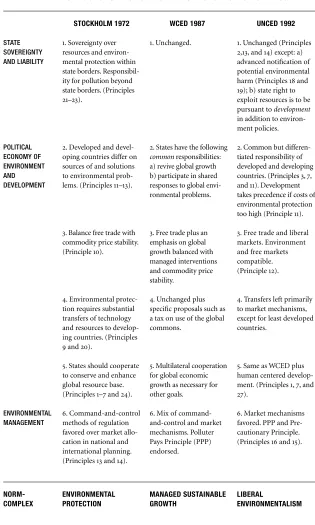
In the first half of the book, I detail the main empirical argument that norms of environmental protection have gradually converged with liberal economic norms in international environmental governance since 1972. The institutionalization of “sustainable development” at the 1992UN Con-ference on Environment and Development (UNCED or Earth Summit) le-gitimated this convergence toward what I label liberal environmentalism.6
This normative compromise predicates environmental protection on the promotion and maintenance of a liberal economic order. It also enabled
environmental concerns to find such a prominent place on the interna-tional agenda.
Chapters 2and 3should not be read, however, as yet another exposition of what “sustainable development” means. Numerous works devoted to that topic only serve to highlight the ultimately elusive quest for a definitional consensus. The widely quoted definition in the Brundtland Commission re-port—“development that meets the needs of the present without compro-mising the ability of future generations to meet their own needs”—identifies a compromise between competing values including growth, conservation, and inter- and intra- generational equity.7As such, it is open to a myriad of
interpretations. By the Earth Summit in 1992, various authors had found as many as forty definitions of the concept, and the Rio Declaration on Envi-ronment and Development, which articulated the global political consensus on sustainable development thinking, does not even attempt a consensus definition.8As noted by the International Institute for Applied Systems
Analysis, the concept “is viewed quite differently by industrialists, econo-mists, planners and environmental and ecological scientists . . .”9
Instead of unpacking the concept itself, I examine the international po-litical and economic norms invoked in the name of sustainable develop-ment and trace their evolution. The focus on norms turns attention to the content of international governance. I define governance broadly as the methods or means of realizing shared values, interests, and goals that may or may not derive from a formal centralized political authority.10
At the basis of global governance are international norms, which define and regulate appropriate state (and other key actors’) behavior, and assign rights and responsibilities regarding the issue in question. This definition corresponds to the constitutive, regulative, and deontic function of norms.11
Norms constitute identities and meanings by defining who may act, in what context they may act, and what their actions mean in that particular context. They regulate by pre/proscribing how actors should behave in defined con-texts (Cancian,1975:5–7; Dessler 1989:456). Finally, norms serve a deontic function when they express values that create rights and responsibilities and thereby empower actors by providing reasons or justifications for particular actions (Onuf1997; Ruggie 1998:21). All norms perform these functions si-multaneously, but to varying degrees. In other words, international norms define, regulate, and empower legitimate state (and other key actors’) behav-ior. While identifying institutionalized norms does not cover all aspects of governance, norms are at the heart of all governance structures.
When “sustainable development” appears as a goal in international en-vironmental agreements, policy positions of multilateral agencies, or
nouncements of intergovernmental and even many nongovernmental fora, it evokes an identifiable set of norms that underlies recent attempts at in-ternational environmental governance. I detail the evolution of interna-tional environmental norms through three key points of norm articula-tion: the 1972 Stockholm conference, the 1987 World Commission on Environment and Development report, and the 1992UNCED in Rio de Janeiro. I pay particular attention to how ideas developed that influenced the formulation of environmental governance through those episodes, who carried those ideas, and what form they took when they became insti-tutionalized. Each event serves as a marker for what is actually an ongoing process of normative evolution.
Following an examination of each event, I describe the set of norms—or
norm-complex—that represents the basis of environmental governance at that time. A norm-complex denotes a set of norms that governs relations of authority and the values promoted that define and regulate activities in a particular issue area. A norm-complex need not be stated explicitly, but can be inferred from specific norms. For example, John Ruggie (1998:62–84) identifies a norm-complex of “embedded liberalism” in the post-World War II era—where the liberal economic order is predicated on domestic inter-vention—based on specific norms constructed to govern international trade and finance as embodied in the Bretton Woods institutions. Similarly, liberal environmentalism can be inferred from the specific norms legitimated through the Earth Summit conference process and related agreements and activities. Like Ruggie, my purpose in articulating a norm-complex is to re-veal the underlying pattern of values and goals that guide international be-havior. Once identified, a norm-complex can be used to assess the signifi-cance of changes, which are best analyzed in relation to underlying collective
purposes embodied in norms.12Threats to the norm-complex stem from
al-ternative norms that undermine the collective purposes that define it. For ex-ample, a string of environmental agreements or programs that endorsed uni-lateral trade measures to protect the environment or denounced economic growth would constitute a serious challenge to liberal environmentalism.
Chapters 2and 3argue that the norm-complex governing global envi-ronmental practices evolved through stages that roughly correspond to the three events listed above. The norm-complex articulated at Stockholm in
1972did contain both environment and development norms, but primarily emphasized the environmental protection side of the equation, as did the practices of international institutions, transnational activities, and interna-tional cooperative efforts following the conference. The Brundtland Com-mission report attempted a synthesis of environment and development
agendas and reflected a Keynesian-like compromise. In it, liberal interde-pendence that generated growth would be tempered by managed interven-tions to cushion and facilitate adjustment in the South and direct develop-ment on a path less likely to harm the environdevelop-ment. Rather than call this norm-complex one of sustainable development, I label it “managed sus-tainable growth.” I do so to contrast it with the currently dominant norm-complex of “liberal environmentalism” institutionalized at UNCED.
Liberal environmentalism accepts the liberalization of trade and finance as consistent with, and even necessary for, international environmental pro-tection. It also promotes market and other economic mechanisms (such as tradeable pollution permit schemes13or the privatization of commons) over
“command-and-control” methods (standards, bans, quotas, and so on) as the preferred method of environmental management. The concept of sus-tainable development, while it legitimated this shift in norms, now masks this compromise that characterizes international environmental governance. A number of studies identify various elements of what I call liberal envi-ronmentalism, but they use terms such as ecological modernization or sim-ply sustainable development.14Many of these studies aim to uncover
contra-dictions in such concepts. Some also critique the form of environmental governance promoted as too accepting of the status quo of state control and of patterns of economic development and practices that created most of the world’s environmental problems in the first place (see especially Chatterjee and Finger 1994). These critiques are not the focus of this study, although the concluding chapter addresses various implications of the institutionalization of liberal environmentalism. Instead, the value added here is to uncover how and why liberal environmentalism became institutionalized, at least at the international level, rather than simply offering a critique of the outcome. To date, no study has carefully traced through the institutionalization of such ideas. A critical understanding of the constraints and opportunities for change in international environmental governance requires understanding how that structure of governance developed over time.
EXPLAINING THE EVOLUTION OF ENVIRONMENTAL GOVERNANCE
Unlike studies that focus on how best to achieve international cooperation on environmental problems, in the second part of the book I explain why a particular set of norms dominates such arrangements. Explanations for the
observed normative developments in environmental governance address two questions: What actors and institutions carried ideas that led to liberal environmentalism? And, why did the set of ideas associated with norms of liberal environmentalism become institutionalized, or, more generally, why does the set of ideas associated with a prevailing norm-complex become institutionalized over others?
The movement from one norm-complex to another occurs when a new set of ideas either redefines existing norms or introduces new norms not previously considered as relevant.15“Ideas” here simply refer to proposals
for new norms, whether stated as an ideology, worldview, principled belief, or causal belief.16Each type of idea can be potentially stated as a norm if it
provides an orientation to action. The importance of ideas in politics comes about through their collective legitimation—that is, when they take on a normative flavor—which is ignored by utilitarian theories focused on indi-vidual beliefs. The distinction between “idea” and “norm,” although some-what artificial,17distinguishes the initial articulation of ideas by individuals
or groups, with the causal properties attributed to normative statements once they become a “collective intentionality” or institutionalized.18
I put forward two competing explanations for the selection of norms in chapters 4and 5that focus on the causal role of ideas in international gov-ernance. Such a focus is appropriate given the overriding concern with the content of international governance, since only knowledge or ideas-based explanations focus on what set of ideas dominate attempts to solve the problem in question.
Still, I take seriously Geoffrey Garrett and Barry Weingast’s (1993:203) assertion that an ideas-based explanation first requires a null hypothesis that only material interests matter. Three difficulties, explored below, stand out that make standard power and interest approaches inadequate or inap-propriate for this study. First, most such theories explicitly leave the con-tent of interests unexplained. Second, even when state interests are known, outcomes in international environmental governance cannot be easily ex-trapolated from them. Finally, existing explanations that do link power and interests to the content of governance leave many of the most important empirical outcomes in environmental governance unexplained.
Limitations of Power and Interest-based Explanations
Leading power and interest-based approaches in International Relations do not, on their own, explain the normative content of institutions, first
and foremost because interests are exogenous, thus unexplained in such theories. Robert Keohane forcefully makes this point in his discussion of neoliberal institutionalist and neorealist explanations for cooperation, the two dominant rationalist explanations in the literature:
In the absence of a specification of interests . . . institutionalist predic-tions about cooperation are indeterminate.
That is, institutional theory takes states’ conceptions of their interests as exogenous: unexplained within the terms of the theory. Unlike naive versions of commercial or republican liberalism, institutionalist theory does not infer a utility function for states simply from the material eco-nomic interests or the alleged values common to democracy. . . . Nor does realism predict interest (1993:285).
As a result, theories that do attempt to explain normative outcomes almost always import interests, usually taking them for granted (Ruggie 1983:198). The literature on environmental institutions partakes in this bias, which accounts for its failure to explore adequately the collective purposes behind responses to global environmental problems.19
Analysts are then left with a very thin conception of interests. Depend-ing on the theory of world politics employed, interests in international pol-itics are assumed to be relatively stable and based on core values such as economic costs/benefits or protection of physical security from outside at-tack. In realist thought, interests are taken as given and the interests of dominant state-actors generally prevail, although the ability of those actors to prevail is conditioned on factors such as the current distribution of ca-pabilities in the international system. Later institutionalist literature broadens the focus from the interaction of rational state actors to include institutional, transnational, and/or domestic factors to the mix of variables considered (Young 1994; Haas, Keohane and Levy 1993). Whatever the merit of specific rational-interest approaches to explaining cooperation (the critiques of specific theories are many and varied and need not be re-hearsed here), by themselves they offer little in the way of analysis of the content of cooperative arrangements that prevail.
Instead, interest-based explanations for international phenomena have typically focused on the problem of how to achieve common interests or joint gains. Such explanations rely on modeling the strategic interaction of actors with given interests or they hypothesize that when core interests of powerful actors are threatened (for example, when they are vulnerable to costly environmental damage), those actors, either by threat, coercion, or by
shouldering extra costs, will ensure action is taken in response to those threats. The outcomes explained by such theories are usually dichotomous— agreement/no agreement, action/no action, or cooperation/conflict—on the concern in question. Studies in this vein can provide interesting analysis of cooperation on particular international environmental issues. For example, Sprinz and Vaahtoranta (1994), while not explicitly presenting a theory of co-operation, use an interest-based explanation to show why some countries more strongly supported international environmental cooperation on con-trolling acid rain and ozone depletion than others. Paterson (1996) and Row-lands (1995a) assess the merits of interest-based explanations, among others, to explain the politics of global responses to climate change. These ap-proaches nonetheless fail to explain the construction of an “interest” in envi-ronmental protection, which would require a subsidiary theory of interest formation. More importantly, the actual framing or kind of responses to en-vironmental problems are also beyond the scope of such theories because a cooperative result, for example, says little about what goals or ends obtain in the cooperative solution.
Supporters of a more traditional liberalism that “takes preferences seri-ously” might still counter that the preferences of all relevant actors could have been gauged on the eve of the Earth Summit, and outcomes extrapo-lated from them (Moravcsik 1997). Such a unit-preference theory would propose that the South wanted primarily to develop and to defend sover-eignty, while it had a limited interest in the environment. Therefore, liberal environmentalism was the best that could be achieved given the North’s desire to protect open trade and investment while at the same time appear-ing to do somethappear-ing about global environmental problems. Likewise, the North would have liked to see the South do more for the environment, but liberal environmentalism was the best it could do, given the South’s inter-ests. Although this approach moves closer to addressing the problem of identifying interests, a simple extrapolation of outcomes from domestic preferences fails to explain the changes in the normative basis of environ-mental governance since 1972.
Earth Summit outcomes did indeed reflect, to varying degrees, the pur-suit of domestic material interests. However, if interests provided a suffi-cient explanation, those outcomes should have more closely resembled the competing sets of interests reflected in the Stockholm conference outcomes
20years earlier, which for the most part simply juxtaposed environment and development. That UNCED produced different outcomes reflects in part that the South’s “interest” in the environment changed drastically be-tween 1972and 1992, as I show in chapters two and three. As one author
scribes it (Imber 1994:86), unlike the uniformly defensive position taken by the South at Stockholm, some countries in the South, as in the North, took positions at UNCED that could be considered “activist” on both environ-ment and developenviron-ment concerns, others took “ambiguous” positions, and still others were on the “defensive.” Indeed, the Stockholm outcomes ap-peared to reflect competing sets of material interests to a much greater de-gree since nascent ideas that linked environment and development had only limited influence. In the intervening years, new ideas that linked environ-ment and developenviron-ment increasingly shaped interest-definition for countries in the North and South.
For example, positions changed substantially between 1972and 1992on arguments put forward by the South over the way in which development ought to be promoted within a framework that also considered environ-mental protection. The embrace (albeit grudging in many cases) of market norms by the South, the support for incorporating environmental con-cerns into development projects and policies, and the willingness to ac-knowledge the severity of global and local threats to the environment all represented substantial shifts from 20years earlier. Likewise, the North’s embrace of the concept of sustainable development in the late 1980s, with its explicit linkage of environment and development, cannot be derived from interests alone, unless those interests changed since 1972. The North resisted the linkage at that time because policymakers perceived the two in-terests to be fundamentally incompatible, and could not conceive of insti-tutions that could promote both goals simultaneously. Admittedly, the pri-ority given to particular environmental issues still often differed in North and South. Nonetheless, the shifts in positions noted above that facilitated the acceptance of liberal environmentalism suggests that its institutional-ization reflects more than the sum of material interests or a simple North-South compromise. Ideas needed to intervene from some source to create, modify, or, at the least, find a focal point around which existing interests might converge and consensus might form.
Even in regard to the type of world order the North supported, noth-ing inherent in the material interest of a wealthy or powerful country makes it desire an economic system characterized by open trade and in-vestment, the liberal side of liberal environmentalism. The Cold War pe-riod, wherein the two most powerful countries pursued vastly different conceptions of world economic order, not to mention the long periods of history where economic nationalist policies of powerful countries domi-nated, demonstrates that power and material interests do not dictate par-ticular policy preferences in a predictable direction. Ultimately, even the
quest to protect sovereignty on the part of the South cannot be consid-ered solely a material interest since it is conditioned on a pre-existing set of social arrangements within the international system that privileges the role of sovereign states and defines relations between sovereign states in particular ways.
Finally, even if a focus on domestic preferences could explain outcomes at given times, such explanations remain extremely inefficient, requiring con-stant reevaluations of changing preferences over time, and would still require a domestic theory of preference formation and change. An explanation that either attempts to explain why interests changed or that endogenizes inter-ests to some degree would be more efficient. Chapter 5, as I explain below, puts forward a more efficient theory than a pure rational-interest approach because it endogenizes the evolving normative context of state practices rather than relying on either the repeated evaluation of particular state pref-erences or the uncritical importation of assumed interests.
A third possible approach is to employ theories that attempt a more ex-plicit linkage of power and interest to norms, most notably those that focus on hegemony. They nonetheless still encounter the theoretical pitfalls of standard rational-interest approaches. Moreover, they have performed poorly as explanations of environmental governance in studies to date and the evidence in subsequent chapters lends little support for such an expla-nation in this case.
The most prominent example is Hegemonic Stability Theory, devel-oped in the 1980s. In its various forms, the theory explains which norms prevail by arguing that international regimes, and the norms they embody, reflect the interest of a dominant or “hegemonic” state in the system, or, in some modified versions, a group of dominant states (e.g., Snidal 1985). This theory served as the fallback position to explain the creation of inter-national institutions for much of the “interinter-national regimes” scholarship, and for questions of world order more broadly. For example, Robert Gilpin, Robert Keohane, and Stephen Krasner—despite differences in their work in other respects—all implicitly or explicitly supported the view that a hegemonic state that is able and willing to play a leadership role, is necessary (though perhaps not sufficient) for the establishment of international regimes.20
This state-centric view of hegemonic stability theory has proven of lim-ited usefulness in explaining either international environmental coopera-tion or normative development. Oran Young, for example, has shown in a series of articles that hegemonic leadership was not necessary for the for-mation of many multilateral environmental agreements and sometimes
played only a minor role, even when a hegemonic power participated in the regime or agreement eventually (Young 1989,1994). Even if one consid-ers the United States a hegemon in the environmental issue area (a dubious proposition in any case) the experience of the Stockholm and Rio confer-ences seems at odds with the basic hypothesis of hegemonic stability theo-ry.21At Stockholm, the United States did play a leadership role, although
the agreements reached did not reflect U.S. interests solely, especially since it showed very little interest in the development side of the agenda. At Rio, the United States was a disengaged player for much of the negotiations, while the European Union (EU) assumed a much more assertive leader-ship role (Hajost 1994; Sjöstedt et al.1994). However, in both cases, the basic framing of issues and interest-definition came as much from the en-trepreneurial leadership of the conference secretariat as from particular states, and drew from ideas and institutional developments not directly de-rived from dominant state interests.
Granted, dominant states may be able to block agreement on or effec-tively veto international norms, since they may provide the resources need-ed to implement the norm or their practices may be a vital part of those that the norm targets. For example, the norm of additionality—that aid transfers for environmental matters from North to South ought to be new and in addition to existing transfers—probably owes its lack of successful institutionalization to consistent opposition by the United States.22
None-theless, little evidence supports the position that given interests of domi-nant states determine what norms willactually arise. One would be hard pressed to make the argument, for example, that norms of environmental protection could be derived from the structural power position of major states, (which requires a questionable theoretical strategy in any case as noted above). The role of interests then cannot be easily derived from a material structural theory of international politics. As will be shown in subsequent chapters, the pursuit of interests by states and groups of states in particular negotiations occurred within a broader normative context that shaped those interests, even those of dominant states.
A more classical argument on the same theme focuses not on state power per se, but on ideational hegemony within particular world orders. This Gramscian approach argues that both the dominant state’s interest and the international order rest on the ideational hegemony of a domi-nant class privileged by the current global mode and relations of produc-tion. To simplify a varied literature, the central argument of Gramscian and historical materialist approaches is that the international order serves the interest of the class privileged by the international division of labor
which reflects, in the modern world, the current stage of capitalist devel-opment and economic relations (Gill 1993; Cox 1983,1987). International organizations and regimes thus reflect such class interests, and give legiti-macy to these interests.23
While these approaches pay more attention to interest-definition and ideational factors, they still say little directly about an issue area such as the environment, interest in which cannot be derived strictly from economic structural factors. Their main advantage is to open up critical appraisals of prevailing practices by shifting the focus from multilateral cooperation to the underlying structural conditions that give rise to environmental degra-dation. They can also reveal contradictions in environmental policies (and the potential of such contradictions to produce historical change) and the underlying patterns of capitalist production that may (or may not) con-tribute to environmentally destructive patterns of development. These rad-ical critiques, however, while revealing of evidence obscured by rational-interest approaches, offer more in terms of description than explanation.
Gramscian approaches are weakest, however, in explaining the dynamic processes through which responses to environmental problems are shaped or why the environment has become a mainstream issue in international politics at all, except by post hoc reasoning (Williams 1996:51–52). A Gram-scian analysis is consistent with some of the patterns of governance identi-fied in chapters 2and 3since liberal environmentalism could certainly be viewed as a way to legitimate or provide optimal political and economic conditions for the maximization of private capital returns (by supporting, for example, the free movement of goods, capital and technology) while appearing to respond to growing environmental concerns. But much re-mains vague and unexplained. The overly general treatment of forces of capitalist production behind a liberal economic order, and underspecifica-tion of the links between material forces and class interests, and the institu-tions that promote, sustain, and legitimate hegemonic orders, limits the ability of Gramscian approaches to explain how environmental governance has evolved. Particularly obscure is the role of agency in promoting new values such as environmental concern, since, evidence suggests, these con-cerns did not originate from the interests of capital.
For example, the resistance to liberal environmentalism by segments of industry suggests that ideas played an independent role from the structural dictates of capital (or else globally minded capitalists did not act in their class interest). Those who suggest that business did play a privileged role in the support of what I call liberal environmentalism point to the close rela-tionship between UNCED secretary-general Maurice Strong and Stephan
Schmidheiny, who founded the Business Council for Sustainable Develop-ment (BCSD) with Strong’s “encourageDevelop-ment and support.”24Strong
ap-pointed Schmidheiny as one of his top advisers and gave funding to BCSD in the lead-up to Rio.25The group had representation from a number of
the largest multinational corporations in the world and its popular report,
Changing Course, articulated a version of environmentalism that meshed closely with many of the Rio outcomes (Schmidheiny 1992). However, the ideas contained in Changing Coursewere already well established within organizations such as the Organization for Economic Cooperation and Development (OECD) and the EU. While Gramscians might be correct that such institutions often function to further the legitimation of hege-monic orders, they are also forums where new ideas can be generated that redefine, in keeping with this language, the form that hegemony will take. Just as an analysis of modern capitalism requires explanations of the rise and decline of the Keynesian welfare state that look to ideas as well as eco-nomic variables, so too does change in global governance, where interna-tional institutions sometimes operate like the state in domestic society, that is, as at least somewhat independent of as well as interactive with the mar-ket and the power of private capital.
In the case of environmental governance, whereas the privileged access given to business, or at least Schmidheiny’s group and perhaps the Interna-tional Chamber of Commerce at UNCED is beyond doubt, industry as a group cannot be credited with formulating ideas around sustainable devel-opment or with being overly significant players in its institutionalization, although BCSD’s support surely helped the profile of UNCED in the inter-national business community. As subsequent chapters demonstrate, indus-try consistently came late and often fought the compromises that eventual-ly evolved into liberal environmentalism.
A key example is the resistance of a major industry lobby to findings of an OECD conference in 1984on Environment and Economics (OECD
1985). As chapter 5will show, this conference articulated many of the core ideas that would later inform the Brundtland Commission report. Among the varied nongovernmental groups and members of governments in-volved,26 only the Business and Industry Advisory Committee to the
OECD issued a separate statement that qualified the findings of the con-ference (OECD 1985:243–247). The group showed resistance to the idea that the economy and environment can be mutually reinforcing, a key finding of the conference and the Brundtland Commission. Instead, it ar-gued, “there should be a balance between environment policy and eco-nomic policy,” indicating that it viewed the balance of environmental and
economic policies as a zero-sum game. Furthermore, industry has tended to be reactive rather than proactive, and in general has shown resistance to environmental policies when they threaten particular interests of individ-ual industries or sectors. This approach outweighs the limited attempts on the part of industry to fit policies into an overall structure supportive of liberal norms.
In addition, little unity can be discerned among industry groups on shaping environmental norms in the main period under investigation. Rather, corporations tend to address specific issues based on how policies directly affect their profits. For example, in negotiations on a climate change convention, oil producers—who formed their own nongovern-mental organizations such as the Global Climate Coalition (GCC)—ac-tively lobbied to prevent any regulation or action that might limit oil con-sumption.27Meanwhile, renewable energy providers, through the World
Sustainable Energy Coalition, emerged as supporters of greenhouse gas emission reductions. Similarly, an alliance arose in the mid-1990s between the environmental group Greenpeace and the insurance industry, which feels vulnerable to catastrophic weather events that may come with global warming (Paterson 1996:164–167; Rogers 1993:244–245).
Finally, observers and analysts of environmental policies have noted that while corporate head offices have endorsed cost-effective, market-ori-ented approaches to environmental protection for some time, industry lobbyists have shown “a curious resistance” (Hahn and Stavins 1991:25). Hahn and Stavins, for example, note this trend in a study of the switch from command-and-control to market-based policies. Specific businesses or industries may resist, they argue, because although market-based poli-cies may provide a given level of environmental protection at minimum cost for society as a whole, they often involve substantial transfers between sectors. Thus the changes I identify toward liberal environmentalism ap-pear to have pulled industry along, rather than vice-versa.
In sum, a Gramscian argument ultimately rests on an overly blunt ex-planatory scheme where classes empowered by the current mode of global production ultimately triumph. If those classes are in fact pulled along, then other causal factors must also be accounted for in any explanation of what international order prevails. A broader historicism that takes account of intellectual movements and noneconomic social forces would open up analyses of other causal linkages, but then also moves beyond variables identified as most important by neo-Gramscian contributions to interna-tional relations.28My proposal below for a “socio-evolutionary”
explana-tion builds on the neo-Gramscian insight that ideas interact with broader
international structures, but attempts a more generalizable explanatory scheme by focusing on international social structure more broadly rather than the structure of capitalist production or the implicit assumption that ideas that succeed are necessarily generated to serve the interests of capital. The inadequacies of strictly rationalist, power and interest-based expla-nations point to the need for alternatives that examine the causal role of ideas in international relations.
Ideational Explanations
The recent attention to the role of ideas in international politics arose to overcome limitations of rationalist approaches by including explanations of why a reconceptualization of interests occurs. The literature is split be-tween those who treat ideas as intervening variables bebe-tween interests and behavioral outcomes and those who take an interpretivist approach that fo-cuses on the persuasive power of ideas or their embodiment in discourses.
The former approaches have the advantage of easily fitting into a posi-tivist epistemology where outcomes can be clearly coded and the condi-tions for those outcomes to occur may be identified in a testable way. Gold-stein and Keohane (1993a), for example, take a rationalist approach, in which ideas inform the preferences actors bring with them to strategic in-teractions, they provide focal points for cooperation when obvious equi-libria are absent, or they act like Max Weber’s famous “switchmen,” direct-ing future policies along certain paths. In all these cases, they view ideas as important not because of their meaning, but because they provide solu-tions to rational cooperation problems or because they are functional for institutional stability. Nonetheless, they admit their approach does “not suggest a theory for the creation of [ideational] switches, or even a fully worked-out model to explain the process by which ideas are selected” (Goldstein and Keohane 1993b:12). The causal capacity of ideas—their abil-ity to provide reasons for actions based in their meanings—is beyond the scope of their approach (Ruggie 1998,22; Woods 1995; Yee 1996).
To achieve a more direct focus on the content, or ideational basis, of en-vironmental governance structures, other authors have turned to dis-course-theoretical approaches. For example, Maarten Hajer (1995) has used discourse analysis to examine how the discursive practices around “ecological modernization”—the notion that environmental problems can be solved in accordance with the workings of the main institutional arrangements of society—influenced the regulation of environmental
flict around acid rain policy in the United Kingdom and the Netherlands. Similarly, Karen Litfin (1994) has shown how the framing and interpreta-tion of scientific knowledge shaped internainterpreta-tional responses to ozone de-pletion. A discourse approach performs best as a way to understand social context and meanings that constrain and enable certain policy choices and regulate social conflict. It can generate revealing descriptions that identify changing discourses and how such changes might influence the legitimacy of particular policy choices.
Discourse analysis performs less well in specifying actual practices or in-stitutional arrangements that prevail. Discourse is significant when it be-comes institutionalized, as competing discourses are constantly present. But discourse analysis alone occurs almost exclusively in the realm of language and meaning, thus is weak in its analysis of political processes that make some discourses heard over others. This method of analysis also makes it difficult to separate the sources of discourse from its effects and runs into the danger of presenting discourses as if they float freely,29to be snared by
actors in a fashion left unexplained within such approaches.30Discursive
approaches, while equipped to analyze symbolic languages and intersubjec-tive meanings, thus face criticism for not being sufficiently explanatory be-cause they emphasize “the interpretation of meaning and/or the ambiguity and instability of all interpretations” (Yee 1996:200; Blyth 1997).
The attempt here is to ground discussion in how, when, and why ideas became institutionalized. I therefore avoid the ambiguities of a focus on the role of discourse and instead examine agreed-to norms and where they originated. The nature of norms as based in intersubjective meanings sug-gests that any norm-based analysis, including this one, shows an affinity to what social theorists refer to as discourse. However, this study attempts to ground its analysis more in practice and institutionalization as these have identifiable empirical referents. The focus below on the movement of ideas to norms accomplishes this task.
From Ideas to Institutionalized Norms: Epistemic Communities and Socio-evolution
Chapters 4and 5test in detail two approaches that focus on how ideas as-sociated with liberal environmentalism became institutionalized. These approaches respond more directly than those just reviewed to the two questions posed at the start of the section—who carried ideas associated with liberal environmentalism and why did they become institutionalized?
Chapter 4tests an “epistemic communities” explanation that looks pri-marily at actors who carry or create ideas. It argues that the ability of new ideas to become institutionalized rests primarily on the legitimacy of their source, focusing especially on the role of groups of scientific ex-perts. It asserts that scientific consensus within an epistemic community, “politically empowered through its claims to exercise authoritative knowl-edge and motivated by shared causal and principled beliefs,” and its promo-tion of norms derived from that consensual knowledge, leads to the adoppromo-tion of its ideas over others as guides to appropriate behavior(Haas 1992a:41— emphasis mine). Following an argument put forward by Peter Haas in the environmental issue area, I test the claim that new norms arose in re-sponse to consensus within a “scientific ecology” community of experts (Haas 1989,1990,1992a,1992b,1996; Haas and Haas 1995). In undertaking a thorough analysis of the influence of scientists and scientific ideas on the evolution of environmental governance, chapter 4not only tests an epistemic communities hypothesis, but also offers more general insights into how science and politics have in fact interacted in the shaping of en-vironmental governance.
The epistemic communities explanation has been used primarily to show how consensual knowledge within such groups aids international policy coordination by redefining state interests to facilitate rational coop-eration. However, I am drawn to it here more for its underlying assertions about how and why a particular set of ideas (in this case, those associated with an expert group of ecological scientists) comes to dominate coopera-tive outcomes. An epistemic communities approach thus offers clear an-swers to questions of both who carried ideas (scientists) and why those ideas had causal weight (legitimacy of their knowledge claims).
Despite recent critiques, the epistemic communities literature still pro-vides the clearest explanatory framework available of how scientific knowl-edge translates into changed patterns of state behavior and international interactions (Susskind 1994; Yee 1996). It has also been influential in schol-arly work on the role of ideas in international relations more broadly (Goldstein and Keohane 1993b:11fn.18; Yee 1996; Litfin 1994). Furthermore, it often serves as a point of departure for studies on international environ-mental action since the complex and uncertain nature of environenviron-mental problems appears to privilege experts in determining the nature of envi-ronmental problems and the technical requirements needed to address them. These factors combine to make environmental governance a para-digmatic or crucial case for the approach in that it should perform best in issue areas characterized by uncertainty and technical complexity.
Ultimately, I find that an epistemic communities approach fails to ac-count for normative evolution in this case. Chapter 4demonstrates that consensus on both cause-effect knowledge and values within the relevant communities of experts were weaker than often portrayed. Furthermore, core ideas of environmental governance did not originate from a single identifiable epistemic community, and often contradicted the preferred outcomes of scientific ecology, as Haas defines it. Indeed, the historical evi-dence suggests that the causal arrow often ran in the opposite direction, with ideas around liberal environmentalism increasingly influencing glob-al environmentglob-al research.
Despite this finding, chapters 4and 5should be read as more of a rescue than a wrecking operation. They highlight that important insights under-lying the epistemic communities argument can be too easily dismissed when tied to the dominant way in which the epistemic communities argu-ment has been presented in empirical research. First, its basic insight about the importance of knowledge and discourse in global policy is too easily dismissed because even friendly critics find that studies that apply the ar-gument to explain policy change or coordination overplay the causal sig-nificance of particular expert groups (agency) and their influence through domestic bureaucracies. Second, perhaps for strategic reasons on the part of its proponents, most published research in this vein remains wedded to a rational institutionalist research program focused on the problem of co-operation rather than broader questions of political change.
Chapter 5can be read as an attempt to recapture many of the core in-sights of the research program (e.g., Adler and Haas 1992), while also mov-ing it in a new direction with greater sensitivity to wider constraints of in-ternational social structure. It introduces an alternative explanation that focuses on the causal role of economic ideas, but not simply as embodied in an epistemic community of economists. Instead, I put forward a socio-evolutionaryexplanation that draws from recent work on the evolution of norms in international politics.31
This explanation begins not with actors or state power and interests (as do liberal and realist explanations), nor with economic structures and class interests (as do Gramscians) but with systemic social structure. It contends that explaining the selection32of norms requires an examination of the
in-teraction of ideas (proposals for new norms) with the social structural en-vironment of institutionalized norms they encounter. The main argument is that the social fitness of proposals for new norms with extant social structure33better explains why some norms are selected, while others fall
tivist” scholars of international relations who argue that interests them-selves are derived, at least in part, from an existing social structure of norms and institutions in which actors participate (Finnemore 1996a, Katzenstein 1996, Ruggie 1998).
The explanation argues that three factors determine the selection of new norms:the perceived legitimacy of the source of new ideas; fitness with extant international social structure; and fitness with key actors’ identities at various levels of social structure. By identities I mean both their status as agents as constituted by international social structure and their socioeco-nomic identities generated domestically which they project in their inter-national affairs, such as their view of legitimate political and economic order as reflected in domestic institutions.
Since social structure and state identities and interests are mutually con-stitutive, this explanation does not exclude material interests or power as important factors in the selection process. Rather, by using extant social structure as a starting point of analysis it endogenizes an important source of interests, and thus offers a more efficient explanation. In so doing, it takes a modest step toward responding to James Caporaso’s challenge to constructivists, “to explain institutions and sociality given some data on extant and prior institutions and sociality” (1993:82–83).
Chapter 5goes over the socio-evolutionary approach and concepts used in detail. This explanation reveals the importance of particular sets of eco-nomic ideas, but attempts to push the current ideas literature further by emphasizing the interaction of new ideas with an existing social structure. In this case, the approach highlights how a group of policy entrepreneurs, drawing primarily on a set of economic ideas, were able to successfully re-frame norms of international environmental governance to fit better with the broader international social structure than had previous attempts. The resulting compromise of liberal environmentalism made possible in-creased international efforts to address environmental problems and shaped how responses would be framed.
The concluding chapter discusses some of the implications of my find-ings for international environmental governance and for explaining and understanding change in international or global governance more broadly. It suggests that certain kinds of knowledge and policy responses are privi-leged not because of their inherent truth or even effectiveness, but because the institutionalization of liberal environmentalism grants them legitima-cy. The legitimation of liberal environmentalism in turn has and will open up and close off various courses of action, with important implications for our ability to manage global environmental problems. The implications of
these constraints on current and future policies and new potential sources of change are also explored. Knowing the origins of these norms and the processes through which they become institutionalized contributes to opening up critical questions of the kind of order institutions promote, rather than taking the progress of international environmental coopera-tion for granted.
METATHEORETICAL ISSUES
The socio-evolutionary approach and the focus on norms more generally raise epistemological issues of explanation and causality that I want to ad-dress at the outset, since they may be a source of confusion.
The socio-evolutionary approach developed in chapter 5is an attempt to move the discussion away from a focus on an expert group alone, and toward the interaction of ideas with their environment. In the formation of international norms, that environment is the existing set of institutional-ized norms that make up international social structure. Because interna-tional social structure is constantly evolving in response to the institution-alization of new norms and altering of old ones, the socio-evolutionary approach lends itself naturally to a historical and interpretivist methodol-ogy. The content, in terms of meaning, of social structure must be investi-gated at any given time as the environment in which new ideas compete. The approach is limited in its ability to model mechanical causal relation-ships because the fitness of ideas associated with liberal environmentalism is historically contingent.
What kind of explanation, then, does a socio-evolutionary approach en-tail? Two kinds of explanation are actually at work in the socio-evolutionary approach: causal and constitutive (Wendt 1998). The explanation is causal because it identifies factors that make some ideas more likely candidates for institutionalization or legitimation than others. Even though these factors, such as fitness with social structure or promotion of ideas through legitimat-ing institutions, are based in part on intersubjective understandlegitimat-ings of meaning, they can still possess causal weight, and have empirical referents. However, the focus on social structure means a constitutive explanation is also at work (although social structure also produces causal effects). Consti-tutive explanations answer “how-possible” or “what” questions. The goal of a constitutive explanation is to “account for the properties of things by refer-ence to the structures in virtue of which they exist” (Wendt 1998:105). Social