Procedia Economics and Finance 37 ( 2016 ) 366 – 371
2212-5671 © 2016 The Authors. Published by Elsevier B.V. This is an open access article under the CC BY-NC-ND license (http://creativecommons.org/licenses/by-nc-nd/4.0/).
Peer-review under responsibility of Faculty of Business Management, Universiti Teknologi MARA doi: 10.1016/S2212-5671(16)30138-1
ScienceDirect
FIFTH INTERNATIONAL CONFERENCE ON MARKETING AND RETAILING (5TH
INCOMaR) 2015
The Relationship Between Marketing Mix And Customer Loyalty In
Hijab Industry: The Mediating Effect Of Customer Satisfaction
Norsyaheera Abd Wahab
a, Lailatul Faizah Abu Hassan
b,*, Siti Asiah Md Shahid
c, Siti
Noorsuriani Maon
da,b,d
Faculty of Business and Management, Universiti Teknologi MARA, 40450 Shah Alam, Selangor Malaysia
c
Institute of Business Excellence, Universiti Teknologi MARA, 40450 Shah Alam, Selangor Malaysia
Abstract
In today's business market, there are so many new entrants in the same industry, selling and providing the same products and services. Therefore, business providers need to compete with one another in order to survive in the industry as there are so many competitors. Business providers need to focus on the customers' needs and preferences to maintain and retain the long term relationship. In order to make customer satisfied, business providers must know the elements in the marketing mix that they need to practice in order to attract customers especially through their buying behaviour. Thus, the objective of this study is to examine the relationship between marketing mix and customer loyalty, and the mediating effect of customer satisfaction in hijab industry. The study setting focused on female customers who are wearing and buying any hijab products at Shah Alam outlets. Questionnaires adapted from prior studies were distributed and 234 usable questionnaires were collected from this study. It is expected that findings from this study will contribute to the existing literature to both theoretical and managerial approaches in order to better understand the pattern of the marketing mix, customer satisfaction and customer loyalty, especially in hijab industry settings.
© 2016 The Authors. Published by Elsevier B.V.
Peer-review under responsibility of Faculty of Business Management, Universiti Teknologi MARA.
Keywords: Customer satisfaction; customer loyalty; Hijab industry; marketing mix
* Corresponding author. Tel.: +6-035-544-4712; fax: +6-035-544-4693.
E-mail address: [email protected]
© 2016 The Authors. Published by Elsevier B.V. This is an open access article under the CC BY-NC-ND license (http://creativecommons.org/licenses/by-nc-nd/4.0/).
1. Introduction
The business market is growing rapidly and becoming more competitive as there are many similar products and services delivered in the same market (Aisha, 2013). With the rapid growth of the new entrants in the business market, switching behaviour among customers was high and organisations have to increase efforts in order to retain their customers (Alden, 2012). Demands on a scarf or hijab have been rapidly raised in the industry; Muslim females have the inclination to buy several of the brands of hijab in the market to complement their attires (Ahmed, 2012). Hijab providers would want to consider the designs, patterns, fabrics, colours, labels, and brands, whether in physical shop or through online to attract its customers. Therefore, the businesses need to compete with one another in order to stand out from other competitors and to survive in the industry (Aisha, 2013). Thus, knowledge on this topic can help business providers in hijab and the fashion industry to maximise returns, prevent customer’s remorse and diversify their products in order to develop customers’ satisfaction that influence the customers to continue doing business and become loyal customers.
2. Literature Review
2.1. Customer Loyalty
Customer's re-purchase behaviour is estimated as a basic requisite for loyalty that is followed by satisfaction (Punniyamoorthy & Raj, 2007; Chang, 2010). Pritchard, Havits, and Howard (1999) claimed that understanding why customers become loyal is important in business as it will become a development of a strategy for business providers to perform and deliver excellent services and products to the customers. By understanding the importance of customer loyalty, an organization can build a commitment in terms of capturing its existing customers to recognize and re-purchase the services or products provided by the organization (Oliver, 1999; McMullan & Gilmore, 2008; Abu Hassan, Wan Jusoh & Hamid, 2013). Every organization needs to measure the degree of its marketing mix strategy that will contribute to customer satisfaction as well as customer loyalty (Ibidunni, 2011).
2.2. Marketing Mix
Marketing is a set of steps that deliver value that could be remembered by customers and can create a relationship with customers as well as providing benefits to the organization (Armstrong & Kotler, 2011). Bay, Petrizzi and Gill (2008) confirmed that when an organization applied marketing mix in their business, it will help them to increase the sales and profits of their organization, hence, achieving their marketing level. Elements in marketing mix, namely product, price, place, and promotion (4P's) are the controllable tools that will reflect to customer's satisfaction (Shankar & Chin, 2011). A clear understanding of elements in marketing mix will help business providers to influence potential and current customers to continue doing business and become loyal customers. In this context, hijab and fashion industry can use marketing mix elements in order to capture the factors that will lead customers to buy the hijab or a scarf from that particular organizations instead of other competitors (Sable, 2013).
2.3. Customer Satisfaction
2.4. Conceptual Framework
There are four elements that served as independent variables under the marketing mix which consist of product, price, place, and promotion. Meanwhile, the dependent variable reflects the outcome of the research study, which is customer loyalty and the mediating effect is customer satisfaction. Those elements are used as the study setting in investigating the relationship among marketing mix, customer satisfaction, and customer loyalty as illustrated in Fig. 1.
Fig. 1 Conceptual Framework
2.5 Hypotheses
Based on the review of the related literature, the following research hypotheses are developed:
H1 – Marketing mix is positively associated with customer satisfaction. H2 – Customer satisfaction is positively associated with customer loyalty.
H3 – Customer satisfaction mediates the relationship between marketing mix and customer loyalty.
3. Research Methodology
This is a correlational study, which answers questions about the relationship among variables (Salkind, 2012, Sekaran & Bougie, 2013). For this study, convenience sampling technique was used in order to obtain data from the respondents. The population at Shah Alam outlets is 600 customers. Thus, based on the Krejcie and Morgan table, the sample size required for this study was 234 (Krejcie & Morgan, 1970). Therefore, questionnaires that were adapted from prior studies were distributed to approximately 250 female customers. The study setting focused on female customers who are wearing and buying any hijab products at Shah Alam outlets.
4. Results and Discussion
4.1. Demographic Profile of the Respondents
234 usable questionnaires were returned, yielding a response rate of 93.6%. Respondents of this study consisted of female customers who are wearing and buying any hijab products at Shah Alam outlets. From the data collected, the majority of the respondents were in the age group category of 20 to 29 years old (39.3%). Meanwhile, the least age group category was 50 years old and above (8.1%). In addition, most of the respondents were single (51.3%), the majority of them worked (58.5%) and 34.2% of the respondents bought hijab twice a month.
4.2. Correlation Analysis among Variables
This section discusses the findings on the correlation among independent variables and depending variable. Table 1 represents the interpretation of the correlation coefficient based on Cohen (1988).
Marketing Mix
x Product
x Price
x Place
x Promotion
Customer Satisfaction Customer Loyalty
H1 H2
Table 1: Designation of strength of association based on the size of correlation correlation based on Cohen (1988)
Degree of Correlation R Values
Small correlation r = -0.10 to -0.29 and +0.10 to +0.29 Medium correlation r = -0.30 to -0.49 and +0.30 to +0.49 Large correlation r = -0.50 to -1.00 and +0.50 to +1.00
The interpretation of the correlation coefficient in Table 1 were used to understand the relationship between marketing mix and customer satisfaction. It also were used to explain the relationship strength in terms of value of the Pearson correlation (r) and the direction of the relationship of the variable that were used in this study. Based on the results illustrated in Table 2 below, it can be seen that the correlation between marketing mix and customer satisfaction is (r=0.367, n=234, p<0.05) which indicates that there is a positive, medium and significant relationship between marketing mix and customer satisfaction. The first variable in marketing mix which is product has the correlation of (r=0.170, n=234, p<0.05) which indicates that there is a positive, small significant relationship between product and customer satisfaction. The second variable is price, with (r=0.177, n=234, p<0.05) also indicates that there is positive small significant relationship between price and customer satisfaction. The third variable of marketing mix that is place has (r=0.268, n=234, p<0.05) which explains that there is positive small significant relationship between place and customer satisfaction. Lastly, the forth marketing mix which is promotion has (r=0.288, n=2.34, p<0.05), shows that there is positive small significant relationship between promotion and customer satisfaction. The last but not least, the results indicated that there is a positive, medium and significant relationship between customer satisfaction and customer loyalty with (r=0.420, n=234, p<0.05). These coefficients show that all variables are associated with one another.
Table 2: Correlational Analysis among Variables
Customer Satisfaction 4.1026 .65566 .170** .177** .268** .288**
Customer Loyalty 4.0615 .62589 .295** .340** .178** .168** .420**
Notes: ** Correlation is significant at the 0.01 level (1-tailed). * Correlation is significant at the 0.05 level (1-tailed).
4.3. Hierarchical Regression Analysis with Mediator
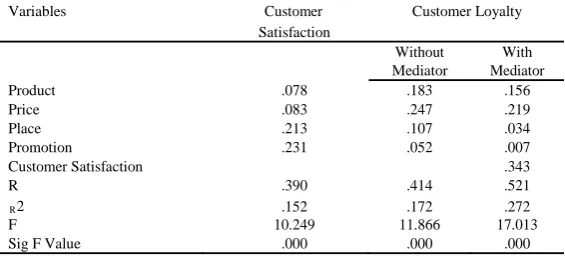
A mediation analysis was conducted using Baron and Kenny (1986) approach. In the first step the effect of the independent variables on the mediator variable was examined. The second step examined the influence of the independent variable on the dependent variable, without the mediator. Finally, the last step was taken to investigate the influence of the combination of the independent variable and the dependent variable, with a mediator.
The first step stipulated that place and promotion were the significant predictors of customer satisfaction with
ȕ S DQG ȕ S +RZHYHU SURGXFW DQG SULFH ZHUH QRW IRXQG DV VLJQLILFDQW SUHGLFWRUV WR
customer satisfaction with
ȕ S!ȕ S!7KHVHFRQGVWHSLQGLFDted that product and price were the significant predictors
RI FXVWRPHU OR\DOW\ ZLWK ȕ S DQG ȕ S +RZHYHU SODFH DQG SURPRWLRQ ZHUH QRW WKH VLJQLILFDQWSUHGLFWRUVRIFXVWRPHUOR\DOW\ZLWKȕ S!DQGȕ S!
TKHODVWVWHSVLJQLILHVWKDWFXVWRPHUVDWLVIDFWLRQZDVVLJQLILFDQWWRLQIOXHQFHFXVWRPHUOR\DOW\ȕ S
Table 3: Hierarchical Regression Analysis on Mediating Variable
Variables Customer Customer Loyalty
Satisfaction
Without With
Mediator Mediator
Product .078 .183 .156
Price .083 .247 .219
Place .213 .107 .034
Promotion .231 .052 .007
Customer Satisfaction .343
R .390 .414 .521
R2 .152 .172 .272
F 10.249 11.866 17.013
Sig F Value .000 .000 .000
5. Conclusion
The fact that customer satisfaction is really important in order to get loyal customers, it is indeed important that marketing mix and its elements can help business providers to know the factors that their customers are looking for when buying a hijab. The aim of this study was to investigate the relationship between marketing mix and customer loyalty in hijab industry, as well as the mediating effect of customer satisfaction. Therefore, business providers in hijab industry will know the marketing needs, they need to focus to attract the customers in hijab selling as well as to keep them loyal. Meanwhile, this study endeavours to make both theoretical and practical contribution to the literature, and also provides several implications for future research. Findings from this study will assist policymakers, marketing practitioners, planners and government change, as needed, in strategies, rules and procedures, and to improve the provision of customer satisfaction and customer loyalty in service industries.
6. Future Research
This research was conducted at hijab outlets in Shah Alam, and may not be generalizable to other outlets. Therefore, more hijab outlets need to be investigated. It is also suggested that other related factors of the marketing mix to be included in the future researches to produce more constructive findings to nourish the measured relationship. In addition, it is suggested to use the interview to get in-depth information on the study. It is expected that respondents can easily express their views and experiences verbally using their own words and impressions to answer questions. Through facial expressions and gestures, it is believed to provide deeper understanding and better outcomes of the phenomena studied.
7. References
Abu Hassan, L.F., Wan Jusoh, W.J., Hamid, Z., 2013. Determinant of customer loyalty in Malaysian Takaful Industry. Procedia - Social and Behavioral Sciences,130, 362–370. 4th International Conference on Marketing and Retailing 2013 doi:10.1016/j.sbspro.2014.04.043 Ahmed, A. M., 2012. How a 25 year old Saudi Entrepreneur is Rethinking the Hijab. Wamda. Retrieved on November 27, 2013, Available at
http://www.wamda.com/2012/11/how-a-25-year-old-saudi-entrepreneur-is-rethinking-the-hijab.
Aisha, R., 2013. Why Are Hijabs So Popular Among Muslim Females? Ask Richa. Retrieved on November 23, 2013, Available at http://www.thejakartaglobe.com/blogs/the-rise-of-the-muslim-fashion-industry-in-indonesia/
Alden, M., 2012. Dividend growth businesses with high switching costs. Dividend Monk. Retrieved on December 10, 2013, Available at http://dividendmonk.com/5-dividend-growth-businesses-with-high-switching-costs/
Baron, R. M., & Kenny, D. A. 1986. The moderator–mediator variable distinction in social psychological research: Conceptual, strategic, and statistical considerations. Journal of personality and social psychology, 51,6, 1173.
Bay, S., Petrizzi, R., & Gill, P. ,2008. The why of the buy: Consumer behavior and fashion marketing. New York: Fairchild Books. Bennett, R., & Rundle-Thiele, S., 2004. Customer satisfaction should not be the only goal. Journal of Service Marketing, 18,7, 514-523. Bloemer, J., & De Ruyter, K., 1998. On the relationship between store image, store satisfaction and store loyalty. European Journal of Marketing,
32,5/6, 499 513.
Chang, C.H., 2010. A study on brand loyalty and customer lifetime value. Journal of Information and Optimization Sciences, 31, 3, 719-728. Cohen, J. 1988. Set correlation and contingency tables. Applied Psychological Measurement, 12,4, 425-434.
Ibidunni, O. S., 2011. Marketing Mix as Tools for Achieving Competitive Advantage in Nigerian Market Place: Multi-National and Indigenous Companies in Perspective. Journal of Marketing Development and Competitiveness, 5,7, 81-94.
Krejcie, R. V., & Morgan, D. W., 1970. Determining sample size for research activities. Educational and Psychological Measurement, 30, 607-610.
Lin, H. H., & Wang, Y. S., 2006. An examination of the determinants of customer loyalty in mobile commerce contexts. Information & Management, 43, 271-410.
McMullan, R., & Gilmore, A., 2008. Customer loyalty: An empirical study. European Journal of Marketing, 42,9/10, 1084-1094.
Moraga, T. E., Parraga, V. A. Z., & Gonzales, Z. F., 2008. Customer satisfaction and Loyalty. Journal of Consumer Marketing, 25,5, 302-313. Oliver, R. L. , 1999. Whence consumer loyalty?. Journal of Marketing, 63, 33-44.
Parasuraman, A., Zeithaml, V. A., & Berry L. L., 1988. SERVQUAL: a multi-item scale for measuring customer perceptions of service quality. Journal of Retailing, 64, 1, 12-40.
Patterson P. G., Johnson L. W., & Spreng R. A., 1997. Modeling the determinants of customer satisfaction for business-to-business professional services. Journal of the Academy of Marketing Science, 25,1, 4-17.
Pritchard, M. P., Havitz, M. E., & Howard, D. R., 1999. Analyzing the commitment-loyalty link in service contexts. Journal of the Academy of Marketing Science, 27, 3, 333-348.
Punniyamoorthy, M., & Raj, M. P., 2007. An empirical model for brand loyalty measurement. Journal of Targeting, Measurement and Analysis for Marketing, 15, 4, 222-233.
Sable, J., 2013. What does a marketing mix consist in fashion?. Chron. Retrieved on December 13, 2013, Available at http://smallbusiness.chron.com/marketing-mix-consist-fashion-24391.html
Salkind, N.J., 2012. Exploring Research. 8thEdition. New Jersey: Pearson Prentice Hall.
Sekaran, U., & Bougie, R., 2013. Research Methods for Business: A skill building approach. John Wiley.