344
SUPPORTING STUDENTS IN LEARNING MULTIPLICATION
THROUGH SPLITTING STRATEGY
Rahmah Johar1, Cut Khairunnisak2
Syiah Kuala University1, STKIP Bina Bangsa Getsempena, Aceh2 [email protected], [email protected]2
Abstract
Most Indonesian textbooks do not support students to develop and discuss a variety of multiplication strategies. The books mostly introduces multiplication tables, let students memorize them, and then continues by ask students use multiplication algorithm. As a result, the students can apply that algorithm but they did not know the reason behind that algorithm. Realistic Mathematics Education for Indonesia (PMRI) has designed PMRI textbooks. Some of topics are developed by using Design Research. There are two cycles in this research; each of the cycles consists of preparation, teaching experiment, and a retrospective analysis phase. The contexts and activities used in the first cycle were revised and changed to be more meaningful for Indonesian students. The changes then were employed in the second cycle. Our findings suggest that to support students in developing a splitting strategy, we need some meaningful activities such as developing multiplication network, multiplication by tens, and various contexts consisting of one-digit and two-one-digit multiplications
Keywords: Splitting strategies, design research, multiplication
INTRODUCTION
In a 'traditional' learning process, the teacher takes control of each activity. The teacher extensively directs, explains, and questions the students, followed by working on paper-and-pencil assignments. Many teachers, included )ndonesian teachers transmit knowledge in the form of rules and tricks and learners have to practice those rules with straightforward and simple problems. In practicing time, the teacher asks student to discuss how to implement their explanation to the similar problem. If there is any mathematical thinking happening in the classroom, it is often the teacher who is doing that thinking. Students are not really invited to think (Dolk et.al, 2010; Widjaya, Dolk, and Fauzan, 2010; Johar and Afrina, 2011). This condition is occurred due to the good ideas of Indonesian curriculum did not supported by neither teaching strategies of teachers nor text book.
Most )ndonesian textbooks do not support students strategies to obtain the result of
multiplication in many ways. They mostly introduce multiplication as a repeated addition through multiplication tables, and then continued using the multiplication
algorithm. For example, when someone asks students to answer x = …., the
345 problems with the bigger number, for instance 26x4, the students use standard algorithm of multiplication. At this condition, the student can apply that algorithm but they did not know the reason behind that algorithm.
According to Realistic Mathematics Education (RME) was introduced by Freudenthal in the Netherlands in 1968 as cited in Gravemeijer (1994), students should experience mathematics as a human activity. It is an activity of solving problems, looking for problems, and organizing a subject matter. In addition, van den Heuvel-Panhuizen (1996) suggests mathematics must be taught in the order in which the students themselves might be inventing it. In this line, van den Heuvel-Panhuizen (2005) explained that mental calculation is the backbone of the primary school number strand. Mental calculation is considered as insightful calculation in which the children make use of memorized number facts and the properties of numbers and operations. Thus mental calculation is not simply doing calculations in the head. It is more a matter of using the head for making the calculations. Writing down intermediate steps or using the empty number line may be part of it. The basic strategies for mental calculation are: stringing, splitting and varying. For example 1) a
stringing strategy; x = … )t is × = ; × = ; + = , b a splitting
strategy; x = … )t is × = ; × = ; + = , and 3) a varying strategy;
× = …. )t is × –(1×25)=475. The splitting strategy is simpler than the stringing strategy because the splitting strategy use tens. Students need experiences using both splitting strategy and stringing strategy.
To develop RME in Indonesia, Indonesian mathematicians and mathematics educator
have designed Realistic Mathematics Education in )ndonesia” or Pendidikan Matematika Realistik Indonesia (PMRI), known as the Indonesian location of RME. Dutch consultants from the APS Netherlands and Freudenthal Institute (FI) of Utrecht University have been involved in the coaching the PMRI team. The team that consists of teachers educator and teachers started a pilot program of PMRI from 2001 until now. The PMRI team wants to change mathematics education in such a way that most children will be able to do and enjoy mathematics to develop their mathematics knowledge, skills, and strategies. Dolk et.al (2010) suggested that such changes start in classroom. Creating learning community in the classroom asks for another role of
teachers and students. One aspect of these new norms is related to the teacher s expectations and beliefs about students mathematical thinking.
In summer 2007, the PMRI team decided to start working on a complete mathematics textbook series for primary education. The team developed a trajectory in which the production of learning materials goes a long side with workshops for prospective authors, with the implementation of design research, and with a further development of the didactical framework for PMRI (Amin et.al, 2010).
346 We are as one of the authors of PMRI textbooks have designed the some learning trajectories for primary school students. Students are guided to solve many realistic problems about multiplication with various strategies, not introduce a formal algorithm immediately for the third grade 3 student. This research aimed to develop a local instruction theory in PMRI textbooks to support students in learning multiplication through splitting strategy.
RESEARCH METHODOLOGY
The main goal of this research is to investigate how to support students in learning multiplication through splitting strategy. This research used a type of research method namely design research for achieving the research goal. Design research is a type of research methods aimed to develop theories about both the process of learning and the means that are designed to support that learning. There are three phases of conducting a design research. Those three phases are preparation and design phase, teaching experiment, and retrospective analysis (Gravemeijer & Cobb, 2006).
There are two cycles in this design research. The preparation of the first cycle is held on November to December, 2010. At that time one of the authors came to Freudenthal Institute, Universiteit Utrecht. Then the topic of multiplication is tried it out for several schools, which are on January 31st in SDN 48 Banda Aceh and on February 9th 2011 in SDN 7 Banda Aceh. Last, at 8th to 15th of March 2011 it is held in Hof ter Weide school and St. Dominiccus school in Utrecht, the Netherlands. At the second cycle, the authors of PMRI text book continue to design text book since June to November 2011 as a Final Draft. Further more on September to November 2012 the learning trajectory for multiplication in PMRI textbook for third grade is implemented at SDIT Nurul Ishlah Banda Aceh on 29th of Augustus 2012 to 19th of September 2012 and 20th to 22th of March 2013. This teaching experiment is held for seven meetings.
During teaching experiment, the research team consisting of teacher educators and teachers designed the investigation, observed the class at work, discussed their
observations, analyzed the data, and planned the following day s investigation. The
resident teacher was present and worked closely together with the research team during all these steps.
Data collection was gained through interviewing teacher and students, observing
activities in classroom, and collecting students works. )n this research the video data
provides the primary data. The video recorded activities and discussion in the whole class and in some groups of students, and also recorded interviews with teacher and some students. The written data was provided as an addition to the video data. In this
research, the written data includes student s work, observation sheet, assessments
result, and some notes gathered during the experiment. .
RESULTS AND DISCUSSION
Result of the First Cycle
347 Hypothetical Learning Trajectory (HLT) designed for the teaching experiment multiplication for the third grade of primary school as follow.
1) Figure of group of tomatoes and two-direction-network of multiplication 2) The number of car s wheel and the number of tennis balls in boxes
3) Students are able to use many ways to split multiplication of 2-digits and 1-digit numbers
4) Rearranging seats in a party and calculate how many seat are there
5) The number of candy in the inside of a tube with 10 candies and the outside of a tube, for the number of student who get them
6) Multiplication of two-digit and one-digit numbers using the rectangle visualization
7) Multiplication of 2-digits and 1-digit using mental calculation without the rectangle
Due to all of Indonesian students at the third grade have learned about algorithm of multiplication of two-digit and one-digit numbers on September to October every year, the researcher choose to implement the stringing strategy of multiplication of two-digit and one-digit numbers. Before teaching experiment, the researchers and
teachers revise context from becak to car, design the lesson plans, and prepare some media. Then we made some conjectures about students strategy to solve the problem.
On January 31st, the teacher of SDN 48 Banda Aceh taught about stringing strategy of
multiplication to count the number of car s wheel see figure a and the total of
tennis balls in 17 boxes, each box has 6 balls.
Figure . a. The car s wheel Problem and b. students strategy
The strategy of many groups of students is repeated addition one by one car, or two by two cars, and so on. Only one group of student has the pattern mentally (see figure 1 b). For the second problem, about the total of tennis balls
in boxes, each box has balls, the students strategy almost the
same. There is one group implements multiplication algorithm to
solve that problem, however they didn t implement that
348 The researchers want to know whether the other students in the different schools have the same strategy to solve the problem above. On February 8th 2011 the teacher at SDN 7 Banda Aceh taught about stringing strategy of multiplication to count the
number of car s wheel and the number of tennis balls. The SDN students strategy are similar to the SDN students strategy, which are the repeated addition, without multiplication symbol as a stringing strategy or splitting strategy.
On February 9th 2011 the researcher taught at SDN 7 Banda Aceh about stringing strategy of multiplication. The context is arranging the seats to count easier the number of seats. The teacher hung the media on the board (see figure on the right side). Firstly, the students add seats row by row. To develop their strategy, teacher gave some small stones as a representative of seats, then teacher
asked student to arrange that seats for some paths so that easy to calculate. Each group of student arranges them and split them into some parts then students draw some stones as a circle, they count the number of seats as stringing strategy (see figure 2 below).
There are only four stringing strategies of the Acehness students found. Next, researcher and some Aceh teachers join Exchange Program to Utrecht, Netherlands for three weeks on February 23rd to March 15th, 2011. One of our activities was give lesson at third grade of Primary School about multiplication. We changed the manipulative as a representative of seats; they are some pieces of paper, instead of small stones. We also changed the picture about 6 balls in a box.
Due to the Dutch students at Hof ter Weide and St. Dominiccus school have learned about splitting strategies on February 2011, they got many stinging and splitting
trategies to solve multiplication problems about the number of cars wheels and
number of 6 balls in 17 boxes, as the figure 3 and 4 follow.
Figure 2. The strategies of students SDN 7 Banda Aceh
There are 5 rows of seats, each row has 16 seats. Is it enough for 90 peoples? How are you sure?
Figure 3. Hof ter Weide School Students’ Strategies
4x4 = 16 16+40 = 56 10x4 = 40
5x5 =25 5x5 =25 5x6 =30
5x6 = 30
349
ccording to the Utrecht students strategy, they found some stringing strategies and
splitting strategy. Some of them represent repeated addition with multiplication symbol. Most of them use mental calculation to count the result of multiplication as whether stringing or splitting strategy. One interesting mental calculation is 17 x 6 = 10 x 6 + 7 = 102. He means 17 x 6 = 10 x 6 + 7 x 6 = 102, he counted quickly. In addition, there is one student at Hof ter Weide School use ratio table to solve that problem.
Next day, the students solve the problem about arranging some seats; There are 5 rows of seats, each row has 16 seats. Is it enough for 90 peoples? How are you sure? How many seats are there? They got many stinging and splitting strategies to solve multiplication problems for lesson 2 as the figure 5 follow.
Figure 5. Hof ter Weide School Students’ Strategies
The St. Dominiccus School students are more fluent than Hot ter Weide School students about implement splitting strategy. They have many various stringing strategies to find the result of 5 x 16. Then, that student decided 5 x 10 and 5 x 6 is the easiest one.
The result of first cycle are; 1) the author of PMRI textbook need to put some activities about multiplication by 10 before splitting strategy and 2) the researcher
have some conjectures of students splitting strategies. This result will be inserted in
Hypothetical Learning Trajectory (HLT) for the teaching experiment of the second cycle.
Result of the Second Cycle
The second cycle of learning splitting strategy of multiplication had purposes to applying, evaluating, and revising the previous HLT. The activities used in the learning trajectory were adapted from PMRI draft book for the third grade students. Therefore, the focus of this second cycle is to know how the route of activities works. It was predicted that the researchers need to reform the design of learning route, according to how the students accept and understand it after the teaching experiment. According to what happened in the teaching experiment at the first cycle, the previous learning route that has been designed in the preparation phase was elaborated and revised. The teaching experiment was conducted in 8 days, each day has a different contexts/ problems. The retrospective analysis through teaching
Figure 4. St. Dominiccus School Students’ Strategies 10x4 + 4x4 = 56
4x4 = 16 = 56
10x4 = 40 11x4 = 44 12x4 = 48 13x4 = 52 14x4 = 56
350
experiment was elaborated in each stage of students learning route, instead of each
day/activity. The designed HLT was used as guideline of the retrospective analysis. The aim of the retrospective analysis was that to explain how students acquire the basic concepts of splitting strategy of multiplication, thus could be generalized to be an instructional design. The activities for the second cycle are as follow:
1. One-Time-Less and One-Time-More Group of Tomatoes as Introduction of Two-Direction-Network of Multiplication
2. Counting Group of Objects: Recalling Repeated Addition as Multiplication 3. Developing Idea of Four-Direction of Multiplication Network
4. Seeds in Pouches and Matches in Glasses: Multiplying by Tens 5. Passengers of Tricycles: Two-Digit and One-Digit Multiplication
6. Rearranging Seats for Party: Stringing Strategy for One-Digit and Two-Digit Multiplication
7. Grouping the Stamps: Eliciting the Splitting Strategy of Multiplication 8. Multiplication of two-digits and one-digit numbers
The discussion of this paper only focus on activity 5 to 8. We will discuss the students answer and their problem to get that answer
Activity 5: Passengers of Tricycles: Two-Digit and One-Digit Multiplication
The context used was about the total number of passengers accommodated by 13 tricycles, which picture presented in front of the classroom. As the starting point, with the aim at engaging the students in the activities, the teachers asked some
students to conduct any question related to the tricycle. One of the student s answers was What is the total number of tricycles wheels? The teacher then asked What can you do to count it easily?
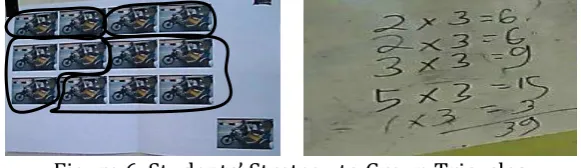
Through the guidance of the teacher, the students told that it can be easier to count it by grouping the tricycles, which consisted different number of tricycles. One group consisted of 2 tricycles, another group had 2 tricycles, and the remainder 3 groups consisted of 3, 5, and 1 tricycle.
Figure . Students Strategy to Group Tricycles
Figure shows the strategy of grouping written by the teacher according to students
answer. As shown in the figure, the tricycles were grouped in five groups with different number of tricycle. The number of wheels for group 1 (consisting 2 tricycles) is 2×3=6. At this rate, the numbers of wheels for the other groups are 2×3=6, 3×3=9, 5×3=15, 1×3=3. Thus, the total number of those wheels is 39.
351 multiplication, even repeated addition (see Figure 7, pointed by the arrow). From the figure, the researcher concluded that in order to make various strategies, the students reversed the order of number.
Figure . Students Strategies in Calculating Passengers Accommodated by Tricycles
On the next day, the teacher provoked students to recall the stringing strategy of multiplication. The teacher asked two students to answer the homework (given before) in front of the class. The task is
about determining the total number of tennis balls in 17 containers if each container accommodated 6 balls. At the first, the students could not remember the idea. However, once they remembered it, those two students came up with many correct stringing strategies of multiplication on the whiteboard.
Appropriate with one of the characteristics of RME, the teacher used the students strategies to assist the other students to grasp with the idea of stringing strategy of multiplication. Thus, the other students could pose some other strategy of stringing the multiplication.
Activity 6: Rearranging Seats for Party: Stringing Strategy for One-Digit and Two-Digit Multiplication
The context offered to extend students understanding of stringing strategy of
multiplication was rearranging seats for party. Initially, the seats were arranged (close-set) in 5 rows of 16 seats. As the representation of the seats, the students had
pebbles to be rearranged. The students task was to put path that people can easily
sit on any seats (including the middle part of the row).
352
The students used objects such as pen or ruler as the path to separate the seats.
Then, they wrote the multiplication represented by those arrangements on a paper. At the Figure 8, the group of students proposed three different stringing strategies: 1) putting the path exactly in the middle of the seats thus the multiplication become
5×8=40 and 5×8=40
2) moving the path to the previous column thus they got × = and × = , and 3) moving the path to the next column thus the multiplication become × = and
5×10=50
Meanwhile, another group used three paths , thus the multiplication was splitting
into four. However, according to the first strategy on the right side of Figure 8, it seemed that at the beginning the group had confusion how to split the multiplication (since the students made some multiplication and then scratched it). Then, after
some guidance from the teacher, how to relate the path rearrangement and the
multiplication, the students in that group could come up with many stringing strategies.
Activity 7: Grouping the Stamps: Eliciting the Splitting Strategy of Multiplication
Firstly, show previous students strategy about finding the number of tennis balls in 17 containers, and about rearrangement seats activity. Teacher ask question, which
strategy is faster than the other? . (owever, the students said that all multiplications
were easy, because multiplication of five rows.
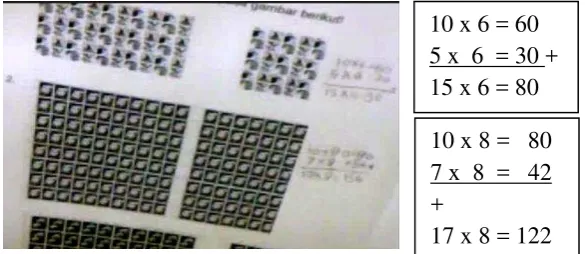
After that, the students were given another new context, which is group of stamps. The stamps were arranged in a rectangular form, each ten columns of stamps were separated from the ones. The expectation from this activity was that the students could grasp the splitting strategy of multiplication, where the two-digit
number was separated by tens and ones. The students solution for stamps problem
as Figure 9 follow.
Figure 9. Examples of Students Splitting Strategy using Stamps Grouping
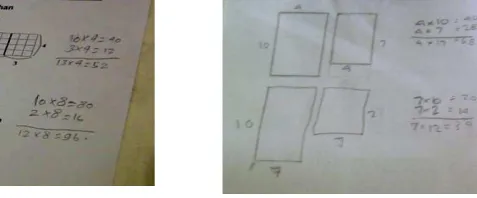
The next problems are some rectangle is spitted by tens and ones. The students
solution is as Figure 10 below on the left side. The last problems are the student draw by themselves to find the results of multiplication one-digit and two digits. Their solutions are as Figure 10 on the right side.
10 x 6 = 60 5 x 6 = 30 + 15 x 6 = 80
10 x 8 = 80 7 x 8 = 42 +
353 Figure 10. Student answer about groups of stamps
According to the students worksheets, the researcher concluded that the students
already understood about the splitting strategy guided by rectangle model.
Activity 8: Multiplication of two-digits and one-digit numbers
They can also elaborate it to the more formal strategy, where they have to make their own rectangle picture to represent the
number split to tens and ones. Finally, the students used splitting strategy mentally, even though for some time it was difficult for them (the students asked to make drawing as the representation). Figure on the right side
shows students answers when they were
asked to write any multiplication of two-digits and one-digit numbers. They used mental splitting strategy to calculate the result.
According to the informal interview with some students, all of them who were interviewed said that the splitting strategy is a lot easier and faster than their other strategies, such as standard algorithm of multiplication or stringing strategy. However, the researcher found that the students got difficulties in mentally calculating the multiplication of two one-digit numbers, for instance 7×6 or 8×7. Sometimes, the students even used their finger to add two numbers.
CONCLUSIONS
The data of this research show that the prerequisite of students is very important to
continue lesson. The Utrecht student have learned step by step about addition and
subtraction in many ways and many mental calculation strategies (van den Heuvel-Panhuizen, 2005). When they come to multiplication, they implement addition to
combine some stringing strategy. )n the other hand, Aceh students got some
difficulties to do it. They use their fingers and add numbers for many times.
Aceh s students need more time to make connection among multiplication. Some
354 Until now, the authors of PMRI text books have published some books for first, second, and third grade student at Primary School. However, the teacher did not implement all of topics in PMRI text books for give lessons; due to the Indonesian government don not give instruction to use PMRI text books yet. This research at the
third grade is very depending on the students experiences in the previous grade. The
impact is the students got some difficulties to get the result of multiplication one digit
and two digits, when they have a not nice number of multiplications, such as 7 x 8. Sometimes, the students even used their finger to add two numbers.
Recommendation of this research are; 1) Indonesian government give instruction to Indonesian teachers to implement PMRI textbook step by step, 2) teachers need coach by the expert teacher or by teacher educator to implement PMRI in the classroom, and 3) this HLT can implement to support students use the splitting strategies, this HLT will get the better impact if students have used PMRI textbook in the previous grade.
References
Amin, S. M., Julie, H., Munk, F., and Hoogland, K. (2010) The Development of Learning Materials for PMRI. InSembiring, R. K., Hoogland, K., & Dolk, M., (Eds), A Decade of PMRI in Indonesia, Bandung, Utrecht: APS International.
Beishuizen, M. (1998) Which Mental Strategies in the Early Number Curriculum? A Comparison of British Ideas and Dutch Views. British Educational Research Journal. Vol. 24 Issue 5, p519
Dolk, M., Widjaya, W., Zonneveld, E. & Fauzan, A. (2010). Examining Teachers Role in
Relation to Their Beliefs and Expectations about Students Thinking in Design
Research. InSembiring, R. K., Hoogland, K., & Dolk, M., (Eds), A Decade of PMRI in Indonesia, Bandung, Utrecht: APS International
Gravemeijer (1994). Gravemeijer, K.P.E. (1994). Developing Realistic Mathematics Education. Netherlands: Technipress
Gravemeijer, K.P.E and Cobb, P. (2006). Design Research from a Learning Design Perspective. In Dekker, van den, Gravemeijer, K., Mc Kenny, S., & Nieven, N. (Eds). Educational Design Research (pp. 17-51). London: Rontledge.
Johar, R. and Afrina, M. . The Teachers Effort to Encourage the Students
Strategies to Find the Solution of Fraction Problem in Banda Aceh. In International Conference of School Effectiveness and Improvement (ICSEI) at Limassol, Cyprus, Jan 4th till 7th, 2011.
van den Heuvel-Panhuizen, M. (1996). Assesment Realistic Mathematics Education. Utrecht, the Netherlands: Freudenthal Institute
van den Heuvel-Panhuizen, M. and Wijers, M. (2005) Mathematics Standards and Curricula in the Netherlands.ZDMJournalVol. 37 (4).
Widjaja, W., Dolk, M., Fauzan, A. . The Role of Contexts and Teacher s Questioning to Enhance Students Thinking. Education Journal in Southeast Asia. Vol.33 No.2, 168-186.
This paper can be cited as Zulkardi(2013). Proceeding The First South East Asia Design/Development Research (SEA-DR) International