
Surface roughness optimization in an end-milling operation using the Taguchi design method
Teks penuh
Gambar
Dokumen terkait
The effect of prominent milling parameters, namely cutting speed, feed rate, depth of cut (DOC), and width of cut (WOC) were studied to evaluate their effects on tool life,
To investigate the effect of cutting parameter namely cutting speed, feed rate and width of cut on surface roughness at the end of milling process on D2 tool steels
• To analyze the effect of CNC milling parameters such as cutting speed, depth of cut, and feed rate to the surface roughness and microhardness of 6061 T6..
Hence there is a great need to investigate the effect of feed rate, cutting speed and depth of cut to the surface roughness by using Response Surface Methodology (RSM) method in
The focus of the study is on the quality of the surface roughness respective to varying depth of cut given other parameters (spindle speed, feed rate, surface speed, tool rake angle
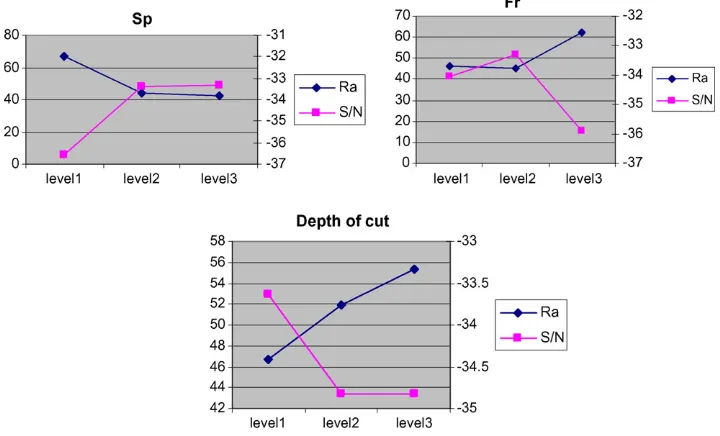
main effect plots for S/N ratios of speed, feed & depth of cut of Rz Above discussion shows that the surface roughness varies very quickly as feed rate varies and with cutting speed..
In a boring operation, for instance, where the critical parameters are the feed rate, depth of cut, spindle speed, and nose radius while machining time and surface roughness are the
This document presents a study on optimizing cutting force and surface roughness in end milling of GFRP composites using a combination of BPNN (backpropagation neural network) and Firefly
