BAHAGIA
BAHAGIAN PEN
N PENGURUSAN SEKOLAH BERASRAMA PENUH
GURUSAN SEKOLAH BERASRAMA PENUH
DAN SEKOLAH K
DAN SEKOLAH KECEMERLANGA
ECEMERLANGAN
N
MODUL
MODUL
PERFECT SCORE
PERFECT SCORE &
&
X
A- X A-PLUS
PLUS
SEKOLAH BERASRAMA PENUH
SEKOLAH BERASRAMA PENUH
TAHUN 2012
TAHUN 2012
PANEL PENYEDIA DAN PEMURNI:
PANEL PENYEDIA DAN PEMURNI:
Pn.
Pn. Wan
Wan Noor
Noor Afifah
Afifah Binti
Binti Wan
Wan Yusoff
Yusoff (Ketua)
(Ketua)
SBPI
SBPI GOMBAK
GOMBAK
Tn
Tn Hj
Hj Ja'afar
Ja'afar B
B Bajuri
Bajuri
SMS
SMS SULTAN
SULTAN MAHMUD
MAHMUD
Pn.
Pn. Norini
Norini Binti
Binti Jaafar
Jaafar
SEKOLAH
SEKOLAH SULTAN
SULTAN ALAM
ALAM SHAH
SHAH
Tn
Tn Hj
Hj Che
Che Malik
Malik Bin
Bin Mamat
Mamat
SBPI
SBPI BATU
BATU RAKIT
RAKIT
Pn.
Pn. Rossita
Rossita Binti
Binti Radzak
Radzak
SMS
SMS TUANKU
TUANKU MUNAWIR
MUNAWIR
En
En Jong
Jong Kak
Kak Ying
Ying
SMS
SMS KUCHING
KUCHING
En
En Ooi
Ooi Yoong
Yoong Seang
Seang
SMS
SMS MUAR
MUAR
Che
Che Ramli
Ramli B
B Che
Che Ismail
Ismail
SMS
SMS FARIS
FARIS PETRA
PETRA
Pn
Pn Masodiah
Masodiah Bt
Bt Mahfodz
Mahfodz
SMS
SMS HULU
HULU SELANGOR
SELANGOR
Pn.
CHEMISTRY PERFECT SCORE MODULE 2012
CHEMISTRY PERFECT SCORE MODULE 2012
CONTENT
CONTENT
1
1 Guidelines &Guidelines & Anwering Tec
Anwering Techniqueshniques
Format of an instrument of chemistryFormat of an instrument of chemistry
Construct requirementConstruct requirement
Guidelines for answering paper 1Guidelines for answering paper 1
Guidelines for answering paper 2Guidelines for answering paper 2
Guidelines for answering paper 3Guidelines for answering paper 3
The common command words in paper 2The common command words in paper 2
2
2 Set Set 11
The structure of AtomThe structure of Atom
Chemical Formulae and equationsChemical Formulae and equations
Periodic Table of ElementsPeriodic Table of Elements
Chemical BondsChemical Bonds
3
3 Set Set 22 ElectrochemistryElectrochemistry
Oxidation and ReductionOxidation and Reduction
4
4 Set Set 33
Acids and BasesAcids and Bases
SaltsSalts
Rate of reactionRate of reaction
ThermochemistryThermochemistry 5
5 Set Set 44
Carbon compoundsCarbon compounds
ManufactureManufactured Substance in d Substance in IndustryIndustry
Chemicals for ConsumersChemicals for Consumers 6
6 Set Set 55
Paper 3 set 1Paper 3 set 1
Paper 3 set 2Paper 3 set 2
CHEMISTRY PERFECT SCORE MODULE 2012
CHEMISTRY PERFECT SCORE MODULE 2012
CONTENT
CONTENT
1
1 Guidelines &Guidelines & Anwering Tec
Anwering Techniqueshniques
Format of an instrument of chemistryFormat of an instrument of chemistry
Construct requirementConstruct requirement
Guidelines for answering paper 1Guidelines for answering paper 1
Guidelines for answering paper 2Guidelines for answering paper 2
Guidelines for answering paper 3Guidelines for answering paper 3
The common command words in paper 2The common command words in paper 2
2
2 Set Set 11
The structure of AtomThe structure of Atom
Chemical Formulae and equationsChemical Formulae and equations
Periodic Table of ElementsPeriodic Table of Elements
Chemical BondsChemical Bonds
3
3 Set Set 22 ElectrochemistryElectrochemistry
Oxidation and ReductionOxidation and Reduction
4
4 Set Set 33
Acids and BasesAcids and Bases
SaltsSalts
Rate of reactionRate of reaction
ThermochemistryThermochemistry 5
5 Set Set 44
Carbon compoundsCarbon compounds
ManufactureManufactured Substance in d Substance in IndustryIndustry
Chemicals for ConsumersChemicals for Consumers 6
6 Set Set 55
Paper 3 set 1Paper 3 set 1
Paper 3 set 2Paper 3 set 2
CHEMISTRY
CHEMISTRY
PERFECT SCORE MODULE
PERFECT SCORE MODULE
GUIDELINES
GUIDELINES
ANSWERING TECHNIQUES
ANSWERING TECHNIQUES
CHEMISTRY SPM
CHEMISTRY SPM
GUIDELINES AND ANSWERING TECHNIQUES FOR SPM CHEMISTRY PAPER 1.0 FORMAT OF AN INSTRUMENT OF CHEMISTRY BEGINNING SPM 2003
No Item Paper 1
(4541/1)
Paper 2 (4541/2)
Paper 3 (4541/3) 1 Type of instrument Objective test Subjective test Written Practical Test
2
Type of item Objective it Section A : Structured Item Section B :
Essay restricted response Item Section C :
Essay extended response Item
Subjective Item : Structured Item
Extended Response Item: (Planning an experiment)
3
Number of question
50 (answers all) Section A : 6 (answer all) Section B : 2 (choose one) Section C : 2 (choose one)
Structured Item : 1/2 items (answer all) Extended Response Item : 1 item
5 Duration of time 1 hour 15 minutes
2 hour 30 minutes 1 hour 30 minutes
2.0 CONSTRUCT REQUIREMENT
Construct Paper 1 Paper 2 Paper 3
Knowledge 20 m ( No 1- 20) 14 -Understanding 15 m ( No 21 – 35) 21 -Application 15 m ( No 36 – 50) 29 -Analysis - 21 -Synthesizing - 15 -Science process - - 50 Total mark 50 100 50
3.0 TIPS TO SCORE “ A “ CHEMISTRY
3.1 Master the topics that contains the basic concepts of chemistry : 1. The structure of the atom
2. Chemical Formulae And Equations 3. Periodic Table
4. Chemical Bond
3.2 Familiarize with different types of questions as listed below and complete the previous SPM papers:
1. Objectives questions (MCQ) (Paper 1) 2. Structured questions ( Paper 2 & 3) 3. Essays (Paper 2)
4. Planning an experiment ( Paper 3) 5. Draw and label the diagram
6. Writing chemical equation( balanced equation, ionic equation, half equation) 3.3 Try to get
:- 40 marks above for paper 1
60 marks above for paper 2
4.0 GUIDELINE FOR ANSWERING PAPER 1 4.1 Paper 1 questions test students on
1. Knowledge ( Number 1 – 20) 2. Understanding ( Number 21 – 35) 3. Application ( Number 36 – 50 )
4.2 Score in paper 1 Indicates student’s level of understanding in chemistry: Less than 20 – very weak
20 – 25 - weak 26 – 30 - average 31 – 39 - good 40 – 45 - very good 46 – 50 - excellent.
4.3 Answer all SPM objective questions (2003 – 2010). Objective questions for each year contain all topics. If your score in paper 1 is 40 and above, you will able to answer questions in paper 2 & 3 easily.
5.0 GUIDELINE FOR ANSWERING PAPER 2 (STRUCTURE AND ESSAY) 5.1 Paper 2 questions test student on
1. Knowledge 2. understanding 3. analyzing 4. synthesizing 5.2 Steps taken are:
1. Underline the command word and marks allocated for each question.
2. Match the command word to the mark allocated for each question. 1 point is awarded 1 mark.
3. Follow the needs of the question (Refer to the command words, page …….) 4. Unnecessary repetition of the statement in the question is not required.
5.3 Three types of questions which involve experiments in paper 2: I. Type 1
Describe an experiment on………Include a labeled diagram in your answer 1. Diagram
2. Procedure
3. Observation/example/data/calculation/equation/sketch of graph/conclusion II. Type 2
Describe an experiment………( The diagram will support your answer.) 1. No mark is allocated for a diagram
2. Procedures
3. Observation/example/calculation/equation/sketch of graph/conclusion III. Type 3
Describe a chemical/confirmatory test for ……. 1. Procedure
2. Observation 3. Conclusion
6.0 GUIDELINE FOR ANSWERING PAPER 3
6.1 Structure Question 1/2 test the mastery of 11 Scientific Skills 1. Observing
2. Classifying 3. Inferring
4. Measuring (burette , stopwatch, thermometer, voltmeter) 5. Predicting
6. Communicating( e.g construct table and draw graph) 7. Space-Time Relationship
9. Defining Operationally 10. Controlling Variables 11. Hypothesizing
Each answer is allocated mark as follows: 3 marks/2 marks/1 mark/0 Score : 11 X 3 = 33 Example of operational definition:
1. what you do
2. what you observe correctly Example:
1. When acid is added into latex, white solid is formed. When acid is added into latex, latex coagulated.- wrong
2. When the higher the concentration sodium thiosulphate solution is added into sulphuric acid, time taken for `X~ mark to disappear from sight is shorter.
3. When iron nail is coiled with copper and immersed into jelly mixed with potassium hexacyanoferrate(III) and phenolphthalein solution, blue spot/colouration is formed.
Operational definition for What you do What is observed
1. Rusting of iron When an iron nail coiled with a less electropositive metal is immersed in hot agar-agar added with potassium
hexacyanoferrate (III) solution,
Blue spots are formed
2. Coagulation of latex When acid is added to latex White solid is formed 3. Reactivity of Group 1
elements
When a metal which is lower in Group 1 is put in a basin half filled with water
Brighter flame is formed 4. Precipitation of silver
chloride
When silver nitrate solution is added to sodium chloride solution
White solid is formed 5. Voltaic cell When two different metals are dipped into an
electrolyte
The needle of the voltmeter deflects
6. An acid When a blue litmus paper is dipped into a substance which is dissolved in water,
Blue litmus paper turns red
Hypothesis: Relate manipulated variable followed by responding variable with direction. Example:
1. The higher temperature of the reactant the higher the rate of reaction – 3 marks The temperature of the reactant affect the rate of reaction – 2 marks
2. Hexene decolourised brown bromine water but hexane does not decolourised brown bromine water.
3. When acid is added into latex, latex coagulates, when ammonia is added into latex, latex cannot coagulates 4. Question 3 (essay) Test The Mastery of Planning Experiment .
Planning should include the following aspects:
1. Aim of the experiment/Statement of the problem 2. All the variables
3. Statement of the hypothesis
4. List of substances/material and apparatus – should be separated 5. Procedure of the experiment
6. Tabulation of data Score : (5 X 3) + 2 = 17
The question normally starts with certain situation related to daily life.
Problem statement/ aim of the experiment / hypothesis and variable can be concluded from the situation given. State all the variables
Manipulated variable : Responding variable :
Constant variable: list down all the fixed variables to ensure the outcome of the responding variable is related only to the manipulated variables.
Separate the substances and apparatus
- Separate the substances and apparatus
- Apparatus: list down the apparatus for the experiment. Example: Rate of reaction – stop watch
Termochemistry - thermometer Procedure :
All the steps taken in the procedure must include the apparatus used, quantity and type of substance (powder, solution, lumps … etc).
No mark is allocated for the diagram. The complete labeled diagram can help students in : I. Writing the steps taken in the procedure
II. Listing the apparatus and materials Tabulation of data:
The number of columns and rows in the table is related to the manipulated and responding
variables
Units must be written for all the titles in each row and column of the table DO NOT WRITE the observation/inference/conclusion in the table.
7.0 THE COMMON COMMAND WORDS IN PAPER 2 & PAPER 3 CHEMISTRY
The question normally starts with a command word.
Students must know the meaning of the command word to make sure that the answer given is according
to the question’s requirement.
Match the command word to the mark allocated for each question.
Command word Explanation/example
Name/State the name (paper 2 & 3)
Give the name , not the formula.
Example: Name the main element added to copper to form bronze. Wrong answer : Sn.
Correct answer : Tin State
(paper 2 & 3)
Give brief answer only. Explanation is not required.
Example : State one substance which can conduct electricity in solid state. Answer : Copper
State the observation (Paper 2 & 3)
Write what is observed physically.
Ex ample 1 : State one observation when magnesium powder is added to hydrochloric
acid. [ 1 mark ]
Wr ong an swer : Hydrogen gas is released.
Cor rect answer : Gas bubbles are released
Indicate the change of colour , give the initial and final colour of the substance/chemical.
Ex ample 2 : What is the colour change of copper(II) suphate solution. [2 marks]
Wr ong an swer : The solution becomes colourless
Cor rect answer : The blue colour of the solution becomes colourless
Explain (Paper 2 & 3)
Give the answer with reasons to explain certain statement / fact / observation/ principal.
Ex ample 1 : Explain why bronze is harder than pure copper [4 marks]
Cor rect answer :
- Copper atoms in pure copper are all of the same size and ...1 - they are arranged in layers that can slide easily when force is applied ...1 - The presence of tin atoms in bronze that are dif ferent in size disturb the
orderly arrangement of atoms in bronze. ...1 - This reduces the layer of atoms from sliding. ...1
What is meant by.. (Definition)
(Paper 2 & 3)
Give the exact meaning
Example: What is meant by hydrocarbon.
Wr ong answer: A compound that contains carbon and hydrogen
Cor rect answer : A compound that contains carbon hydrogen only Describe chemical
test
(Paper 2 & 3)
State the method to conduct the test , observation and conclusion.
Example : Describe how to identify the ion present in the solution . [3 marks]
Answer : - Pour in 2 cm3of the solution in a test tube. Add a few drops of sodium
- A reddish brown precipitate formed. ...1
- Fe3+ ions present ………1
Describe gas test. (Paper 2 & 3)
State the method to conduct the test observation and conclusion.
Example: Describe the confirmatory test for gas released at the anode (oxygen). [3 marks]
Wr ong an swer : Test with a glowing wooden splinter.
Cor rect answer: - Place a glowing wooden splinter to the mouth of the test tube ..…….1 - The glowing wooden splinter is lighted up ...……1
- Oxygen gas is released ..…….1
Describe an experiment ( 8 - 10 marks) (Paper 2)
- No mark is awarded for the diagram. The diagram can help students write the steps taken in the procedure.
- List of materials 1m - List of apparatus 1m - Procedure ( 5 – 8 m)
- Observation/tabulation of data/ calculation/sketch of the graph/ chemical equation /ionic equation /conclusion …… etc.
- Any additional details relevant derived f rom the question.
Plan an experiment ( 17 marks) ( Paper 3)
Answer the question according the requirement :
Problem statement/Aim of experiment Hyphotesis
Variables
List of substances and apparatus Procedure
Tabulation of data
Note: For question 3, unlike PEKA report students only need to answer according to what is stated in the question.
- No mark for the diagram. Diagram can help student writing the steps taken in the procedure. Describe the process … Describe the structure …. Describe and write equation… Describe how… (Paper 2 & 3)
Give relevant details derived from the question.
Predict
(Paper 2 & 3)
Make a prediction for something that might happen based on facts
Example: Experiment 1 is repeated using a larger beaker. Predict the increase in temperature
Answer : The increase in temperature is lower than experiment 1 . Compare
(Paper 2)
Give the similarities and differences between two items/ situations
Differentiate (Paper 2)
Give differences between two items/situations
Example : State three differences between ionic and covalent compound.
Answer : State three properties of ionic compound and three properties covalent compo und Draw a labeled
diagram of the apparatus (Paper 2)
Draw a complete set up of apparatus (i) Functional set up of apparatus (ii) Complete label
(iii) Shade solid, liquid and gas correctly.
(iv) Draw an arrow and label ’ heat’ if the experiment involves heating
Draw a diagram to show the
bonding formed in the compound (Paper 2)
(i) Ionic compound – The number of electrons in each shell is correct, 2 electrons in the first shell
and 8 electrons in the second and third shell. – Show the charge of each particle.
– Write the symbol of each element at the centre of the ion. (ii) Covalent compound
The number of electrons in each shell is correct, 2 electrons in the first
shell and 8 electrons in the second and third shell.
Write the symbol of each element at the center of each atom in the
molecule.
Draw graph (Paper 3)
Draw graph as follows :
Label the two axis with the correct unit
Choose suitable scale, the size of the graph should be at least ¾ of the size of the
graph paper.
Plot all the points correctly
Smooth graph ( curve or straight line )
For the determination of the rate of reaction
(i) Draw a tangent at the curve. (ii) Draw a triangle at the tangent Calculate the gradient of the tangent Draw the energy
level diagram ( Paper 2)
Draw an arrow for the vertical axis only and label with energy. Draw two horizontal lines for the reactants and products
Draw the
arrangement of particles in solid,
liquid and gas. (Paper 2)
Solid: Draw at least three layers of particles closely packed in orderly manner and
they are not overlap.
Liquid : The particles packed closely but not in orderly manner Gas : The particles are very far apart from each other
Draw the direction of electron flow (Paper 2 /3)
Draw the direction for the flow of electrons on the circuit, not through the solution. Write chemical
equation (Paper 2 & 3)
Write the balanced chemical equation Differentiate :
(i) Balanced chemical equation (ii) Ionic equation
(iii) Half equation for oxidation (iv) Half equation for reduction Calculate
(Paper 2 & 3)
Show all the steps taken Give final answer with unit.
Classify (Paper 3)
CHEMISTRY MODULE
SET
1. The Structure of Atom
2. Chemical Formulae and Equations
3. Periodic Table of Elements
SECTION A
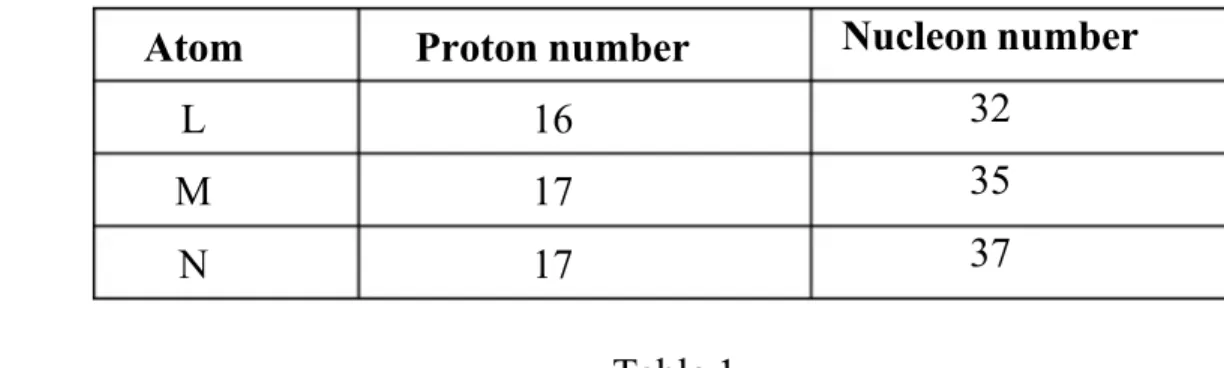
1. Table 1 shows the proton number and nucleon number for atoms L, M and N.
Atom Proton number Nucleon number
L 16 32
M 17 35
N 17 37
Table 1 (a) (i) What is meant by proton number ?
………
[1 mark ] (ii) What is the number of neutrons in atom M ?
………
[1 mark ] (b) Which atoms are isotopes ? Explain your answer.
……… ………
[2 marks] (c) (i) Write the electron arrangement for atom L.
………
[1 mark ] (ii) State the position of atom L in the Periodic Table
………
[1 mark ] (iii) Explain your answer in c (ii)
……….. ……….
[2 marks ] (d) Write the formula of ion formed from atom M
………
2 Diagram 2 shows part of the Periodic Table of Elements.T, U, V, W, X, Y and Z do not represent the actual symbol of the elements.
1 18 2 13 14 15 16 17 V X W Z U Y T Diagram 2 (a) Write the electron arrangement of U atom.
………...
[1 mark ] (b) (i) Which of the element exist as a monoatomic gas ?
……...
[1 mark ] (ii) Explain your answer in (b)(i).
………….………. . ………...
[2 marks ] (c) V reacts with W to form a compound.
(i) Write the formula for the compound formed.
………
[1 mark ] (ii) Draw the electron arrangement for the compound formed in (c)(i).
[2 marks ]
(d) (i) Choose an element that is a halogen.
……… [1 mark ] (ii) Which element forms an amphoteric oxide ?
…….………
[1 mark ] (iii) Choose the element which form a coloured ion or compound
……….
3 Table 3 shows the element in Period 3 with their respective proton numbers.
Element Na Mg Al Si P S Cl Ar
Proton number 11 12 13 14 15 16 17 18
Table 3
(a) (i) Write the electron arrangement of sulphur atom,
[1 mark ] (ii) In which group of the Periodic Table is Sulphur, S located ?
...
[1 mark ] (b) (i) How does the atomic size change when going across the Period from left to right ?
...
[1 mark ] (ii) Explain your answer in 2(b)(i)
... ...
[2 marks ] (c) Argon, Ar is chemically unreactive. Explain why ?
... ...
[2 marks ] (d) Which of the element when reacts with oxygen produces an amphoteric oxide ?
…………...
[1 mark ] (e) Write the chemical equation when sodium react with water.
...
[2 marks ] 4. Table 4 shows the electron arrangement of atoms of elements J,K,L,M and N.
Element Electron arrangement of atom
J 1 K 2.8.1 L 2.8.6 M 2.8.7 N 2.8.8 Table 4
(a) State one element in Table 4 which is metal and non-metal?
Metal : ... Non- metal : ...
(b) (i) State an element that exist as a diatomic gas. Explain your answer.
....……….. [1 mark ] (ii) Explain your answer in (b)(i)
……….... [3 marks] (c) (i) What is the Proton Number for atom M
...
[1 mark ] (ii) Which group is atom M located in the Periodic Table ? Explain your answer.
... ...
[2 marks ] (d) Arrange atoms K, L and M in increasing atomic size
...
[1 mark ] (e) Write the formula for K ion.
...
[1 mark ] (f) K and M react to form an ionic compound.State the formula for this compound.
...
[1 mark ] 5 (a) Table 5 shows three substances and their respective chemical formulae.
Name of substance Chemical formula
Chlorine Cl2
Magnesium Mg
Magnesium chloride MgCl2
Table 5
Use information from Table 1 to answer the following questions : (i) State one substance which exists as an atom.
……….……….[1 mark ] (ii) Write the ionic formula for the substance in (a) (i).
……….……….
[1 mark ] (iii) Which substance has the lowest melting point?
……….……….
(iv) What is the state of matter of chlorine at room temperature?
……….……….
[1 mark ] (v) Magnesium chloride can conduct electricity in aqueous solution. Give a reason.
……….……….
[1 mark ] (b) Graph 1 shows the temperature against time when molten of acetamide, C2H5 NO is cooled.
Graph 1
(i) State the type of compound of acetamide.
...……… [1mark ] (ii) State the melting point of acetamide.
……….……… [1 mark ] (iii) Describe the movement of the particles of acetamide between A and B during cooling.
……… [1 mark ] (iv) Draw the arrangement of particles of acetamide at stage CD.
[1 mark ] Temperature / 0C Time / s
T
1T
2T
3A
B
C
D
Heat
6 (a) In a close container, contains 3.0 dm3of carbon dioxide gas at room temperature. (i) How many molecules are there in 3.0 dm3of carbon dioxide gas, CO2?
[Avogadro’s number = 6.02 x 10²³mol-1]
[1 mole of gas occupies 24 dm3at room temperature] Use: Number of mole = Number of particles
6.02 x 10²³ mol-1
[2 marks] (ii) Calculate the mass of carbon dioxide gas in the container
[Relative molecular mass for CO2 = 44] Use: Number of mole = mass
molar mass
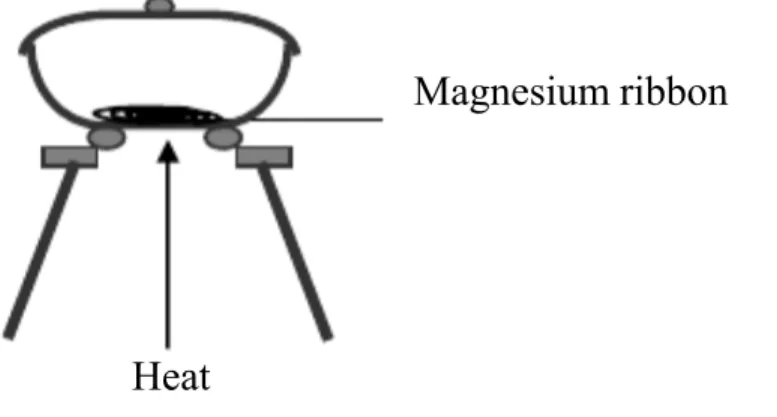
[1 mark ] (b) Diagram 6 shows the set-up of apparatus for an experiment to determine the empirical formula
of magnesium oxide..
Diagram 6 Table 1 shows the results of this experiment
Description Mass (g)
Mass of crucible + lid 34.0
Mass of crucible + lid + magnesium ribbon 36.4 Mass of crucible + lid + magnesium oxide 38.0
Table 1 (b) (i) What is the meaning of emperical formula
………. ………..
[1 mark ] Magnesium ribbon
(ii) Base on table 1, calculate the mass of: Magnesium :
Oxygen :
[2 marks]
(iii) Calculate the ratio of mole of magnesium atoms to oxygen atoms. [Relative atomic mass: O=16, Mg =24]
[1 mark ] (iv) Determine the empirical formula of magnesium oxide.
[1 mark ] (v) Why was the crucible lid opened once in a while during the experiment?
…………..………..
[1 mark ]
(v) State why the empirical formula of copper oxide cannot be determine by using the same technique.
…………..………..
[1 mark ] 7. (a) What is the meaning of molecular formula?
………... ………..
[1 mark ] (b) Diagram 7.1 shows an incomplete equation which is one of the steps involved in determining the
empirical formula.
Complete this equation.
Diagram 7.1
Mass
(c) Diagram 7.2 shows the apparatus set-up for two methods used to determine the empirical f ormula of two compounds.
Method 1 Method II
Diagram 7.2
(i) Which method is suitable to be used to determine the empirical formula of magnesium oxide? ……….………
[1 mark ] (ii) Why did you choose the method in 2(c)(i)?
……….………
[1 mark ] (iii) When carrying out an experiment using Method I, why does the crucible lid need to be opened
once a while?
……… ………
[1 mark ] (d) Diagram 7.3 shows the results for an experiment to determine the empirical formula of lead oxide.
Diagram 7.3
Based on Diagram 2.3, determine the values of the following [Relative atomic mass of O =16 , Pb = 207]
(i) Mass of lead
= ……… g
[1 mark ] (ii) Number of moles of lead.
= ………mol
[1 mark ] (iii) Mass of oxygen
= ………..g
[1 mark ] (iv) Number of moles of oxygen.
= ………mol
[1 mark ] (v) Empirical formula of oxide of lead.
= ………
[1 mark ] Mass of combustion tube + porcelain dish = 54.00 g
Mass of combustion tube + porcelain dish + lead oxide = 107.52 g Mass of combustion tube + porcelain dish + lead = 103.68 g
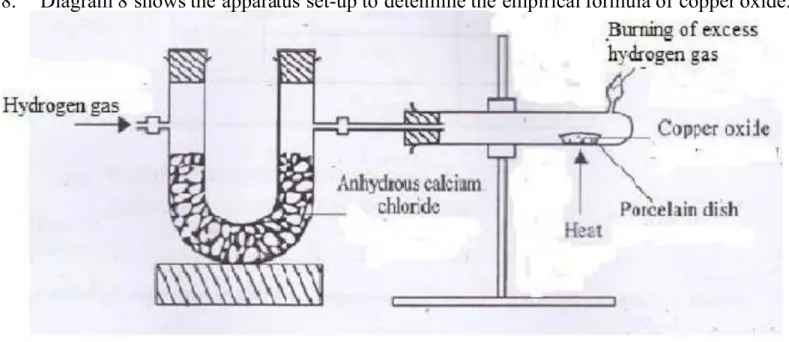
8. Diagram 8 shows the apparatus set-up to determine the empirical formula of copper oxide.
Diagram 8 Table 8 shows the result of this experiment.
Description Mass(g)
Combustion tube + porcelain dish 42.25
Combustion tube + porcelain dish + copper oxide 52.25 Combustion tube + porcelain dish + copper 50.25
Table 8 (a) (i) What is the meaning of empirical formula?
……… ………
[1 mark ] (ii) State the function of the anhydrous calcium chloride.
………..
[1 mark ] (b) (i) Based on Table 8, determine the mass of:
Copper:
=………..g Oxygen:
= ………..g
[2 marks]
(ii) Calculate the ratio of moles of copper atoms to oxygen atoms. [Relative atomic mass: O = 16 ; Cu = 64]
(iii) Determine the empirical formula of copper oxide.
………
[1 mark ] (c) (i) Why is hydrogen gas passed through the combustion tube after heating has
stopped?
………. ……….
[1 mark ] (ii) State how to determine that the reaction between copper oxide with hydrogen has
completed.
……… ………
[1 mark ] (d) (i) State why the empirical formula of magnesium oxide cannot be determined by
using the same technique.
……… ………
[1 mark ] (ii) State the name of another metal oxide whose empirical formula can be
determine using the same technique.
………..
[1 mark ]
SECTION B
9
(a) Diagram 9.1 shows the atomic structure of two carbon isotopes.
Diagram 9.1
(a) Compare the two isotopes above in terms of number of proton, number of electron, nucleon
number,physical properties and chemical properties.
[6 marks]
Nucleus
6 neutrons
Nucleus
8 neutrons
(b) Diagram 9.2 shows the set up of apparatus used in experiment to determine the melting
points of X.
Diagram 9.2
(i)
Suggest one example of substance X.
[1 mark ]
(ii)
State the name of P. Explain why P is used?
[2 marks]
(iii) Graph 9 shows the heating curve of X.
Graph 9
Describe Graph 9 in terms of state of matter, particles arrangement, kinetic energy of
particles and attraction forces between particles.
[10 marks]
(iv) After t
3minutes, X is cooled at room temperature. Sketch a graph of temperature
against time for cooling process.
.
[2 marks]
Temperature /
0C
Time/
minutes
100
30
t
1t
2t
380
0
Q
X
Heat
P
10
(a)
Helium,
4 He2
exists as a monoatomic gas whereas chlorine,
Cl 3517
exists as a diatomic gas.
Explain why.
[6 marks]
(b)
Table 10.1 shows the proton number of magnesium, chlorine and carbon.
Element
Magnesium Chlorine Carbon
Proton number 12 17 6
Table 10.1
(i)
Carbon reacts with chlorine to form a compound.
What type of the compound formed?
Draw the electron arrangement to show the chemical bond in the compound.
[3 marks]
(ii) Explain how ionic bond is formed between magnesium and chlorine atoms.
[7 marks]
(c)
Diagram 10 shows the set-up of apparatus to investigate the electrical conductivity of
naphthalene and sodium chloride solution.
Diagram 10
Table 10.2 shows the result of the experiments.
Compound Observation
Naphthalene Bulb does not light up Sodium chloride solution Bulb lights up
Table 10.2
Explain the electrical conductivity of the two compounds.
[4 marks]
Bulb
Carbon
electrode
Empirical formula is CH2O. Relative molecular mass is 60.
Reacts with calcium carbonate to produce a type of gas that turns lime
water chalky.
11
. (a) The following are the formulae of two compounds. Al2O3 PbO2(i) Based on the two formulae, write the formula for ion aluminium and ion lead
[2 marks] (ii) Name both compounds based on the IUPAC nomenclature syst em.
[2 marks] (b) The following information is about an organic compound, K.
Based on the information given:
(i) Determine the molecular formula of K.
[Relative atomic mass : H = 1, C = 12, O = 16]
[3 marks] (ii) Write a balanced chemical equation for the reaction of compound K with calcium carbonate.
[2 marks]
(c) Diagram 11 shows the apparatus set up for experiment of decomposition of copper(II) carbonate. In this experiment copper(II) oxide and carbon dioxide gas are f ormed.
Based on Diagram 11
(i) State two observations.
[2 marks] (ii) Write a balanced chemical equation for the r eaction
[2 marks] (iii)) State two informations from the chemical equation in (c)(ii).
[2 marks] Diagram 11
Copper(II) carbonate powder
Lime water Heat
(v) Calculate the mass of the copper(II) oxide formed from the decomposition of 12.4 g of copper(II) carbonate.
[ Relative atomic mass of C = 12; O = 16; Cu = 64 ]
[3 marks]
(vi) In other experiment 4.0 g copper(II) oxide is reacted with hydrogen gas to produce copper and water. If the mass of copper in copper(II) oxide is 3.2 g, calculate the mass of oxygen and the simplest mole ratio for the copper atoms to oxygen atoms
[ Relative atomic mass of O = 16; Cu = 64 ]
[2 marks]
12. Table 12 shows the positive and negative ions in three salts solution. Name of salt Positive ion Negative ion
Iron(III) chloride Fe3+ Cl
-Potassium sulphate K + SO4
2-Lead(II) nitrate Pb2+ NO3
-Table 12
Use the information in Table 12 to answer the following questions.
(a) (i) What are another name for a positively charged ion and negatively charged ion?
[2 marks] (ii) Name the ions in iron(III) chloride.
[2 marks] (iii) Write the formula for potassium sulphate.
[1 mark ] (b) When 10 cm3of 0.5 mol dm-3potassium sulphate solution is added to excess lead(II) nitrate
solution, a white precipitate is formed.
(i) Name the white precipitate and write the chemical equation for the reaction.
[3 marks] (ii) Describe the chemical equation in (b)(i).
[1 mark ] (iii) Calculate the mass of precipitate formed.
[Relative atomic mass of O = 16; S = 32; Pb = 207]
[4 marks] (c) The information below is regarding an organic compound Z.
Relative molecular mass is 46 Carbon : 52.2%
Hydrogen : 13.0% Oxygen : 34.8%
Relative atomic mass of H = 1; C = 12 and O = 16
Based on the information of the organic compound Z:
(i) Determine the molecular formula for compound Z and [6 marks] (ii) Draw its structural formula.
SECTION C
13
(a)
An experiment is carried out using Group 1 elements; X, Y and Z react with oxygen
gas.The set-up of apparatus and observations of the reaction are shown in Table 13.
Set
Set-up of apparatus
Observation
I
Burns slowly and
white fumes formed
II
Burns vigorously and
white fumes formed
III
Burns rapidly and
white fumes formed
Table 13
(i)
Based on the observation in Table 13, compare the reactivity of element X and Y.
Explain your answer.
[5 marks]
(ii) Suggest the name of element Z. Using the symbol of element suggested, write the
chemical equation for the reaction in set III.
[3 marks]
(b)
State how elements of Group 1 are stored in laboratory and give a reason.
[2 marks]
(c)
Using an example of Group 1 element, describe an experiment to prove above statement.
Your description should include the following :
List of material and apparatus
Procedures of the experiment
Observation
Chemical equation
[10 marks]
Group 1 elements react with water to produce alkaline solution.
Z
X
14
Table 14 shows the melting point, boiling point and electrical conductivity of compound PQ
2and compound XY.
Compound Melting point and Boiling point Electrical conductivity
Solid Molten
P Low No No
Q High No Yes
Table 14
(a)
Suggest one possible compound for P.
State the type of compound for P.
Explain why P has low melting and boiling points.
[4 marks]
(b)
Chemical formula of compound P is XY.
Suggest one possible electron arrangement of atom X and atom Y.
State the type of chemical bond and explain how the bond is formed between atom X and
atom Y.
[7 marks]
(c)
Plan one laboratory experiment to investigate the electrical conductivity of compound Q.
Your answer should include the following :
A list of material and apparatus
Procedure of the experiment
Observation of the experiment
A labeled diagram showing the apparatus set-up
[9 marks]
15(a) Metal P has the following
characteristics:-Based on the information above, state the method used to determine the empirical formula of oxide of metal P.
Give a reason for your answer .
[2 marks] (b) Diagram 15 shows the set up of apparatus for an experiment to determine the empirical
formula of the oxide of metal Y.
Diagram 15 The results are obtained as follows:
Table 15
Grey in colour
Can react with steam Reactive metal
Dry hydrogen
Oxide of metal Y
Combustion tube
Mass of combustion tube + Porcelain dish = 54.30 g Mass of combustion tube + Porcelain dish + Oxide of Metal Y = 56.69 g Mass of combustion tube + Porcelain dish + Metal Y = 56.37 g
(i) Based on the above information, determine the empirical formula of oxide of metal Y Given that the relative atomic mass of O = 16, Y = 207
[4 marks]
(ii) Describe the steps that should be taken to ensure that all the air in t he combustion tube has been expelled
.
[3 marks] (b) Describe an experiment on how to determine the empirical formula of magnesium oxide. In your
description, state the precautions should be taken during the experiment and show how the empirical formula of magnesium oxide is obtained.
[Relative atomic mass: O = 16; Mg = 24]
[11 marks]
16. (a) The following is the chemical formula of a compound. SO3
Name the compound and describe the composition of this compound.
[3 marks] (b) Excess calcium carbonate chips is added to 30 cm3of 0.5 mol dm-3acid HX.
The chemical equation below shows the reaction between calcium carbonate and acid HX.
CaCO3 + nHX CaX2 + CO2 + H2O
Given that the relative atomic mass of C = 12, O = 16 , Ca = 40 and the molar volume of any gas is 24 dm3 mol-1at room temperature and pressure.
(i) Suggest acid HX and name salt CaX2 Determine the value of n
[3 marks] (ii) Calculate the maximum volume of carbon dioxide gas produced.
[4 marks]
(c) You are provided with a sample of M oxide powder. The colour of the M oxide powder is green while the colour of metal M is grey. When it is heated with hydrogen, the M oxide is reduced to M metal. Based on the information given, describe an experiment to determine the empirical formula of the M oxide. In your description, include the precautions that should be taken and show how the empirical formula of M oxide is obtained.
[Relative atomic mass of O = 16 and M = 56]
CHEMISTRY MODULE
SET
1. Electrochemistry
SECTION A 1 Diagram 1 shows the set-up of apparatus of a voltaic cell.
Diagram 1
Based on Diagram 1 , answer the following questions.
(a) What is the energy change that occurs in the voltaic cell?
...
[1 mark ] (b) Write the formula of all ions in copper(II) sulphate solution.
...
[1 mark ] (i) State the name of the negative terminal of the voltaic cell.
……...
[1 mark ] (ii) Give a reason for your answer in (c)(i).
...
[1 mark ] (d) (i) State one observation at copper plate.
...
[1 mark ] (ii) Write the half equation for the reaction occur at the copper plate.
...
[1 mark ] (e) What is the colour change of the copper(II) sulphate solution? Give a reason.
... ...
[2 marks] (f) Another experiment is carried out by replacing the zinc plate with P , Q and R metals.
Table 1 shows the results.
.Pair of metal Voltage/V Negative terminal
P/Cu 2.7 P
Q/Cu 2.0 Q
R/Cu 0.5 R
Table 1
Copper(II) nitrate solution Copper plate
Zinc plate
(i) Arrange P, Q, R and Cu metal in accending order of electropositivity.
...
[1 mark ] (ii) Predict the voltage for pair of Q/R.
...
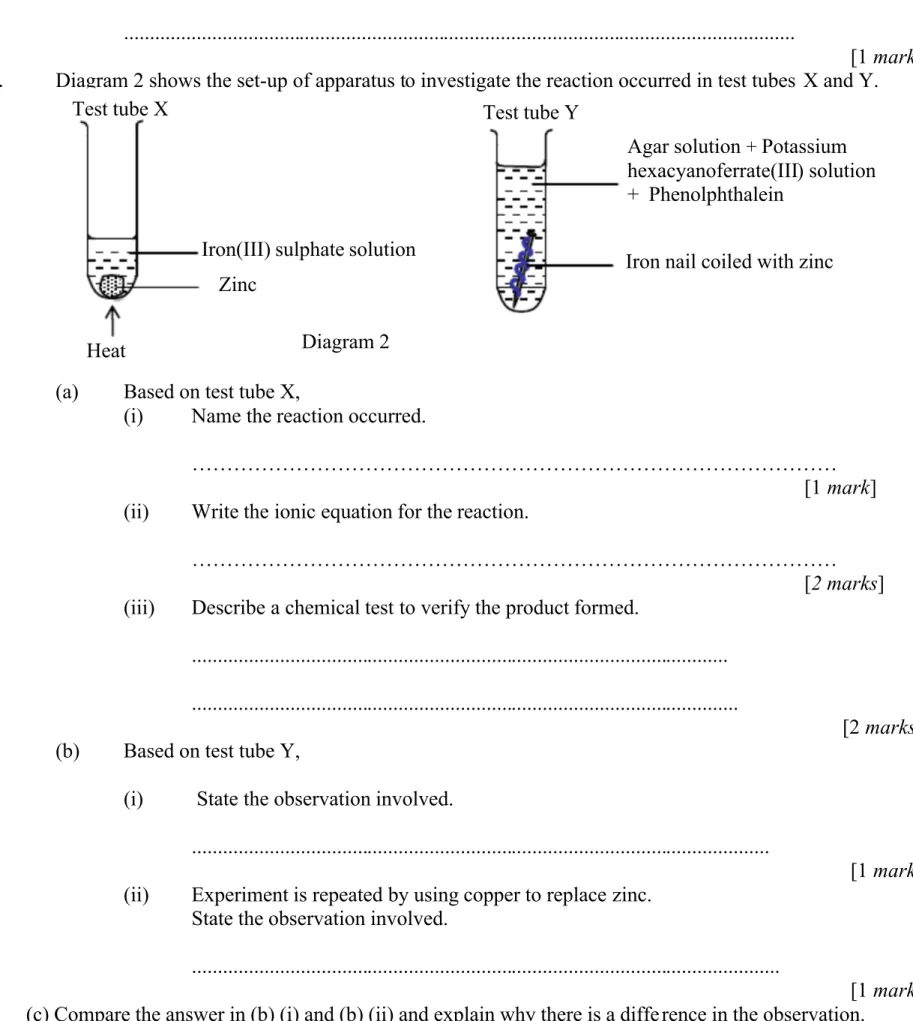
[1 mark ] 2. Diagram 2 shows the set-up of apparatus to investigate the reaction occurred in test tubes X and Y.
(a) Based on test tube X,
(i) Name the reaction occurred.
……… [1 mark ] (ii) Write the ionic equation for the reaction.
……… [2 marks] (iii) Describe a chemical test to verify the product formed.
... ...
[2 marks] (b) Based on test tube Y,
(i) State the observation involved.
...
[1 mark ] (ii) Experiment is repeated by using copper to replace zinc.
State the observation involved.
...
[1 mark ] (c) Compare the answer in (b) (i) and (b) (ii) and explain why there is a diffe rence in the observation.
... ...
[2 marks] (d) When iron is exposed to water and oxygen, it rusts easily. State one method to prevent the rusting of
iron.
...
[1 mark ]
Test tube X Test tube Y
Agar solution+Potassium hexacyanoferrate(III) solution + Phenolphthalein
Iron nail coiled with zinc
Diagram 2 Zinc
Iron(III) sulphate solution
SECTION B
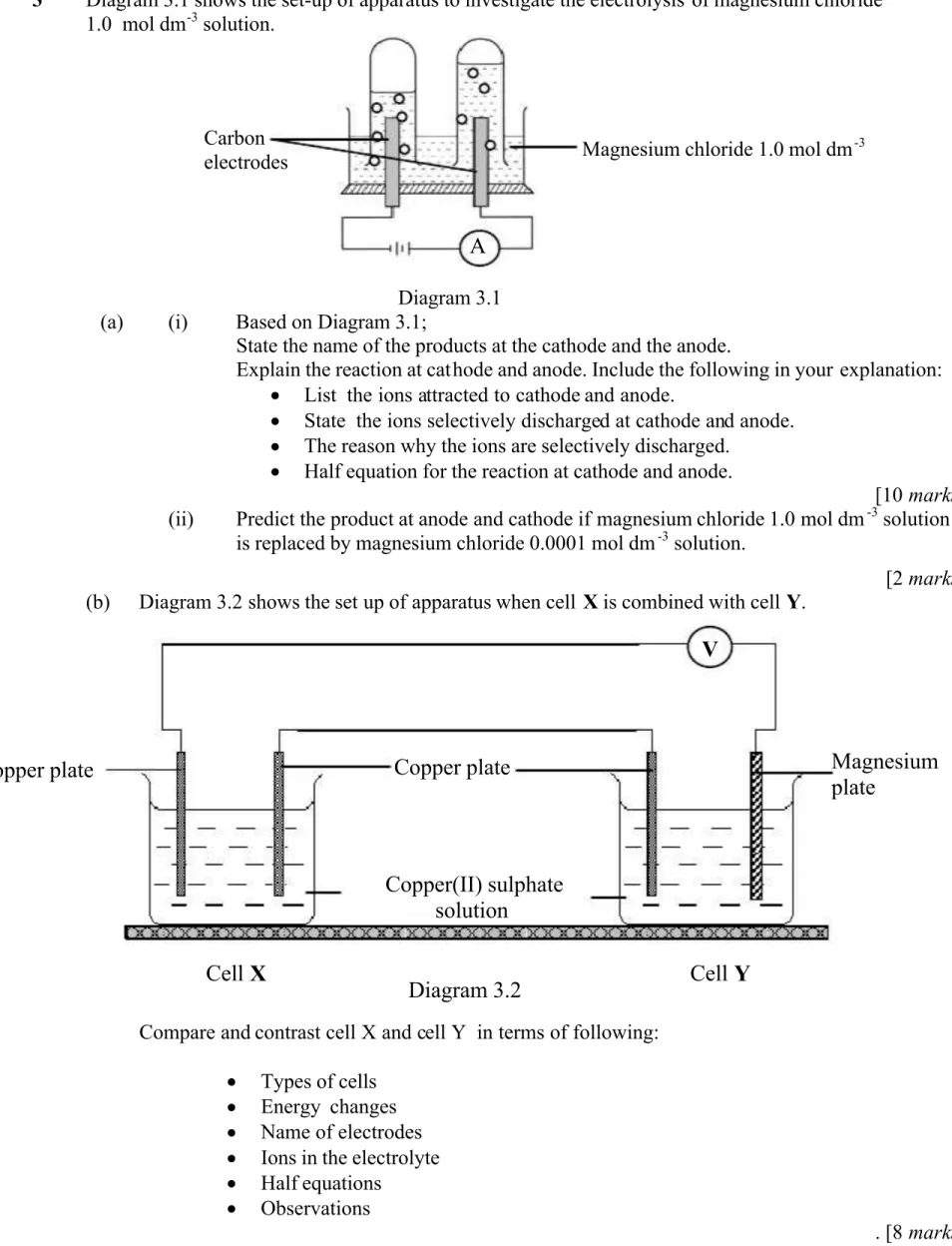
3 Diagram 3.1 shows the set-up of apparatus to investigate the electrolysis of magnesium chloride 1.0 mol dm-3solution.
Diagram 3.1 (a) (i) Based on Diagram 3.1;
State the name of the products at the cathode and the anode.
Explain the reaction at cathode and anode. Include the following in your explanation:
List the ions attracted to cathode and anode.
State the ions selectively discharged at cathode and anode. The reason why the ions are selectively discharged.
Half equation for the reaction at cathode and anode.
[10 marks] (ii) Predict the product at anode and cathode if magnesium chloride 1.0 mol dm-3solution
is replaced by magnesium chloride 0.0001 mol dm-3 solution.
[2 marks] (b) Diagram 3.2 shows the set up of apparatus when cell X is combined with cell Y.
Compare and contrast cell X and cell Y in terms of following:
Types of cells Energy changes Name of electrodes Ions in the electrolyte Half equations Observations . [8 marks]
Copper plate
Copper(II) sulphate
solution
Magnesium
plate
Cell X
Cell Y
Copper plate
Diagram 3.2
V
Magnesium chloride 1.0 mol dm-3
A
Carbon electrodes
Chemistry Perfect Score/ X A- Plus Module 2012 32 4 (a) The following are the formulae of two compounds.
Na
2O
PbO
2(i) Based on the two formulae , state the oxidation number for sodium and lead.
[ 2 marks] (ii) State the name of the compounds based on the IUPAC nomenclature.
[ 2 marks] (b) Diagram 4 shows the observation of two experiment to study the effect of metal P and metal Q on the
rusting of iron.
Experiment Observation Experiment 1
Large amount of dark blue precipitate Experiment 2
No dark blue precipitate. Solution turns pink. Diagram 4
(i) Suggest metal P and metal Q.
(ii) Explain the observations and write the chemical equation for the reaction in the experiment 1 and experiment 2.
[ 10 marks] (c) The equation shows a redox reaction. M is a metal.
X(s) + CuSO4 (aq) XSO4 (aq) + Cu(s)
Suggest metal X and explain the redox reaction in terms of the transfer of electrons .
[6 marks] SECTION C
5 Diagram 5 shows the set-up of apparatus for electrolysis of 1.0 mol dm-3sodium sulphate solution.
Diagram 5
(a) State the name of gas produced at electrode X and electrode Y.
[2 marks] Carbon electrode Y Carbon electrode X
1.0 moldm- sodium sulphate solution
(b) Explain the reaction at electrode X and electrode Y. Include the following inyour explanation.
List of ion attracted to each electrodes, X and Y.
State the name of the ions selectively discharged at each electrode. The reason why the ion are selectively discharged.
[5 marks] (c) When sodium sulphate solution is replaced by a solution of substance Z with same concentration, the
equal gas produced at electrode X and electrode Y .
Suggest the substance Z. Write the half equation for the reaction at electrode X.
[3 marks] (d) Zinc is placed above metal A in the electrochemical series. Zinc and metal A can be used to build a
chemical cell, using suitable apparatus and the following chemicals ; Zinc
Zinc nitrate solution Metal A
A nitrate solution
By naming metal A and A nitrate solution, describe how you build the chemical cell. Include a labelled diagram in your answer.
On your diagram, mark the direction of electron flow, the positive terminal and the negative terminal.
[ 10 marks] 6 (a) The following are the equations of two reactions:
Determine which reaction is a redox reaction. Explain your answer in terms of oxidation number.
[4 marks] (b) Table 6 shows the observations of two experiments to determine the position of carbon in the
reactivity series of metal.
Experiment Reactants Observation
I Carbon + oxide of metal P A flame spreads to the whole mixture. A brown residue is formed.
II Carbon + oxide of metal Q No change
III Carbon + oxide of metal R A glow spreads to the whole mixture. A grey residue is formed.
Based on observations in Table 6, arrange the reactivity of metals P, Q, and R in descending order. Explain your answer.
[6 marks] (c)
By using a named metal as a reducing agent and a named halogen as an oxidising agent, describe briefly how you would carry out these two conversion.
Describe a test to show that each conversion has taken place.
[ 10 marks]
Reaction I : NaOH + HCl NaCl + H2O
Reaction II : Mg + Zn(NO3)2 Mg(NO3)2 + Zn
Table 6
CHEMISTRY MODULE
SET
1. Acids and Bases
2. Salts
3. Rate of reaction
4. Thermochemistry
SECTION A
1. Diagram 1 shows four test tubes labeled A,B,C and D which are used to study the relationship between pH value of acid and alkali with the molarity.
pH paper
A B C D
5 cm3HCl 5 cm3HCl 5 cm3 NaOH 5 cm3 NaOH 0.1 mol dm-3 0.01 mol dm-3 0.1 mol dm-3 0.01 moldm-3
(a) Determine which solution has (i) highest pH value.
` ……….………...
[1 mark ] (ii) lowest pH value. Give a reason for your answer.
………... [2 marks] (b) If the hydrochloric acid in test tube B is replaced with 5 cm3of 0 .01 mol dm-3ethanoic acid,
predict the pH value of the solution. Explain your answer
………...………..
……… ……….
[3 marks] (c) Excess of magnesium powder is added to 5 cm3of 0.1moldm-3hydrochloric acid in test tube A
(i) State the name of the products formed. .
……...……….. [1 mark ] (ii) Write the chemical equation for the reaction in test tube A
……… [1 mark ] (iii) Calculate volume of hydrogen gas released at room conditions in test tube A
[1 mol of gas occupies 24 dm3at room conditions]
[3 marks]
Add water
(d) If the solution in test tube C is added to lead(II) nitrate solution. State the observation from the reaction.
…….……… [1 mark ] 2. (a) Diagram 2.1 shows the pH value of glacial ethanoic acid in solvent P and solvent Q
respectively.
(i) Suggest solvent P and solvent Q.
Solvent P: ……….
………...
………Solvent Q: ………. [2 marks] (ii) If magnesium ribbon is added into beaker containing glacial ethanoic acid and solvent
P, what can be observed?
……….……… [1 mark ] (iii) Explain why ethanoic acid in solvent P and solvent Q has different the pH value.
….……… ….……… ….……… ...………
[3 marks] (b) Diagram 2.2 shows the concentration of hydrochloric acid in volumetric flask when a certain
volume of hydrochloric from the beaker is transferred to the volumetric flask and added with water
7.0 4.8
Glacial ethanoic acid
+ solvent P Glacial ethanoic acid +solvent Q
100 cm of 0.5 moldm- hydrochloric acid
Diagram 2.1
Diagram 2.2 250 cm
3
Chemistry Perfect Score/ X A- Plus Module 2012 37 (i) What happen to the pH value of the hydrochloric acid when water is added to the acid?
Give a reason for your answer.
….……… .………
[2 marks] (ii) Calculate the volume of hydrochloric acid that is needed to prepare 250cm3of 0.04 mol dm-3
hydrochloric acid.
[2 marks] 3. A student carried out an experiment to investigate the p roperties of three solutions. Diagram 3 shows the
results of the experiments.
Test tube P Q R Set-up of
apparatus
Observation The red litmus
paper turned blue. No change Diagram 3
(a) What is meant by strong alkali?
...
[1 mark ] (b) What is the property of the solution in test tube P?
...
[1 mark ] (c) What are the types of particles that exist in the test tubes P and Q?
Particles in the test tube P: ... Particles in the test tube Q: ...
[2 marks] (d) Is there any changes of colour of the litmus paper in test tube Q? Give a reason to your answer.
... ... [2 marks] Ammonia gas dissolved in water Red litmus Paper Ammonia gas dissolved in propanone Red litmus Paper Hydrogen chloride gas dissolved in water Magnesium
(e) (i) What can be observed in test tube R?
...
[1 mark ] (ii) Write a chemical equation for the reaction in test tube R.
...
[2 marks] (iii) 2.4 g of magnesium is reacted completely with the solution in test tube R.
Calculate the volume of the hydrogen gas produced at room condition
[Relative atomic mass: Mg,24; 1 mol of gas occupies 24 dm3 at room conditions]
[2 marks]
4 Diagram 4 shows the apparatus set-upfor the neutralisation reaction between sulphuric acid and potassium hydroxide solution for preparation of salt X.
Diagram 4
(a) (i) State the colour change of the solution in the conical flask at the end point.
……….……… [1 mark] (ii) Write a chemical equation for the above reaction.
………. [2 marks] (iii) Calculate the concentration of potassium hydroxide used.
[2 marks] (b) (i) State the name of salt X.
……….. 25.0 cm3 potassium hydroxide solution + phenolphthalein indicator 15 cm of 0.1mol dm -sulphuric acid
[1 marks] (ii) Calculate the maximum mass of salt X formed.
[Molar mass of salt X = 174 g mol-1]
[3 marks] (c) (i) The experiment is repeated with 0.1 mol dm-3 nitric acid to replace sulphuric acid. Predict the
volume of nitric acid needed to neutralize completely potassium hydroxide
……….. [1 mark] (iii) Explain your answer in (c) (i).
... ...
[2marks] 5. Diagram 5 shows a series reaction of copper compound.
(a) Copper(II) nitrate solution reacts with sodium carbonate solution to form copper(II) carbonate precipitate.
(i) What is the colour of copper(II) carbonate?
………...
[1 mark ] (ii) State the name of the reaction.
... [1 mark ] (b) Heating of copper(II) carbonate produces copper(II) oxide and gas X.
(i) State the name of gas X.
……….. [1 mark ] (ii) Write the chemical equation of the reaction.
...………... [2 mark ] Copper(II) carbonate Copper(II) oxide Sodium carbonate Copper(II) nitrate Copper(II) sulphate Diagram 5
Acid Y
Heat
Gas X +(iv) Draw a labeled diagram for the heating of copper(II) carbonate to produce copper(II) oxide and gas X. In your diagram show how gas X is tested.
[2 marks] (c) Copper(II) carbonate reacts with acid Y to produce copper(II) sulphate. The chemical equation is
shown below.
CuCO3 + Acid Y → CuSO4 + CO2 + H2O (i) What is acid Y?
……… [1 mark ] (ii) 12.4 g copper(II) carbonate reacts completely with excess acid Y.
Calculate the mass of copper(II) sulphate formed.
[Relative atomic mass: C = 12, O=16 , S = 32, Cu = 64]
[3 marks] 6. Three experiments were conducted to investigate factors affecting the rate of reaction. The results a re
shown in the Table 6
Experiment Reactants Temperature /0C Time taken for all the
magnesium to dissolve/s I 0.4g magnesium ribbon and 50 cm
3
1 moldm-3hydrochloric acid 30 100
II 0.4g magnesium powder and 50 cm
3
1 moldm-3hydrochloric acid 30 60
III
0.4g magnesium ribbon and 50 cm3
1 moldm-3hydrochloric acid and copper(II) sulphate solution
30 45
Table 6
(a) Write a chemical equation to show the reaction between magnesium and hydrochloric acid. ………
[2 marks] (b) Calculate the number of mole of
(i) Magnesium
[Relative atomic mass of Mg = 24]
[1 mark] (ii) Hydrochloric acid
(c) If hydrochloric acid used is excess, calculate the maximum volume of hydrogen gas produce at room temperature and pressure.
[1 mole of gas occupies the volume of 24 dm3at room temperature and pressure]
[2 marks] (d) Calculate the average rate of reaction for
(i) Experiment I
[1 mark] (ii) Experiment II.
[1 mark] (iii) What is the purpose of using copper(II) sulphate?
…….………
[1 mark] (f) The factor that affects the rate of reaction in this experiment is total surface area and the use of
catalyst. State two other factors that affect the rate reaction in this experiment.
……… ……..………
[2 marks] 7. Diagram 7 shows two experiments to investigate one of the factors that affect the rate of reaction between
zinc and hydrochloric acid
Diagram 7
(a) (i) Based on Diagram 7, state the factor that affect the rate of reaction in this experiment.
………. [1 mark] 50 cm31 mol dm-3HCl Hydrogen gas Excess zinc granules Experiment I 50 cm 1 mol dm- HCl + copper(II) sulphate solution Hydrogen gas Excess zinc granules Experiment II
(ii) Besides measuring the change of volume of gas released at certain time interval, suggest another measurable change to determine the rate of reaction?
……….. [1 mark] (b) In Experiment II, 2.0 cm30.5 moldm-3copper(II) sulphate solution is added. The maximum volume of
hydrogen gas released in Experiment I is V cm3.
(i) Compare the volume of gas released in Experiment I and Experiment II. Give a reason for your answer.
……….. ……….
[2 marks] (ii) The graph of volume of hydrogen gas released against time in Experiment I is shown below.
Sketch the curve for Experiment II on the same axes in the graph above.
[2 marks] (iii) With reference to collision theory, explain how copper(II) sulphate solution affect the rate o f
reaction in this experiment.
[3 marks] (c) Table 7.1 shows three experiments done by a student.
Experiment Reactants
A Excess calcium carbonate chips + 25 cm
31.0 mol dm-3
hydrochloric acid
B Excess calcium carbonate chips + 25 cm 0.5 mol dm
-hydrochloric acid
C Excess calcium carbonate chips + 100 cm 0.5 mol dm
-hydrochloric acid Table 7.1 Time / s Volume of gas released/ cm3 Key : Experiment I : Experiment II :
…
The graph of volume of carbon dioxide released against time is sketched as shown in graph 7
Based on the above table and graph, determine which curve represents the results for experiment B and C. Write your answers in the boxes provided.
[1 mark] 8. An experiment is conducted to study the heat of displacement for reaction between copper(II) sulphate
and excess magnesium powder. 50.0 cm3of 0.5 mol dm-3copper(II) sulphate solution is poured into a polystyrene cup and the initial temperature is recorded. The excess magnesium powder is added to the
same polystyrene cup. The mixture is stirred slowly and the highest temperature is recorded. Initial temperature of copper(II) sulphate solution = 28.5 oC
Highest temperature of mixture = 33.5 oC
[Relative atomic mass : Cu=64; S=32; O=16; Zn= 65;
(a) What is the meaning of heat of displacement in this experiment?
...
... [1 mark ] (b) Why does zinc in the form of powder is used in this experiment?
………
[1 mark ](c) Write the ionic equation for the reaction in this experiment.
...
[2 marks] (d) (i) Based on the experiment, calculate the heat energy released.
[1 mark ] (ii) number of mole of copper(II) sulphate that has reacted
[1 mark ] (iii) heat of displacement in this reaction
[2 marks] (e) Draw an energy level diagram for the reaction.
[3 marks] Time/s Volume of carbon dioxide /cm3 Experiment Graph 7
5 g of zinc powder
50 cm3of 0.2 mol dm-3 copper(II) sulphate solution Plastic cup
(f) Why polystyrene cup is used in this experiment?
………
[1 mark ] 9. Diagram 9 shows the apparatus set-up to determine heat of displacement of copper by using zinc
powder. The result of the experiment is recorded in the Table 9.
Diagram 9
Initial temperature of copper(II) sulphate solution (oC) 30.0 Highest temperature of the mixture (oC) 38.0
Table 9 (a) What is the meaning of heat of displacement?
……… ………
[1 mark ] (b)
(c)
Why plastic cup is used in this experiment.
……… [1 mark ]
State the type of reaction that occurs based on the temperature change.
………
[1 mark ] (d) Calculate :
(i) the heat change for the reaction
[Specific heat capacity of solution = 4.2 J g-1 oC-1; Density of solution = 1 g cm-3]
[1 mark ] (ii) the heat of displacement for the reaction.
[2 marks] (e) Draw energy level diagram for the reaction.
(f) Experiment is repeated by using 100 cm3of 0.2 mol dm-3of copper(II) sulphate solution. (i) Predict the temperature change in the experiment.
.
………...
[1 mark ] (ii) Explain your answer in (e) (i).
………... ………... ………...
[2 marks]
10. The equation for combustion of propanol in excess oxygen is given below.
(a) What is meant by heat of combustion in this reaction?
...………
[1 mark] (b) State two information that can be obtained from the equation
...………
………
[2 mark] (c) Heat given out from the complete combustion of 1.2 g propanol is used to heat 200 cm3of water.
Calculate:
(i) The heat energy given out in the reaction.
[Molar mass of propanol, C3H7OH = 60 gmol-1]
[2 marks] (ii) The temperature change in the reaction.
[Spesific heat capacity of water = 4.2 Jg-1 oC-1 ; Density of water = 1 gcm-3 ]
[2 marks]
(d) Draw the energy level diagram for this reaction.
[3 marks] C3H7OH + 9 O2 3CO2 + 4H2O , ∆H = -2015 kJ mol-1
(e)
(e) The value of the heat of combustion The value of the heat of combustion of propanol obtained from the eof propanol obtained from the experiment is less xperiment is less than thethan the
theoretical value. Suggest one precaution step that should be taken in order to get a more accurate result. theoretical value. Suggest one precaution step that should be taken in order to get a more accurate result.
...
...
[1 mark] [1 mark] (f)
(f) Table 10 show s the molecular formula anTable 10 show s the molecular formula and the heat of combustion for methanol and d the heat of combustion for methanol and ethanol.ethanol.
Alcohol
Alcohol Molecular Molecular formula formula Heat Heat of of combustion/kJmolcombustion/kJmol-1-1
Methanol CH
Methanol CH33OH OH -728-728
Ethanol C
Ethanol C22HH55OH OH -1376-1376
Based on the information in Table 10, explain why there is a difference in the value of
Based on the information in Table 10, explain why there is a difference in the value of heat of heat of combustion between methanol and ethanol.
combustion between methanol and ethanol. ... ... ... ... ... ... ... ... [3 marks] [3 marks] SECTION B SECTION B 11.
11. (a) (a) A studenA student has t has carried carried out an out an experiment experiment to consto construct an truct an ionic equatiionic equation for on for the the formation of formation of lead(II)lead(II) iodide.
iodide. Seven test Seven test tubes of the same size wetubes of the same size were labeled 1 to 7. re labeled 1 to 7. A fixed voluA fixed volume of 5.0 cmme of 5.0 cm33of 1.0 molof 1.0 mol dm
dm-3-3potassium iodide solution was pourepotassium iodide solution was poured in each test tube. d in each test tube. The volume of 1.0 mol dmThe volume of 1.0 mol dm-3-3lead(II)lead(II) nitrate solution that added are sh
nitrate solution that added are shown in Table 11. own in Table 11. The height of precipitThe height of precipitate formed in each test tubeate formed in each test tube was measured.
was measured. The results The results are shown in are shown in Table 11.Table 11.
Table 11 Table 11
(i)
(i) Based on Table 11, plot a graph of the height of precipitate against volume of Based on Table 11, plot a graph of the height of precipitate against volume of lead(II) nitratelead(II) nitrate solution.
solution.
[3
[3 marksmarks]]
(ii)
(ii) Determine the number of moles of Determine the number of moles of lead(II) lead(II) ions and iodide ions that are required for thions and iodide ions that are required for thee formation of l
formation of lead(II) iead(II) iodide. odide. Your answer Your answer should should consist of the consist of the following:following:
the volume of lead(II) nitrate solution that had reacted completely with 5.0 cmthe volume of lead(II) nitrate solution that had reacted completely with 5.0 cm33of 1.0of 1.0
mol dm
mol dm-3-3potassium iodidepotassium iodide
calcúlate the number of moles of lead(II) ions and iodide ionscalcúlate the number of moles of lead(II) ions and iodide ions
calculate the number of moles of iocalculate the number of moles of iodide ions that has reacted with 1 mol of dide ions that has reacted with 1 mol of lead(II) ions.lead(II) ions.
write the ionic equation for write the ionic equation for the formation of lead(II) iodide.the formation of lead(II) iodide.
[7
[7 marksmarks]] Test tube
Test tube 1 1 2 2 3 3 4 4 5 5 6 6 77
Volume of 1.0 moldm
Volume of 1.0 moldm-3-3lead(II)lead(II) nitrate
nitrate solution solution / / cmcm33 0.5 0.5 1.0 1.0 1.5 1.5 2.0 2.0 2.5 2.5 3.0 3.0 3.53.5 Height of precipitate /cm
Height of precipitate /cm 1.1 1.1 2.2 2.2 3.4 3.4 4.4 4.4 5.5 5.5 5.5 5.5 5.55.5
Table 10
Table 10
(b)
(b) Diagram 11 shows the flow chart of reacDiagram 11 shows the flow chart of reaction of salt J. tion of salt J. X oxide which is browX oxide which is brown when hot and yellown when hot and yellow when cold is formed when sa
when cold is formed when salt J is heated strongly. lt J is heated strongly. Salt J dissolves in water to form colourlessSalt J dissolves in water to form colourless solution.
solution. The solution formed is The solution formed is tested with potassium iodide, tested with potassium iodide, KI solution.KI solution.
+ + ++ ∆ ∆ H H22OO Diagram 11 Diagram 11 Based on the information in Diagram 11:
Based on the information in Diagram 11: (i)
(i) Identify salt J, Identify salt J, X oxide, brown gas Y, colourX oxide, brown gas Y, colourless gas Z and yellow precipitate L.less gas Z and yellow precipitate L.
[5
[5 marksmarks]] (ii)
(ii) State the name of the anion present in salt J. TState the name of the anion present in salt J. T hen describe one chemical test to determine thehen describe one chemical test to determine the presence of anion in salt J.
presence of anion in salt J.
[5
[5 marksmarks]]
12.
12. Diagram 12.1 shows a series of reaction for salt S which is Diagram 12.1 shows a series of reaction for salt S which is a green colour compound. Salt S is heateda green colour compound. Salt S is heated strongly to produce black residue of
strongly to produce black residue of compound T and gas U.compound T and gas U.
Compound T reacts with sulphuric acid to form blue solution of compound W. Compound T reacts with sulphuric acid to form blue solution of compound W.
Diagram 12.1 Diagram 12.1 Based on Diargram 12.1:
Based on Diargram 12.1: (a)
(a) (i) (i) Suggest one Suggest one formula formula of of the the anion anion in in salt salt S.S.
[1
[1 mark mark ]] (ii)
(ii) Identify Identify salt salt S, S, compound compound T, T, gas gas U U and and compound compound W.W.
[4
[4 marksmarks]] (b)
(b) Write a chemical equation for the reaction between compound T and sulphuric acid.Write a chemical equation for the reaction between compound T and sulphuric acid.
[2
[2 marksmarks]] (c)
(c) Compound W is a soluble salt. Describe chemical test to verify the cation and anion in compound W.Compound W is a soluble salt. Describe chemical test to verify the cation and anion in compound W. [[5 marks5 marks]] Salt J
Salt J X OxideX Oxide Brown gas YBrown gas Y Colourless gas ZColourless gas Z
Salt
Salt J J solution solution Yellow Yellow precipitate precipitate LL Potassium iodide Potassium iodide solution solution
Heat
Heat
+
+
Salt S
Salt S
Compound T
Compound T
Gas U
Gas U
Compound W
Compound W
+ H + H22SOSO44