______________________________
Corresponding author: Jelena Srdić,, Maize Research Institute, Zemun Polje,
Belgrade, Serbia, S. Bajića 1, 11185 Zemun Polje, Serbia
UDC 575: 633.15 DOI:10.2298/GENSR0803291S
Original scientific paper
YIELDS OF ZP SWEET MAIZE HYBRIDS IN DEPENDENCE ON SOWING DENSITIES
Jelena SRDIĆ, Milena SIMIĆ, Živorad VIDENOVIĆ and Zorica PAJIĆ
Maize Research Institute, Zemun Polje, Belgrade, Serbia
Srdić J, M. Simić, Ž. Videnović and Z. Pajić (2008): Yields of ZP sweet maize hybrids in dependence on sowing densities. – Genetika, Vol. 40, No. 3, 293 -301.
Sweet maize differs from maize of standard grain quality by many important traits that affect the ear appearance, and especially by traits controlling taste. The ear appearance trait encompasses the kernel row number, configuration, row pattern (direction and arrangement), seed set, kernel width and depth, ear shape and size. The quality of immature kernels is controlled by genes by which sweet maize differs from common maize. In order to obtain high-ranking and high-quality yields, it is necessary to provide the most suitable cropping practices for sweet maize hybrids developed at the Maize Research Institute, Zemun Polje. The adequate sowing density is one of more important elements of correct cropping practices.
The objective of the present study was to determine the effect of four sowing densities in four ZP sweet maize hybrids of different FAO maturity groups on ear qualitative traits and yields obtained on chernozem type of soil in Zemun Polje.
The observed traits of sweet maize (ear length, kernel row number, number of kernels per row, yield and shelling percentage) significantly varied over years. The higher sowing density was the higher yield of sweet maize was, hence the highest ear yield of 9.67 t ha-1 , on the average for all four hybrids, was recorded at the highest sowing density of 70,000 plants ha-1. The highest yield was detected in the hybrid ZP 424su. The highest shelling percentage (67.81%) was found in the hybrid ZP 521su at the sowing density of 60,000 plants ha-1. Generally, it can be stated that sweet maize hybrids of a shorter growing season (FAO 400) could be cultivated up to 70,000 plants ha-1, while those of a longer growing season (FAO 500) could be grown up to 60,000 plants ha-1. In such a way, the most favourable parameters of yields and the highest yields can be obtained.
Key words: hybrid, sweet maize, sowing density, yield .
INTRODUCTION
The annual sweet maize production in Serbia is carried out on the area of approximately 5,000 ha. The highest amount of produced sweet maize is exported in the form of frozen grain. As the habit of consuming sweet maize has been increasing over years, its production not only in our country, but also in the world, has been increasing. It is assumed that this trend will continue.
Sweet maize differs from maize of standard grain quality by many important traits that affect the appearance of ear with and without husk, and especially by traits controlling taste. The importance of these traits varies in relation to the method of hybrid utilisations (TRACY, 1994). Sweet maize is harvested 18-24 days after pollination and is often consumed directly as an ear, so the ear traits are very important. The ear appearance trait encompasses the kernel row number, configuration, row pattern (direction and arrangement), seed set, kernel width and depth, ear shape and size. The traits that affect the appearance of kernels and the normal appearance (condition) of kernels after cutting, as well as, the kernel colour, width and depth, are the most important properties of sweet maize hybrids that are used for industrial processing, i.e. for kernel cutting (PAJIĆ AND RADOSAVLJEVIĆ, 1987). Sweet maize is used as human food or for industrial processing at the milk stage of the endosperm development. The quality of immature grain is controlled by genes by which sweet maize differs from common maize.
Sweet maize growing practices differ, to a certain extent, from cropping practices applied when hybrids of standard grain quality are grown. Sweet maize under our conditions can be sown from the beginning of April till the mid July,
depending of the maturity group and requirements. The sweet maize seed is wrinkled, hence "air pockets" are formed between the endosperm and the pericarp, and therefore germination and emergence are aggravated under unfavourable conditions during sowing (PAJIĆ et al., 2005). Consequently, its germination and emergence in the field, as well, as the early growth are somewhat reduced in relation to maize of standard grain quality. This particularly happens under dry conditions, which have been occurring very often in our country in spring during sowing. The sweet maize plant habitus is shorter and poorly developed. As maize hybrids of standard grain quality, these hybrids have a smaller or greater leaf area, depending on a hybrid, hence they differently response to a sowing density (MORIS et al., 2000; RANGARAJAN et al., 2000; SIMIĆ and STEFANOVIĆ, 2007). Factors driving yield loss varied among sweet maize hybrids - more competitive hybrids established canopy dominance, restrained weed growth and experienced less yield loss (WILLIAMS et al., 2008). Consequently the aim of sweet maize breeding programmes is the identification of the best hybrids with high, stable and quality yields, over several years and different locations.
During the 1970s, sweet maize breeding and selection was initiated at the Maize Research Institute, Zemun Polje. Twenty eight sweet maize hybrids of different growing periods have been released (PAJIĆ et al., 2000). In order to obtain high-ranking and high-quality yields, it is necessary to provide the most suitable cropping practices for these hybrids. The adequate sowing density is one of more important elements of correct sweet maize growing practices.
Considering above stated facts, the objective of the present study was to determine the effect of four sowing densities in four ZP sweet maize hybrids of different FAO maturity groups grown on chernozem type of soil in Zemun Polje on qualitative traits and yields.
MATERIAL AND METHODS
The trial was carried out on slightly calcareous chernozem in the experimental field of the Maize Research Institute, Zemun Polje, during 2007 and 2008. Winter wheat was a preceding crop. The stubble field was ploughed in after harvest, while deep ploughing was done in autumn. The following rates of fertilisers were applied in autumn: 90 kg N ha-1, 90 kg P ha-1 and 90 kg K ha-1. A total amount of 69 kg N ha-1 in the form of Urea was applied to the soil in spring during the seedbed preparation.
The three-replicate two factorial trials were set up according to the RCB design. The following four sweet maize hybrids were observed in the trial: H1-ZP 424su, H2-ZP 462su, H3-ZP 504su and H4-ZP 521su. Manual sowing was done on April 20, 2007 and April 23, 2008. The inter-row distance of 70 cm was equal for all sowing densities, while the within-row plant distance was 20, 24, 28 and 35 cm, by which the following densities were obtained: D1- 40,000 plants ha-1; D2 - 50,000 plants ha-1 ; D
necessary density, two seeds per hill were sown, but one plant was removed in the three-leaf stage. The standard combination of pre-emergence herbicides acetochlor (Harness) + atrazine (Atrazine-50) + prometrin (Prometrin 500) in the amount of 2 + 1 + 1 l ha-1 were applied after sowing and prior to emergence.
Harvest was performed 24 days after pollination, i.e. on August 3 and August 6 in 2007 for hybrids H1 and H4 and for hybrids H2 and H3, respectively, while harvest in 2008 was performed earlier: on July 24 for hybrids H1 and H4 and July 25 for hybrids H2 and H3. The total yield of ears harvested from the elementary plot was measured and then the ear length, kernel row number, number of kernels per row, kernel weight and cob weight were determined on a sample of 10 ears. Shelling percentage was estimated as a kernel weight to cob weight ratio. The results gained on the number of kernels per row, ear weight and shelling percentage of sweet maize are presented in this paper.
Obtained data were statistically processed by the three factorial analysis of variance, while the differences between means were tested with the LSD-test (GOMEZ and GOMEZ,1984).
Temperature conditions during the performance of the trial were favourable. The year of 2007 was characterised by dry spring and precipitation deficit in April during sowing, which resulted in poor emergence of maize and the inadequate plant stand. A precipitation distribution was somewhat more favourable in 2008, which reflected upon the yield.
RESULTS AND DISCUSSION
The observation of effects of sowing densities on quantitative and qualitative traits of sweet maize hybrids pointed out to significant differences in values of observed parameters. Based on the analysis of variance, the year of investigation, as a factor, very significantly affected the ear length, kernel row number, number of kernels per row, yield and shelling percentage in sweet maize hybrids (Table 2). The ear length significantly differed over observed hybrids and also as a result of the year x hybrid interaction. The kernel row number depended on the year and the hybrid. The ear length of sweet maize is a trait that is mainly affected by the non-additive gene action, i.e. affected by dominance and epistasis (VOICHTA, 2001). The additive gene action is more important for the kernel row number (DUTTA et al., 2004).
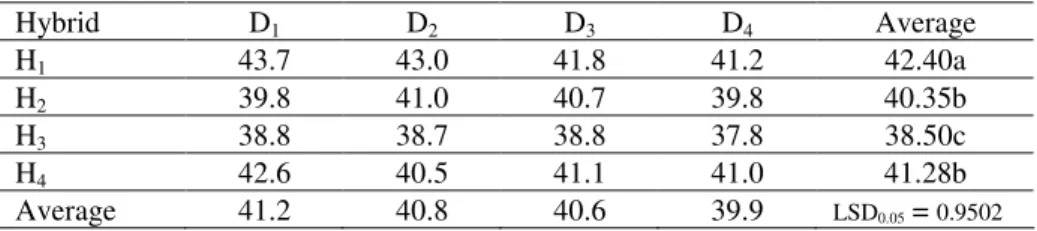
According to obtained results, the number of kernels per row was affected by the year of investigation and year x density x hybrid interaction. The number of kernels per row significantly differed over observed hybrids, on the average for both years (Table 1). The sowing density resulted in differences in the number of kernels per row. But, these differences were not statistically significant. The highest (41.2 kernels), i.e. the lower number of kernels (39.9 kernels) was recorded in the lowest (D1), i.e. highest D4 density, respectively, Table 2.
Differences in the number of kernels per row among observed sweet maize hybrids were also significant and the highest number of kernels, on the average for both years of investigation, was detected in the hybrid H1- ZPSC 424su.
Table 1. F-values for the observed factors (for the 2007-2008 period) Ear length Kernel
row number Number of kernels per row Yield Shelling percentage Year 70.61** 5.57* 36.39** 199.39** 30.29** Densities 1.32ns 0.89ns 2.46ns 13.65** 0.48ns Year x Density 0.87ns 0.89ns 4.15** 2.23ns 0.37ns Hybrid 6.89** 56.00** 23.79** 4.20** 0.56ns Year x Hybrid 16.76** 1.96ns 13.96** 1.06ns 6.50** Dens x Hybrid 0.91ns 1.50ns 1.13ns 0.95ns 0.86ns Year x Density x Hybrid 0.94ns 0.52ns 0.99ns 1.08ns 0.63ns
**-significant at 0.01 level; *- significant at 0.05 level; ns-not significant
Table 2. Effects of density, genotype and their interaction on the number of kernels per row (for the 2007-2008 period)
Hybrid D1 D2 D3 D4 Average H1 43.7 43.0 41.8 41.2 42.40a H2 39.8 41.0 40.7 39.8 40.35b H3 38.8 38.7 38.8 37.8 38.50c H4 42.6 40.5 41.1 41.0 41.28b Average 41.2 40.8 40.6 39.9 LSD0.05 = 0.9502
The sowing density and observed genotypes significantly affected the yield of sweet maize hybrids, Table 3. The higher density was the higher yield was. Hence, the highest ear yield (9.67 t ha-1), on the average for all four hybrids, was recorded in the highest sowing density (70,000 plants ha-1). The hybrids H1- ZP 424su had the highest yields. Individually, the highest ear yield was recorded in the hybrid H2- ZP462su in the density D3. This trait is inherited by the non-additive gene action, while superdominance is the mode of inheritance (PAJIĆ and RADOSAVLJEVIĆ, 1984).
Table 3. Effects of density and genotype and their interaction on the yield (t ha-1) of sweet maize hybrids (for the 2007-2008 period)
Year D1 D2 D3 D4 Average
H1 8.23 9.64 9.59 9.90 9.34a
H2 7.31 7.75 10.22 9.88 8.79ab
H3 7.26 7.26 8.69 8.86 8.02c
H4 7.45 7.84 8.96 9.91 8.54bc
Average 7.56b 8.12b 9.37a 9.64a
LSD0.05 = 0.7527
LSD0.05 = 0.7527
Hybrids had the highest shelling percentage (65.37%), on the average for both years of investigation, in the density D1, Table 4. Individually, the best shelling percentage (67.81%) was detected in the hybrid H4 in the third sowing density, while this percentage amounted to 65.68% on the average over densities.
Similar results on effects of sowing densities on the yield of hybrids of standard grain quality were previously obtained during long-term studies carried out under conditions of Zemun Polje (VIDENOVIĆ and STEFANOVIĆ, 1994; SIMIĆ, 2003; SIMIĆ and STEFANOVIĆ, 2007). The higher densities were the higher yields of sweet maize grown in the USA were (RANGARAJAN et al., 2000; MORRIS et al., 2000). According to results obtained by MORRIS et al. (2000), the sowing densities of sweet maize usually recommended for the conditions of
Table 4. Effects of density and genotype and their interaction on shelling percentage (average for the 2007-2008 period)
Year D1 D2 D3 D4 Average H1 64.86 62.83 64.08 64.64 64.10 H2 64.34 64.63 64.72 63.28 64.24 H3 67.04 65.40 62.97 61.54 64.24 H4 65.25 62.83 67.81 66.82 65.68 Average 65.37 63.92 64.89 64.07
the northeast USA are quite low, hence sweet maize cultivation in the densities of 49,400 and 59,300 plants ha-1 resulted in significantly higher yields, while ears were longer than 178 mm. Furthermore, there are differences in the response of a genotype, i.e. sweet maize hybrid to the conditions of modified within-row plant distances, i.e. to increased number of plants per ha (RANGARAJAN et al., 2000).
CONCLUSION
According to presented results of two-year studies on the response of ZP sweet maize hybrids to growing methods under agroecological conditions of Zemun Polje, the following can be concluded:
* The observed traits of sweet maize (ear length, kernel row number, number of kernels per row, yield and shelling percentage) significantly varied over years. This means that the stated traits depend to a great extent on meteorological conditions.
* The highest number of kernels per row, on the average for both years, was recorded in the hybrid ZPSC 424su.
* The increase of the sowing density from 40,000 to 70,000 plants ha-1 led to the increase of sweet maize yields. Hence, the highest ear yield (9.67 t ha-1), on the average for all four hybrids, was determined in the highest sowing density (70,000 plants ha-1). The highest ear yield was recorded in the hybrid ZP 424su. This hybrid is a short season maize hybrid and it was evident that its yield increased up to the highest sowing density. In other hybrids, the higher sowing density was the lower yield was.
* The highest two-year average of shelling percentage (65.37%) was recorded in hybrids grown in the lowest density. Individually, the best shelling percentage (67.81%) was detected in the hybrid H4-ZP 521su in the density of 60,000 plants ha-1.
* Generally, it can be established that sweet maize hybrids of a shorter growing season (FAO 400) could be cultivated up to 70,000 plants ha-1, while those of a longer growing season (FAO 500) could be grown up to 60,000 plants ha-1. In such a way, the most favourable parameters of yields and the highest yields can be obtained.
ACKNOWLEDGEMENT
These research was supported by the Ministry of Science and Technology, Republic of Serbia, through Project TR 20007.
Received October 28th, 2008
REFERENCES
DUTTA, A., H.S. PRODHAN,andB.K. CHAUNDHURY (2004): Combining ability for yield along with some other qualitative and quantitative characters in sweet corn. Environment and Ecology, 22, pp. 543-546.
MORRIS, F.T., G. HAMILTON, S. HARNEY (2000): Optimum Plant Population for Fresh-market Sweet Corn in the Northeastern United States. Hort Technology, Vol. 10, pp. 331-336.
PAJIĆ, Z.,and M.RADOSAVLJEVIĆ(1987): Yield and Carbohydrate Grain Composition in Sweet Corn (Zea mays L. saccharata). Proceedings of the XIVth Congress of Eucarpia, Sept. 7-11, 1987, Nitra, Czechoslovakia. pp. 68-75.
PAJIĆ, Z., J. DUMANOVIĆ, M. MIŠOVIĆ,and M. ROŠULJ (2000): Breeding Maize for Nutritional Value and Industrial Use. Maize and Sorghum Breeding at the End of 21st Century. Genetika, Vol.
32, pp. 255-282.
PAJIĆ, Z., L.ĐUKANOVIĆ, U. ERIĆ(2005): Effects of endosperm mutants on maize seed germination . Genetika, Vol. 36, pp. 265-270.
PAJIĆ, Z., M. RADOSAVLJEVIĆ (1984): Proučavanje genotipskih komponenata prinosa klipa i ugljenohidratnog sastava zrna kukuruza šećerca (Zea mays L. var. saccharata). Arhiv za poljoprivredne nauke, 45, pp. 411-426.
RANGARAJAN, A., B.INGALL, S.M. ORFANEDES (2000): Impact of Plant Population, Nitrogen, and Variety on Early Fresh-market Sweet Corn Quality. Hort Science, Vol. 35, pp. 439-440.
SIMIĆ, M. (2003):Sezonska dinamika korovske sinuzije, kompetitivnost i produktivnost kukuruza u integralnim sistemima kontrole zakorovljenosti. Doktorska disertacija. Univerzitet u Beogradu, Poljoprivredni fakultet, Beograd.
SIMIĆ, M., L.STEFANOVIĆ(2007): Effects of maize density and sowing pattern on weed suppression and maize grain yield. Pesticides & Phytomedicine, Vol. 22, pp. 93-103.
TRACY, W.F. (1994): Sweet corn. In: Speciality Corns, CRC Press Inc., Ames, Iowa, USA, 147. VIDENOVIĆ, Ž., L. STEFANOVIĆ (1994): Uticaj mera gajenja na pojavu korova u kukuruzu. Savremena
poljoprivreda, Vol. 42, Novi Sad, pp. 97-105.
VOICHITA, H. (2001): Heritability of some traits in sweet corn. Buletinul Universitatii de Stiinte Agricole si Medicina Veterinaria Cluj-Napoca, Seria Horticultura, 55/56.
(http://www.cababstracts.org/google/abstract.asp?AcNo=20043111435)
WILLIAMS, M.M II, R.A. BOYDSTON, A.S. DAVIS (2008): Crop competitive ability contributes to herbicide performance in sweet corn. Weed Research, Vol. 48, pp. 58-67.
PRINOS ZP HIBRIDA KUKURUZA ŠEĆERCA U ZAVISNOSTI OD GUSTINE GAJENJA
Jelena SRDIĆ, Milena SIMIĆ, Živorad VIDENOVIĆ i Zorica PAJIĆ
Institut za kukuruz „Zemun Polje“-Beograd, Srbija
I z v o d
Kukuruz šećerac se razlikuje od kukuruza standardnog kvaliteta zrna po
većem broju važnih osobina koje uslovljavaju izgled klipa, a posebno po
osobinama koje uslovljavaju ukus. Osobina izgled klipa obuhvata broj redova zrna, konfiguraciju, raspored redova (pravac i uredjenje), ozrnjenost, širinu i dubinu zrna, oblik i veličinu klipa. Kvalitet nezrelog zrna odredjuju geni po kojima se
šećerac razlikuje od običnog kukuruza. Za hibride kukuruza šećerca selekcionisane
u Institutu za kukuruz je potrebno odrediti najpogodniju tehnologiju gajenja, kako bi oni ostvarili visoke i kvalitetne prinose. Jedan od važnih elemenata pravilne tehnologije gajenja šećerca je adekvatna gustina setve.
Cilj rada je bio da se utvrdi efekat četiri gustine setve kod četiri ZP
hibrida kukuruza šećerca različitih FAO grupa zrenje na kvalitativne karakteristike
klipa i visinu prinosa na černozemu u Zemun Polju.
Ispitivane osobine dužina klipa, broj redova zrna, broj zrna u redu, prinos i randman kukuruza šećerca vrlo su značajno varirale po godinama. Prinos kukuruza
šećerca se povećavao sa povećanjem gustine gajenja pa je najveći prinos klipa,
prosečno za sva četiri hibrida, od 9.67 t ha-1 utvrđen u najvećoj gustini od 70000
bilj. ha-1. Među ispitivanim hibridima najveći prinos klipa je imao hibrid ZP 424su. Najbolji randman je imao hibrid ZP 521su u gustini od 60000 bilj/ha – 67.81%. Gledano u celini može se konstatovati da je hibride šećerce kraće vegetacije (FAO
400) moguće gajiti do 70000 bilj/ha a one duže vegetacije (FAO 500) do 60000
bilj/ha. Na taj način se dobijaju najpovoljniji parametri prinosa i najveći prinosi.
Primljeno 28. X 2008.