|
455
Raising Student Engagement
through ‘
’
Puguh Jatmikoa
a
BINUS School Serpong, Jl. Lengkong Karya – Jelupang No.58. Serpong, Tangerang, Indonesia
Corresponding e-mail: [email protected]
Abstract: The study was to examine if an Instagram post could help to raise students‟ engagement towards a certain topic. The first step was to introduce and discuss with the students a topic in the class. The students were then asked to find more information about the topic at home, and when they found any, they were asked to post it on their Instagram accounts with a certain hashtag. Once students posted pictures on Instagram, they then were asked to give comments to each other‟s posts. The aspects explored were the student‟s engagement and involvement in a discussion off the class, while they were away from the school. Upon completion of the study, I found that there were more students engaged in the discussion; this was shown by the number of pictures the students posted on Instagram. This study offered another option for teachers to help students review and get ready for the next class.
Keywords: student engagement, Instagram, hashtag
1 BACKGROUND OF THE STUDY
The internet generation, digital natives, or millenials are terms used to describe people who have grown up with the internet. They are groups of young people who were born roughly between 1980 – after 2000.In their 2008 book, „Born Digital‟, John
Palfrey and Urs Gasser of the Berkman Centre at Harvard Law School argue that digital natives are groups of people who are growing up with internet. These young people like to use new, digital ways to express themselves. They will likely shooting a Youtube video, for example, while their parents write an essay.
Students nowadays are digital natives; they value on-line interactions just like off-line interactions. They are social network heavy users. For students, social media, like Facebook,
Twitter, or Instagram, is like „an internet in the
internet.‟ This means a social network is turning
into a multi-tool service. These digital natives are not only socializing on-line but they also follow fan pages, seek for new information, shop, advertise, and even do campaigns on social media.
In addition, technology has shaped and changed the way students see education, particularly teachers and their classes. They now
„require‟ their teachers to be active on-line.
They expect their teachers to be more aware of social media; they will ask if their teachers have social media accounts and would like them to check, befriend or follow theirs. With this,
students feel that their teachers live in the same
„world‟ with them.
The implication of digital natives in education is real. Students eventually hope that their teachers will integrate technology in their classes. Generally, students think that it is always more interesting if classes utilise computers, internet, videos, or movies. And when technology is absent, they call it boring.
On the other hand, teachers have been increasingly focusing on student engagement as a pivotal point to help students with their achievement. It has primarily been related to increased achievement, positive behaviours and a sense of belonging in students. (Taylor & Parsons, 2011)
When dealing with students, student engagement is seen as a way to re-engage or
reclaim students‟ focus. Teachers have been
puzzled with how to get their students aware and ready for classes. Giving students homework assignments or asking students to read a chapter at home a day before the actual classes are often futile. Students often see traditional homework assignments out-dated and boring.
Thus, this paper attempts to observe whether social media, particularly Instagram,
can help boost students‟ engagement towards a
| 456
help raise students‟ involvement and
participation about a topic of discussion. This paper is concerned with the use of social media, particularly Instagram, to raise students‟ engagement towards a certain topic of discussion outside the classroom setting.
1.2 Research Objective
Based on the problem identification above, it can be assumed that the use of on-line social
media can help raise students‟ interest towards a
certain topic.
Thus, the objective of the study is whether
Instagram can be used to raise student engagement of 6th grade students in BINUS Serpong.
1.3 Problem Limitation
The research was conducted in the Elementary department of BINUS School Serpong. The subject of the research was 6th grade students in BINUS Serpong.
However, the research only focused on the students‟ engagement in the subject English.
1.4 Research Significance
It is expected that this research is able to give contribution to the institution, the teachers and the students.
For the institution, this research can help to justify the need of internet to support teaching and learning practices which in turn will be able to enhance the quality of education in the institution.
This research will also help to inform teachers about a possible way of raising student engagement using a social network service,
Instagram.
Finally, students will find it interesting for they can utilise what they like to help them prepare for their classes. By interacting on
Instagram, students‟ motivation is refined and
thus raises their involvement and participation in the class.
2 THEORETICAL DESCRIPTION
2.1 Students’ Engagement
Students‟ engagement started to get significant attention in the mid-1990‟s.It became the latest focus of attention for many educators to enhance learning and teaching.
Studies conducted on students‟ engagement concluded robust correlations between students‟ involvement in a educationally purposive activities and positive outcomes of students‟ success and development (Astin 1984, 1993;
There are some education practitioners who propose definition of students‟ engagement. Among the definitions, there are those proposed by the Department of Educational Research, Lancaster University and Kuh et al.
2.1.1 Definition of Students’ Engagement
Students‟ engagement has been defined as a
“participation in educationally effective
practices, both inside and outside the classroom, which leads to a range of measurable
outcomes.” (Kuh et. al.2007)
In addition to that, Coates (2007, 122) has
defined engagement as „a broad construct
intended to encompass salient academic as well as certain non-academic aspects of the student
experience‟ comprising the following:
1. active and collaborative learning;
2. participation in challenging academic activities;
3. formative communication with academic staff;
4. involvement in enriching educational experiences;
5. feeling legitimated and supported by university learning communities.
| 457
Based on the explanation above, it is clear that students‟ engagement is mainly concerned with:
1. Active participation in educationally effective, challenging practices inside and outside the classroom.
2. Intention to enhance learning outcomes and enrich educational experiences.
Therefore, there are two behaviours that the researcher wants to observe in this study.
2.2 Instagram
Instagram is an online video-sharing and photo-sharing social network service which enables its users to connect and share their pictures and videos on other social network services such as Flickr, Facebook and Twitter.
There are more than 300 million people who sign up on Instagram and shares their moments through pictures and videos online.
2.3 Hashtag
A hashtag (#) is a type of code or label used on social network services that makes the users easier to use it to find messages, posts, pictures or videos under a certain theme or topic. The Oxford Dictionary defines hashtag as a word or phrase preceeded by a hash sign (#) on social media sites such as Twitter to identify messages on a specific topic.
For example, on Instagram, the hashtag #ESL will allow its users to search for posts, pictures and videos related to #ESL.
3
RESEARCH METHOD
The fact that students are often disengaged with their classes prompted the researcher to conduct this study. This is often caused by the teaching strategies and methods used by the teacher. The use of Instagram as an interactive, age-appropriate instrument to aid students with their engagement is expected to be a way of enhancing learning outcomes.
Classroom action research is a strategic way to conduct the study.
3.1 Significance of Classroom Action Research
Classroom action research is aimed at finding what works best in the classroom to improve teaching and learning practices.
Classroom action research is typically
personal to a teacher‟s teaching practices; with
this method, a teacher has opportunity to research his/her own impact of his/her own
teaching. Therefore, this research has a huge significance for teachers for it is a very effective
way of improving teachers‟ teaching practices.
3.2 Subject and Location of the Research
The subject of the research was 6th grade students of the Elementary Department of BINUS School Serpong.
The research itself was conducted for one moth which comprised planning, acting, observing and reflecting.
3.2.1 Research Variable and Data
The research focused on „student
engagement‟ which was shown by the students
being actively participated in educationally effective, challenging practices inside and outside the classroom.
The data collected and used to observe student engagement in the research was the
students‟ posts and comments on Instagram,
students‟ statements, interactions and comments
during discussion in the classroom.
Observation and interview were the two methods used in obtaining the data. In conducting this, the researcher, himself, was the one who directly did it.
3.2.2 Research Procedures
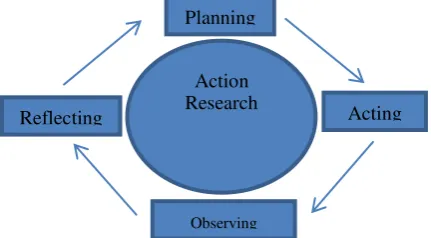
For its simplicity, the researcher followed
Bridget Somek‟s action research. The action
research process can be seen in the picture 3.2.2.
Figure 3.2.2 Action Research Process. (Somekh & Zeicher, 2009)
There were four main stages in conducting the research, namely planning, action, observation and reflection.
The planning stage started by conducting a mini observation and survey on the students‟ engagement of social media. He observed that the students were very engaged and focused when the teacher shared posts taken from
Instagram and Twitter. This led to a mini survey
| 458
on how many students who having at least one social media account.
The mini survey was conducted
spontaneously and directly in the class. It was done by the students showing a hand if they had at least one social media account. It was clear
„#6benglish‟, „#6cenglish‟, „#6denglish‟,
„#6bidioms‟, and „#6fidioms‟. The students
then were asked to give comments and have a small discussion about the posts on-line. The students were given one week time to post.
After the students were explained and informed, the researcher did an observation and collected the pictures posted by the students. evaluating the activities done by the students. It was done by the students discussing and commenting on the use of Instagram. They were asked to discuss with a partner and share their the process of the study. This stage was aimed at knowing the general condition, potential,
strengths and weaknesses of the teacher‟s
teaching practices in the class. The data was collected by interview and observation.
The researcher observed the students‟
homework assignments; on how well they have completed and done their assignment at home. In doing this, the researcher focused on the
completed students‟ English worksheets and
workbooks.
The findings were surprising, despite the finished assignments, many items were left unanswered. A small interview with some of the students was then conducted. This interview was aimed at knowing what made the students left many items in the assignments unanswered.
After the short interview, the word „lazy‟ and „forget‟ became the two most common
answers. They, moreover, argued that they felt a bit bored with the assignments.
Based on the initial observation, the
3. Traditional, pen-and-paper homework assignments sometimes ineffective to help students with their schooling at home.
These findings then drew the researcher‟s
attention and led to an assumption that the students would be more engaged with their homework assignments at home if there were some small changes in the types of assignments a teacher gave.
The researcher then assumed that technology and internet could be an effective way to help the students with their assignments.
4.1.1 General Description
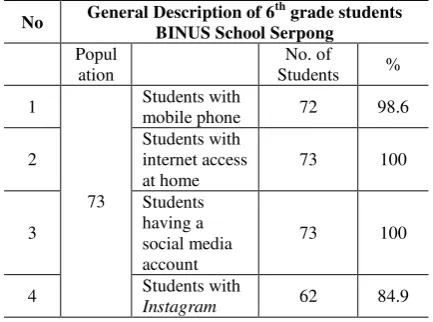
This study involved 73 students of the 6th grade in the Elementary Department of BINUS School Serpong.
The initial aspects observed for the success of the study if the students had a mobile phone, internet access at home, at least one social media account and Instagram. The general condition of the students based on the initial observation can be seen in the table 4.1.1.
No General Description of 6
th
Table 4.1.1. General Description of 6th grade students BINUS School Serpong
4.2 Action and Observation
| 459 Instagram about a topic given by the researcher.
The students were given one week to post their pictures using two hashtags, #6benglish, #6bidiom, #6cenglish, #6denglish, and
#6fenglish, Then, the students were informed that they could give comments about the posts. Moreover, the students could post their pictures at their own convenience and disposal.
The researcher observed the students‟ posts on Instagram through the hashtags. In the classroom, the researcher show what he found on Instagram with the students.
Some samples of the students‟ posts on
Instagram could be seen in the figure 4.2.
Figure 4.2. Samples of students‟ posts
During the observation week, the researcher found that there were many students posted and shared pictures on Instagram. The number of students‟ posting pictures on
Instagram could be shown in the table 4.2
.
No. of students with Instagram
No. of students posting pictures on Instagram
%
62 57 91.9
Table 4.2. Students‟ Instagram Posts
With 91.9% students‟ posting pictures on
Instagram, it was clear to the researcher that students were highly engaged in the activities. Moreover, when brought into class discussions, the posts could be a good instrument to initiate discussion amongst students. The researcher observed that students were more enthusiastic
when discussing the posts with their peers in the classroom.
4.3 Reflection
Reflection was done towards the process of planning and how the students reacted to the task on Instagram.
Based on the researcher‟s observation,
students were more engaged when they were to post pictures on Instagram. It was shown by the
numbers of the students‟ posts and comments.
Compared to traditional pen-and-paper homework as homework assignments, using
Instagram could draw more of students‟
attention.
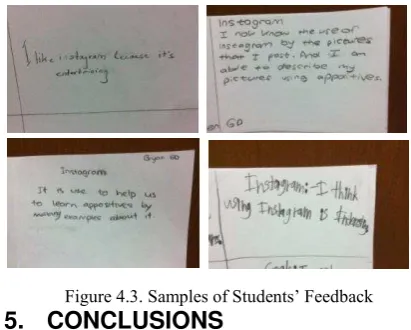
A small survey on students‟ feedback towards the use of Instagram in the class showed a promising result. 89% of students described that using Instagram in class was interesting, not boring, entertaining, fun, and helpful.
The details of the survey can be seen in the table 4.3.
Students’ Feedback on the Use of Instagram No. of Students % Positive
feedback 65 89
Negative
feedback 8 11
Table 4.3. Students‟ Feedback
Some samples of the students‟ feedback can
be seen in the figure 4.3.
Figure 4.3. Samples of Students‟ Feedback
5. CONCLUSIONS
| 460
1. able to draw more students‟ attention. This was shown by the number of picture posted by the students on Instagram.
2. able to increase the number of students involved in the discussion in class. Students were more focused and attentive when discussing the Instagram posts compared to when discussing the traditional pen-and-paper assignments. This was also supported by the feedback from the students.
These two indicators showed that the use of
Instagram is effective to raise student engagement towards a certain topic.
Suggestion
Based on the summary above, the researcher would like to point out a few things to consider for further study.
Though the research was restricted to the use of Instagram, it was arguably possible that in general, students were more engaged to their classes when there is an involvement of technology and internet. Therefore, a study on the use of other social media such as Facebook
or Twitter in class can be conducted.
Moreover, Educational institutions can now start to provide more training for their teachers on the use of technology in education.
6. REFERENCES
Kuh, G.D. (2007) How to Help Students Achieve.
Chronicle of Higher Education. 53 (41). pp. B12-13 Nagara, Aloy Tua. (2010). Peningkatan Minat Belajar
Siswa Dalam Pembelajaran Ilmu Pengetahuan Sosial Dengan Menggunakan Metode Bermain Peran SDN Purnasatria Kecamatan Satria Alas
Somekh, B., & Zeichker, K. (2009). Action Research.
Science Scope, 34(1), 24-29
Taylor, L. & Parsons, J. (2011). Improving Student Engagement. Current Issues in Education, 14(1). Retreived from http://cie.asu.edu/