| 565
AN ACTION RESEARCH THROUGH COOPERATIVE LEARNING
TO IMPROVE STUDENTS’ PORTFOLIOS
Suratni
Politeknik Negeri Media Kreatif, Jakarta, Indonesia
Corresponding e-mail: [email protected]
Abstract: This article is based on a classroom action research (CAR). In this research, I have acted as a Lecturer in CAR. This CAR has involved students in one class of Publishing Study Program Batch 6 Semester 3 in Politeknik Negeri Media Kreatif (PoliMedia) Jakarta. By applying a cooperative learning strategy, I set out to make magazines as a result of the writing assignments on English lesson. Magazines are chosen because the students have got writing and editing skills from English lesson, and layouting skills from Digital Graphics lesson. It means that the students have been taught to write and edit manuscripts, and they also have learned how to design magazine's cover and content. During sixteen weeks, the students followed the process of creating magazines. Finally, the students can increase their writing and editing capabilities, and thus help students to make their portfolios.
Keywords: CAR, cooperative, magazine, English, students, portfolio
1
INTRODUCTION
Action Research is a wide-ranging movement that has been going on in education. It is connected to the designs of ‘reflective practice’ and ‘the teacher as researcher’. Therefore, the action starts from problematizing, which means taking an area you feel could be done better, subjecting it to questioning, and then developing new ideas and alternatives. Thus, in Action Research, a teacher becomes an ‘investigator’ or ‘explorer’ of his or her personal teaching context, while at the same time being one of the participants in it.
Related to this Action Research, I am as an English lecturer in PoliMedia Jakarta would like to identify the gaps between what was actually happening in my teaching situation and what I would ideally like to see happening. In my action research, my colleague helped me to be the Observer, especially which related to magazine layout.
Through English lesson in Publishing Study Program, the students were given knowledge and skills of English gradually. In the first semester, the students got General English in order to achieve the same level of English lesson understanding among the students having various backgrounds. Then, in the second semester the students learned more on reading
texts and speaking. The learning outcome of this semester was that the students had speaking and reading skills at intermediate level.
Meanwhile, in the third semester the students got English for Specific Purpose (ESP) or English for Publishing. During the first and second semester, the students got general terminology, but in this semester they learned publishing terminology. The students were expected to be competent in writing and editing articles in English.
Good English language competences will help students put these capabilities into their long-term memory system and can be used to think at higher levels such as problem solving and creative thinking. These competences will facilitate students to achieve graduation standards criteria that have been set.
| 566
evaluation scores and the results of pre-researchsurvey, it was known that majority of students just learned English in the classroom and the students had a tendency to learn English for the exams only. Students have not applied their English skills in their daily life. When they got their internship interview, most company asked the students’ portfolios to see what things they learned and mastered in.
The gaps between the ideal conditions with current conditions as described above caused problems in learning English. The first semester learning outcome couldnot be continued to the second semester, and so on. In addition, the students’ behaviour to learning English only for the exam made problems up increasing that they only used their short-term memory. In fact, these English language skills should be applied in long-term memory, as the assets of communication that could be applied in the industrial world soon after the students graduate. The steps of English learning which did not run well made me as the teacher could not complete the learning package. The learning scheme became longer and slower because sometimes I needed to repeat or review some materials given in the previous semester.
To solve the issues, I took an action research. Here, I implemented a cooperative learning strategy to improve students’ writing and editing, skills. This learning design was considered the most effective way so that the students were easier to write and edit articles in English language because they finished the writing assignments cooperatively in their groups.
In this research, the given assignment was creating magazines. Magazines were selected because the students have studied related subjects, namely Introduction to Publishing, Introduction to Graphic Arts, Writing, Editing Basics, Graphics Digital and Photography. This research focus was to find ways to increase the students’ English writing and editing skills. It is associated to the product-based learning activity.
2.
METHOD
This research applied a classroom action
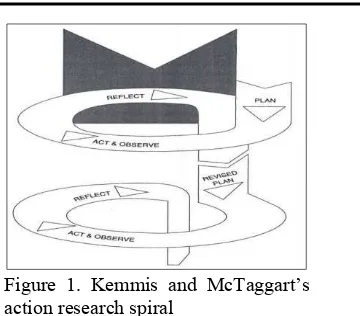
research (CAR) Kemmis & McTaggart Model that was shown on Figure 1. I arranged into three research cycles.
Figure 1. Kemmis and McTaggart’s action research spiral
2.1 Students: participants and collaborators in research
The research was conducted in term of the Academic Year 2014, when I taught English to the third semester. There is one class which had a total of thirty students, 12 boys and 18 girls, aged between seventeen and nineteen year old.
I was allocated a teaching time of sixteen weeks within three hours in each meeting. Most of the students were less able and had inefficient outcomes for English even though they had learned English for at least two semesters before. The students and I had met each other before I initiated this research.
2.2 Data collection
In this project, judgements of research outcomes were based on students’ work and their target language performance, so several methods were used for collecting data in order to increase the credibility of the obtained data (McMillan & Schumacher, 2001). They were the following: a. The magazine drafts were used as a means of
assessment in which students’ progress was measured. I kept the draft to analyze their language performance and progress after each cycle was completed and used them in parallel with other data collections over the period of research.
| 567
c. I observed the students’ activities in eachgroup to see the effectiveness of cooperative learning in creating magazines their portfolios.
d. I did a group interview at the end of each research cycle. The purpose of the interview was to get students’ feedback on the new teaching arrangements and their requirements of learning activities in the follow research cycles.
2.3 Data analysis
The magazine drafts were analyzed to see their language performance and progress after each cycle was completed and used them in parallel with other data collections over the period of research. Furthermore, I used my teacher journal to notice and remember all actual activities and events that happened and the feedback of students. Last, I used the group interview transcript to know their articles writing progress.
2.4 The action research cycles
We divided the period of data collection and analysis into three cycles. Each research cycle included four procedures of Plan, Act, Observe and Reflect following the action research method of Kemmis and Mc Taggart (1988), and comprised one classroom within a 5 week-long cycle.
2.4.1 Research Cycle 1
Plan, Act, Observe
a. I modified the syllabus and lesson plans of English lesson to be applied in this research. b. I decided to create magazines as students’
portfolios.
c. I devided the class into five groups.
They were divided according to their abilities so that would be beneficial to all students.
d. I explained the member responsibility.
e. Students discussed the magazine theme and created its structures.
Reflect
a. I evaluated the group composition and their magazines themes.
b. I gave feedback from the evaluation.
c. I revised the act based on the evaluation to be applied in the next cycle.
d. I evaluated the reflected act.
Research Cycle 1 would be assumed success, if it achieved these indicators
a. the instruments that have been prepared for this cycle can be applied properly, and
b. the learning process in the classroom runs well as its plan.
2.4.2 Research Cycle 2 Plan, Act, Observe
a. Each group reported their manuscripts.
b. All the manuscripts were going to be reviewed and edited.
c. The edited manuscripts were given to me for proofing. If it was acceptable, could be designed. If yet, the group reedited or changed the manuscripts.
d. After I agreed, the manuscripts could be layouted as the previous plan.
Reflect
a. I evaluated the group work.
b. I discussed the evaluation with the group. c. I revised the act based on the evaluation.
Research Cycle 2 would be assumed success, if it achieved these indicators
a. the instruments that have been prepared for this cycle can be applied properly, and
b. the learning process in the classroom runs well as its plan.
2.4.3 Research Cycle 3
Plan, Act, Observe
a. The group reported their dummy.
b. The observer gave his review on the magazine design.
c. After the group revised the dummy, both the observer and I gave proofing.
Reflect
a. I evaluated the group work.
b. I gave feedback based on the evaluation result. Research Cycle 3 would be assumed success, if it achieved these indicators
a. the instruments that have been prepared for this cycle can be applied properly, and
b. the learning process in the classroom runs well as its plan.
3
RESULT AND DISCUSSION
3.1 Research Result
Research Cycle 1
| 568
could be applied in publishing products, such asnewspapers and magazines.
Related to the class, I divided the class into five groups, which means one group consisted six students which had the mixed skills, ranging from writing, editing, to layouting.
The following were the five groups in my classroom research action. In each group, three students became writers, two editors, and one layouter. After that, each group hold a initial meeting to discuss their magazine’s theme, and made the structures.
Group I Job Description
1. Annisa Trihardi : Writer 2. Febri Retno : Writer 4. Alfian Hutabarat : Editor 5. Lucky Barata : Editor 6. Shindy Bonita : Layouter
Group III Job Description 1. Dinda Dara : Writer
2. Nisa : Writer
3. Sukriyati Fahma : Writer
4. Lukis : Editor
6. Sabrina Anggraini : Layouter
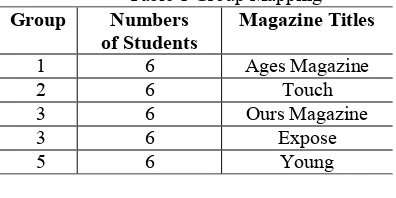
In the reflection, the students gave their opinion about themes and structures of their magazines. The fact, thay had much ideas on it. Although these ideas were pretty good, but it was quiet hard to accomplish due to variuos causes. That’s why, the five groups and I came to an agreement that the theme of magazines was about young people and their lifestyles. Table 1 was a summarize of Research Cycle 1.
Table 1 Group Mapping reviews on their manuscripts, relevant or not for their magazines. If the manuscripts were be approved, the students would continue to edit them. If yet, the group would reedit or change the manuscripts. Table 2 below was my record of this process.
Table 2. Review Record of Group Group SUB REL IRR ADD ADD : submit new manuscripts
| 569
Research Cycle 3
In the third Research Cycle, the group of students reported their dummy to me. Then, I asked the observer to give his review on the magazine design. The students made some revision. After the group revised the dummy, both the observer and I gave proofing.
3.2 Research Discussion
After sixteen weeks activity, the students have printed their magazines. They named their magazines into Ages Magazine, Touch, Ours Magazine, Expose, and Young. Below are covers and discussion of each magazine.
Group I
Ages Magazine is for young readers. It contains six rubriks. They are Hoax, Tips, Recipes, Community and Trends, Innovation, Hang out, and Culinary. It consists 16 pages including 10 articles and five advertisements.
Figure 2. Cover of Ages Magazine Group II
Touch is a magazine for young readers. It contains fourteen rubrix. They are Medical Update, Why Nuts are Good Food?, Musang Lovers Indonesia, Aerosmith, and many more. It consists 18 pages including 14 articles and five advertisements.
Figure 3. Cover of Touch
Group III
Ours magazine consists 24 pages, including two advertisements. Its contents are about fashion, event, healthy, tips and tricks, poem, design, biography, lyric and music, news, recommendation, sport, gossip, movie, culinary, and zodiac.
Figure 4. Cover of Ours Magazine
Group IV
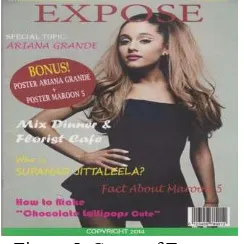
Expose is segmentated for youngsters. It consists of 28 pages. Some of the articles are about health, fashion, musician such as Ariana Grande and Maroon 5, and tourism spots at Nias.
Figure 5. Cover of Expose
Group V
| 570
Figure 6. Cover of YoungThis writing and editing activities resulted magazines as portfolios for its participants. Though the result still remained several weaknesses, but it could be a learning model for teaching English language writing and editing. The activity that was done by cooperatively gave us an innovation for teaching writing. Writing activity became easier because the students cooperated each other to write and edit the manuscripts.
4 CONCLUSIONS
Action Research is not problem-solving in the sense of trying to find out what is wrong, but rather a question for knowledge about how to improve. By doing this action research, I found that to be teachers all we have to do is updating ourselves. One of them is by arranging an action research.
Traditionally, students submitted their handwritting for writing assignments. Then, we asked them to type or send it to our email. We often used both types of giving writing tasks.
Based on the discussion, we can ask students to write and collect their writing tasks become one media, that is magazines. If our students do not have skills to create magazines, we may ask them to create leaflets, booklets, or even books using so many online templates.
5 ACKNOWLEDGEMENTS
In having the permission and the prvilege of making this research, I would like to express my gratitude and appresiasion to Director of PoliMedia, Vice Director for Academic Affairs, and Head of Publishing Major, all coelagues in Publishing Study Programs especially Mr Sulistiyo Wibowo for becoming the observer. Last but not least for my dear students, thank you for your understanding. I realized that this research is far from perfect that is why I appreciate it very much for any critisims concerning this research. I wish that it
might be useful and bring improvement to those who concern about it.
6 REFERENCES
Kemmis, S., & McTaggart, R. (eds). (1988). The action research planner (3rd ed). Victoria : Deakin University.