PROSIDING ICTTEFKIP UNS 2015 ISSN: 2502-4124 Vol 1, Nomor 1, Januari 2016
Halaman:
| 812
How Student Learn Ohm Law in The Classroom
Sarwanto, Widha Sunarno, Elvin Yusliana
Sebelas Maret University Jl Ir. Sutami 36 A, Surakarta, Indonesia
Corresponding e-mail: [email protected]
Abstract: Most of Indonesian Physics teachers begin to teach dynamic electricity with explain the meaning of electric
current, ohm’s law, a parallel series circuit, continuing with the example problems, provide practice answer -questions, ending with examination. This study aims to analyze how to learn ohm’s law on student learning with this traditional approach and problem based learning approach. This research method is descriptive analytic study, with a sample of first-year students at the college. In traditional approach student can solve the problem in low order thingking skills but not in high order thingking skills. Student who learn with problem based learning can demonstrate their skill in thingking and psychomotor. It shows students how to think is partial, view of the symptoms considered only on the symptoms. The mindset of the students has been changed into a more holistic when the research data analyzed simultaneously by using linear regression.
Keywords: ohm’s law, traditional approach, problem based learning
1.
INTRODUCTION
Research related to the study of physics has been widely published (Carmichael et al, 1990; Pfundt & Duit, 1991; Wandersee, Mintzes & Novak, 1994). Results of the research show that students already have a prior knowledge, ideas of science, knowledge of nature and technology prior to the formal learning process is done. In addition, also found some intuitive concept that is different from a scientific view, giving rise to
misconceptions (e.g. Helm, 1980),
preconceptions (e.g. Novak, 1977), alternative conceptions (Driver & Easley, 1978) or children’s science (Gilbert, Osborne & Fensham, 1982).
Physics Education Program of Teacher Training and Education Faculty have many problems in student performance. One indicator is in the laboratory we found more than 50% damaged electricity measuring devices. These tools are indispensable to do an experiments on electricity yet. The experience from study in senior high school, most of Indonesian physics teachers begin to teach dynamic electricity with explain the meaning of electric current, ohm’s law, a parallel series circuit, continuing with the example problems, provide practice
answer-questions, ending with examination.
Furthermore, these intuitive conceptions were found to be extremely robust to change and were often held intact by children and adults alike even after completion of years of formal science instructions. Thus the problem of how to bring about conceptual change in learners becomes a major challenge to science educators.
Indonesian Curriculum 2013 requires learning is done with scientific approach. In scientific approach, student activities include observing, ask, try, reason and communicate. Student activity like this is easy to do when learning the experimental method. Student inquiry is defined as a versatile activity that involves making observations, posing questions, examining books and other sources of information to see what is already known; planning investigations; reviewing what is already known in light of the student's experimental evidence; using tools to gather, analyze and interpret data; proposing answers,
explanation, and predictions; and
PROSIDING ICTTEFKIP UNS 2015 ISSN: 2502-4124 Vol 1, Nomor 1, Januari 2016
Halaman:
| 813
practice of teaching (e.g., Piaget & Szeminska,1952; McLellan & Dewey, 1895; Brownell, 1928).
Psychometrics lent support to classical experimental design—that to experiment means to manipulate variables. In classical experimental research, tasks, items, dimensions, and so forth were objects to be manipulated. It was through such manipulation that researchers controlled students’ environments and, hence, uncovered the reality of their knowledge. From a constructivist perspective, however, there is no such thing as a “constant” stimulus; students construct for themselves the tasks in which they actually engage, and it is the constructive process and the constructed task that are interesting scientifically (Powers, 1978).
2. METHOD
This study was conducted on 32 students of physical education study subjects who will took as a teacher physics in high school. The student has the 6th semester, this semester they also take courses microteaching. Students already passed the fundamental physics courses, basic math, electronics and mechanics. Based on the description of the subjects that have been taken, the students have the ability early enough to pack into a physics course in high school physics teaching.
Study of secondary school physics lecture was held for four months (12 lectures), and by learning through multiple instructional methods. At first the students were given a demonstration of learning method, followed by an experimental method, the last lecture was held by the method of inquiry. Learning resources using Serway book, and students are asked to pack the material physics for microteaching activities. Learning ohm’s law itself is done as much as one-off meeting of the two meetings about dynamic electricity. Data were analyzed descriptively qualitative.
3.
RESULT AND DISCUSS
The identification results using physics textbooks in middle school together showed 94% of students do not like textbooks. Textbook contains many lengthy verbal information, detailed information, using a standard language, make students confused and difficult to understand the content of textbooks. It shows students have difficulty understanding the information that is textual. These results are consistent with research Ramelan (2008) which states that high school students have a weakness
in understanding the text, and text comprehension correlated with cognitive ability.
The preferred source of lessons students are work-books students (Lembar Kerja Siswa-LKS). Analysis of the 10 LKS for physics students found that: LKS book contains a summary of the material, physics formulas, and examples of problems, exercises, and exams. Although in LKS no indication experiment, but experiments in LKS is verification of the summary material. Physics interpreted by most students as subjects which contain definitions, formulas and calculations. Therefore, the book is a book that favored students who directly provide definitions, formulas, and practice counting using the existing formula. This result is in line with the opinion that in the textbooks, the subject matter is often approached from a factual and calculus-based angle. Students are presented with facts, definitions, and laws, and they are taught equations (e.g., based on Ohm’s Law, I = V/R) that can be used to solve standard circuit problems (Frederiksen et al., 1999; Gunstone et al., 2009; Jaakkola et al., 2011; McDermott & Shaffer, 1992).
PROSIDING ICTTEFKIP UNS 2015 ISSN: 2502-4124 Vol 1, Nomor 1, Januari 2016
Halaman:
| 814
Geban, 2007). Electrical learning difficultiescaused by lack of mastery of concepts, lack mathematical ability, and the incapacity of students in converting units. Students find it difficult to achieve the goal of learning: using a voltmeter and ammeter in series; and understand the Law of Kirchoff II, for 2 loops (Rusilowati, 2006).
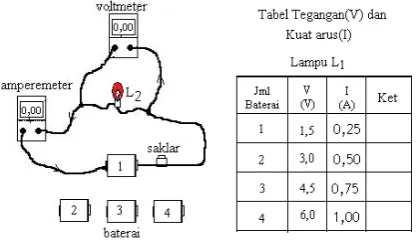
In inquiry learning, students learn through exploration and application of scientific reasoning. It has been found to be among the most effective methods for acquiring conceptual knowledge (Alfieri, Brooks, Aldrich, & Tenenbaum, 2011; Deslauriers & Wieman, 2011). But in Indonesia, most famous learning resources is LKS not textbook. In the LKS, students can study definitions, laws, and they are taught equations (e.g., based on Ohm’s Law, I = V/R). Another student activity is doing an experiment that be designed like figure 1.
Figure 1. Ohm’s Law experiment design
Based on the design of this experiment, the students conducted an experiment to prove the data that has been presented in the table. Design of experiments like these do not require students to experiment, because the existing data students can analyze the data. However, if this data is analyzed will be found a lot of mistakes. Graphics are not through the center of coordinates, so that there is a deviation from the chart should be. Implementation of the study, was not carried out an analysis of the chart is formed, only the relationship between V and I. Based on this design, the compiler of the book looks not seriously attempted to obtain data.
The experiments were performed despite
ohm’s law for verification, it was quite
interesting for students. One of which caused a lot of students who are still not familiar with
electrical measuring instruments. This fascination with the power tool make students enthusiastic in learning about electricity. The fact that occurs when the design is implemented, the impact ammeters damaged. Papadouris and Constantinou (2009) argued that the accumulation of experiences with natural phenomena through active exploration, investigation, and interpretation provides a basis
for the development of conceptual
understanding. The role of active
experimentation by students in science learning was also emphasized by Steinberg (2000). In his opinion there are at least two elements that appear to be critical in making science instruction successful. First, successful instruction is based on understanding how students make sense of the subject matter. That is, instruction must take into account the ideas and conceptions the students already have about the subject matter. As stated in the introduction, electricity is an abstract and intangible concept; however, most people have conceptions, often pre-scientific and idiosyncratic ones, about what electricity is and how electricity “behaves”. Steinberg emphasizes the importance for instruction of helping students to “elicit” their own conceptions and using those conceptions as a starting point for the instruction. Second, students must be actively engaged in finding out what is happening instead of just witnessing something being presented.
We did redesign the experiment guide ohm’s law. Wrong electrical circuit causes damage ammeter because current flows exceeds the maximum allowed by the electrical measuring devices. So that the current flowing through the ammeter according to their ability in the circuit ammeter then mounted potentiometer as a flow regulator. By using a variable potentiometer daam free this trial is an electrical current, while the dependent variable is the electrical voltage. The data obtained will be more than in the previous experiment design. Transformation into a flow chart on the abscissa and on the ordinate the voltage will make it easier to get the physical meaning of the slope of the graph. Mathematically, the slope of this graph has meaning barriers and in accordance with the ohms law.
4
CONCLUSIONS
PROSIDING ICTTEFKIP UNS 2015 ISSN: 2502-4124 Vol 1, Nomor 1, Januari 2016
Halaman:
| 815
student learning verbalistic. Ohm’s law issimply a statement of concepts, mathematical formula, which needs to be calculated to get the result. Through redesign learning ohm’s law, students learn in a holistic manner, covering the circuit, the data pattern, data analysis and conclusions obtained. Students not only understand the ohm’s law, but also showed activity in thinking, planning, implementing in real events in everyday life.
5 REFERENCES
Alfieri, L., Brooks, P. J., Aldrich, N. J., & Tenenbaum, H. R. (2011). Does discovery-based instruction enhance learning? Journal of Educational Psychology, 103, 1-18.
Başer, M., & Durmuş, S. (2010). The effectiveness of computer supported versus real laboratory inquiry learning environments on the understanding of direct current electricity among pre-service elementary school teachers. Eurasia Journal of Mathematics, Science and Technology Education, 6, 47-61.
Başer, M., & Geban, Ö. (2007). Effect of instruction based
on conceptual change activities on students' understanding of static electricity concepts.
Research in Science & Technological Education, 25, 243-267
Brownell, W. A. (1928). The development of children’s number ideas in the primary grades. Chicago: University of Chicago Press.
Campbell, D. T., & Stanley, J. C. (1966). Experimental and quasi-experimental designs for research.
Chicago: Rand McNally
Carmichael, P., Watts, M., Driver, R., Holding, B., Philips, I. & Twigger, D. (1990). Researchon students’
conceptions in science: A bibliography.
Leeds,England: Children’s Learning in Science
Research Group. (University of Leeds).
Deslauriers, L., & Wieman, C. E. (2011). Learning and retention of quantum concepts with different teaching methods. Physical Review Special Topics - Physics Education Research, 7, 010101. Driver, R. & Easley, J. (1978) Pupil and paradigms: A
review of the literature related to concept development in adolescent science students.
Studies in Science Education, 5, 61- 84.
Frederiksen, J. R., White, B. Y., & Gutwill, J. (1999). Dynamic mental models in learning science: The importance of constructing derivational linkages among models. Journal of Research in Science Teaching, 36, 806-836.
Gilbert, J., Osborne, R., & Fensham, P. (1982). Children’s
science and its consequences for teaching.
Science Education, 66, 623-633.
Gunstone, R., Mulhall, P., & McKittrick, B. (2009). Physics teachers’ perceptions of the difficulty of teaching electricity. Research in Science Education, 39, 515-538.
Hart, C. (2008). Models in physics, models for physics learning, and why the distinction may matter in the case of electric circuits. Research in Science Education, 38, 529-544.
Helm, H. (1980) Misconceptions in Physics amongst South African Students. Physics Education, 15(2), 92-97.
Jaakkola, T., Nurmi, S., & Veermans, K. (2011). A comparison of students' conceptual understanding of electric circuits in simulation only and simulation-laboratory contexts. Journal of Research in Science Teaching, 48, 71-93. McDermott, L. C. (1991). What we teach and what is
learned: Closing the gap [Millikan Lecture 1990].
American Journal of Physics, 59, 301-315. McDermott, L. C., & Shaffer, P. S. (1992). Research as a
guide for curriculum development: An example from introductory electricity. Part I: Investigation of student understanding. American Journal of Physics, 60, 994-1003.
McLellan, J. A., & Dewey, J. (1895). The psychology of number. New York: constantly Appleton. Novak, J. D (1977). A Theory of education. Ithaca, NY:
Cornell University press.
Papadouris, N., & Constantinou, C. P. (2009). A methodology for integrating computer-based learning tools in science curricula. Journal of Curriculum Studies, 41, 521 - 538.
Pfundt, H, & Duit, R. (1991). Bibliography: Students’
alternative frameworks and science education.
Kiel, Gen. University of Kiel Institute for Science Education.
Piaget, J., & Szeminska, A. (1952). The child’s conception
of number. London: Routledge and Kegan Paul. Powers, W. (1978). Quantitative analysis of purposive
systems: Some spadework at the foundations of scientific psychology. Psychological Review, 85(5), 417–435.
Ramelan, R. (2008). Bahasa dan kognisi Studi korelasional tentang pemahaman teks ekspositori dan berpikir
deduktif dan induktif pada siswa SMA. Wacana,
Journal of the Humanities of Indonesia, 10(1), 72-89
Steinberg, R. N. (2000). Computers in teaching science: To simulate or not to simulate? American Journal of Physics, 68, S37-S41.
Wandersee, J.H., Mintzes, J.J. and Novak, J.D.(1994) Research on alternative conceptions in science. In D.L. Gabel (Eds.), Handbook of research on science teaching and learning, Macmillan, 177-210.