J.Food Pharm.Sci. 1 (2013) 18-21
Avalaible online at www. jfoodpharmsci.com
Research Article
The Effect of Size Reduction and Preparation Duration on The Antioxidant
Activity of White Saffron (
Curcuma
mangga
Val.)
Dwiyati Pujimulyani1*, Sri Raharjo2, Y. Marsono2 and Umar Santoso2 1
Faculty of Agroindustry, Mercu Buana University, Yogyakarta, Indonesia 2
Faculty of Agricultural Technology, Gadjah Mada University, Yogyakarta, Indonesia
ARTICLE INFO ABSTRACT
Received 05/01/2012
Received in revised form 23/02/2012 Accepted 03/03/2012
Available online 06/03/2012
1. Introduction
White saffron which is locally known as “temu
mangga” is a bush perennial plant and has stalk rhizomes. When the rhizome is cut, the yellow flesh is clearly visible on the outside layer and slightly light yellow flesh in the center layer. The aroma and taste of white saffron are similar to those of ripe mangoes. The white saffron extract showed antioxidative activity, mainly due to curcuminoid and tannin contents (Pujimulyani and Sutardi, 2003). The antioxidative activity of curcumin, demethoxy curcumin, and
bisdemethoxy curcumin were 20, 9 and 8 times higher
than that of α–tocopherol, respectively (Toda et al.,
1985). Jitoe et al. (1992) examined the antioxidative activity of curcuminoids in alcohol-water system and reported that each compound gave an antioxidative
activity of approximately .5 times higher than α–
tocopherol.
Previous studies exhibited that white saffron in the form of syrup, instant powder, effervescent tablet (Pujimulyani and Wazyka, 2005), and dried sweets (Pujimulyani and Wazyka, 2009) have antioxidant activity. These products were prepared by heating (boiling), but they remain to have antioxidant activity. This suggests that some of antioxidant components within the white saffron are thermally stable, and some other compounds may change into different compounds having higher antioxidative activity compared to parent compounds.
The processing of agricultural product is always conducted through several preparation stages, namely peeling, washing, cutting, and storing during waiting of processing stage. The preparation of material must be done carefully, in order to keep products in good quality. The rhizomes of white saffron contain antioxidant; therefore, it is interesting to carry out a Food processing is usually conducted through preparation stages such as peeling, slicing, or cutting. The purpose of this research was to determine the correlation between the antioxidant activity and the total phenolic compounds of white saffron as affected by different level of size reduction and the duration of rhizome preparation at room temperature. White saffron rhizomes were peeled, washed, and cut into 1x1x1 cm3. The whole white saffron was sliced diagonally at thickness of 4 x 2 mm, and grated. The antioxidant activity of the white saffron was determined by radical scavenging activity using 2-2-diphenyl-1-picrylhydrazyl (DPPH) radical and by ferric reducing antioxidant power (FRAP) method. The total phenol and total flavonoid contents were also determined at 2, 4, and 6 hours, respectively. The result showed that the antioxidant activities, total phenolic and flavonoid contents due to the preparation of whole white saffron for 6 hour are not statistically different compared to those of fresh white saffron. The preparation of white saffron sliced at 2 mm and grated for 2 hour showed a significant decrease in the antioxidant activities, compared to those of fresh white saffron.
Keywords: white saffron, preparation duration, antioxidant activity, total phenol
2
research on the antioxidant activity of white saffron during preparation. The purpose of this research was to determine the correlation between the antioxidant activity and total phenolic contents of white saffron, as affected by different level of size reduction and the duration of rhizome preparation at room temperature.
2. Materials and Methods 2.1 Materials
The rhizomes of fresh white saffron (Curcuma
mangga Val.) were harvested from a local farm in
Yogyakarta. Methanol, HCl, acetic buffer, 2,4,6-tri-(2-pyridyl)-s-triazine (TPTZ), FeCl3.6H2O, Fe2+, N2, CH3CN, citric acid, acetic ethyl are purchased from E. Merck (Darmstat, Germany). Aquabidestilata was bought from Ika Pharmindo (Indonesia). 2,2-diphenyl-1-picrylhydrazyl (DPPH) radical, Folin-ciocalteu reagent, gallic acid (GA), sodium carbonate, and ethanol were obtained from Sigma Chemical Co. The equipments used were spectrophotometer (Shimadzu UV-Vis 1601), vortex, centrifuge (BUCHI Rotavapor R-114), and an incubator.
2.2 Methods
2.2.1 Preparation of White Saffron Samples
The rhizomes of white saffron were peeled, washed, cut into 1x1x1 cm3. Other variants are: the whole white saffron, sliced diagonally 4 mm thick and 2 mm antioxidant of extract was determined using radical scavenging of 2-2-diphenyl-1-picrylhydrazyl (DPPH) and ferric reducing antioxidant power (FRAP). The total phenol and total flavonoid contents were also determined at 2, 4, and 6 hours.
2.2.2 Radical Scavenging Activity
The radical scavenging activity of of white saffron extracts toward DPPH radical was determined according to Xu and Chang (2007). 0.2 ml of the sample was added with 3.8 mL of 0.05 mM DPPH and was mixed with vortex (1 minute), and incubated for 30 minutes at room temperature,. The absorbance was measured at 517 nm The control was ethanol without extract. The capacity of free radical scavenging activity (RSA) was calculated using the following equation:
2.2.3 Ferric Reducing Antioxidant Power (FRAP) Assay Antioxidant capability to reduce Fe3+ was FRAP reagent was heated at 37 ºC for 10 minutes. A-100
l of the sample was mixed with 00 l distilled water
and mixed with FRAP reagent using vortex for 1 minute and left for 4 minutes. The absorbance was determined
at 59 nm.The FRAP value was calculated in mg ferro
equivalent/g dried extract using calibration curve of Fe2+ (from 4.3 to 137.5 mg ferro/L, r = 0.99).
2.2.4 Determination of Total Phenolic Content
The total phenolic content (TPC) was determined by a Folin Ciocalteu assay (Singleton and Lamuela-Raventos, 1999; Roy et al., 2009) using gallic acid (GA) as
the standard. The sample 50 L and 50 L of Folin
-Ciocalteu’s reagent were mixed in a tube and incubated
for 1 minute at room temperature. Furthermore, 20% Linearity range of the calibration curve was 31.875 to 510 µg/L with the coefficient of correlation of 0.9998.
2.2.5 Determination of Total Flavonoid Content
The total flavonoid content (TFC) was determined expressed as quercetin equivalent (mg of QE/g sample) through the calibration curve of quercetin. Linearity range of the calibration curve was 1.25 to 80 mg/L with the coefficient of correlation (r) of 0.9998.
2.2.6 Statistical Analysis
The data were tested statistically with SPSS software. If there is any significant difference, the test was followed by Duncans Multiple Range Test (DMRT). Person correlation analysis is used to indicate a correlation between antioxidant activity with levels of total phenols and flavonoids of white saffron during preparation. The significance level was set at p <0.05.
3. Result and Discussion 3.1 Antioxidant Activity
3
(Figure 1). . Furthermore, Figure 2 exhibited the FRAP value of white saffton as a function of preparation duration.
Fig 1. The changes in antioxidant activity of white saffron as affected by level of size reduction and duration of
preparation.
Fig 2. FRAP values during the preparation of white saffron
Figure 1 and Figure 2 showed that the preparation of saffron whole and pieces of white cubes and slices of 4 mm for 6 hours had no effect on the level of antioxidant activity. Preparation of white saffron and grated 2 mm slices for 6 hours showed a lower antioxidant activity significantly. The surface area of white saffron in the form of grated white saffron became larger so it is expected to accelerate the enzymatic oxidation, resulted in DPPH values decreased significantly. This was because the surface of grated white saffron was the largest. This could increase the activity of polyphenol oxidase, so that antioxidant activity to decrease.
The higher the level of white saffron tissue damage, the more effective contact between phenolic substances and poliphenolases, which lead to faster enzymes oxidation reaction. In accordance with the results of research Gardjito et al. (2006) that the surface area mesocarp sliced yellow squash 3 times larger then the enzyme activity poliphenoloxidase 3 times larger as well. Enzymatic oxidation reactions that lead to polyphenol compounds transformed into quinone, this will lead to the capture of free radicals including antioxidant polyphenol compounds also decreased.
3.2 The Total Phenol and Flavonoid Content of the White Saffron During Preparation
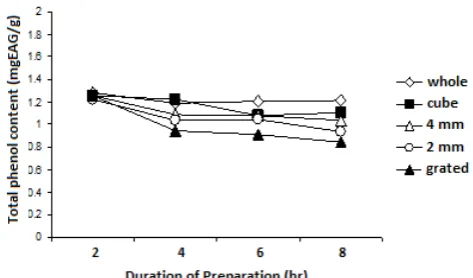
Levels of total phenols and flavonoid during the preparation of white saffron is presented in Figure 3. and Figure 4, respectively.
Fig 3. Levels of total phenols during the preparation of white saffron
Fig 4. Total flavonoid content of white saffron during the preparation
The levels of phenolics and flavonoid contents of white saffron prepared at 6 hr showed levels of total phenols fixed or do not change significantly, this also occurs in white saffron cubes and slices of 4 mm. Preparation of no sliced white saffron for 6 hours did not affect significantly on levels of total phenols. White saffron slices with a thickness of 2 mm and grated form shows the total phenol content decreased significantly during the preparation of 0 hours and 2 hours, 2 hours and 4 hours, 4 hours and 6 hours. This is because of suspected enzymatic oxidation of the tissue damage triggered by the level of the greater surface area of white saffron. Phenols or polyphenols experienced oxidation enzymatically to form quinone, then undergo polymerization into melanin, then total phenol levels decrease.
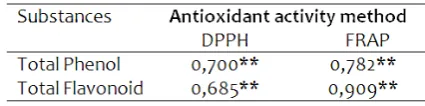
The correlation between the antioxidant activity, the total phenol, and the total flavonoid of white saffron at a duration of 6 hour preparation in room temperature is shown in Table 1.
4
Table 1. Correlation between antioxidant activity, total phenol, and total flavonoid of white saffron
**Correlation is significant at the 0.01 level
Table 1 showed that the antioxidant activity correlated significantly with white saffron phenolic compounds namely DPPH (Etrolox mg/g) with total phenols (EAG mg/g), total flavonoids (mg CE/g) and total value of FRAP with phenols and total flavonoids. This is accordance with the results of research Xu and Chang (2007) on antioxidant activity and phenolic compounds of nuts.
4. Conclusion
The preparation of whole white saffron for up to 6 hours showed no significant difference in terms of antioxidant activity, total phenol, and total flavonoid compared to those of fresh white saffron. The antioxidant activity of white saffron has significantly positive correlation with total phenol, and total flavonoid.
Acknowledgements
The authors thank the Directorate General for Higher Education (DGHE), Ministry of National Education, Republic of Indonesia, for providing fund for this study through BPPS scholarship and HIBAH DOKTOR 2009 research grant.
References
Aditya, I. P. Formulasi Tablet Effervescent Ekstrak Kunir Putih
dengan Variasi Sumber Asam. Fakultas Farmasi, UGM,
Yogyakarta. 2004.
Damayanti, L. Y. Upaya Pembuatan Tablet Ekstrak Temu
Mangga (Curcuma mangga Val.). Fakultas Farmasi, UGM,
Yogyakarta. 2002.
Dewanto, V.; Wu, X.; Adom, K.K.; and Liu, R.H. Thermal Processing Enhances The Nutritional Value of Tomatoes by Increasing Total Antioxidant Activity. J. Agri. Food
Chem.2002. 50(10). 3010-3014.
Gardjito, M.; Adnan, M.; and Tranggono. Etilen luka, Aktivitas Enzimm Peroksidase, Polifenol Oksidase dan fenil Alanin Liase pada Irisan Mesokarp Labu Kuning. Agritech. 2006. 26 (1). 14-23.
Pujimulyani D.; and Wazyka A. Sifat Antioksidan Sifat Kimia dan Sifat Fisik Manisan Basah dari Kunir Putih (Curcuma
mangga Val). Agritech. 2009a. 29 (3). 167-173.
Pujimulyani D.; and Wazyka A. An Antioxidant Activity and Curcumin Content of Dry Sweets from White Saffron
(Curcuma mangga Val), International Chemistry Seminar
Proceeding. ISSN No.1410-8313. 2009b. 82-86.
Rahayu, Y. D. Pengaruh Perbandingan Bahan Pengisi Manitol-dekstrosa terhadap Kualitas Tablet Hisap Ekstrak Rimpang
Temu Mangga (Curcuma mangga Val). Fakultas Farmasi
UGM. Yogyakarta.2004.
Roy, M.K.; Juneja, L.R.; Isobe, S.; and Tsushida, T. Steam Processed Broccoli (Brassica oleracea) has Higher Antioxidant Activity in Chemical and Cellular Assay Systems. Food Chem. 2009. 114. 263-269.
Turkmen, N.; Sari, F.; and Velioglu, Y. S. The Effect of Cooking Methods on Total Phenolics and Antioxidant Activity of Selected Green Vegetables. Food Chemistry. 2005. 93. 713-718.
Volden, J.; Borge G. I. A.; Bengtsson G. B.; Hansen M.; Thygesen I.E.; and Wicklund T. Effect of Thermal Treatment on Glucosinolates and Antioxidant-Related Parameters in Red Cabbage (Brassica oleracea L. ssp. capitata f. rubra),
Food Chem. 2008. 109. 595-605.