®
A Comprehensive Comparison
of Lexemes in the Major
Languages of Tanna, Vanuatu
A Comprehensive Comparison of Lexemes
in the Major Languages
of Tanna, Vanuatu
Kenneth Nehrbass
SIL International
®SIL e-Books
34
2012 SIL International
®ISBN: 978-1-55671-276-0
ISSN: 1934-2470
Fair-Use Policy:
Books published in the SIL e-Books (SILEB) series are intended for scholarly research and educational use. You may make copies of these publications for research or instructional purposes free of charge (within fair-use guidelines) and without further permission. Republication or commercial use of SILEB or the documents contained therein is expressly prohibited without the written consent of the copyright holder(s).
Series Editor
Mike Cahill
Volume Editors
Dirk Kievit
George Huttar
Managing Editor
Bonnie Brown
Composition
iii
Contents
Acknowledgments Abstract
List of map, tables, and figure
Section A. Background
Chapter 1. Introduction to the study
1.0 Introduction
1.1 Purpose of the study 1.2 Data collection 1.3 Methodology
1.3.1 The advantage of dictionaries over Swadesh wordlists 1.3.1.1 Discovering idiosyncrasies of a language
1.3.1.2 Potential for errors in a Swadesh wordlist
Chapter 2. Some preliminary results from the comparative analysis
2.0 Introduction
2.1 Determining cognates
2.1.1 Phonological reasons for dissimilarity of cognate lexemes 2.1.1.1 Consonant correspondence
2.1.1.2 Vowel correspondence
2.1.2 Non-phonological reasons for dissimilarity of cognate lexemes 2.1.2.1 Historical synonyms
2.1.2.2 Idioms and abstract ideas with different base words 2.2 Applications of a comparative analysis
2.2.1 Determining degree of similarity between languages 2.2.2 Finding identical lexemes in languages
2.2.3 Doing semantic comparison between languages 2.2.3.1 Semantic correlation in languages
2.2.3.2 Semantic non-correlation in languages
2.2.4 Differentiating between homonyms and polysemous lexemes
Chapter 3. Using the multi-language lexicon
3.0 Introduction 3.1 Orthography
3.1.1 Influence of mission history on orthography 3.1.2 Influence of unique phonologies on orthography 3.1.3 Modern orthography
iv
Section B. Lexicon
Appendix A.Nearly identical lexemes in Tanna’s languages Appendix B. Birds of Vanuatu included in the lexicon
Appendix C. Plants and trees of Vanuatu included in the lexicon Abbreviations
References
v
Acknowledgments
Dozens of people helped with the data and analysis of this lexicon and with the preparation of the manuscript. Specifically, Ruben Aiyoh, Pastor Joshua Jimmy Ioanavir, Eliud Kapan and his wife Miriam, Tom Napikou, Jymi Nokout and his wife Anita, Pastor Peter Rei, Jacob Willie, Daniel Yahi, and Kilion Yo assisted as informants. In addition, Greg and Beth Ann Carlson, Erik and Michele Stapleton, and Tim Zylstra provided their dictionaries, expertise, and opinions on the lexical entries and analysis of North Tanna, Kwamera, and Lenakel
respectively, while John Lynch provided guidance on Proto South Vanuatu. My wife Mendy helped me tremendously with the compilation of the SW Tanna dictionary. Chuck Grimes, David Healey, and Ross and Lyndal Webb gave
vi
Abstract
Tanna Island in Vanuatu has five major languages and perhaps as many as two dozen dialects. However, only a few grammar sketches and dictionaries have been published on the languages of Tanna. In this document, more than 1,700 of the commonly used lexemes in all of the five major languages as well as a dialect spoken on Tanna are presented in one volume. Rather than eliciting the data from wordlists based on the lingua franca, the lexemes have been gleaned from full-length dictionaries compiled by three linguists who have worked for a combined experience of 34 years on Tanna Island. A comparative analysis based on this lexical data has made it possible to determine degrees of similarity between all of the island’s languages. The dissimilarity in lexemes across languages has also been revealing, as it has shown idiosyncrasies of each of the languages. The
vii
List of map, tables, and figure
Map 1. Map of Tanna: Languageareas and villages where data was elicited. ... 3
Table 1.1. Demographic information on the languages of Tanna. ... 3
Table 1.2. Some idiosyncratic lexemes in the languages of Tanna. ... 4
Table 1.3. Some Tanna lexemes with idiosyncratic secondary meanings. ... 5
Table 1.4. Potential errors when performing a cursory survey. ... 7
Table 2.1. Consonant correspondence. ... 9
Table 2.2. Vowel correspondence. ...11
Table 2.3. Degree of correspondence between the languages of Tanna. ...16
Table 2.4. (Nearly) identical kastom lexemes in the languages of Tanna. ...17
Table 2.5. Idiosyncratic lexemes in the languages of Tanna. ...19
Table 3.1. Minimal pairs for [ɨ], [ə], and [a]. ...24
Section A. Background
Chapter 1.
Introduction to the study
1.0
Introduction
When people greet each other in Lenakel, Tanna, they say rawɨt lakapnəpɨn. In Whitesands, they say tawɨr laplapen. In the southern mountains they say rhuvə namsuk. In Kwamera, on the southern tip, it’s ramasan nəpnəpɨn. A small number of people by Mount Yasur Volcano in the southeast say thuvə yenpengenpeng. In the north, they say tawɨr loulaugɨn. Tanna’s folklore says that the ancestors in the mythical days argued with each other about how to talk, so one said, “Fine, I’ll say ‘I do it’ my way,” and another said, “Fine, I’ll say ‘I do it’ my way.” Thus, the argument was settled. They spread out and each began speaking his own way.
1.1
Purpose of the study
Inhabitants of Tanna have counted as many as 25 different dialects, but linguists recognize five major languages spoken on Tanna: Kwamera (a.k.a. South Tanna, hereafter S Tanna), Lenakel, North Tanna (hereafter N Tanna), Southwest Tanna (hereafter SW Tanna), and Whitesands (Gordon 2005:303; Lynch 1982:2). It has been difficult to establish the language boundaries and language group sizes on Tanna and to determine whether a particular variety is a dialect or a different language. The reason for this is the lack of adequate language data to verify the degree to which the languages vary from one another. Most of the languages and dialects have had minimal analysis. Only three have dictionaries or grammar sketches. For others, comprehensive lexical data has not been published previously, making such data unavailable to linguists and speakers of Tanna’s vernaculars.
In light of the underrepresentation of Tanna’s languages, the purpose of this book is to supply a substantial portion of the previously unpublished lexical data and to begin some comparative analysis. Here, I compare more than 1,700 lexemes in the five major languages of Tanna listed above as well as a dialect of SW Tanna called Vaha, which is spoken between the Whitesands and SW Tanna language boundary.1
The language data here presented can prove helpful for historical linguists to determine how the languages of Tanna have evolved. Or, to continue the legend mentioned above, this data can help us discover just what the ancestors did when they settled their argument, spread out, and began talking in their own ways. Which of the ancestors won that mythical argument—that is, which
lexemes seem to have been most resistant over time? What ‘paths’ did those
1
ancestors follow as they began settling and speaking in their own ways—that is, can we determine a geographic pattern of language change based on changes in the lexicons? Such questions are not fully answered here, but sufficient data is provided to begin answering them.
Charpentier’s (1982) monumental atlas of lexemes in the languages of the southern half of Malekula (Vanuatu) inspired me to create a comprehensive ‘map’ of the Tannese lexemes. South Malekula experienced drastic migration in the past one hundred years, as those who lived inland moved to the coast. The migration patterns are evident in the language changes. While Tanna has not undergone the same sort of migration, the lexical changes still enlighten us about migration patterns and the relationships between languages.
On a more popular level, the data of this study can be used by speakers of one Tanna language to ascertain how their words are expressed in other areas on Tanna. As more works in the Tanna vernaculars are published, readers will encounter words in languages with which they are less familiar. This book thus helps to familiarize speakers of Tanna languages with the other languages spoken on the island.
1.2
Data collection
The data in this volume was collected by myself between 2003 and 2010, as well as by two other SIL linguists who performed extensive fieldwork on Tanna: Greg Carlson (1991–2007) and Erik Stapleton (2004–2010). Many local speakers have assisted in the task of lexicography during this time. I held numerous lexicography workshops in various villages throughout my tenure on Tanna in order to elicit words, find synonyms, track dialectal changes, refine English glosses, and produce example sentences. Carlson, Stapleton, and myself have also carried out numerous discourse analyses in order to determine specific nuances of lexemes.
I am indebted to Lamont Lindstrom for his dictionary of Kwamera (1986), and to John Lynch for his work on Lenakel (1978) and SW Tanna (1982). The data and analysis here were informed by their work. In some cases this study corresponds with lexemes that they recorded; in other places this study shows how lexemes have changed since their works were published.
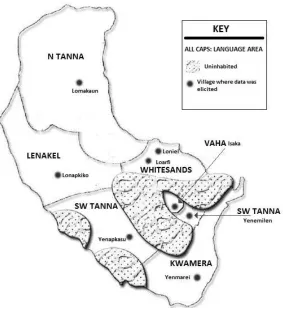
Map 1. Map of Tanna: Languageareas and villages where data was elicited.
Table 1.1. Demographic information on the languages of Tanna.†
Language Selfnames Population Village(s) where elicited Kwamera/South
Tanna nəfe ‘what’ 3,300–5,000 Yenmarei Lenakel nɨtuar ‘what’
(historically) 8,500–11,500 Lonapkiko N Tanna nɨnakə ‘say what’ 5,000 Lomakaun SW Tanna naha ‘what’;sipəru
‘give it’ 3,500–4,500 Yenemilen, Yenapkasu Vaha (‘give it’) nəlpai mɨne‘fat
tribe’ 400–600 Isaka Whitesands narak ‘what’
(historically) 5,500–7,500 Loarfi, Loniel
1.3
Methodology
1.3.1
The advantage of dictionaries over Swadesh wordlists
There are a number of advantages of a comparison of lexemes based on comprehensive dictionary data, rather than on a Swadesh wordlist. First, a Swadesh wordlist is English-based and does not give an adequate picture of the richness or idiosyncrasies of a language. Second, when a Swadesh wordlist is compiled by a linguistic surveyor who is largely unfamiliar with the language, the likelihood of errors is greater than when a linguist compiles a dictionary over time as he or she becomes familiar with the language.
1.3.1.1
Discovering idiosyncrasies of a language
A lexicon based on a language of wider communication (LWC) is unlikely to elicit words for which there is no equivalent in the LWC. For instance, it is unlikely that an English-speaking surveyor would discover words for which there is no English or Bislama equivalent.2
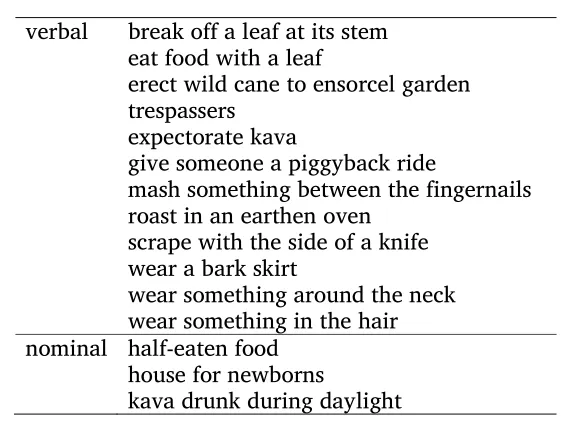
Table 1.2 lists some of the lexemes in Tanna’s languages which are idiosyncratic and would not typically show up on a general survey list.
Table 1.2. Some idiosyncratic lexemes in the languages of Tanna. verbal break off a leaf at its stem
eat food with a leaf
erect wild cane to ensorcel garden trespassers
expectorate kava
give someone a piggyback ride
mash something between the fingernails roast in an earthen oven
scrape with the side of a knife wear a bark skirt
wear something around the neck wear something in the hair nominal half-eaten food
house for newborns
kava drunk during daylight
Additionally, Tanna vernaculars have idiosyncratic words for ceremonies, such as dances and rites of passage, and for localized methods of cultivation. For example, Tanna languages list five stages of a coconut and more than a hundred types of banana, taro, and sweet potato. Lexical data elicited through surveys would not turn up these words; they are discovered over time.
2
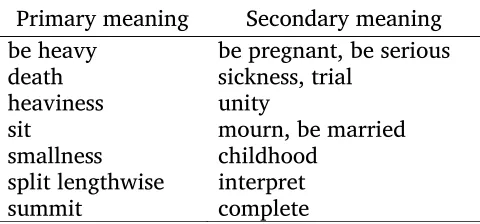
Compiling comprehensive dictionaries also enables us to find secondary meanings that may not be elicited with a wordlist based on an LWC, such as those listed in Table 1.3 from various Tannese languages.
Table 1.3. Some Tanna lexemes with idiosyncratic secondary meanings.
Primary meaning Secondary meaning be heavy be pregnant, be serious death sickness, trial
heaviness unity
sit mourn, be married smallness childhood
split lengthwise interpret summit complete
In this study, when lexemes have multiple, related meanings, the various meanings are separated by semicolons. The primary meaning is listed first and additional meanings are listed following it. The meanings least directly related to the primary meaning are listed last. This is illustrated in example (1):
(1) canoe; ship; village; generation
Here, ‘canoe’ is the primary meaning; ‘ship,’ ‘village,’ and ‘generation’ are additional meanings. ‘Ship’ is the most closely related to ‘canoe’ and therefore listed first, while ‘generation’ is the least directly related to ‘canoe’ and therefore listed last.
1.3.1.2
Potential for errors in a Swadesh wordlist
Tryon (1976) published a comparison of nearly 300 lexemes spoken in 179 locations throughout Vanuatu, including 14 locations on Tanna. It was a seminal work, showing not only lexical similarity of languages and dialects throughout Vanuatu but also describing the phonology of each of these languages and dialects. However, a survey of that sort—even one done by as apt a linguist as Tryon—is likely to produce the following types of errors:
1) Synonym mismatch
The linguist tries to elicit a lexeme and informants in some languages give one word while informants in related languages give a synonym rather than the actual lexeme the linguist is looking for. Even though the corresponding lexeme is also present in their languages, the linguist is not privy to that information, leaving the linguist with the impression that the languages differ on this lexical item.
2) Grammatical mismatch
informant gives a different lexeme from the one that actually corresponds to the lexemes the other informants gave for their respective languages. (Note that, at times, one Tanna language uses the noun form of a lexeme while another related language may use only the verb form or a nominalized verb. See, for instance, the entry for ‘poison.’ Four of the languages form the word for ‘poison’ with the agentive k- + verb akonə while N Tanna and Whitesands form it with the nominalizing prefix n- + verb akona + nominalizing suffix -an.)
3) Word joining
The informant joins two words when answering the linguist, while only one word actually belongs to the lexical category the linguist is trying to elicit.
4) Incorrect answer
The informant misunderstands the linguist or does not know the answer and so gives an incorrect answer. Therefore, the informant’s answer does not
correspond semantically or lexically to the other languages being compared.
5) Linguist’s mistake
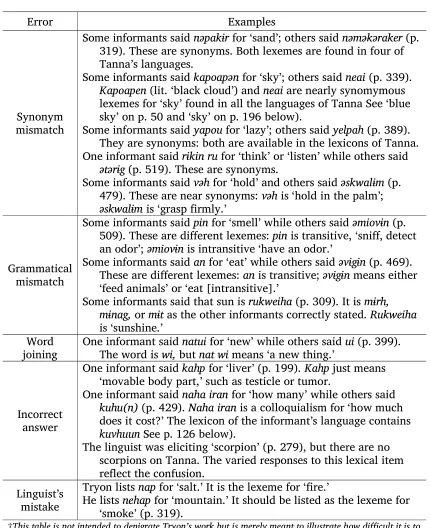
The linguist hears, records, or reports the information incorrectly. Each of these errors would give the analyst the impression that the languages are more dissimilar than they really are. Furthermore, since the resulting data is not wholly accurate, it can muddle things for the historical linguist who is trying to infer patterns of language change. For each of the errors listed above, Table 1.4 (next page) gives examples which I found in Tryon’s (1976)
Table 1.4. Potential errors when performing a cursory survey.†
Error Examples
Synonym mismatch
Some informants said nəpakɨrfor ‘sand’; others said nəməkəraker(p. 319). These are synonyms. Both lexemes are found in four of Tanna’s languages.
Some informants said kapoapən for ‘sky’; others said neai (p. 339). Kapoapen (lit. ‘black cloud’) and neai are nearly synomymous lexemes for ‘sky’ found in all the languages of Tanna See ‘blue sky’ on p. 50 and ‘sky’ on p. 196 below).
Some informants said yapou for ‘lazy’; others said yelpah (p. 389). They are synonyms: both are available in the lexicons of Tanna. One informant said rɨkin ru for ‘think’ or ‘listen’ while others said
ətərɨg (p. 519). These are synonyms.
Some informants said vəh for ‘hold’ and others said əskwalɨm (p. 479). These are near synonyms: vəh is ‘hold in the palm’; əskwalɨm is ‘grasp firmly.’
Grammatical mismatch
Some informants said pinfor ‘smell’ while others said əmiovɨn (p. 509). These are different lexemes: pin is transitive, ‘sniff, detect an odor’; əmiovɨn is intransitive ‘have an odor.’
Some informants said an for ‘eat’ while others said əvɨgɨn (p. 469). These are different lexemes: an is transitive; əvɨgɨn means either ‘feed animals’ or ‘eat [intransitive].’
Some informants said that sun is rukweiha (p. 309). It is mɨrh, mɨnag, or mɨt as the other informants correctly stated. Rukweiha is ‘sunshine.’
Word
joining One informant said The word is wi, but natuinat wi for ‘new’ while others said means ‘a new thing.’ ui (p. 399).
Incorrect answer
One informant said kahpfor ‘liver’ (p. 199). Kahpjust means ‘movable body part,’ such as testicle or tumor.
One informant said naha iran for ‘how many’ while others said kuhu(n) (p. 429). Naha iran is a colloquialism for ‘how much does it cost?’ The lexicon of the informant’s language contains kuvhuun See p. 126 below).
The linguist was eliciting ‘scorpion’ (p. 279), but there are no scorpions on Tanna. The varied responses to this lexical item reflect the confusion.
Linguist’s mistake
Tryon lists nap for ‘salt.’ It is the lexeme for ‘fire.’
He lists nehap for ‘mountain.’ It should be listed as the lexeme for ‘smoke’ (p. 319).
Chapter 2.
Some preliminary results from the comparative analysis
2.0
Introduction
There are pragmatic as well as theoretical reasons for presenting the lexical data for Tanna’s languages in one volume. Pragmatically, it can facilitate cross-language communication. On a theoretical level, having the data in one volume makes it easy to perform a comparative analysis of the lexical entries across the languages of Tanna. In this chapter, I summarize some of the benefits I have found by doing such a comparative analysis.
The chapter is organized as follows. In the first part I discuss the methods for determining cognates. Here I look at both phonological and non-phonological reasons for the dissimilarity of related lexemes across languages. In the second part, I discuss the applications of doing a comparative analysis based on a comprehensive lexical database. First, I demonstrate how it helps us determine the degree of similarity of the languages of Tanna. Second, I show how it helps us find which semantic categories of lexemes are most resistant to language change. Third, I show how it helps us find those semantic categories which have correlates across languages as well as those which are idiosyncratic to one or several
languages. Finally, I show how it helps us differentiate between homonyms and polysemous lexemes.
2.1
Determining cognates
A comparative analysis allows us to determine lexical similarity across languages and to suggest reasons why lexemes have changed over time in various regions on Tanna. In order to begin this task, we need to establish the criteria for determining cognates, i.e., lexemes which are historically derived from the same source lexeme. We do so by examining two sets of reasons for the dissimilarity of lexemes: phonological and non-phonological.
2.1.1
Phonological reasons for dissimilarity of cognate lexemes
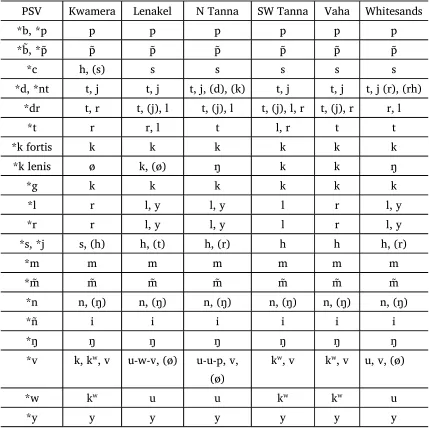
In this section I discuss phonological reasons why cognate lexemes may differ in form. Here, I have used the criteria developed from Lynch’s (2001) study of phonological shifts from Proto South Vanuatu (PSV) to the modern languages of Southern Vanuatu (see Table 2.1 and Table 2.2 below). I have updated the data to represent the modern-day (rather than historical) phonemic orthography and have added the data from Vaha. The PSV form is given in the first column using IPA symbols and the modern-day reflexes are listed in the following columns for each of the six languages.
2.1.1.1
Consonant correspondence
Table 2.1. Consonant correspondence (after Lynch 2001:201–202).†
PSV Kwamera Lenakel N Tanna SW Tanna Vaha Whitesands
*b, *p p p p p p p
*b̃, *p̃ p̃ p̃ p̃ p̃ p̃ p̃
*c h, (s) s s s s s
*d, *nt t, j t, j t, j, (d), (k) t, j t, j t, j (r), (rh) *dr t, r t, (j), l t, (j), l t, (j), l, r t, (j), r r, l
*t r r, l t l, r t t
*k fortis k k k k k k
*k lenis ø k, (ø) ŋ k k ŋ
*g k k k k k k
*l r l, y l, y l r l, y
*r r l, y l, y l r l, y
*s, *j s, (h) h, (t) h, (r) h h h, (r)
*m m m m m m m
*m̃ m̃ m̃ m̃ m̃ m̃ m̃
*n n, (ŋ) n, (ŋ) n, (ŋ) n, (ŋ) n, (ŋ) n, (ŋ)
*ñ i i i i i i
*ŋ ŋ ŋ ŋ ŋ ŋ ŋ
*v k, kw, v u-w-v, (ø) u-u-p, v,
(ø)
kw, v kw, v u, v, (ø)
*w kw u u kw kw u
*y y y y y y y
†Following standard orthography on Tanna, <p̃> represents a velarized voiceless bilabial stop [pʷ] and <m̃> represents a velarized bilabial nasal [mʷ]. Parentheses indicate that the form is used only in certain environments. Forms separated by hyphens (for *v) refer to initial, medial, and word-final position respectively.
(2) pregnant, be (early stage) V/TR Kwamera: əp̃əh məkuə
Lenakel: ap̃əs mouk
In the case of ‘curly, be’ in example (3) PSV *w remains in the Whitesands lexeme, but in Vaha it becomes /kw/. PSV *dr has become /r/ in Whitesands and
/j/ in Vaha.
(3) curly, be V/A
Vaha: kwujinkwujin Whitesands: werinwerin
As Table 2.1 indicates, PSV *r becomes /l/, /r/, or /y/. Therefore, the Kwamera and Lenakel lexemes for ‘grasp, feel’ in example (4) are cognates. In Lenakel, PSV *r has become /y/ and /ə/ has been dropped.
(4) grasp; feel V/TR Kwamera: ərap Lenakel: yap
Consonant switching is also a consideration when determining cognates. In the case of ‘float around’ in example (5), the position of /n/ relative to *s has switched in N Tanna, and PSV *s has become /h/. These two words are, therefore, treated as cognates.
(5) float around V/INTR Kwamera: ənas N Tanna: əhan
Likewise, in the case of ‘child’ in example (6), /n/ switches relative to *t in the case of Kwamera, and PSV *t has become /r/ in Lenakel. Therefore, these two words are also treated as cognates.
(6) child N PSV *natu-3
Kwamera: tɨni Lenakel: nɨrɨ*
2.1.1.2
Vowel correspondence
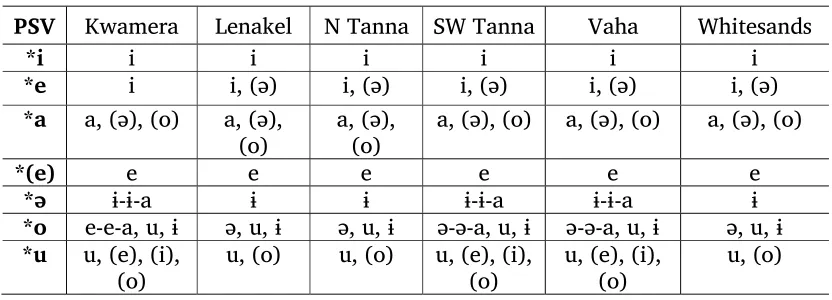
Table 2.2 (next page), also based on Lynch’s study (Lynch 2001:203), shows vowel correspondence between modern Tanna languages and PSV. The table has been adapted to reflect modern representations of vowel values (especially /ɨ/) and to show the data from Vaha. Again, forms separated by
3
hyphens refer to word-initial, word-medial, and word-final position respectively, and parentheses indicate that the form is restricted to certain environments.
Table 2.2. Vowel correspondence (after Lynch 2001:203).
PSV Kwamera Lenakel N Tanna SW Tanna Vaha Whitesands
*i i i i i i i
*e i i, (ə) i, (ə) i, (ə) i, (ə) i, (ə) *a a, (ə), (o) a, (ə),
(o) a, (ə), (o) a, (ə), (o) a, (ə), (o) a, (ə), (o)
*(e) e e e e e e
*ə ɨ-ɨ-a ɨ ɨ ɨ-ɨ-a ɨ-ɨ-a ɨ
*o e-e-a, u, ɨ ə, u, ɨ ə, u, ɨ ə-ə-a, u, ɨ ə-ə-a, u, ɨ ə, u, ɨ *u u, (e), (i),
(o) u, (o) u, (o) u, (e), (i), (o) u, (e), (i), (o) u, (o)
If the lexemes for two languages are identical, or if their vowel values follow regular sound correspondences to PSV, they are considered cognates. For example, the SW Tanna and Whitesands lexemes for ‘bicker; argue’ in example (7) are considered cognates, since PSV *a is represented as either /ə/ or /o/ in
modern Tanna languages. The vowel /ɨ/ is epenthetic and the final /u/ in SW Tanna is dropped, as SW Tanna drops final vowels.
(7) bicker; argue V/TR SW Tanna: ətgoh Whitesands: orɨgəhu
If two lexemes differ in any way not described by the above phonological shifts from PSV to modern Tannese languages, they are considered dissimilar in this study. Speakers of one language may recognize such lexemes in another language—and the lexemes may even ‘look alike’—but, for the purposes of this study, unless they meet the above phonological criteria, they are not considered cognates.
2.1.2
Non-phonological reasons for dissimilarity of cognate lexemes
Based on a comparative analysis of the data collected in this study, I have noticed two non-phonological reasons why cognate lexemes may differ in form. The first reason is that a set of synonyms existed at one time in the Tanna lexicon, with some modern languages maintaining one lexeme and other modern
2.1.2.1
Historical synonyms
At times, lexemes in the Tanna languages appear to be quite different with no apparent reason for the phonological shift. For instance, as shown in example (8), N Tanna’s lexeme suwɨt ‘grave’ differs from that of Kwamera, Lenakel, Vaha, and Whitesands, which is a variant of təkw.4 One possible explanation is that
Tanna’s lexicon historically contained two nearly synonymous entries for ‘grave.’ Both are still extant in the SW Tanna lexemes təkw and suranə. Kwamera, Lenakel, Vaha, and Whitesands employ only the former, while N Tanna employs only the latter.
(8) grave N
Kwamera: tapu Lenakel: təu N Tanna: suwɨt
SW Tanna: təkw, suranə Vaha: təkw
Whitesands: nɨtəu
Another illustration is Tanna’s lexeme for ‘be stupid’ in example (9). The variations in the modern languages of Tanna are not based on phonological shifts; rather, the historical lexicon may have contained two entries: armar and ətəwao. N Tanna retains the former, while Kwamera,Vaha and Whitesands retain the latter. Again, SW Tanna retains both. (Lenakel’s lexeme for ‘be stupid’ is different because it is an abstraction of the lexeme eno-eno ‘forget.’)
(9) stupid, be; ignorant, be V/A
Kwamera: ətəwao Lenakel: eno-eno N Tanna: alməl
SW Tanna: ətəwao, armar Vaha: ətəwao
Whitesands: ətəwao
Also, as shown in example (10), the lexemes for ‘show-off’ are dissimilar, not because of phonological shifts, but because Kwamera, SW Tanna and Vaha use abstractions of the verb amso ‘show off’ while Lenakel and N Tanna use
abstractions of the verb ausit ‘be proud.’
4
(10)show-off N
Kwamera: yemamso Lenakel: yausit N Tanna: yausit SW Tanna: yamso Vaha: yamso Whitesands: —
Another example is the lexemes for ‘be skinny’ and ‘be malnourished’ in example (11). The entries for ‘be skinny’ look dissimilar because it seems Tanna’s historical lexicon had two nearly synonymous entries, əkiriao and əvirɨg.
Informants from Kwamera, SW Tanna, Vaha and Whitesands were able to dinstinguish between the two synonyms, but informants from Lenakel and N Tanna employ avilɨg for both.
(11)skinny, be V/A malnourished, be V/A
Kwamera: əkiriao Kwamera: əvirɨg Lenakel: aviləg Lenakel: avilɨg N Tanna: avilɨg N Tanna: avilɨg SW Tanna: əkiriao SW Tanna: əvirɨg
Vaha: əkilus Vaha: əvilɨg
Whitesands: akilkili Whitesands: avilɨg
Also, as shown in example (12), Lenakel, SW Tanna, and Vaha have both a noun ‘hunger’ and a verb ‘be hungry,’ while Kwamera, N Tanna, and Whitesands have only the noun ’hunger.’ If the linguist discovers only the nominal form, it will appear that all the lexemes are cognates. If the linguist discovers only the verbal form, the results are not cognates, because the informants of Kwamera, N Tanna, and Whitesands will give the noun, whereas informants of Lenakel, SW Tanna, and Vaha will give the verb.
(12)hunger; famine; tuberculosis N hungry, be V/A
PSV *na-(t,v)umwac5 PSV *atolV6
Kwamera: nukumhə Kwamera: swei ramousi [OBJ] Lenakel: nəumɨs Lenakel: əmek
N Tanna: nəumɨs N Tanna: sweiwei tatoh [OBJ] SW Tanna: nɨkumhə SW Tanna: əmkərəv
Vaha: nɨkumɨs Vaha: əmkələv
Whitesands: nəumɨs Whitesands: sweiwei tatuh [OBJ]
5
From Lynch (2001:307). 6
2.1.2.2
Idioms and abstract ideas with different base words
Idioms and compound words may further skew the percentage of lexical similarity between any two languages. Therefore, a brief list consisting only of simple words based on survey data may reveal many cognates, while one—such as this study—which is based on data from dictionaries and discourse analyses rich in idioms and compound words may reveal that the languages are quite dissimilar.
For example, since the base word for ‘taboo’ is different in the various languages, any idioms based on that word will be different as well. One such idiom is an idiom for ‘off limits; genitals,’ which is ‘thing’ + ‘taboo.’Since ‘taboo’ is lexically dissimilar in the Tanna languages, the idiom will be dissimilar too, as shown in example (13).
(13)off-limits; genitals N
Kwamera: nari ikinan Lenakel: nat ausim N Tanna: nat asim SW Tanna: nar rhakə Vaha: nat thakə Whitesands: naji asim
Likewise, since the base lexeme for ‘carry in one hand’ is not a cognate in Tanna languages, all the compound words based on it will be different as well. This is shown in example (14) with the idiom ‘get for free,’ which is formed by combining ‘carry in one hand’ + ‘commonplace.’
(14)get for free V
Kwamera: vehi ouər a Lenakel: os apnapɨn N Tanna: os apnapɨn SW Tanna: vəh apnapɨg Vaha: vah apnapɨg Whitesands: os apnapɨn
(15)shelter N
Kwamera: nim̃ə kvipəhe Lenakel: nim̃ə lətən N Tanna: makeen SW Tanna: nim̃ə kvipə Vaha: nim̃ə kvihiə Whitesands: nim̃ə entəni
Another illustration is ‘demon-possessed’ in example (16). Kwamera forms the idiom by combining ‘ghost’ + ‘lives’ + ‘in him’ whereas the other languages use the combination ‘makes’ + ‘ghost’ + ‘TR.’
(16)demon-possessed, be V/A
Kwamera: yeremhə ramarə irən Lenakel: ol yarmɨs in
N Tanna: o yərɨmɨs in SW Tanna: or yahmhə kɨn Vaha: ol yatɨmhiə kɨn Whitesands: ol yerm̃ɨs lan
The base word for forming uncommon or abstract meanings may vary from language to language, further skewing the percentage of lexical similarity. The uncommon lexical entry ‘entirely’ in example (17) serves as a good illustration. Kwamera pam and Whitesands rafwin are both based on another, more common lexical entry, ‘all.’ The Lenakel, N Tanna, SW Tanna, and Vaha forms for ‘entirely,’ on the other hand, are based on the lexeme for ‘be smooth, be tidy.’
(17)entirely ADV all ADJ smooth, be; tidy, be V/A
Kwamera: pam Kwamera: pam Kwamera: piəpiə Lenakel: popiə Lenakel: pətɨm Lenakel: opiə N Tanna: apiəpiə N Tanna: rafin N Tanna: apiə SW Tanna: piəpiə SW Tanna: fam SW Tanna: piəpiə Vaha: piəpiə Vaha: fam Vaha: piəpiə Whitesands: rafwin Whitesands: rafwin Whitesands: piəpiə
2.2
Applications of a comparative analysis
There are a number of benefits of doing a comparative analysis of
languages. In this section I discuss four applications of a comparative analysis of the languages of Tanna.
2.2.1
Determining degree of similarity between languages
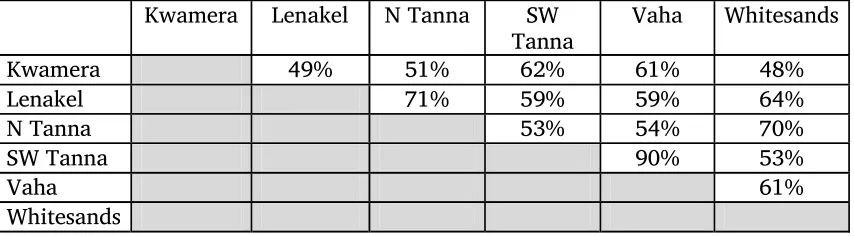
suggesting that SW Tanna and Vaha are in fact dialects of one language. Bordering the Whitesands language group, Vaha is 8 percent more similar to Whitesands than SW Tanna is. In other words, most of the lexemes in Vaha that are not cognates with SW Tanna are instead cognates with Whitesands. The two languages most dissimilar are Kwamera and Whitesands, which have only 48 percent cognates.7
Lynch’s data (in Lynch 1978), based on a modified Swadesh wordlist, shows Lenakel, N Tanna, and Whitesands to have at least 70 percent cognates, making them almost a dialect chain. Specifically, he predicted the similarity between Lenakel and N Tanna to be 73–80 percent, between N Tanna and Whitesands to be 81–86 percent, and between Lenakel and Whitesands to be 75–81 percent. Based on the data and phonological criteria for cognates in this study, the comparison of Lenakel and N Tanna is close to Lynch’s (71 percent), but this study found at least 11 percent lower lexical similarity for both N Tanna–Whitesands and Lenakel–Whitesands.
Table 2.3. Degree of correspondence between the languages of Tanna. Kwamera Lenakel N Tanna SW
Tanna Vaha Whitesands
Kwamera 49% 51% 62% 61% 48%
Lenakel 71% 59% 59% 64%
N Tanna 53% 54% 70%
SW Tanna 90% 53%
Vaha 61%
Whitesands
2.2.2
Finding identical lexemes in languages
A second application of a comparative analysis is that it enables us to find identical lexemes in languages and to determine which categories are most resistant to change. The table in Appendix A lists 81 common lexemes that were discovered which are (nearly) identical in the six Tanna languages of this study. Loan words such as kon ‘corn,’ kau ‘cow,’ tata ‘father,’ and toka, a Polynesian word referring to a kind of dance, are not listed, since they are expected to maintain a strong resemblance to their original form. Similarly, proper names (for
geographical terms, demigods, and ghosts), onomatopoeia (e.g., tuk-tuk for summoning pigs), grammatical infixes (e.g., perfective aspect, non-singular
marker), and interjections (e.g., Aweh!) are not counted, since they are unlikely to vary to any extent across Tanna’s language boundaries.
The data in Appendix A suggests that words related to kastom (i.e., traditional religion, ritual, and social organization in Vanuatu) are particularly resistant to language change. This is evident from the fact that the list of (nearly) identical lexemes contains a fair number of such terms (see Table 2.4).
7
Table 2.4. (Nearly) identical kastom lexemes in the languages of Tanna.
Gloss Vernacular
chief yeni
dance (women, by jumping up and down) əmako
evening meal for the men nahunu/nəhunu/nafunu/nəfunu festival of exchanging food with cousins niel/nieli/nier/nieri
prohibit, fast from something atuakəm/ətuakəm
sacred dancing place im̃arəm̃/im̃ərəm̃/im̃eim̃/im̃aim̃
2.2.3
Doing semantic comparison between languages
A third application of a comparative analysis is that it enables us to do a semantic comparison of lexemes between languages, to see which semantic categories correlate and which do not.
2.2.3.1
Semantic correlation in languages
I have compiled over 1,700 lexemes which have a strong semantic
correlation across language boundaries in the languages of Tanna. These lexemes form the body of the data in this book. Ideally, the base entry in a dictionary would be the vernacular lexeme. However, when we compare multiple
vernaculars, it is impossible to choose which language will become the primary one around which to organize the data. In fact, the only way to have a multiple-language dictionary based on the vernacular lexemes would be to have six separate sections: one based on Kwamera, one on Lenakel, etc. This would be repetitive and unnecessary. For this reason, I have had to settle on English as the base entry, as Charpentier did in his multiple-language study of Malekula
(Charpentier 1982).
Some lexical entries have multiple senses which are shared by all languages of Tanna. In these cases, I have listed those additional meanings in the English
gloss, as in example (18):
(18)burn; bite; sting; sore, be; in pain, be V/TR, V/A PSV *aɣac8
Kwamera: ahi Lenakel: kɨs N Tanna: aan, us SW Tanna: əs Vaha: as Whitesands: us
In the above example, all the languages of Tanna see ‘burn,’ ‘bite,’ ‘sting,’ ‘be sore,’ and ‘be in pain’ as semantically related. At times, however, it can be “messy” to base vernacular terms on an English gloss, since the lexemes may be
8
nuanced in each particular language. Secondary meanings and figurative senses may exist in one language but not in another. Where this is the case, rather than combining secondary meanings with the primary lexical entry, I have given them a separate entry. For instance, the entry for ‘make noise’ has a secondary meaning in N Tanna, SW Tanna, and Vaha, which is ‘sprout.’ Speakers of these languages see the growth of vegetation as semantically related to making noise. But the other languages of Tanna do not share this secondary sense. Therefore, ‘sprout’ receives a separate entry in the lexicon, as shown in example (19), with data from only those languages that employ that meaning.
(19)make noise V /INTR sprout above ground V/INTR
Kwamera: arukw Kwamera: — Lenakel: atp̃əluəh Lenakel: — N Tanna: atp̃erəh N Tanna: atp̃erəh SW Tanna: əməteih SW Tanna: əməteih Vaha: əməltei Vaha: əməlteih Whitesands: atp̃ərerəh Whitesands: —
Another example is the entry for ‘split lengthwise.’ In Kwamera, SW Tanna, and Vaha, this lexeme has a secondary meaning, ‘interpret.’ Since not all
languages of Tanna share this secondary meaning, there are two separate entries, as shown in example (20).9
(20)split s.th. lengthwise V/TR interpret V
Kwamera: ərp̃ɨi Kwamera: ərp̃ɨi Lenakel: whaprai Lenakel: — N Tanna: uhapɨk N Tanna: — SW Tanna: hoprai SW Tanna: hoprai
Vaha: ohaptai Vaha: ohaptai
Whitesands: ətamtei Whitesands: —
2.2.3.2
Semantic non-correlation in languages
A comparative analysis also reveals semantic non-correlation. Sometimes, the reason for this is that synonyms in the historical lexicon seem to have been discontinued or have changed meaning (see §2.1.2.1). Some languages have retained both nearly synonymous lexemes, whereas other languages have retained only one. For example, SW Tanna has two words for ‘bathe in coconut oil,’ ətagə and əteihuvə, but Vaha has only əteihuvə. SW Tanna has four nearly synonymous words for ‘child’: ji, tɨni, narɨ, and kwajikovə. In the case of ji and tɨni, the
synonyms are both historically related to the same word but underwent different phonological shifts.
Idiosyncratic lexemes are possibly vestiges of proto forms which survived in one language but which perished in others. For a more comprehensive list of lexemes, and their idiosyncratic nuances, a language-specific dictionary is
9
necessary. Dictionaries in N Tanna, Vaha, and Whitesands have not yet been published for each language but are being compiled.
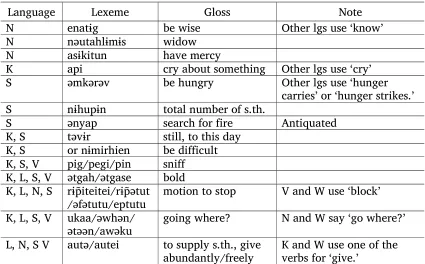
There are scores of lexemes present in one or more languages of Tanna which are not found in others. Language-specific dictionaries include hundreds of these idiosyncratic lexemes. However, since the nature of this study is to compare lexemes across language boundaries, only lexemes which appear in three or more of the languages are listed. Table 2.5 gives some examples of lexemes which are idiosyncratic to one or more languages of Tanna.
Table 2.5. Idiosyncratic lexemes in the languages of Tanna.†
Language Lexeme Gloss Note
N enatɨg be wise Other lgs use ‘know’ N nəutahlɨmɨs widow
N asɨkitun have mercy
K api cry about something Other lgs use ‘cry’ S əmkərəv be hungry Other lgs use ‘hunger
carries’ or ‘hunger strikes.’ S nɨhupɨn total number of s.th.
S ənyap search for fire Antiquated K, S təvɨr still, to this day
K, S or nɨmirhien be difficult K, S, V pig/pegi/pin sniff K, L, S, V ətgah/ətgase bold K, L, N, S rɨp̃iteitei/rɨp̃ətut
/əfətutu/eptutu motion to stop V and W use ‘block’ K, L, S, V ukaa/əwhən/
ətəən/awəku going where? N and W say ‘go where?’ L, N, S V autə/autei to supply s.th., give
abundantly/freely K and W use one of the verbs for ‘give.’ †The following language abbreviations are used in this table: K: Kwamera, L: Lenakel, N: N Tanna, S: SW Tanna, V: Vaha, W: Whitesands.
2.2.4
Differentiating between homonyms and polysemous lexemes
A fourth application of a comparative analysis is that it helps us
differentiate between homonyms and polysemous lexemes. Sometimes a lexeme appears to be polysemous and the supposed connection between the various senses can be intriguing or puzzling. However, when the data from related languages becomes available, it appears that it is not an instance of one lexeme with multiple senses but of two or more lexemes that are homophones. In this section I discuss several examples.
means ‘dig’ and kɨt means ‘lead.’ These are two separate entries, confirming that there is no semantic connection; they are simply homonyms in SW Tanna.10
(21)dig V/TR lead V/TR
Kwamera: eri Kwamera: iri Lenakel: ilh Lenakel: ir N Tanna: el, il N Tanna: it SW Tanna: kɨr SW Tanna: kɨr
Vaha: kɨl Vaha: kɨt
Whitesands: il Whitesands: it
The SW Tanna name for Aniwa Island, situated off the east coast of Tanna, is imɨr, which seems to be derived from i (from ikɨn ‘place’) + mɨrh ‘sun,’ i.e., ‘place where the sun rises.’ However, when the lexeme is compared to
Whitesands, it becomes apparent that it is a coincidence that SW Tanna’s name for Aniwa could mean ‘place of the sun.’ In Whitesands, the name for Aniwa is imɨt, but the word for sun is mɨtɨgar.
As shown in example (22), the word for ‘festival of exchanging food with cousins’ and ‘casuarina’ (a kind of tree) are both nier in SW Tanna, while in Lenakel, N Tanna, and Vaha they are both niel. Do we have here a case of two homonyms or of multiple senses of one lexeme? In Whitesands, ‘casuarina’ is niel, but ’festival of exchanging food with cousins’ is nieli, and in Kwamera the contrast is between nier and nieri. As shown further in example (22), the word for ‘cross-cousin’ patterns like ‘festival of exchanging food with cousins.’ Since there is no obvious semantic correlation between ‘casuarina’ and ‘cross-cousin’ or ‘festival of exchanging food with cousins,’ and taking into account the phonological
differences between the lexemes in Whitesands and Kwamera, we may conclude that they are just homonyms in Lenakel, N Tanna, SW Tanna, and Vaha.
(22)festival of exchanging
food with cousins N casuarina N cross-cousin N
Kwamera: nieri Kwamera: nier Kwamera: *ieri Lenakel: niel Lenakel: niel Lenakel: ta* iel N Tanna: niel N Tanna: niel N Tanna: rəh* iel SW Tanna: nier SW Tanna: nier SW Tanna: kapa* ier Vaha: niel Vaha: niel Vaha: kapa* iel Whitesands: nieli Whitesands: niel Whitesands: rəh *ieli In Kwamera, ‘take feces out of intestines from an animal’ and ‘dip’ are both eitesi, as shown in example (23). Based just on this data, it seems possible that there is a semantic connection between the two. However, comparison with the lexemes in the other languages of Tanna indicates that the two are not
semantically related. They are just homonyms in Kwamera.
10
(23)take feces out of intestines
from an animal V dip V/TR
Kwamera: eitesi Kwamera: eitesi Lenakel: ətkerɨn Lenakel: el N Tanna: əgəlɨn N Tanna: er SW Tanna: əhi SW Tanna: eires
Vaha: əhi Vaha: eiel
Whitesands: eiəh Whitesands: el
In SW Tanna and Vaha, the lexeme for ‘whipa person or animal’ seems to be a reduplication of the lexeme for ‘carry someone on a stretcher; fasten something.’ This gives the impression that these two glosses are multiple senses of a single lexeme. There is little doubt that ‘whipa person or animal’ and ‘fasten something’ are semantically related, as both verbs involve working with ropes. However, because they are phonologically contrastive in Lenakel, N Tanna, and Whitesands (/a/ and /ə/ being contrastive in Tanna languages), these two verbs cannot be treated as multiple senses of the same lexeme. (Note also that Kwamera’s lexemes for these two verbs differ significantly.)11
(24)carry s.o. on a stretcher; fasten s.th. V/TR
PSV *avis12 whip a person or animal V/TR
Kwamera: ərihi Kwamera: ətəkwus Lenakel: əlis Lenakel: alis-alis N Tanna: əlis N Tanna: alis-alis SW Tanna: arkɨs SW Tanna: arkɨs-arkɨs Vaha: alkɨs Vaha: alkɨs-alkɨs Whitesands: əlis Whitesands: alis-alis
As shown in example (25), in SW Tanna the lexemes for ‘throw something elongated, such as a spear,’ ‘clap; slap,’ and ‘set something upright’ are identical: ərɨp. This might suggest they are semantically related. But the diverse lexemes in the other languages of Tanna indicate they are probably just homonyms in SW Tanna. (Note that Vaha and Whitesands also have homonyms for ‘clap; slap’ and ‘set something upright.’)
(25)throw s.th. elongated, set s.th. upright
such as a spear V/TR clap; slap V/TR V/TR
Kwamera: erɨp Kwamera: ep̃i Kwamera: ərpi Lenakel: eipatkin Lenakel: apatkin Lenakel: eipatkin N Tanna: argin N Tanna: əf N Tanna: em SW Tanna: ərɨp SW Tanna: ərɨp SW Tanna: ərɨp Vaha: alɨp Vaha: əlɨp Vaha: əlɨp Whitesands: arəg lan Whitesands: emh Whitesands: emh
11
It should be noted that there are numerous examples in Tanna languages where /ə/ is contrastive with /a/. 12
Chapter 3.
Using the multi-language lexicon
3.0
Introduction
In this chapter I explain the orthography choices for this study as well as the abbreviations and layout of the lexicon presented in section B.
3.1
Orthography
The unique phonologies of each of the languages of Tanna and the specific mission histories of the language groups on Tanna have affected contemporary opinions about orthography on the island. I have taken both of these factors into consideration in deciding on an orthography for this study.
3.1.1
Influence of mission history on orthography
In the first half of the twentieth century, missionaries in Kwamera, Lenakel, and Whitesands produced publications with orthographies based on the English alphabet.13 Example (26) is a hymn from a mid-twentieth century Whitesands
hymnal, Nupume ia nafwakien (n.d.:102). The hymn is a translation of the English hymn I need Thee every hour. It does not use <y> and <w>. For example, as shown here, it uses Iesu for ‘Jesus.’ It accurately represents the stops as voiceless.
(26) Whitesands hymn with English translation
Atatig oniau, Iesu rahak. Pah otasiru lak Iau isou lam? Iuaker Iesu keikei Ik iuaker agen; Iatasak ua iatagien, Asiru lak.
Abide in me, My Jesus. Who will help me
[Since] I am so far from You? Nearby beloved Jesus
You are very near;
[Whether] I am sad or happy, Help me.
The Kwamera hymnal Napuanmen nafuakien parhien, on the other hand, represents the bilabial stop as voiced, as shown in example (27), taken from Napuanmen (1941:25). While bilabial stops do become voiced in that
environment, it is now recognized that it is unnecessary to represent this in the orthography. Also, occasionally the hymnal uses <w> instead of <u> to represent the rounded semi-vowel.
13
(27) Kwamera hymn with English translation
Ketaha pam tesagien Asori te Iesu. In reiwaiupehe iesa, Mamabi ketaha.
We all rejoice
Greatly about Jesus. He came here
And had mercy on us. In ravahi namiseien
Ia nei kamerkwauwi. In ratagi neten, menwa, Rahakwi ketaha.
He has goodness On the cross.
He poured out His blood so that It cleanses us.
The difference between these two orthographies is not due to different phonologies but reflects different opinions of how the sounds of the various languages should be represented in their respective orthographies. Missionaries who printed materials in Kwamera were not opposed to using <w> to show velarization. However, Lynch and Lindstrom used <w> to show velarization only after <p> and <m>, while after <k> they used <u>.
These early orthographies also set the trend for representing [ŋ] as <g> and the high central unrounded semi-vowel as <v>.
3.1.2
Influence of unique phonologies on orthography
The languages of Tanna have slightly varying phonologies. These slight variations affect decisions about a suitable orthography. For example, dialects of Kwamera, SW Tanna, and Vaha employ either /r/ or /l/ but not both, while the rest of the languages of Tanna employ both of these phonemes. The phoneme /fw/
is more common in Kwamera than in the other languages and has, therefore, at times been represented in Kwamera publications. As shown in example (28), certain dialects—or certain speakers of some dialects—regularly pronounce *ti as [ti] rather than with an affricate as [tʃi]. Note that for ‘choke,’ Lenakel uses /ti/ whereas Kwamera, SW Tanna, Vaha, and Whitesands use/ji/ (pronounced [tʃi]). Likewise, in the word for ‘earthworm,’ Lenakel and N Tanna use /ti/ (reduced to /t/ in Lenakel) whereas the other languages use /ji/.
(28)choke V/TR earthworm N
Kwamera: jiu Kwamera: m̃əjikəro Lenakel: tiu Lenakel: m̃ɨtkələu N Tanna: armegah N Tanna: m̃atikəlo SW Tanna: jiu SW Tanna: m̃əjikərəu
Vaha: jiu Vaha: m̃əjikələu
3.1.3
Modern orthography
Publications are now being produced in all of Tanna’s languages. The orthographies are more phonemic than the older, English-based ones, making them not only more readable but also more phonologically accurate. However, having been developed by linguists working more or less independently from one another, the modern orthographies vary somewhat from one another. Lindstrom’s dictionary (1986), and recent publications in Lenakel such as the New Testament (2007) use only <ɨ> to represent a mid central vowel. These orthographies are based on the assumption that [a] becomes [ə] when unstressed, so only one grapheme <a> is necessary. Hammond’s recent work (2009) on the grammar of Whitesands operates on the same assumption, but he uses <ə> to represent the mid central vowel, instead of <ɨ>.
There may be historical evidence to support the decision to use only one mid central vowel but there is ample synchronic evidence that the modern
languages of Tanna distinguish between [ɨ], [ə], and [a]. Complete orthographies would be helpful in proving this, but presenting these would go beyond the scope of this study. Table 3.1 presents some minimal pairs that suffice to prove the distinction.
Table 3.1. Minimal pairs for [ɨ], [ə], and [a].
Language Vernacular Gloss
Kwamera [ˈtɨpwɨk] ‘wall of a house’
[ˈtəpwɨk] ‘my stomach’
Lanakel [nɨˈraiyan] ‘writing’ [nəˈraiyan] ‘cutting’ N Tanna [nɨˈpɨtən] ‘lightning’
[nɨˈpwətən] ‘his body’
[eˈmɨtəp] ‘I followed’ [eˈmətəp] ‘I jumped’ [ˈəlis] ‘tie/fasten’ [ˈalisˈalis] ‘whip’ SW Tanna [nɨˈrukiɛn] ‘fetching’
[nəˈrukiɛn] ‘rooting (of pigs)’ [naˈrukiɛn] ‘throwing’
There are also variations in how to handle affricates, semi-vowels, and palatalized stops. Kwamera, Lenakel, N Tanna, and Whitesands have the phoneme /tʃ/ but publications in these languages represent it with <ti>, whereas
publications in SW Tanna and Vaha represent it with <j>. Additionally, some publications in Kwamera and N Tanna represent many glides [w] and [y] with <u> and <i> respectively. Some recent Kwamera publications represent the palatalized consonants [pw], [kw], [fw], and [mw] as <p̃>, <kw>, <fw>, and
<m̃> respectively. Orthographies in the other languages have not represented palatalization at all, thus not distinguishing palatalized consonants from non-palatalized ones in writing.
In this study, I follow three guidelines in order to utilize a uniform orthography. First, I represent lexemes as they are spoken today. The phoneme /tʃ/ is undoubtedly a phonemic change from [ti] and it remains [ti] for some lexemes in some dialects today. But where the lexeme is pronounced [tʃ] today, I have indicated so with <j>, and where it is still spoken as [ti] I have indicated so with <ti>. Second, I have employed an orthography that is readable. The lexeme eiwaiyu ‘go down’ may be written accurately, phonologically speaking, as either <eiwaiyu> or <eiuaiiu>, but when I tested orthographies, I discovered that Tannese speakers found the latter to be less readable than the former. Third, since data is being compared, I have found it necessary to distinguish between [ɨ] and [ə], so both vowel values are represented. Finally, /p̃/, /kw/, /fw/, and /m̃/ are also represented to help in comparison of data.
3.2
Layout
The lexicon is alphabetized by the English gloss. The Bislama gloss is on the next line below the English gloss. The lexical data for the six languages follows in alphabetical order by language. Figure 3.1 (next page) explains the
Section B. Lexicon.
Notes:
1) Phrases are presented in the normal word order (e.g., ‘give affection’) unless inverting them brings related entries together (as with ‘scabies’ and ‘scabies, have’). Phrases which include the verb ‘be’ are inverted (e.g., ‘bald, be’). 2) Two kinds of cross-references are used: See references refer to lexemes that are
structurally related while See also references refer to lexemes that are
semantically but not structurally related (see entry for ‘above’for examples of both of these).
3) Morpheme breaks are not indicated; however, for ease of reading, and in line with current orthography conventions for these languages, hyphens are used to break up longer words involving reduplication (as with the lexeme ‘ant
(biting)’). Hyphens are also used to break up longer words at the end of a line (as with the second Kwamera entry for ‘cardinal honeyeater’).
4) Parts of the English gloss that are not bolded must be expressed with separate words (c.f. ‘bother s.o.’ and ‘envy s.o.’; in the former, the object (‘someone’) must be expressed separately; in the latter, the object is understood).
5) For a list of abbreviations, refer to p. 255 at the end of the lexicon; for other notes on the layout, see Figure 3.1 on p. 26.
a ART wan
Kwamera: riji Lenakel: ker N Tanna: kit SW Tanna: kɨrik Vaha: kɨjik Whitesands: kəji Seeone
abandon (1) V/TR livim i stap, mo go longwe
Kwamera: kwenə Lenakel: əunə N Tanna: əlɨn ətain SW Tanna: knə Vaha: knə Whitesands: amrin abandon (2) V/TR
livim
Kwamera: əp̃ewə Lenakel: akəm tənin N Tanna: agɨm tənin SW Tanna: apitan kɨn
Vaha: əptan kɨn Whitesands: agaru in Abelmoschus Manihots N
Seesunset hibiscus
ability; wisdom N save, waes
Kwamera: nukurənien Lenakel: ninətinan N Tanna: nitunən SW Tanna: nɨrkunien Vaha: nɨtkunien Whitesands: nərunien able, be; know V
save
about PREP long saed blong
Kwamera: ye nɨkare* sei Lenakel: ye nɨkal* taha N Tanna: ye nɨkalɨ*
raha SW Tanna: ye nɨkar*
kape Vaha: ye nɨkalɨ*
kap̃e Whitesands: ye nɨkalɨ*
raha Lit. toward + side + BEN Seeside of s.o. or s.th. above PREP
antap
Kwamera: puta Lenakel: ilɨs N Tanna: ilɨs SW Tanna: faktə Vaha: pəktə Whitesands: ilɨs
Seeclimb; See also come from above
abundantlygive s.th. V/TR Seesupply s.th.
accidentally hit s.th. or s.o. V/TR Seehit s.th. or s.o. (3)
accidentally run into V/TR akseden long
Kwamera: rei peikɨn Lenakel: ətɨk pɨkɨn N Tanna: aiyu pɨkɨn SW Tanna: haipɨkɨn Vaha: haipɨkɨn Whitesands: ərupɨkɨn Accipiter faciatus N
Seebrown goshawk
accompany V Seefollow (1)
accomplished, be V/A (INTR)
Seewell done
Acridotheres tristis N
Seecommon myna
actions N fasin
Kwamera: noyen Lenakel: nolan N Tanna: nolən SW Tanna: norien Vaha: nolien Whitesands: nolien act quickly V
Seesurprised, be Adam’s apple N
Seetesticle (2)
addressee, away from DIR
Seeaway from speaker and
addressee
addressee, toward DIR See toward addressee adopt a child V
Seesend a child away for adoption
adultery, commit V
Seecommit adultery
advise V wonem
Kwamera: — Lenakel: —
N Tanna: em əskasɨkən SW Tanna: or kwirəg Vaha: ol kwilɨg Whitesands: em əskasɨk Lit. make + warning
adze N
akis oli wokem long ston
Lenakel: kɨpas apɨn N Tanna: kɨpas apɨn SW Tanna: kɨpas apɨg Vaha: kɨpah apɨg Whitesands: kɨpas apɨn,
kɨpas apɨg Lit. black + axe
See alsoaxe affection, give V
Seegive affection after; then ADV afta
Kwamera: nənə Lenakel: ka N Tanna: tə SW Tanna: ai Vaha: ai Whitesands: ko afternoon/evening, be V naet
Kwamera: əruvarəv Lenakel: enaiyu N Tanna: enhaipɨn SW Tanna: enaiyu Vaha: enaiyu Whitesands: enaiyu See alsomorning, be
afternoon/evening, in the PREP PHR
naet
Kwamera: ye nəpɨn Lenakel: lenaiyu N Tanna: yenai ipən SW Tanna: yenaiyu Vaha: yenaiyu Whitesands: lənaiyu See also (1) morning, in the; (2) night, at
again; too ADV bakegen
Kwamera: m̃ɨ Lenakel: m̃ɨn N Tanna: m̃ɨn
SW Tanna: m̃ɨn Vaha: m̃ɨn Whitesands: m̃ɨn agree; permit V/TR agri
Kwamera: əseni Lenakel: heiganin N Tanna: egəhan SW Tanna: eighaan Vaha: eighaan Whitesands: egahan algae N
nalumlum
Kwamera: natgɨmerə Lenakel: nətgətɨg N Tanna: nɨtgatɨg SW Tanna: nətgətɨg Vaha: nətgətɨg Whitesands: narɨgarɨg alive, be V/A (INTR)
i laef
Kwamera: mɨru Lenakel: miuh N Tanna: megah SW Tanna: mragh Vaha: mɨlagəh Whitesands: miəgəh
Seebreathe
all ADJ evriwan
Kwamera: pam† Lenakel: pətɨm N Tanna: rafin‡ SW Tanna: fam Vaha: fam Whitesands: rafwin†,‡ †See entirely
‡See that’s all
See (1) complete (2); (2) completion
almond N
alone; only ADJ nomo
Kwamera: əpa Lenakel: am N Tanna: əm SW Tanna: əmə Vaha: əmə Whitesands: əmə Seeonly ADV although ADV
See even though ambidextrous ADJ raet lef
Kwamera: maolmatukw Lenakel: murmatu N Tanna: məwulmatɨp̃ SW Tanna: maworma-
tukw Vaha: məwolma-
tukw
Whitesands: məwulmaro Lit. left-right
among (1) PREP medel blong
Kwamera: kurkwa Lenakel: ilukə* N Tanna: ilugɨ* SW Tanna: kwerkwa* Vaha: yelkwa* Whitesands: nəlugɨ* among (2) PREP
long
Kwamera: reri* Lenakel: lənki* N Tanna: yenki* SW Tanna: yerki Vaha: yeli Whitesands: yenki* amputated, be V/A
oli bin katemaot han o leg Kwamera: pɨp Lenakel: upupɨs N Tanna: ɨpupɨs
SW Tanna: əpup Vaha: əpup Whitesands: pup ancestor N
bubu
Kwamera: kaha Lenakel: kaha N Tanna: naiyu SW Tanna: kaha Vaha: kaha Whitesands: kaha
Seegreat-grandparent
ancestors N ol bubu
Kwamera: lis Lenakel: lis N Tanna: lus SW Tanna: rus Vaha: lis Whitesands: lus fr.Eng. list, roots
Seemythology about
ancestors; See also tell stories about ancestors
ancestral mythology N
Seemythology about
ancestors and (1) CONJ mo
Kwamera: kɨni Lenakel: kəni N Tanna: kən SW Tanna: kɨni Vaha: kɨni Whitesands: kəni and (2) (for subjects within a clause) CONJ
mo
Whitesands: mɨne anger N
kros
Kwamera: niemaha Lenakel: niemha N Tanna: nemɨha SW Tanna: niemha Vaha: niemha Whitesands: nieməha animal (1) N
anamol
Kwamera: nəri mɨru Lenakel: narmivh N Tanna: nat meigəh SW Tanna: narmɨragh Vaha: natɨmlagəh Whitesands: nat miəgəh Lit. thing + living
animal (2) (female) N woman anamol
Kwamera: kəpran Lenakel: pɨravɨn N Tanna: pətan SW Tanna: kapiraovɨn Vaha: kaptavən Whitesands: pətan animal (3) (female, fertile) N woman animol we I save karem pikinini
Kwamera: kəreji Lenakel: kəleiwə N Tanna: karet SW Tanna: kəros Vaha: kəros Whitesands: kareki animal (4) (male) N
man anamol
Kwamera: kərman Lenakel: yerman N Tanna: yerman SW Tanna: karman Vaha: kətman Whitesands: yerman
animal (5) (tame) N
Seelame person or animal
animal (6) (wild) N Seewild animal animal, feed an V
See feed an animal animal marker G makem wan animol
Kwamera: k- Lenakel: k- N Tanna: k- SW Tanna: k- Vaha: k- Whitesands: k-
(with color and gender terms) See alsoimpersonal marker animism N
Seelife (1) ankle N
Seeheel
anklets; k.o. nut N nalake
Kwamera: karkarepə Lenakel: noanpərpə N Tanna: noanpɨrɨpa SW Tanna: kwənpərəpər Vaha: kwənpərəpər Whitesands: noanpɨrɨpə another person N
defren man
Kwamera: yərməpə Lenakel: yerə pɨsɨn N Tanna: etəm pɨsɨn SW Tanna: yarmə Vaha: yatmə pɨsɨn Whitesands: etəm pɨsɨn answer (1); appoint; choose V/TR
Kwamera: rɨfi Lenakel: huatɨkun
iato† N Tanna: ɨtəp̃ɨn SW Tanna: rp̃en Vaha: lp̃en Whitesands: ɨtəp̃ɨn †Lit. point + out See alsoask
answer (2); continue a discussion V
ansarem
Kwamera: hopɨn Lenakel: arəmton N Tanna: uhalpən SW Tanna: horpɨn Vaha: əwhalpɨn Whitesands: ətalpɨn ant (biting) N
anis (we hemi kakae man) Kwamera: m̃iəhi Lenakel: kəsɨk N Tanna: kɨt
SW Tanna: kasɨk-asɨk Vaha: kasɨk-asɨk Whitesands: kasɨk apɨn ant (small) N
anis (smol wan)
Kwamera: m̃ərə-m̃ərə Lenakel: m̃eiyə-m̃eiyə N Tanna: m̃ea-m̃ea SW Tanna: m̃ərə-m̃ərə Vaha: m̃ələ-m̃ələ Whitesands: m̃ələ-m̃ələ anus (1) N
as blong
Kwamera: kəh* ukuə Lenakel: hɨma* sin N Tanna: mansi* SW Tanna: kapa* kuə Vaha: kunɨs ila*† Whitesands: mansi* †Seebuttocks
Seestinger; See also wipe one's anus
anus (2) (vulgar) N Seestinger aperture for door N
See door aperture apple N
See Malay apple appoint (1) V
See lift up appoint (2) V/TR
See answer (1) Araceae N
See taro (1)
area that’s enclosed N See enclosed area argue V/TR
See bicker argument N faet
Kwamera: tɨməji Lenakel: tɨmət N Tanna: tɨməht SW Tanna: tɨməht Vaha: tɨməht Whitesands: təməhti See also bickering
arm; hand; handle N han blong
hips; (5) support oneself with one arm
armpit N ananit han
Kwamera: tɨkɨrkəv* Lenakel: nɨku* N Tanna: nɨku* SW Tanna: tɨkɨrkəu* Vaha: tɨkɨlkəu* Whitesands: nɨkəufɨ* See alsocarry or support s.o. under the armpits arms, flap V
Seeflap wings (3) aromatic leaf N
Seeleaf, k.o. (1) arrive V/INTR kamtru
Kwamera: apirap̃ Lenakel: ieratou N Tanna: arəp SW Tanna: ajiərhav Vaha: ajiətam Whitesands: ajego arrowhead N
Seeblunt arrowhead
arrow shaft; wild cane used for building yam trellises N stik blong ara
Kwamera: kwənkurkur Lenakel: nuwulul N Tanna: noanwulwul SW Tanna: kwənkurkur Vaha: kwənkulkul Whitesands: noanwulwul See also (1) erect wild cane to ensorcel garden trespassers; (2) make a lattice of wild cane; (3) make walls with wild cane; (4) wild cane (1)
Artocarpus altilis N Seebreadfruit as CONJ
Seewhen (3)
ashamed, be V/A i harem sem
Kwamera: aurɨs Lenakel: aulɨs N Tanna: aulɨs SW Tanna: aurɨs Vaha: aulɨs Whitesands: aulɨs
Seeshame
ashes N asis blong faea
Kwamera: nɨmrakw Lenakel: nɨmraoh N Tanna: nəmtap SW Tanna: nɨmrakw Vaha: nɨmtakw Whitesands: nəmtao
Seegray (of animals)
ash from volcano N
Seevolcano steam and ash
ashore, go V/INTR See go ashore ask V
askem
Kwamera: əres Lenakel: ərhapɨk N Tanna: easiə, ətam,
ətapəh SW Tanna: aiyoh Vaha: əlɨgəpəh Whitesands: ətapuə See also answer
ask for V/TR Seebeg for assist V
assistance N See help N asthma N
sotwin
Kwamera: keiahag
Lenakel: amigh-amigh N Tanna: kameg-ameg SW Tanna: keihaag Vaha: keihaagh Whitesands: neihagien
Seebreathe
at PREP
Seetoward (1)
atmosphere N See sky (2) authority N
Seepower
avenge s.o. or s.th. V Seereturn (2) avoid V/TR
Seerespect awaken; startle V/TR girapem
Kwamera: sui Lenakel: sɨg N Tanna: əgh SW Tanna: sɨg Vaha: sɨg Whitesands: əghi See alsowake up
away from speaker and addressee DIR
long hem
Kwamera: pen Lenakel: pən N Tanna: pɨn SW Tanna: pən Vaha: pən Whitesands: pən
See also (1) toward addressee; (2) toward speaker
a while ADV sot taem
Kwamera: pəm Lenakel: upən N Tanna: pitɨn SW Tanna: pom Vaha: pom Whitesands: pəm axe N
akis
Kwamera: paha Lenakel: kɨpas N Tanna: kɨpas SW Tanna: kɨpah Vaha: kɨpah Whitesands: kɨpas See also (1) adze; (2) machete; (3) split s.th. lengt