THE GRAMMATICAL ACCURACY, COHESION AND
ENGLISH
WRITING AT DARAWITHAYA SCHOOL,
NARATHIWAT THAILAND
THESIS
Submitted in partial fulfillment of the requirement for the degree of
Sarjana Pendidikan (S. Pd) in Teaching English
By:
Ruqoyyah Amilia Andania
D05211024
ENGLISH TEACHER EDUCATION DEPARTMENT
FACULTY OF TARBIYAH AND TEACHERS TRAINING
SUNAN AMPEL STATE ISLAMIC UNIVERSITY
SURABAYA
THE GRAMMATICAL ACCURACY, COHESION AND
ENGLISH
WRITING AT DARAWITHAYA SCHOOL,
NARATHIWAT THAILAND
THESIS
Submitted in partial fulfillment of the requirement for the degree of
Sarjana Pendidikan (S. Pd) in Teaching English
By:
Ruqoyyah Amilia Andania
D05211024
FACULTY OF TARBIYAH AND TEACHERS TRAINING
SUNAN AMPEL STATE ISLAMIC UNIVERSITY
Surabaya, 30 Juli 2015
ABSTRACT
Andania, Ruqoyyah Amilia. (2015). The Grammatical Accuracy, Cohesion and
Coherence a School,
Narathiwat Thailand. A Thesis, English Teacher Education Department, Faculty of Education and Teacher Training, Sunan Ampel State Islamic University, Surabaya. Advisors: Rizka Safriyani, M.Pd. and Zulidyana Dwi R, S.Hum, M.hum.
Key Words: Writing, Grammar Accuracy, Cohesion and Coherence
Writing has been recognized as important skill to be mastered by all students both English as Foreign Language (EFL) and English as Second Language (ESL) students since many universities around the world offer writing courses. Hence, this study attempts to analyze the grammatical accuracy, cohesion and coherence of Thai Writing at Darawithaya School. This study is designed to investigate
and coherence on Stu of the study consists of 14
Second Grade Students of Senior High School who enroll Academic Education at Darawithaya School, Narathiwat Thailand. Since this study is descriptive qualitative approach, the data is docu writing work. Some guidelines and rubric are used in this research for analyzing. The findings reveal that
there are 73 errors They occur on
singular/plural followed by subject omission, the use of article, pronoun, preposition, verb omission, S-V agreement, word formation, tense, and extraneous subject. Consequently, those err
TABLE OF CONTENTS
TITLE SHEET i
ADVISOR APPROVAL SHEET ii
MOTTO iii
DEDICATION SHEET iv
ABSTRACT v
ACKNOWLEDGEMENTS vi
TABLE OF CONTENTS viii
LIST OF TABLESAND FIGURES .. xii
LIST OF APPENDICES xiii
CHAPTER I: INTRODUCTION
A. Research Background . . 1
B. Research Questions 8
C. Objective and Significance of The Study . . 9
D. .. . 11
E. Definition of Key Terms .. .. 12
CHAPTER II: REVIEW OF RELATED LITERATURE
A. . .. 14
1. English Curriculum in Thailand 14
2. Grammar Accurac 17
3. Cohesion and Coheren 26
CHAPTER III: RESEARCH METHOD
A. Approach and Research 34
B. ... 37
C. Research Location 38
D. Data and Source of The 40
E. 41
F. 42
G. 48
CHAPTER IV: RESEARCH FINDINGS AND DISCUSSION
A. Research Findings 50
1. 51
2. 59
B. Discussion 76
1. 77
2. Cohesion and Coher 89
CHAPTER V: CONCLUSION AND SUGGESTION
A. 98
B. Suggestion 101
REFERENCES
tool for communication, learning, and self-expression.1 Writing English is not
a simple task for all learners, mainly to non-native learners. Learners who
learn English as a second language (ESL) or English as a foreign language
(EFL) have to spend a lot of time and struggle to be intent in obtaining the
language and learning on how to write well.
Santos explains that there are three reasons of making writing
increasingly essential, which are; first, more international linguists are
promoting writing as their field of concentration, second, more articles and
journals are available in English for this age, and last, more international
-students are pursuing their degrees in English speaking countries, like
Australia, England, America, Filipina Canada, and others.2 Considering those
three main reasons, becoming something a must for all ESL/EFL learners to
1
S. Graham, et.al. Teaching elementary school students to be effective writers: A practice (NCEE 20124058) (Washington, DC: National Center For Education Evaluation And Regional Assistance, Institute Of Education Sciences, U.S. Department Of Education), 2012, 15. Retrieved From http://ies.ed.gov/ncee/wwc/publications_reviews.aspx#pubsearch.
2
2
have good knowledge in writing English to enlarge global knowledge and
global community to then be able to compete in this era.
English becomes a compulsory subject for Thai students from primary
to tertiary levels, but commonly they think more in Thai than in English.3 In
this case, English is not used as the instructional medium or communication
language in other subjects in Thai educational institutions, as it is in
Singapore, Malaysia, and the Philippines. This situation supports Thai
students use more Thai rather than English in their English language
classroom and other classroom, moreover when they are outsides the
classroom area. This reality makes them difficult to develop their English
both spoken and written.
On the other hand, the importance of writing in Thailand has been
recognized since many universities provide writing courses as both elective
and compulsory subjects for students to register. To evidently prove,
according to the curricula of Thepsatri Rajabhat University, English major
students have to pass four English writing courses in order to graduate, they
are Paragraph Writing, Writing for Specific Purposes, Writing Strategies in
English, and Creative Writing.4 For Thai students who live in South Thailand,
3
Somchai Watcharapunyawong, - Siriluck Usaha
Types: The Interference of the First Language . English Language Teaching; 6 (1), 68. doi:10.5539/elt.v6n1p67 4
3
Patani Province. This reality was proven by researcher since being a teacher at
Darawithaya School, Narathiwat.
Students of Darawithaya School tend to consider that English is
difficult to be learned, especially in written. Many of them who are at Senior
High School are not used to write the base English material as introduction,
greeting, members in family, colors, numerals, days, months etc. Ideally,
those materials have been mastered by EFL students since at elementary level.
Beside that, most of them do not know how to apply grammar use in their
text, like the rules of plural, S-V agreement, to be, pronoun, etc.
This weakness is caused by the fact that between English and Thai is
so difference in the linguistic elements. It can be known from the grammatical
structures, vocabulary items and discourse. Some sources, researcher finds
that Thai does not have tenses, and articles, so Thai students often use the
same V forms and neglect article when they write idea in English.5 Moreover,
in terms of vocabulary use and the letter of the alphabet styles which are
English, especially writing. Pairote Bennui stated that written
English shows more repetitions, and they neglect the use of conclusions in the
5
4
end of their writing.6 This wide of different aspects offers learners to
unavoidably make errors in some areas of their English writing.
Most students of Darawithaya School disposed mastering their
knowledge in religion subjects (Arab). Meanwhile, English becomes a foreign
language which is difficult to be mastered, therefore English is rarely used in
their daily conversation, both spoken and written. They use Thai and Melayu
Pattani for their communication language. This reality makes them get
difficulty in building their competence in English.
While attending at that school as an English teacher, researcher found
some problems dealing with English, especially in writing. It is proven by
which are found some errors. Grammar and the
connection of sentences and ideas are the most frequent problem that found in
which is not the nationality of the researcher, it becomes something
challenging and interesting to do this research. Finally, the researcher decides
Darawithaya School as research place in this recent study by choosing
participants of Mathyum 5 grade in academic school. This grade is equal with
second grade students of Senior High School. At Darawithaya School,
Mathyum 5 is devided into 5/1 and 5/2. Then, 5/2 class is selected in this
6
5
study because the researcher was assigned in that class since being a teacher at
Darawithaya school.
This study is focused only on the grammatical accuracy, however there
are various other types of accuracy in writing, as lexical and semantic which
both are similarly become a significant case in presenting valuable
information and comprehensions dealing w
how a second language or foreign language is learned and received by
students.
This focus is based on consideration that one of the most frequent
errors in English writing lies on the grammar that has been
found to be a major source of writing errors.7 Celce-Murcia, emphasized the
importance of a reasonable degree of grammatical accuracy in academic
writing. She stated that high frequency of grammatical errors in nonnative
probably makes their writings unacceptable to the University faculties.8 In the
other sources, she also highlighted that the writing process is necessary for
being a successful writer in a second or foreign language to express the ideas
with reasonable coherence and accuracy.9
7
Pairote Bennui, A Study of L1 Interference in the Writing of Thai EFL Students Malaysian Journal Of ELT Research, Vol. 4,74. Retrieved from www.melta.org
8
Sasan Baleghizadeh Yahya Gordani , Grammatical Accuracy: The Role of Gist Education and Learning Research Journal, 1692-5777. no. 6 ShahidBeheshti University, G.C. Irán, 2012, 159-176
9
Nantanawan Nanwita. The
6
This case persuades the teachers who are responsible for their
competence in writing to not only care about r use, but also
how they express the idea and arrange the words, sentences, and paragraphs or
discourse should be paid attention. As stated by Norrish that it is important to
be able to write sentences that are acceptable and grammatically correct.10 It
means that writers should write writing which is acceptable for the readers in
giving understanding meaning in each sentence. As stated by Jeremy Harmer
on his book,
.11 This statement means that a writing will be
truly acceptable for readers if it has both cohesion and coherence aspect on the
text itself. Therefore, other than grammatical accuracy aspect this study also
c
Holloway states that when writers present their ideas in writing,
especially in academic writing tasks, they need to ensure a text run through a
sequence of sentences.12 This point becomes one of the criterions in the
should be involved to the ideas
they want to express as well as the sentences they use to express those ideas.
Besides that, Brostoff also provides his idea; he states that sentences need to
be connected to each other. If the ideas or sentences are only distinguished
Jeremy Harmer. How to Teach Writing. (Pearson Education Limited: England, 2004), 22. 12
7
without being connected to one another, it will be difficult or impossible for
the reader to understand the sequence.13 By having those above
argumentations, this study attempts to examine the grammatical accuracy and
both cohesion and coherence aspect compositions participating in
this research, second grade students of senior high school at Darawithaya
School.
There are some previous studies relating to this current study. The first
study was conducted by Somchai Watcharapunyawong & Siriluck Usaha
u
This study revealed that the first
language interference errors of Thai students fell into 16 categories: verb
tense, word choice, sentence structure, article, preposition, modal/auxiliary,
singular/plural form, fragment, verb form, pronoun, run-on sentence,
infinitive/gerund, transition, subject-verb agreement, parallel structure, and
comparison structure. Second study was conducted by Ratanakul, under the
- Tense Errors in English Writing Made by Thai Students: A
verbs and tenses made by Thai students, they were the lack of subject-verb
agreement, the omission
-The last study
13
8
was conducted by
among grammatical accuracy, discourse features, and the quality of second
The finding showed that no
statistically significant correlation between grammatical accuracy and
cohesion but a statistically significant correlation between grammatical
accuracy and coherence.
Different from the previous studies, this current study analyzes the
grammatical accuracy through 12 categories of grammar use provided and the
aspect of coherence and cohesion of Thai students which are
analyzed individually. Therefore, this current study will not correlate both of
them.
take school at Islamic Boarding House where their study is not only
Academic, but also Islamic lesson.
B. Research Questions
This research is interested in examining the grammatical accuracy,
coherence and cohesion which participants perform in their writing.
The research question will be as follows:
1) How is the grammatical accuracy
Darawithaya School?
2) How are the
Darawithaya School?
9
C. Objectives and Significances of the Study
1. Objectives of the Study
as an Indonesian English teacher to Thai EFL students, the researcher intends
to analyze the grammatical accuracy, cohesion and coherence on
writings.
With the result above, this study has purpose to know the grammatical
accuracy, cohesion and coherence
writing of senior high school at Darawithaya School, Narathiwat-Thailand by
examining the frequent grammatical errors and analyzing the cohesion and
coherence aspect on their writing.
2. Significance of the Study
This study is especially expected to give awareness for participants as
EFL students of what they have been understood and what they need to
improve dealing with their English writing skill. This effort is expected to
Beside that, as recognized that KKN-PPL Thailand program becomes
continuous program that will be held by UINSA, so the result of this study
might become a crucial reference for students who will take the program to
understanding and weakness of grammatical accuracy
10
(KKN students) can prepare themselves to choose the materials dealing with
This study also obtains English Education Department of UIN Sunan
Ampel Surabaya, both lectures and students as the major which concentrate in
English, moreover at educational field. As Indonesian learners, the EED
dents in learning English. Both of
them consume English as their foreign language. Regarding the reality, many
sources indicated that errors are inevitable in second or foreign language
learning process, especially in writing. So, identifying, categorizing, and
Then, for the lectures/teachers, this study becomes reference and
tence in writing. It then may be useful for
ESL/EFL teachers in preparing ESL/EFL courses, determining instructional
significances, formulating effective lessons and learning activities, developing
teaching materials, and improving teaching methods and techniques.
Particularly for teachers of ESL/EFL writing, the results of the study may
support teachers in determining what grammatical rule and cohesion and
coherence should be concerned and to be focused immediately on a writing
11
D. Scope and Limitation
Since English writing is crucial in this modern age for both ESL and
work based
on the grammatical accuracy and the cohesion and coherence. The scope of
this study is focused only on the grammar.
Besides that, as consideration of focusing on grammar accuracy, it lies
on the fact that ESL/EFL learners have dedicated various types of
grammatical errors in their written products. A number of studies in the field
of error analysis have investigated types of errors committed by learners from
a variety of first language backgrounds such as Spanish, German, Swedish,
Arabic, Chinese, and Japanese in the acquisition of English as a second
language or English as a foreign language.14 However, there is little
information available concerning errors made by Thai EFL learners.
As stated in the previous discussion, the assessment of ESL/EFL
writing not only concerns in grammatical accuracy but also in discourse
organization. So, it is important in examining those two aspects of cohesion
and coherence to ensure that the learners demonstrate successful performance
on grammatical accuracy and both cohesion and coherence.
Then, this study is also narrowed into a group of Thai EFL students
who are at second grade of senior high school of Islamic Foundation. Besides
14
N. An Error of Analysis of Fourth Year English Majors' Research Proposal .
12
which have been given in their class. So, the result of this study may be
inapplicable for other level and other writing types.
E. Definition of Key Terms
In order to let readers easy to understand about the main idea of this
research, operationally some definitions of key terms are provided
1. Writing
Writing is a person's style of writing with a pen on paper which
can be recognized as their own.15 In this study, writing refers to the
the final assignment
in their English class, that is writing a descriptive text
Those student compositions are taken as data for this
research after being used for the main purpose. Therefore, the data is
documentation.
2. Grammatical Accuracy
Accuracy is the ability to be free from errors while using
language to communicate both in oral or written text.16 Operationally,
grammatical accuracy refers to from
grammar errors on their writings as the data in this study.
15
Walter, E., Cranz, D., - Glannon D. . Cambridge University Press,
2008. 16
Wolf-Quintero on research by N. An Error of Analysis of Fourth Year English Majors'
13
3. Coherence and Cohesion
Coherence
Crystal states that coherence is the underlying connectedness
of a piece of language. It is the sense that a text is connected and it
makes logic and is not just a jumble of sentences. It deals with clear
and well-thought argumentations, ideas or an organization of words,
and each part of it connects or follows in an accepted or sensible
cohesive devices such as references, substitution and ellipsis,
conjunction, and lexical relationships.18 This study is intended to
m
sentence or even paragraph to paragraph to express their idea. It deals
understandable meaning and content.
17
Charuporn Pongsiriwet, Doctoral Dissertation: Relationships among Grammatical Accuracy, Discourse Features, and The Quality of Second Language Writing: The Case of Thai EFL Learners (Morgantown: West Virginia University, 2001), 11.
18
CHAPTER II
REVIEW OF RELATED LITERATURE
A. Review of Related Literature
1. English Curriculum in Thailand
The current National Curriculum of Thailand has been designed
and reformed based on the progress of economic, society, and technology
that require all society to be aware and cooperate about that. According to
National Education Act B.E. 2542 and Amendments (Second National
Education Act B.E. 2545, the basic education curriculum is divided into
two stages, they are national and institutional. Then, based on Ministry of
Education, the curriculum framework at the national stage has three
components: (1) the curricular framework specifying its objectives,
standards, as well as assessment and evaluation methods of teaching and
learning; (2) the framework for the national core curriculum to be
organized consistently through four three-year key stages; and (3) the
framework for local curriculum providing schools with plans for
adaptation of learning contents appropriate to their localities. At the
framework, there are eight subjects that are applied: Thai language;
15
physical education; art, work education and technology; and foreign
languages.19
Based on the framework and standards for educational subjects
that are provided in Thailand National Curriculum, English is included
into the subject which is categorized as foreign languages. According to
the Thai TESOL Association study, English language has been taught in
Thailand for over a century.20
In responding to the global era, the Ministry of Education
encourages all university classes to use English as a medium of
instruction. In Thailand, many international programs both in
undergraduate and graduate level use English to carry out teaching and
learning. Bureau of International Cooperation Strategy, Commission on
Higher Education in 2008
degree programs,
degree programs. However, in many universities, there is no clear policy
of using English as a medium of instruction for each subject and each
teacher. Therefore, there is no consistency in every class and subject.
Some teachers use English along the course, some use it sometimes, and
19
Sirinit Chanawong Reshaping ELT in Thailand: Reconsidering curriculum design through reflective writing . Journal of Humanities and Social Sciences, Vol.3 (2), 158
20
16
others rarely use it. The cause of this problem may be because there is a
variety in English language abilities of individual teachers. While the
National Curriculum aims to shift the teaching paradigm from the
traditional grammar-translation method to communicative teaching
methods, there is a need to reconsider whether teachers themselves still
have difficulties in using English to convey their instruction.21
In Thailand, English was made as a compulsory subject after
grade 4 (first grade of Senior High School). It becomes the first
compulsory foreign language subject for Thai students at levels of
primary, secondary, and high school as it becomes a required subject in
the National University Entrance Examination. Then, for the method of
teaching English in Thailand is applied in memorization and grammar
translation. These methods are traditional approaches of teaching and
learning students who learnt the language without guiding students to
practice and use it in the real life. By the time, English language teaching
pedagogies have strongly emphasized a communicative approach, and
learners are expected to apply the language skills in their real life
situations in the last two decades. Though, the English curriculum in the
21
Nakhon Kitjaroonchai.
17
secondary school and university cannot meet the request for English used
in the current factory. 22
The importance of writing has been recognized since many
universities provide writing courses, as both elective and compulsory
subjects for students to register. To evidently prove, according to the
curricula of Thepsatri Rajabhat University23, English major students have
to pass four English writing courses in order to graduate, they are
Paragraph Writing, Writing for Specific Purposes, Writing Strategies in
far from satisfactory, especially, for Thai students who are living in South
Thailand, Patani Province.
2. Grammar Accuracy in Writing
Many researchers have reasonably argued that for academically
oriented and advanced L2 learners, grammar instruction is essential if
they are to achieve their educational and professional goals.
Celce-Murcia,24 emphasized the importance of a reasonable degree of
grammatical accuracy in academic writing. She stated that high frequency
22
Nakhon Kitjaroonchai. tion Toward English Language Learning of Students in Secondary . International Journal of Language and Linguistics. Vol. 1, No. 1, 2013, pp. 25. doi: 10.11648/j.ijll.20130101.
23
Somchai Watcharapunyawong, - Siriluck Usaha,
English Language Teaching; 6 (1), 68. doi:10.5539/elt.v6n1p67
24
18
average of 7.2 errors per 100 words) most probably makes their writings
unacceptable to the University faculties.
Torut analyzed errors in grammar, lexicon, and sentence structures
of free writing made by Thai first year university students at Silapakorn
University.25 The grammatical morphemes and syntax were identified and
grouped based on the study of Bardovi-Harlig and Bofman. The results
revealed that ill-formed sentence errors were the most frequent syntactic
errors. Fragments or incomplete sentences appeared the most. Run on
sentences and omission of subjects were the second andthird most frequent
errors, respectively. Besides that, Chownahe studied grammatical errors of
English compositions of Thai high school students. 26 It was an
experimental study, having pre and post-test design.Errors were classified
were three kinds of
errors; inter-lingual, intra-lingual and developmental errors. Errorsfrom the
first compositions. Another source, Ayurawatana27 analyzed types and
frequency of errors in lexical and sentential levels of research proposals
P.Chownahe, An Error Analysis of English Compositions Written by Mattayomsuksa Six Students. Master of Arts Thesis in English, Khon Khaen University, 2000, 41
27
N. Ayuwaratana, Master
19
written by fourth year English major students of Khon Kaen University.
Data were analyzed based on the T-unit analysis system. The first three
error types at the sentential levels which most frequently occurred in the
study were: punctuation, subject-verb agreement, and fragments and run-
ons. The results showed that, with regard to errors at the sentential level,
the main cause of errors was the difference of Thai and English typology.
This means that interference errors appeared as the students were unable to
see the different structure of the two languages clearly. Application of
accurate grammar is an important aspect of any good piece of writing.28
In recognizing grammatical accuracy, firstly, the
compositions are classified and analyzed using a measurement of
grammatical errors. This measurement has been used in several previous
studies in second language writing to measure grammar accuracy in
English written. . This
guideline only measures some categories of grammar use to analyze the
grammar accuracy, the categories are pronouns, articles, singular/plural
nouns, prepositions, tenses, subject omission, verb omission, verb
formation, fragments, word formation, subject-verb agreement, extraneous
subject, and fragment.
28
N. Ayuwaratana,
20
All the grammatical categories above are analyzed and identified
based on some Standard English Grammar books.
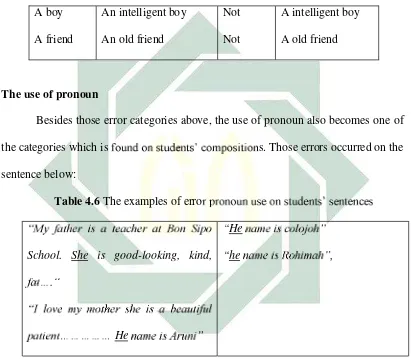
1) Pronoun
Marcella writes on her grammar that the person of being
spoken of, called the third person. Singular he (for male), -she (for female), -it (for thing; also for live beings whose sex is unknown or
unimportant for the speaker). Plural they (for all live beings and for all things).
Pronouns are words used in place of nouns, substantives
(words taking on the function of nouns), or noun phrase (noun
accompanied by articles, demonstratives, adjectives, and so on). The
noun that a pronoun replaces is called an antecedent. 29
For examples:
Antecedence Pronoun
John is American He is American
That book belongs to Marry That belongs to Marry
That woman is American She is American
Give that book to John Give that book to him
29
21
2) Article
For the use of article a is not necessary to be presented if
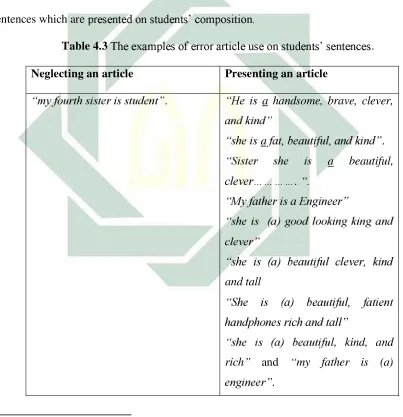
there is no antecedent provided on a sentence. For instance a
handsome. In this sentence, the article a is appropriate to be
presented.30 Betty argues on her grammar book that usually a/an is
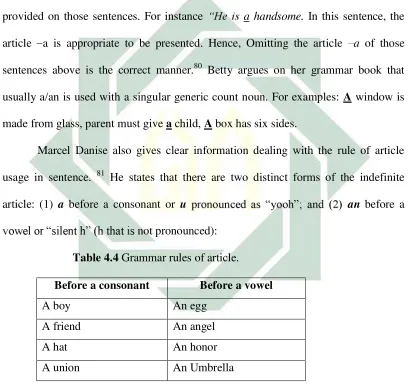
used with a singular generic count noun. For examples: a window is made from glass, parent must give a child, a box has six sides. Marcel Danise also gives clear information dealing with the rule of article
usage in sentence. 31 He states that there are two distinct forms of the
indefinite article: (1) a before a consonant or u
and (2) an
For examples:
Before a consonant Before a vowel
A boy An egg
A friend An angel
A hat An honor
A union An Umbrella
30
Marcel Danesi. Basic American Grammar and Usage: an ESL/EFL Handbook. (USA: Printed in the United States of America, 2006), A20.
31
22
Be careful! When an adjective or some other part of speech
precedes a noun, you have to adjust the article according to its initial
sounds.
3) Singular/plural nouns
The theory of this singular/plural noun use is based on the
plural noun rules on the grammar book written by Irene E. Schoenberg
and Jay Maurer. 32 The other source of this singular/plural noun rule
stated clearly by Marcel Danesi on his book
subdivided into count and non-count. Count nouns refer to anything
that can be counted (one book, two books and so son). They can be
specified with any article, numeral, or quantity term (many, several)
.33
For examples:
Singular Plural
A book Four books
One cake Many cakes
The church Several churches
32
Irene E. Schoenberg - Jay Maurer. Focus on Grammar: An Introductory Course For Reference And Practice. (USA: Pearson Education White plan, 2002), 262.
33
23
The rules of those statements explain that plural noun (regular)
should be added s/es. Then, for the singular noun should not be added
s /es. This analysis is also based on the rules of singular and plural
nouns created by Betty, she explains that a final s or es is added to a
noun to make a noun plural. 34
4) Preposition
Based on the rule of preposition, there are some types of
preposition provided. One of them is preposition for position. There are three kinds of preposition which are used for preposition, they are
in or inside, on and at. 35
In or inside : giving the area of something enclosed a container, a
drawer, a room, building, world - . For example:
On : indicating the surface of something a floor, a wall, a
desk, a street. For instance:
At : refers to a general vicinity. For instance:
34
Betty Schrampfer Azar. Understanding and Using English Grammar: Second Edition. (Prentice Hall regents: United States of America, 1989), 197-198.
35
Marcel Danesi. Basic American Grammar and Usage: an ESL/EFL Handbook. (USA: Printed in the United States of America, 2006), 163-165.
24
5) Subject omission and verb omission
verb. Who or what the sentence speaks about is called the subject;
what the sentence says about the subject is called the verb 36 This
statement means that every sentence should have subject and verb.
6) Tenses
Simple Present Tense expresses events or situations that exist
always, usually, habitually. The formula is S+V1+O/ S+V1s/es+O.
For instance: I go to school/ Ani goes to school. 37
7) Word formation
Prefixes and suffixes that are used in English give clues as to
the meaning and, or, the function of words. Typically suffixes indicate
the function of a word in a sentence. For instance there are some
suffixes that are used only for nouns and others that are used for verbs,
adjectives and adverbs. The particular suffix used in forming a word Grammar. (Suarabaya: Indah Surabaya, 2009), 411.
37
Betty Schrampfer Azar. Understanding and Using English Grammar: Second Edition. (Prentice Hall regents: United States of America, 1989), 2.
38
This source is taken fro
http://www.thefreedictionary.com/word+form,
25
8) fragments
Every sentence has to have a subject and a verb in order to be
complete. If it doesn't, it is a Ran into
(No subject) and (No verb). So, A
sentence fragment is a sentence in the sense that it cannot stand by itself. It does not contain even one independent clause.39
9) Extraneous subject
Every sentence has to have a subject and a verb in order to be
complete. In this case, the subject and verb can be more than one,
depending on the context. But, for the subject who/what has been
mentioned and the subject refers to the same people, place or thing
does not need to be mentioned twice. For example: my mother she is
beautiful. 40
10)Verb formation
In a sentence, the existence of verb should agree with the
context and meaning of that sentence logically. For example:
39
This source is taken from website of Capital Community College Foundation.
http://grammar.ccc.commnet.edu/grammar/fragments.htm, http://aliscot.com/bigdog/fragments.htm 22 40
26
This sentence is grammatically correct, but it is incorrect
logically. 41
11)subject-verb agreement
John Langan states that a verb must agree with its subject in
number. A singular subject (one person or thing) takes a singular verb.
A plural subject (more than one person or thing) takes a plural verb. 42
John S. Hartanto and friends state that is used to
combine between subject and complement of the sentence. The
complement of sentence can consists of adjective, noun, adverb, and verb showing continuous.43 In the present tense, the use of
are am, are, is dependson the subject.
3. Cohesion and Coherence in Writing
Chafe stated that writing is generally produced under basically
different expectations from those of speaking. Whereas speaking typically
occurs in a face-to-face interactive situation, writing is typically performed in
atures of a well-written text are the unity
41
Betty Schrampfer Azar. Understanding and Using English Grammar: Second Edition. (Prentice Hall regents: United States of America, 1989), A1.
42
John S. Hartanto, S. Koentjoro, - manaf Asmoro Seputro. Accurate, Brief and Clear: English Grammar. (Suarabaya: Indah Surabaya, 2009), 453.
43
27
together and relate to one another, it is stated by Celce-Murcia and Olshtain
on Supong Tangkiengsirisin research.44 This textual relationship is partly a
result of coherent organization of the intentions and ideas presented in writing.
In addition, Cornbleet and Carter argued that this relationship
significantly depends on the specific process of the writer goes through in
order to create formal and grammatical cohesion among paragraphs and
among sentences in each paragraph.45 Therefore, the writer can strengthen
coherence, and create global and local unity by employing various devices.
l-formed text is the unity
are essential for university-bound learners to be able to recognize and
reproduce. Celce-Murcia and Olshtainstated argued that these organizational
patterns make significant contributions to the overall coherence of the
discourse by indicating logical connections between ideas, dividing text into
chunks of information and drawing attention to themes and meaning with
lexical choices.46
since 1976 whose major concern is to investigate how sentences are linked in
44
Supong Tangkiengsirisin. Cohesion and Coherence in Text Language Institute, (Thammasat University), 9.
45
Supong Tangkiengsirisin. Cohesion and Coherence in Text Language Institute, (Thammasat University), 10.
46
28
a text. For them, the various parts of a paragraph are connected together by
cohesive ties. They argued that the writer is able to hold together meanings in
the related sentences in a number of ways, and cohesion is created to establish
the structure of meaning. They also claim that cohesion is a factor that
indicates whether a text is well-connected or simply a group of unrelated
sentences. In this case, certain linguistic devices that are used in relating
different parts of a text to one another are called cohesive devices.47
Various Cohesive Devices
Halliday and Hassan discussed cohesive devices under five heads,
reference, substitution, ellipsis, conjunction and lexical cohesion. But
according to them, cohesion can be generally classified as grammatical
(reference, substitution, ellipsis) and lexical (reiteration, collocation).
Halliday and Hassan keep conjunction on the uncertain of the grammatical
and lexical cohesion with the greater tilt on the grammatical side. Similar
views are shared by Steffensen, Hatch and Paltridge.48 They give more detail
explanation dealing with each item as follow:
Reference, Halliday and Hassan explanation that when one item of the language appears second time in the discourse that is the continuity of
47
Kolawole Olaniyan Cohesion And Coherence In Comments In Tell Ife Studies in English Language. Vol. 9 No 1. 2011, 6.
48
Ambreen Shahriar -
29
reference it it refers to the
previous word in that sentence, the book.
Substitution. Writersfrequently substitute a short phrase for a longer one that has preceded it, in much the same way as they use pronoun
reference.49 Simply, substitution is the replacement of one item by another
remark. For instance,
because he was desperate to get into university. The word did so substitutes
for cheated in his exam.
Nominal: one, ones; same.
Verbal: do
Clausal: so,not
Substitutions are believed as very important cohesive function, Cook
mentions that the brief forms of the sentences with substitutions are more
authentic than the longer sentences without substitutions.50
Ellipsis, is a gap or unsaid information that is known to the listener/reader of the text already, as it refers back to something already said.
Writers use ellipsis where words are deliberately left out of a sentence when
the meaning is still clear. 51 For example: Penny was introduced to a famous
49
Jeremy Harmer. How to Teach Writing. (Pearson Education Limited: England, 2004), 24. 50
Ambreen Shahriar -
Language in Indiawww.languageinindia.com, Vol.12, 2012, 377. 51
30
author, but even before she was she had recognized him. The second clause
omits the unnecessary repetition of introduced a famous author.
Conjunctions. Cook defines conjunction as the words which draw attention towards the relationships between sentences, clauses and words. The
(and, also, moreover,
furthermore), (however, on the other hand, but, yet)
etc.52
Reiteration. McCarthy defines reiteration as restating a word (or a phrase) by either direct repetition or using the lexical relations for that word
(for example, synonyms,antonyms, hypernyms, meronyms etc).
Collocation. McCarthy, Hatch finds collocation to be an important element for building
collocation among the devices of lexical cohesion, they do not find that
collocation can present a semantic relation between various items of discourse
as other cohesive markers do.
Coherence may be t
on the interpretation each individual sentence relative to the interpretation of
53
Jeremy Harmer. How to Teach Writing. (Pearson Education Limited: England, 2004), 24. 53
31
thought. 54
. The reader should be able to understand what
purpose is. Is it to give information, suggest a course of action,
make a judgment on a book or play, or express an opinion about world
. The reader should be able to follow the
discursive piece. If the text is a
narrative, the reader should be able to follow the story and not get confused
by time jumps, the characters, etc. Then, in a descriptive text, the reader
should know what is being described and what it looks, sounds, smells, or test
like.Therefore, coherence is frequently achieved by the way in which a writer
sequences information, and this brings us right back to the issue of genre and
text construction. Because, different genres provoke different writing.
54
32
B. Review of Previous Study
There are some previous studies dealing with this current study. First,
the study was done by Somchai Watcharapunyawong & Siriluck Usaha under
Writing Errors in Different Text Types: The
Foreign Languages, Institute of Social Technology, Suranaree University of
Technology, Thailand. This study aimed at analyzing writing errors caused by
the interference of the Thai language, regarded as the first language. The
results revealed that the first language interference errors of Thai students fell
into 16 categories: verb tense, word choice, sentence structure, article,
preposition, modal/auxiliary, singular/plural form, fragment, verb form,
pronoun, run-on sentence, infinitive/gerund, transition, subject-verb
agreement, parallel structure, and comparison structure.
-
Tense Errors in English Writing Made by T hai Students: A Comparative
-tense errors in Thai
differences. The findings suggested that errors of verbs and tenses made by
Thai students were the lack of subject-verb agreement, the omission of
33
Third, the study was conducted by Charuporn Pongsiriwet under the
study was done at college of Human Resources and Education at West
Virginia University. This study attempted to combine the study of
grammatical accuracy with the study of discourse features of second language
writing. The findings reveal no statistically significant correlation between
grammatical accuracy and cohesion but a statistically significant correlation
between grammatical accuracy and coherence.
CHAPTER III
RESEARCH METHOD
A. Approach and Research Design
The goal of this study is to examine and then describe the profile of
grammatical accuracy, cohesion and coherence on English writings which are
produced by Thai students at Darawithaya School. Considering the goal, this
study is included as qualitative design using descriptive approach, since it
tries to describe a phenomenon of language behavior. This study includes
library research.
Qualitative research employs words and images to answer questions.55 As
stated that one of the characteristics of qualitative study is the natural setting
since its goal is to describe social phenomenon as it occurs naturally without
manipulation. Furthermore, the writers define qualitative research as the
research which investigates the quality of relationships, activities, situations,
and materials. It focuses on understanding the context and attempts to explain
the intentionality of behaviors.56 By those functions of qualitative research, it
is believed to be an appropriate method in this current study, since it tries to
give a description of phenomenon in language behavior naturally without
manipulation.
55
Donald. Ary, et.al., Introduction to Research in Education (Belmont, CA: Wadsworth, 2009), 420. 56
35
Descriptive approach is designed primarily to describe what is going on or
what exists.57
Whitney states that descriptive qualitative is a data collection
which interprets the fact truly.58 This way agrees with the requirements in this
recent study.
In qualitative study, there are three major categories of data collection;
in-depth interviews, direct observation and document analysis.59
The other
source, we can see four varied nature of qualitative forms of data. They are:
Observations, interviews and questionnaires, documents and audiovisual
materials.60 Document analysis is used in this recent study to collect the data.
Document is believed as a valuable source of information in qualitative
research. It can include newspapers, minutes of meetings, personal journals,
and letters. 61
F.L Whitney. The element of research, Asian Ed,. Overseas Book Co., Osaka, 1960, 35
59
William M. K. Trochim, Research Methods Knowledge Base (Cincinnati, OH: Atomic Dog Pub., 2001), 159
60
John W Creswell. Educational research : planning, conducting, and evaluating quantitative and qualitative research / John W. Creswell. 4th ed, 2012, 212
61
36
Documents provide the advantage of being in the language and words
of the participants who have usually given thoughtful attention to them. They
are also ready for analysis without the necessary transcription that is required
with observational or interview data.62 In this case, the data is taken from
Descriptive Text.
as the main data that will be analized, while the
other data are also taken
English class. Those additional data are used as refference for this research
but those are not
analized.
In this research, both researchers and theories are handled in second
and foreign language acquisition field that can offer important evidence of
knowledge, and the main areas of linguistic and discourse difficulty of learner
62
37
may occur in learning writing in target language. Studies on linguistic
accuracy presents appropriate information for research in three parts: second
language acquisition, second language writing assessment, and second
language writing pedagogy.63 Thus, the focus on examining grammatical
accuracy and the aspect of cohesion and coherence on
study may also provide valuable insights concerning the importance of them
in assessing the writing quality.
While leading this study, the researcher takes up a role as a complete or covert participant. Complete participant is a member of the group or
context under study and focuses on the natural activity of the group without
informing the group that it is under study. It can be a researcher who becomes
a certified teacher and takes a position in a school for the purpose of
conducting research without telling anyone.64 In this study, researcher is a
63
C. G. Polio, Measures of Linguistic Accuracy in Second Language Writing Research.Language Learning, 47, 1997, 101-143
64
38
teacher for the participants for five months. In collecting the data, researcher
does not need to tell anyone.
C. Research Location
This study takes place at Darawithaya School Muhammadiyah
Islamiyah Islamic Bording House, Kiambang Dalam Tanyongmas Rangae
Narathiwat, South of Thailand. The researcher formerly attended as an
English instructor at that School for about five months both Academic course
and Islamic course.
Most students of Darawithaya School disposed mastering their knowledge
in religion subjects (Arab). Meanwhile, English becomes a foreign language
which is difficult to be mastered, as stated in detail in the previous discussion.
English is rarely used in their daily conversation, both spoken and written.
They use Thai and Melayu Pattani for their communication language every
time. This reality makes them get difficulty in building their competence in
English.
While attending at that school as an English teacher, researcher finds
some problems dealing with English, especially in writing. It is proven by
found some errors. Grammar and the
connection of sentences and ideas are the most frequent problem that found in
65
65
39
The participants of this study enroll as students of Mathyum 5 in second
semester, year 2014-2015. Mathyum grade is provided from 1 up to 6.
Mathyum 1 up to 3 is equal with Junior High School level, and Mathyum 4 up
to 6 is equal with Senior High School. So, the participants of this study are
equal with second grade students of Senior High School. In this school,
Mathyum 5 is divided into two classes; 5/1 class and 5/2 class. The researcher
takes 5/2 class for taking the sample, then focuses on female learners only for
data collection. That class consists of 25 students with 14 females and 11
males.
Mathyum 5/2 class is selected based on the reality that the researcher only
took a role as a teacher at that class for Academic School. Furthermore, as
recognized that second grade students are in the middle process in that level,
familiarly it is known as transition age. In this age they have experienced
learning in first grade that is believed they are capable of doing the
instruction/tests given in this study and they need to face one more level after
passing this age then. In the last level, third grade, they will face final
examination which should be taken by all learners under government rule,
included English. Therefore, it becomes something crucial for them also
instructor to know their capability in writing English and what they need to
improve to be ready in joining the next level, and prepare for final
40
Female learners become a focus in this study because a certain
consideration. During the semester, male students have not attended the class
house.
students in the other room. Thus, they do not get learning optimally during the
semester and this case is worried they do not get the material that deals with
data collection.
D. Data and Source of The Data
1. Data
a. Primary
data is taken after those writings are used for the final project of
. The data is the
study at
senior High School, year 2014-2015. This data is included into
documentation data.
b. Secondary
This data is used for supporting the primary data. This data is
regarded as additional data which gotten from some sources; books,
41
2. Source of the data
Source of the data in this recent study is observer as the teacher of the
class, and participants as the students who make the primary data.
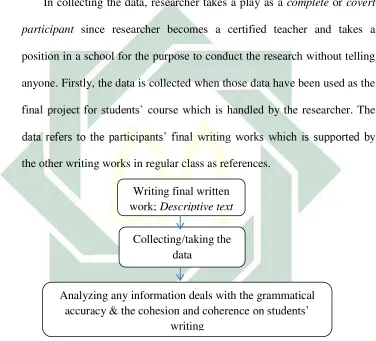
In collecting the data, researcher takes a play as a complete or covert
participant since researcher becomes a certified teacher and takes a
position in a school for the purpose to conduct the research without telling
anyone. Firstly, the data is collected when those data have been used as the
course which is handled by the researcher. The
the other writing works in regular class as references.
Figure. 3.1 Data Collection Technique.
E. Research Instrument
The instruments which are used in this research to collect the data are the
documents themselves, guidelines and rubrics. Documents provide the
advantage of being in the language and words of the participants, who have
usually given thoughtful attention to them. They are also ready for analysis Writing final written
work; Descriptive text
Collecting/taking the data
Analyzing any information deals with the grammatical accuracy & the cohesion and coherence
42
without the necessary transcription that is required with observational or
interview data.66
In this current study, the become instruments
which then being analyzed to know the grammar accuracy and the cohesion
and coherence on the writings which are produced by students. Then, a rubric
is chosen to be standard guide the
grammatical accuracy and the coherence and cohesion aspect.
F. Data Analysis Technique
Data analysis deals with processing the data such as organizing, breaking
into manageable units, synthesizing, discovering the patterns, finding out the
important points, and deciding what should be explained to others. All
qualitative analysis includes trying to comprehend the phenomenon under
study, synthesize information and explain relationships, theorize about how
and why the relationships perform as they do, and relink the new knowledge
with what is already known. The task of analyzing qualitative data can appear
overwhelming but becomes manageable when broken down into key stages. 67
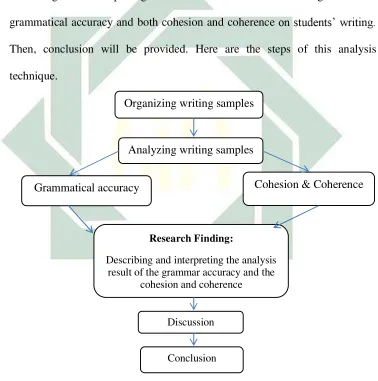
In order to come to the last step of analyzing data, there are several steps
Donald. Ary, et.al., Introduction to Research in Education (Belmont, CA: Wadsworth, 2009), 432. 67
43
organizing all the writing samples. The next step is analyzing all the writing
samples to see the grammatical accuracy and the cohesion and coherence
After analyzing those two aspects in the writing samples, the last step is
describing and interpreting what have been known dealing with the
grammatical accuracy and both cohesion and coherence
Then, conclusion will be provided. Here are the steps of this analysis
technique.
Figure. 3.2 Steps of the Data Analysis Technique
Organizing writing samples
Analyzing writing samples
Research Finding:
Describing and interpreting the analysis result of the grammar accuracy and the
cohesion and coherence
Grammatical accuracy Cohesion & Coherence
Discussion
44
In this case, to examine the grammatical accuracy on
writing samples, firstly, the composition are classified and analyzed using
a measurement of grammatical errors. This measure has been used in
several previous studies in second language writing to measure grammar
accuracy in English written, for example in a research done by Chastian,68
Frantzen,69 Kobayashi & Rinnert,70 Kroll.71 Those researches have
showed to offer theoretically valuable information dealing with this
current study. All grammatical errors which are established in the
rules which provided in any grammar book. The following guidelines
suggested by Polio. 72
1. Do not count spelling errors
2. Do not look at the sentence in isolation.
4. Do not count errors in capitalization.
68
K. Chastian, .Modern Language Journal, 11, 367-383.
69
D. Frantzen,
Content Course . Modern Language Journal, 79, 1995, 329-344 70
H. Kobayashi - C. Rinnert,
Comparison , 42, 1992, 183-215.
71
B. Kroll, What Does Time Buy? ESL Student Performance on Home Versus Class Compositions. In B. Kroll (Ed.), Second Language Writing: Research Insights for the Classroom (pp. 140-154). Cambridge: Cambridge University Press, 1990
72
45
5. Count errors that can be made by native speakers (e.g., between you
and I)
6. Ignore an unfinished sentence at the end of the essay.
This guideline
method used by Kroll to tabulate composition error. Then, it can prove useful finding
since it allows for comparison of compositions of any length. This measurement is
specified into some categories of grammatical errors involved errors such as
pronouns, articles, singular/plural nouns, prepositions, tenses, verb formation, word
formation, fragments, verb omission, extraneous subject, subject omission, and
subject-verb agreement. The errors are highlighted or underlined to make it easy in
categorizing the various types of errors.
46
12 Fragment
Total
After categorizing the various types of errors, each composition is then
measured to know the level of the grammatical accuracy from each composition. To
measure this grammatical accuracy, grading rubric adapted from the Assessment
rubric for The Writing Task based on CEFR descriptor at Universitat de le Illes
Balears (UIB) is used. (See appendix B)
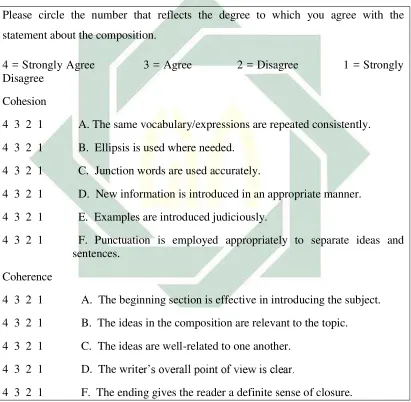
Then, for the coherence and cohesion are firstly measured by the rating scale
which is collected of two subscales aiming at two major areas of cohesion and
theory which is aimed to measure
and appropriateness in the organization of ideas above the sentence
level and among 73 This theory is taken to check an
understanding involving 7 features for
cohesion and 7 features for coherence. But, this study uses rating scale which consists
of only 6 features for cohesion and 5 features coherence. The point of
in cohesion aspect is not included. Since, that point has been evaluated in
grammar category as . Then, there are two points of coherence
which are not used, they are
and .
73
47
This consideration is based on the compositions which are used as data in this study
are simple writings about descriptive text under the topic MY FAMILY which consist
only one paragraph in each composition. Therefore, those categories are not obtained.
Please circle the number that reflects the degree to which you agree with the
statement about the composition.
4 = Strongly Agree 3 = Agree 2 = Disagree 1 = Strongly Disagree
Cohesion
4 3 2 1 A. The same vocabulary/expressions are repeated consistently.
4 3 2 1 B. Ellipsis is used where needed.
4 3 2 1 C. Junction words are used accurately.
4 3 2 1 D. New information is introduced in an appropriate manner.
4 3 2 1 E. Examples are introduced judiciously.
4 3 2 1 F. Punctuation is employed appropriately to separate ideas and sentences.
Coherence
4 3 2 1 A. The beginning section is effective in introducing the subject.
4 3 2 1 B. The ideas in the composition are relevant to the topic.
4 3 2 1 C. The ideas are well-related to one another.
4 3 2 1 D. The writ
4 3 2 1 F. The ending gives the reader a definite sense of closure.
48
Then, each feature from those 11 features is categorized into four numbers
based the criteria of measurement, why getting 4, 3, 2, and 1. This categorization has
been approved by Prof. Furqon as the writing lecture at UIN Sunan Ampel. (See appendix D) Further, after analyzing the cohesion and coherence aspects through the rating scale above, each composition is finally measured to examine the level of the
cohesion and coherence from each composition through grading rubric adapted from
the Assessment Rubric for The Writing Task based on CEFR descriptor at Universitat
de le Illes Balears (UIB) is used. (See appendix B)
There are five levels provided on assessment rubric for the writing task with
the highest score up to the lowest score; from 1, 0.75, 0.5, 0,25, and 0. In this case,
researcher decides those five levels as very good, good, fair, weak, and failed to
writings.
G.Checking Validity of Findings
In checking the validity of findings, firstly, researcher consults the
instruments used in analyzing the data to some qualified lecturers including the
advisors. After that, the researcher analyzes the data many times until the same result
is gotten. Then, researcher also relates the findings with some theories needed, as
theory of grammar use, cohesion and coherence theories. After relating the findings
with the theories, researcher also asks other researcher to analyze the data in order to
49
consults the finding to some qualified lecturers including the advisors to get the
CHAPTER IV
RESEARCH FINDINGS AND DISCUSSION
This chapter presents research finding and discussion. The finding of this
study is presented based on the research questions mentioned in Chapter One. Then,
relating the result of the finding with the theories becomes a discussion point in the
end of this chapter. The research questions of this research are (1) how is the
? and
(2) how are the cohesion and coherence
Darawithaya School?
A.Research Findings
In this session, the process of collecting data and data finding are described in
detail based on those two research questions above. Firstly, this study is library
research that the data is documents that were collected after those data had been
used as the final assignment of the course which was handled
by the researcher as a teacher at Darawithaya School. The data refers to the
; composition of descriptive text under the topic MY
51
1. Grammatical Accuracy
Answering the first research question including the grammatical accuracy on
writing, some certain grammar categories are decided to be analyzed. Those
grammar categories are based on Standard English grammatical rule which is
provided in any grammar book. Specifically, the guideline of grammar categories
suggested by Polio is used in this research, as stated and showed in the previous
chapter.74 After analyzing and categorizing, then the result is described and
explained in detail of each error type by enclosing the examples found on each
composition. In this analysis, some grammar books are used as the sources to support
the validity of this result.
Student 1 (ST1)
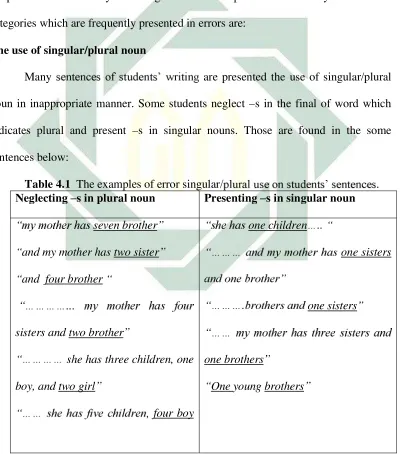
The result of the analysis shows that there are some errors presented on the
composition especially in the use of singular/plural noun. The errors of this category
are found in some sentences. For example: My mother has seven brother , and my
mother has two sister , and four brother , and my sister are single. My first sister
is a student. She is tall, friendly, good-looking. She is 17 years old. Second sister is a
student. She is beautiful, tall, and kind .
Those sentences prove that student 1 has lack understanding in grammar,
especially in the use of singular/plural category. Then, student 1 also presents one
error of using pronoun. It occurs on the sentence
74