vii ABSTRACT
Baninda, Agustina Krisma. (2015). Feedback-Based Improvement of Grammatical Accuracy of the Eighth Grade Students of SMP Kanisius Pakem in Writing Skill. Yogyakarta: English Language Education Study Program, Sanata Dharma University.
Learning English is important for all students. Although Indonesia does not use English as the first language, learning English is also important because English is one of the compulsory subjects in junior high school and senior high school. In the process of learning English, many students made a lot of grammatical mistakes in their writing.
The research was meant to find out whether teacher’s feedback facilitated grammatical accuracy in writing of the eighth grade students of SMP Kanisius Pakem. In line with the problem formulation, the research was intended to assess to what extent teacher’s feedback facilitated grammatical accuracy in writing of the eighth grade students of SMP Kanisius Pakem.
The research was essentially Classroom Action Research (CAR), which consisted of two cycles, each of which consisted of one meeting. The participants were 17 students from 8A Disiplin class SMP Kanisius Pakem 2014/2015 academic year. The students were asked to write dialogues based on the pictures and the situation given. The data were gathered from the students’ worksheet, students’ reflection, teacher’s reflection, field notes, questionnaire, and interview. The researcher used grammatical error analysis to analyze the students’ worksheet. The data analysis of teacher’s reflection was what went well and wrong in each of cycles. In field notes, the data analysis was non-verbal information report of the interaction between participants. The data analysis of the students’ reflection, questionnaire, and interview were the students’ opinion after receiving teacher’s feedback. The analysis of those data showed that the students made fewer mistakes after receiving teacher’s feedback.
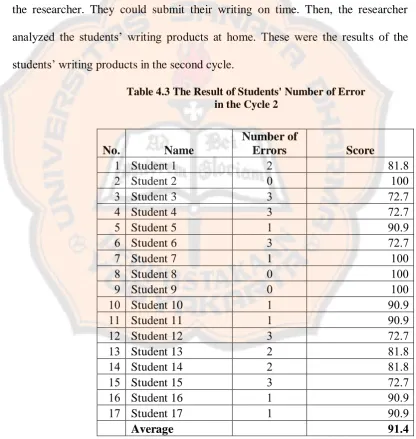
The result from the first cycle showed that the students made mistakes such as double verbs and verb endings. However, the second cycle showed that the students made fewer mistakes. By comparing the result of the first and second cycle, the students made fewer mistakes after teacher’s feedback was given. Before conducting the first cycle, the score average of the class was 68.7. Then, after the second cycle was conducted, the score average of the class became 91.4. It was concluded that the teacher’s feedback improved the students’ grammatical accuracy in their writing. Therefore, it is suggested that English teachers give feedback to the students’ writing products. The teacher’s feedback should be clear to avoid misunderstanding and motivates the students so the students feel motivated to make better writing product.
viii ABSTRAK
Baninda, Agustina Krisma. (2015). Feedback-Based Improvement of Grammatical Accuracy of the Eighth Grade Students of SMP Kanisius Pakem in Writing Skill. Yogyakarta: English Language Education Study Program, Sanata Dharma University.
Pembelajaran Bahasa Inggris sangat penting untuk seluruh murid. Meskipun Indonesia tidak menggunakan Bahasa Inggris sebagai bahasa utama, pembelajaran Bahasa Inggris juga penting karena Bahasa Inggris adalah salah satu mata pelajaran wajib di sekolah menengah pertama dan sekolah menengah atas. Dalam proses pembelajaran Bahasa Inggris, banyak murid yang membuat kesalahan grammar di tulisan mereka.
Penelitian ini dimaksudkan untuk menemukan apakah koreksi guru memfasilitasi keakuratan grammar di tulisan murid-murid kelas 8A SMP Kanisius Pakem. Sehubungan dengan rumusan masalah, penelitian ini dimaksudkan untuk menilai seberapakah koreksi guru memfasilitasi keakuratan penggunaan tata bahasa di tulisan murid-murid kelas delapan SMP Kanisius Pakem.
Penelitian ini adalah Penelitian Tindakan Kelas yang terdiri dari dua siklus, masing-masing siklus terdiri dari satu pertemuan. Peserta penelitian berjumlah 17 murid dari kelas 8A Disiplin SMP Kanisius Pakem tahun ajaran 2014/2015. Murid-murid diminta untuk menulis beberapa percakapan sesuai dengan gambar yang diberikan. Dalam siklus kedua, murid-murid diminta untuk menulis beberapa percakapan berdasarkan situasi yang diberikan. Data penelitian dikumpulkan dari lembar kerja siswa, refleksi siswa, refleksi guru, pengamatan lapangan, kuesioner dan sesi tanya jawab. Peneliti menggunakan analisa kesalahan tata bahasa dalam menganalisa lembar kerja siswa. Analisa data dari refleksi guru adalah apa yang berjalan baik dan tidak baik di setiap siklus. Dalam pengamatan lapangan, analisa datanya adalah laporan informasi lisan dari interaksi antar murid. Analisa data dari refleksi siswa, kuesioner dan tanya jawab adalah pendapat murid setelah mendapat koreksi guru. Analisa dari data-data tersebut menunjukkan bahwa murid-murid membuat sedikit kesalahan setelah menerima koreksi guru.
FEEDBACK-BASED IMPROVEMENT OF GRAMMATICAL ACCURACY OF THE EIGHTH STUDENTS OF SMP KANISIUS PAKEM IN WRITING
SKILL
A SARJANA PENDIDIKAN THESIS
Presented as Partial Fulfillment of the Requirements to Obtain the Sarjana Pendidikan Degree
in English Language Education
By
Agustina Krisma Baninda Student Number: 111214103
ENGLISH LANGUAGE EDUCATION STUDY PROGRAM DEPARTMENT OF LANGUAGE AND ARTS EDUCATION FACULTY OF TEACHERS TRAINING AND EDUCATION
SANATA DHARMA UNIVERSITY YOGYAKARTA
i
FEEDBACK-BASED IMPROVEMENT OF GRAMMATICAL ACCURACY OF THE EIGHTH GRADE STUDENTS OF SMP KANISIUS
PAKEM IN WRITING SKILL
A SARJANA PENDIDIKAN THESIS
Presented as Partial Fulfillment of the Requirements to Obtain the Sarjana Pendidikan Degree
in English Language Education
By
Agustina Krisma Baninda Student Number: 111214103
ENGLISH LANGUAGE EDUCATION STUDY PROGRAM DEPARTMENT OF LANGUAGE AND ARTS EDUCATION FACULTY OF TEACHERS TRAINING AND EDUCATION
SANATA DHARMA UNIVERSITY YOGYAKARTA
iv
Di dalam hidup ini, semua ada waktunya
Ada waktunya kita menabur
PertolonganNya pasti kan tiba tepat pada waktuNya
Bagaikan kuncup mawar pada waktunya mekar
Ajarlah kami setia selalu menanti waktuMu Tuhan
(1 Korintus 10 : 13 & Pengkothbah 3 : 11a)
This thesis is dedicated to my beloved parents,
v
STATEMENT OF WORK’S ORIGINALITY
I honestly declare that this thesis, which I have written, does not contain the work or parts of the work of other people, except those cited in the quotations and the references, as a scientific paper should.
Yogyakarta, 10 September 2015 The Writer
vi
LEMBAR PERNYATAAN PERSETUJUAN
PUBLIKASI KARYA ILMIAH UNTUK KEPENTINGAN AKADEMIS Yang bertanda tangan di bawah ini, saya mahasiswi Universitas Sanata Dharma:
Nama : Agustina Krisma Baninda Nomor Mahasiswa :111214103
Demi pengembangan ilmu pengetahuan, saya memberikan kepada Perpustakaan Universitas Sanata Dharma karya ilmiah saya yang berjudul:
FEEDBACK-BASED IMPROVEMENT OF GRAMMATICAL ACCURACY OF THE EIGHTH GRADE STUDENTS OF SMP KANISIUS
PAKEM IN WRITING SKILL
beserta perangkat yang diperlukan (bila ada). Dengan demikian, saya memberikan kepada Perpustakaan Universitas Sanata Dharma hak untuk menyimpan, mengalihkan dalam bentuk lain, mengelolanya dalam bentuk pangkalan data, mendistribusikannya di internet atau media lain untuk kepentingan akademis tanpa perlu meminta ijin maupun royalty kepada saya selama tetap mencantumkan nama saya sebagai penulis.
Demikian pernyataan ini saya buat dengan sebenarnya. Dibuat di Yogyakarta
Pada tanggal: 10 September 2015 Yang menyatakan,
vii ABSTRACT
Baninda, Agustina Krisma. Feedback-Based Improvement of Grammatical Accuracy of the Eighth Grade Students of SMP Kanisius Pakem in Writing Skill. Yogyakarta: English Language Education Study Program, Sanata Dharma University. Learning English is important for all students. Although Indonesia does not use English as the first language, learning English is also important because English is one of the compulsory subjects in junior high school and senior high school. In the process of learning English, many students made a lot of grammatical mistakes in their writing.
The research was meant to find out whether teacher’s feedback facilitated grammatical accuracy in writing of the eighth grade students of SMP Kanisius Pakem. In line with the problem formulation, the research was intended to assess to what extent teacher’s feedback facilitated grammatical accuracy in writing of the eighth grade students of SMP Kanisius Pakem.
The research was essentially Classroom Action Research (CAR), which consisted of two cycles, each of which consisted of one meeting. The participants were 17 students from 8A Disiplin class SMP Kanisius Pakem 2014/2015 academic year. The students were asked to write dialogues based on the pictures and the situation given The data were gathered from the students’ worksheet, students’ reflection, teacher’s reflection, field notes, questionnaire, and interview The researcher used grammatical error analysis to analyze the students’ worksheet The data analysis of teacher’s reflection was what went well and wrong in each of cycles In field notes, the data analysis was non-verbal information report of the interaction between participants The data analysis of the students’ reflection, questionnaire, and interview were the students’ opinion after receiving teacher’s feedback The analysis of those data showed that the students made fewer mistakes after receiving teacher’s feedback.
viii ABSTRAK
Baninda, Agustina Krisma. Feedback-Based Improvement of Grammatical Accuracy of the Eighth Grade Students of SMP Kanisius Pakem in Writing Skill. Yogyakarta: English Language Education Study Program, Sanata Dharma University. Pembelajaran Bahasa Inggris sangat penting untuk seluruh murid. Meskipun Indonesia tidak menggunakan Bahasa Inggris sebagai bahasa utama, pembelajaran Bahasa Inggris juga penting karena Bahasa Inggris adalah salah satu mata pelajaran wajib di sekolah menengah pertama dan sekolah menengah atas. Dalam proses pembelajaran Bahasa Inggris, banyak murid yang membuat kesalahan grammar di tulisan mereka.
Penelitian ini dimaksudkan untuk menemukan apakah koreksi guru memfasilitasi keakuratan grammar di tulisan murid-murid kelas 8A SMP Kanisius Pakem. Sehubungan dengan rumusan masalah, penelitian ini dimaksudkan untuk menilai seberapakah koreksi guru memfasilitasi keakuratan penggunaan tata bahasa di tulisan murid-murid kelas delapan SMP Kanisius Pakem.
Penelitian ini adalah Penelitian Tindakan Kelas yang terdiri dari dua siklus, masing-masing siklus terdiri dari satu pertemuan. Peserta penelitian berjumlah 17 murid dari kelas 8A Disiplin SMP Kanisius Pakem tahun ajaran 2014/2015. Murid-murid diminta untuk menulis beberapa percakapan sesuai dengan gambar yang diberikan. Dalam siklus kedua, murid-murid diminta untuk menulis beberapa percakapan berdasarkan situasi yang diberikan. Data penelitian dikumpulkan dari lembar kerja siswa, refleksi siswa, refleksi guru, pengamatan lapangan, kuesioner dan sesi tanya jawab. Peneliti menggunakan analisa kesalahan tata bahasa dalam menganalisa lembar kerja siswa. Analisa data dari refleksi guru adalah apa yang berjalan baik dan tidak baik di setiap siklus. Dalam pengamatan lapangan, analisa datanya adalah laporan informasi lisan dari interaksi antar murid. Analisa data dari refleksi siswa, kuesioner dan tanya jawab adalah pendapat murid setelah mendapat koreksi guru. Analisa dari data-data tersebut menunjukkan bahwa murid-murid membuat sedikit kesalahan setelah menerima koreksi guru.
Hasil dari siklus pertama menunjukkan bahwa murid-murid membuat kesalahan seperti kata kerja ganda dan akhiran kata kerja. Namun, hasil siklus kedua menunjukkan bahwa murid-murid membuat sedikit kesalahan. Dengan membandingkan hasil tersebut, murid-murid membuat sedikit kesalahan setelah menerima koreksi guru. Sebelum siklus pertama, rata-rata kelas adalah 68,7. Setelah siklus kedua, rata-rata kelas menjadi 91,4. Hal ini dapat disimpulkan bahwa koreksi guru dapat memfasilitasi keakuratan tata bahasa di tulisan mereka. Oleh sebab itu, hal ini disarankan kepada guru bahasa Inggris untuk memberi koreksi pada tulisan siswa. Koreksi guru harus jelas untuk menghindari kesalahpahaman dan memotivasi murid untuk membuat tulisan yang lebih baik.
ix
ACKNOWLEDGEMENTS
First off all, I would like to give my deepest gratitude to my beloved Lord, Jesus Christ for the guidance, blessing, and love during my life. He always helps me when I did my thesis. I am nothing without Him.
I would like to thank my supervisor, Agustinus Hardi Prasetyo, S.Pd., M.A., for the feedback, patience, and encouragement during the process of writing the thesis. I also thank to my academic advisor Fidelis Chosa Kastuhandani S.Pd., M.Hum., for his guidance during my study in PBI Sanata Dharma University. I would also like to thank M.M. Rika Febriani, S.Pd. for the opportunity which is given to me to conduct the research in her class in 8A Disiplin. My thankfulness also goes to the students of 8A Disiplin SMP Kanisius Pakem from 2014/2015 academic year for their cooperation during the process.
This thesis is dedicated to my beloved parents, Benedictus Bambang Suranto and Lidwina Sunindar, and also my sister Lusia Devina Lisa Baninda. I am also grateful to my beloved grandma Uti, Om Robert, Om John, and my beloved uncle Father Marcellinus Roselawanto, Pr. I thank all of them for their care, patient, support, and greatest love for me. I am very grateful to have my family.
x
I thank to all of my friends in PBI Santa Dharma, especially my best friends Syusan, Chachong, Didii, Ell-ell, and Tante, for the support, jokes, and crazy experiences during these 4 years. I also give my special thanks to Bundo Putri, Ester, Chris, Nisa, and Fam6 for the wonderful friendship and their care during my happiest and hardest days of my life. My gratitude also goes to Nengdud, Yayen, and Masjud for their care, affection, laugh, and unforgettable moment during my last semester. I am very happy to have all of my friends. May God always bless them.
Finally, my deepest thanks go to all of my friends and everyone who helped and supported me in finishing my thesis but I could not mention here one by one. May God always bless them.
xi
TABLE OF CONTENTS
TITLE PAGE ... i
APPROVAL PAGE ... ii
DEDICATION PAGE... iv
STATEMENT OF WORK’S ORIGINALITY ... v
LEMBAR PERSETUJUAN PUBLIKASI ... vi
ABSTRACT ... vii
ABSTRAK... viii
ACKNOWLEDGEMENTS ... ix
TABLE OF CONTENTS ... xi
LIST OF TABLES ... xiv
LIST OF FIGURE ... xv
LIST OF APPENDICES... xvi
CHAPTER I. INTRODUCTION
A. Research Background ... B. Research Problem ... C. Research Limitation ... D. Research Objective ... E. Research Benefits ... F. Definition of Terms ...
CHAPTER II. REVIEW OF RELATED LITERATURE
xii
1. The Nature of Writing ... 2. Principles of Teaching Writing ... 3. The Purposes of Writing ... 4. Feedback ... a. Forms of feedback ... b. Sources of feedback ... 5. The Purposes of Feedback ... 6. Grammar ... 7. Classroom Action Research ... B. Theoretical Framework ...
CHAPTER III. METHODOLOGY
A. Research Method ... B. Research Setting ... C. Research Participants ... D. Instruments and Data Gathering Technique ... E. Data Analysis Technique ... F. Research Procedure ...
CHAPTER IV. RESEARCH RESULTS AND DISCUSSION
xiii
D. Research Results ... E. The Other Findings ...
CHAPTER V. CONCLUSIONS AND RECOMMENDATIONS
xiv
LIST OF TABLES
Table Page
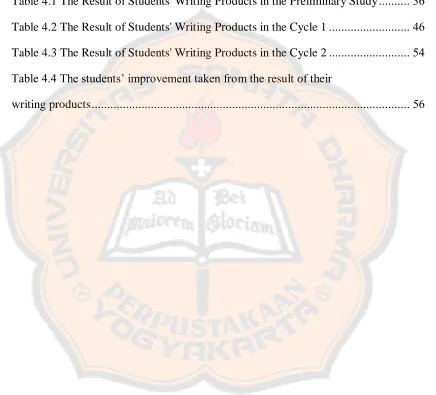
Table 4.1 The Result of Students' Writing Products in the Preliminary Study ... Table 4.2 The Result of Students' Writing Products in the Cycle 1 ... Table 4.3 The Result of Students' Writing Products in the Cycle 2 ... Table The students’ improvement taken from the result of their
xv
LIST OF FIGURE
Figure Page
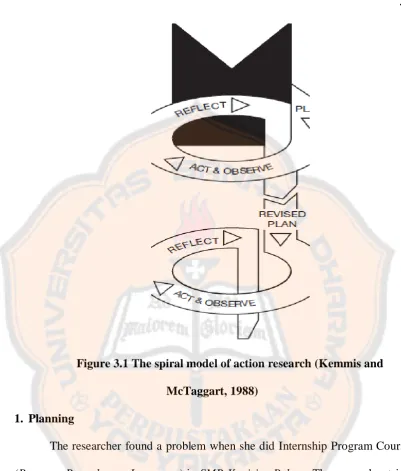
Figure 3.1 The spiral model of action research (Kemmis and
xvi
LIST OF APPENDICES
Appendix Page
APPENDIX 1. Teaching Materials of Preliminary Study ... APPENDIX Teacher’s Reflection of Preliminary Study ...
APPENDIX 3. Teaching Procedure of Preliminary Study ... APPENDIX 4. Teaching Materials of First Cycle ... APPENDIX 5. Teacher’s Reflection of First Cycle ... APPENDIX 6. Teaching Procedure of First Cycle ... APPENDIX 7. Teaching Materials of Second Cycle ... APPENDIX 8. Teacher’s Reflection of Second Cycle ... APPENDIX 9. Teaching Procedure of Second Cycle ... APPENDIX 10. The Raw Data of Questionnaire... APPENDIX 11. The Interview Transcript ... APPENDIX The Sample of Students’ Writing Products in
1 CHAPTER I INTRODUCTION
In this chapter, the researcher presents the research background, the research problem, the research objective, the research benefits, and definition of terms used in the thesis.
A.Research Background
Learning English is important for all students. Learning English is important for students in Indonesia, it is because English is one of the compulsory subjects in both junior and senior high school. In this case, learning English is significant for all students.
It involves the language skills in the learning English. They are speaking, writing, reading, and listening. Writing skill in English will be mostly discussed in this study. It will be the main discussion because the researcher found mistakes in the students’ writing products. Writing is not only a tool for communication.
Zimmerman and Rodrigues (1992) state that writing is a way of thinking, learning, and sharing ideas with others. It serves how the students learn, think, and organize their knowledge or ideas. The students write the composition of their ideas or opinions and communicate them to the readers.
are writing in a second or a foreign language in academic contexts. It is difficult
because the students still make a lot of mistakes in their writing. In learning
writing, the students must have knowledge of how the rules of combining words
to make a sentence. This basic understanding is known as grammar. EFL students
in Indonesia should have obtained the basic knowledge of grammar because they
learn it since they are in the elementary school.
In the process of writing, the students can improve their writing skill by
receiving feedback from the others. By receiving feedback, they will know
whether their writing is good or not. In this case, others’ opinion or feedback of
their writing is needed. Hyland and Hyland (2006) said that “feedback has long
been regarded as essential for the development of second language (L2) writing
skills, both for its potential for learning and for student motivation” (p. 83). By
receiving feedback from others, students can practice and revise the incorrect part
to the correct one.
Dinham’s research study (2008) tells about the powerful teacher feedback.
He finds that one of the most powerful forms of feedback, which is used by
effective teachers, is the one-to-one interview with a student. In this case, the
effective teacher provides answers to these questions; what can I do? what can’t I
do? how does my work compare with that of others? and how can I do better? In
addition, Wiggins (1998) said that feedback is actually different from guidance.
Feedback tells about what resulted from your action, whereas guidance tells about
Pertiwi's study (2003) shows that most students tend to respond positively
toward the feedback which has been provided by the teacher and they consider
that it is helpful for them to write better. She points out that the teacher’s feedback
is an important aspect for the students in helping them to make a better writing.
Moreover, she adds that it is also important to pay attention to the forms of
feedback given. In this case, the students show improvement in their writing after
receiving feedback from their teacher. Therefore, the teacher should give clear
feedback on the students’ writing.
The previous study from Negari (2011) shows that writing is one of the
important skills that the students must have. However, most of them still make a
lot of mistakes. Many students make grammatical errors on their writing products.
The mistake that the students do is about the minimum requirements. Actually,
that is the basic understanding of grammar that the students should know.
Therefore, the feedback is chosen in this study to solve the problem and achieve
students’ good writing products.
This thesis describes the action research in improving grammatical
accuracy in writing of the eighth grade students of SMP Kanisius Pakem. The
researcher is the pre-service teachers in SMP Kanisius Pakem. The researcher
taught one class during the Internship Program Course; 8A Disiplin. In the
learning English, the researcher found a problem. The problem was the 8A
Disiplin students made a lot of mistakes in their writing products. They made a lot
some words and wrong punctuation. Those mistakes that the students made were
the important things for the students to build their good writing.
The researcher wanted to improve the grammatical accuracy in writing of
the eighth grade students of SMP Kanisius Pakem. According to Hyland and
Hyland (2006), there are two sources of feedback. They are teacher feedback and
peer feedback. In this study, the type of feedback that was used by the researcher
was teacher’s feedback. The researcher chose to give written feedback to solve the
problem.
B.Research Problem
In relation to the background mentioned earlier, the problem is formulated
as follows: To what extent does the use of giving feedback facilitate grammatical
accuracy in writing of the eighth grade students of SMP Kanisius Pakem?
C.Research Limitation
The study tried to find out that the teacher’s feedback improved
grammatical accuracy in writing of the eighth grade students of SMP Kanisius
Pakem. The researcher focused on the students’ writing products of making
dialogues based on the topic that they learned. In addition, the researcher did not
only see the grade that the students got from their writing products. However, the
researcher also would see the students’ behavior change during the
implementation of teacher’s feedback. This research was limited for the eighth
D.Research Objective
In line with the problem limitation previously, the research was intended
to asses to what extent the teacher’s feedback facilitated grammatical accuracy in
writing of the eighth grade students’ of SMP Kanisius Pakem.
E.Research Benefits
This is educational research. The researcher wants to give the contribution
to the development of education through this study. There are some benefits
intended to the researcher, the teacher, and the students.
1. The researcher
By doing this research, the researcher can understand whether the
feedback by the teacher can improve students’ writing skill. It is expected that the
researcher can find out how far the utility of the feedback improve the students’
writing skill.
2. The teacher
The teacher can use the method to improve students’ writing skill. It is
expected that the teacher can help the students to solve their problems by applying
this teacher’s feedback.
3. The students
The students can improve their writing skill. It is expected that the
students can understand well about grammar in their writing. The students can
F. Definition of Terms
This part presents several definitions in dealing with what the researcher
will mostly discuss in this research. The purpose is to make a clarification as well
as to avoid the misconception about the research.
1. Writing
As Sokolik (2003) says “writing is the mental work of inventing ideas, thinking about how to express them, and organizing them into statements and paragraphs that will be clear to a reader” (p. 88). It is clear that writing is a
process of delivering people thoughts or expression in a written form. Based on Cohen (1990), there are five purposes of writing. This research focuses on the first and second purposes of writing. They are imitate some model of writing by copying some sentences and train the students in the use and manipulation of linguistic and rhetorical forms.
2. Grammar
Thornbury (1999) claims that grammar is the study of what forms (or structures) are possible in a language. It means that in a language, there are some structures that are used to produce sentences. In this research, the items of grammar that are included are words spelling, punctuation, verb endings, and language transformation.
3. Accuracy
refers to produce the items of grammar such as words spelling, punctuation, verb endings, and language transformation accurately.
4. Feedback
Feedback is defined as any form of response by a teacher to a students’
performance, attitude or behavior, at least where attitude or behavior impinges
upon performance (Dinham, 2008). Thus, feedback is a technique to give
information such as advices, suggestions, comments, and corrections which are
usually made by the teacher to observe the students’ writing products. In this
study, feedback is given from the teacher by using comments and correction to the
students’ writing products.
5. Classroom Action Research
According to Mills (2011), “action research is any systematic inquiry
conducted by teacher researchers, principals, school counselors, or other stakeholders in the teaching/learning environment to gather information about how their particular schools operate, how they teach, and how well their students learn”. It is clear that action research can be done by people who want to solve the
problems by gathering the data and analyzing it. In this research, the term action research and classroom action research (CAR) are interchangeable. Whenever the researcher mentions the action research, it means classroom action research (CAR), and vice versa.
6. Eighth Grade of Indonesian Junior High School
Junior High School (SMP) is the first level of high school. The average
are those who have graduated from Elementary School (SD). Junior High School
is divided into three grades; seventh grade, eighth grade, and ninth grade. The
eighth grade is the second grade in Junior High School. In this research, the
participants were 1 students from 8A of SMP Kanisius Pakem in the 2014/2015
CHAPTER II
REVIEW OF RELATED LITERATURE
In this chapter, the researcher presents the discussion on some theories, which become the basis of the research. This chapter is divided into two major parts which are the theoretical description and theoretical framework. The theoretical description consists of the theories directly relevant to the topic, which is discussed, in the research. The theoretical framework summarizes and synthesizes all major relevant theories, which help the researcher to solve the research problems.
A.Theoretical Description The Nature of Writing
Cohen (1990) states that the product-focused approach is mostly concerned with the final or finished product of the writing. It means that the writing product-focused approach emphasizes on the quality of the final product without noticing the stages that the students have to reach the final writing product. On the other hand, Cohen (1990) states that writing refers to the process in which the final expected product comes after a period of time.
It is better to say that writing is both a process and a product. This idea is supported by Sokolik (2003). She states that “it is both a process and a product.
that the process of writing is often cyclical and sometimes disorderly and what the readers see is a product.
This idea implies that both the process and the product of writing must be equally useful. In other words, the process of writing should be as important as the product of writing. In this case, the students must experience the process of writing to increase the best quality of their final writing products.
2. Principles of Teaching Writing
Sokolik (2003) states that there are some principles that every teacher should consider, whether it is a writing course, or a course in which writing will play a part. The principles are understand your students’ reason for writing, provide many opportunities for students to write, make feedback helpful and meaningful, and clarify for yourself and for your students, how their writing will be evaluated. The explanation of the principles as follows:
a. Understand your students’ reason for writing
Sokolik (2003) points out that if the teacher’s goals do not match with the students’, it will give disappointment with the writing instruction. It is important
to understand and deliver goals to students so that the students can apply the skill they learn in personal writing and other types or writing.
b. Provide many opportunities for students to write.
physical activities-it requires practice, and lots of it” (p. 92). In this case, the students can practice to write anything without receiving grade from the teacher. Therefore, “students will become more comfortable with the act of writing” (Sokolik, 2003, p. 93).
c. Make feedback helpful and meaningful.
Sokolik (2003) argues that the teacher should give clear comment on the students’ writing products. The teacher should use symbols or vocabulary that the
students can understand. Therefore, the teacher can take the time to discuss the comment in class. In giving the comment, the teacher has to be careful because “feedback should not entail “correcting” a student’s writing” (Sokolik, 2003, p.
93). Moreover, he states that the teacher can provide the summary comments that make the students look for problems and correct them on their own.
d. Clarify for yourself, and for your students, how their writing will be evaluated.
Based on Sokolik (2003), there are some questions which can help the teacher to develop a rubric. The questions are how important is creativity, or originality of ideas; how important is following a particular written format; how important is grammatical accuracy; how important is it that the assignment include recently taught material; and how important is accuracy in spelling and punctuation. Sokolik (2003) states it will help the teacher to make a rubric when the teacher answers these questions.
provide many opportunities for students to write and make feedback helpful and meaningful. In addition, the researcher applied the other principles of writing to design the questionnaire and interview questions. Next, it will discuss about the purposes of writing in the next part.
3. The Purposes of Writing
Writing tasks have different purposes which can influence the students how and what they write (Raimes 1987b as cited in Cohen, 1990, p. 103). According to Cohen (1990), there are five purposes of writing. First, imitate some model of writing by copying some sentences. Second, train the students in the use and manipulation of linguistic and rhetorical forms. For example, the students have to change some sentences from present tense to past tense. Third, reinforce some material that has been learned. Fourth, improve the writing fluency. Fifth purpose would be that of authentic communication. In this research, the researcher used two purposes of writing. Those purposes were imitate some model of writing by copying some sentences and train the students in the use and manipulation of linguistic and rhetorical forms. The next part will discuss the feedback; the form and the sources of feedback.
4. Feedback
According to Lewis (2002), feedback is the way of teachers to give clear description of the learners’ language and it is also a form of evaluation on their
like comment, suggestion, or correction. All the information that the students get will help them to improve themselves to be better.
a. Forms of feedback
There are two forms of feedback; direct feedback and indirect feedback. According to Hyland and Hyland (2006), direct feedback may take various forms. It can be crossing out an unnecessary word, phrase, or morpheme; inserting a missing word or morpheme; or writing the correct word or form near the erroneous form. On the other hand, Hyland and Hyland (2006) state that indirect feedback takes place when the teacher indicates that there is an error has been made by the students. The teacher can give feedback such as an underline, circle, code, or mark, but does not provide the correct form. In this case, the teacher gives the students chance to solve the problem. Those two forms of feedback can be applied in the students’ writing products. Giving correction is very useful for
them.
b. Sources of feedback
In giving feedback to the students, it can be from the teacher or the students who have been divided in small groups or in pairs.
1) Teacher feedback
2) Peer feedback
Peer feedback can be given by the student’s partner. According to Hyland
and Hyland (2006), “peer review can be seen as a formative developmental
process that gives writers the opportunities to discuss their texts and discover others’ interpretations of them” (p. 6). Those are about the form and sources of
feedback. The purposes of feedback will be presented in the next part.
5. The Purposes of Feedback
According to Lewis (2002), there are five purposes of feedback (p. 3-4). The purposes are:
a. Feedback provides information for teachers and students.
Lewis (2002) states that the feedback by the teacher provides information about the strength and weaknesses of the individual progress. It means that the students can learn from the teacher’s feedback to improve their writing products.
b. Feedback provides students with advice about learning.
Lewis (2002) says that feedback describes the language use of the students. In addition, the feedback can be made on the students’ learning process. It gives the students information about the progress of their learning process. c. Feedback provides students with language input.
d. Feedback is a form of motivation.
Lewis (2002) points out that feedback can encourage the students to study and use language in learning process. They will be enthusiastic in achieving higher score than before.
e. Feedback can lead students towards autonomy.
Lewis (2002) argues that feedback can lead the students to find their own mistakes. Moreover, the students can revise their work by themselves. It gives the students chance to learn from mistakes. Those are the purpose of feedback which was used for analyzing the data. After knowing the purposes of feedback, the next part will discuss grammar.
6. Grammar
According to Nunan (2003), “grammar is generally thought to be a set of rules specifying the correct ordering of words at the sentence level” (p. 154).
There are three principles of teaching grammar. The principles are integrate both inductive and deductive methods into your teaching, use tasks that make clear the relationship between grammatical form and communicative function, and focus on development of procedural rather than declarative knowledge. The explanation of the principles as follows:
a. Integrate both inductive and deductive methods into your teaching.
Nunan (2003) states in deductive teaching, “the teacher gives a
that the teacher explains how the rule to the students and then gives them some exercises to make sure that they get the point of the explanation. On the other hand, Nunan (2003) says that “in inductive teaching, you present the learners with samples of language and, through a process of guided discovery, get them to work out the principle or rule for themselves” (p.158).
b. Use tasks that make clear the relationship between grammatical form and communicative function.
Nunan (2003) argues that “many grammar-based courses are relatively
ineffective because they teach grammar as an abstract system, present the language as isolated sentences, and fail to give learners a proper context for the grammar point” (p.159).
c. Focus on development of procedural rather than declarative knowledge. Nunan (2003) claims that the teacher should focus on the development of procedural rather than declarative knowledge. Declarative knowledge means knowing the language rules (Nunan, 2003). It means that the students know how the language can be formed. On the other hand, procedural knowledge is being able to use the knowledge for communication (Nunan, 2003). It means that the students do not only know the rules of language but they also can apply it in either oral or written way.
7. Classroom Action Research
According to Kemmis and McTaggart (1988), as cited by Burns (2010), “action research typically involves four broad phases in a cycle of research. The
first cycle may become a continuing, or iterative, spiral of cycles which recur until the action researcher has achieved a satisfactory outcome and feels it is time to stop” (p. 7).
Kemmis and McTaggart (1988) claim that there are four steps in doing action research. Those steps are planning, action, observation, and reflection. a. Planning
In this step, the researcher identifies a problem and then develops an action plan. It is used to solve the problem or improve the specific area of the research context.
b. Action
After the researcher makes plan, she can carefully applies the plan or what she is going to do in solving the problem.
c. Observation
This step involves the researcher in observing the effects of the action. The researcher observes the condition and situation around the research setting and then tries to analyze the data.
d. Reflection
In 2006, Lodico, Spaulding, and Voegtle state that there are four characteristics of action research (p. 290). Those characteristics are:
1) Action research is conducted in the practitioner-teacher’s own educational setting and the practitioner takes an active part in the research.
2) Action research involves collaboration with other educators and persons involved in the educational process.
3) Action research focuses on taking action to change and improve educational practice.
4) Action research is ongoing and includes several waves of data collection, reflection, and action.
It means that the action research is conducted by the researcher based on the reality on the educational practices. It takes actions on the research. Moreover, the actions aim to give improvement on the education. In the implementation of the research, it often works with others at school. It will help the researcher to get all of the perspectives.
B.Theoretical Framework
In the theoretical framework, the researcher tried to relate the theory to this research. Sokolik (2003) says that “writing is the mental work of inventing ideas,
thinking about how to express them, and organizing them into statements and paragraphs that will be clear to a reader”. By writing sentences, the students can
grammar. When the students can use appropriate grammar, they will be able to understand the meaning of language. Therefore, the students should learn to write.
The 8A Disiplin students of SMP Kanisius Pakem had difficulties in writing. They made a lot of grammatical errors or wrong punctuation and misspelling in their writing. The researcher suggested giving feedback to solve the problem. The source of feedback which will be given is the teacher’s feedback. In addition, the forms of feedback are direct and indirect feedback.
The researcher chose four principles for teaching writing according to Sokolik (2003). They are understand your students’ reason for writing, provide many opportunities for students to write, make feedback helpful and meaningful, and clarify for yourself, and for your students, how their writing will be evaluated. The researcher implemented the second and third principle for the learning activity. Also, the researcher applied the other principles of writing to design the questionnaire and interview.
This research used Classroom Action Research (CAR) in order to implement the use of feedback in writing skill. Based on Kemmis and McTaggart (1988), there are four important steps to do in Action Research. Those steps are planning, action, observation, and reflection.
CHAPTER III METHODOLOGY
In this chapter, the researcher would like to present a description of research method. They are research method, research setting, research participants, and research instruments and data gathering technique.
A.Research Method
The study employed Classroom Action Research as the method. This method was used in order to answer the research problem which was how giving feedback could facilitate grammatical accuracy in writing of the eighth grade students of SMP Kanisius Pakem.
Mills (2011) states that “action research is any systematic inquiry conducted by teacher researchers, principals, school counselors, or other stakeholders in the teaching/learning environment to gather information about how their particular schools operate, how they teach, and how well their students learn” (p. ).
Figure 3.1 The spiral model of action research (Kemmis and McTaggart, 1988)
1. Planning
The researcher found a problem when she did Internship Program Course (Program Pengalaman Lapangan) in SMP Kanisius Pakem. The researcher tried to make a plan after finding the problem which was faced by the students. The plan was the researcher wanted to give the teacher’s feedback in order to correct the students’ error in their writing.
2. Action
the students’ writing, the researcher asked the students to write dialogues based on
the pictures that they got. It was submitted to the researcher. The researcher corrected the students’ drafts at home. The researcher also gave the feedback on the students’ drafts by giving comments and corrections. In the next meeting, the
researcher asked the students to revise their drafts. Then, the students were asked to revise the new writing.
3. Observation
The researcher did the observation and the action at the same time. The researcher observed the students in the class when they wrote their writing products. The researcher also wrote anything that happened in the class on a paper. It helped the researcher to recall her memories of what had happened in the class.
4. Reflection
After knowing the result of the students’ drafts, the researcher tried to
reflect on the implementation worked well or not. After that, the researcher prepared the next action for the next cycle.
B.Research Setting
C.Research Participants
The participants were the students of the eighth grade Disiplin of SMP Kanisius Pakem in the 2014/2015 academic year. There were nineteen students in the class, but only seventeen students who joined this research. Some students had difficulties in writing. The researcher planned to find out how giving feedback facilitates grammatical accuracy in the students’ writing products.
D.Instruments and Data Gathering Technique 1. Research Instruments
There were six kinds of instruments which were used in this research. Those instruments were students’ worksheets, students’ reflection, teacher’s
reflection, field notes, questionnaire, and interview. a. Students’ worksheets
The researcher used worksheets to get the data. The researcher checked the errors that the students made in their worksheets. Therefore, it could be seen whether the students got the improvement or not in their writing.
b. Students’ reflection
c. Teacher’s reflection
After finishing each cycle, the researcher wrote the reflection. The researcher reflected on what went well and what went wrong. It helped the researcher to do the next plan; what should the researcher do and what should not do.
d. Field notes
Field notes include some reports of non-verbal information, physical setting, groups structures, and records of conversations and interactions between participants (Burns, 1999). It helped the researcher to know the detail situation of what had happened in the classroom. Moreover, it helped the researcher to know the students’ behavior during the implementation.
e. Questionnaire
The researcher used questionnaire to gather the data. Burns (1999) states that questionnaire “involves predetermined questions presented in written form
and thus it also assume adequate literacy skills on the part of those surveys” (p.
129). The purpose of this instrument was to know the students’ opinions about feedback. From the questionnaire, the researcher could get information whether the feedback helped the students or not in improving the students’ writing skill. f. Interview
After knowing the result of the interview, the researcher could get more information whether the feedback helped the students’ writing product or not.
1. Data Gathering Technique
The researcher got the data by gathering and analyzing it. The researcher gave feedback in order to facilitate the students’ grammatical accuracy. Then, the
researcher asked the students to revise it. The researcher would ask the students to write the new writing. Then, the researcher could see whether the students showed the improvement or not in their writing.
Then, the teacher obtained more information from the students’ reflection. The students wrote reflection after finishing each implementation of the action research. It helped the researcher to know whether the students had difficulty or not and about their opinion of the learning activity.
The researcher also used the teacher’s reflection. In this research, the
researcher used the term teacher which is same as the term researcher. The teacher’s reflection was very useful because the researcher could reflect on what
had happened during the implementation. It helped the researcher to know what went well and what went wrong. In addition, it would help the researcher to make the next plan.
of teaching and learning, for example the interesting or common error made by the students.
The questionnaire would be distributed to the students after the students revise some drafts. It aimed to get the students’ opinions about the use of feedback
to improve the students’ writing products.
The interview would be held in the class after the implementation. The researcher would use focus group discussion to gather the data. The students would be divided in small group, and then the researcher asked some questions to the students. The students would directly answer it and the researcher recorded the interview. The researcher did the interview through focus group discussion in order to know the deeper information about what the students’ feel, suggestion, or
opinion during the implementation. Moreover, the researcher wanted to know the students’ opinion, whether the teacher’s feedback could help them improve their
writing skill or not.
E. Data Analysis Technique
The researcher analyzed the data based on the result of the students’
writing products, the transcript of the field note, the students’ reflection, the
teacher’s reflection, questionnaire, and interview. Not only did the researcher
1. Feedback provides information for teachers and students.
The researcher gave feedback to the students’ writing products by circling,
crossing, underlining, and giving comment, which could make the students looked for the problems and corrected them on their own. Moreover, the researcher also discussed the feedback in the class so that the students would understand the feedback that they did not know the meaning. By giving feedback, the researcher would know how far the students’ grammatical accuracy in their writing. In
addition, the students would also understand about their mistakes in their writing products. Based on this first purpose, which is feedback provides information for teachers and students, the researcher analyzed what had happened in each cycle. The students could learn from feedback or not. It could be seen from the result of the students’ writing products or from the other instruments.
2. Feedback provides students with advice about learning.
The researcher gave feedback on the students’ learning process, so that the
students knew about the progress of their learning process. The researcher analyzed it from the result of the students’ writing products which showed the
improvement of grammatical accuracy that they did. In addition, the researcher also analyzed the other instruments to see what changes that the students made. 3. Feedback provides students with language input.
4. Feedback is a form of motivation.
The researcher investigated how the students’ reactions toward feedback in
each cycle. It could be seen from the learning process during the implementation. The researcher could see it from the field note that the researcher did. Moreover, the other instruments could also be used.
5. Feedback can lead students towards autonomy.
Based on this purpose, the students could find their own mistakes from the feedback given and revised it by themselves. Therefore, the researcher analyzed what had happened in each cycle and analyzed whether the purpose happened or not during the implementation.
The data analysis of each instrument would be explained as follows. The students were asked to submit their writing products and analyzed them at home. Since the focus of the research was grammar, the researcher modified the grammar aspect. The researcher counted the students’ errors of the
wrong structure in each sentence. In the preliminary study, the researcher asked the students to write 4 short dialogues. Each dialogue consisted of 4 sentences so there were 16 sentences in the preliminary study.
Therefore, the maximum score of preliminary study was 100. In the cycle 1, the students were asked to complete some dialogues based on the pictures. There were 18 items that the students should write. The score of the correct grammar was 1. The researcher used same rules for the wrong spelling or punctuation and for counting maximum score. In the cycle 2, the students were asked to write short dialogues based on the situations given. There were 3 dialogues and the total sentences were 11. The researcher used same rules for counting the maximum score and for wrong spelling or punctuation. Then, the researcher summarized the analysis in the descriptive form. The researcher would see the improvement of the score of each cycle and the changes that the students made in each cycle in order to know whether the implementation was successful or not.
The researcher used field notes in this research. The researcher wrote anything that happened in the class during the implementation. It would be useful for the researcher because she could remember what had happened and what she should do based on the situation that she got.
The students’ reflection and teacher’s reflection were used in this research. The researcher analyzed them at home. The researcher read the students’ reflection and then those were used to make the next plan. From the students’
The researcher also used questionnaire and interview in order to know further about the students’ opinions about the use of feedback. For the
questionnaire, the researcher counted the result and presented it in a percentage form. For the interview, the researcher presented the result of the interview in a transcript form. Then, the researcher analyzed the result of the interview to get further information to answer the research question. From those instruments, the researcher could get the information about the students’ opinions about giving feedback in improving their grammatical accuracy in their writing.
By analyzing those instruments, the researcher could answer the research problem. The researcher connected what she got from those instruments and from the analysis, based on the purpose of feedback, which showed the improvement that the students achieved. There were successful criteria in this research. The first one was the students’ score increased from the preliminary study until the second
cycle. The second one was the students made improvement, which could be seen from the analysis of the purposes of feedback.
F. Research Procedure
The researcher found the problem when she did Internship Program Course (Program Pengalaman Lapangan) in SMP Kanisius Pakem. Then, she did the preliminary on November 13, 2014 in order to make sure the students’ problem. After that, the researcher made plan to solve the problem face by the students.
The first cycle was conducted on November 18, 2014. The researcher returned the students’ writing products which had been given feedback by the
researcher. Then, the students were asked to revise their writing products and then submitted it. After that, the researcher gave the new handout and asked them to write new dialogues. They had to submit their writing in the end of the class. The researcher checked and analyzed the students’ writing products at home.
The second cycle was conducted on November 27, 2014. The researcher returned the students’ writing products which they wrote in the first cycle. Then,
CHAPTER IV
RESEARCH RESULTS AND DISCUSSION
This chapter presents the data presentation and discussion of each cycle, the research result, and the other findings of this research. The findings were taken from the students’ writing draft analysis, the students and the teacher’s reflection,
questionnaire analysis, and interview analysis. The researcher conducted two cycles and each of cycle consisted of planning, action, observation, and reflection. The researcher conducted Classroom Action Research. There were two cycles in this research. The first cycle was conducted on November 18, 2014 and the second cycle was conducted on November 2 , 2014. Before the implementation, the researcher conducted the preliminary study on November 13, 2014. The researcher conducted the research in 8A Disiplin class SMP Kanisius Pakem. There were 19 students in 8A Disiplin. However, not all of them joined the research from the preliminary study until the second cycle. The reason was there were two students who were sick. In this case, they did not come to school from the beginning of the first semester in SMP Kanisius Pakem.
The researcher improved the students’ grammatical accuracy in writing by giving feedback on the students’ drafts over period of time. The researcher gave
written feedback frequently on the students’ drafts from the preliminary study
until the second cycle. The students showed the improvement of using grammar in their writing. The further description of the plans and the discussion of the result from the preliminary study until the second cycle would be explained as follows.
A.Data Presentation and Discussion on the Preliminary Study
The researcher did preliminary study on November 13, 2014 in order to make sure the problem which was faced by the students. In the preliminary study, the researcher asked the students to write short dialogues based on the pictures that had been provided by the researcher. The researcher provided one picture and its dialogue for the example. The students had to write the dialogues based on other four pictures. Each of dialogue consisted of four sentences. They had to submit their writing products in the end of the class. Then, they wrote the reflection based on some questions from the researcher. After that, the researcher analyzed the students’ writing products at home. The researcher checked the
students’ writing products by giving feedback. The researcher gave feedback in a
form of corrections, comments, suggestions by circling, marking, and underlying on the students’ writing products.
The researcher as a teacher wrote reflection:
”The class was so noisy. When the researcher entered the class, one
student knocked the table and all of the students greeted “Good afternoon, Miss Gustin”. Then, the researcher also greeted the students. It proved that the students
had awareness of the situation.” (The teacher’s reflection of the preliminary study)
The next activity was recalling the memories of the students about present continuous tense. The researcher gave some questions to give stimulus for the students about the learning material. The students did not only answer the questions orally, but also they were asked to write their answer on the whiteboard. One of the students wrote the answer.
“He wrote “My mother eating with my brother”. To check their understanding, the researcher asked the students whether the answer was correct or not. They answered that it was correct. It proved that most of them had not understood yet about present continuous tense because they still had wrong grammar.” (The teacher’s reflection of the preliminary study)
After that, the researcher and the students discussed the answer together. They understood the reason why the answer was incorrect by saying “Oh, iya ya. Nggak ada “is”nya”(Oh, yes. There is no “is”). Then, the researcher asked them to write dialogues based on the pictures given. It was also provided the example of the dialogue. They had great enthusiasm to write the dialogue. They asked some vocabularies or the spelling of some words and the researcher helped them.
The researcher analyzed the students’ writing products outside the class.
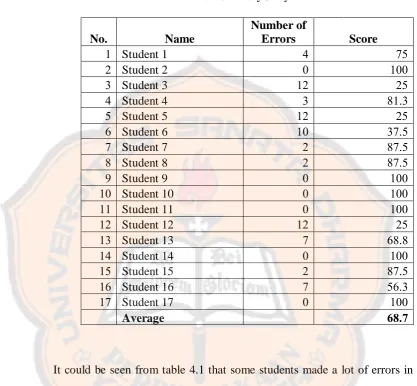
Table 4.1 The Result of Students' Number of Errors
It could be seen from table 4.1 that some students made a lot of errors in writing simple dialogues especially in the use of correct grammar. From table 4.1, the highest score that the students got was 100, and the lowest score was 25. The
average of the students’ scores was . . It meant that the average score was still
low because the KKM (Kriteria Ketuntasan Minimal) for English subject in SMP Kanisius Pakem is 72.
There were many grammatical errors in the students’ writing products. These were the examples of students’ grammatical errors in their writing products.
2. She is cooking fried rice? (Student 1) 3. What she is doing? (Student 18) 4. Are she cooking? (Student 7) 5. She are cooking. (Student 1) 6. What is they doing? (Student 5)
Those sentences were incorrect sentences because they were grammatically wrong. In the first sentence, the students should use gerund because the sentence showed an action that was happening. The verb should be added by –ing. Therefore, they had to use present continuous tense form not present tense form.
Then, the second and the third sentences were inappropriate sentences. The students made wrong structure of those sentences. They should arrange the verb before the subject to make a question. It should be “is she cooking fried
rice?” and “what is she doing?”.
Next, the fourth, fifth, and sixth sentences were also inappropriate sentences. The subject of the fourth and fifth sentences was singular. However, the verb that the students used was wrong. It should be “is”. The sixth sentence
also used wrong verb. The subject was plural. Consequently, the verb should be “are”.
English teacher of SMP Kanisius Pakem, the researcher found that the teacher did not give feedback on the students’ writing products. She only gave score on the
students’ writing products. Therefore, the students still made a lot of grammatical
errors on their new writing.
B.Data Presentation and Discussion on the First Cycle
The researcher conducted the first cycle on November 18, 2014. The researcher returned the students’ writing products which had been given feedback
by the researcher and asked them to revise it. Then, the researcher asked the students to submit their revisions. After that, the researcher asked the students to write new dialogues based on the instruction and they had to submit it in the end
of the class. Next, the students wrote students’ reflection based on some questions
that had been provided by the researcher. The researcher gave feedback in form of corrections, comments, suggestions by circling, marking, and underlying on the students’ writing products.
In the first cycle, there were 17 students who participated in this cycle. In this cycle, the researcher employed the teacher’s feedback to improve the
students’ grammatical accuracy in their writing. There were four steps in the first
cycle. Those steps were planning, action, observation, and reflection. Each step would be discussed as follows.
a. Planning
grammar. They could write the simple dialogue based on the pictures given. However, they still made many grammatical errors in their writing. In addition, they made wrong punctuation and spelling. It could be seen from the students’
writing products. Knowing the problem faced by the students, the researcher
planned to improve the students’ grammatical accuracy in their writing products.
The teacher’s feedback was chosen to help the students to improve their
grammatical accuracy. The researcher decided to use teacher’s feedback because she was a pre service teacher in SMP Kanisius Pakem and she had an experience in teaching the students when she did Internship Program Course. At that time, the researcher taught present tense and she asked the students to make simple dialogues based on the situation given. They made some errors in their writing, especially about their grammar. The researcher gave feedback by underlying, circling, and marking the wrong grammar. Moreover, she always gave
encouragement sentences in the students’ writing products. The students gave
positive response to the feedback that the researcher gave. It could be seen that the students revised their writing products enthusiastically. Therefore, the researcher gave the teacher’s feedback to help the students to improve their grammatical accuracy in their writing.
researcher. The researcher expected that the students could be more aware of their mistakes and did not do it again. After that, the researcher asked them to submit their writing products. For the main activity, the researcher planned to distribute some incomplete dialogues with the pictures there. The researcher planned to ask the students to write those incomplete dialogues based on the pictures given. The researcher also provided teaching procedure and field notes to help her to write anything that happened during the implementation of the research.
b. Action
The first cycle was conducted in November 18, 2014. The participants were 17 students. It was not all of the students joined the class because two of them were sick and absent. The time allocation was 90 minutes. The researcher
prepared the teaching procedures, students’ worksheets, and students’ writing
products from the preliminary study, which had been given feedback by the researcher. Then, the researcher greeted the students and checked the attendance list.
The researcher started the class by writing some present continuous sentences on the whiteboard and asked the students whether the sentences were correct or not. Some students were correct when they answered the questions. The researcher and the students did discussion of the answers together. The purpose was for recalling the students’ memories about the present continuous tense.
The next activity was revising the students’ writing products. The