xiv ABSTRACT
MAHARDIKENGRAT, AZIZTA LAKSA. Foreignization and Domestication of Culture-Bound Terms in The English Translation of Ahmad Tohari's “Kind Looking Eyes”. Yogyakarta; Department of English Letters, Faculty of Letters, Sanata Dharma University, 2016
Translation is needed to bridge communication between two languages. In the process, translation also takes account each individual cultural value that a language has. As such, cultural value is one element that needs to be considered when translating a literary text. To cope with this, translation has two strategies; foreignization and domestication. Foreignization is a translation strategy that emphasizes SL cultural values. Domestication assimilates SL and Tl cultural values. This thesis discusses the foreignization and domestication of culture-bound terms found in Ahmad Tohari’s short story collection “Kind Looking Eyes”. This book is translated by Tirsa Tanagara and both the Indonesian and English versions are published by Gramedia.
There are two objectives in this research. The first objective is to find out foreignization and domestication translation strategies in culture-bound terms. The second objective is determining the translation ideology based on the ratio of foreignized and domesticated culture-bound terms. The ratio is important in determining translation ideology, whether it is biased toward SL or TL cultural values.
This research applied library research and contrastive explicatory method. The researcher acquired both English and Indonesian version of “kind looking Eyes”. This thesis is a text based research and a qualitative study because it analyzed the quality of translation and then compared the number of strategies used to reveal the ideology of translation.
There are 5 categories of culture-bound terms in this thesis; those are related to social structure (14 terms), food (3 terms), derogative words (3 terms), religion (8 terms), and nickname (5 terms). The finding in this research reveal that from 33 data, 23 data (70%) used domestication strategy, and 10 data (30%) used foreignization strategy. Thus from the ratio of 2.3:1, the translation of “Kind Looking Eyes” is biased toward TL culture.
xv ABSTRAK
MAHARDIKENGRAT, AZIZTA LAKSA. Foreignization and Domestication of Culture-Bound Terms in The English Translation of Ahmad Tohari's “Kind Looking Eyes”. Yogyakarta; Jurusan Sastra Inggris, Fakultas Sastra, Universitas Sanata Dharma, 2016.
Penerjemahan dibutuhkan untuk menjembatani dua bahasa yang berbeda. Dalam prosesnya, penerjemahan memperhitungkan nilai budaya yang dipunyai setiap bahasa. Karena itu, nilai budaya adalah salah satu elemen yang harus diperhatikan ketika menerjemahkan teks sastra. Dalam hal ini, penerjemahan mempunyai dua strategi; domestikasi (Domestication) dan pengasingan (foreignization). Domestikasi adalah strategi yang meleburkan nilai budaya BSu dan BSa. Sedangkan, pengasingan menonjolkan nilai budaya dari BSu. Skripsi ini meneliti pengasingan dan domestikasi dari lema terikat budaya dari kumpulan cerpen oleh Ahmad Tohari “Mata yang Enak Dipandang”. Versi bahasa inggris diterjemahkan oleh Tirsa Tanagara. Kedua versi bahasa Indonesia dan inggris dipublikasikan oleh Gramedia.
Ada dua tujuan di skripsi ini. Tujuan yang pertama adalah mengetahui strategi yang digunakan pada lema terikat budaya yang ditemukan di objek studi. Tujuan kedua adalah menentukan ideologi penerjemahan dari rasio jumlah strategi yang digunakan, apakah menonjolkan Bsu atau BSa.
Skripsi ini menerapkan studi pustaka dan explicatory constrative method. Peneliti mendapatkan kedua versi bahasa Indonesia dan Inggris dari “Mata yang Enak Dipandang”. Penelitian ini berbasis teks dan melihat kualitas lema terkait budaya dari strategis diatas dan menghitung rasio antara strategi domestikasi dan pengasingan yang digunakan untuk menentukan ideologi terjemahan.
Dari analisis, terdapat 5 kategori lema terkait budaya, lema struktur social (14), lema makanan (3), lema kata merendahkan (3), lema agama, dan lema nama panggil (5). Hasil dari skripsi ini memperlihatkan dari 33 data, 23 data (70%) mengunakan strategi domestikasi. Sedangkan 10 data (30%) menggunakan strategi pengasingan. Dari rasio 7:3, ideologi penerjemahan berpihak terhadap nilai budaya BSa.
i
FOREIGNIZATION AND DOMESTICATION OF
CULTURE-BOUND TERMS IN THE ENGLISH TRANSLATION OF
AHMAD TOHARI'S “KIND LOOKING EYES”
AN UNDERGRADUATE THESIS
Presented as Partial Fulfillment of the Requirements For the Degree of Sarjana Sastra
In English Letters
By
AZIZTA LAKSA MAHARDIKENGRAT Student Number: 134214078
ENGLISH LETTERS STUDY PROGRAM DEPARTMENT OF ENGLISH LETTERS
FACULTY OF LETTERS SANATA DHARMA UNIVERSITY
ii
FOREIGNIZATION AND DOMESTICATION OF
CULTURE-BOUND TERMS IN THE ENGLISH TRANSLATION OF
AHMAD TOHARI'S “KIND LOOKING EYES”
TITLE PAGE
AN UNDERGRADUATE THESIS
Presented as Partial Fulfillment of the Requirements For the Degree of Sarjana Sastra
In English Letters
By
AZIZTA LAKSA MAHARDIKENGRAT Student Number: 134214078
ENGLISH LETTERS STUDY PROGRAM DEPARTMENT OF ENGLISH LETTERS
FACULTY OF LETTERS SANATA DHARMA UNIVERSITY
vii
MOTTO PAGE
viii
DEDICATION PAGE
ix
ACKNOWLEDGEMENTS
I cannot thank enough for all people who have helped me in the writing of this thesis and all of my friends for all these wonderful four years. Que sera sera, for whatever happen after this, it will happen. I pray in my deepest hard that we will see each other in brighter future.
Exceptional mention to my mom, mom, mom, and dad for supporting me in my whole life. From all of that road stories you told to real life events, I learn who I am as a Javanese. This thesis is the manifestation of how you teach me about Javanese values that I hold dear. Also my gratitude to Nurul, whom I share my deepest insecurity to prideful achievements, thank you for everything.
Special mention to my thesis advisor Harris Hermansyah Setiajid, S.S., M.Hum, as the one who has opened my eyes in the translation field and Dr. Francis Borgias Alip, M.Pd, M.A as my co-advisor. To my fellow boarding house mates, Dimas Mahardika, Krisdianto, Manggala, and Hendra, who I shared discussion with about Javanese myths and saying.
x
TABLE OF CONTENTS
TITLE PAGE ... ii
APPROVAL PAGE ... iii
ACCEPTANCE PAGE ... iv
STATEMENT OF ORIGINALITY ... v
LEMBAR PERNYATAAN PERSETUJUAN PUBLIKASI KARYA ILMIAH UNTUK KEPENTINGAN AKADEMIS ... vi
MOTTO PAGE ... vii
DEDICATION PAGE ... viii
ACKNOWLEDGEMENTS ... ix
LIST OF TABLES AND CHARTS ... xii
LIST OF ABBREVIATIONS ... xiii
ABSTRACT ... xiv
ABSTRAK ... xv
CHAPTER I: INTRODUCTION ... 1
A, Background of the Study ... 1
B. Problem Formulation ... 3
C. Objective of the Study. ... 4
D. Definition of Terms ... 4
CHAPTER II: REVIEW OF LITERATURES ... 7
A. Review of Related Studies ... 7
1. Sari’s “The Domesticated Translation of the Terms Related to Tools in Toer’s This Earth of Mankind: A Study of Accuracy and Readability.” ... 7
2. Widiastuti’s “The Accuracy and Readability of Domesticated and Foreignized Translation of Specific Words in Stephene Meyer’s Twilight into Indonesian Translation Twilight” ... 8
3. Durdurenau's “Translation of Cultural Terms: Possible or Impossible?” 9 B. Review of Related Theories ... 9
1. Theories of Translation... 9
2. Foreignization and Domestication ... 11
3. Ideology of translation. ... 13
xi
CHAPTER III: METHODOLOGY ... 17
A. Areas of Research ... 17
B. Object of the Study ... 17
C. Method of the Study ... 18
D. Research Procedure ... 18
1. Types of Data ... 18
2. Data Collection. ... 19
3. Population and Sample ... 20
4. Data Analysis... 21
CHAPTER IV: ANALYSIS RESULTS AND DISCUSSIONS ... 23
A. The Translation Strategies Applied in The Culture-bound terms ... 24
1. Translation Strategies Applied in Social Structure Terms... 25
a. Applied Domestication Translation Strategy ... 25
b. Applied Foreignization Translation Strategy ... 31
2. The Translation Strategies in Food Related Terms ... 32
a. Applied Foreignization Translation Strategy ... 33
3. The Translation Strategies in Derogative Terms ... 34
a. Applied Domestication Translation Strategy ... 34
4. Translation Strategies Applied in Religious Terms ... 36
a. Applied Domestication Translation Strategy ... 36
b. Applied Foreignization Translation Strategy ... 39
5. Translation Strategies Applied in Nickname Related Terms ... 40
a. Applied Domestication Translation Strategy ... 40
d. Applied Foreignization Translation Strategy ... 41
B. The translation Ideology Seen from The Translation Strategies Applied .... 42
CHAPTER V: CONCLUSION ... 47
BIBLIOGRAPHY ... 48
xii
LIST OF TABLES AND CHARTS
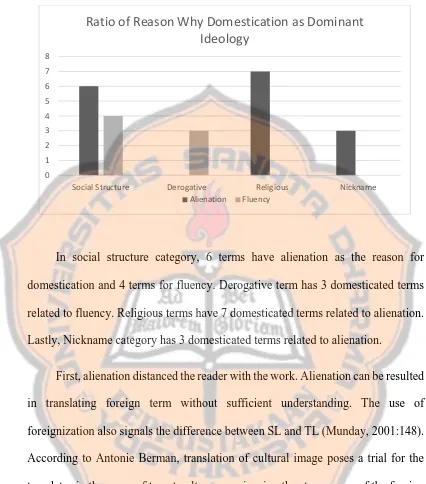
Table 1: Example of Data Management……….…….…….17 Table 2: The List of Title in the Object of Study……….18 Table 3: The form of Presented Data ………...………….…….……….20 Table 4: The Percentage of Applied Translation Strategy ………….……….22 Table 5: The Ratio of Applied Translation Strategy ………...42 Table 6: Diagram of Applied Translation Strategies ………...43 Table 7: Ratio of Reason Why Domestication as Dominant Ideology……....45
xiii
LIST OF ABBREVIATIONS
xiv ABSTRACT
MAHARDIKENGRAT, AZIZTA LAKSA. Foreignization and Domestication of Culture-Bound Terms in The English Translation of Ahmad Tohari's “Kind Looking Eyes”. Yogyakarta; Department of English Letters, Faculty of Letters, Sanata Dharma University, 2016
Translation is needed to bridge communication between two languages. In the process, translation also takes account each individual cultural value that a language has. As such, cultural value is one element that needs to be considered when translating a literary text. To cope with this, translation has two strategies; foreignization and domestication. Foreignization is a translation strategy that emphasizes SL cultural values. Domestication assimilates SL and Tl cultural values. This thesis discusses the foreignization and domestication of culture-bound terms found in Ahmad Tohari’s short story collection “Kind Looking Eyes”. This book is translated by Tirsa Tanagara and both the Indonesian and English versions are published by Gramedia.
There are two objectives in this research. The first objective is to find out foreignization and domestication translation strategies in culture-bound terms. The second objective is determining the translation ideology based on the ratio of foreignized and domesticated culture-bound terms. The ratio is important in determining translation ideology, whether it is biased toward SL or TL cultural values.
This research applied library research and contrastive explicatory method. The researcher acquired both English and Indonesian version of “kind looking Eyes”. This thesis is a text based research and a qualitative study because it analyzed the quality of translation and then compared the number of strategies used to reveal the ideology of translation.
There are 5 categories of culture-bound terms in this thesis; those are related to social structure (14 terms), food (3 terms), derogative words (3 terms), religion (8 terms), and nickname (5 terms). The finding in this research reveal that from 33 data, 23 data (70%) used domestication strategy, and 10 data (30%) used foreignization strategy. Thus from the ratio of 2.3:1, the translation of “Kind Looking Eyes” is biased toward TL culture.
xv ABSTRAK
MAHARDIKENGRAT, AZIZTA LAKSA. Foreignization and Domestication of Culture-Bound Terms in The English Translation of Ahmad Tohari's “Kind Looking Eyes”. Yogyakarta; Jurusan Sastra Inggris, Fakultas Sastra, Universitas Sanata Dharma, 2016.
Penerjemahan dibutuhkan untuk menjembatani dua bahasa yang berbeda. Dalam prosesnya, penerjemahan memperhitungkan nilai budaya yang dipunyai setiap bahasa. Karena itu, nilai budaya adalah salah satu elemen yang harus diperhatikan ketika menerjemahkan teks sastra. Dalam hal ini, penerjemahan mempunyai dua strategi; domestikasi (Domestication) dan pengasingan (foreignization). Domestikasi adalah strategi yang meleburkan nilai budaya BSu dan BSa. Sedangkan, pengasingan menonjolkan nilai budaya dari BSu. Skripsi ini meneliti pengasingan dan domestikasi dari lema terikat budaya dari kumpulan cerpen oleh Ahmad Tohari “Mata yang Enak Dipandang”. Versi bahasa inggris diterjemahkan oleh Tirsa Tanagara. Kedua versi bahasa Indonesia dan inggris dipublikasikan oleh Gramedia.
Ada dua tujuan di skripsi ini. Tujuan yang pertama adalah mengetahui strategi yang digunakan pada lema terikat budaya yang ditemukan di objek studi. Tujuan kedua adalah menentukan ideologi penerjemahan dari rasio jumlah strategi yang digunakan, apakah menonjolkan Bsu atau BSa.
Skripsi ini menerapkan studi pustaka dan explicatory constrative method. Peneliti mendapatkan kedua versi bahasa Indonesia dan Inggris dari “Mata yang Enak Dipandang”. Penelitian ini berbasis teks dan melihat kualitas lema terkait budaya dari strategis diatas dan menghitung rasio antara strategi domestikasi dan pengasingan yang digunakan untuk menentukan ideologi terjemahan.
Dari analisis, terdapat 5 kategori lema terkait budaya, lema struktur social (14), lema makanan (3), lema kata merendahkan (3), lema agama, dan lema nama panggil (5). Hasil dari skripsi ini memperlihatkan dari 33 data, 23 data (70%) mengunakan strategi domestikasi. Sedangkan 10 data (30%) menggunakan strategi pengasingan. Dari rasio 7:3, ideologi penerjemahan berpihak terhadap nilai budaya BSa.
1
CHAPTER I INTRODUCTION
A, Background of the Study
Language has important roles in human society. Not only as a tool to deliver message and meaning to each other, language also shapes how people communicate with each other. Trudgill (2000:2) states that the function of language is in establishing social relationship and conveying information about the speaker.
Language affects society and vice versa. The social structure and value system are different from one language to another. Trudgill (2000:8) writes that different language has its own value system and structure that differ from one to another.
The need of communication among people with different languages triggers the need of multi-language people being able to communicate between sets of language. To accommodate this need, translation is needed to bridge the communication between languages.
Translation is dealing with two languages and the cultural values behind them. For example, the difference in culture resulted in difference of vocabulary. Bassnett (2002:36) notices this problem when she observed the language of southern Venezuela. She found it difficult to find satisfactory terms for the English murder, stealing, lying, etc in TL equivalent term.
Translating Indonesian literature to English language poses its own difficulties especially in culture bound terms. As the culture between Indonesia and English are different, it needs extra attention to the difference in culture. For example, the term “rice” in English is too general to describe the term of staple food in Indonesia. In Indonesian language, we have “gabah”,”padi”,”nasi” to address the above terms. The difference in vocabulary results from the cultural values in Indonesia. Therefore, it is exclusive only in Indonesia.
Ahmad Tohari is an Indonesian author that plays a prominent role in Indonesian literature. His works, such as Kubah, Ronggeng Dukuh Paruk, and Di kaki Bukit Cibala capture the Indonesian culture and portray Indonesian people
lives.
This thesis is discussing “Kind Looking Eyes” which is a collection of short stories ranging from the lives of beggars to religious problem such as afterlife. Prostitution and family matters are also depicted in this collection of short stories. “Kind Looking Eyes” can be said is the reflection of Indonesian cultural values.
In Ahmad Tohari’s short stories collection “Kind Looking Eyes”, the translator used both strategies in translating the short stories. For example, the term Tahi kucing! is translated as Rubbish! When translating this swear words,
Translator used domestication strategies because there is no direct equivalence between them. To make it understandable for TL, Translator used common swear words in TL culture to accommodate the meaning of SL although the meaning is different from the SL intended to.
Domestication and Foreignization is translator’s tool to emphasize SL culture of TL culture. Venutti in Introducing Translation Studies: Theories and Application (2001:146) writes that this method can be either assimilates between two cultures or make each culture difference becomes more prominent.
This thesis focuses on foreignization and domestication of culture-bound terms in “Kind Looking Eyes” by Ahmad Tohari which translated by Tirsa Tanaraga.
B. Problem Formulation
In this thesis, the researcher formulates the questions which become the focus of this research. The two problems are following,
2. What translation ideology is reflected from culture-bound terms in Ahmad Tohari’s “Kind Looking Eyes”?
C. Objective of the Study.
This thesis aims to reveal the foreignization and domestication translation strategies when translating culture-bound terms in one of Ahmad Tohari’s short stories collection “Kind Looking Eyes” which is translated to English version by Tirsa Tanaraga
Firstly, this thesis focuses on revealing the translation strategies whether it is foreignization or domestication in translating culture-bound terms in this work. This thesis observes this phenomenon and identifies which strategy is used in translating each culture-bound terms.
Secondly, this thesis also aims to find out the ideology of translating in culture-bound terms “Kind Looking Eyes”. From understanding which translation strategy is more prominent, researcher can understand translation ideology whether it emphasizes SL culture or TL culture.
D. Definition of Terms
Domestication is defined as translation strategy that reduce the foreignness in the TT. Munday (2001:144) states that domestication is a style used in order to minimize the foreignness of the TT. Venutti added that domestication is reduction of SL values to accommodate TL values (1995:20).
Foreignization is defined as emphasization of SL values in the TT. (Venutti, 1998:242) writes that foreignization makes the SL culture values dominant. Foreignization makes sure that the reader gets the sense of culture in the SL (Munday, 2001:145).
A social structure is the distinctive, stable arrangement of institutions whereby human beings in a society interact and live together (Form and Wilterdink, 2015). This term defines the interaction and organization within a society. For example, the social structure in relation to the government organization, social activity, and common metaphors.
A religious term is term which expresses religious practices. Greetz explains that “Religion is a cultural system of behaviors and practices, world views, sacred texts, holy places, ethics, and societal organization that relate humanity to what an anthropologist has called "an order of existence" (Greetz 1993:87).
A derogative term is a term of insult expression or implying something negative. According to Oxford Advanced Learner’s Dictionary 8th edition,
A food term is a term which expresses the naming of food and drink in a society. According to Oxford Advanced Learner’s Dictionary 8th edition, food is
things that people or animal eats. For example, staple food such as bread and rice. A nickname is a substitute proper name of a familiar person, place or a thing. According to Oxford Advanced Learner’s Dictionary 8th edition, nickname term is
7
CHAPTER II
REVIEW OF LITERATURES
Chapter II refines this thesis by adding the review of related studies and theoretical ground that will be used in this study. The previous studies that are used to compare and contrast with this thesis are from Aluysia Vicka Tunjung Sari and Maria Agatha Rina Widiastuti. Those studies mentioned will be reviewed in relation to this thesis to find out the similarities and the different perspectives used by each thesis. Some theories will also be used to provide the foundation which this thesis is based upon.
A.Review of Related Studies
1. Sari’s “The Domesticated Translation of the Terms Related to Tools in Toer’s This Earth of Mankind: A Study of Accuracy and Readability.”
Sari’s thesis is discussing the domesticated translation of tools terms in This Earth of Mankind. Sari’s research found out that from the readability point of view,
domesticated translation enables the terms to be understood easily (85%). This research also stressed that the use of domestication translation made the reader comprehend the text easily and minimizing the strangeness of foreign text.
Sari’s research provides this thesis with the view how the domestication strategy appeal to reader from its readability and accuracy point. Sari’s research also points out the use of domesticated translation on how the readers understand a translation product.
2. Widiastuti’s “The Accuracy and Readability of Domesticated and Foreignized Translation of Specific Words in Stephene Meyer’s Twilight into Indonesian Translation Twilight”
Similar to Sari’s thesis, Widiastuti’s thesis also talks about the readability and accuracy of a literary text. What makes them different is that Widiastuti’s research also includes the foreignized terms into equation. In Widiastuti’s research, she emphasizes on specific terms such as measurement, clothes, terms of address, technological terms, colors, plants, food and drinks, idiomatic expressions, and everyday expression.
In the end of her thesis, Widiastuti implies that foreignization strategy is used because the translator cannot find the appropriate equivalent terms in the TL. She also added that this strategy is part of publisher policy to add “exoticism” to the text. In other words, the foreign word is intact to add the intimacy to ST culture.
Different from Widiastuti’s research, this thesis focuses on both domestication and foreignization translation strategies to understand the translator ideology in translating literary text.
3. Durdurenau's “Translation of Cultural Terms: Possible or Impossible?” Durdurenau talks about the possibility and challenge in translating culture-bound terms. She stresses that translation and culture are so entwined to each other that translator cannot ignore the significance of cultural element in the text. She quotes Peter Newmark for his definition of culture as “the way of life and its manifestation that are particular to a community that uses a particular language as its means of expression”. She examines the area of culture-bound terms that deeply rooted in culture such as in time division, jobs, positions, professions, food, drinks and notes that expressions above can differentiate a community from another. The translation of such terms affects the cultural significance of a particular community.
In approaching the difference, translator has a great amount of translation strategies and methods to achieve a certain degree of acceptability to TL audience. Her paper provides this thesis with the insight how culture-bound terms affects the works in the perception of TL reader and its possibility to be translated to TL without compromising in its cultural significance.
B. Review of Related Theories 1. Theories of Translation
Translation is not simply just alteration of the language from SL to TL in the text. Translation is aimed to be acceptable and understood to TL reader. In order to do that, meaning in SL must be transferred to TL in sense that TL reader can easily understand.
As a result, a foreign text is the site of many different semantic possibilities that are fixed only provisionally in any one translation, on the basis of varying cultural assumptions and interpretive choices, in specific social situations, in different historical periods. Meaning is a plural and contingent relation, not an unchanging unified essence and therefore a concepts of semantic equivalence one to one correspondence (1995:18).
Venutti writes that translation is a process of interchanging chain ST signifier to TL signifier (1995:17). In relation to meaning, exist a way to establish common ground and link in meaning from SL to TL. In this manner, the translator provides the interpretation of meaning in SL to adhere the common sense in TL.
Meaning comes with form. In translation, form and meaning are integral unit to communicate. Larson writes that this form is the surface structure such as words, clauses, sentences, paragraphs (1998:3).
Because of the varying form and meaning, there could be one form that represent varying meaning. Larson observes this phenomenon from the English word “run” (1998: 7). This word has different lexical meaning, according to Oxford Advanced Learner’s Dictionary (Horby, 2010:1031), “runs” can mean to move
using legs at a speed, participating in a race, or fleeing from a situation.
Translation deals with the meaning inside the ST and trying to produce the same meaning in TT. In relation to meaning, form of meaning also takes notice. Larson states that translation is a process where the form in SL change to TL. Form in here means the actual words, phrases, clauses, sentences, paragraphs, etc (1998:3). The bridge that connect SL and TL in terms of form is semantics structure. Larson writes,
In short, translation deals with how meaning and form is transferred from SL to TL. The difference in context, cultural background, history period affects how the meaning revolves around translation. In relation to meaning, form also need to be considered. The semantic structure between the forms in SL and TL is the consideration when translating from SL to TL.
This means that a translation is a process of transferring meaning and form from one language to another. When translating, meaning is important to be considered. Translator must take notes on the cultural background, history periods or the context of ST to translate it in TT.
2. Foreignization and Domestication
There is a significant amount of debate in transferring meaning from SL to TL. It compromises the significance of culture values in either SL to TL respectively. The discussion is revolved around the cultural significance of SL and TL.
Translator is faced with two options in this case, either valorize the SL culture or assimilate SL cultural values to TL cultural values. Schleiermarcher addresses this issue saying that “ST meaning is couched in language that is very culture-bound and to which the Tl can never fully correspond (Munday, 2001: 28)”
Domestication and foreignization is methods of translation that contribute to translation visibility. This term refers to how the translator reproduces the ST to TT
fluently. Venutti writes in his book;
A translated text, whether prose or poetry, fiction or non-fiction, is judged acceptable by most publishers, reviewers, and readers when it reads fluently, when the absence of any linguistics or stylistic peculiarities makes it seem transparent, giving the appearance that it reflects the foreign writer’s personality or intention or the essential meaning of the foreign text – the appearance, in other words, that the translation is not in fact a translation but the ‘original’ (Venutti, 1995:1)
Domestication strategy is a method to ensure that the TL reader is able to read with ease. Venutti adds that domestication “entails translating in a transparent, fluent, ‘invisible’ style in order to minimize the foreignness of the TT” (Munday, 2001:144).
Meanwhile, foreignization strategy is a method to ensure that the TL reader get the sense of SL culture through reading the translation product. Munday, further emphasizes “In a bid to make the translator ‘visible’ and to make the readers realize they reading a translation of a work from a foreign culture” (Munday, 2001:145).
Domestication and Foreignization are closely tied to what Vennuti called as the result of translator invisibility. He addresses this situation saying that the effects of fluent or domesticated translation caused cultural marginality and economic exploitation due to significant reduction in SL cultural values (Vennuti, 1995: 17). He also adds that the dominancy of Anglo-American is prevalent as translators have to resubmit the domesticated revision of translated foreign text.
bring the work closer to TL audience and loses the cultural significance (Munday, 2001:29). Schleiermarcher prefers that translator moves the work closer to ST writer because he valorizes the SL cultural values. He addresses that true translation is like “A German reading the work in the original language” (Munday, 2001:29). Venutti also supports the valorization of SL. In his book, translator’s invisibility he quotes John Hookham Frere, “The absence of any syntactical and
lexical peculiarities produces the ‘illusion” that the translation is not a translation, but the foreign text, reflecting the foreign writer’s intention (Venutti, 1995:77)”. Foreignization and domestication has been long debated as to how the translation should be. Venutti adds that translation should broaden its scope to “value driven nature of the socio-cultural framework” (Munday, 2001:146). Both methods are dealing with the question how the translation should be represented to TL audience that have different values of culture. Lefevere also adds that SL self-image is either preserved or changed according to translation strategy used (Lefevere, 1992; 125)
3. Ideology of translation.
Because of the different set of culture values in SL and TL, translation tends to have its own methods to deal with this difference. However, the choice of method whether it is foreignization or domestication is heavily influenced by the ideology of translation. Andre Lefevere in his collection of essay, Translation, Rewriting and the Manipulation of Literary Fame (1992) focuses translation as rewriting. He
Lefevere then describes that the translation function is govern by three components, professionals within the literary system, patronage outside the literary system, the dominants poetics (Munday, 2001:126).
Lefevere gives an example in his book taken from Aristophanes’ lysistrata about the sentence ‘en me dido ten cheira tes sathes age’ [lit. ’if he doesn’t give you his hand, take him by the penis’] (Munday, 2001:128). The term ‘penis’ is translated to English version as membrum virile, nose, leg, life-line and many other. He states that this translation indicates the ideology dominant at that time in a certain set of culture. He writes that if it translated as it is, TT audience cannot understand the meaning behind it.
Ideology of translation is interested in uncovering the manipulation in TT that may be indication of the translator ideology (Munday, 2001:137). There are factors such as pressure from publishers, editor or other. The choice of using foreignization or domestication method can be the indication of translator ideology, whether it is biased to SL or TL culture.
4. Culture-bound term
Language as a system is influenced by the culture and society structure. Peter Bourdien states that
“language is a linguistic habitus which means that language is not only a particular system of words and grammatical rules, but also a symbolic power of a particular way of communication, with specific patterns for every community (particular system of classification, specialized lexicon, metaphors, reference forms, etc) (1952:52)”.
From Bourdien statement, a language has its own specialized lexicon based on the its particular society structure. Therefore, a language has its own specialized term called culture-bound terms. Duranti (1997:46) observes this phenomenon and states that any act of language is a participation in a certain community. Yule (2010:267) adds that culture-bound terms are “all the ideas and assumptions about the nature of things and people that we learn when we become members of social group”
Culture-bound term is specialized because the reference it used is exclusive to a particular language. Harvey defines culture-bound terms as “the terms which refers to concepts, institution, and personnel which are specific to the source language culture (2002:2)”. For example, the Eskimo language has 30 words for snow and Arabic language has 200 names for the synonym of word camel. From
the example, language realizes how a particular society views their surrounding and culture, the Eskimos has various vocabulary because of their environment in snowy condition and the Arabic for their familiarity with camel.
B.Theoretical Framework
of translation are needed to be the ground of this thesis. Sari, Widiastuti theses and Durdurenau paper also provides basic insights on this thesis.
In order to understand the basic of translation we need to apply the theories of translation. Larson and Venutti provides the basic foundation about what is a translation and how meaning revolves around it. Foreignization and domestication theories also play a role in understanding the translator intention. Finally, the ideology of translation guided us on how the translator worked in a set of ideological pressure, whether he/she is biased toward SL or TL culture values.
The first problem needs theories of translation, foreignization and domestication, and culture-bound term to categorize the culture-bound terms in Ahmad Tohari‘s “Kind Looking Eyes”.
17
CHAPTER III
METHODOLOGY
This chapter elaborated how this research is done. In conducting this research, there are steps that need to be taken to ensure the validity of research. Methodology also ensured this thesis have the procedures to be applied. There are four parts in this chapter. They are areas of research, object of study, methodology, and research procedure.
A. Areas of Research
The area of this thesis is text analysis and translation. This area of research is comparing the original work with its translation based on textual analysis. In text analysis and translation, the focus can be syntactic, semantic, and stylistic feature of the source text in comparison to its translation. The focus in this thesis is the analysis of the communicative condition regarding to who, why, where, and what the translation product intended to (Williams and Chesterman, 2002:6).
B. Object of the Study
C. Method of the Study
The method taken by this research is library research and explicatory constative method. Library research is a method of collecting data in the form of articles, books, essays, and other that relevant to this study (George, 2008:6). Library research is used when collecting theories, articles, and journal prior to analyzing the data. Explicatory contrastive method is a method that entails a careful, close, and focused examination of a single major text, or an element of a text (George, 2008:6). This method is used to collect the data in the object of study. This thesis requires the copies of both Indonesian and English versions from “King Looking Eyes”. This study is a qualitative study which means generates result in words rather than numbers to understand a specific quality (Bricki and Green, 2004:4). Then researcher compared the number of foreignized and domesticated culture-bound terms in English and Indonesian versions found in the object of study in order to reveal the translation ideology.
D. Research Procedure 1. Types of Data
2. Data Collection.
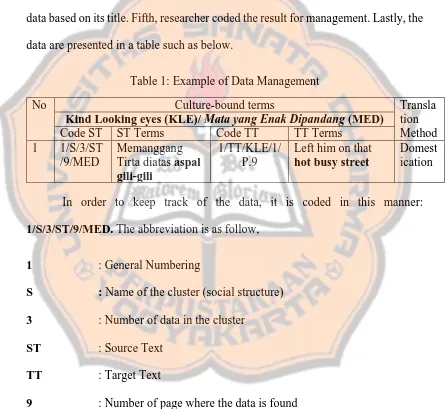
The data in this thesis were collected from 15 stories in the object of study. Text based collection is used in this study. First, researcher read both ST and TT to understand the context of each titles. Second, culture-bound terms in ST are listed out. Third, researcher compared the culture-bound terms in TT with finding found in ST. The comparison is listed out in a table. Fourth, the researcher categorized the data based on its title. Fifth, researcher coded the result for management. Lastly, the data are presented in a table such as below.
Table 1: Example of Data Management
No Culture-bound terms Transla
tion Method Kind Looking eyes (KLE)/ Mata yang Enak Dipandang (MED)
Code ST ST Terms Code TT TT Terms
In order to keep track of the data, it is coded in this manner: 1/S/3/ST/9/MED. The abbreviation is as follow,
1 : General Numbering
S : Name of the cluster (social structure) 3 : Number of data in the cluster
ST : Source Text
TT : Target Text
9 : Number of page where the data is found
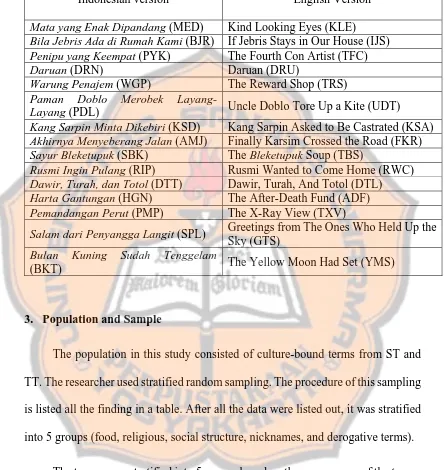
Here is the list and codes of titles that can be found in the object of study;
3. Population and Sample
The population in this study consisted of culture-bound terms from ST and TT. The researcher used stratified random sampling. The procedure of this sampling is listed all the finding in a table. After all the data were listed out, it was stratified into 5 groups (food, religious, social structure, nicknames, and derogative terms).
The terms were stratified into 5 groups based on the occurrences of the terms. These groups were determined in 5 groups because the population stratification is based on the most populous types. They are social structure, religious, derogative, food, and nicknames terms.
Table 2: List of Title in the Object of Study
Indonesian version English Version
Mata yang Enak Dipandang (MED) Kind Looking Eyes (KLE)
Bila Jebris Ada di Rumah Kami (BJR) If Jebris Stays in Our House (IJS) Penipu yang Keempat (PYK) The Fourth Con Artist (TFC)
Daruan (DRN) Daruan (DRU)
Warung Penajem (WGP) The Reward Shop (TRS) Paman Doblo Merobek
Layang-Layang (PDL) Uncle Doblo Tore Up a Kite (UDT) Kang Sarpin Minta Dikebiri (KSD) Kang Sarpin Asked to Be Castrated (KSA) Akhirnya Menyeberang Jalan (AMJ) Finally Karsim Crossed the Road (FKR) Sayur Bleketupuk (SBK) The Bleketupuk Soup (TBS)
Rusmi Ingin Pulang (RIP) Rusmi Wanted to Come Home (RWC) Dawir, Turah, dan Totol (DTT) Dawir, Turah, And Totol (DTL) Harta Gantungan (HGN) The After-Death Fund (ADF) Pemandangan Perut (PMP) The X-Ray View (TXV)
Salam dari Penyangga Langit (SPL) Greetings from The Ones Who Held Up the Sky (GTS)
Bulan Kuning Sudah Tenggelam
After the researcher stratified the data, each stratum is divided by 3 to maintain its proportion. Then, the researcher used the data in this study taken only from the result of sampling above. The data in this study before sampling was 96 culture-bound terms. The data used after sampling are 33 culture-bound terms.
4. Data Analysis
This thesis analyzed the data based on the problem formulations. First problem was answered by analyzing and contrasting the translation strategies used by ST and TT culture-bound terms. Second problem is answered by comparing the ratio of translation strategies used by culture-bound terms and motive behind the dominant translation strategy to reveal the translation ideology.
For the first problem formulation the researcher analyzed the literal meaning from ST and TT term according to KBBI Online for ST term and Oxford dictionaries for TT terms. Second, the researcher then analyzed the cultural significance of ST term and TT terms. Lastly, both term is contrasted by its cultural significance to determine the translation strategy used.
Table 3: The form of Presented Data 12/S/3/ST/19/BJR Di pojok dusun itu
kini sudah berdiri surau yang seperti demikian adanya,
12/S/3/TT/21/IJS (Omitted) They built a small communal mosque, which stood very near to Jebris house.
For the second problem formulation researcher analyzed the ratio between foreignized and domesticated culture-bound terms and decided the translation ideology. The researcher also tried to understand the motive behind the dominant translation strategy.
For example, the ratio between foreignized and domesticated is 3:5 respectively. The researcher based his/her analysis on the theories from Chapter II analyzed the possible reason why either foreignization or domestication is used. From that, the researcher inferred that the dominant translation ideology is biased toward SL. The dominant translation strategy that the translator chose caused reduction either in SL or TL culture.
23
CHAPTER IV
ANALYSIS RESULTS AND DISCUSSIONS
This chapter is divided into two sections in response to the problem formulations. The first section discussed the translation strategies of foreignization or domestication used in culture-bound terms. Second section discusses the ideology of translation based on the ratio of foreignization and domestication translation strategies applied.
The first part in this chapter discusses the analysis of each culture-bound terms found in the object of study. The analysis focuses on the cultural values represented in TT in relation to its ST counterpart.
A culture-bound term is deemed using domestication if the cultural value is assimilated in TT and the sense of ST culture is lost or partially lost (Munday, 2001:144). Meanwhile, a culture-bound term is deemed using foreignization if the cultural values are translated intact to TT with minimum alteration and the sense of cultural values is delivered fully (Munday, 2001:145).
A. The Translation Strategies Applied in The Culture-bound terms
The 33 data analyzed in the study are categorized in 5 groups. They are; 14 terms in social structure terms, 3 terms related to food, 3 derogative terms, 8 religious terms, and 5 nickname related terms. The data are represented in the table below.
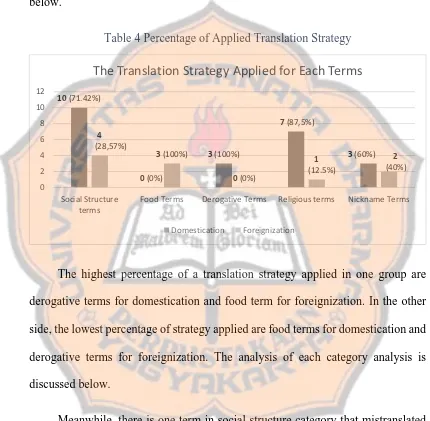
Table 4 Percentage of Applied Translation Strategy
The highest percentage of a translation strategy applied in one group are derogative terms for domestication and food term for foreignization. In the other side, the lowest percentage of strategy applied are food terms for domestication and derogative terms for foreignization. The analysis of each category analysis is discussed below.
Meanwhile, there is one term in social structure category that mistranslated by translator. The mistranslated term code in ST is 37/S/16/ST/56//WGP and its TT code is 37/S/16/TT/53/TRS. ST term is “Kulak” and TT term is “sold goods”. Kulak in Javanese language means restocking the inventory to be sold again; translated. (Mangunsuwito 2002:126). According to KBBI Online, kulak has a meaning of
10(71.42%)
Food Terms Derogative Terms Religious terms Nickname Terms
The Translation Strategy Applied for Each Terms
“membeli barang dalam jumlah besar untuk dijual kembali” (buying a large number of item to be sold again; translated). Kulak is translated in TT to “sold goods”. Both terms have different meaning and context of use. This translation didn’t translate the meaning nor the form. Therefore, this is a mistranslation.
1. Translation Strategies Applied in Social Structure Terms
This category involved the culture-bound terms that define what the structure of a society is. Social Structure terms includes terms used in metaphors, clothing, social activity, social organization, myth, and saying.
There are 14 culture-bound terms in this category. The strategy applied in translation of culture-bound terms is discussed below.
a. Applied Domestication Translation Strategy
3/S/2/ST/10/MED Dan membawa seribu kunang-kunang
3/S/2/TT/10/KLE Directly making his head spin
According to Kamus Besar Bahasa Indonesia (KBBI) Online, kunang-kunang is “Binatang kecil sebesar lalat yang mengeluarkan cahaya berkelip-kelip
headache. This expression assimilates the meaning from SL (headache) but in different form (firefly vs spinning). Thus, promoting the fluent translation style. Although, the element of “firefly” as the cultural values is not translated to TT.
12/S/3/ST/19/BJR Di pojok dusun itu kini sudah berdiri surau yang seperti demikian adanya,
12/S/3/TT/21/IJS (Omitted) They built a small communal mosque, which stood very near to Jebris house. According to KBBI Online, Dusun means “kampung; desa; dukuh” (village; translated). Dusun has cultural value of social organization in “village”. The ST term Dusun is not translated in TT. The translator chose to omit ST term to avoid alienation because of the difference in social organization of TL with SL. This strategy erases the cultural values of Dusun.
14/S/5/ST/21/BJR Para perempuan sering berhimpun dalam pertemuan atau arisan.
14/S/5/TT/19/IJS When the women of the village got together, which is quite often
(Omitted),
According to KBBI only Arisan means;
“Kegiatan mengumpulkan uang atau barang yang bernilai sama oleh beberapa orang kemudian diundi diantara mereka yntuk menentukan siapa yang memperolehnya, undian dilaksanakan dalam sebuah pertemuan secara berkala sampai semua anggota memperolehnya”
(An activity of gathering money or things that have the same value by several people. Then the prize is drawn to determine the winner. The lottery is held in a periodic meeting until all member get the prize; translated)
Arisan has the cultural values of “gathering” and “winning specific gift”. This
gift” of ST term and promoting the fluent style of translation as it only transferred the meaning only.
15/S/6/ST/22/BJR Tetapi, ketika menghidangkan minuman itu, Jebris hanya berpinjung kain batik, tanpa kebaya, dan rambut tergerai
15/S/6/TT/20/IJS Jebris also served the coffee According to KBBI Online, berpinjung means “cara membungkus dengan daun pisang, biasa digunakan untuk membungkus bunga rampai, botok, penganan dan sebagainya yang tidak basah, bentuknya seperti limas”. (Berpinjung is an activity of wrapping in a pyramid shape usually using a banana leaves; translated). In this case, adding the context means that berpinjung is an activity of wearing something in a pyramid shape. The translation of wearing does not convey all cultural values of berpinjung. This choice transferred only the “wearing” element. However, the sense of cultural value is lost as “wrapping in pyramid shape “is not conveyed to TL. This choice is to avoid alienation to TT audience as it transfers only the “wearing” meaning.
the same as “a piece of cloth” the cultural value of “special pattern” is lost, whereas sarong is just a piece of clothes that not necessarily has batik pattern. The translator
chose sarong to represent the Indonesian clothes but lost the “special pattern” properties in the translation.
25/S/8/ST/25/BJR Sar dan Jebris bersama-sama masuk Sekolah Rakyat.
25/S/8/TT/23/IJS Sar and Jebris went to the same local school.
Sekolah Rakyat is a school for Indonesian children in the time of Japanese
invasion and after Indonesian independence it is changed into “Sekolah Dasar” (elementary school; translated) (Safwan et al, 1986:28). At that time, Sekolah Rakyat is partially available to common people. The institution is often established
in big villages or cities. This term is translated to local school. The meaning of “education institution” is intact in this translation. However, TT term added element of “local” to describe Sekolah Rakyat. This addition added the sense of availability where “local” means that it is available in every village or at least close to character’s home. This add the fluency as TT audience able to read the story easily. Therefore, because of the addition, the cultural values of “partially available” is lost.
36/S/15/ST/55/WGP Kata Jum, yang mengaku telah tahu ngelmu perwarungan, …
36/S/15/TT/53/TRS Jum, who claimed to have
Ngelmu is a Javanese term that means more than knowledge. In Javanese song
is the pinnacle of spiritual journey; translated) (Nurhayati, 2010:43). Ngelmu has a cultural value of “life value”. The term is translated to TT in descriptive phrase to emphasize its “knowledge in metaphysic” and avoid alienation of cultural value “Javanese life value”. However, the sense of “life value” of Javanese people is lost in the translation.
39/S/18/ST/56/WGP Orang bilang Jum pergi ke sana demi memperoleh penglaris bagi warungnya.
39/S/18/TT/54/TRS People said that Jum wanted to get a charm for her shop.
Penglaris is not a standardized Indonesian term. However, the meaning can
be inferred from the plot of the story. Jum wants to improve her shop not only using hard work but also mystical help. This is supported by this part of the story; “Kartawi did not mind at all about acquiring a charm, he even agreed with her about that. Yes, Kartawi believed that hard work alone would not be adequate to achieve one’s dream (Tohari, 2015:55)”. From the story we can infer penglaris as a “thing” or “way” to improve sales of goods and connection of her shop. Meanwhile, Charm according to Oxford Advanced Learner’s Dictionary means “a small object worn on a chain or bracelet, that is believed to bring good luck (Hornby, 2010:187)”. This choice improves the fluency although only partially conveying the cultural values. The cultural values of “to improve sales of goods or connection” is lost. The TT only transfers the “good luck” but not specifically saying about improving sales.
43/S/21/ST/60/WGP “keluargaku bisa hidup wareg, anget, rapet.”
43/S/21/TT/57/TRS “My family can lead a
The term of wareg, anget, rapet is a Javanese term which means the basic human need. They are wareg (fulfilled in food; translated), anget (having home; translated), and rapet (having clothes; translated) (Mangunsuwito. 2002:16). Therefore, there are three basic needs that need to be specifically stated to transfer it meaning to TT. However, in TT, this term is translated to can lead a comfortable life to avoid the alienation of Javanese three basic needs. this term is not translated
the three basic needs stated above.
56/S/29/ST/84/KSD Saya merasa semua orang menanggung beban rasa pakewuh, serbasalah.
56/S/29/TT/77/KSA It seemed to me that everyone felt awkward; they didn’t know what to say.
Pakewuh means “sungkan; enggan” (awkward, unwillingness; translated)
(Mangunsuwito. 2002:181). This term expresses shyness and awkwardness in an activity of Javanese people. Pakewuh is used to describe Javanese people way of life that emphasized on self-control mechanism of a certain activity even though that specific activity is allowed. This term is translated to TT as awkward that means “making you feel embarrassed”,” not comfortable” (Hornby, 2010 :71) to avoid alienation. However, this translation loses the cultural values “Javanese way of life”
97/S/42/ST/22/BJR Tetapi, ketika menghidangkan
96/S/42/TT/20/IJS Jebris also served the coffee to the
that covers the whole hands; translated). When translated to blouse, the meaning stays. However, in Indonesia, kebaya has a special pattern such as batik pattern or others (Rangkuti, 2014:362). This “pattern” cultural value is lost when directly translated in order to avoid its alienation to TT audience.
b. Applied Foreignization Translation Strategy
32/S/11/ST/51/WGP Warung Penajem
32/S/11/TT/49/TRS The “Reward” Shop
Penajem has a connotative meaning that can be inferred from the story. In ST
it states that “Kartawi tahu penajem, yaitu syarat yang harus diberikan kepada dukun agar suatu upaya mistik berhasil (Tohari, 2013:56)”. Meanwhile in TT “Kartawi knew that in order for a charm to work its magic, some kind of reward
must be given to the shaman (Tohari, 2015:54)”. From sentence above, it is inferred that penajem is a requirement for magic to be executed. The translator chose denotative term “reward” to give the meaning of “something is given”.
54/S/28/ST/83/KSD Apakah Kang Sarpin adalah lelaki yang disebut cucuk senthe?
54/S/28/TT/76/KSA Back inside, a question popped up in my head. Was Kang Sarpin a cucuk senthe?
64/S/35/ST/101/SBK Namun, Parsih
64/S/35/TT/92/TBS But Parsih also remembered an Wis sajege wong lanang gedhe gorohe means that “it is inherent that man lies;
translated” (Mangunsuwito, 2002:65). In TT this term is left untranslated and added descriptive sentences to explained the meaning “-men always have a habit of lying” (Tohari, 2015:92). This term is important to the TT reader as it emulates Indonesian saying about man’s nature.
76/S/36/ST/141/HGN “ Kalau begitu, terima kasih banyak. Matur Nuwun “
76/S/36/TT/128/ADF “in that case, Matur
nuwun, thank you very much
Javanese language has its own unique politeness system (Sasongko, 2004:104). This term in Javanese means “Thank you; translated” in polite way (Mangunsuwito, 2002:252). This term is left untranslated and the translator added descriptive phrases “thank you”. This addition is to let TT reader understand the meaning of this term and preserving the foreignness of this term.
2. The Translation Strategies in Food Related Terms
commonly consumes. There are 3 terms in this category. The analysis of these term is discussed below.
a. Applied Foreignization Translation Strategy
40/F/4/ST/56/WGP Bisa berupa uang, ayam cemani, atau bahkan tubuh pasien sendiri.
40/F/4/TT/54/TRS Could be money, a cemani chicken (a chicken that was all black, even to its bones), or it could even be a sexual reward.
Cemani chicken is a rare breed of poultry originated from a village in
Indonesia called cemani (Lukanov and Genchev , 2013: 242). This rare breed of chicken is prized because it has relation with mystical help. According to KBBI, Online, cemani is “hitam sama sekali (sampai ke tulang-tulangnya)” (The color is black (black to the bone); translated). The translator described the characteristic of cemani in the parentheses following the term “a chicken that was all black, even to
its bones (Tohari, 2015:54)”. This addition allowed TT reader to understand what is a cemani chicken and also the mystical aspect of it. The cultural values of “black chicken” and “mystical help” is conveyed successfully.
52/F/5/ST/79/KSD …, penjual pecel di kilang padi ...
52/F/5/TT/73/KSA …, the woman who sold pecel – boiled vegetable with peanut sauce ran away when …
and added “boiled vegetable with peanut sauce” as descriptive sentences following the term. This translation strategy preserves the cultural values of “Indonesian food” and “vegetable with peanut sauce”.
69/F/7/ST/122/DTT Dia punya dua ketupat.
69/F/7/TT/112/DTL He had two ketupats – steamed rice wrapped in woven palm leaf
According to KBBI Online, ketupat is “makanan yang dibuat dari beras yang dimasukkan ke dalam anyaman pucuk daun kelapa, berbentuk kantong segi empat dan sebagainya, kemudian direbus, dimakan sebagai pengganti nasi“ (a food from cooked rice wrapped in palm leaves; translated). This term is left untranslated and the translator added description (steamed rice wrapped in woven palm leaf). The description preserves the cultural values of “steamed rice wrapped in palm leaf”.
3. The Translation Strategies in Derogative Terms
Derogative terms included the common swear words used in SL. The cultural values of these terms are essential to build the social interaction. This category has 3 terms. The analysis is discussed below.
a. Applied Domestication Translation Strategy
5/D/2/ST/11/MED “Panas sekali, Bangsat!”
5/D/2/TT/11/KLE “Terribly hot, dammit!”
TT swear word as “dammit” which according to Oxford Advanced Learner’s Dictionary 8th edition means “a swear word that people used when they are
annoyed”. This choice promotes the fluency as TT reader can understand the term easily. Although both terms are derogative, the value of “man with evil intention“ is not conveyed.
6/D/3/ST/13/MED Kamu Kere bukan? Yang namanya kere harus ngemis, bukan?
6/D/3/TT/13/KLE You’re a beggar. A beggar begs. Right?
According to KBBI Online, kere is “orang yang sangat miskin; gembel” (people stricken with poverty; translated)”. ST term has cultural values of “swear word” and “stricken with poverty”. Kere is translated to beggar as it promotes the fluency of this term. According to Oxford Advanced Learner Dictionary 8th Edition
beggar is “people who asking for money”. The cultural values of “stricken with
poverty” carried over in this case. However, the addition of “people who beg” is misleading to TT reader. The term kere “people stricken with poverty” is not necessary ask for money. because of this addition, the image of term kere is different.
50/D/10/ST/78/KSD “ya, wong gemblung itu sudah
meninggal”
50/D/10/TT/72/KSA “yes. That nutcase has died”
(Mangunsuwito, 2002:58) Gemblung is translated to nutcase as it promotes fluency. This term according to Oxford Advanced Learner Dictionary 8th Edition means
“a crazy person”. TT term transferred the meaning of “crazy”. However, the cultural values of “ignorant” and” stubborn” is not conveyed.
4. Translation Strategies Applied in Religious Terms
The religion terms are closely tied to Islamic religion practices such as praying, social interaction and ceremonies. These terms are exclusive to Islamic religious practices. There are 8 terms in this category.
a. Applied Domestication Translation Strategy
18/R/2/ST/23/BJR Lalu sering jadi Jebris berpapasan dengan anak-anak yang mau
mengaji
18/R/2/TT/21/IJS Jebris often bumped into kids who went to the mosque to pray
According to KBBI Online, the term mengaji means “mendaras (membaca) Al-Quran” (reading, learning or studying the holy Quran; translated). This term has the cultural values of “studying Al-Quran”, and ”learning Al-Quran”. This term is translated to went to mosque to pray which emphasized on “praying” only. TT term fails to transfer the cultural values “studying Al-Quran” as it avoids alienation of the term mengaji.
24/R/3/ST/25/BJR Jebris diboyong dan harus menyesuaikan diri dengan gaya hidup suaminya yang nyantri.
According to KBBI Online, the term nyantri is a derivation from santri “orang yang mendalami agama islam” (people who dedicated his life to learn about Islam; translated). Nyantri has the cultural values of “student” and “learning about Islam lifestyle”. Nyantri is translated to religious lifestyle. The translated term fails to convey the cultural values of “Islamic religious lifestyle” and “a student” as it avoids alienation.
According to KBBI Online, kain kafan is “Kain (putih) pembungkus mayat” (white clothes used to shroud the dead person; translated). Kain kafan has the cultural values in Islam religion in how the corpse should be treated in burial (Abidin, 2001:88). The procedure specifically mentioned the requirement of shroud for male and female corpse. Therefore, the term shroud is not enough to describe Islamic burial clothes and only translated to shroud to avoid alienation.
66/R/9/ST/109/RIP Kang Hamim melihat beberapa orang pulang dari salat berjamaah subuh.
66/R/9/TT/99/RWC Kang Hamim saw some people walking home from the dawn prayer at the mosque.
translated). This term has the cultural values of “a prayer by group of people in the dawn or sunrise”. The translated term of dawn prayer at the mosque is only partially conveyed the meaning as it avoids alienation of Islamic religious practices. The translator only added at the mosque to describe the general Islamic prayer. However, the cultural values of “a group of people” is not transferred to TT.
70/R/11/ST/133/HGN Surau kecil itu berada di …
70/R/11/TT/121/ADF The little mosque stood in …
Surau is an Islamic assembly found in Sumatra of Malay Peninsula which has
its own unique architectural inheritance, the form is smaller than Mosque but the function remains the same (Azyumadi, 2006 :63). This term has the cultural values of “smaller than mosque” and “found in Sumatra or Malay Peninsula” the TT term is only denoting the meaning of “little mosque” to avoid alienation. However, the properties of “found in Sumatra of Malay Peninsula” which required to describe the architectural inheritance is missing.
71/R/12/ST/133/HGN Di dalam bilik itu orang berwudu …
71/R/12/TT/121/ADF There, people did the
washing ritual before
praying …
convey the cultural values of “erasing thing that invalidates Islamic praying” as it avoids alienation of Islamic religious practices.
81/R/17/ST/158/SPL Dan, Kiai tongat yang akan memimpin tahlilnya.
81/R/17/TT/142/GTS Kiai Tongat will lead the prayer ritual.
According to KBBI Online, tahlil means “Pengucapan kalimat tauhid la ila ha illallah ‘tidak ada tuhan selain Allah’ secara berulang-ulang” (a prayer ritual repeating la ila ha illallah (no god but Allah); translated). Tahlil usually done in choir. This term has cultural values of” repeating la ila ha illalah”. The prayer ritual avoids alienation of Islamic religious practices. TT term emphasizes the prayer ritual only. The translated term is generalizing tahlil as generic a prayer ritual not an Islamic religious ritual.
b. Applied Foreignization Translation Strategy
85/R/20/ST/158/SPL “Baik. Insya Allah saya menyusul”
5. Translation Strategies Applied in Nickname Related Terms
Nickname related terms involved the nickname for respected person and family. The cultural values of these terms determine the closeness between the speaker and the hearer. The choice of translation of this term impacted the intimacy between characters. There are 5 terms in this category. The analysis is discussed below.
a. Applied Domestication Translation Strategy
26/N/3/ST/33/PYK “Sampeyan betul.”*has a footnote : Sampeyan (bahasa jawa): Anda
26/N/3/TT/30/TFC “You’re right”
In Javanese, there are three levels of politeness in addressing someone. The politest is called krama inggil, the middle one is krama madya and the lowest one is krama ngoko (Sasongko, 2004:104). Sampeyan is a Javanese term to address someone in middle strata. ST term has a footnote “sampeyan: anda” (the polite ways to address someone, you; translated). ST term is translated to You in TT to promote fluency. However, because the different politeness addressing system from TT and ST, the cultural values of “middle level politeness” is missing.
93/N/10/ST/179/BKT “Ada apa, Nyi? Ada apa? “ tanyaku …
93/N/10/TT/161/YMS “What happened? (omitted)” I asked …
fluency. This term has the cultural values of “nickname” and “to address older woman”. This choice erases the cultural values of the ST term. The cultural values of “nickname” and “to address older woman” is lost.
95/N/13/ST/197/BKT “Mang According to KBBI Online, Mang is” kata sapaan kepada laki-laki yang usianya kurang lebih sebaya dengan paman” (a nickname for uncle or person that can be considered the same age as uncle; translated). This term has the cultural values of “nickname for uncle or same age as uncle”. However, translator chose to omit in TT term to promote fluency. This choice erases the cultural values from ST term Mang.
d. Applied Foreignization Translation Strategy
84/N/15/ST/158/SPL Tentu saja Kiai Tongat, …
84/N/15/TT/142/GTS Kiai Tongat must be chosen
11/N/1/ST/11/MED ‘Panas, Kang Mirta?”
11/N/1/TT/11/KLE “Do you feel hot, Kang?” According to KBBI Online, the term kang means “kakang; kakak” (a nickname to address older brother or someone who is older in Sundanese (a local language from west java); translated)”. The translator left this untranslated and added a footnote to describe the term. The description is “Kang (Sundanese): a short form of akang, a term of address to an elder brother or a man”. The description matches the cultural values of the ST terms.
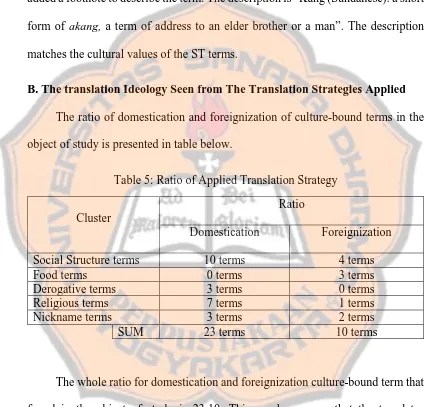
B. The translation Ideology Seen from The Translation Strategies Applied The ratio of domestication and foreignization of culture-bound terms in the object of study is presented in table below.
Table 5: Ratio of Applied Translation Strategy
Cluster
Ratio
Domestication Foreignization
Social Structure terms 10 terms 4 terms
Food terms 0 terms 3 terms
Derogative terms 3 terms 0 terms
Religious terms 7 terms 1 terms
Nickname terms 3 terms 2 terms
SUM 23 terms 10 terms
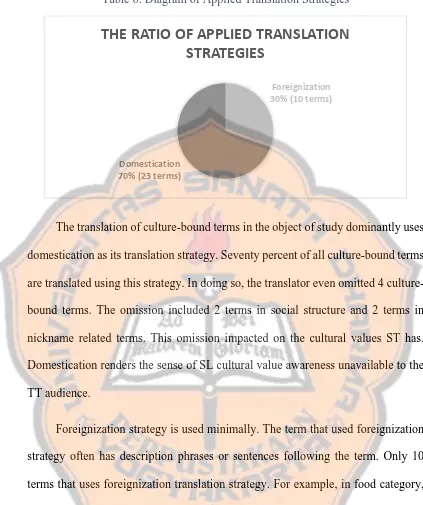
Table 6: Diagram of Applied Translation Strategies
The translation of culture-bound terms in the object of study dominantly uses domestication as its translation strategy. Seventy percent of all culture-bound terms are translated using this strategy. In doing so, the translator even omitted 4 culture-bound terms. The omission included 2 terms in social structure and 2 terms in nickname related terms. This omission impacted on the cultural values ST has. Domestication renders the sense of SL cultural value awareness unavailable to the TT audience.
Foreignization strategy is used minimally. The term that used foreignization strategy often has description phrases or sentences following the term. Only 10 terms that uses foreignization translation strategy. For example, in food category, pecel is translated in its description boiled vegetable with peanut sauce.
The translator chose to assimilate the ST cultural values to accommodate the TT reader interest and bring the literary work closer to TT audience by using domestication. Venutti states that domestication “entails translating in a transparent, fluent, ‘invisible’ style in order to minimize the foreignness of the TT” (Munday,
Foreignization 30% (10 terms)
Domestication 70% (23 terms)
2001:144). However, the translated product lost most of it cultural values of the Javanese cultural values and social construction where the object of study is based on.
For example, in the category of religious terms, 7 terms are translated using domestication and only 1 term is translated using foreignization. The translator uses domestication to minimize the cultural differences from SL to TL. in the religious term category, the terms are related to Islamic practices is assimilated to general religious practice including praying, washing, and burial. TT audience is not given the concrete description or narration about practice on how Islam view those practices.