ABSTRACT
Ganita, Raras. (2015). Students’ Perception on the Use of Group Video in Speaking Practice. Yogyakarta: Sanata Dharma University.
English has become a lingua franca which is widely accepted as a mean of communication between speakers who have different native languages. Having good skills in English especially in speaking English has become a need for the learners. Speaking English fluently will take a lot of time because it is a
students’ perception on the use of group video in speaking practice? (2) What is
the students’ perception on the implementation of group video? The aims of this research were to find out the students’ perception on the use of group video in speaking practice for the second grader of SMP Negeri 2 Mlati and to find out the
students’ perception on the implementation of group video for the second grader of SMP Negeri 2 Mlati.
This research was included as quantitative research. The researcher gathered the data by using survey method. In collecting the data, the researcher used questionnaire, interview, and observation as the research instruments. The data which were derived from the questionnaire became the main data. The data which were obtained from the interview and the observation as the supporting data.
The first finding towards the students’ perception on the use of group video showed that the students tended to have positive perception towards the use of the group video. Students were interested to practice speaking English through the group video. Through the group video, the students expressed themselves in speaking English freely. The students’ positive perception on group video made the students became confident to speak English in front of the class and they could participate to share their ideas in the learning activity. The second finding
towards the students’ perception on the implementation of video group showed
that the students tended to have positive perception on the implementation of group video. The students had more time to practice speaking English outside the classroom. The intensity in using English to communicate among the students in the classroom was increased because the students practiced speaking English intensively through group video. The students also learned how to pronounce English words correctly.
ABSTRAK
Ganita, Raras. (2015). Students’ Perception on the Use of Group Video in Speaking Practice. Yogyakarta: Universitas Sanata Dharma.
Bahasa Inggris telah menjadi lingua franca yang diterima untuk berkomunikasi antara pembicara yang memiliki perbedaan bahasa ibu. Memiliki ketrampilan berbahasa Inggris yang baik terutama dalam berbicara bahasa Inggris menjadi sebuah kebutuhan bagi pelajar. Berbicara bahasa Inggris secara lancar akan membutuhkan waktu lama karena hal ini merupakan proses yang berkelanjutan. Siswa tidak bisa dengan mudah lancar berbicara bahasa Inggris hanya dengan mempelajari teori di kelas. Siswa harus memiliki pengalaman berbicara bahasa Inggris. Salah satu teknologi yang dapat digunakan siswa untuk berlatih berbicara bahasa Inggris adalah video project.
Ada dua permasalahan di dalam penelitian ini yaitu: (1) Apa persepsi siswa terhadap penggunaan group video dalam berlatih berbicara? (2) Apa persepsi siswa terhadap implementasi group video? Tujuan dari penelitian ini adalah untuk mengetahui persepsi siswa mengenai penggunaan group video
dalam berlatih berbicara bahasa Inggris dan untuk mengetahui persepsi siswa mengenai implementasi group video untuk siswa kelas dua di SMP Negeri 2 Mlati.
Penelitian ini bersifat kuantitatif. Peneliti mengumpulkan data dengan menggunakan metode survei. Dalam mengumpulkan data, peneliti menggunakan kuesioner, wawancara, dan observasi sebagai instrumen penelitian. Data dari kuesioner menjadi data utama. Data dari wawancara dan observasi sebagai data pendukung.
Hasil temuan pertama mengenai persepsi siswa terhadap penggunaan
group video menunjukkan bahwa siswa memiliki persepsi positif terhadap group video. Siswa tertarik untuk berlatih berbicara bahasa Inggris dengan menggunakan group video. Melalui group video, siswa dapat mengekspresikan diri mereka dalam berbicara bahasa Inggris dengan bebas. Persepsi positif siswa tentang group video menjadikan siswa lebih percaya diri untuk berbicara bahasa Inggris di depan kelas dan mereka dapat berpartisipasi untuk menuangkan gagasan dalam aktivitas pembelajaran. Hasil temuan kedua mengenai persepsi siswa terhadap implementasi group video menunjukkan bahwa siswa memiliki persepsi positif mengenai implementasi group video. Siswa memilki waktu lebih banyak untuk berlatih berbicara bahasa Inggris di luar kelas. Intensitas dalam menggunakan bahasa Inggris untuk berkomunikasi di antara para siswa meningkat karena siswa berlatih berbicara bahasa Inggris secara intensif melalui group video. Siswa juga belajar bagaimana untuk mengucapakan kata dalam bahasa Inggris secara tepat.
STUDENTS’ PERCEPTION ON THE USE OF GROUP VIDEO
IN SPEAKING PRACTICE
A SARJANA PENDIDIKAN THESIS
Presented as Partial Fulfillment of the Requirements to Obtain the Sarjana Pendidikan Degree
in English Language Education
By Raras Ganita
Student Number: 111214066
ENGLISH LANGUAGE EDUCATION STUDY PROGRAM DEPARTMENT OF LANGUAGE AND ARTS EDUCATION FACULTY OF TEACHERS TRAINING AND EDUCATION
SANATA DHARMA UNIVERSITY YOGYAKARTA
STUDENTS’ PERCEPTION ON THE USE OF GROUP VIDEO
IN SPEAKING PRACTICE
A SARJANA PENDIDIKAN THESIS
Presented as Partial Fulfillment of the Requirements to Obtain the Sarjana Pendidikan Degree
in English Language Education
By Raras Ganita
Student Number: 111214066
ENGLISH LANGUAGE EDUCATION STUDY PROGRAM DEPARTMENT OF LANGUAGE AND ARTS EDUCATION FACULTY OF TEACHERS TRAINING AND EDUCATION
SANATA DHARMA UNIVERSITY YOGYAKARTA
GOD HAS MADE EVERYTHING BEAUTIFUL ON
THE RIGHT TIME
(ECCLESIASTES 3:11)
’ A
Y
A A
GREATER THAN MY FEARS
(WELEN FAGAN)
I dedicate this thesis to:
My beloved parents for their everlasting love
My best sisters ever
ABSTRACT
Ganita, Raras. (2015). Students’ Perception on the Use of Group Video in Speaking Practice. Yogyakarta: Sanata Dharma University.
English has become a lingua franca which is widely accepted as a mean of communication between speakers who have different native languages. Having good skills in English especially in speaking English has become a need for the learners. Speaking English fluently will take a lot of time because it is a
students’ perception on the use of group video in speaking practice? (2) What is
the students’ perception on the implementation of group video? The aims of this research were to find out the students’ perception on the use of group video in speaking practice for the second grader of SMP Negeri 2 Mlati and to find out the
students’ perception on the implementation of group video for the second grader of SMP Negeri 2 Mlati.
This research was included as quantitative research. The researcher gathered the data by using survey method. In collecting the data, the researcher used questionnaire, interview, and observation as the research instruments. The data which were derived from the questionnaire became the main data. The data which were obtained from the interview and the observation as the supporting data.
The first finding towards the students’ perception on the use of group video showed that the students tended to have positive perception towards the use of the group video. Students were interested to practice speaking English through the group video. Through the group video, the students expressed themselves in speaking English freely. The students’ positive perception on group video made the students became confident to speak English in front of the class and they could participate to share their ideas in the learning activity. The second finding
towards the students’ perception on the implementation of video group showed
that the students tended to have positive perception on the implementation of group video. The students had more time to practice speaking English outside the classroom. The intensity in using English to communicate among the students in the classroom was increased because the students practiced speaking English intensively through group video. The students also learned how to pronounce English words correctly.
ABSTRAK
Ganita, Raras. (2015). Students’ Perception on the Use of Group Video in Speaking Practice. Yogyakarta: Universitas Sanata Dharma.
Bahasa Inggris telah menjadi lingua franca yang diterima untuk berkomunikasi antara pembicara yang memiliki perbedaan bahasa ibu. Memiliki ketrampilan berbahasa Inggris yang baik terutama dalam berbicara bahasa Inggris menjadi sebuah kebutuhan bagi pelajar. Berbicara bahasa Inggris secara lancar akan membutuhkan waktu lama karena hal ini merupakan proses yang berkelanjutan. Siswa tidak bisa dengan mudah lancar berbicara bahasa Inggris hanya dengan mempelajari teori di kelas. Siswa harus memiliki pengalaman berbicara bahasa Inggris. Salah satu teknologi yang dapat digunakan siswa untuk berlatih berbicara bahasa Inggris adalah video project.
Ada dua permasalahan di dalam penelitian ini yaitu: (1) Apa persepsi siswa terhadap penggunaan group video dalam berlatih berbicara? (2) Apa persepsi siswa terhadap implementasi group video? Tujuan dari penelitian ini adalah untuk mengetahui persepsi siswa mengenai penggunaan group video
dalam berlatih berbicara bahasa Inggris dan untuk mengetahui persepsi siswa mengenai implementasi group video untuk siswa kelas dua di SMP Negeri 2 Mlati.
Penelitian ini bersifat kuantitatif. Peneliti mengumpulkan data dengan menggunakan metode survei. Dalam mengumpulkan data, peneliti menggunakan kuesioner, wawancara, dan observasi sebagai instrumen penelitian. Data dari kuesioner menjadi data utama. Data dari wawancara dan observasi sebagai data pendukung.
Hasil temuan pertama mengenai persepsi siswa terhadap penggunaan
group video menunjukkan bahwa siswa memiliki persepsi positif terhadap group video. Siswa tertarik untuk berlatih berbicara bahasa Inggris dengan menggunakan group video. Melalui group video, siswa dapat mengekspresikan diri mereka dalam berbicara bahasa Inggris dengan bebas. Persepsi positif siswa tentang group video menjadikan siswa lebih percaya diri untuk berbicara bahasa Inggris di depan kelas dan mereka dapat berpartisipasi untuk menuangkan gagasan dalam aktivitas pembelajaran. Hasil temuan kedua mengenai persepsi siswa terhadap implementasi group video menunjukkan bahwa siswa memiliki persepsi positif mengenai implementasi group video. Siswa memilki waktu lebih banyak untuk berlatih berbicara bahasa Inggris di luar kelas. Intensitas dalam menggunakan bahasa Inggris untuk berkomunikasi di antara para siswa meningkat karena siswa berlatih berbicara bahasa Inggris secara intensif melalui group video. Siswa juga belajar bagaimana untuk mengucapakan kata dalam bahasa Inggris secara tepat.
ACKNOWLEDGEMENTS
First of all, I would like to express my deepest gratitude to Jesus Christ for His everlasting love, His blessing, His guidance, and also His protection for me so that I am able to finish my thesis. I would like to deliver my special gratitude to my thesis advisor, Fidelis Chosa Kastuhandani, S.Pd., M.Hum., for his patience, guidance, suggestions, and also time in helping me from the beginning until the end of this thesis.
I also would like to whole-heartedly thank my beloved parents Ignatius Haryanto and Nanik Budi Pudyastuti, and also my sisters, Diksi Kresnawati and Anindita Dhiaksa, for their eternal love, their support, their curiosity about the time I finish my thesis and my thesis defense. I would not able to finish my thesis without the support from my beloved best-friends, Tabhita Dwi Apriani, Indrias Pratama, Hanung Yulianto, Alexandra Teffannia and also Felix. I thank for their biggest support, their jokes that have been given to me when I feel down and want to give up and also their help. My biggest love for Siska and Cici for helping me to conduct this research and to gather the data. I also thank mbak
Venty forher help to proofread my thesis.
My deepest gratitude to all of students in class 8D and class 8C SMP Negeri 2 Mlati, and also pak Mei, for their willingness in helping me to conduct this research. Finally, I would like to deliver my gratitude to everybody who has helped me in finishing my thesis.
TABLE OF CONTENTS
PERNYATAAN PERSETUJUAN PUBLIKASI ... vi
ABSTRACT ... vii A. Theoretical Description ... 8
1. Perception ... 8
D.Research Instruments and Data Gathering Technique ... 37
1. Observation ... 37
2. Questionnaire ... 39
3. Interview ... 42
Page
F. Research Procedure ... 46
CHAPTER IV. RESEARCH RESULTS AND DISCUSSION A.Data Presentation ... 50
1. Frequency Distribution ... 50
2. Percentage Distribution ... 51
B.Data Interpretation ... 51
1. Students’ Perception on the Use of Group Video in English Speaking Practice ... 52
2. Students’ Perception on the Implementation Of Group Video ... 76
CHAPTER V. CONCLUSIONS AND RECOMMENDATIONS A.Conclusions ... 83
B.Recommendations ... 84
REFERENCES ... 86
LIST OF TABLES
Table Page
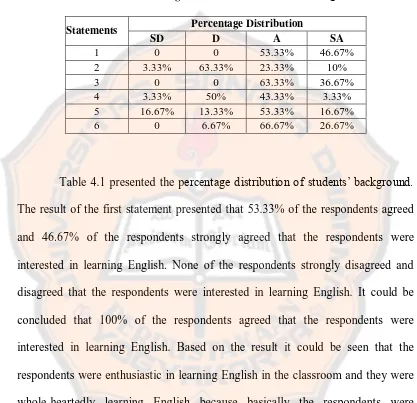
3.1 Scores Distribution ... 40 3.2 Negative and Positive Criteria ... 45 4.1 Percentage Distribution of Students’ Background ... 53 4.2 Percentage Distribution of
Students’ Perception on Speaking ... 56 4.3 Percentage Distribution of
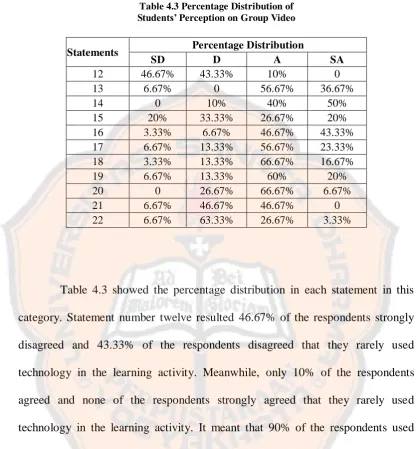
Students’ Perception on Group Video ... 60 4.4 Percentage Distribution of Students’ Perception on
Cooperative Learning (Group Work) ... 69 4.5 Percentage Distribution of Students’ Perception on
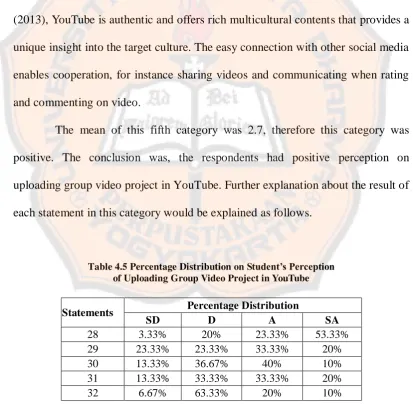
Uploading Video Project in YouTube ... 72 4.6 Percentage Distribution of Students’ Perception on the
LIST OF FIGURES
Figure Page
LIST OF APPENDICES
Page
APPENDIX A The Research Permission Letter ... 90
APPENDIX B The Pilot Questionnaire Blueprint ... 93
APPENDIX C The Pilot Questionnaire ... 97
APPENDIX D The Questionnaire Blueprint ... 101
APPENDIX E The Questionnaire ... 105
APPENDIX F The Questionnaire Changes List ... 109
APPENDIX G The Interview Protocol ... 112
APPENDIX H The Data of the Respondents ... 122
APPENDIX I The Computation Result of the Questionnaire ... 125
CHAPTER I INTRODUCTION
In this chapter, the researcher presents the background of the research why the researcher conducted a research about students’ perception on the use of group video in speaking practice. This chapter is divided into six parts. They are the research background, the research problems, the problem limitation, the research objectives, the research benefits, and the definition of terms. The introduction of this research contains the background information related to the
researcher’s reasons in conducting this research.
A. Research Background
According to Harmer (1991) English has become a lingua franca which is widely accepted as a mean of communication between speakers who have different native languages. Having a good English speaking skill is a need for the students. Students are not able to speak English fluently only by learning theories in the classroom. Students should have experiences in speaking English. They need more practices to speak in order to get better ability in speaking English. Freeman (1986) states if the students only memorize the language rule systems, they may understand the rules of language usage, but will be unable to use the language.
essential in helping the students to learn and practice the knowledge that they have. According to Newby, Stepich, Lehman, Russell, and Leftwich (2011), technology has been used to address problems in communication, medicine, sports, construction, and to address practical problems involved in human learning. Technology in education is generally called educational technology. Seels and Richey (1994) explain that educational technology is the application of technological processes and tools which can be used to solve problems of instruction and learning (as cited in Newby et al., 2011). Educational technology utilizes application tools to accomplish the overall goal of constructing and delivering optimal learning experiences.
Nikitina (2009) explains that with the help of video project, students have a chance to practice the target language in a more meaningful way and to develop useful strategies that can help them in their learning process (as cited in Procedia, 2014). Moreover, Masats, Dooly, and Costa (2009) state video making as an effective learning tool since it engages students in a cooperative project which is an excellent opportunity for integrating students in the class (as cited in Procedia, 2014). By creating their own video and uploading into the web, students can practice language in speaking more easily and then the students will get a lot of benefits in using a video project as their learning media. Salmon and Edirisingha (2008) explain that there are some benefits of uploading video. The benefits that the students will receive are the accessibility. The video can be accessed with
students’ gadget everywhere which is compatible to access the link of the uploaded video, enhancing students’ confidence and students’ ability to identify error, and also knowing in what parts of their speeches which are needed to be improved (p. 48).
Related to the explanation above, the researcher conducts a research
about students’ perception on the use of group video in speaking practice. The aim
of this research is to discover the students’ perception on the use of group video in speaking practice for the second grader of SMP Negeri 2 Mlati. This research also
discovers the students’ perception on the implementation of group video.
B. Research Problems
questions:
1) What is the students’ perception on the use of group video in English speaking practice?
2) What is the students’ perception on the implementation of group video?
C. Problem Limitation
The researcher limits this research into the students’ perception on the use of group video in English speaking practice for the second grader of SMP Negeri 2 Mlati. This research focuses on students’ personal perception, their experiences in creating their group video projects and the implementation of group video in English speaking practice. The participants of this research are 30 students from second grade of SMP Negeri 2 Mlati who have experienced of creating group video project.
D. Research Objectives
Related to the research problems above, the researcher formulates two research objectives, they are:
1. To find out the students’ perception on the use of group video in English speaking practice for the second grader of SMP Negeri 2 Mlati.
E. Research Benefits
There are some benefits that can be obtained in this research. The results of the research can be beneficial for students, teachers and future researchers. The benefits are:
1.Students
This research is aimed to solve students’ problem in English speaking practice. Therefore, the students could use group video to practice their English speaking skill. Through creating video project, the students can practice speaking English in a fun way.
2.Teachers
The teachers will get new way of teaching students to speak English. Through this research, the teachers could use group videos as teaching media in helping students to practice speaking English interestingly and effectively. The teachers can motivate the students to be confident in speaking English.
3.Future Researchers
F. Definition of Terms
In order to avoid misunderstanding, some terms are defined by the researcher as follows:
1.Perception
According to Altman (1985), perception is the way stimuli are selected and grouped by a person so that they can be meaningfully interpreted (p. 85).
Perception is a person’s view of reality. Moreover, Huffman (2000) states perception as the process of selecting, organizing, and interpreting sensory data into useful mental representations of the world (p. 107). Perception in this research refers to the students’ view or interpretation on the use of group video in speaking practice.
2.Group Video
A video according to Hyun-suk, Sub, and Jin-il (2000) is technology of electronically capturing, recording, processing, storing, transmitting, and reconstructing a sequence of still images representing scenes in motion. According to Hafner and Miller (2011), a video project provides a social context in which students are able to interact with one another (as cited in Procedia, 2014). Thus, group video in this research is the video project that is created by the students in groups.
3.Speaking Practice
CHAPTER II
REVIEW OF RELATED LITERATURE
This chapter presents theories which are related to this research. This chapter is divided into two parts, they are the theoretical description and the theoretical framework. The theoretical description explains the theories being used in this research and the theoretical framework contains all major relevant theories which help the researcher to conduct this research.
A. Theoretical Description
In this part, the researcher presents the theories which are relevant to be used in this research. This part is divided into three sections. They are perception, speaking skill, and video usage in education.
1. Perception
People get information in their environment by gathering the data and then collecting the information on the brain. In collecting the information, actually people have their perceptions related to the information that they get based on the data received from their surroundings. Generally, perception is a process of attaining awareness in understanding the sensory information.
a. Definition of Perception
change (p. 16). Vernon (1982) explains that change and variation of stimuli are essential to increase an efficiency of perception and a cognitive process. It has been found that people are conscious about something new, something outside there and different from general. In short, perception can be defined as the way people think of something that is different from the surroundings. In order to have perception, based on the explanation which is previously stated, people are affected by their interests and their motives. Thus, every person actually has his or her own perception depends on the benefits that he or she gets from it. It is difficult to decide whether the perception is right or wrong. It means that people have their rights to have their perceptions as long as the perception has the facts that can be proved.
Altman (1985) describes perception as the way stimuli are selected and grouped by a person so that they can be meaningfully interpreted (p. 85).
b. Perceptual Process
Based on Altman (1985), there are several factors that influence person‟s perception. The four important factors are selection of stimuli, organization of stimuli, the situation, and the person‟s self-concept. Those four factors are very important to be known in order to see what kinds of perceptions that someone has (p. 86).
The first factor in perceptual process is selection of the stimuli. Selection is one of reasons why people perceive things differently. Each person selects specific cues and filters out the others. The second perceptual process is organization of stimuli. After the information has undergone the screening process, it must be arranged to become meaningful. The third perceptual process is the situation. Situation as well as someone past experiences affects what the person perceives. Perceiving a situation accurately is also related to how well a person adjusts his or her behavior to the situations. The fourth perceptual process is self-concept. Self-concept is the way people feel about and perceive themselves. The way people see themselves affects their perception of the world around them. Altman (1985) figures the perceptual process as in this picture below:
Huffman (2000) explains three steps in the perception. The first step in perception is selection the stimuli. Selection is choosing the stimuli to which people will pay attention. Selective attention directs the attention to the most important aspect of the environment (p. 108). Huffman also states that there are three major factors involved in any selection decisions. They are physiological factors, stimulus factors and psychological factors.
1) Physiological Factors
The basic mechanisms for perceptual selection are built into the brain, but a certain amount of interaction with the environment is apparently necessary for feature detector cells to develop normally. A physiological factor is a biological influence on selection. There are two major factors of physiological, they are feature detectors and habituation. The eature detectors are specialized cells in the brain that is distinguished between different sensory inputs. Another physiological factor is habituation. Habituation refers to the tendency of the brain
to ignore environmental factors that remain constant. The brain seems “prewired”
to pay more attention to the changes in the environment than to the stimuli that remain constants.
2) Stimulus Factors
3) Psychological Factors
The psychological factors refer to the influences on selection. Motivation and personal needs are two factors why people attend to some stimuli and not to others. What people choose to perceive is determined largely by their current level of satisfaction or deprivation. Students will have positive stimuli and it will also create positive interpretation if they have motivation that by using their group video students will get a lot of benefits and students have personal needs to practice speaking English. It is clearly showed that motivation and personal needs influence the stimuli. In this psychological factor there is a subliminal stimulus. A subliminal stimulus occurs below the threshold of people‟s conscious awareness. Therefore, people sometimes do not realize that the stimuli that they have are influenced by their own motivations and also satisfactions.
They are the trichromatic theory and the opponent-process theory. The trichromatic theory explains about three color systems maximally sensitive to blue, green and red. Those are operated in cones of retina. Opponent-process theory is also about three color systems but each is sensitive to two opposing colors (blue and yellow, red and green). It occurs in optic nerve and thalamus.
The last step in the perception is the interpretation. The interpretation is influenced by early life experiences, perceptual expectancy, cultural factors, needs, interests and frames of reference. In this step of perception, when people interpret external stimuli and the patterns they form, people are trying to make sense of their world.
2. Speaking Skill
and synthetic speech. Digitized speech stores a numeric encoding of a real utterance and regenerates the utterance at playback time. Synthetic speech, which is only beginning to offer acceptable quality on microcomputers, involves rule-based speech production using highly advanced microprocessor circuitry.
Bedford (1991) explains that language also can be learned in the education field. As language teachers, people are all in the business of helping learners to gain competence of language (as cited in Harmer, 2007, p. 162). A learning part about another person‟s language involves assimilating appropriate speech acts within particular social contexts, appropriate behavior within those contexts, and how to make an effective communication within groups. If people want to be able to speak fluently in English, they need to be able to pronounce phonemes correctly, use appropriate stress and intonation patterns and speak in connected speech. In the education field, asking students to speak in class sometimes can be easy. In a good class atmosphere, students who cooperate with each other and whose English is at an appropriate level will often participate freely and enthusiastically if they are given a suitable topic and task.
Slavin (1995) states that cooperative learning refers to a variety of teaching methods in which students work in small groups to help one another learn academic content (p. 2).
Mercer, Wegerif, and Dawes (1966) explain that cooperative learning provides students with ways of interacting together, so they learn to listen to what others have to say and how they say it (as cited in Gillies & Ashman, 2003, p. 7). When students interact with others, they learn to develop their abilities to use the language. Moreover, Dewey (1966) states that by interacting with others, students receive feedback from their friends and teacher, students learn socially appropriate behaviors, and they also understand how to work together in a group (as cited in Gillies & Ashman, 2003). The cooperative learning requires pupils to work together in small groups to support each other and to improve their own learning (Jolliffe, 2007, p. 14). Jolliffe also explains the two most important key elements in cooperative learning. Those keys are positive interdependence and individual accountability.
student achievement, acceptance of academically handicapped classmates, and increased self-esteem. There are two major categories of the theories that make the group work work well, motivational and cognitive. First is a motivational theory. It focuses on the reward or goal structures under which students operate. Deutsch (1949) identifies three goal structures (as cited in Slavin, 1995, p. 16). First goal structure is cooperative; each individual‟s goal-oriented efforts
contribute to others‟ goal attainment. Second goal structure is competitive; each
individual‟s goal-oriented efforts frustrate others‟ goal attainment. Third goal structure is individualistic; individual‟s goal-oriented efforts have no
consequences for others‟ goal attainment. Based on the motivational theories, cooperative goal structures create a situation in which the only way group members can attain their own personal goals is if the group is successful. Therefore, to be successful, every group member should encourage their groupmates to the maximum effort.
cited in Gillies & Ashman, 2003). The most effective means of elaboration is explaining the material to others.
Through cooperative learning, students can practice speaking with group more effectively since cooperative learning gives a chance for the students to work together and help each member to speak English confidently. There are number of things which help students to practice speaking. Therefore, students should give more attention for it. According to Harmer (2007) there are number of things that can help the students in speaking. Some of them are preparation, the value of repetition, big groups and small groups, and mandatory participation. a. Preparation
b. The Value of Repetition
Repetition has many beneficial effects. The repetition allows students to improve on what they did before. When students repeat speaking tasks they have already done once or twice, their first attempt is like a rehearsal for the final effort. It gives them more confidence as they are not attempting to get the words out for
the first time when they try to speak in subsequent „performances‟.
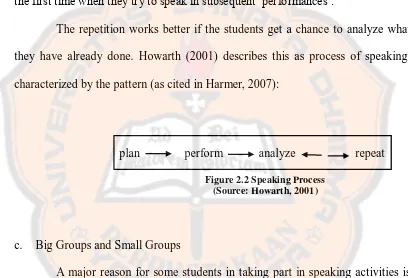
The repetition works better if the students get a chance to analyze what they have already done. Howarth (2001) describes this as process of speaking, characterized by the pattern (as cited in Harmer, 2007):
plan perform analyze repeat
Figure 2.2 Speaking Process (Source: Howarth, 2001)
c. Big Groups and Small Groups
A major reason for some students in taking part in speaking activities is because they find themselves having to talk in front of a big group. Students counteract this by making sure that they get chances to speak and interact in smaller groups too. Students will be more confidence when others listen and appreciate what they are talking about. They also can learn from others‟ speeches in order to get a better speaking skill.
d. Mandatory Participation
drawing a grid and writing the names of half of the students on the vertical axis, and half on the horizontal access (as cited in Harmer, 2007, p. 35). Students are writing the numbers 1-4 in the first column of the vertical axis and then write the numbers diagonally downwards. They put number 4 at the top of the second column and then enter it diagonally too. After that, write 3 at the top of the third column and 2 at the top of the fourth column. Mandatory participation also lies at the heart of jigsaw reading activities and story-circle writing since both of these and other similar activities only work when all the students take part.
them to be confident to speak. For example, in jigsaw, students feel important because they have information that is indispensable to the group. Moreover, Johnson and Johnson (1983) state that cooperation increases students‟ general and school self-esteem (as cited in Gillies & Ashman, 2003). Students who had worked in group were doing a good practice of learning.
Second is proacademic peer norms. Cooperative learning motivates students to get each other to do academic work and makes students feel that their classmates want them to do their best. Third is locus of control. In this locus of control, Slavin (1995) explains that cooperative learning make students feel that they have a chance to succeed, that their efforts will lead to success, and that success is a valued goal. Cooperative leaning gives mutual benefits to the all group members. The benefits are gain from each other‟s efforts, recognize that all group members share a common fate, know that one‟s performance is mutually
caused by oneself and one‟s team members, and feel proud and jointly celebrate
using English language since their friends support them. 3. Video Use in Education
the product of making a video or audio recording.
According to Hyun, Sub, and Jin-il (2000) video is a technology of electronically capturing, recording, processing, storing, transmitting, and reconstructing a sequence of still images representing scenes in motion. Newby (2000) states that any media format that uses a television screen or monitor to present a picture can be referred to the video. In this research, group video means a video project for the students in a form of group using English language. Through group video project, each member of the group can review individual performance and group performances as well as their work in progress. Guo (2013) suggests that students come to know themselves better in the learning process because the use of video data provides individuals with unique opportunities to reflect on their experiences in a tangible manner, therefore allowing for improvements to be possible.
particular area. Secondly, students can determine in which pronunciation and conversation skills are desired to acquire the clip. Thirdly, students can browse videos in YouTube by their own. Fourthly, students can investigate all clips which are particularly interesting and useful in language learning freely. An intelligent and self-guided examination into YouTube can be conducted if students feel that the materials being studied in class are not useful.
too many effects (as cited in Dal, 2010). The third step is presentation and evaluation or post-task. In this last step, the video can be presented to the class, to the peers from other classes, and can be made public such as upload it in YouTube. Therefore, making a video can be seen as a way of getting the students to use the target language in class and as a medium to develop fluency and competence on the use of English in speaking.
sharing.
YouTube is a good medium for sharing the result of the video project since YouTube is widely used by the students and easy to be accessed. In this research, YouTube is used as the engine to upload students‟ group video project and also to help the students in finding the appropriate videos example related to the topic of the group video project. Brunner (2013) explains that YouTube is the largest video portal and the second largest video search engine. Terantino (2011) states that in February 2005, Chen, Hurley, and Karim founded YouTube with domain name http://youtube.com. The site was created as a forum for people to create and share short video clips online.
learner should be responsible in using YouTube to learn language.
Brunner (2013) describes some of the quality criteria for using YouTube as an educational tool. First is about the accessibility. People can access YouTube anywhere, anytime, and the interesting part is that it is free of charge. It makes YouTube becomes user-friendly because it allows people easier in uploading videos that people can subscribe into different channels. Second, YouTube is authentic and offers many multicultural contents related to the target culture. Third is about the connectivity. YouTube has easy connection to other social media and it enables cooperation to share videos and communicate when rating and commenting on videos. YouTube is also available in many devices including mobile phone which make it easy to be used in education. Fourth is media agreement. It means that YouTube is the media in which students interact with on in daily basis (p. 1). Watkins and Wilkins (2011) state the two primary benefits in using YouTube in the classroom are the exposure to authentic English as well as the promotion of a learning style that is more autonomous and student-centered (p.113). Johnson and Swain (1997) also explain that when students regularly use a wide variety of English media, they are achieving a degree of language learning immersion that might otherwise be unavailable outside the classroom (as cited in Watkins & Wilkins, 2011, p. 114).
Terantino (2011) presents several general methods in which YouTube videos can be utilized, they are:
a. YouTube for Providing Content and Information
important is the uploaded videos are used to provide linguistic, cultural content, and information in the target language. According to Berk (2009) explains that utilizing YouTube videos in an informative manner is also beneficial for illustrating a concept, presenting an alternative viewpoint, stimulating a learning activity, and motivating the students (as cited in Terantino, 2011, p. 12). The YouTube videos which are commonly used in language learning are videos for less commonly taught languages and culture-based videos. Some of YouTube videos provide access to spoken samples, instructional units, and reading and writing practice. Moreover, related to linguistic and motivational purposes, YouTube videos deliver the representations of cultural information.
b. YouTube for Student-Created Videos
YouTube also gives opportunity for students to create their own videos in target language. Through creating their own videos, students can apply the target language into real world situations. By creating their own videos and uploading in YouTube, students are able to develop creativity and freedom of expression, it encourages them to utilize the target language.
c. YouTube for Collaboration
these facilities, students can get real feedbacks. Students and also teachers can subscribe to certain channels maintain by individuals or companies from around the world to keep up with their videos.
Skerritt (1984) explains that video project gives students opportunity to experience learning as controlled by themselves and assists students in producing their own recording with the aim of understanding and applying strategies of learning. Mestre and Lian (n.d.) believe that video is an excellent tool for developing awareness of critical features of the target language and for defining the individual needs of students (as cited in Skerritt, 1984). Video project enables the learner to develop their English speaking skill through a broad range of possible activities and a sensitivity to the critical or elements of communication. Successful language learning occurs in people who have the ability to recognize patterns and to re-create patterns in short time. Therefore, working with the video project provides learners with the opportunity of becoming aware of the framework of the target language and to develop and modify them according to the demands of the target language. Furthermore, students can observe their own current English oral proficiency and discover ares they need to improve.
performances. Harmer (2007) states that one of the main benefits of video project or video-making for the students is the chance to display what they have done and get feedback from the classmates or from the teachers. It can be achieved in several ways according to Harmer (2007); class feedback, teacher feedback, video installation, and individual and library copies. In class feedback, students show their video in front of the class and their classmates can vote for the best video or they can record the successful and less successful examples of the video that they already made. This way will be more useful if different students take charge of different areas such as effectiveness, clarity, grammar, vocabulary, production, face expression, and voice quality. Meanwhile, in the teacher feedback the teachers respond to each video, saying what the teachers liked about it, correcting mistakes, and giving suggestions about how it might be improved. The general point of view is that students should learn from their mistakes so that they are able to develop their ability to speak English (Hartford & Harlig, 2004, as cited in Dal, 2010).
video project creates students autonomy and enables students to practice the target language in a collaborative, enjoyable, and comfortable atmosphere. As emphasized by Nikitina (2009), students have a chance to practice the target language in a more meaningful way and to develop useful strategies that can ease their learning process (as cited in Procedia, 2014). Moreover, Masats, Dooly, and Costa (2009), state video project as an effective learning tool since it engages students in a cooperative project which is provided an opportunity for integrating all members in the group (as cited in Procedia, 2014). Besides that, it is suggested that video production should be used as an integrative learning tool. Therefore, video project that the students made in this research was as an integrative English learning tool.
B. Theoretical Framework
This section synthesizes all major relevant theories which are already reviewed by the researcher above. The use of those theories is intended to help the researcher to conduct a research to solve the research problems. In this research, the researcher attempts to answer two research questions. First is about the
students‟ perception of the use of group video in speaking practice. Second is
about the role of group video in speaking practice.
interpreted. The way the students perceive on something, whether it is in positive
or negative way influences the students‟ behavioral responses (p. 85). The behavioral responses can be positive or negative. It depends on the students‟ perception. If the students perceive the use of group video positively, they will
have positive perception and the students‟ behavioral responses will positive too.
The positive behavioral responses of the students will motivate the students more to use group video in speaking practice. On the other hand, negative behavioral responses of the students will make the students have less motivation in using group video to practice speaking.
Huffman (2000) states three steps in perception. They are selection the stimuli, organization, and interpretation (p. 108). Related to this research, the students should be aware in selecting the stimuli towards the use of group video. Students have to look at the importance of using group video in speaking practice, so that the students will get the stimuli to use the group video. After the students selected the stimuli, the students should organize the stimuli into patterns which can help the students to understand the use of video project in their speaking practice. The last step is the interpretation. The students interpret the patterns that they have after organizing their stimuli and resulted their own perception toward the use of group video in speaking practice.
developing awareness of critical features of the target language and for defining the individual needs of students (Mestre & Lian, n.d., as cited in Skerritt, 1984). The use of video in language learning become more meaningful in form of video projects because through video project, students can learn the language authentically. According to Hafner and Miller (2011), video project provides a social context within which learners are able to interact with one another, students can capture and play back their own performances to reflect on their speaking English (as cited in Procedia, 2014). By making video project and using it as a tool in practicing speaking English, students are able to reflect on their own performances in that video. Therefore, they know in what areas of their speeches which are needed to be improved. It is strengthen with the theory from Harmer (2007) that one of the main benefits of video project or video-making for the students is the chance to display what they have done and get feedback from the classmates or from the teachers. Therefore, students can publish their video by uploading it in YouTube.
CHAPTER III
RESEARCH METHODOLOGY
This chapter presents a rationale for the method of research and analysis. The researcher described the method of research and analysis, outlined the procedure in gathering and analyzing the data and revealed the boundaries of the research. This chapter divides into six parts: the research method, the research setting, the research participants, the instruments and the data gathering technique, the data analysis technique, and the research procedure.
A. Research Method
Since this research is aimed to find out the students‟ perception on the use of group video in speaking practice for the second grade of SMP Negeri 2 Mlati, researcher used quantitative research. According to Creswell (2014), quantitative research is the process of collecting, analyzing, interpreting, and writing the result of the study. Quantitative research emphasizes on collecting and analyzing information in the form of numbers. The data were collected in a form of quantitative data.
Survey method uses a written questionnaire or formal interview to gather information on the backgrounds, behaviors, beliefs, or attitudes of a large number of people. Another explanation of survey method is stated by Vaus (2002), survey method is one method of collecting, organizing and analyzing the relevant data which are collected by a variety of techniques and in many studies it may be appropriate to use a range of research methods. The researcher presented the data in a quantitative way. In collecting the data, the researcher used questionnaire, interview, and observation as the tools. The data which were derived from the questionnaires became the main data and the data which were derived from the interview as the supporting data. The main data collected from the questionnaires were presented in a quantitative way, in a form of numeric information. The supporting data gathered from the interview and the observation were presented descriptively.
B. Research Setting
The researcher conducted the research in SMP Negeri 2 Mlati which is located in Jl. Perkutut, Sinduadi, Mlati, Sleman, Yogyakarta. The researcher chose second grade students as the research participants. The researcher distributed the questionnaire on May 20, 2015.
C. Research Participants
explain that to infer validity that the results of a study are applicable to a larger group than just the participants in the study, researchers must be careful in defining the population to which inferences are sought and design a study in which the sample has been appropriately selected from the designated population. The larger group to which one hopes to apply the results is called the population. According to Ott and Longnecker (2010) a population is the set of all measurements of interest to the sample collector. The population of this research were 63 students in second grade who had experiences in using group video.
According to Fraenkel, Wallen, and Hyun (2012) sampling refers to the process of selecting the individuals. A sample in a research study is the group in which information is obtained. The total sample of this research were 30 students in second grade. All of 30 participants were asked to answer the questionnaire. In deciding the participants who would answer the questionnaire, the researcher used purposive sampling. Fraenkel et al. (2012) explain purposive sampling consists of individuals who have special qualifications of some sort or are deemed representative on the basis of prior evidence. Cohen, Manion, Morrison (2007) also state that in purposive sampling the researchers build up a sample that is satisfactory to their specific needs. The qualifications of the respondents related to
the researcher‟s needs are the respondents should have experienced in using group video and the respondents have the same intensity in using the group video.
Neuman (2011) explains that stratified sampling is a random sample in which the researcher identifies a set of mutually exclusive and exhaustive categories, divides the sampling frame by the categories, and then uses random selection to select cases from each categories. Therefore, the researcher chose the sample from three strata, higher-achievement, medium-achievement, and lower-achievement. Two research participants were selected from each strata. Thus, the researcher gathered the supporting data from the result of the interview of two students with higher-achievement, two students with medium-achievement, and two students with lower-achievement. In order to triangulate the data, the researcher used observation, questionnaire, and also interview as the research instruments.
D. Research Instruments and Data Gathering Technique
As stated before, the researcher used survey method in gathering the data. Neuman (2011) states that surveys have many uses and take may forms such as interview, internet opinion polls, and questionnaires. In collecting the data that the researcher needed, observation, questionnaire and interview are selected as the research instruments. The complete information about the three research instruments that the researcher uses will be explained as follows.
1. Observation
p. 212). Moreover, Creswell also states that observation is the process of gathering open-ended firsthand information by observing people and places at a research site. Observation requires good listening skills and careful attention to visual detail. Hammersley and Atkinson (1995) state that observation also requires management of issues such as the potential deception by people being observed and the initial awkwardness of being an outsider without initial personal support in a setting (as cited in Creswell, 2012, p. 214).
Observation also has the advantages and also the disadvantages. The advantages of observation are an opportunity to record the information, study the actual behavior, and study the individuals who have difficulty in verbalizing their idea. Meanwhile, the disadvantages of observation are the researcher may have difficulty in developing the information, individuals and the researcher will also be limited to those sites, and situations where the researcher can gain access. In this research, the researcher used participant observation. Based on Fraenkel, Wallen, and Hyun (2012), researcher actually participates in the situation or setting which is being observed. The researcher should interact as natural as possible. Participant can be overt or covert. Overt observation means that the researcher is easily identified and the subjects know that they are being observed. While covert observation means that the researcher disguises the identity and acts just like other participants. The researcher implemented the covert observation in this research in order to produce more valid observations of what really happens. It also offers opportunity to see experiences from the views of participants.
the observation. First is selecting a site to be observed that can help in understanding the central phenomenon. Second is put into the site slowly by looking around. Third is identifying who or what to observe and when and how long to observe. Fourth is determining the respondents. Fifth is initialling the researcher‟s role as an observer. Sixth is conducting multiple observations. Seventh is getting time to obtain the best understanding of the site and the individuals. Eight is designing some means for recording notes during an observation. Ninth is considering what information the researcher will record during an observation. The last is recording descriptive fieldnotes (events, activities, and people) and reflective fieldnotes (personal thoughts).
2. Questionnaire
In gathering the response of the respondents related to their perception on using group video, researcher distributed questionnaire in collecting the data. According to Best and Kahn (1986) questionnaire is one of the data gathering instruments in which the respondents answer several questions or respond in a form of writing. In this research, the researcher used two types of questionnaire, both close-ended and open-ended. According to Neuman (2011), open-ended question is a type of survey method that allows respondents free to offer any answer they wish to the question. While close-ended question is a type of survey method in which respondents must choose from a fixed set of answer. There were 39 close-ended questions and 2 open-ended questions.
that Likert scale is a scale often used in a survey method in which people express attitudes or other responses in term of ordinal-level categories that are ranked along a continuum. The researcher used four degrees of possible agreement,
„strongly disagree‟, „disagree‟, „agree‟, and „strongly agree‟. In order to make it
easier for the researcher in analyzing the data, the numbers one to four were used to represent the degrees of agreement. The scores distribution for the degree of agreement based on Riduwan (2002) can be seen in table 3.1.
Table 3.1 Scores Distribution (Source: Riduwan, 2002)
Positive Statements Negative Statements Strongly Agree = 4 Strongly Agree = 1 Agree = 3 Agree = 2 Disagree = 2 Disagree = 3 Strongly Disagree = 1 Strongly Disagree = 4
The researcher made blueprint of the questionnaire to make the statements in the questionnaire being structured. The blueprint of the questionnaire can be seen in the appendix D. After the questionnaire had been developed, each question and the questionnaire as a whole should be evaluated before distributed to the respondents. Evaluating the questionnaire is called pilot testing (Vaus, 2002). Researcher discusses pilot testing into two categories, they are stages of pilot testing questions and pilot testing questionnaire.
stages are question development, questionnaire development, and polishing pilot test. In the stage one, question development has purpose to establish how to phrase each question and to evaluate how respondents interprete the questions‟ meaning. The researcher in this stage evaluated each statement based on the
respondents‟ understanding about the statements. If none of the respondents asked about the statements and they clearly understand what the meaning of the statements were, it could be concluded that the statements in the questionnaire are clear enough to be distributed. In the stage two, questionnaire development, it enables the further evaluation of individual items and the questionnaire as a whole. The researcher identified the flow of the questionnaire. The researcher evaluated whether the transition from one section into another section were jump quickly or smooth enough. The time that the respondents spent to fill the questionnaire can be used as the consideration for the researcher. If the respondents take too long to fill the questionnaire, the questionnaire might be not clear, too difficult to be understood or there are some similar statements.
redundancy. Open-ended questionnaire can be revised by evaluating the answers that the respondents gave. The result of the pilot testing showed that there were two questions that cannot be understood by the respondents. Both of the two questions were omitted by the researcher based on the consideration that those two questions did not support the data that the researcher needed.
Second is pilot testing questionnaire. Vaus (2002) explains that there are at least four things should be carefully checked, they are flow, question skips, timing, and respondent interest and attention. The flow of the questionnaire is needed to see the transitions from one section to another are smooth or not. The researcher identified whether the questionnaire moved too quickly or jumped from one topic to another topic too quickly or not. In the question skips, the researcher‟s evaluation based on the question instructions to ensure that the instructions guided the respondents through the questionnaire directly. Timing also needed in checking the questionnaire. If the respondents take too long to fill the questionnaire, the researcher could gain some idea of how much needs to be cut for the final questionnaire. The researcher looked from respondents‟ interest and attention, if respondents seem to be getting bored, the questionnaire may be too long. The statements should be restructured, removed or placed at the end of the questionnaire.
3. Interview
interview involved some forms of direct contact between people in the sample group and the researcher who presented the questions to each person in the sample group and recorded their responses. Personal interview or face-to-face interview was used in this research. Personal interview meant that the interviewer read the questions to the respondent in a face-to-face setting and recorded the answers (Ary et al., 2010). The researcher chose face-to-face interview in order to get the detailed answers from the respondent directly.
Stratified random sampling was used in selecting the respondents to be interviewed. Stratified sampling produced more representative and thus more accurate samples. According to Neuman (2010), stratified sampling is a random sample in which the researcher first identifies a set of mutually exclusive and exhaustive categories, divides the sampling frame by the categories, and then uses random selection to select cases from each category. The researcher chose research participants from three strata, higher-achievement, medium-achievement, and lower achievement. Two respondents were selected from each stratum. So, the total respondents to be interviewed are six participants. Blueprint of the interview guideline can be seen in the appendix G.
constructing the sentences in English. The respondents understand the statements in close-ended questionnaire because the respondents only read the statements which were easy to be understood and only chose the degree of agreement.
E. Data Analysis Technique
The data of this research were gathered from the questionnaire, the interview, and the observation. In order to analyze data from the questionnaire, the researcher firstly coded the data from close-ended questions. According to Blackstrom and Cesar (1981), all responses must be converted to numbers for tabulating called coding. The researcher used scales to measure how an individual feels or think about something. Likert scales was used in this research by the researcher. Neuman (2011) explains that Likert scales are widely used in survey method. Likert scales are called summated-rating or additive scales because a
person‟s score on the scale is computed by summing the number of responses he
or she gives. The scale that the researcher used was in a form of numbers, 1 up to
4. The degree of agreement were „strongly disagree‟, „disagree‟, „agree‟, and
formula that the researcher used:
Figure 3.1 Percentage Formula
Ʃ x: total of the respondents who chose at the same degree of agreement in each statement
Ʃ n: total of all respondents
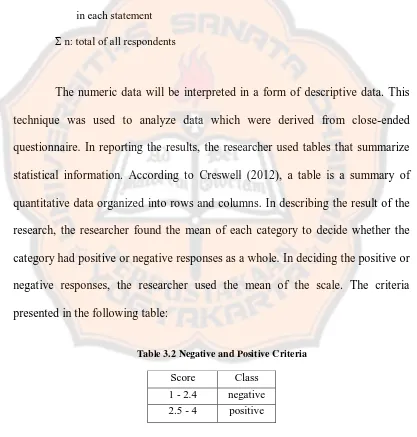
The numeric data will be interpreted in a form of descriptive data. This technique was used to analyze data which were derived from close-ended questionnaire. In reporting the results, the researcher used tables that summarize statistical information. According to Creswell (2012), a table is a summary of quantitative data organized into rows and columns. In describing the result of the research, the researcher found the mean of each category to decide whether the category had positive or negative responses as a whole. In deciding the positive or negative responses, the researcher used the mean of the scale. The criteria presented in the following table:
Table 3.2 Negative and Positive Criteria
Score Class 1 - 2.4 negative 2.5 - 4 positive
The data which were derived from the open-ended questionnaire and interview, researcher used different technique in analyzing the data. The
Ʃ x x 100%
easy in collecting the results, the researcher used note-taking technique in analyzing the data. After all the data that the researcher needed were collected, the researcher made it in the form of paragraphs, therefore the data will be more easier to be understood. The data from the interview were analyzed by coding the interview data. Then, the researcher examined the recording interview and the results were in the form of paragraphs. The last step in analyzing the data was summarizing the results of the interview and the results of the questionnaire, both close-ended and open-ended. Thus, the researcher had the conclusion according to the data that had been analyzed.
F. Research Procedure
The data gathering technique that the researcher used in this research is survey method. The researcher explains the procedure used in this research. According to Ary, Jacobs, and Sorensen (2010), there are six basic steps involved in survey method. Those steps are planning, defining the population, sampling, constructing the instrument, conducting the survey, and processing the data. 1. Planning
Survey method begins with a question that the researcher believes can be answered most appropriately by means of the survey method (Ary et al., 2010). In this step, the researcher decided the research problem or research questions based on the topic that the researcher chose. There are two research questions in this
research, they are: “What is the students‟ perception on the use of group video in
group video”. The researcher looked into literature review in order to know what other researchers have learned about the topic being discussed in this research. 2. Defining the Population
The next step is defining the population of the research. It is important to define the population in which the research will be conducted. Ary et al. (2010) explain that defining population is essential for identifying the appropriate subjects to select and knowing to whom the results can be generalized. The population that the researcher decided was all students in class VIII D of SMP Negeri 2 Mlati. The researcher selected class VIII D because the class had the qualifications that the researcher needed to get better results of the research. The qualifications were, the class were enthusiastic in learning English, the class were enthusiastic in making the video project with their own creativity, and the class were active in following the learning process.
3. Sampling