A CULTURE REPRESENTED BY THE WORDS
“
WHITE
AND WHITENING”
ON HAND AND BODY LOTION
PRODUCT’S LABEL
A FINAL PROJECT
In Partial Fulfillment of the Requirement For S-1 Degree in Linguistics
In the English Department, Faculty of Humanities Diponegoro University
Submitted by: Cindy Clarissa Suntiarko
13020112140054
FACULTY OF HUMANITIES DIPONEGORO UNIVERSITY
ii PRONOUNCEMENT
The writer states truthfully that this project is compiled by her without taking any results from other research in S-1, S-2, S-3 degrees and in diploma
degree of any university. In addition, the writer ascertains that she does not take and quote any material from other publications or someone’s work except for the
references mentioned in bibliography.
Semarang, August 2016
iii MOTTO AND DEDICATION
“The fear of the Lord is the beginning of wisdom, and the knowledge of the Holy One is understanding.” Proverbs 9:10
“But his delight is in the law of the Lord; and in his lawn doth he mediated day and night. And he shall be like a tree planted by the rivers of water that bringeth forth his fruit in his season; his leaf also shall not wither; and whatsoever he doeth shall prosper.” Psalm 1:2-3
“Trust in the Lord with all your heart, and lean not on your own understanding. In all your ways acknowledge Him, and He shall direct your paths. Do not be wise in your own eyes. Fear the Lord and depart from evil. It will be health for your flesh, and strength to your bones.” Proverbs 3:5-8
“Now faith is the substance of things hoped for, the evidence of things not seen.” Hebrew 11:1
This final project is dedicated to Jesus Christ, my parents, my grandparents, and my
vi
ACKNOWLEDGEMENT
Praise and thank to the God Almighty, Jesus Christ, as the source of
knowledge, understanding and wisdom. I owe Him all I have until today and forevermore. The writer would also like to acknowledge with deep appreciation and gratitude the invaluable help of the following people.
My parents and my grandparents, as financial supporters and advisors of my life. Because of them, I manage to study at English Department at Diponegoro
University in 2012 and graduated in 2016.
My superhero, my dad, as the person who teaches me much about how to live happily and cheerfully in this world and much about good moral values.
Mr. Herudjati Purwoko, as my academic mentor and seminar project advisor.
Mrs. Ayu Ida Savitri, as my project advisor in writing this research. HUDI of CHUDI members, abbreviation of Hilman, Ulin, Diah, Indah. The English Department students, Academic Year 2012.
Indah Zumrotun, S.Hum.
vii My spiritual-physical mentors, Mbak Evi Christiani, Jyoti, and mas Wawan.
My spiritual mentors, Tante Puji and Om Henoch.
Gereja Bethel Tabernakel KAON, as my harvest field, second home and God’s service, also the first place that gets me to socialize with friends.
Mr. Prihantoro, Mrs. Deli and all members of Korean Project from September 2015 to January 2016. Thank you for the best moment I could
experience with all of you during my 4 (four) years as a university student. The person at printing-service who makes this book printed.
Tourism and Culture Office Province of Central Java, especially the staff of Human Resource and Development Section of Tourism Destination Development, Bu Eta, Bu Wulan, Bu Uti, Pak Basuki, Pak Warno, Pak Noto, Pak
Pomo; and my partners, Zainal and Angger.
IronMoonLy members, Ira, Syerly, Gizka and Tiffany.
KKN TIM I, Bintang, Irish, Ucok, Bowo, Kiki, Ema, Dila, Adit S.W., Devin, Adit R.W., Puti, and Rita.
All lecturers of the English Department, Diponegoro University.
All staff of Faculty of Humanities, Diponegoro University. Diponegoro University, Tembalang, Semarang.
Semarang, August 2016
viii
TABLE OF CONTENTS
Title ... i
Pronouncement ... ii
Motto and Dedication ... iii
Approval ... iv
Validation ... v
Acknowledgement... vi
Table of Contents ... vii
Abstract ... ix
Abstrak ... x
INTRODUCTION ... 1
THEORETICAL FRAMEWORK ... 4
RESEARCH METHODS ... 7
RESULTS AND DISCUSSION ... 9
CONCLUSION ... 17
References ... 20
ix
Abstract
This research is about the words ‘white’ and ‘whitening’ that are found on the label of hand & body lotion product which represent a cultural product based on the study of Linguistic Anthropology. This research is purposely conducted as the writer notices that hand and body lotion product contains linguistic data manifesting Indonesian culture, particularly women. The purpose of the study is to reveal the culture of Indonesian women that is set by the hand and body lotion products’ producers by using the words ‘white’ and ‘whitening’ in the labels of hand and body lotion products. The writer used Open-ended Questionnaire from Creswell (2010:26) to collect the respondents’ answers. To collect the words ‘white’ and ‘whitening’, the writer used Note-Taking Technique from Creswell (2010:272) and Non-Participatory Observation Method from Liu and Maitlis (2010). To analyze the data, the writer used Theory of Culture as a System of Mediation by Duranti (1997:40-41). The writer found that the words ‘white’ and ‘whitening’ refer to a certain concept of what Indonesian women expect to be. The writer concludes that it is a condition that one characteristic of beauty shaped by the Indonesian women is having white or bright complexion.
x
Abstrak
Penelitian ini menganalisa kata ‘white’ dan ‘whitening’ pada label produk hand and body lotion yang mengarah pada sebuah kultur dalam bentuk produk menggunakan pendekatan Antropologi Linguistik. Penelitian ini dilakukan karena peneliti melihat bahwa produk hand and body lotion di Indonesia secara linguistik merupakan sebuah kultur orang Indonesia, khususnya wanita sebagai penggunanya. Tujuan penelitian ini adalah menunjukan budaya wanita Indonesia yang dibentuk oleh produsen hand and body lotion lewat penggunaan kata ‘white’ dan ‘whitening’ di label. Peneliti menggunakan Metode Wawancara Terbuka dari Creswell (2010:26) untuk mengumpulkan respon dari responden. Untuk mengumpulkan kata ‘white’ dan ‘whitening’, peneliti menggunakan Metode Teknik Catat dari Creswell (2010:272) dan Metode Simak Bebas Libat Cakap dari Liu dan Matlis (2010). Untuk menganalisa data, penulis menggunakan Theory of Culture as a System of Mediation dari Duranti (1997:40-41). Peneliti menemukan bahwa kata ‘white’ dan ‘whitening’ mempunyai makna yang mengarah pada suatu konsep yang diinginkan oleh para wanita Indonesia. Pada akhirnya, peneliti menyimpulkan bahwa salah satu karakteristik cantik yang terbentuk oleh wanita Indonesia adalah dengan memiliki warna kulit putih atau cerah.
1
1.
Introduction
Language is a tool that people use for communication. By using language,
someone conveys their thoughts, feelings, desires and emotional states. Some say that what we think is influenced by our language so that our speech
influences our ways of thinking as well. However, anthropologists believe that someone’s speech is influenced by their culture to which society they belong
because culture lives in people’s thoughts.
Linguistic Anthropology is a study about the relation between language and culture. Duranti (1997:2) states that Linguistic Anthropology is
a science studying language as culture and speaking as a cultural practice. By means of this study, the writer is interested in writing a research project about the words ‘white’ and ‘whitening’ on one of cosmetic products, that is, hand
and body lotion used by Indonesian women.
The object of the study in this paper is the words ‘white’ and ‘whitening’ on the labels of hand and body lotion product. The writer assumes
that those words have become a part of Indonesian culture, especially for women. They become a culture because there is a way of thinking of the
2 Duranti states that, culture is “what “others” have, what makes them and keeps them different, separate from us” (1997:23). Furthermore, Duranti
proposed six theories of culture in which language has important roles. Through his theory, Duranti (1997:40-41) wrote examples of culture shaped in
things that people use, and in language that people speak. Therefore, the writer believes that the words ‘white’ and ‘whitening’ imply a particular thought of Indonesian women regarding to the hand and body lotion product
that they use.
Based on linguistic anthropology approach, the writer analyzes the
collected data to draw a conclusion of the way Indonesian women think of the usage of hand and body lotion for their skin is that they believe it can whiten or brighten their skin (as reflected in the words ‘white’ and ‘whitening’ on the
labels of hand and body lotion product and the questionnaire). Those words indicate the skin color change of lotion users into ‘whiter’ or ‘brighter’ after
they use the product. The writer assumes that this phenomenon is also influenced by a particular belief of Indonesian women, that fairy complexion is more beautiful than dark complexion.
The studies about words that reflect people’s way of thinking had been conducted by some university students. The first study, “Pengaruh Terpaan
Iklan Citra White Lasting Bengkoang Hand and Body Lotion di Televisi
terhadap Tindakan Membeli (Survey Pada Mahasisswa Ilmu Komunikasi
3 (2009) focused on the influence from the advertisement of ‘Citra’ hand and body lotion. She used the theory of A-I-D-D-A
(Attention-Interest-Desire-Decision-Action) from theory of marketing, with quantitative design. She assumed that all advertisements are made to attract attention and interest of
the consumers so that they have a desire to make a decision in the form of an act of buying products that have been advertised.
The second study, “Makna Cantik di Kalangan Mahasiswa dalam
Perspektif Fenomenologi” by Novitalista Syata (2012) focused on the meaning of beauty. She used phenomenology approach in conducting her
research. She analyzed the concept of beauty which is created in a particular time (in her paper, the concept of beauty is created by media or by a certain brand of cosmetics that is popular in a particular time). In her conclusion, the
concept of beauty is changing from one time to another because it depends on the popular concept of beauty built in that time.
The last study, Analisis Makna Simbol Unsur Alam dalam Kanyooku
Bahasa Jepang” by Tri Cuciati (2013) focused on the meaning of natural
symbol of the word kanyooku using the theories of culture by Duranti for
identifying the means of symbols. She concluded that the word kanyooku has a culture meaning with Japan’s environment element.
4 cultural meaning or values do the words ‘white’ and ‘whitening’ represent?”. The purpose of the study is to explain the way of text producer used the words ‘white’ and ‘whitening’ to represent cultural values.
2.
Theoretical Framework
In analyzing the data, the writer used Theory of Culture as a System of Mediation proposed by Duranti (1997:40-41) to analyze culture in product
through words that are used in the product’s label. Duranti (1997:40) states that any tools that humans use on a purpose, that tools have become culture to them as the users. Duranti (1997:39) explained that the meditational objects or
tools can be anything that is used by human to do something within their environment. For example, a fork is a meditational object between human and
their food. It can also be an utterance that is spoken by humans to others. For example, when a lecture teaches his or her student, the language is used for mediating between the lecture and his/her students. Through language, people
can understand what is inside other person’shead or someone’s thought Moreover, meditational objects could be a mental representation
between a person and his/her thoughts (Duranti, 1997:39-40). Duranti (1997:40) wrote another example of culture, that is, an umbrella. Umbrella is
5 when people use umbrella with a purpose. Umbrella then is used for reducing
the harm of the rain for human, such as getting wet or sick.
Furthermore, Duranti (1997:40) states that there is always “something” (mediation) between human and their environment. Human
always needs tools, in this term, the tools are called as meditational objects to
stand between human and their environment. When we use umbrella to keep our body stay as it should be (dry), we and our environment are mediated by a
particular tool, in this case, the umbrella which represents culture (Duranti, 1997:40). It can be said that the use of tools is organized by culture, so that
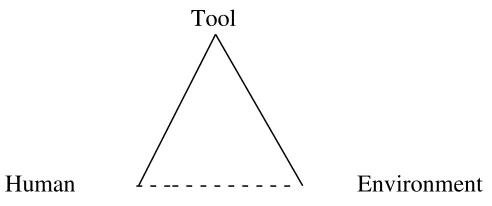
when we are hunting or cooking, we are actually using our tools (as well as culture). The relation of human and their environment when they are mediated by tools is drawn below.
Human Tool Environment
Figure 1.1. Tools mediate between humans and the environment (Duranti, 1997:40)
However, human always has choices to use or not to use tools to mediate him/her and his/her nature. When the tools become an alternative,
there is another relation among them. The relation between human and his environment when tools become an alternative for human is represented in the
6 Tool
Human - - -- - - Environment
Figure 1.2. Tools as a mediating alternative between humans and the environment (Duranti, 1997:40)
In Figure 1.2, the relation between the straight and the intermittent line
is an alternative one. The straight line that represents mediated relationship is an alternative to the intermittent line that represents the unmediated
relationship with the environment. Within this view, culture (tool that is used on purpose) includes material objects such as the umbrella and ideational objects such as belief systems and linguistic codes (Duranti, 1997:40). Thus,
Duranti (1997:40-41) concludes that both material and ideational structures are instruments through which humans mediate their relationship with the
world. By using umbrella, in this case, people will be little bit of wet than they will be without using umbrella, so that umbrella is a culture because people believe when they are using umbrella, it will prevent them from getting wet
7 Based on the Theory of Culture as a System of Mediation (Duranti, 1997:40-41), Figure 1.2 shows that human and their environment might not be
mediated by any tools. The intermittent line between human and environment in Figure 1.2 means that human can have direct contact with their
environment. However, sometimes the use of tools in human’s life is not recognized by the users because tools can be represented by a symbol so that when we use symbols, we actually use tools. As a result, non-material or
ideational objects such as symbols are also included as culture.
Moreover, people can use symbols to communicate with others.
Instead of directly saying to someone to do something, a person can use symbol to state their mind or what they want other people to do. For example, the sign ‘no visitor’ in a dorm means nobody can enter the room. When we
point it to someone particular, if he/she understands, he/she will not enter the room (Duranti, 1997:41). The use of symbol here shows that people and their
environment are (always) mediated by something.
3. RESEARCH METHOD
This research belongs to a qualitative descriptive research as the analyzed data on this research are the words ‘white’ and ‘whitening’ found on 13 (thirteen) products’ labels from 3 (three) different hand and body lotion brands in
8 written document. The writer uses two kinds of data, those are, primary data and secondary data. The primary data are the words ‘white’ and ‘whitening’
on the hand and body lotion product’s label as the main data to be analyzed. Meanwhile, the secondary data are the respondent’ answers from the
interview about their thought of those words and they are taken in order to support the main data.
In this paper, the primary data are collected from official websites of ‘Citra’, ‘Nivea’, and ‘Vaseline’ hand and body lotion products as the primary
data sources. They are www.nivea.co.id, www.vaseline.co.id, and
www.rumahcantikcitra.co.id. The writer collects 5 (five) labels of ‘Citra’ hand and body lotion products, 3 (three) labels of ‘Nivea’ hand and body lotion products, and 5 (five) labels of ‘Vaseline’ hand and body lotion products.
To document the data, the writer uses Note-Taking Technique from Creswell (2010:272) by firstly visiting those three brands of hand and body
lotion products’ official websites. After that, the writer puts the words describing the products (or the data) in tables. The next step is classifying them regarding to the writer’s purpose. The writer also uses Non-Participatory
Observation Method from Liu and Maitlis (2010) because the writer does not involve directly in the observation.
9 (questionnaire) from Creswell (2010:26) since the writer does not limit the answer that the respondents want to write. Since this research is qualitative
descriptive in nature, the writer does not determine the number of respondents taking questionnaires as Nasution (2011:101) stated that the quality of a
research is not qualified by the amount of sample, but by the underlying theory that is used in that research.
In analyzing the data, the writer uses Theory of Culture as a System of
Mediation from Duranti (1997:40-41) as the primary data (the words ‘white’ and ‘whitening’) and the secondary data (the respondents’ answers relating to
the words ‘white’ and ‘whitening’) are classified and assessed regarding to the writer’s purpose. In addition, the writer also uses Semantics and Pragmatics
approaches in analyzing the words ‘white’ and ‘whitening’ in hand and body lotion products’ labels as the data in this paper. Semantics is a study about
meaning while Pragmatics is a study about meaning in context. Both study
about sentence meaning, but Pragmatics is a science about sentence meaning within its context.
4. RESULTS AND DISCUSSION
In this chapter, the writer used the Theory of Culture as a System of
10 are used in the labels of hand and body lotion products by the producers. This phenomenon shows us that the producers have intention to persuade the text
receiver about the beauty that ‘white’ skin is appealing for Indonesian women. In addition, those words are also ‘intangible’ culture because they influence
the thought of the lotions’ users and they become the belief system of the users that by using them, the users’ skin can be ‘white’. The users may think
that ‘white’ skin is appealing is match to the producers’ intention in using the
words ‘white’ and ‘whitening’ in the labels of hand and body lotion products.
There are 9 (nine) ‘white’ words and 4 (four) ‘whitening’ words that
are found on ‘Citra’, ‘Nivea’, and ‘Vaseline’ hand and body lotion products’ labels. The words ‘white’ and ‘whitening’ in lotion’ labels indicate that the producers of hand and body lotion products wants to put the belief regarding
to ‘white’ skin to the lotions’ users. The lotions’ producers use the words ‘white’ and ‘whitening’ with the intention that the harm of the environmental
event in Indonesia (getting high sunlight exposure) can be reduced by using the hand and body lotion products. The following subchapter describes the analysis.
4.1 Cultural Meanings of the Words ‘White’ and ‘Whitening’ on Hand
and Body Lotion Product in Indonesia (Duranti, 1997:40-41)
The words ‘white’ and ‘whitening’ are used as the labels of hand and body
11 thought that ‘white’ skin is appealing and this will be proven by the
questionnaire in this paper. The first brand, ‘Citra’, uses the words ‘white’ and ‘whitening’ on its 5 (five) products. The second brand, ‘Nivea’, uses the word ‘whitening’ on its 3 (three) products. The third brand, ‘Vaseline’, uses the
words ‘white’ on its 5 (five) products. The following table shows the data of
this research.
Table 4.1 The Words ‘White’ and ‘Whitening’ Found on
Hand and Body Lotion Product Label from Three Brands
No. Name
12 From the labels on the Table 4.1 above, the writer analyzes that the words ‘white’and ‘whitening’ in ‘Citra’ hand and body lotion product’ labels
also have meaning in Semantics and Pragmatics. In Semantics, these are the meaning of the words in labels of ‘Citra’: (1) ‘Lasting’ means ‘continuing a long while’; (2) ‘Pearly’ means ‘having the shiny, white color of pearls’; (3) ‘Night’ means ‘part of the day when there is no sunlight’; (4) ‘Spotless’
means ‘having no spot’; (5) ‘Advanced’ means ‘being beyond others in progress or ideas’. Therefore, the words ‘Lasting’, ‘Pearly’, ‘Night’, ‘Spotless’, and ‘Advanced’ that follows the words ‘white’ and ‘whitening’ in
‘Citra’ hand and body lotion product can be pragmatically concluded that ‘Citra’ persuades the text receivers to use its products because they are lasting
in skin and can give skin full coverage of lotion that is already advanced even
when it is used in the night.
The writer also analyzes that the words ‘white’ in ‘Nivea’ hand and body lotion product’ labels also have meaning in Pragmatics. ‘Nivea’ relates the ‘UV’ and ‘Night’ to ‘whitening’. The writer concluded that pragmatically,
producer of ‘Nivea’ correlate that in any condition, our skin can be whitening if we apply the ‘Nivea’ hand and body lotion products.
Conversely, the producer of ‘Vaseline’ hand and body lotion product uses the word ‘white’ following the word ‘healthy’ which semantically means ‘the condition of being well or free from disease’. ‘Nivea’ also uses the words
13 ‘UV’ means ultraviolet; (2) ‘Fair’ means not dark; (3) ‘SPF’ means sun
protection factor; (4) ‘Perfect’ means having all the qualities you want in something; (5) ‘Serum’ means ‘the watery part of something’. The writer concluded that ‘Nivea’ pragmatically persuades the text receivers that its
products give not only ‘white’ or bright skin, but also health to the users’ skin. According to the Theory of Culture as a System of mediation by
producers in order to fulfill the needs of lotions’ users, that is, to have ‘white’
or bright skin.
Located on equator, Indonesia is a country which is getting exposed of
sunlight highly. The sunlight has some good and bad impact to human. The good impacts are sunlight helps the development of vitamin D in human’s bones and it also makes laundry become dry fast. Meanwhile, the bad impacts
are it can cause skin cancer and darken skin. Based on the respondents’ answers, darken skin colour is considered as not appealing for Indonesian
14 words, that is, the words ‘white’ and ‘whitening’ that are used as the names of the products’ labels. The words ‘white’ and ‘whitening’ written as the names
of hand and body lotion product are considered as culture because there is purpose which the lotions’ producers try to put on Indonesian women’
thoughts. The writer draws the correlation of the users of hand and body lotion product with the product they use as follows.
The words ‘white’ and ‘whitening’ on the lotions’ label (Tools)
Users (Human) - - -- - - Sunlight (Environment)
Figure 1.3. The words ‘white’ and ‘whitening’ on lotions and Lotion Users based on Theory of Culture as a System of Mediation (Duranti, 1997:40)
In Figure 1.3, the relation between ‘Users’ and their ‘Environment’ are
mediated by ‘The words ‘white’ and ‘whitening’ on the lotions’ labels’. When the users of hand and body lotion product use lotion on purpose, that is,
15 The users of hand and body lotion can choose not to use lotion, but when they choose to use it (on purpose), their relation with their environment
is like in Figure 1.3. Their purpose in using hand and body lotion is match to the producers’ thought that having bright skin is more appealing than having
dark skin, or they may assume that hand and body lotion is able to cover their skin from bad impact of sunlight exposure so that their skin is not darkening. Those thought match to the belief system that the hand and body lotion’s
producers try to put on Indonesian society. Hand and body lotion is used because the users have purpose that is same as what the products or producers
claim, that is, in this case, to be able to give brighter skin or prevent skin from darkening because of sunlight exposure.
In previous paragraph, the writer showed how the words ‘white’ and ‘whitening’ represent culture in Indonesia. In this paragraph, the belief system
of hand and body lotion users who use the lotion with the words ‘white’ and ‘whitening’ will be analyzed in order to support the main analyses in this
paper. Culture can be tangible such as umbrella, or intangible such as belief system (Duranti, 1997:41). Belief system is a set of beliefs that people use in
order to survive in this world (Domenech and Selva, 2013:1).
The responses of respondents who have been continuously using hand
16 skin will be ‘coated’ (covered from or avoided of the bad impact of sunlight)
so that their skin will be brighter or will not get tanned. The users believe that
the words ‘white’ and ‘whitening’ in the label of hand and body lotion product show the formula that can brighten their skin or prevent their skin
from being darkened as the bad effect of sunlight.
It can be said that the users of hand and body lotion product using the words ‘white’ and ‘whitening’ use the lotion because they believed that the
lotion have a particular formula that can make the users’ skin become bright. Or else, it can ‘coat’ the skin from sunlight in order to prevent skin darkening.
Based on the data of this research, the writer concluded that the users of hand and body lotion product want to prevent their skin from getting darkened. The writer has asked 3 (three) respondents who are continuously using this
product to lighten their skin as they think that lighter skin is appealing. The questionnaire will be included in Appendices.
The first respondent who is using ‘Citra’ believes that ‘Citra’ hand and body lotion product is able to brighten her skin. Therefore, in order to make her skin brighter, she uses it since she was in junior high school. The second
respondent who is using ‘Nivea’ hand and body lotion product believes that ‘Nivea’ can brighten her skin. Consequently, to make her skin or keep her
skin as bright as she wants, she uses the product for five years. The third respondent who is using ‘Vaseline’ hand and body lotion believes that
17 addition, the users of hand and body lotion product believe that lotion with the
words ‘white’ and ‘whitening’ will make their skin whiter or brighter, or can prevent their skin from being darkened due to the direct sunlight exposure in Indonesia.
5. CONCLUSION
There are 9 (nine) words of ‘white’ and 4 (four) words of ‘whitening’ found on the label of three hand and body lotion brands that are analyzed using the Theory of Culture as a System of Mediation (Duranti, 1997:40-41). The result
shows that those words represent culture in Indonesia as they have a close correlation with Indonesian environment (climate) as a country which is
18 In addition to those words’ analyses, there are 3 (three) respondents
who continuously use the product as they believe that it can make their skin
whiter or brighter. Their reason of using the product is also analyzed by using the Theory of Culture as a System of Mediation (Duranti, 1997:40). The result
shows the belief system of the users of hand and body lotion product, that is, a belief that the product which are labeled with the words ‘white’ and ‘whitening’ are capable of covering the users’ skin from sunlight exposure
that may darken their skin colour so that they keep using hand and body lotion product. Moreover, they also believe that the product is able to lighten their
skin.
It can be concluded that the words ‘white’ and ‘whitening’ become a
‘culture’ because the producers use those words on the labels of hand and
body lotion product that are continuously used by the users to protect their skin from sunlight exposure. The words ‘white’ and ‘whitening’ are
categorized as ‘tangible’ culture in mediating the users and sunlight by being
written on the labels of hand and body lotion product that are used by the users.
Since the users in Indonesia believe that the product, with those words written on their label, can keep their skin colour bright or even make it
19 In conclusion, the same words ‘white’ and ‘whitening’ on the label of
hand and body lotion have been ‘a culture’ for Indonesian women because
those words are found in the labels of hand and body lotion products. In addition, they also become belief system of the users of hand and body lotion
products based on the analyses using the Theory of Culture as a System of Mediation (Duranti, 1997:40-41). Therefore, the producers of hand and body lotion products are successful in persuading the users or the text receiver to
20
References
Duranti, Alessandro. 1997. Linguistics Anthropology. Cambridge: Cambridge University Press.
Khaerunnisa, Nafida. 2009. “Pengaruh Terpaan Iklan Citra White Lasting Bengkoang Hand and Body Lotion di Televisi terhadap Tindakan Membeli (Survey pada Mahasiswa Ilmu Komunikasi Universitas Muhammadiyah Malang Angkatan 2006)”. Unpublished thesis. Malang: University of Muhammadiyah Malang.
Syata, Novitalista. 2012. “Makna Cantik di Kalangan Mahasiswa dalam Perspektif Fenomenologi”. Unpublished thesis. Makassar: Universitas Hasanuddin.
Cuciati, Tri. 2013. “Analisis Makna Simbol Unsur Alam dalam Kanyooku Bahasa Jepang”. Unpublished thesis. Semarang: Universitas Negeri Semarang.
Creswell, John W. 2010. Research Design Pendekatan Kualitatif, Kuantitatif, dan Mixed. Yogyakarta: Pustaka Pelajar.
Mukhtar. 2013. Metode Praktis Penelitian Deskriptif Kualitatif. Jakarta: REFERENSI (GP Press Group).
21
22 Appendix 1
Questions
1. Why do you choose (Citra/Nivea/Vaseline) hand and body lotion product? (Please mention which one of three products above that you use at least for about a year)
2. How long have you used it?
3. Do you really think that getting a lighter or whiter skin is appealing so that you choose to use this product?
23 Appendix 2
Respondents’ Biodata
Biodata
Name :
Age :
Occupy/Activity :
Address :
Phone Number :
Email Address :
27 Appendix 3