O R I G I N A L A R T I C L E
Cynics All Around? The Impact of Election
News on Political Cynicism in Comparative
Perspective
Andreas R.T. Schuck, Hajo G. Boomgaarden, & Claes H. de Vreese
Amsterdam School of Communication Research (ASCoR), University of Amsterdam, Amsterdam 1012 CX, the Netherlands
Previous research suggests that the news media’s reporting about politics in terms of strategy fosters political cynicism. The question remains, however, what individual and contextual factors facilitate or inhibit this effect. In this study, we draw on a unique multimethod and comparative cross-country design, combining a media content analysis (N=48,892) with a 2-wave panel survey conducted in 21 countries (N=22,791) during the 2009 European Parliamentary elections. Our findings show that citizens who are less aware of the election campaign become more cynical. Furthermore, strategy news has an effect on cynicism in countries in which quality of governance is higher. Overall, our study provides the first comprehensive overview over the conditional impact of election news on political cynicism in comparative perspective.
doi:10.1111/jcom.12023
Scholarly and public debates about the role of the media during election campaigns are heated and ongoing. Previous research has identified different features of campaign news with the potential to affect citizens in electoral contexts. An important strand of extant research has established a link between news media’s reporting of election campaigns in terms of strategy and people’s political cynicism (Cappella & Jamieson, 1997). The news media’s emphasis on framing politics in terms of strategy thereby is suggested to lead citizens to perceive politics as nothing more than a strategic game of political actors that is remote from representing citizens’ interests (Cappella & Jamieson, 1997; Patterson, 2002; Valentino, Buhr, & Beckmann, 2001). These findings seem to confirm what Patterson concluded already in 1993, namely that ‘‘election news, rather than serving to bring candidates and voters together, drives a wedge between them’’ (p. 52).
The literature hitherto has addressed this topic by and large in single country studies and mostly in a U.S. context. However, we know from studies of national
election campaigns in other countries that strategic news reporting is also found in election news coverage outside of the United States, albeit in varying degrees (e.g., Str¨omback & Kaid, 2008). Some scholars even refer to strategic coverage as the dominant journalistic mode since the 1970s (e.g., Esser, Reinemann, & Fan, 2001), but there is little specific evidence of strategic news reporting and in particular its effects beyond the U.S. example (see Jackson, 2011) or with regard to European politics specifically (see De Vreese & Semetko, 2002). What is missing so far in the literature on effects of strategy news on political cynicism is a comparative perspective which allows us to consider not only the relationship between news and cynicism itself, but also its conditionality on both individual as well as contextual, system-specific factors.
Thus, whereas the relationship between citizens’ exposure to strategy framing in the news and their cynicism toward politics has been established previously, we know little about the specificconditionsunder which this relationship is more or less likely to occur. Without specifying these conditions, however, we may draw incorrect inferences about the nature and pervasiveness of this phenomenon. We expect that the impact of strategy news on political cynicism is not equal for all citizens across all countries, but differs depending on relevantindividual characteristics, especially the attention paid to an election campaign, andcontext characteristics, such as the quality of democracy and governance in a country.
To investigate this conditional model of the effects of strategic news on political cynicism we need a design with sufficient variation in both the level of strategic news to which citizens are exposed to as well as in quality of democracy and governance across countries. Specifically, we investigate the relationship between strategy news and political cynicism in a unique multimethod and comparative cross-country design, which combines a large-scale media content analysis and a two-wave panel survey, conducted in 21 EU member states during the 2009 European Parliament (EP) elections. While the design allows us to investigate a wide range of country-specific questions, ourkey focus is on the underlying pattern. We approach this topic by using an election taking place in different national contexts at the same time and with considerable variation on both the individual and the contextual level. This allows for a unique comparative perspective on the relationship between campaign news contents, exposure to such news, and changes in cynicism over the course of the campaign.
Cynical citizens—the media’s fault?
Oxley, 1997). Previous research focusing on the role of strategy framing in elections has demonstrated that the news report about elections with a focus on tactics, strategic considerations, the style of presentation of political leaders, and the game character of politics rather than substantive issues or policies (e.g., Cappella & Jamieson, 1997; Valentino, Buhr, & Beckmann, 2001).
A lot of this research has dealt with the presumed negative consequences of this way of framing electoral contests (Patterson, 2002; Valentino et al., 2001). Accordingly, Rhee (1997) found that news framed in terms of strategy bolsters participants’ strategic interpretations of an election campaign. This is assumed to have important implications for democracy since other research suggests that higher levels of cynicism can—in turn—alienate people from politics, reduce learning, erode civic engagement, and result in lower levels of participation in the political process (see e.g., Ansolabehere & Iyengar, 1995; Elenbaas & De Vreese, 2008; Patterson, 1993, 2002; Valentino, Beckmann, & Buhr, 2001). Other studies have referred to a ‘‘spiral of cynicism’’ according to which news media report largely strategically about politics which fuels distrust in and cynicism about politics and politicians among the public (e.g., Cappella & Jamieson, 1997) even though this view has been challenged (De Vreese & Semetko, 2002).
Given the context of this study rather than focusing on general political cynicism we are specifically interested in how strategic reporting affects campaign-specific cynicism. Recent research has shown that such more specific measures of cynicism are especially suitable when assessing the effect of strategy framing (Jackson, 2011) and we believe it is an important addition to the existing literature to investigate such campaign-specific cynicism and to tailor the object of the cynicism measures to the exact object of interest. As we will come back to later, both concepts of course share substantial theoretical grounds and only differ with regard to the exact object cynicism is targeted at (politicians in general vs. politicians acting in the campaign under study). We consider our concept of campaign-specific cynicism to be more nuanced and specific and thus more suitable for our investigation.
Strategy news—focusing on the ‘‘game of politics’’
described as stressing the strategies, performances, styles, and tactics of campaigning necessary for a candidate or party to obtain and remain in a favorable position (Esser & D’Angelo, 2006; Jamieson, 1992).
Such strategic news framing is assumed to appeal to audiences and appears to be a standard ingredient of election coverage nowadays, at the expense of substantial issue news coverage (Cappella & Jamieson, 1997; Iyengar, Norpoth, & Hahn, 2004). This observation applies to the U.S. context, even outside election times (Cappella & Jamieson, 1997; Lawrence, 2000), but has also recently been made—among others—in Denmark (Pedersen, 2012), Germany (Esser & Hemmer, 2008), the UK (Jackson, 2011; Scammell & Semetko, 2008), or the Netherlands (Elenbaas & De Vreese, 2008). A systematic assessment of the way in which campaign news frame an election in terms of strategyacross countries, however, has not been conducted. Such an investigation is crucial to overcome the scattered picture currently emerging from existing research looking at specific elections in certain countries and thus falling short of being capable to generalize findings beyond the respective national election context. In this study, in a first step, we therefore take a comparative look at the presence of strategic news framing in media coverage across Europe and within the same election context.
A ‘‘spiral of cynicism’’—but not for all
It is widely acknowledged that media effects are unlikely to be across-the-board effects and may strongly depend on recipients’ characteristics or the contexts in which they operate (e.g., McLeod, Kosicki, & McLeod, 2002). Such conditionality has also been shown to apply to the strategy–cynicism relationship (e.g., De Vreese, 2005; Jackson, 2011; Valentino, Beckmann, et al., 2001). In more concrete terms, the conditionality of framing effects is usually seen to be caused by recipients’ ability to take in and process new information. In this study, we apply and further extend the argument that effects of strategy framing on cynicism are not omnipresent and we put this expectation to an empirical test. This is important given that most previous studies assumed a ‘‘spiral of cynicism’’ across the board in which exposure to strategically framed news leads to increasing cynicism in what eventually becomes a vicious circle (Cappella & Jamieson, 1997).
political judgments. In fact, when it comes to strategy news it is likely that people with little political awareness do hinge more strongly on behind-the-scenes information that describes strategic moves of political actors that they did not presuppose. In this vein De Vreese (2005) found that strategy news had a stronger effect on citizens low in political sophistication, however, only based on a two-country comparison. Also on a more general level, the literature is divided as to whether political sophistication enhances or limits media effects. Whereas some studies argue that lower levels of political knowledge or sophistication make citizens more prone to media influence (e.g., Kinder & Sanders, 1990; Schuck & De Vreese, 2006) others argue the exact oppo-site as citizens possessing more cognitive resources would be better able to process and incorporate new information (Krosnick & Brannon, 1993; Nelson et al., 1997).
In this study, we consider EP campaign awareness (i.e., knowledge about and interest in the EP election campaign) as an indicator of political sophistication which might condition the impact of strategy news on cynicism. Whereas some types of news frames may invite for more active processing and may therefore be more influential for those with high political sophistication, we assume that given the specific nature of the strategy frame (i.e., focusing on the ‘‘game’’ character of politics), the effect of strategy news on political cynicism is greater—or only occurring—among those with low awareness of the campaign (H1).
Context matters—moving beyond borders
There are numerous different definitions of democracy and conceptualizations concerning the quality of democracy (see Held, 2006). We do not aim at adding to this theoretical debate in this study; instead we are interested in how levels of democratization can impact media influence on cynicism. The democracy concep-tualization we draw on puts the aspect of ‘‘good governance’’ central (see Kaufman, Kraay, & Zoido-Loabton, 1999). In line with previous research we broadly define governance as ‘‘the traditions and institutions by which authority in a country is exercised’’ (Kaufman et al., 1999, p. 1). Importantly, such a conceptualization of democratization incorporates, as one important indication, the respect of citizens and the state for the institutions that govern interactions among them. Such respect is meant to reflect the success of a society in developing an environment in which principles like fairness, confidence, and predictability are characteristic. We deem this aspect to be particularly relevant in the context of our study, that is, when assessing the conditioning influence of democratization or ‘‘good governance’’ on the impact of strategy framing on cynicism.
We argue that in a situation in which levels of democratization are high, it is more likely that election news stories framed in terms of strategy will contribute to greater political cynicism. In such cases citizens might be more prone to this influence, with regard to short-termchangein levels of cynicism, because the baseline levels of cynicism are lower and such news can be expected to stick out more in contexts in which good governance is the norm. Also it runs against what people are used to in terms of their common experience with well-functioning institutions and can remind them that, in fact, not all is functioning well. Reversely, in countries with lower levels of democratization, in which baseline levels of cynicism are higher and political performance is seen more critically, it is more likely that strategically framed election news has no or less effect on change in levels of cynicism given that it is ‘‘no news’’ and simply less surprising to citizens and rather seen as accurate reflection of what is already perceived as a deficient or malfunctioning system.
Our case, the 2009 EP elections, lends itself well to such an investigation, given that common measures of democratic performance show sufficient variation across those countries included in our investigation.1 In line with our above reasoning, we expect that in countries in which levels of democratization are stronger and practices of good governance are more established campaign news framed in terms of strategy has more of an effect on cynicism compared to contexts in which levels of democratization are lower and practices of good governance are less established (H2).
Data and methods
coverage on the decision of voters to turn out to vote. This design enables us to assess the effect of campaign news more specifically by building the results from our media content analysis into our measure of individual news exposure to those same news outlets in our panel survey analysis. For this, we analyze the media content of exactly those specific media outlets which are also included in our panel study design and for which respondents report their individual exposure.
What is furthermore unique about our design is that it includes an in-depth content analysis of campaign coverage in 21 of the 27 EU member states and combines it with panel survey data in the same 21 countries, allowing for a multilevel analysis assessing the impact of both individual-level and country-level variables on political cynicism in the 2009 EP elections across Europe in one single study.
Media content analysis
To empirically test our expectations and collect information to build into our weighted measure of news exposure in the analysis of our panel data, we rely on a large-scale media content analysis. This content analysis was carried out within the framework of PIREDEU (www.piredeu.eu; Providing an Infrastructure for Research on Electoral Democracy in the European Union). PIREDEU is funded by the European Union’s FP 7 program (for more details see data documentation report in Schuck, Xezonakis, Banducci, & De Vreese, 2010).
Sample
The content analysis was carried out on a sample of national news media coverage in all 27 EU member states. In each country we include the main national evening news broadcasts of the most widely watched public and commercial television stations. We also include two ‘‘quality’’ (i.e., broadsheet) and one tabloid newspaper from each country. Our overall television sample consists of 58 TV networks and our overall newspaper sample consists of 84 different newspapers.
Period of study
The content analysis was conducted for news items published or broadcast within the 3 weeks running up to the election. Since election days varied across countries also the coding period varied from for example, May 14 to June 4 for some countries up to May 17 to June 7 for others.
Data collection
Coding procedure
Coding was conducted by a total of 58 coders at two locations, the University of Amsterdam (the Netherlands) and the University of Exeter (UK). Coders were trained and supervised and the coder training included repeated tests of intercoder reliability which yielded satisfactory results (reported below).2
Strategy framing
We rely on Cappella and Jamieson’s (1997, p. 33) work which we adapted to this study context and coded three indicators of strategic news. (1) ‘‘Does the story mention a person’s, group’s, institution’s, or organization’s presentation and style – of how, in which way, in which manner they handle an issue?’’ (2) ‘‘Does the story mention that an action of a person, group, institution, or organization was taken in order to stabilize, consolidate, or enhance his/her/its position, in order to make him/her/it look better in public opinion or in the political arena? That is, does the story mention a tactical, calculated, or strategic move with a certain motivation?’’ and (3) ‘‘Does the story use one or more metaphors from the language of games, sport and/or war?’’ Each of these items was coded as being either present (=1) or not present (=0) in the news item and the individual item scores were then summed up and divided by three to build an average index which represents the relative presence of the frame per individual item and news outlet (reaching from 0-fully absent to 1-fully present) (see e.g., Schuck & De Vreese, 2006). Krippendorff’s alpha for intercoder reliability was .61. The three items form a common factor in a factor analysis (Eigenvalue=1.65,
55 % explained variance, factor loadings>.71) and an acceptable scale (M=.29,
SD=.33; Cronbach’s alpha=.59). These scores are later built into our outlet-specific
survey news exposure measures.
Panel survey
The data for this study come from the 2009 European Election Campaign Study (for details see De Vreese et al., 2010). A two-wave panel survey was carried out in 21 EU member states.3 Respondents were interviewed 1 month prior to the EP elections and immediately afterwards. Fieldwork dates were 6–18 May (wave 1) and 8–19 June (wave 2) 2009. The survey was conducted using Computer Assisted Web Interviewing (CAWI).
Country sample
census data (see the documentation in De Vreese et al., 2010, for more information on sampling).
Dependent variable
To measure citizens’ level of cynicism about the EP election campaign, we rely on three items, answered on 7-point disagree-agree Likert scales. The three items were (1) ‘‘During the European Parliamentary election campaign, many promises were made that were never kept,’’ (2) ‘‘During the European Parliamentary election campaign, politicians were more concerned with their own image than with the future of Europe,’’ and (3) ‘‘During the European Parliamentary election campaign, politicians were too concerned with their standing in the polls.’’ The sum score of these three variables was divided by three to represent EP campaign cynicism on a 7-point scale, and we use the identical measurement to control for wave 1 EP campaign cynicism (wave 1: M=5.14, SD=1.36, alpha=.84; wave 2: M=5.22,
SD=1.39,alpha=.83). To empirically assess the uniqueness of campaign-specific
cynicism we also included four general cynicism items in the first wave of the survey.4 A confirmatory factor analysis confirms the existence of two factors, one including the three campaign-specific cynicism variables introduced above (first factor), and one containing the four general cynicism variables (second factor) (Eigenvalues: 3.43 and 1.33; factor loadings>.83 and .60, respectively, overall explained variance of 68 %). This analysis provides additional evidence that we are addressing a unique aspect of political cynicism, that is campaign-specific.5 The bivariate correlation between the two scales of general political and campaign-specific cynicism is significant and positive (r=.46,p<.001,N=22,806). These analyses on the one hand demonstrate
that by looking at campaign-specific cynicism we measure a unique concept that discriminates from general political cynicism, on the other hand they show that with confidence we can rely on the general theoretical build-up indicated by the substantial positive association between both measures. We will return to this point in the discussion section.
Independent variables
In order to modelchangebetween our two panel waves, we use a lagged term for cynicism at wave one in our model (see Markus, 1979, for discussion of the use of lagged specifications in panel data). This enables us to control for the level of initial cynicism and to assess individual change during the period between the two panel waves.
News exposure (individual level)
exposure in an average week. For our main independent variable we build a weighted additive index by weighing the individual exposure to each news outlet by the degree of strategy framing in its coverage of the EP elections and adding up outlet exposure into one strategy frame exposure variable. This constructed measure ranges from 0 (no strategy frame exposure) to 14.6 (highest individual strategy frame exposure score in our sample) (M=2.21, SD=2.07). Whereas the mean of the exposure
variable seems to suggest fairly low amounts of exposure overall, one has to keep in mind that the variable is a construct of exposure to potentially five news outlets, with most people turning to two outlets at the maximum (therefore a low mean), and only some very regularly reading and watching more outlets (therefore the high maximum value and a decently sized standard deviation).6Also this combined index suggests that overall EP election news was framed in terms of strategy only to a modest degree.7
EP campaign awareness (individual level)
Awareness of the EP election campaign is an indicator comprised of two variables, interest in the EP election campaign on a 1 (low) to 7 (high) scale and knowledge of the campaign measured by a battery of four items coded 1 (correct) or 0 (incorrect) and summing up these scores to create an overall knowledge measure (ranging from 0 to 4).8 This measure was weighted to be on the same 1–7 scale as the interest measure and both measures were then added to build a composite index for EP campaign awareness (M=3.76,SD=1.36).9
Democratization (country level)
To assess the conditioning impact of the level of democratization as elaborated above, we draw on a number of conceptualizations and aspects of democratization. The indicators are all well established in previous research and used in the analyses such that higher values indicate a higher level of democratization/a better quality of democracy. Our main model relies on the Kaufmann/Kraay Good Governance index provided by the World Bank (e.g., Kaufman et al., 1999; Kaufman, Kraay, & Mastruzzi, 2007). This index comprises six dimensions relating to government performance (voice and accountability, political stability, government effectiveness, regulatory quality, rule of law, and control of corruption). Countries from our sample with low values on the Good Governance index include Bulgaria, Poland, Italy, and Greece, whereas Austria, the Netherlands, and the Scandinavian countries fare high on this index (sample mean=1.11, min=0.22, max=1.90). In addition to the complete
index, we also estimated a model in which we rely on the accountability aspect of good governance only (focusing on selection of authority, citizen participation, and free media) (sample mean=1.16, min=0.60, max=1.53) since this has the closest
bearing with our theory.
more strongly captures the formal political dimension of democracy (standardized version used, see Norris, 2008) (sample mean=61.75, min=44.89, max=79.43).
Campbell’s Quality of Democracy index (Campbell, 2008) is composed of a broad set of different variables that pertain to political system characteristics, but also civic qualities such as gender equality, health, or the environment, thereby con-stituting one of the most encompassing democracy indices (sample mean=75.87,
min=62.36, max=88.18). Furthermore, the Freedom House 2008 standardized
scale of Liberal Democracy (sample mean=33.23, min=24.16, max=42.75) and
the Freedom House 2006 Press Freedom Index (sample mean=81.24, min=66,
max=91) were employed (obtained from Norris, 2008). Again, these two
indi-cators focus more on the civil and libertarian qualities of democracy. Finally, the Democracy Index 2011 is compiled by the Economist Intelligence Unit (2011) and measures the state of democracy based on 60 indicators grouped in five different categories: electoral process and pluralism, civil liberties, functioning of govern-ment, political participation, and political culture (sample mean=8.02, min=6.78,
max=9.52). The bivariate correlations between these different indices are positive
and range fromr=.29 (Press Freedom and Vanhanen Democracy index) tor=.95
(Campbell Democracy and Kaufman Good Governance index). If our expectation regarding the conditioning impact of a country’s level of democratization is substan-tiated by employing these different measures, then the robustness of the findings is considerable.
Controls (individual level)
Furthermore, we control for age measured in years (M=39.29,SD=13.21), gender
(1=female, 0=male, 46.7 % male), and education, measured with country-specific
lists indicating obtainable educational degrees and recoded into six categories com-parable across countries from lowest to highest (M=3.83,SD=1.53). Finally, we
include a number of campaign and information-related variables as additional con-trol variables to provide a more conservative test of our hypotheses. First, we are the first study to take into account different types of contact with parties’ election campaign efforts. Two measures indicating citizens’ contact with the EP campaign are utilized. The first indicates direct, face-to-face contact with a candidate or party member either on the street or at the front door, and the second indicates mediated campaign contact through e-mail, social network sites, telephone, or direct mail. In particular, compared to the mediated campaign contact measure we assume that having direct, face-to-face contact with a candidate running for the EP or with a party member that is campaigning may reduce EP campaign cynicism over the course of the campaign. Face-to-face contact is thought to contribute to perceiving candidates as more sincere and honest. The direct campaign contact variable ranges between 0 and 2 (M=0.14,SD=0.39) and the mediated campaign contact variable ranges
between 0 and 4 (M=0.57, SD=0.75). Finally, we also include the frequency of
Analysis
We specified multilevel regression models with EP campaign cynicism (wave 2) as the dependent variable. In our model we focused on change between the panel waves by controlling for EP campaign cynicism at time 1 and assessed the impact of individual news exposure as well as other individual-level and country-level variables on EP campaign cynicism at wave 2 (following the procedure advised by Markus 1979).10 All independent variables werez-standardized before entered into the analysis and interaction terms were computed from thez-standardized variables.
Results
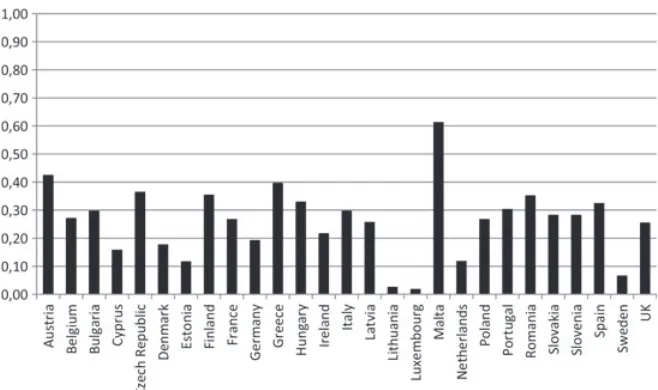
As Figure 1 illustrates, the degree of strategy framing in campaign news varies across countries and has been of considerable prominence in campaign news (M=.29,
SD=.34). Averaging the degree of strategy framing per country (i.e., including all
news outlets in a country), yields high scores for Malta (M=.61,SD=.42), Austria
(M=.42,SD=.32) and Greece (M=.39,SD=.36), followed by the Czech Republic
(M=.36,SD=.32), Finland (M=.35,SD=.35), and Romania (M=.35,SD=.33).
Strategy framing was least prominent in Luxembourg (M=.02,SD=.08), Lithuania
(M=.02,SD=.09), Sweden (M=.06,SD=.15), Estonia (M=.12,SD=.21), and
the Netherlands (M=.12,SD=.18). In our analysis below, we will build the
outlet-specific strategy framing scores of our media content analysis into our survey measure of individual news exposure in order to assess the impact of strategy framing on EP campaign cynicism.
Figure 2 Levels of EP campaign cynicism at w2 and change in EP campaign cynicism between wave 1 and wave 2 by country. Note: The grey bars indicate the absolute levels of cynicism at wave 2 (ranging from 0 to 7) and the black bars indicate the average change in between the two panel waves (possibly ranging from−7 to+7, scores shown here ranging from−0.5 to +0.5).
Figure 2 displays the country means of EP campaign cynicism at wave 2 (grey bars) and the average change in EP campaign cynicism during the campaign by country (black bars). We see the lowest levels of cynicism in some of the Northwestern European countries such as Denmark, Sweden, the Netherlands, Germany, and the UK, in contrast to high levels of cynicism in Greece, Bulgaria, Poland, and the Czech Republic. On average EP campaign cynicism slightly increased over the course of the campaign (wave 1M=5.14,SD=1.36; wave 2 M=5.22,SD=1.39). We can
see considerable variation across countries, however, with cynicism increasing the most in Greece, Bulgaria, Lithuania, Czech Republic, and Spain with more than .20 on a 7-point scale. Also increases in Finland, the UK, Hungary, and Denmark (>.10) are significant as shown by paired-samplet-tests for the different countries (allt-values>2.57,p<.05). EP campaign cynicism decreased significantly over the course of the campaign only in Germany and Belgium (t-values>3.02,p<.01).
and
Table 1 Multilevel Regression Explaining EP Campaign Cynicism in 2009 EP Elections (wave2)
Empty Model Coefficient SE Coefficient SE Coefficient SE Coefficient SE Coefficient SE Coefficient SE
Constant 5.226*** 0.059 5.225*** 0.046 5.228*** 0.046 5.229*** 0.032 5.231*** 0.032 5.231*** 0.035
Intraclass correlation 0.165 0.149 0.147 0.105 0.105 0.105
Nlevel 1 22,791 22,791 22,791 22,791 22,791 22,791
Nlevel 2 21 21 21 21 21 21
AverageNper group 1085.3 1085.3 1085.3 1085.3 1085.3 1085.3
Log likelihood −39,442.83 −36,688.84 −36,693.08 −36,674.72 −36,680.01 −36,687.59
Waldχ2 6251.34 6258.20 6320.43 6326.27 6326.68
who were in direct contact with political candidates indeed tended to become less cynical. We furthermore find a substantial effect of age, with older people showing a higher likelihood to become more cynical over the campaign. Women became less cynical, and frequently discussing the campaign was related to increasing cynicism.
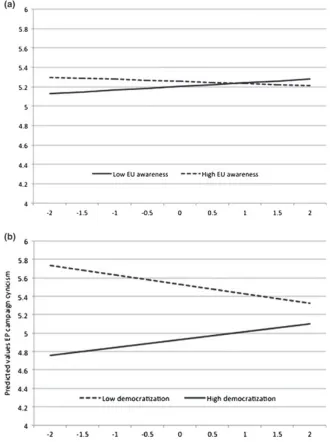
The next model shows the hypothesized interaction effect between strategy frame exposure and awareness of the EP campaign. The interaction effect is significant and negative,11 which is in line with our expectations: It is the politically unaware for whom strategy frame exposure leads to increases in cynicism. The effect, however, is modest in substantial terms, as also shown by its illustration in Figure 3a. This finding yields partial support for Hypothesis 1.
Next, we turn to our second hypothesis. We expected that in contexts with higher levels of democratization, cynicism is more likely to increase in response to exposure to strategy framing compared to contexts that are characterized by lower levels of democratization. The cross-level interaction model shown in the fifth column confirms this expectation with the interaction between the Good Governance index and strategy news exposure yielding a strongly significant positive coefficient. We indeed find significant variation in the effect of strategy framing across countries: In countries with high levels of democratization, exposure to strategy frames increases EP cynicism. In low-democratization countries, and against expectations, we see a reverse impact. The intraclass correlation decreases substantially to 11% after the inclusion of the country-level variable. To complement these analyses we estimated the baseline model for those countries above and below one standard deviation of the mean of the Good Governance index, using unstandardized variables. Whereas in the group of countries scoring low on the Good Governance index we find a negative direct effect of strategy news exposures (b= −0.029,p<.05), in countries scoring high on Good Governance we find the opposite, a significant positive effect of strategy news exposure (b=0.023,p<.01). Thus, in the latter case, moving from the lowest to the highest value in strategy news exposure brings about a 0.33 increase in cynicism, holding all other variables constant. Although this appears to be a small effect on a variable measured on a 7-point scale, one needs to keep in mind that we are actually controlling for prior levels of cynicism and therefore assess change in cynicism rather than constant levels.
The last two models are included to again show the robustness of our results. First, we include both interaction terms in one model in the complete model in column six in the table. Substantially, the effects remain as discussed previously. Finally, the inclusion of two different interaction terms with strategy frame exposure yields the question of the interplay between all three factors. Therefore, in the final model we test the 3-way interaction effect between strategy frame exposure, EP awareness, and country-level democratization. As can be seen this effect is not statistically significant. We therefore are confident in our finding that the impact of exposure to strategy frames on cynicism depends on individual and country-level factors.12
to test for the robustness of the interaction effect we employ a number of different but related conceptualizations. Appendix A shows the results of these additional tests. The coefficients of the interaction terms all range between 0.04 and 0.06 and are all strongly significant. We can conclude from these findings that the interaction between exposure to strategy news and democratization is very robust.
Discussion
This study investigates the impact of strategy framing in campaign news on levels of political cynicism. The analysis was conducted in the context of the European Parliamentary elections in 2009 and in 21 countries which allows us to study the variation of the framing of one single event and its impact on political cynicism beyond borders and all across Europe. The study draws on a comprehensive analysis of election news coverage in the most prominent television news and newspapers across the EU, totaling more than 48,000 stories. It combines media content with panel survey data and provides evidence that political cynicism toward the EU increased during the period of the 2009 EP election campaign and that the impact of exposure to strategically framed news on political cynicism was conditional on both individual and contextual factors.
This study contributes another step toward modeling contextual variables, along-side individual variables, in order to help explain how and when news coverage may or may not matter during election campaigns. Comparative research including a large range of countries and multilevel modeling analysis techniques, as well as an investigation of moderating variables on the individual and country level, is an important step in media effects research given the call for media effects researchers to consider the mechanisms and situations in which media effectiveness differs (e.g., see Shrum, 2009).
On the individual level, previous research addressed the question of how political sophistication influences the magnitude as well as the processing of a news frame, with mixed results (e.g., De Vreese, 2005; Kinder & Sanders, 1990; Schuck & De Vreese, 2006; Nelson et al., 1997). Druckman and Nelson (2003, p. 732) argue it may not be political knowledge that moderates framing effects, but the availability of relevant knowledge and the existence of prior opinions on that issue. For this reason, our awareness indicator was a combination of political interest and knowledge. Our findings support the notion that it is likely that strategic news framing is only affective in terms of fuelling cynicism for those who are less politically engaged. For other news frames this may work differently since these frames invite for more active processing and may therefore be more influential for those high in political sophistication. The finding that exposure to strategic news led to a decrease in cynicism for those who are more politically engaged could be an indication that this news coverage may have less negative effects for some groups than previously assumed, which is something for future research to further pursue.
strategic news framing on political cynicism. Our findings suggest that in countries in which good governance is the norm and the quality of democracy is comparably good according to standardized assessments, strategic news with its focus on tactical maneuvers and considerations by political actors is more likely to lead to cynical reactions than in contexts in which such quality of governance and democracy is already at lower levels. Indeed most extant research on the strategy news–cynicism nexus happens to have been conducted in countries which score relatively high on good governance indications, such as the United States, Denmark, and the Netherlands. Future research will have to engage more in specifying the exact underlying mechanism behind this effect but we argued that in contexts in which democracy and governance are commonly perceived to be well functioning, strategic news coverage sticks out more and can take more of an effect as it seems to trigger impressions that there are reasons to be more critical after all. In contexts in which the quality of governance and democracy is lower to begin with such news will hardly contribute to changesin levels of cynicism. This is in line with previous research stressing that in a news environment in which negative news is the norm positive news has the potential to stick out more and be more effective (Vliegenthart et al., 2008). We do not claim that quality of democracy and governance is the only relevant contextual factor with the potential to condition the effects of strategy framing, however, it is particularly related to the conceptual nature of strategic news with its inherent focus on democratic performance and our findings are strikingly robust over a variety of different established indicators and we also controlled for and ruled out other alternative explanations. On a more general level, our findings provide evidence that the same media content can have different effects in different contexts, which questions the universality of some of our common theoretical assumptions.
Furthermore, there are other notable findings in our analysis which are not the main focus of this study but deserve attention nevertheless. As we expected, our findings indicate that it makes sense to distinguish indirect mediated campaign contact (via e-mail, phone, or internet) from direct face-to-face campaign contact (with political candidates). Whereas mediated campaign contact showed no relationship with changes in cynicism among citizens over the course of the campaign, having direct, face-to-face contact with a political candidate actually reduced cynicism. We conclude that such direct form of face-to-face contact contributes to perceiving candidates as more sincere and honest, which carries important practical implications for both campaign practitioners and politicians running for office as well as more substantially regarding the quality and function of political campaigns.
of governance are high. Strategy news does not further contribute to increased levels of cynicism for those more engaged with EU politics and those living in a country in which levels of democratization and quality of governance are low.
It is important to pause and reflect on the absence of direct main effects in our analysis. Past research on the relationship between election coverage and political cynicism has expressed serious concerns about the role of the media in contributing to eroding confidence in politics and politicians (Cappella & Jamieson, 1997; Patterson, 1993). Several studies have added nuance to this discussion by pointing to the contingency of effects resulting in a spiral of cynicism only for some (De Vreese, 2005; Valentino, Beckmann, et al., 2001) and this study further adds to these observations by its comparative scope and its focus on both individualand contextual factors conditioning effects. Again, it is important to point out that there is no overall direct effect of strategy news on political cynicism. We are thus not looking at a pervasive across-the-board phenomenon here.
cover the EU is not decided in a vacuum, as recent research has shown politicians themselves often are the source of strategic reporting (Jackson, 2011). Furthermore, as we demonstrate in this study, if strategy framing in the news leads to political cynicism or not depends on various individual and contextual factors, which we took a first step to investigate in this study. The conditionality of effects we show may also help to understand why previous studies, conducted only in single-country contexts, came to different conclusions regarding the connection between strategy framing in the news and political cynicism.
We acknowledge several shortcomings in our study. First, in response to recent calls for a standard measure of intercoder reliability we report Krippendorff’s alpha scores for our content analytic indicators (Hayes & Krippendorff, 2007). Compared to other measures these provide a rather conservative reliability test, however, even then our scores are rather low which asks for caution in interpreting our results and could have hampered the possibility to document larger effects. While the number of coders do not directly affect reliability scores they have the potential to do so indirectly with regard to the practical challenges a comparative research project like ours is inevitably faced with. The media content analysis from which the data for this study are derived spanned over 21 countries involving coders of 19 different native languages. Coder training was conducted in English and reliability had to be tested on English language material (even though coders subsequently continued to more comfortably code their own language material as part of the full sample coding) in two subgroups of coders at different locations. These practical challenges were dealt with to the best of our ability (e.g., identical coder trainers at both locations) to provide the basis for such a comparative research project. To our knowledge the scope of the current media content analysis is unprecedented in a European election context and the considerable efforts that have been invested in assuring reliable results are documented in this article and in greater detail in the official data documentation report (Schuck et al., 2010). In light of these considerations we still fully acknowledge the limitations in terms of the reliability scores we report.
The above limitations notwithstanding, our findings contribute to the discussion of the role of the news media for political cynicism and provide a step forward in modelingthe conditionsunder which campaign news matters. On the basis of our findings we conclude that future research should consider the contents of campaign news as an important factor in explaining cross-country variation in levels of political cynicism and, importantly, also take into account those factors that can explain how the same content can have different effects in different contexts.
Notes
1 Of course European countries represented in our sample overall do comparatively well in terms of quality of democracy in indices that span the entire world. Still there is
considerable variation also in this select sample of comparatively speaking well developed countries (for statistics see methods section).
2 The intercoder reliability scores reported are based on a combined test including all 58 coders from both locations and are based on a subsample of 35 randomly selected news items, including both TV and newspaper items and including EU, EU election as well as non-EU stories (see the documentation report, Schuck et al., 2010).
3 Countries include: UK, France, Italy, Germany, Spain, Sweden, Denmark, Greece, Hungary, Czech Republic, Poland, Ireland, Austria, Portugal, Belgium (Flanders and Wallonia), Netherlands, Finland, Lithuania, Latvia, Slovakia, and Bulgaria.
4 These were the following statements measured on 7-point disagree-agree scales. (1) Almost all politicians will sell out their ideals or break their promises if it will increase their power. (2) Most politicians are in politics for what they can get out of it personally. (3) Most politicians are truthful with the voters. (4) Most politicians are dedicated and we should be grateful to them for the work they do.
5 We did not measure general cynicism in both waves and therefore cannot say anything about possible changes in this variable due to media coverage.
6 When looking at the unweighted exposure measures to the 113 outlets that were
included, exposure, measured on scales from 0 to 7 days per week, ranged between means of 0.28 and 2.45 days per week for newspapers, and between 1.05 and 4.90 days per week for television news.
7 Some argue that measuring exposure to news is insufficient and news attention should also be considered (Chaffee & Schleuder, 1986). Others warn that this procedure might produce effects which are mainly due to antecedents of attention, not exposure, and thus exaggerate effects (Slater, 2004). Including attention to EP campaign news in our model yields a significant negative direct effect, but we do not find significant interaction effects of attention and exposure, or attention, exposure, and awareness, and the results remain unchanged whether or not attention is included.
9 In our analysis we also test both measures separately to validate our findings.
10 An alternative model specification would be to predict true change scores by subtracting the t1 from the t2 measure. Such models were estimated and yield substantially the same results with regard to our two hypotheses.
11 The same is true when using the two separate measures our EP campaign awareness index measure is derived from. The interaction is significant also when using the political knowledge or interest measure instead of the combined measure.
12 Alternative explanations of the country-level conditioning effect could be related to the length of a country’s EU membership or to whether a country belonged to Communist Eastern Europe. To rule out these alternative explanations we estimated models including these variables showing no significant direct effect on the outcome variable and results with regard to our democracy indices are virtually unchanged. Also the interaction terms of these variables with news exposure were not significant.
References
Aalberg, T., Str¨omb¨ack, J. & de Vreese, C. H. (2012). The framing of politics as strategy and game: A review of concepts, operationalizations, and key findings.Journalism,13(2), 162–178. doi: 10.1177/1464884911427799
Ansolabehere, S. & Iyengar, S. (1995).Going negative: How political ads shrink and polarize the electorate. New York, NY: The Free Press.
Buhlmann, M., Merkel, W., & Wessels, B. (2007).The quality of democracy: Democracy barometer for established democracies. Working Paper No. 10. Zurich: National Center of Competence in Research (NCCR).
Campbell, D. F. J. (2008).The basic concept for the democracy ranking of the quality of democracy. Vienna, Austria: Democracy Ranking.
Cappella, J. & Jamieson, K. (1997).Spiral of cynicism: The press and the public good. New York, NY: Oxford University Press.
Chaffee, S. & Schleuder, J. (1986). Measurement and effects of attention to media news. Human Communication Research,13, 76–107. doi: 10.1111/j.1468-2958.1986.tb00096.x De Vreese, C. H. (2002).Framing Europe: Television news and European integration.
Amsterdam, the Netherlands: Aksant Academic Publishers.
De Vreese, C. H. (2005). The spiral of cynicism reconsidered: The mobilizing function of news.European Journal of Communication,20(3), 283–301. doi:
10.1177/0267323105055259
De Vreese, C. H. & Semetko, H. (2002). Cynical and engaged: Strategic campaign coverage, public opinion and mobilization in a referendum.Communication Research,29(6), 615–641. doi: 10.1177/009365002237829
De Vreese, C. H., van Spanje, J., Schuck, A. R. T., Boomgaarden, H., Vliegenthart, R., Azrout, R., et al. (2010).2009 European election campaign study, scenario I: Data and
documentation. Amsterdam, the Netherlands: University of Amsterdam. Druckman, J. N. & Nelson, K. R. (2003). Framing and deliberation: How citizens’
conversations limit elite influence.American Journal of Political Science,47(4), 729–745. doi: 10.1111/1540-5907.00051
Esser, F., Reinemann, C. & Fan, D. (2001). Spin doctors in the United States, Great Britain, and Germany: Metacommunication about media manipulation.International Journal of Press/Politics,6(1), 16–45. doi: 10.1177/1081180X01006001003
Esser, F. & Hemmer, K. (2008). Characteristics and dynamics of election news coverage in Germany. In J. Stromback & L. L. Kaid (Eds.),Handbook of election news coverage around the world(pp. 289–307). London, England: Routledge.
Esser, F. & D’Angelo, P. (2006). Framing the press and the publicity process in U.S., British, and German General Election Campaigns: A comparative study of metacoverage. International Journal of Press/Politics,11(3), 44–66. doi: 10.1177/1081180X06289188 Graber, D. (2003). The media and democracy: Beyond myths and stereotypes.Annual Review
of Political Science,6, 139–160.
Hayes, A. & Krippendorff, K. (2007). Answering the call for a standard reliability measure for coding data.Communication Methods and Measures,1(1), 77–89.
Held, D. (2006).Models of democracy(3rd ed.). Cambridge, MA: Polity Press.
Iyengar, S. (1991).Is anyone responsible? How television frames political issues. Chicago, IL: University of Chicago Press.
Iyengar, S., Norpoth, H. & Hahn, K. S. (2004). Consumer demand for election news: The horserace sells.The Journal of Politics,66(1), 157–175. doi:
10.1046/j.1468-2508.2004.00146.x
Jackson, D. (2011a). Strategic media, cynical public? Examining the contingent effects of strategic news frames on political cynicism in the United Kingdom.International Journal of Press/Politics,16(1), 75–101. doi: 10.1177/1940161210381647
Jackson, D. (2011b). Strategic news frames and public policy debates: Press and television news coverage of the euro in the UK.Communications. The European Journal of Communication,36(2), 169–193. doi: 10.1515/COMM.2011.009
Jamieson, K. H. (1992).Dirty politics. Oxford, England: Oxford University Press. Karp, J., Banducci, S. & Bowler, S. (2003). To know it is to love it? Satisfaction with
democracy in the European Union?Comparative Politics,36(3), 271–292. doi: 10.1177/0010414002250669
Kaufman, D., Kraay, A., & Mastruzzi, M. (2007).Governance matters VI: Aggregate and individual governance indicators for 1996–2006. World Bank Policy Research Working Paper No. 4280. Washington, D.C.
Kaufman, D., Kraay, A., & Zoido-Loabton, P. (1999).Governance matters. World Bank Policy Research Working Paper No. 2196. Washington, D.C.
Kavanagh, D. (1995).Election campaigning: The new marketing of politics. Oxford: Blackwell. Kinder, D. R. & Sanders, L. M. (1990). Mimicking political debate with survey questions: The
case of white opinion on Affirmative Action for blacks.Social Cognition,8(1), 73–103. doi: 10.1521/soco.1990.8.1.73
Krosnick, J. A. & Brannon, L. A. (1993). The impact of the Gulf War on the ingredients of presidential evaluations: Multidimensional effects of political involvement.American Political Science Review,87, 963–975.
Lawrence, R. G. (2000). Game-framing the issues: Tracking the strategy frame in public policy news.Political Communication,17, 93–114. doi: 10.1080/105846000198422 Markus, G. B. (1979).Analyzing panel data. Thousand Oaks, CA: Sage.
Nelson, T., Clawson, R. & Oxley, Z. (1997). Media framing of a civil liberties conflict and its effect on tolerance.American Political Science Review,91, 567–584.
Norris, P. (2000).A virtuous circle: Political communications in postindustrial societies. Cambridge, England: Cambridge University Press.
Norris, P. (2004).Electoral engineering: Voting rules and political behavior. New York, NY: Cambridge University Press.
Norris, P. (2008). Democracy time-series dataset. Available at: www.hks.harvard.edu/fs/pnorris/Data/Data.htm.
Patterson, T. (1993).Out of order. New York, NY: Knopf.
Patterson, T. (2002).The vanishing voter: Public involvement in an age of uncertainty. New York, NY: Alfred Knopf.
Pedersen, R. T. (2012). The game frame and political efficacy: Beyond the spiral of cynicism. European Journal of Communication,27(3), 225–240.
Peter, J. (2004). Our long ‘Return to the concept of powerful mass media’: A cross-national comparative investigation of the effects of consonant media coverage.International Journal of Public Opinion Research,16(2), 144–168. doi: 10.1093/ijpor/16.2.144 Rhee, J. (1997). Strategy and issue frames in election campaign coverage: A social cognitive
account of framing effects.Journal of Communication,47(3), 26–48. doi: 10.1111/j.1460-2466.1997.tb02715.x
Scammell, M. & Semetko, H. A. (2008). Election news coverage in the U.K. In J. Str¨omback & L. L. Kaid (Eds.),Handbook of election news coveragearound the world (pp. 73–89). New York: Routledge.
Schuck, A. R. T. & de Vreese, C. H. (2006). Between risk and opportunity: News framing and its effects on public support for EU enlargement.European Journal of Communication,
21(1), 5–32. doi: 10.1177/0267323106060987
Schuck, A.R.T., Xezonakis, G., Banducci, S.A., & de Vreese, C.H. (2010).EES (2009) Media study data advance release documentation, 31/03/2010. (www.piredeu.eu)
Shrum, L. J. (2009). Media consumption and perceptions of social reality. In J. Bryant & M. B. Oliver (Eds.),Media effects: Advances in theory and research(pp. 50–73). New York, NY: Psychology Press.
Slater, M. (2004). Operationalizing and analyzing exposure: The foundation of media effects research.Journalism and Mass Communication Quarterly,81(1), 168–183. doi:
10.1177/107769900408100112
Slothuus, R. & de Vreese, C. H. (2010). Political parties, motivated reasoning, and issue framing effects.Journal of Politics,72(3), 630–645. doi: 10.1017/S002238161000006X Str¨omback, J. & Kaid, L. L. (Eds.) (2008).Handbook of election news coveragearound the
world. New York: Routledge.
Valentino, N., Buhr, A. & Beckmann, M. (2001a). When the frame is the game: Revisiting the impact of ‘‘strategic’’ campaign coverage on citizens’ information retention.Journalism and Mass Communication Quarterly,78, 93–112.
Valentino, N., Beckmann, M. & Buhr, A. (2001b). A spiral of cynicism for some: The contingent effects of campaign news frames on participation and confidence in government.Political Communication,18(4), 347–367.
R.
Appendix A:Alternative Specifications of the Moderating Context Variable
Campbell
Coefficient SE Coefficient SE Coefficient SE Coefficient SE Coefficient SE Coefficient SE Coefficient SE
Democratization −0.14*** 0.03 −0.08(*) 0.04 −0.08(*) 0.045 −0.15*** 0.03 −0.15*** 0.03 −0.13*** 0.04 −0.11** 0.04 Democratization
*Exposure strategy news 0.05*** 0.01 0.04*** 0.01 0.04*** 0.01 0.06*** 0.01 0.05*** 0.01 0.04*** 0.01 0.06*** 0.01 Intercept variance 0.15*** 0.02 0.20*** 0.03 0.20*** 0.03 0.14*** 0.03 0.14*** 0.03 0.16*** 0.03 0.17*** 0.03
Intraclass correlation 0.111 0.141 0.141 0.106 0.105 0.117 0.125
Nlevel 1 22,791 22,791 22,791 22,791 22,791 22,791 22,791
Nlevel 2 21 21 21 21 21 21 21
AverageNper group 1085.3 1085.3 1085.3 1085.3 1085.3 1085.3 1085.3
Log likelihood −36,695 −36,689 −36,688 −36,676 −36,680 −36,685 −36,677
Waldχ2 6322 6283 6281 6333 6326 6303 6300