Social Determinants and Risk Factor of Tuberculosis
Patients: Case Control Study at Health Services Applying
Directly Observed Treatment Shortcourse (DOTS)
in Bandar Lampung, Indonesia
Dyah Wulan Sumekar Rengganis Wardani
1,21
Department of Community Medicine and Public Health, Faculty of Medicine, University of Lampung,
Jl. Soemantri Brojonegoro No. 1, Bandar Lampung, Indonesia
2
Research Center of Nutrition, Health and Herbal, Research and Community Service Institution, University of Lampung,
Jl. Soemantri Brojonegoro No. 1, Bandar Lampung, Indonesia
Abstract.
Tuberculosis (TB) control program will be more emphasizes on social
determinants. It is because those social determinants directly or through TB risk factor
influence TB incidence. This study aimed to identify significant influence of social
determinants and TB risk factor of TB incidence. A total of 238 smear-positive TB patients
and 238 patients without TB, were obtained from all smear-positive TB patients as well as TB
suspects, in all of Directly Observed Treatment Shortcourse (DOTS)
‟s health service
facilities, in Bandar Lampung, Indonesia. Data were collected, by structured interview
questions, and was then analyzed using both bivariable Chi square and multivariable logistic
regression analysis. The results showed that social determinants (education and income per
capita), housing condition (ventilation and house density index) and household food security
(food budget) proved significant influences to the TB incidence. Those indicators could
explain 50.7% variation of the TB incidence. In conclusion, TB control program should
highlight social determinants, housing condition, and household food security improvement.
However, the program will require participation of all related institutions and should also be
supported by an appropriate government policy.
Keywords
: tuberculosis, social determinants, housing condition, household food security,
health access, DOTS strategy
1. Introduction
Tuberculosis is a contagious disease caused by Mycobacterium tuberculosis. It is transmitted when an infectious person coughs, sneezes or even talks that can spread M. tuberculosis to the air and
inhaled by healthy person. About one third of the world‟s population has been infected by TB, and become latent of TB infection. In certain condition, such as immune decreasing, latent of TB infection become active TB infection (Thorn 2007).
In 2013, it was estimated about nine million incidence of TB globally, which is equivalent to 126 cases per 100 000 population. Most of the cases, about 56%, occurred in Asia. Indonesia was one of the five countries with the highest TB incidence (0.41 – 0.52 million cases) (WHO 2013). Moreover, World Health Organization (WHO) tuberculosis control related to the 2015 Millennium Development Goal (MDG) of halting and reversing TB incidence has been achieved in most countries, but not in some burden countries including Afghanistan, Bangladesh, Indonesia and South Africa. In
as less than one case per one million population per year, is a big challenge especially for some burden countries (WHO 2012).
In order to accelerate incidence decreasing, TB control program will „move out of the TB box‟ with more emphasize on social determinants (Raviglione 2009). It is because that tuberculosis is closely related to social determinants. It is also well known that social determinants directly or through TB risk factors influence TB (Lönnroth 2011). Regarding to WHO, social determinants consist of low education, unemployment, low income per capita, low social class, gender and race (Solar and Irwin 2010). These determinants affect risk factors, that can be explained as the following: a) poor housing condition ( consist of: lack of ventilation, overcrowding and existence of indoor pollution) affect high-level contact with infectious droplets; b) household food insecurity (consist of: lack of food budget, food diversity and food quantity) affect to host defense; c) poor access to health care (consist of: long distance to health care, transportation need) affect to host defense; and d) unhealthy behavior (HIV and alcohol abuse) also affect to host defense (Lönnroth 2011).
Studying social determinants and risk factors of TB comprehensively is required to identify significant influence of certain variables. This research provide an influence of social determinants and risk factors of TB as a comprehensive variables, rather than as a partial variable as discussed by previous researchers (Boccia et al. 2011; Harling, Ehrlich, and Myer 2008; Hill et al. 2006; Ximenes et al. 2009).
Bandar Lampung is the capital city of Lampung Province, Indonesia. In the city, there are 27 primary health centers (PHC), and one general hospital, that conducted Directly Observed Treatment Shortcourse (DOTS) strategy. According to notification cases, which was recorded in the health services, although cure rate in the period of 2011 – 2013 has been maintained at 85%, the notification cases during 2012 – 2014 increased from 968 – 972 cases (Dinas Kesehatan Kota Bandar Lampung 2011; Dinas Kesehatan Kota Bandar Lampung 2010). Moreover, Lampung was classified as one of the poorest provinces in Indonesia, as well as province with poorest housing condition (Kementrian Kesehatan Republik Indonesia 2010).
This study aimed to identify significant influence of social determinants, and risk factors to TB incidence. In this study, all variables of the concerned determinants will be analyzed in order to have a comprehensive understanding. The knowledge, influence of social determinants, and risk factors to TB incidence, can be worthwhile to support TB control program, especially in decreasing TB incidence.
2. Material and Method
2.1. Study Design
This study was a case control study that compared case and control groups to identify significance influence of social determinants and risk factors to TB.
2.2. Study Site and Samples
This research has been conducted at all health services that applying DOTS strategy, in Bandar Lampung. Population of this research consisted of case population and control population. The case population was consisted of all smear-positive TB patients that were recorded at the health services during period of January – July 2012. Meanwhile, control population was consisted of all TB suspects who did not suffer from TB which confirmed by negative microbiological of sputum examination or a chest X-ray examination. The samples size of both case and control group consisted of 238 smear-positive TB patients and 238 patients without TB, based on samples calculation for case control study with significance level of 95% and 80% power.
2.3. Research Variables
Pusat Statistik Kota Bandar Lampung, 2013; Solar & Irwin, 2010). Indicators of housing conditions consisted of house density index (house area divided by number of person: < 8 m2, > 8 m2), ventilation (percentage of ventilation area of house width: < 20%, > 20%), and indoor air pollution (> 1 sources, none) (Balakrishnan et al., 2004; Kementrian Kesehatan Republik Indonesia, 2010). Indicators of household food security consisted of food budget (monthly food budget for each person: < US$ 30, > US$ 30), diet diversity (number of diet type of daily consumption: < 3 , > 3), and food sufficiency (ever missed meal time and reduced meal portion, never missed meal time or reduced meal portion) (Badan Pusat Statistik Provinsi Lampung, 2013; Bickel & Cook, 2000). Meanwhile, indicators of health access consisted of distance to health facility (> 5 km, < 5 km) and transportation needs (yes, no) (Badan Perencana Pembangunan Nasional 2010b). Based on observation, in Bandar Lampung, there was no differences in race and gender related to TB cases and there was no TB patients have HIV confection, as well as alcohol abuse, therefore, the variables were not studied in this research (Wardani 2011).
2.4. Data Collection and Analysis
In this research, data was collected by using direct interview based on designed questionnaire. Data was then analyzed using bivariable analysis (Chi square) and multivariable analysis (logistic regression), in order to identify the influence of each variable and influence of significant variables to the TB cases, simultaneously. Enter method was used in order to perform logistic regression analysis in this research. The first step of the method, variables with p value less than 0.25 in bivariable analysis can be followed to multivariable analysis. In the second step, variables with p value of more than 0.05 was moved out from the model, one by one regarding to their p value. Variable with the highest p value will be taken out. The second step will be ended when all of variables had p value of less than 0.05 and the model resulted was the final model (Hastono 2001).
2.5. Ethical Clearance
Ethical clearance for this study was obtained from the Medical and Health Research Ethics Committee, Faculty of Medicine, Gadjah Mada University, Indonesia. In this research, all of involved respondents also asked to participate on voluntary basis and received sufficient information to consider consent prior to the interview.
3. Result and Discussion
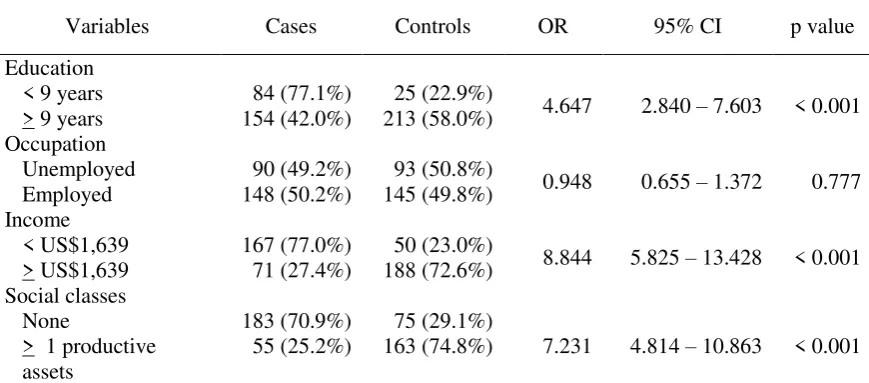
Based on the bivariable analysis, using Chi Square, it is shown that all of research variables have p value of less than 0.05, except occupation as presented in Table 1. Refer to the result, all variables, except occupation, have significant influence to TB. In addition, diet diversity and housing density index were categorized as variables with the highest odds ratio (OR) among the other variables.
Table 1: Bivariable Analysis of Social Determinants and Risk Factors to TB.
House density index
The results show that there were more respondents with lower education in case group, rather than respondents in control group. It was logically correlated with the fact that there were more respondents in case group, who have lower income per capita, and have less productive assets, compare with the respondents in control group. The conditions also associated with the fact that there were more respondents in case group with worse housing condition, food security and lower health care access, compare with the respondents in control group. A related research presented that person with higher education will also tends to have higher occupation, higher income and have more productive assets, compare with the person with lower education (Braveman et al., 2011). Some researchers also showed that person with better social determinants tends to have better housing condition, food security and health access (Alexiu et al., 2010; Hur et al., 2011; Sabawoon et al., 2011). In this research, occupation was not risk factor of TB, since most of women both in case group and control group, were housewives. In addition, although distance to PHC and transportation needed were significant to TB incidence, however, the significance values were only a slight differences. It is mostly correlated with the spatial condition of the concerned PHC across the city, which has the longest distance to their respondents is only about six kilometers.
Based on the multivariable analysis using logistic regression, it is shown that, in the last model, education, income per capita, ventilation, house density index and food budget have significant influence to TB (Table 2). Equation of the model was developed as the following: - 2.389 + 0.943 Education + 1.339 Income per capita + 1.023 Ventilation + 1.328 House density index + 0.692 Food budget. Those variables simultaneously explained 50.7% variation of TB incidence
.
Table 2 Multivariable Analysis of Social Determinants and Risk Factors to TB.
Variables B p value Exp (B) 95% CI
Education 0.943 0,002 2.569 1.408 – 4.686
Income per capita 1.339 < 0,001 3.814 2.331 – 6.238
House density index 1.328 < 0.001 3.775 2.193 – 6.500
Food budget 0.692 0.047 1.997 1.011 – 3.945
Constant -2.389 <0.001 0.092
B: Beta
Exp (B): Exponent Beta
Our findings suggest that social determinants (represented by education and income per capita), together with housing condition (represented by ventilation and house density index), as well as household food security (represented by food budget), influence the TB incidence. Those variables explained 50.7% variation of TB incidence. Meanwhile, the rest of variation tends to be affected by other variables, which is beyond this research. This result concurred with a review, presented that social determinant, directly or through TB risk factors, influence TB incidence (Lönnroth 2011).
Founding of this research is also interrelated with the „Stop TB Strategy‟, stated that TB control
program should address the need of poor, and vulnerable populations (WHO, 2014). Moreover, action of social determinants improvement, in order to support TB control program, has been conducted in
Lima, Peru. The study showed that social determinants improvement, namely „Fighting Poverty to Control TB Project‟, could decrease poverty in one hand and in another hand support TB control program. The project included improving access to training program for worker, providing microcredit loans, and supporting development of microenterprises (Hargreaves et al. 2011).
4. Conclusion
Based on the findings above, TB control program should highlight social determinants improvement, housing condition, as well as food security improvement. Some of the improvement, will require participation of all related institutions, therefore the inter institution coordination and mutual respect among the involved stakeholders should be strengthened. The improvement also need to be supported by an appropriate government policy, through economic and social development, with a more emphasize on the most vulnerable people.
Acknowledgements
I would like to thank all of health-services officer across Bandar Lampung, particularly TB‟s taskforce, for their support during the data collection.
References
Alexiu, Mircea, Ungureanu, et al. 2010. Impact of Education in Terms of Housing Opportunities.
Procedia - Social and Behavioral Sciences 2: 1321–1325.
Ariyanto. 2009. Aspek Kesejahteraan Masyarakat Dalam Konsumsi
Pangan.
.
http://www.bappenas.go.id/index.php/download_file/view/10158/1920/?&kid=1
397612052
.
(accessed July 29, 2014).Badan Perencana Pembangunan Nasional. 2010a. Pendidikan Dasar 9 Tahun. http://www.bappenas.go.id/get-file-server/node/585/. (accessed July 29, 2014).
Badan Perencana Pembangunan Nasional. 2010b. Peningkatan Akses Masyarakat Terhadap Kesehatan Yang Lebih Berkualitas. http://www.bappenas.go.id/get-file-server/node/8428. (accessed July 29, 2014).
Bickel, Gary, and John Cook. 2000. Guide to Measuring Household Food Security, Revised 2000.
Aleandria VA.
Boccia, Hargreaves, De Stavola, et al. 2011. The Association Between Household Socioeconomic Position and Prevalent Tuberculosis in Zambia: A Case-Control Study. PloS One 6 (6).
Braveman, Egerter, Mockenhaupt. 2011. Broadening the Focus: The Need to Address the Social Determinants of Health. American Journal of Preventive Medicine 40: S4–18.
CSDH. 2007. A Conceptual Framework for Action on the Social Determinants of Health. Geneva.
Dinas Kesehatan Kota Bandar Lampung. 2010. Laporan Pencegahan Dan Pemberantasan (P2) Penyakit Tuberkulosis Tahun 2010. Bandar Lampung.
Dinas Kesehatan Kota Bandar Lampung. 2011. Laporan Pencegahan Dan Pemberantasan (P2) Penyakit Tuberkulosis Tahun 2011. Bandar Lampung.
Hargreaves, Boccia, Evans, et al. 2011. The Social Determinants of Tuberculosis: From Evidence to Action. American Journal of Public Health 101 (4): 654–62.
Harling, Ehrlich, and Myer. 2008. The Social Epidemiology of Tuberculosis in South Africa: A Multilevel Analysis. Social Science & Medicine 66: 492–505.
Hastono. 2001. Analisis Data. Jakarta: Fakultas Kesehatan Masyarakat UI.
Hill, P, Jackson-Sillah, Donkor, et al. 2006. Risk Factors for Pulmonary Tuberculosis: A Clinic-Based Case Control Study in The Gambia. BMC Public Health 6 (156)
Hur, I, -Jin Jang, and Kyungwon Oh. 2011. Food and Nutrient Intakes According to Income in Korean Men and Women. Public Health and Research Perspectives 2 (3): 192–7.
Kementrian Kesehatan Republik Indonesia. 2010. Riset Kesehatan Dasar. Riskesdas 2010. Jakarta: Kementrian Kesehatan RI.
Lönnroth, K. 2011. “Risk Factors and Social Determinants of TB. The Union NAR Meeting 24 Feb 2011.”
http://www.bc.lung.ca/association_and_services/documents/KnutUnionNARTBriskfactorsanddet erminantsFeb2011.pdf. (accessed June 28, 2014).
Lönnroth, K, Jaramillo, Williams. et al. 2009. Drivers of Tuberculosis Epidemics: The Role of Risk Factors and Social Determinants. Social Science & Medicine 68: 2240–6.
Pemerintah Daerah Propinsi Lampung. 2009. Ekonomi Makro Daerah. Bandar Lampung. http://www.old.lampungprov.go.id. (accessed June 28, 2014).
Raviglione, M.C. 2009. TB Prevention, Care and Control, 2010-2015: Framing Global and WHO Strategic Priorities. In Report of The Ninth Meeting 9-11 November 2009. Geneva.
Sabawoon, Wrishmeen, Sato, et al. 2011. Regional Differences in Delay to Tuberculosis Treatment in Afghanistan: A Cross-Sectional Study. Applied Geography 31: 1123–1131.
Thorn, Paul. 2007. Overcoming Tuberculosis: A Handbook for Patients. Geneva: Stop TB Partnership.
Wardani, D W. 2011. Pemanfaatan Variabel Pengaruh TB Dalam Prediksi Kejadian TB Di Kota Bandar Lampung. Bandar Lampung.
WHO. 2012. “Global Tuberculosis Report 2012”. Geneva.
WHO. 2013. “Global Tuberculosis Report 2013”. Geneva.
WHO. 2014. “Global Tuberculosis Report 2014”. Geneva.