e-ISSN: 2613-9723 dan p-ISSN: 2613-9715
110 This work is licensed under a Creative Commons Attribution-NonCommercial 4.0 International License.
THE DEVELOPMENT OF COMIC LEARNING MEDIA IN PRIMARY TEACHER EDUCATION’S STUDENTS OF FKIP UNTAN
Maha Lastasabuju Basafpipana Habaridota
Primary School Teacher Education Study Program of Universitas Tanjungpura, Pontianak, Indonesia
E-mail: [email protected]
Abstract
This study aims to determine the development of learning comic media for students majoring in basic education FKIP UNTAN. The study was carried out in the department of basic education with 15 people. The data collected in the development of learning materials and the final product in the form of learning comics using data collection tools in the form of observation sheets (questionnaires) and documentation. Data analysis with several stages, namely: needs analysis, initial product creation, expert evaluation, first product revision, small group trial, product revision, field test, and final product. The results of the study show that comic feasibility can be shown by the assessment of material experts by 4.64 with the category of "very good" and the assessment of media experts by 4.45 with the category of "very good." While the assessment of field tests regarding presentation of the material is 4.60 with the category "very good and the presentation of the media is 4.28 with the category" very good." The results of this study, it is recommended to be used as a reference for similar research related to learning comics, always developing and dedicating themselves as prospective educators in the future.
Keywords:Development, Media, Comic Learning
Introduction
Inspiring figures are an important part of the learning process. Teachers are not only limited to teaching and educating but how to be inspiring, exemplary and always missed by their students. For that, in creating interesting, challenging and memorable learning, readiness is needed well from the planning stage to the implementation. The national education function contained in Law No.20 of 2003 Chapter III Article 3 states that:
National Education functions to develop the capacity and shape the nature of civilization that is empowered in the intellectual life of the nation, aims to develop the potential of students to be faithful and devoted to God Almighty, noble, healthy, knowledgeable, capable, creative, independent and become citizens of a democratic country and accountable.
To achieve these goals, strong commitment from various parties, especially educators, is needed as the spearhead of education in Indonesia, especially West Kalimantan. The person who inspires and creatively is the heart's call to advance this country, for that educators born from generation to generation need to be given direction and a driving force so that the ideals of national education can be achieved well.
e-ISSN: 2613-9723 dan p-ISSN: 2613-9715
111 observations of the researchers in the Elementary Education Department FKIP UNTAN students in all semesters, students who are prospective educators have high creativity only sometimes their creativity decreases due to the lack of this activator.
Some opportunities for researchers to provide jobs to make learning creations from making learning videos, mind mapping, modifying folklore and others. Their works are amazing even though some tasks are done less focused but for beginners, they are inspiring educators who will be anticipated by their students in the future.
The results of observation during the research in this campus were then adjusted to the conditions and situations of learning in elementary schools which found teachers who could not develop with various reasons; some said they were going to be retired, so there was no desire to develop themselves. As long as teaching is enough, there are also those who want to develop themselves don't know how.
Seeing the real condition in the field becomes a motivation for the researchers in the morning to develop learning, especially in the presentation of material that is so monotonous presented with an attractive and fun appearance for children. In this study, researchers will develop learning material by making it a learning comic. Armed with an image is a thousand words and a word is a thousand images, then the comic has both "image power" and "power of words."
Utilizing various applications both connected online and various parties can use offline. The only thing needed is the willingness to learn and prepare time to compile this learning comic, especially for 5th and 7th-semester students to equip them in implementing the knowledge they have at elementary school later.
FKIP UNTAN Primary Education Department students are prospective future educators who will be the basic foundation in the cultivation of attitudes and scientific concepts. Planting at the beginning is not an easy matter that requires high patience and sincerity in serving to advance education in this western province. The knowledge and experience they have are expected to contribute to the world of education wherever they are.
For this reason, it is necessary to research with the title "Media Development of Learning Comics on Students of Elementary Education Department FKIP UNTAN." So this development is expected to improve the creativity of prospective educators, and always innovate in learning.
Research Method
There are two approaches used, namely qualitative and quantitative. Qualitative approach uses descriptive research type; the aim is to describe the analysis of subject matter content contained in the curriculum. The quantitative approach uses a type of survey research to present data about the methods and media used by teachers in learning materials in elementary schools. The subjects involved in this study were V and VII semester students in the UNTAN Education Science Education Elementary School Department.
e-ISSN: 2613-9723 dan p-ISSN: 2613-9715
112 Table I
Variables, Indicators, and Types of Research Measurement Instruments
No. Variable Indicators Measurement
1 Learning comic media
1. The type of media commonly used by teachers in learning in elementary school
2. 2. The way teachers get media in learning in elementary 2. Learning resources suitable
for learning comics
The stages of this development procedure can be described as follows. 1. Needs analysis
Needs analysis is the first step in media development and learning models in elementary schools. Needs analysis is carried out by assessing the situation in the field to find out whether prospective educators need this development product. At this stage, researchers conduct observations and interviews.
2. Making the initial product
Based on the results of the needs analysis, the next step is the production of learning comic media development products.
3. Evaluation of Experts
The product that the researcher has made is then evaluated by two experts, namely learning media experts. Experts see and analyze the development of learning comic media in elementary school. From the expert evaluation, it is expected that suggestions and inputs will be collected which will be used to improve the initial product that has been made by the researcher.
4. First Product Revision
e-ISSN: 2613-9723 dan p-ISSN: 2613-9715
113 5. Small Group Trials
The next stage is product testing; this trial is intended to find input, suggestions, and assessments of the products developed. At this stage, small group trials were carried out by six students taking subjects randomly using a random sampling method. The purpose of this small group trial is to eliminate the errors encountered and find out the initial response of the product being developed.
6. Product revision
After product testing, a revision of the results of the small group trial and expert input was carried out, as an improvement of the product that was tested. Along with this, a questionnaire was given in the form of questions to find out the subject's opinions about the development of learning comic media. After being reviewed and analyzed through a percentage formula, revisions will appear. So the results of the revision will be the development of media and dance learning models that are ready to be tested in large groups.
7. Field Test
At this stage, a field test was carried out on products developed using involving students in the basic education department of FKIP UNTAN as research subjects totaling ten people. Along with this, a questionnaire was given in the form of questions to find out the subject's opinion about the development of learning comic media. From this field test, data will be obtained which will later be used to improve this product. From the results of the revision of the field test, the final product will be produced in the form of learning comic media development.
8. Final Product
The final results in the form of products that have been produced from field tests as a form of learning comic development with various subjects.
The instrument used in the development of learning comic media used qualitative analysis techniques (questionnaire). This questionnaire is used to collect data including a) Needs analysis; b) Evaluation from experts, assessment of product design to be tested; c) Assessment or response of prospective elementary school teachers about the developed learning comic media. After the data was obtained, the data analysis was carried out for each trial subject, including instructional media experts and prospective elementary school teachers in the Department of Basic Education FKIP UNTAN.
This product trial was conducted to collect data used as a basis for determining the feasibility of the product being developed. The type of data obtained is qualitative data and quantitative data. Qualitative data is data from various expert experts in the form of input, evaluation, and advice. Quantitative data is obtained from initial research (needs analysis) to determine the percentage of product needs to be developed as well as from small group trial data and large group field testing.
In this development research data analysis techniques used are quantitative descriptive analysis techniques with percentages. This technique is used to analyze quantitative data obtained from the results of the distribution of evaluation questionnaires from experts and subjects regarding the results of the products developed. The formula for processing responses or evaluations from experts and subjects is as follows:
Formulas for processing data per trial subject (Sudjana: 1990: 44). Percentage = s
Information :
F = number of respondent's answers in 1 item N = number of students who answer questions
e-ISSN: 2613-9723 dan p-ISSN: 2613-9715
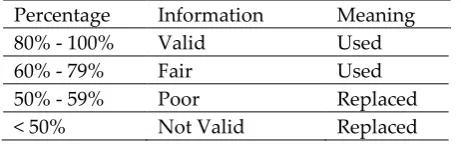
114 Table II
Percentage Analysis of Evaluation Results by Test Subjects Percentage Information Meaning
80% - 100% Valid Used
60% - 79% Fair Used
50% - 59% Poor Replaced < 50% Not Valid Replaced
(Sudjana:1990: 45)
Result and Discussion A. Result
The results of the study of comic development learning as a social learning media will be described based on the steps of Borg and Gall's development which are grouped into four stages, namely: preliminary study, development, field testing, and final products. The results of the study can be described as follows.
1. Preliminary Study
Interviewing PPL students and students who have become teachers regarding the obstacles faced in the social studies learning process. The tendency they often face is the difficulty of growing children's interest and interest in learning.
Based on this, researchers attempt to invite prospective teachers and teachers to make a breakthrough that is able to overcome these problems by developing learning media, in which learning materials that are felt so monotonous for children are developed into learning comics.
2. Product development a. Objective Analysis
The aim to be achieved in the development of this media is to produce comic media as learning media that can increase motivation and facilitate children in learning. b. Ability Analysis
Estimating the funds, energy and time needed to conduct research. The use of funds is as efficient as possible for the cost of printing the comic book. How to make it using the application www.toondoo.com.
c. Development Procedure
The media product developed is a learning comic in social studies learning, the material contained in the book is then converted into comics. This media is designed as a visual media that does not require other facilities and infrastructure in its use. Media can be read wherever and whenever a child is in the classroom or outside the classroom.
d. Expert Validation Results
Before the product is tested in the field, the product is validated first with media lecturers and material experts. Expert validation was carried out so that the comic products that were developed received a guarantee that the initial product developed was worth testing. The results of expert validation are as follows.
Table III
Assessment of Material Experts
Indicators Assessment Item Score Criteria
A. Curriculum Suitability 1. The material presented is by SK and KD
e-ISSN: 2613-9723 dan p-ISSN: 2613-9715
115 2. The indicator reflects
the description that supports KD
4 Good
3. Formulation of appropriate learning objectives
4 Good
B. Truth of Contents 4. Suitability of the storyline
5 Very Good
5. Suitability of image illustrations
4 Good
6. Suitability of dialogue with events
4 Good
7. The accuracy of the story setting
4 Good
C. How to Serve 8. Presentation of coherent material
5 Very Good
9. Children easily understand language
5 Very Good
10. Helping students understand material
5 Very Good
11. Easy to use for students
5 Very Good
12. Easy to use for teachers
5 Very Good
13. Can be used alone outside KBM
5 Very Good
14. Increase children's learning motivation
5 Very Good
TOTAL 65/14
= 4,64
e-ISSN: 2613-9723 dan p-ISSN: 2613-9715
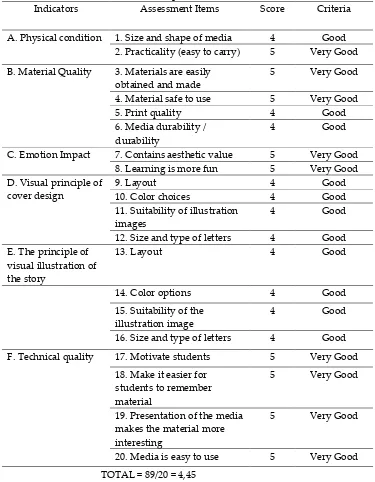
116 Table IV
Media Expert Assessment
Indicators Assessment Items Score Criteria
A. Physical condition 1. Size and shape of media 4 Good 2. Practicality (easy to carry) 5 Very Good
B. Material Quality 3. Materials are easily obtained and made
5 Very Good
4. Material safe to use 5 Very Good
5. Print quality 4 Good
6. Media durability / durability
4 Good
C. Emotion Impact 7. Contains aesthetic value 5 Very Good 8. Learning is more fun 5 Very Good D. Visual principle of
cover design
9. Layout 4 Good
10. Color choices 4 Good
11. Suitability of illustration images
4 Good
12. Size and type of letters 4 Good E. The principle of
visual illustration of the story
13. Layout 4 Good
14. Color options 4 Good
15. Suitability of the illustration image
4 Good
16. Size and type of letters 4 Good
F. Technical quality 17. Motivate students 5 Very Good
18. Make it easier for students to remember material
5 Very Good
19. Presentation of the media makes the material more interesting
5 Very Good
20. Media is easy to use 5 Very Good
TOTAL = 89/20 = 4,45
Based on the assessment of material experts, learning material for comic media obtained a score of 4.45 with a very good category.
3. Field Test
Field testing of comic media was carried out on 5th-semester students with various abilities from high, medium and low abilities, the results of field tests as follows.
Table V Field test results
No Statement Score Criteria
1. The illustration images contained in the comic are
e-ISSN: 2613-9723 dan p-ISSN: 2613-9715
117 interesting
2. Students feel more interested in learning to use comics
4 Good
3. The contents of the comic material in accordance with the one in the lesson book
4 Good
4. The language used in comic media is easy to understand
5 Very Good
5. Presentation of material in comics is more interesting than textbooks/textbooks
5 Very Good
6. The media size of comics is compact, so it's easy to carry everywhere
4 Good
7. Comic media is easy to use 4 Good
8. The colors used in comic media are interesting
4 Good
9. The shape and size of the letters are read
5 Very Good
10. The illustration is appropriate and clear
4 Good
11. The storyline in comic media is clear and easy to understand
4 Good
12. Comic media can be studied alone or together
5 Very Good
TOTAL = 53/12 = 4,41
Based on the results of field trials using learning comic media obtained a score of 4.41 with a very good category.
4. Final Product
The stage of comic media development has not yet arrived at the dissemination stage for wider publication because considering the limited costs; the publication is only in a small scope where researchers conduct research trials.
B. Discussion
Based on the results of data analysis on the results of the material expert validation carried out with a slight revision obtained an average score of 4, 64 with the category "very good." Appraisal of material experts is based on the criteria for considering the content of the material (curriculum suitability, truth of content, method of presentation).
e-ISSN: 2613-9723 dan p-ISSN: 2613-9715
118 Then seen from the indicators of how to present the material, with an average score of 5.00 indicating that the media is very good. Comic products that were developed were able to present more concrete material, presentation of material more coherently, can help children understand material, remember material and be able to motivate children. Media expert assessment is carried out based on production criteria, visual design, and technical quality. In general, based on the criteria for comic media production developed, it obtained an average score of 4.63 including the "very good" category of physical conditions, quality of materials and impact emoticons. Media comics are developed about aesthetic values and are able to make learning more enjoyable.
Based on the visual design criteria the product developed has met the principle of visual design with an average score of 4.00 including the criteria of "good" by taking into account the layout, choice of colors, suitability of the image, type and size of letters. Furthermore, in technical quality with good media requirements indicators, comic media is included in the criteria of "very good" with an average score of 5.00. Good evaluation of media requirements includes the ability to motivate children, make it easier for children to remember, foster children's interest, present interesting and easy to use the material.
Media products that have received appropriate recommendations from material experts and media experts have fulfilled the requirements to be tested in the field. The results of the assessment of field tests of students and students in terms of material presentation obtained an average score of 4.60 with indicators of media attractiveness, benefits for children, contextual material and language use. The media presentation aspect obtained an average score of 4.28 in the "very good" category. Assessment indicators include shape and size, ease of use, choice of colors, use of letters, illustrated images, comic story content, and technical quality. The use of comic media can activate children physically, mentally and emotionally.
When tested on children, they seemed enthusiastic and even innocently asked for comic books to be brought home. The child's ability to remember learning material is much faster because comics are presented with interesting, illustrated and colored storylines. The final stage of the research is product dissemination and socialization. The socialization has only been carried out but has not reached the stage of dissemination because it requires a large amount of money to print comic books except in the small scope of printing for certain schools involved in research.
Conclusions
Based on the results of research and discussion, it can be concluded that the development of learning comics which refers to the stages of development of Borg and Gall are grouped into four stages, namely preliminary studies, development, field testing, and product dissemination and dissemination.
Media comics that are developed quantitatively and qualitatively are suitable for use in learning. Comic feasibility can be indicated by the assessment of material experts by 4.64 in the category of "very good" and media expert's assessment of 4.45 with the category "very good." While the assessment of the field test in terms of material presentation amounted to 4.60 with the category "very good and the presentation of the media at 4.28 with the category" very good."
e-ISSN: 2613-9723 dan p-ISSN: 2613-9715
119 References
Arsyad Azhar, 2002. Media Pembelajaran. Jakarta: PT. Raja Grafindo Persada.
Asim, 2002. ”Langkah-langkah Penelitian Pengembangan” Disajikan dalam Lokakarya Nasional Angkata II, Metodologi Penelitian Pengembangan Bidang Pendidikan dan Pembelajaran. Malang: Universitas Negeri Malang.
Borg. W. R & Gall, M. D, 1983. Educational Research An Introduction. New York: Longman. Dwiyogo, D. Wasis, 2002. ”Langkah-langkah Penelitian Pengembangan” Disajikan dalam
Lokakarya Nasional Angkata II, Metodologi Penelitian Pengembangan Bidang Pendidikan dan Pembelajaran (Malang: Universitas Negeri Malang.
Kemendiknas, 2003. Undang-undang Republik Indonesia Nomor 20 tahun 2003 Tentang Sistem Pendidikan Nasional. Jakarta: Kemendiknas.
Sadiman, Arif. S, 2003. Media Pendidikan Pengertian, Pengembangan, dan Pemanfaatannya. Jakarta: Pustekom Dikbud.
Sudjana.1990. Penilaian Hasil Proses Belajar Mengajar. Bandung : PT. Remaja Rosdakarya. Sugiyono, 2008. Metode Penelitian Kuantitatif, Kualitatif dan R & D. Bandung: Alfabeta.
Sukmadinata, 2005. Metode Penelitian Pendidikan. Jakarta: PPs UPI dan PT Remaja Rosdakarya. Yudha Munadi. 2013. Media Pembelajaran (Sebuah Pendekatan Baru). Jakarta: Gaung