e-ISSN: 2613-9723 dan p-ISSN: 2613-9715
92 This work is licensed under a Creative Commons Attribution-NonCommercial 4.0 International License.
THE IMPLEMENTATION OF CONTEXTUAL TEACHING AND LEARNING APPROACH ON SCIENCE LEARNING IN ELEMENTARY SCHOOL
Hery Kresnadi1), Ridho Nuryanto2), Umi Rawdhatul Islami3)
1)Universitas Tanjungpura, Pontianak, Indonesia
E-mail: : [email protected]
2)Universitas Tanjungpura, Pontianak, Indonesia
E-mail: [email protected]
3)Universitas Tanjungpura, Pontianak, Indonesia
E-mail: [email protected]
Abstract
This study aims to describe the way to apply contextual teaching and learning approach on natural science learning of 6th-grade students of Pontianak Selatan 14 State Elementary School. This research uses qualitative descriptive method. The subjects of this study were researcher, teacher, and all of 6th-grade students of Pontianak Selatan 14 State Elementary School totaling 34 students. Data collection technique which used in this study are two techniques; they are direct observation technique and documents analyze. Instruments which used in this study are direct observation sheet and documents. Based on data analyze obtained, learning planning that uses the contextual teaching and learning approach needs to attention about the continuity between the
learning material with the student’s experience in real life and the determination of
efficient time allocation. The steps for implementing the contextual teaching and learning approach to natural science learning in Pontianak Selatan 14 State Elementary School have generally been well implemented and have an impact on the mastery of the material even though it has not been maximally individual.
Keywords:Contextual Teaching and Learning Approach, Science Learning
Introduction
Natural Sciences (IPA) is part of science or science. Science itself can be interpreted as a study of nature. More specifically, Trianto (2014: 136-137) explains that "Science is a systematic collection of theories, its application, in general, is limited to natural phenomena, born and developed through scientific methods such as observation and experimentation and demands scientific attitudes such as desire know, open, honest, etc. "
In science, two things are related and inseparable, namely science as a process and science as a product (Asih Widi Wisudawati and Eka Sulistyowati, 2014: 22). Then Trianto (2014: 137) states that "IPA is built by scientific products, scientific processes, and scientific attitudes." Furthermore, Marsetio Donosepoetro (in Trianto, 2014: 137) adds that "IPA is seen as a process, as a product, and as a procedure." So, science is based on four important things that are interrelated, namely processes, procedures, products, and scientific attitudes. These four bases are the nature of IPA.
e-ISSN: 2613-9723 dan p-ISSN: 2613-9715
93 technology development to advance the life of nation and state. It is in line with Usman Samatowa (2016: 4) which states that "the material welfare of a nation depends a lot on the ability of the nation in the field of science because science is the basis of technology, often touted as the backbone of development."
In science learning, teachers must be able to design and implement learning in accordance with children's cognitive development. According to Piaget (in A. Wahab Jufri, 2017: 20) states that "the concrete operational stage starts from the age of 7-11 years. Children who are in this phase begin to be able to think logically, but their thinking ability is very concrete ". Children at the elementary school level, cognitive development is included in the concrete operational stage. therefore, in the presentation of the concept of science must be started from the concrete to abstract, easy to difficult, and simple to complicated. In addition, the teacher must also direct learning that can train students to construct their knowledge. It is consistent with the paradigm of science learning directed towards constructivism (Asih Widi Wisudawati and Eka Sulistyowati, 2014: 9). Then Piaget, Bruner, and Vygotsky (in Rusman, 2017: 112) as pioneers of constructivist learning theory state that, "knowledge and understanding are not obtained passively but actively through personal experience and experimental activities." The process of constructing students' knowledge is also in accordance with the stages of learning according to Piaget (in A. Wahab Jufri, 2017: 23), namely: 1) assimilation is the process of uniting (integrating) new information into the cognitive structures that already exist in the minds of learners, 2) accommodation is the process of adjusting the cognitive/mental structure on the characteristics of the event or object he thinks about, and 3) Equilibration is a continuous adjustment between assimilation and accommodation.
For the implementation of science learning to be in accordance with its nature, it is necessary to apply approaches, models, methods, or learning techniques. Where this can involve students actively in learning, train students to learn science using scientific methods and scientific attitudes, construct their knowledge and can instill the values of science in accordance with their nature. Many approaches, models, methods, or learning techniques are growing rapidly today, so it is possible for teachers to be more creative and selective in choosing and applying them. Analyzing skills are needed to choose one among many approaches, models, methods or learning techniques so that in its application according to material characteristics, class characteristics, student characteristics and especially in accordance with the characteristics of the subjects.
One of the learning approaches that are considered to be in accordance with the nature of science and can make learning as expected is the contextual teaching and learning approach. As research conducted by Rindang Wijayanti Raharjo (2011) shows that the use of contextual teaching and learning has a positive effect on science learning outcomes. In addition, research conducted by Ni Luh Tirtasari (2015) shows that the application of the contextual teaching and learning approach in science learning can improve science learning outcomes. These two studies are studies that are relevant to this study. The two research equations with this study are the application of contextual teaching and learning approaches and to measure student learning outcomes. Then there are also differences, namely the type of research used by Ni Luh Tirtasari, Wyn Romi Sudhita, and Ni Wyn Rati are Classroom Action Research, research sites, and subject matter.
e-ISSN: 2613-9723 dan p-ISSN: 2613-9715
94 teaching and learning approach must, "involves seven main components of effective learning, namely: constructivism (questioning), finding (inquiry), learning community (learning community). ), modeling (reflection), reflection (authentic) (authentic assessment) ". In other words, in the implementation of contextual learning in addition to connecting material in the daily lives of students, it must also involve the seven main components.
The CTL approach itself is a learning approach that adheres to the principle of constructive learning. It is in accordance with the opinion of I Wayan Sadia (2014: 103) which states that "CTL departs from a constructive learning principle, namely the best way of learning is that students construct themselves actively in their understanding." It is also in accordance with the paradigm adopted in science learning, namely the constructivism paradigm. So, the learning process carried out is natural in the sense that students learn directly to experience and construct their knowledge through a process of discovery that is connected in their daily lives.
To see the extent to which students understand in understanding the material or concept of science after the implementation of learning, the teacher can analyze it from student learning outcomes. According to Purwanto (2016: 45), "Learning outcomes are the acquisition of student learning processes in accordance with teaching goals (ends are being attained). Thus, if the teacher can carry out science learning by applying appropriate learning approaches and models, then science learning will be more meaningful for students and have a good impact on student learning outcomes. It is in accordance with the opinion of Donni Junni Priansa (2017: 187) which states that "The learning model used by teachers in the learning process will affect the achievement and learning achievement of students."
From the results of observations and interviews in several elementary schools, it was revealed that there were still teachers who did not understand how to choose an approach and how to implement it so that it could describe the demands of the objectives in general subjects and the material. Most teachers in choosing an approach or learning model without considering the factors of conformity with the demands of the student's eyes, they immediately determine an approach or learning model to be applied in a learning process.
Based on these explanations, it is considered necessary and important to conduct a research in elementary schools which are expected to be used as a reference and consideration in applying the CTL approach with the title "Application of the Contextual Teaching and Learning Approach to Natural Science Learning in State Elementary Schools 14 South Pontianak ". With the formulation of the problem, namely: (1) how to make a learning plan that uses the contextual teaching and learning approach in learning Natural Sciences at the 14 Pontianak Elementary School? (2) how are the steps in applying the contextual teaching and learning approach in learning Natural Sciences at the 14 Pontianak Elementary School? (3) Does the application of the contextual teaching and learning approach to natural science learning affect the mastery of the material?
Research Method
e-ISSN: 2613-9723 dan p-ISSN: 2613-9715
95 descriptive research. This research was conducted at the 14th Pontianak Elementary School 14 in the odd semester 2018-2019. The students of South Pontianak 14 Elementary School are totaling 34 students.
There are two data collection techniques used, namely direct observation techniques and document scrutiny. Direct observation techniques are used to collect data relating to the process during learning. The document scanning technique is used to collect data for student learning outcomes.
Data collection tools used for observation sheets and documents. The observation sheet is used to implement the approach. This document is in the form of a valuable book that is used as a score of learning outcomes obtained from 34 students in each treatment and photo of learning activities.
There are two data collection techniques used, namely direct observation techniques and document scrutiny. Direct observation techniques are used to collect data relating to the process during learning. The document scanning technique is used to collect data relating to student learning outcomes.
Data collection tools used are observation sheets and documents. The observation sheet is used to collect data relating to the learning process and the accuracy of implementing the approach. This document is in the form of a valuable book that is used to get a score of learning outcomes obtained in each treatment and photo of learning activities.
Results and Discussion
Results
1. Results of Student Worksheet Assessment
Student Worksheet assessments are carried out for each treatment during the study as a result of student group work. The student worksheet provided contains questions relating to the experiments conducted to make conclusions about the material being studied. student worksheet is made based on the material carried out in each treatment. The aim is to assess the performance of students with group members in understanding experimental learning material. Below are the results of the student worksheet assessment for each treatment.
a. Meeting 1 Treatment 1
The results of the student worksheet assessment at meeting 1 treatment 1 with temperature and heat material can be seen in the following table.
Table I
Results of student worksheet Assessment Meeting 1 Treatment 1
No Group Name Number of
Members Score
1 Pencakar Langit 5 76
2 Coolz 5 85
3 Sun Generation 5 83
4 Dragon 5 78
5 Golden 5 87
6 Legendaris 5 83
Total 30 492
Average 82
e-ISSN: 2613-9723 dan p-ISSN: 2613-9715
96 b. Meeting 2 Treatment 2
The results of the student worksheet assessment at meeting 2 of treatment 2 with conduction material can be seen in the following table.
Table II
Results of Assessment of Student Worksheet Meeting 2 Treatment 2
No Group Name Number of
Members Score
1 1 3 90
2 2 3 90
3 3 3 92
4 4 3 54
5 5 3 60
6 6 3 72
7 7 3 84
8 8 3 90
9 9 3 80
10 10 3 90
Total 30 802
Average 80,2
From the table above, it can be seen that the highest group value is 92 obtained by group 3, while the lowest group value is 54 obtained by group 4. The average value obtained is 80.2. a. Meeting 3 Treatment 3
The results of the student worksheet assessment at the 3 treatment meeting 3 with convection material can be seen in the following table.
Table III
Results of Assessment of Student Worksheet Meeting 3 Treatment 3
No Group Name Number of
Members Score
1 1 5 94
2 2 4 88
3 3 4 75
4 4 4 88
5 5 4 75
6 6 4 88
7 7 4 75
8 8 4 75
Total 33 658
Average 82,25
From the table above, it can be seen that the highest group value is 94 obtained by group 1, while the lowest group value is 75 obtained by group 3, group 7, and group 8. The average value obtained is 82.25.
b. Meeting 3 Treatment 4
e-ISSN: 2613-9723 dan p-ISSN: 2613-9715
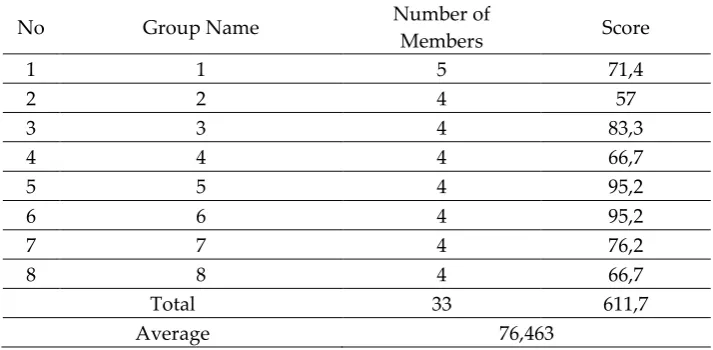
97 Table IV
Results of Assessment of Student Worksheet Meeting 3 Treatment 4
No Group Name Number of
Members Score
1 1 5 71,4
2 2 4 57
3 3 4 83,3
4 4 4 66,7
5 5 4 95,2
6 6 4 95,2
7 7 4 76,2
8 8 4 66,7
Total 33 611,7
Average 76,463
From the table above, it can be seen that the highest group value of 95.2 is obtained by groups 5 and 6, while the lowest group value is 57 obtained by group 2. The average value obtained is 76.463.
2. Student Final Test Results
The final test was carried out with the aim of knowing the mastery of the students' material after all treatments were carried out. The type of test used is a written test with a total of 15 questions, of which ten questions are in the form of short entries and five essays. The final test results of these students can be seen in the following table.
Table V
Student Final Test Results
No Students Name Score
1 Adinda Khadijah 61
2 Ayla Altahya I. A. 85,4
3 Bryan 92,7
4 Cassey Regina 97,6
5 Davin 56,1
6 Delon 78
7 Elliana 65,8
8 Feri Steven F. 48,8
9 Fransius 56,1
10 Gilbert 87,8
11 Herryarivianus 19,5
12 Husnul Khotimah 63,4
13 Irvan 61
14 Jerry 68,3
15 Jisen 14,6
16 Julianto 78
17 Kristina 48,8
18 Maya Sari 53,6
19 Mehwa 31,7
No Students Name Score
e-ISSN: 2613-9723 dan p-ISSN: 2613-9715
98
21 Nabila 71
22 Natali Eva 34,1
23 Naufal 68,3
24 Qurnia Nindi N. 80,4
25 Ricky 83
26 Rio Nardi 48,8
27 Seli Marsela 78
28 Selviana 53,6
29 Siti Halizakh 92,7
30 Tiara Mulyana 68,3
31 Tyas 29,3
32 Vereen Artikasari 56,1
33 Wildan 75,6
34 Yuni Manurung 51,2
Total 2095,2
Average 61,624
From the table above, it can be seen that the highest value is 97.6, while the lowest value is 14.6. The average value obtained is 61,624.
3. Implementation of the Learning Process a. Meeting 1 Treatment 1
The learning process of meeting 1 treatment 1 was held on Thursday, August 2, 2018, with material about temperature and heat. The schedule starts at 11.00 and finishes at 12:10 WIB, precisely takes place in 2 x 35 minutes. But because this is the first meeting with students, the first 10 minutes are used for introductions while creating learning conditions that are not rigid and pleasant through encouraging slogans. The students who took part in learning at this 1st meeting amounted to 30 students from a total of 34 students. Four students who were absent were due to 2 sick students, one student permission, and one absent student.
Furthermore, learning begins with apperception in the form of question and answer that leads to students' initial knowledge about temperature and heat. At this stage, the teacher carries out the stages of constructivism in the CTL approach. The results of this activity, it appears that in everyday life students have felt or know about the cold heat of an object, but most students do not know the term of the event. Therefore, to complement students' knowledge of temperature and heat, two experimental activities were carried out, where activity 1 specifically studied temperature and activity 2 specifically studied heat. The experiment was carried out by students and groups; this was intended to create a learning community in the learning process.
Students are grouped into six study groups with each member are five students. Group formation is carried out by the teacher taking into account the differences in students based on gender and the close distance between sitting positions between students. Group formation takes a lot of time because some students don't want one group with another friend. But this can be well anticipated by the teacher.
e-ISSN: 2613-9723 dan p-ISSN: 2613-9715
99 experimental activities cannot be separated from the guidance of the teacher, the teacher gives freedom to the group to write the answers according to their findings through experiments. Students are given the freedom to ask things that are not understood during the trial process. During the 2 experiment activities, it can be described that most students seemed enthusiastic about conducting experiments with their groups. But also seen some group members who were not active in their group activities.
After discovering two experimental activities, the teacher assigns 1 group randomly to communicate the results of their work. It is done because the study time will be finished. At the same time, the teacher also asks about the suitability of the group's advanced answers with other groups. It is so that students can exchange opinions. In this activity, the teacher directs students to associate temperature and heat with events in everyday life.
The final activity in meeting 1 treatment 1 was to conclude the temperature and heat material jointly. Closing activities such as reflection, question, and answer about things that are not understood by students, and previously prepared evaluations cannot be carried out due to limited study time.
b. Meeting 2 Treatment 2
The 2nd treatment meeting 2 was held on Friday, August 3, 2018, at 09.35 until 10:45 WIB. Learning material discussed is about how to conduct heat transfer by conduction. Students who take part in learning are still 30 students out of a total of 34 students. Two students were absent because of illness, one student was permitted, and one student without explanation.
Learning begins with conducting apperception in the form of question and answer which leads to students' initial knowledge of how to conduct heat transfer by conduction. Question and answer questions are given based on prior learning material, which is about temperature and heat. At this stage, the teacher carries out the stages of constructivism in the CTL approach. The results of this activity show that most students still remember the previous material, that based on experiments heat can move from the candle flame to the spoon. But students have not learned about the full nature of heat from the experiment. Therefore, to complete the students' knowledge about how to conduct heat transfer by conduction, two experimental activities were carried out, where activity 1 learned about conduction heat transfer and activity 2 studied the relationship between the distance of the object with the rapid propagation of heat. The experiment was carried out by students and groups; this was intended to create a learning community in the learning process.
Students are grouped into ten study groups with each member are three students. Group formation is left entirely to students. It is because, at the previous meeting, the formation of groups was quite time-consuming and with the number of members of 5 students, causing not all group members to participate in the activities of their groups actively.
e-ISSN: 2613-9723 dan p-ISSN: 2613-9715
100 After the discovery activities through two trial activities are carried out, then the teacher then directs students to be able to exchange opinions about their learning outcomes. Because in the previous meeting not all students pay attention to their friends communicating the results of their work and not all students are active in giving their opinions, then the teacher tries other ways so that the exchange of ideas can be carried out properly. The way to do it is to give questions about randomized experiment activities to each group and show randomly to other students to respond until finally, the other students join in responding. The result is, students are more enthusiastic, attention is more focused, even though eventually all students participate in answering and the teacher needs time back to calm the class condition and confirm the student's answers, and guide students to mention activities in daily life such as what shows heat transfer by conduction.
The final activity in meeting two treatment 2 was to jointly conclude the material on how to conduct heat transfer by conduction. Closing activities such as reflection, question, and answer about things that are not understood by students, and previously prepared evaluations cannot be carried out due to limited study time.
c. Meeting 3
The 3rd meeting will be held on Thursday, August 9, 2018. The time given by the school is from 09.35 - 10.45 then continued at 11.00 - 12.10 WIB, 15 minutes is used for rest. In other words, the allocation of learning time is 4 x 35 minutes. Students who attended the study still numbered 33 students out of a total of 34 1 students absent due to illness.
Taking into account that the previous two meetings were unable to evaluate due to time constraints, and the last day of the meeting was Friday, August 10, 2018, it was decided that at the 3rd meeting, two times treatment was carried out with different learning materials. Furthermore, at the 4th meeting on Friday, 10 August 2018 at 09.34 - 10.45 WIB, a summative test was conducted to determine the extent to which students had understood learning from one subject to the next. The following is a description of the learning process at meeting 3.
1) Treatment 3
Treatment 3 at the 3rd meeting was held at 09.35 - 10.45 WIB with learning material about how to transfer heat by convection. Beginning with apperception to explore students' initial knowledge in the form of question and answer related to previous learning material. Some students still remember that based on experiments at previous meetings, heat can move through an intermediate substance that is a solid object without being accompanied by the transfer of the builder substances. Students can also answer that in addition to objects on; heat can also move through liquid substances, such as water. But students do not yet know the nature of the method of heat transfer by convection. Therefore, to complete the students' knowledge about the method of convection heat transfer, an experiment was conducted to study heat transfer by convection. The experiment was carried out by students and groups; this was intended to create a learning community in the learning process.
e-ISSN: 2613-9723 dan p-ISSN: 2613-9715
101 student worksheet, to guide students in making conclusions. Students can ask questions about things that are poorly understood. During the trial activity, it can be described that the activity of students and their groups is getting better from previous meetings
After the discovery activities through experiments are carried out, then the teacher then directs students to be able to exchange opinions about their learning outcomes by giving questions about randomized experimental activities to each group and showing randomly also to other students to respond, until finally, other students respond. The result is that students are more enthusiastic, their attention is more focused. The final activity in treatment 3 is to conclude convection heat transfer material jointly. 2) Treatment 4
Treatment 4 at the 3rd meeting was held at 11.00 - 12.10 WIB with learning material about radiation heat transfer. Beginning with student responses in the form of question and answer related to previous learning material. Some students can answer that based on experiments on previous treatments; heat can move through an intermediate substance, namely water, accompanied by the transfer of substances to the builder. Furthermore, based on the opinion trail there is a group of students who answer that heat can move without going through an intermediate substance. There is also a group of students who answer that heat cannot move without going through an intermediate substance. Students also do not understand the nature of radiation heat transfer. Therefore, to supplement students' knowledge about how to transfer radiation heat, an experiment is conducted to study it. The experiment was carried out by students and groups; this was intended to create a learning community in the learning process. Students are still learning together with groups in treatment 3.
The teacher then distributes the worksheets to each group and shares the tools and materials needed to experiment. In conducting experiments, students together with the group are fully guided by the teacher. The teacher gives a model of how to use experimental tools and materials and is followed by each group. In addition, the teacher also guides students in answering each question contained in the student worksheet, to guide students in making conclusions. Students can ask questions about things that are poorly understood. During the experiment, some students were still active in conducting experiments, but also some students were no longer excited.
After the discovery activities through experiments are carried out, then the teacher then directs students to be able to exchange opinions about their learning outcomes by giving questions about randomized experimental activities to each group and showing randomly also to other students to respond, until finally, other students respond. The result is that students are more enthusiastic, their attention is more focused.
The closing activity in treatment 4 begins with a question and answer session about things that are poorly understood during the learning process from several meetings. Because no students ask, the teacher asks the students randomly. Most students can answer correctly, but some students answer incorrectly. The activity was continued by making conclusions from all the learning material that had been carried out. Some students are active in submitting their opinions in making conclusions. The closing activity ends with reflection. All students feel happy with all the learning that has been done. But they have their own experience about which experiments are the most interesting.
Discussion
e-ISSN: 2613-9723 dan p-ISSN: 2613-9715
102 society, and reflection. Learning by applying the CTL approach can increase student learning interest which can be seen from the activity of students during the learning process.
For the assessment component, it has not been implemented properly. Where the actual assessment of the CTL approach must include attitude, knowledge, and psychomotor assessments conducted periodically to review the development of student learning outcomes. However, due to time constraints, the number of students is quite large, and the teacher is in situations and conditions that do not know students in depth, then the actual assessment can only be done in the cognitive domain through assessment of student worksheets and summative tests. For all components of the CTL approach to be carried out properly, the teacher must know all of his students in depth both in terms of psychology and ability to think.
In addition, based on student worksheet assessment and student activity during learning, the ideal number of group members is four students. It is so that each student in the group can play an active role in completing the group's tasks during the learning process. Then by looking at students' ability to understand learning material through the application of the CTL approach, the teacher must consider the amount of material to be taught in one meeting. If the teacher wants to apply the CTL approach to learning, then focus on just one learning material specifically for the material that contains the experiment. Because based on the research that has been done on the student worksheet meeting 3 which contains two treatments with different learning materials, it can be seen that the student worksheet value in treatment 4 has decreased compared to the 3rd treatment. It is also meant so that students are not too deprived of learning and are more focused on understanding the material being taught.
Furthermore, for the components of the learning community in the CTL approach, the teacher must have the ability to ask questions that can provoke students to provide answers. It is because students at the elementary school level cannot yet express their opinions, responses, and questions independently. Therefore, the role of the teacher in bridging the implementation of the components of the learning community is very necessary.
In making conclusions in the student worksheet, students should be given directions in the form of questions related to what they learned. Next, the time allocation used when applying the CTL approach must be considered. Based on the research time allocation of 2 times 35 minutes each treatment is still felt to be lacking in particular which includes learning by conducting experiments. Because during the treatment in this study the teacher cannot carry out the final evaluation of learning.
Based on the assessment of the summative tests conducted with KKM = 70, it was seen that 12 students received scores above the KKM and 22 students were still under the KKM. If it is confusing, 35.3% of students complete and 64.7% of students do not complete. It is because some students are not present in all treatments and all present when summative tests. In addition, the ability of the teacher to manage the class is quite slow, which has an impact on the lack of students' understanding of learning. Therefore, the teacher must anticipate that all students can obtain learning with the CTL approach and have the ability to manage the class well.
Conclusions and Suggestions
Conclusions
e-ISSN: 2613-9723 dan p-ISSN: 2613-9715
103 learning process, it is better that there are two teachers in the classroom, where each task is teaching and then evaluating, both cognitive, affective, and psychomotor.
The steps for applying the CTL approach to learning Natural Sciences in South Pontianak 14 Elementary School, in general, have been well implemented. Where CTL components such as constructivism, modeling, questioning, discovery, community learning, and reflection can be implemented in learning. But it cannot be denied that there are deficiencies in its implementation. One of them is that the evaluation is not carried out at the end of each treatment, but it is done when the whole series of learning is carried out. Then there is no authentic assessment of the affective and psychomotor domains.
The application of the CTL approach to science learning has an impact on the mastery of the material. It can be proven through scores obtained by students and their groups from worksheets given to each treatment. Where the average student worksheet score for each treatment has reached KKM, which is 70. However, for individual scores obtained by students at the final evaluation, it has not shown maximum mastery of the material. Because of 34 students, only 12 students achieved KKM, while 22 other students had not yet reached KKM. If it is confusing, 35.3% of students complete and 64.7% of students do not complete, and with an average overall score of students is 61,624.
Suggestions
Based on the results and findings obtained during the study, suggestions that can be conveyed are as follows: (1) in classifying students, the maximum number of members of 4 students should be heterogeneous based on sex and ability to think; (2) know deeply the characteristics of students both in terms of psychological and cognitive; (3) consider the time allocation that will be used in the implementation of learning by applying the contextual teaching and learning approach; (4) teachers must have the ability to ask and manage good classes; (5) Student worksheet must be made by including continuing questions, so students are easy to make conclusions.
References
Jufri, A. Wahab. 2017. Belajar dan Pembelajaran Sains: Modal Dasar Menjadi Guru Profesional. Bandung: Pustaka Reka Cipta.
Priansa, Donni Junni. 2017. Pengembangan Strategi & Model Pembelajaran Inovatif, Kreatif, dan
Prestatif dalam Memahami Peserta Didik. Bandung: Pustaka Setia.
Purwanto. 2016. Evaluasi Hasil Belajar. Yogyakarta: Pustaka Belajar.
Raharjo, Rindang Wijayanti. 2011. Pengaruh Pendekatan Contextual Teaching and Learning (CTL) terhadap Hasil Belajar IPA Siswa Kelas IV di SDIT Nurul Falah Cilincing Jakarta Utara. Skripsi. Universitas Muhammadiyah Prof. Dr. Hamka. Jakarta.
Riyanto, Yatim. 2014. Paradigma Baru Pembelajaran: sebagai Referensi bagi Pendidik dalam
Implementasi Pembelajaran yang Efektif dan Berkualitas. Jakarta: Kencana.
Rusman. 2017. Belajar dan Pembelajaran Berorientasi Standar Proses Pendidikan. Jakarta: Kencana. Sadia, I Wayan. 2014. Model-model Pembelajaran Sains Konstruktivistik. Yogyakarta: Graha Ilmu. Samatowa, Usman. 2016. Pembelajaran IPA di Sekolah Dasar. Jakarta: PT Indeks.
Sugiyono. 2016. Metode Penelitian Kuantitatif, Kualitatif, dan R&D. Bandung: Alfabeta.
Tirtasari, Ni Luh. 2015. Penerapan Pendekatan Contextual Teaching and Learning untuk Meningkatkan Hasik Belajar IPA pada Siswa Kelas V. Jurnal PGSD Universitas Ganesha Vol. 3 No. 1.
Trianto. 2014. Model Pembelajaran Terpadu Konsep, Strategi, dan Implementasinya dalam
Kurikulum Tingkat Satuan Pendidikan (KTSP). Jakarta: Bumi Aksara.