S
TRUCTURED
O
N
-
THE
-J
OB
T
RAINING
Effectively Training Employees with
Employees
A
UTHORSJ
OSEPHM
OLNARB
RITW
ATTSA R
ESEARCHR
EPORT OF THEC
ENTER FORE
NTREPRENEURIALS
TUDIES ANDD
EVELOPMENT, I
NC.
West Virginia University College of Engineering
P.O. Box 6070
Morgantown, WV 26506-6070
Introduction
Brent, a Human Resources Manager has been assigned the task of improving the training program at his aluminum production facility. Brent met with a department foreman, a few hourly workers, and the Vice President of Human Resources to get a better grasp on his assignment. The more he heard, the less he liked. The foreman began, “Most of the training we do consists of assigning a new employee to an experienced employee. Whoever is on-shift gets stuck with the new person while having to do their job too.” “Then the next day, the trainee gets somebody else who teaches the same job a better way, their way,” one of the hourly guys adds. As the group talks, it becomes increasingly apparent that this cycle goes on until the training period is over. The foreman complains, “After the training is done, I’m supposed to talk to everyone, and then make a performance evaluation. I still don’t understand why the guys doing the training don’t judge if the trainee can do the job or not.”
“We have experienced and skilled people working out there. All they need is a little time to train, some skills to improve their training ability, and some standard materials to use,” the VP points out. “Why don’t we just use our standard operating procedures and job descriptions?” The foreman replies, “Those things are useless for training. They were written ten years ago and they are never updated.” One of the hourly employees points out that the problem isn’t all about training job skills. “We hire new employees off the street. They have never worked a serious job in their life. Most got out of high school and thought they’d make a good living working at the mall. Now, they realize it takes more, and they are two or more years out of school with no intention on going back to get the skills we need.” Brent addresses the VP. “Our absenteeism and turnover rates are killing us. We try to screen incoming workers but we have to take what we can get. They get in here, and they can’t even use a damn broom!”
After the discussion, Brent and his team realized that they needed to change their approach to workforce development. “For years we would hire people, assign them a job, and let them learn on their own with little guidance. Those days are long gone.” One of the workers adds, “Used to be you could just show somebody how to do a job, but what we show them now isn’t that simple anymore. We need to build some
consistency. There is so much to cover. I forget the little things because I’ve been doing them for so long. I need a way to remember and be sure the new person understands the stuff I’m talking about.” “We also have to think about getting people to simply understand what it is to work,” says Brent. “We can’t wait for the new people to just figure it out because it will cost us more in the long run.”
2
© 2000. CESD, Inc. All rights reserved. SJT – Effectively Training Employees with Employees (10/20/02) seasoned workforce to a workforce that, for one reason or another, lacks basic or
general job skills. These general skills are not limited to technical skills, but also include more basic skills such as general mechanical aptitudes, coming to work everyday,
arriving on time, and generally being recognized as someone who “works hard.”
So, what Brent thought to be a simple training task; hire some people and train them on-the-job, is really much more complicated.
The Learning Curve and On-the-Job Training
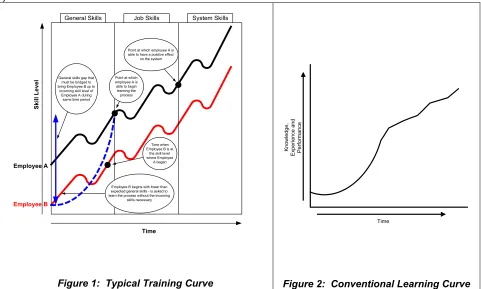
Figure 1 illustrates a general representation of the learning curve associated with on-the-job training. It is referred to as the training curve. It is slightly different from the conventional arced learning curve (shown in figure 2) because it takes into account training and retraining over time. Based on experience, this curve is the same in manufacturing, health care, services or government – whenever someone learns a new job.
General Skills Job Skills System Skills
Point at which employee A is able to begin learning the process
Point at which employee A is able to have a positive effect
on the system
Employee B begins with lower than expected general skills - is asked to learn the process without the incoming
skills necessary
Figure 1: Typical Training Curve
Time
Figure 2: Conventional Learning Curve
Figure 1 illustrates the typical training curve for two employees, (A and B). Employee A has some previous work experience and possesses the basic building blocks to enter the workforce. S/he is trained and re-trained over time (represented by the dips in the curve). Employee B is more typical of the new hire today, having limited “practical” work experience that prepares him/her for the workforce.
One Human Resources Director at a manufacturing facility described this point as “having enough knowledge to be dangerous and to know what questions to ask.” As shown in figure 1, Employee A will be prepared to learn specific job skills at the point where Employee B has developed his/her general working skills. Without a plan in place for Employee B to rapidly develop these general skills, the performance gap between the two employees will always exist.
The learning curve continues where time and training have introduced the employees to the proper rules, facts, and hands-on experience placing them at an acceptable skill level - one where the employees have control over the system and the tasks associated with daily activity. At some point in time, the employees will reach a skill level that allows them to make sound judgements and decisions about the performance of the system. As figure 1 indicates, this skill level will be reached much faster by Employee A than by Employee B. The learning continues as the employees develop new and
improved procedures to operate the system.
Today, unemployment is decreasing. This equates to a shrinking of an experienced labor pool. Organizations are now faced with the task of developing whomever they can find or hoping that the educational systems are developing the general skills they require. To make matters worse, the experienced employees are moving to higher-paying jobs. This results in lower-higher-paying organizations having the responsibility to not only train job skills, but to take a more active role in developing the much needed enabler skills. These lower paying organizations may actually be required to spend more time in “up-front” training than a company paying higher wages.
The Training Gap
What we know about on-the-job training is that almost every new trainee will begin at the bottom of the training curve. And in most cases, every trainer will be somewhere near the middle or top of the training curve. This situation is illustrated in figure 3. The trainer’s perception is that the trainee ‘comes to the table’ with certain knowledge, skills and abilities. S/he may train using language and concepts that are completely foreign to the trainee. Bridging this perception gap is one of the most critical elements for effective on-the-job training.
4
© 2000. CESD, Inc. All rights reserved. SJT – Effectively Training Employees with Employees (10/20/02) Through training activities and research, here is what we know about the job training process. The points outlined below may seem like common sense, but many
organizations rarely understand their implications.
• On-the-job trainers are existing employees that have gained adequate to excellent
experience over time. In most cases, they know what they are talking about.
• Trainers tend to “tolerate” a trainee that has the general job skills needed to enter the
job successfully more than those that need special attention. If a lacks general job skills, the trainer tends to become frustrated and the training quality suffers.
• On-the-job trainers rarely receive the skills needed to train properly. They train the
only way they know how – show and do.
• The ‘show and do’ method of training, by itself, is not necessarily a poor way of
training. We tend to learn better by imitation and visual, hands-on applications. However, the proper feedback mechanisms are rarely included (among other skills mentioned later), making the on-the-job training experience less than desirable.
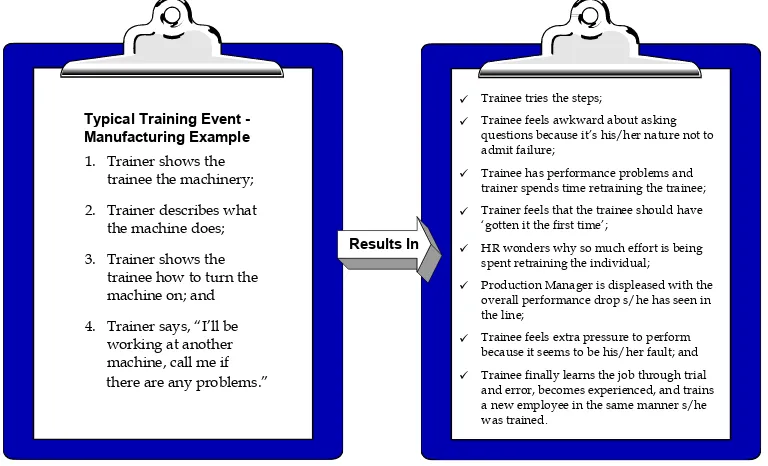
Using a manufacturing setting as an example, a typical on-the-job training event is represented in figure 4.
9 Trainee tries the steps;
9 Trainee feels awkward about asking questions because it’s his/her nature not to admit failure;
9 Trainee has performance problems and trainer spends time retraining the trainee;
9 Trainer feels that the trainee should have ‘gotten it the first time’;
9 HR wonders why so much effort is being spent retraining the individual;
9 Production Manager is displeased with the overall performance drop s/he has seen in the line;
9 Trainee feels extra pressure to perform because it seems to be his/her fault; and
9 Trainee finally learns the job through trial and error, becomes experienced, and trains a new employee in the same manner s/he was trained.
The training steps indicated in figure 4 are lacking critical elements for producing an effective training event. This ineffective training event is a direct result of the
knowledge and performance gap that exists between the trainer and trainee illustrated in figure 3 and occurs in every industry. The experience level of the trainer is higher than that of the trainee. Key training skills are not properly employed to elevate the trainee to the desired performance level in a timely manner. To overcome this problem, a structured but flexible format for on-the-job training must be implemented.
Goal of the Structured On-the-Job Training (SJT) System
The goal of any on-the-job training system should be to smooth out the curve shown in figure 3. In other words, the training experience should be one that makes the most of retraining provided and minimizes the amount of retraining needed. At the end of the designed training period, the trainee should be able to perform the tasks and steps within the boundary of the current operating system.
Based on experiences with a variety of organizations, “smoothing the curve” has the following effects:
• Increased performance characteristics (quality, productivity, etc.) of the trainee in
less time compared to traditional on-the-job training;
• Reduced cost of training due to less time spent retraining (i.e., more time for
experienced employee to do the job and more quality production from the trainee); and
• Understanding that effective training is an investment and not a liability
(creating a cultural change).
To smooth out the training curve, a number of issues need to be addressed. Five of the critical components are:
1. General job skills of “working” must be established before a trainee can begin to
effectively learn job specific skills;
2. Properly trained ‘mentors’ must lead the on-the-job training;
3. Adequately documented procedures should be stated in a training format using
process descriptions with memory anchors;
4. A structured but flexible training schedule should be applied to keep the mentor
and trainee on track and allow for follow-up training if needed; and
5. A procedure to evaluate if the trainee has acquired the skills necessary, as well as
6
© 2000. CESD, Inc. All rights reserved. SJT – Effectively Training Employees with Employees (10/20/02)
SJT Component 1: Building General Workplace Skills
During the hiring process, questions are asked about discipline, follow through, attentiveness to the job, applying yourself, commitment, and fundamental mechanical and problem-solving skills - all skills and traits that are difficult to assess. If the new employee does not possess these skills, then the job-specific training may be a waste of resources, and adversely affect quality, customer satisfaction, and existing employee satisfaction.
To ensure that job skill training is meaningful, it is important for the organization to develop general job skills for new employees. Organizations can depend on these skills developing over time, but the effects of waiting can be detrimental to the timely success of the trainee. The question for the organization is: Can you afford not to invest in general job skills training at the onset of employment?
The general job skill training should be integrated with the orientation process of the organization. When a new employee enters an organization, the core values and concepts of ‘work’ need to be reinforced by the trainer and the organization. This should be done through a classroom-application approach and be delivered by the organization, not an external provider.
SJT Component 2: Mentor Training
Traditional solutions to developing trainer skills consist of teaching off-the-shelf train-the-trainer programs. The typical trainer usually learns feedback skills, how to
communicate effectively, and how to give directions, among others. These skills are certainly necessary. However, the problem with ‘classroom-style’ training is that it rarely utilizes real-life and real-time experiences and applies them to the skills taught. Without actively integrating this training into the everyday tasks performed by the trainers, the skills are lost within a matter of days or weeks. Training efforts have been proven successful by implementing a classroom-application combination that focuses on the experience gap between the seasoned employee and the new trainee. This combination of classroom application training incorporates the language used in the organization and in the general working environment. It also mirrors the cultural traits of the organization.
The trainer’s job is to integrate the trainee into the organization and build job skills, not to simply show them how a job is done. To develop his/her ‘style’, the trainer must build coaching skills through a trial-and-error process. When on-the-job trainers learn training skills in this way, they become mentors and coaches, not just trainers.
When teaching mentor skills, it is critical to match the skills to real-life situations in the organization. Through a short but targeted training effort, mentors should learn to provide coaching versus teaching skills in an on-the-job format. The focus is on the
(trainer) and the trainee is the goal, so that knowledge and abilities are more easily transferred on-the-job. This helps eliminate a ‘throw-to-the-sharks’ type of training experience. In addition, mentors should acquire the ability to provide evaluations for
skill acquisition. The mentor must work with the trainee. For this reason, it is the
mentor’s responsibility to assess the trainee’s ability to understand job basics.
SJT Component 3: Documented Procedures
Have you ever been trained by someone at the workplace, only then to have another co-worker tell you another way to do the job? A metals manufacturer had its trainees exposed to three shifts over the course of their training period. The trainees were exposed to three or four different trainers performing the same jobs. Through exit interviews, it was discovered that each of these trainers taught different procedures for performing the same job tasks. Imagine how the trainee felt after the training period. Exposure to the different shifts was a good idea, however it may have come too early in the learning process. The trainees were not learning a standard process at the most critical learning time of the training period – in the beginning. Structured training procedures, which agreed-upon standard practices, improved the situation.
The structured training manual should contain operating procedures documented with the input of the current job incumbents. This provides up-to-date process information while gathering key experiences not normally captured in a standard operating
procedure or job description. The flow of the training document should mirror the flow of the process (from start-up to shut down). Unlike a typical manufacturer’s equipment manual, the training document should read as though it were being told, and contain the basic information introduced first with detailed information used as support.
Special circumstances should be highlighted using memory anchors. Memory anchors such as a red cross representing a safety hazard, provide a mental link to the
documented process. The trainee may not remember all of the documented processes, but they may recall a hazard or quality concern based upon the memory anchor.
A structured training manual should be a tool that assists the hands-on learning process. The mentor uses the manual as a check to ensure that all the necessary information has been provided over the training period. If multiple mentors are used during the training period, then each will have a reference for what the others have taught. The trainee uses the documentation as a general introduction and reference guide to learn by reading, seeing and doing.
SJT Component 4: Structured and Flexible Training Schedule
The training process needs to be structured and flexible. The training schedule should
contain an outline of all the necessary components and a timeline established for
8
© 2000. CESD, Inc. All rights reserved. SJT – Effectively Training Employees with Employees (10/20/02) ‘atmosphere’ of the job. Have you ever started a training effort while a process was in the middle of its cycle? If a training schedule is not flexible, this situation can cause havoc on the learning process, not to mention possible downtime for the trainee waiting for the process to cycle back to its starting point. At the conclusion of the training
period, specific plans to address the skills not obtained should be employed so that all the necessary skills are learned by the trainee.
SJT Component 5: Diagnosing the Trainee
A trainee is like a patient. The mentor is the doctor who is trying to make the trainee feel better, function better, and assess how s/he is doing after the ‘treatment’ (training period). When the mentor spends the quality time necessary with the trainee, the skills acquired will become evident through observation and results. A simple checklist can satisfy this need with a feedback mechanism to show additional training when
required.
Summary
Brent’s plant implemented the team’s ideas. They structured their job-process training to build consistency, developed mentors to guide learning, and they implemented a ‘big brother’ program to build general workplace skills for the younger (and older)
employees.
The plant experienced results similar to other facilities:
• The cost of training was reduced by approximately 15% during a three-year period
when the plant trained around 800 new employees that replaced a retiring workforce.
• Hours spent training employees on-the-job decreased by roughly 18%.
• Workforce grievances that averaged 96 per month dropped to 0 for the first time.
• First-run quality improved as rework decreased.
• Reportable safety incidents declined.
• Absenteeism reduced by almost 20%.
• Turnover was reduced from approximately 50% to 22%.