i
TABUNG MASJID
WAN FADHLI BIN WAN ISMAIL
A report submitted in partial fulfillment of the requirements for the award of the Diploma of Mechanical Engineering
Faculty of Mechanical Engineering Universiti Malaysia Pahang
ii
SUPERVISOR DECLARATION
I hereby declare that I had read this thesis and in my opinion this thesis is sufficient in terms of scope and quality for the purpose of the granting of Diploma of Mechanical Engineering.
Signature : ………
Name of Supervisor : WAN ANUAR B WAN HASSAN
iii
AUTHOR DECLARATION
I declare that this thesis entitled “Tabung Masjid” is the result of my own research except as cited in references. The thesis has not been accepted for any diploma and is not concurrently submitted in candidature of any other diploma.
Signature : ___________________________
Name of candidate : WAN ANUAR BIN WAN HASSAN_____ Date : ___________________________
:
: WAN FADHLI BIN WAN ISMAIL :
iv
DEDICATION
To my beloved father and mother En. Wan Ismail Bin Wan Abdullah
v
ACKNOWLEDGEMENTS
First of all I am grateful to ALLAH S.W.T for blessing me in finishing my final year project (FYP) with success in achieving my objectives to complete this project.
Secondly I want to thank my family for giving morale support and encouragement in completing my project and also throughout my study in UMP as they are my inspiration to success. I also would like to thank my supervisor En. Wan Anuar Bin Wan Hassan for guiding and supervising my final year project throughout this semester. He has been very helpful to me in finishing my project and I appreciate every advice that he gave me in correcting my mistakes. I apologize to my supervisor for any mistakes and things that I done wrong while doing my project. The credits also goes to all lecturers, tutors, teaching engineers (JP) and assistant teaching engineers (PJP) for their cooperation and guide in helping me finishing my final year project.
Last but not least I want to thank all my friends that have given me advice and encouragement in completing my project. Thank you very much to all and may ALLAH bless you.
vi
ABSTRACT
Mosque fund use wheel seldom seen in several mosque to collect fund raising. With are wheel placed beneath this mosque fund, it would facilitate this mosque fund can be moved by shelf Islamic from one place to one another place. Hereby also, shelf Islamic no need move and find mosque fund because shelf Islamic can move mosque fund to raise fund. This is because seem shelf Islamic continuous going in a crowd to mosque fund previously difficult to be moved especially when prayer time Friday. To ease shelf Islamic which wanted donate some alms, put wheel in mosque fund is one creativity
vii
ABSTRAK
Penggunaan tabung masjid bertroli jarang dilihat di beberapa masjid untuk mengutip kutipan derma. Dengan adanya roda diletakkan di bawah tabung masjid ini, ia akan menyenangkan tabung masjid ini dapat digerakkan oleh para muslim dari satu tempat ke satu tempat yang lain. Dengan ini juga, para muslim tidak perlu bergerak dan mencari tabung masjid kerana para muslim dapat mengerakkan tabung masjid untuk mengutip derma. Ini kerana kelihatan para muslim berpusu-pusu pergi ke tabung masjid sebelum ini yang sukar untuk digerakkan terutamanya ketika waktu solat jumaat. Bagi menyenangkan para muslim yang mahu mendermakan sedikit sedekah, perletakkan roda pada tabung masjid adalah satu kreativiti yang amat berguna.
viii
TABLE OF CONTENTS
CHAPTER TITLE PAGE
TITLE i
SUPERVISOR DECLARATION ii
AUTHOR DECLARATION iii
DEDICATION iv
ACKNOWLEDGEMENTS v
ABSTRACT vi
ABSTRAK vii
TABLE OF CONTENTS viii
LIST OF TABLES xii
LIST OF APPENDICES xii
LIST OF FIGURES xiii
1 INTRODUCTION 1.1 Introduction 1 1.2 Problem Statement 1 1.3 Objective 1 1.4 Scope 2 1.5 Project Background 2-3
ix 2 LITERATURE REVIEW
2.1 Introduction 4
2.2 Types of Tabung Masjid
2.2.1 Triangle Box 5
2.2.2 „House Donation Box‟ 5 2.2.3 „Tissue Donation Box‟ 6
2.3 Types of Material
2.3.1.1 Stainless Steel 6
2.3.1.2 Properties of Stainless Steel 7 2.3.1.3 Applications of Stainless Steel 7-8
2.3.2 Aluminum 8-9
2.3.2.1 Properties of Aluminum 9-10 2.3.2.2 Applications of Aluminum 10-12
2.4 Types of Machines
2.4.1 Band Saw 12-13
2.4.1.1 Types of Band Saw 13 2.4.1.2 Metal Cutting Band Saw 13-14 2.4.1.3 Stone Cutting Band Saw 14 2.4.1.4 Meat Band Saw 15
2.4.2 SMAW 15
2.4.2.1 Operation of SMAW 16-17 2.4.2.2 Applications and Materials
SMAW 17
2.4.3 Drill 18
2.4.3.1 Operation of Drill 18-19 2.4.3.2 Power Requirement of Drill 19
2.4.4 Grinder 19-20
2.4.5 Rivet 20-21
x 3 METHODOLOGY 3.1 Introduction 22 3.2 Flow Chart 23 3.3 Sketching 3.3.1 Concept 1 25 3.3.2 Concept 2 25-26 3.3.3 Concept 3 26 3.3.4 Concept 4 27 3.4 Concept Screening 27-28 3.5 PDS 29-30 3.6 Fabrication Process 3.6.1 Measuring 30-31 3.6.2 Cutting 31-32 3.6.3 Drilling 33 3.6.4 Joining 33-34 3.6.5 Rivet 34-35 3.6.6 Finishing 35-36 3.7 Bill of Material 36
4 RESULT AND DISCUSSION
4.1 Introduction 37
4.2 Analysis
4.2.1 Measured Density of Penny 37-38 4.2.2 Measured Density of Coin using
Bottom Archimedes Principle 38-40
4.3 Result 40-41
xi 5 CONCLUSIONS AND RECOMMENDATION
5.1 Conclusion 42
5.2 Recommendation
5.2.1 Student Budget 42
5.2.2 Distance of Main Campus 43
5.2.3 Time Frame 43
5.2.4 Limitation of Material 43 5.2.5 Use the Electronic Keys 43
Appendices A 44
xii
LIST OF TABLES
TABLE NO. TITLE PAGE
1 Power Requirement of Drill 19
2 Concept Screening 28
3 Bill of Material 36
LIST OF APPENDICES
APPENDIX TITLE PAGE
xiii
LIST OF FIGURES
FIGURE NO TITLE PAGE
1 Triangle Box 5
2 ‟House Donation Box‟ 5
3 Tissue Donation Box‟ 6
4 Aluminum 6
5 Aluminum Foam 12
6 Band Saw 13
7 Shielded Metal Arc Welding 16
8 Drill 18
9 Power Requirment of Drill 19
10 Grinder 20 11 Rivet 21 12 Flow Chart 23 13 Concept 1-4 25-27 14 Concept Screening 28 15 Final Concept 28 16 Measuring 31 17 Cutting 32 18 Band Saw 32 19 Drilling 33
xiv
20 Joining 34
21 Rivet 35
22 Finishing 36
23 Bill of Material 36
24 Measured Density of Penny 38
1
CHAPTER 1
INTRODUCTION
1.1 Introduction
For this chapter, we will discuss about the problem statement, objective of the project, scope of the project, and lastly project background.
1.2 Problem Statement
After spotting a few basic points in design process I can be to design mosque fund with systematic and orderly so that able to perform task successfully. First step, I need identify matter and how applicable mosque fund safely by mosque guests to donate some contributions.
Between those problems has identified is matter problem that mosque fund movement, manufactured goods security problem and selection problem suitably at making mosque fund.
1.3 Objective
The objective of this project is to design a Tabung Masjid and to fabricate a new concept of user friendly „Tabung Masjid‟.
2 1.4 Scope
(a) This design of Tabung Masjid can put Surah Yassin or flyers in the drawer
(b) Maximum load that this Tabung Masjid can put the money is about 30-50 kg of coin
(c) This Tabung Masjid can move anywhere to collect the fund
1.5 Project Background
This project started with made a research and literature review from internet, books, supervisor, and others material to the project title, this literature review takes about a week. I continued with another method.
After get any information for the literature review, I continue with focus about the scope of the project because this scope very important for the product in my project. I choose this scope because it is suitable for my project which has at my product.
Next, I continue my project to sketch and design. My sketching must allow the scope before it can be fabricated. The purpose of sketching the design is making easily to fabrication my project. This time, I have sketch about 3 design of project before select the best and final selection design. So, I have compared the design which I sketch and doing the concept selection and concept screening method. From this, I can get the final design to fabricate the project.
For final is a testing and evolution. Here, if have any problem for my project, I will check the designing and repair my project should be achieved following the scope. If have not any problem, I can continue my project to fabricate the product following the final design sketching.
3 After all the parts had been joined together, here comes the last phase of process that is result and discussion. In result and discussion, the draft report and all the related articles are gathered and hand over to the supervisor for error checking. The finish product will be compared with the report to make sure that there is no mistake on both project and report.
After the product and the report had been approved by the supervisor, the report is rearrange and print out to submit at the supervisor, the project coordinator and faculty of Mechanical Engineering. In this stage, the final presentation was also being prepared and waited to be present.
4
CHAPTER 2
LITERATURE REVIEW
2.1 Introduction
A literature review is a body of text that aims to review the critical points of current knowledge and or methodological approaches on a particular topic. Literature reviews are secondary sources, and as such, do not report any new or original experimental work.
Most often associated with academic-oriented literature, such as theses, a literature review usually precedes a research proposal and results section. Its ultimate goal is to bring the reader up to date with current literature on a topic and forms the basis for another goal, such as future research that may be needed in the area.
A well-structured literature review is characterized by a logical flow of ideas; current and relevant references with consistent, appropriate referencing style; proper use of terminology; and an unbiased and comprehensive view of the previous research on the topic.
5 2.2 Types of Tabung Masjid
2.2.1 Triangle Box
Figure 2.1: Triangle Box
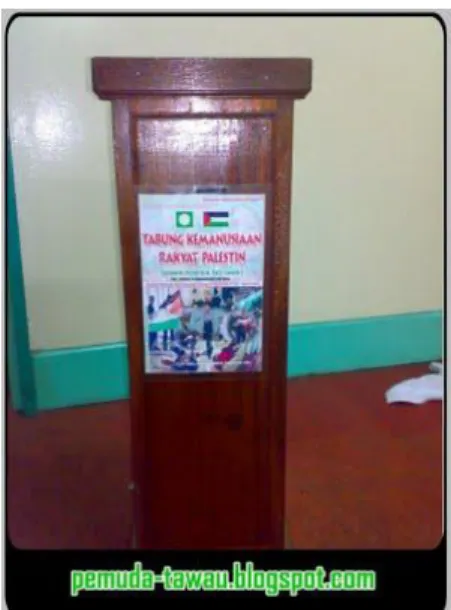
2.2.2 ‘House Donation Box’
6 2.2.3 ‘Tissue Donation Box’
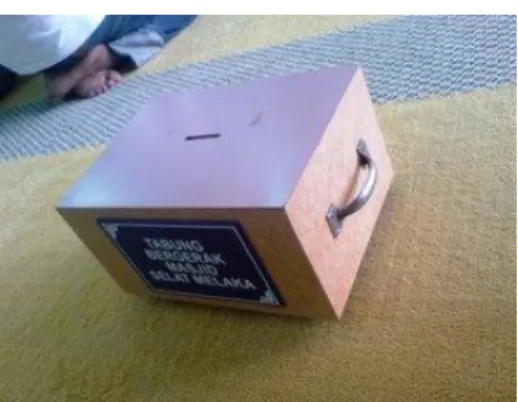
Figure 2.3: „Tissue Box‟
2.3 Types of Materials
2.3.1 Stainless Steel
In metallurgy, stainless steel, also known as inox steel or inox, is defined as a steel alloy with a minimum of 10.5 or 11% chromium content by mass. Stainless steel does not stain, corrode, or rust as easily as ordinary steel (it stains less, but it is not stain-proof). It is also called corrosion-resistant steel or CRES when the alloy type and grade are not detailed, particularly in the aviation industry. There are different grades and surface finishes of stainless steel to suit the environment to which the material will be subjected in its lifetime. Common uses of stainless steel are cutlery and watch cases and bands.
Stainless steel differs from carbon steel by the amount of chromium present. Carbon steel rusts when exposed to air and moisture. This iron oxide film (the rust) is active and accelerates corrosion by forming more iron oxide. Stainless steels have sufficient amounts of chromium present so that a passive film of chromium oxide forms which prevents further surface corrosion and blocks corrosion from spreading into the metal's internal structure.
7 2.3.1.2 Properties of Stainless Steel
High oxidation-resistance in air at ambient temperature are normally achieved with additions of a minimum of 13% (by weight) chromium, and up to 26% is used for harsh environments. The chromium forms a passivation layer of chromium (III) oxide (Cr2O3) when exposed to oxygen. The layer is too thin to be visible, and the metal remains lustrous. It is impervious to water and air, protecting the metal beneath. Also, this layer quickly reforms when the surface is scratched. This phenomenon is called passivation and is seen in other metals, such as aluminum and titanium. Corrosion resistance can however be adversely affected if the component is used in a non-oxygenated environment, a typical example being underwater keel-bolts buried in timber.
When stainless steel parts such as nuts and bolts are forced together, the oxide layer can be scraped off causing the parts to weld together. When disassembled, the welded material may be torn and pitted, an effect that is known as galling. This destructive galling can be best avoided by the use of dissimilar materials, e.g. bronze to stainless steel, or even different types of stainless steels (martensitic against austenitic, etc.), when metal-to-metal wear is a concern. In addition, Nitronic alloys (trademark of Armco, Inc.) reduce the tendency to gall through selective alloying with manganese and nitrogen.
2.3.1.3 Applications of Stainless Steel
Stainless steel‟s resistance to corrosion and staining, low maintenance, relatively low cost, and familiar luster make it an ideal base material for a host of commercial applications. There are over 150 grades of stainless steel, of which fifteen are most common. The alloy is milled into coils, sheets, plates, bars, wire, and tubing to be used in cookware, cutlery, hardware, surgical instruments, major appliances, industrial equipment, and as an automotive and aerospace structural alloy and construction material in large buildings. Storage tanks and tankers used to transport orange juice and other food are often made of stainless steel, due to its
8 corrosion resistance and antibacterial properties. This also influences its use in commercial kitchens and food processing plants, as it can be steam cleaned, sterilized, and does not need painting or application of other surface finishes.
Stainless steel is also used for jewelers and watches. The most common stainless steel alloy used for this is 316L. It can be re-finished by any jeweler and will not oxidize or turn black.
Some firearms incorporate stainless steel components as an alternative to blued or packetized steel. Some handguns, such as the Smith & Wesson Model 60 and the Colt M1911 can be made entirely from stainless steel. This gives a high-luster finish similar in appearance to nickel plating; but, unlike plating, the finish is not subject to flaking, peeling, wear-off due to rubbing (as when repeatedly removed from a holster over the course of time), or rust when scratched.
2.3.2 Aluminum
Aluminum or aluminum is a silvery white and ductile member of the boron group of chemical elements. It has the symbol Al; its atomic number is 13. It is not soluble in water under normal circumstances. Aluminum is the most abundant metal in the Earth's crust, and the third most abundant element therein, after oxygen and silicon. It makes up about 8% by weight of the Earth's solid surface. Aluminum is too reactive chemically to occur in nature as a free metal. Instead, it is found combined in over 270 different minerals. The chief source of aluminum is bauxite ore.
Aluminum is remarkable for its ability to resist corrosion due to the phenomenon of passivation and for the metal's low density. Structural components made from aluminum and its alloys are vital to the aerospace industry and very important in other areas of transportation and building. Its reactive nature makes it useful as a catalyst or additive in chemical mixtures, including being used in ammonium nitrate explosives to enhance blast power.
9
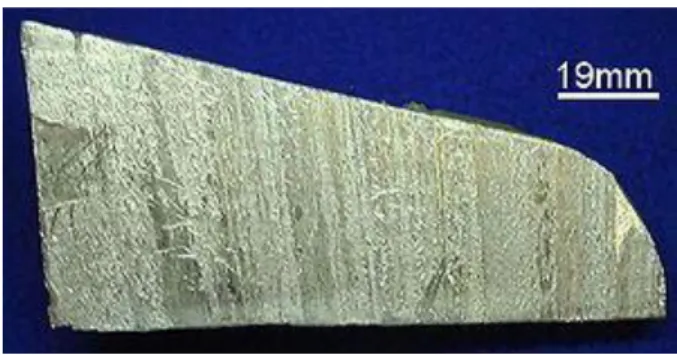
Figure 2.4: Aluminum
2.3.2.1 Properties of Aluminum
Aluminum ammonium sulfate ([Al(NH4)](SO4)2), ammonium alum is used as a mordant, in water purification and sewage treatment, in paper production, as a food additive, and in leather tanning.
Aluminum acetate is a salt used in solution as an astringent.
Aluminum borate (Al2O3 B2O3) is used in the production of glass and ceramic.
Aluminum borohydride (Al(BH4)3) is used as an additive to jet fuel. Aluminum bronze (CuAl5)
Aluminum chloride (AlCl3) is used: in paint manufacturing, in antiperspirants, in petroleum refining and in the production of synthetic rubber.
Aluminum chlorohydrate is used as an antiperspirant and in the treatment of hyperhidrosis.
Aluminum fluorosilicate (Al2(SiF6)3) is used in the production of synthetic gemstones, glass and ceramic.
Aluminum hydroxide (Al(OH)3) is used: as an antacid, as a mordant, in water purification, in the manufacture of glass and ceramic and in the waterproofing of fabrics.
Aluminum oxide (Al2O3), alumina, is found naturally as corundum (rubies and sapphires), emery, and is used in glass making. Synthetic ruby and
10 sapphire are used in lasers for the production of coherent light. Used as a refractory, essential for the production of high pressure sodium lamps.
Aluminum phosphate (AlPO4) is used in the manufacture: of glass and ceramic, pulp and paper products, cosmetics, paints and varnishes and in making dental cement.
Aluminum sulfate (Al2(SO4)3) is used: in the manufacture of paper, as a mordant, in a fire extinguisher, in water purification and sewage treatment, as a food additive, in fireproofing, and in leather tanning.
Aqueous Aluminum ions (such as found in aqueous Aluminum Sulfate) are used to treat against fish parasites such as Gyrodactylus salaris.
In many vaccines, certain aluminum salts serve as an immune adjuvant (immune response booster) to allow the protein in the vaccine to achieve sufficient potency as an immune stimulant.
2.3.2.2 Applications of Aluminum
Aluminum is the most widely used non-ferrous metal. Global production of aluminum in 2005 was 31.9 million tones. It exceeded that of any other metal except iron (837.5 million tones). Relatively pure aluminum is encountered only when corrosion resistance and/or workability is more important than strength or hardness. A thin layer of aluminum can be deposited onto a flat surface by physical vapor deposition or (very infrequently) chemical vapor deposition or other chemical means to form optical coatings and mirrors. When so deposited, a fresh, pure aluminum film serves as a good reflector (approximately 92%) of visible light and an excellent reflector (as much as 98%) of medium and far infrared radiation.
Pure aluminum has a low tensile strength, but when combined with thermo-mechanical processing, aluminum alloys display a marked improvement in mechanical properties, especially when tempered. Aluminum alloys form vital components of aircraft and rockets as a result of their high strength-to-weight ratio. Aluminum readily forms alloys with many elements such as copper, zinc,