WITH ACTION LEARNING STRATEGY AT EIGHT GRADE OF MTS PAB 1 HELVETIA
Submitted to the Tarbiyah Faculty UIN SU Medan as a Partial Fulfilment of the Requirement for S-1 Program
By: ARMASITA NIM: 34133009
Advisor I Advisor II
Dr. Sholihatul Hamidah Daulay, S.Ag, M.Hum Ernita Daulay,M.Hum
NIP. 197506222003122002 NIP. 198012012009122003
DEPARTMENT OF ENGLISH EDUCATION FACULTY TARBIYAH AND TEACHER TRAINING THE STATE ISLAMIC UNIVERSITY OF NORTH SUMATERA
Perihal : Skripsi Bapak Dekan Fakultas
Ilmu Tarbiyah dan Keguruan
a.nArmasita UIN Sumatera Utara
di
Medan Assalamu’alaikum Wr.Wb
Dengan Hormat,
Setelah membaca, meneliti, dan memberi saran-saran perbaikan
seperlunya terhadap skripsi mahasiswa a.n Armasita yang berjudul “Improving Students’ Speaking Skill in English Lesson by Using Action Learning Strategy at Eight Grade of MTs PAB 1 Helvetia”, maka kami berpendapat bahwa skripsi ini sudah dapat diterima dan dimunaqasyahkan pada sidang
Munaqasyah Fakultas Ilmu tarbiyah dan Keguruan UIN Sumatera Utara Medan.
Demikian kami sampaikan, atas perhatian saudara kami ucapkan terima
kasih.
Wassalam,
Advisor I Advisor II
Dr. Sholihatul Hamidah Daulay, S.Ag, M.Hum Ernita Daulay,M.Hum
Saya yang bertanda tangan di bawah ini:
Nama : Armasita
Nim : 34133009
Jurusan/Program Studi : Pendidikan Bahasa Inggris/S-1
Judul Skripsi :“IMPROVING STUDENTS’ SPEAKING
SKILL IN ENGLISH LESSON BY USING ACTION LEARNING STRATEGY AT EIGHT GRADE OF MTS PAB 1 HELVETIA”
Menyatakan dengan sebenarnya bahwa skripsi yang saya serahkan ini
benar-benar merupakan hasil karya sendiri, kecuali kutipan-kutipan dari
ringkasan-ringkasan yang semuanya telah saya jelaskan sumbernya.
Apabila dikemdian hari terbukti atau dapat dibuktikan skripsi ini hasil
ciplakan, maka gelar dan ijazah yang diberikan oleh Universitas batal saya terima.
Medan, 27 April 2017
Yang membuat pernyataan
IMPROVING STUDENTS’ SPEAKING SKILL IN ENGLISH LESSON BY USING ACTION LEARNING STRATEGY AT VIII-A GRADE OF
MTs PAB 1 HELVETIA
ARMASITA 34.13.3.009
Keyword: Action Learning Strategy, Students’ Speaking Skill
This research aimed to improved the students’ speaking skill in English lesson by using action learning strategy. This research was conducted by using Classroom Action Research (CAR). The subject of this research was VIII-A grade of MTs PAB 1 Helvetia 2016/2017 academic year which consisted of 48 students. The objective of this research was to improve students’ speaking skill in English Lesson by using Action Learning strategy at Eight Grade of MTs PAB 1 Helvetia. This research was conducted in two cycles which each consists’ of planning, acting, observing, and reflecting. The data were gathered through quantitative and qualitative data.
In the name of Allah, the beenficent, and the Merciful. Praise and gratitude
be to Allah for giving the strength and guidance for the writer, so that this skripsi
can be finished accordingly. Peace and blessing be upon Prophet Muhammad
SAW, his family, his relatives, and all his followers.
The written of this skripsi entitled “Improving Students’ Speaking Skill in
English Lesson by Using Action Learning Strategy at Eight Grade of MTs PAB 1 Helvetia”. This skripsi is written to fulfill one requirement to obtain the Sarjana
degree at Department of English Education of Faculty Tarbiyah Science and Teachers Training State Islamic University of North Sumatera.
Finishing of Writing this skripsi is actually a miracle for me since it was
firstly regarded as atask woul be very hard to do. However, it has now been
denied since this skripsi has finally been written. Then, I would like to thank
Allah SWT for The Blessing given to me so that the writing of this skripsi has
been finished without any meaningful problem. Additionally, the writer is grateful
to the following for their supports and helps.
1. A profound gratitude is directed to My beloved parents Arianto and Pariani who always give me support, advice, motivation, help, goodness, care, and all of things that I need to finish my study.
2. Dr. Amiruddin Siahaan , as the Dean of Faculty of Tarbiyah Scince and Teachers Training State Islamic University of North Sumatera.
5. Ernita Daulay, M.Hum as the second advisor who has guidance, dedication, and support during writing this skripsi.
6. All the lectures in English Department for teaching Precious
knowledge,sharing philoshophy of life, and giving wonderful study
experince.
7. The principal of MTs PAB 1 Helvetia Drs. Fauzi Sunara, M.A, English teacher Rohana, S.Ag and all of the students of VIII-A who helped the writer during the research.
8. My Beloved Brother Ahmad Rifa’i, my beloved sister Afifah Azzahra, and all of my family for their moral, support, patient, and ptayer.
9. My best friends Enam Samudera Ika Rahmadhani Lubis, Sartika, Leli Aprida Hartini, Khairun Nisyak, Mirwana Siska who always pray, support, and entertain me when I felt down.
10.Thanks to Enam Samudera’s sister,Nurul Umi, SEwho has supported me to do my skripsi.
11. My beloved boy friend Randy Gustiansyah, A.Mk who always give me support, care and advice to finish my study.
12. All of my family in the same struggle PBI-1 stambuk 2013,thank you so
this skripsi is hoped. I hope this skripsi can be useful to all of people.
Medan, 19 April 2017
ABSTRACT ... i
ACKNOWLEDGEMENT ... ii
TABLE OF CONTENT... v
LIST OF TABLE ... viii
LIST OF FIGURE ... ix
LIST OF APPENDIX ... x
CHAPTER 1 INTRODUCTION ... 1
1.1 The Background of the study... 1
1.2 The Identification of the Problems ... 4
1.3 The Limitation of the Study... 5
1.4 The Formulation of the Study ... 5
1.5 The Objective of the Study ... 5
1.6 The Significance of the Study... 6
CHAPTER II THEORITICAL REVIEW... 7
A. Theoritical Framework ... 7
2.1 The Definition of Speaking... 7
2.1.1 Students Speaking Achievement ... 11
2.3.1 The Components of Action Learning Program... 17
2.3.2 The Steps of Action Learning Strategy... 20
2.3.3 The Advantages of Action Learning Strategy ... 21
2.3.4 The Disadvantages of Action Learning Strategy ... 22
2.4 Related Study ... 22
2.5 Conceptual Framework ... 23
2.6 Hyphothesis Action ... 25
CHAPTER III METHOD OF RESEARCH ... 26
3.1 Location of the Research ... 26
3.2 Type of the Research ... 26
3.3 Subject of the Reseach ... 32
3.4 Time of the Research ... 33
3.5 Procedure of Observation ... 33
3.6 Instrument of Collecting Data... 35
3.7 Technique of Collecting Data ... 36
3.7.1 The Quantitative Data ... 36
3.7.2 The Qualitative Data ... 38
3.8 Technique of Analysis Data... 39
CHAPTER IV DATA ANALYSIS AND RESEARCH FINDINGS ... 42
4.1 The Data... 42
4.1.1 The Quantitative Data... 42
4.2.2 Qualitative Data... 61
4.3 Research Findings ... 64
4.4 Discussion ... 65
CHAPTER V CONCLUSION AND SUGGESTION ... 66
A. Conclusion ... 66
B. Suggestion ... 67
CHAPTER I INTRODUCTION
1.1 The Background of the Study
In this era of Globalization, English Language is important for our lives. In
fact, it is the second most spoken language in the world. Globalization made the
use of English language more widen. The ability to speak and to write English
property has been one essential benchmark skills in the professional world.
Learning English in Junior High Schools are important given other than us a
preparation of the globalization process but as the provision of Junior High School
students to continue higher education level of the established English teaching as
a lesson that must be controlled by students.
As a professional teacher in language teaching, especially the teaching of English methodology for greater effectiveness in student’s acquisition on English,
designing and implementing materials, test, and practice. Teacher are responsible
to educate the students from little or no knowledge to sufficient English speaking
environment. Mostly of teaching before the past few decades, found the teacher
tend to carry out the teaching process in the classroom by applying traditional and
monolingual principle ways of teaching with unsatisfactory. This shows that
teachers an enrichments with appropriate ways of teaching atmosphere, that why
in teaching English as the second language by applying new and modified
fashions in order that the result of the teaching process would contribute more
input to reach satisfied learning outcome. Whole around the world recently, where
the people encourage that English as their target or second language used based
aspects of their life. English is most widely used in teaching learning process of
broader aducational occasions either formal or environment.
It is removable that English in programmed as the first foreign or second
language in many countries on this earth, futhermore in present global era. That is
why experts on language teaching range must be invented today English teaching
and learning environment.
As one of the basic skill of English, speaking has an important role in
language learning process. According to Fulcher that speaking is the verbal use of
language to communicate with others.1 Maxom states that speaking is the most
important skill in English language teaching to be mastered in school. Through
speaking, students express their ideas, feelings and desires to others. In school, the
student learns how to speak English easier because there are teachers and friends
who can be their their facilitators and pairs to practice English.2 So, speaking is
ability of people to communicate with other people by using verbal language.
In this case, the students must study hard to master it and the teacher
Glenn Fulcher,(2003), Teaching Second Language Speaking, New York: Pearson-Longman, p.24
2
Nurokhma, (2009), Elicitation Technique Used in Teaching Speaking,
interesting, this is because the method or strategy that is used less attrack students
learning has focus on the teachers and put the listener.
Speaking is an activity used by someone to communicate with other. It
takes place every where ans has become part of our daily activities. When
someone speaks, they interact and use the language to express their ideas, feeling
and thought. They also share information to other through communication. In
some situations, speaking is used to give instructions or to get things done, for example, to describe things or someone, to complain about people’s behavior,
asking and giving services and others. In the teaching and learning process, the
teachers give less attention to speaking. Therefore, if students do not learn how to
speak or do not get any opportunities to speak in the language classroom, they
may soon lose their interest in learning. Students, who do not develop strong oral
skills during this time, will find it difficult to keep face with their peers in later
years. Based on the characteristic of the problems, they can be solved by giving
appropriate technique. The researcher gives solutions to applying the technique in
speaking English, namely action learning strategy. Action learning is a process for
bringing together a group of people with varied levels of skills and experience to
analyze an actual work problem and develop an action plan. The action learning
process attempts to achieve this blend through giving rigour and pace to the cycle
of learning and through using the positive powers of small groups, to sustain this
discipline and rhythm.3 The group continues to meet as actions are implemented,
learning from the implementation and making mid-course corrections. Action
learning is a form of learning by doing. Learning is done in groups where each
3Mike Pedler. (2011).Action Learning in Practice, England: Gower Publishing
groups is presented an action and dialogue by students with attention to
pronounciation, vocabulary, accuracy and fluency. This is done to improve
students English speaking skills in daily life.
Learning conversational skills turned out receive less attention from
teachers. Through observation at MTs PAB 1 Helvetia, researchers found data
that speaking English skills provided by teachers are dominant by using grammar
that makes students know only the form of language tenses, without giving an
opportunity for student to practicing phrases. This affect of those the student have
not skilled to communicate in English, which can be seen from the inability of
students to answer question that raise by teacher in English speaking students and
test results that show only 10 of the 44 students who scored highly skilled students
speak English while the other 28 students scored below the value of skilled
individuals.
To overcome this problem, the researchers tried to use the action learning strategy to improve student’s speaking skills. Based on the descriptions above, the
title of research study conducted was“Improving the students’speaking skill in English Lesson by using action learning strategy at eight grade students of MTs PAB 1 Helvetia”
1.2 The Identification of the Problems
Based on the background of the problem described above, it can be
identified several issues such as:
1. The student motivation is low in learning English
2. The English teacher has taught about speaking skill and the media is still
3. The teaching methods is not appropriate on activities to practice speaking in English that’s why the students have low speaking skill in English.
1.3 The Limitation of the Study
It is necessary for the researcher to limit the study. It is intended to avoid a
big problem area and helped her to focus on the research. In the reference to the
background of the problem and identification of the problem, this study would focus on improving students’ speaking skills in English Lesson by using action
learning strategy. The reason why the researcher chose it because it is fun to do
and allows the learners to contribute actively even the quiet ones. The researcher
believes that it would give them more opportunities to practice speaking in the
class. In light of view, the study is conducted by focusing on improving the
speaking ability of Eight Grade students of MTs PAB 1 Helvetia by using Action
Learning strategy.
1.4 The Formulation of the Problem
Based on the limitation of the problem above, the formulation in this study: How is the action learning strategy conducted to improve students’
speaking skill in English Lesson at Eight Grade Students of MTS PAB 1 Helvetia
academic year of 2016/2017?
1.5 The Objective of the study
The objective of this research was to improve students’ speaking skill in
English Lesson by using Action Learning strategy at Eight Grade of MTs PAB 1
1.6 The Significance of the Study
The significance of the study will be useful for:
a. For the English teachers, the result of this research is expected to provide
them with an alternative technique to teach speaking. It is also expected to
motivate the teachers to be more creative so the students will be more
enthusiastic in learning English in the class.
b. For the researcher, the result of this research can develop her experience
related to her knowledge in research on education and English teaching,
especially for speaking.
c. For the students, the result of this research is expected to give them new
experience in English learning, especially in learning speaking so they can be
CHAPTER II
THEORITICAL REVIEW
A. Theoritical Framework
Based on the discussion in chapter I, in this chapter, the researcher
describes some theories related to the speaking ability, action learning strategy,
and conceptual framework.
2.1 The Definition of Speaking
Many definitions about speaking have been proposed by language. Speaking derives from the word “Speak”. According to Oxford dictionary,
“Speak” means say things; talk, be able to use a language, make a speech, express
ideas, feelings, etc.4 Speaking is the verbal use of language to communicate with
other.5 In additional, Hughes explain that speaking in interactive and according to
accomplish pragmatic goals through interactive discourse with other speaker of
language.6
Speaking is the productive aural/oral skill. It consists of producing
systematic verbal utterances to convey meaning. Teaching speaking is sometimes
considered a simple process. Commercial language schools around the world hire
people with no training to teach conversation. Although speaking is totally
natural, speaking in a language other than our own is anything but simple.7
4
Martin H. Manser, (1995), Oxford Learner’s Pocket Dictionary, New York: Oxford University Press, p.398
5
Fulcher, G. (2003). Testing Language Second Language Speaking. Sydney: Longman. p.79
6
Dewi Hughes. (2007).Public Speaking. Jakarta: Gramedia Widiasarana. p.57
7
According to ng also explain in the Qur’ an which in Q.SAr-R
ted man, (and) taught him eloquence.9
eces of the verses of the Qur'an above says that A
and taught the humans are good at talking.
comes from God Almighty. We as humans can onl
king. Allah SWT also says in Q.S Al-Mujadila: 9
you who have believed, when you converse pr
n and aggression and disobedience to the
hteousness and piety. And fear Allah SWT , to
se Allah SWT exhorts to the believers not to
hostility and disobedience to the Messenger. All
ng a virtue and piety. Then it can be inferred tha
am, speaking is to deliver a message to someone
road, with a gentle word, don't talk about sin and always talks about the good
things. That's the attributes of the believers if seen from the way he speaks. From
the discussion above, the writer can conclude that speaking is the ability of human
being to deliver the message to the listener by the good way in some context, and
the listener understand about the message.
Speaking has often been dealt with in a similar way in language teaching.
It is sometimes thought of as something which is covered sufficiently by virtue of
being so bound up in the teaching of everything else. Paradoxically, although
many learners feell that being able to communicate effectively through speech is
their main priority, when speaking is the main aim of the lesson I can be sometimes lead to dissatisfaction. Some learners can’t quite see the point of doing
something in the classroom that they could quite easily do over a coffee, and
teachers can feel a sense of guilt because they have not taught something with a
clear learning outcome that can be held up as justification for the lesson.11
As we can see, there are many reasons why people speak to each other.
One primay use of language is to establish and maintain social relationship. We say “hello” to people when we meet them, exchange small talk about the weather,
work, sport and family relationships. As part of this social use of language we also
try to entertain each other by making jokes and telling anecdotes and stories. We
may also share views and opinions on a variety of subjects. When we chat to
friends there is no agenda of what we should cover. Those involved in the
converstaion can introduce a variety of subjects.12
11
Watkins, Peter. (2007).Learning to Teach English:A Practical Introduction for New Teachers.England : Viva Books Private Limited. p. 26
12
Harmer defines speaking ability as the ability to speak fluently
presupposed not only knowledge of language features, but also the ability to process information and language ‘on the spot’. It requires the ability to cooperate
in the management of speaking turns and non-verbal language. It happens in the
real situation and has little time fo detailed planning. Therefore, the fluency is
required to reach the goal of the conversation.13
Cameron states that it is also important to organize the discourse so that
the interlocutor understands what the speaker says. Speaking is important for
language learners because speaking is the first form of communication. They are
expected to be able to speak English accurately, fluently, and acceptably in the
daily life.14
Tarigan said that the main point of speaking is for communicating, so we
have to convey the thinking and feeling effectively and the speaker must
understand the meaning to be communicated in order to make other people
understand with what they are talking about.15 It means that people in the world
have speaking ability because speaking is an activity that we always do in every
time to communicate with other people and to make a good relationship in
society.
From the explanation above, the researcher concludes that speaking is a
process to convey and sharing ideas and feelings orally. Speaking involved some
skills such as vocabulary, pronounciation, accuracy and fluency. Students need to
13
Harmer, J. (2001).Practice of English Language Teaching. Edinburgh Gate: Longman. p. 269
14
Cameron, Lynne. (2001).Teaching Languages to Young Learners.Cambridge: Cambridge University Press. p.41
15
mastered all of those elements. Speaking, especially in a foreign language, is a
very necessary activity for all ages of learners because from this activity people
can understood what the other said who use a foreign language too.
2.1.1 Students Speaking Achievement
The students use achievement in speaking when they wish to express
themselves but have problems because they lack the knowledge of the elements of
language to communicate. The students try to overcome this lack of knowledge by finding ways around the problem. The term “Speaking Achievement” here means
the ability to apply grammatical and discourse to communicate effectively in
particular contexts for particular purposes. Speaking achievement within these
purpose: the ability to understand English dealing with every subjects and spoken
at normal speed, to answer questions which requires short and extended answers,
to use orally the substance of passage of English after having hear it several times
and read it, to conduct a simple conversation on every subjects and to give a short
talk and etc.
Based on the explanation, it can be summarize that speaking achievement
is to achieve the language appropriately in social interactions. Diversity in
interactions here involves not only verbal communication but also paralinguistic
components of speech such as pronunciation, vocabulary, accurancy and fluency
for Junior High School students. It puts on how students can use their English
2.1.2 The Function of Speaking Skill
The mastery of speaking skills in English is a priority for many second and
foreign language learners. Several language experts have attempted to categorize
the functions of speaking in human interaction. According to Brown and Yule there are three functions of speaking. “…three part version of Brown and Yule’s
framework: talks as interaction: talk as transaction: talk as performance. Each of
these speech activities is quite distinct in term of form and function and requires
different teaching approaches.16
1. Talk as interaction
Speaking as interaction refers to the interaction which serves a primarily
social function. When people meet, they exchange greetings, engage in small
speaking and chit chat, recount recent experiences because they wish to be
friendly and to establish a comfortable zone of interaction with others. The focus
is more on the speaker and how they wish to presents themselves to each other.
2. Talk as performance
Speaking as performance refers to public speaking; it is talk which
transmits information before and audience such as public announcements and
speeches. Speaking as performance tends to be in form of monolog rather than
dialogue, often follow a recognizable format and it is closer to written language
than conversational language.
16Jack C. Richards, (2008).Teaching Listening and Speaking; From Theory to
3. Speaking as transaction.
Speaking as transaction refers to situation where the focus is on the
message about what is said or achieved in order to make people understood
clearly and accurately.17
2.2 Classroom Speaking Activities
Many of the clasroom speaking activities which are currently in use fall at
or near the communicative end of the communication continuum. In this section
we will look at some of the most widely-used.
1. Acting from a Script
We can ask our students to act out scenes from plays and/or their
coursebooks, sometimes filming the results. Students will often act out dialogues
they have written themselves. This frequently involves them in coming out to the
front of the class.
2. Communication Games
Games which are designed to provoke communication between students
frequently depend on an information gap so that one student has to talk to a
partner in order to solve a puzzle, draw a picture (describe and draw), put things
in the right order (describe and arrange), or find similarities and differences
between pictures.
3. Discussion
Some discussions just happen in the middle of lessons; they are
unprepared for by the teacher, but, if encouraged, can provide some of the most
enjoyable and productive speaking in language classes. Their success will depend 17
upon our ability to prompt and encourage and, perhaps, to change our attitude to
errors and mistakes from one minute to the next.pre-planned discussions, on the
other hand, depend for their success upon the way we ask students to approach the
task in hand.
4. Prepared Talks
A popular kind of activity is the prepared talk where students make a
presentation on a topic of their own choice. Such talks are not designed for
informal spontaneous conversation; because they are prepared, they are more ‘writing-like’ than this. However, if possible, students should speak from notes
rather than from a script.
Prepared talks represent a defined and useful speaking genre, and if
properly organised, can be extremely interesting for both speaker and listener. Just
as in process writing the development of the talk, from original ideas to finished
work, will be of vital importance.
5. Questionnaires
Questionnaires are useful because, by being pre-planned, they ensure that
both questioner and respondent have something to say to each other. Depending
upon how tightly designed they are, they may well encourage the naturaluse of
certain repetitive language patterns-and thus be situated in the middle of our
communication continuum.
Students can design questionnaires on any topic that is appropriate. As
they do so the teacher can act as a resource, helping them in the design process.
The results obtained from questionnaires can then form the basis for written work,
6. Simulation and Role-Play
Many students derive great benefit from simulation and role-play. Students ‘stimulate’ a real-life encounter (such as a bussiness meeting, an encounter in an
aeroplane cabin, or an interview) as if they were doing so in the real world, either
as themselves in that meeting or aeroplane, or taking on the role of a character
different from themselves or with thoughts and feelings they do not necessarily
share. Simulation and role-play can be used to encourage general oral fluency, or
to train students for specific situations especially where they are studying ESP.18
2.3 Definition of Action Learning Strategy
Action learning is a dynammic process where a team meets regularly to
help individual members address real issues through a highly structured,
facilitated team process of reflection and action. Peer accountability and visibility
of plan execution are powerful motivators that get results for the individual team member and meaningful experiential learning for all. Joel Barker once said “A
Vision without Action is merely a dream. Action without Vision just passes the time. Vision with Action can change the world.” Action learning is a tool that
brings vision and action together, helping propel people and their organizations to
the next level in terms of production, developement, recruiting and even retention
(people who are growing and learning rarely leave and organization).19
According to Revans, Action learning is a team-based, workplace activity
that brings together people with a common problem or project to work out
solutions or achieve project outcomes. The action learning group or set provides
18
Jeremy Harmer, (2001), The Practice of English Language Teaching,
Edinburgh: Pearson Education Limited, p. 271-274
19
support and encouragement to try out new ways of doing things and new ways of
thinking about things. Developed by Reg Revans as a staff development activity
for managers in industry, it attempts to overcome resistance to new learning and
the tendency to stay with the familiar methods and avoid taking personal and
professional risks. Action learning provides participants with opportunities to pool
their knowledge and skills, share learning tasks, review and reflect on their
learning, question each others' views and ideas and learn how to work
productively in a team. The process of action learning helps participants learn
how to learn by dealing with real problems in the workplace. The strengths of
action learning that members of one set were experiencing related to the team
building process: "expressing and resolving our feelings about the process";
learning to handle criticism; "being equal to one another and being valued for our
input"; "getting feedback from others and bouncing ideas off people extends the
learning and helps to make changes". Facilitation skills were recognised as a
critical factor in promoting open communication and handling conflict A number
of staff mentioned the time taken by action learning as a weakness of the process.
One insightful comment from a member of a well-informed set was that
"availability of time could be an issue to people who didn't understand what action
learning is all about."20
So the conclusion is Action learning is a process that requires members of
an organisation to work together to solve problems through action and reflection.
It has the potential to become a multi-purpose organisational activity depending
on the extent to which it is integrated into the organisation's systems and made
20
central to the organisational culture. Action learning processes promote reflection,
mentoring and collaboration and cast employers into the role of continuous
learners who are capable of both investigating and improving work practices.
2.3.1 The Components of Action Learning Program
Developed by Professor Reg Revans in England in the middle of the 20th
century, action learning was slow to be understood and applied until Jack Welch
began using it at General Electric. Over the past 20 years, various approaches to
action learning have appeared, but the model that has gained wide-spread
acceptance is the Marquardt Model, which incorporates the successful elements of
both European and American forms of action learning. This model contains six
interactive and interdependent components that build upon and reinforce one
another.
1. A problem (project, challenge, opportunity, issue or task)
Action learning centers around a problem, project, challenge, issue or task, the
resolution of which is of high importance to an individual, team and/or
organization. The problem should be significant, urgent and be the responsibility
of the team to solve. It should also provide an opportunity for the group to
generate learning opportunities, to build knowledge and to develop individual,
team and organizational skills. Groups may focus on a single problem of the
organization or multiple problems introduced by individual group members.
2. An action learning group or team
The core entity in action learning is the action learning group (also called a set
or team). Ideally, the group is composed of four-to-eight individuals who examine
should have diversity of background and experience so as to acquire various
perspectives and to encourage fresh viewpoints. Depending upon the action
learning problem, groups may be volunteers or appointees, may be from various
functions or departments, may include individuals from other organizations or
professions, and may involve suppliers as well as customers.
3. A process that emphasizes insightful questioning and reflective listening Action learning emphasizes questions and reflection above statements and
opinions. By focusing on the right questions rather than the right answers, action
learning focuses on what one does not know as well as on what one does know.
Action learning tackles problems through a process of first asking questions to
clarify the exact nature of the problem, reflecting and identifying possible
solutions, and only then taking action. The focus is on questions since great
solutions are contained within the seeds of great questions. Questions build group
dialogue and cohesiveness, generate innovative and systems thinking, and
enhance learning results.
4. Taking action on the problem
Action learning requires that the group be able to take action on the problem it
is working on. Members of the action learning group must have the power to take
action themselves or be assured that their recommendations will be implemented (barring any significant change in the environment or the group’s obvious lack of
essential information). If the group only makes recommendations, it loses its
energy, creativity and commitment. There is no real meaningful or practical
learning until action is taken and reflected upon; for one is never sure an idea or
because it provides a basis and anchor for the critical dimension of reflection. The
action of action learning begins with taking steps to reframe the problem and
determining the goal, and only then determining strategies and taking action.
5. A commitment to learning
Solving an organizational problem provides immediate, short-term benefits to
the company. The greater, longer-term, multiplier benefit, however, is the learning
gained by each group member as well as the group as a whole and how those
learnings are applied on a systems-wide basis throughout the organization. Thus,
the learning that occurs in action learning has greater value strategically for the
organization than the immediate tactical advantage of early problem correction.
Accordingly, action learning places equal emphasis on the learning and
development of individuals and the team as it does on the solving of problems; for
the smarter the group becomes, the quicker and better will be the quality of its
decision-making and action-taking.
6. An action learning coach
Coaching is necessary for the group to focus on the important (i.e., the
learnings) as well as the urgent (resolving the problem). The action learning coach
helps the team members reflect both on what they are learning and how they are
solving problems. Through a series of questions, the coach enables group
members to reflect on how they listen, how they may have reframed the problem,
how they give each other feedback, how they are planning and working, and what
assumptions may be shaping their beliefs and actions. The learning coach also
helps the team focus on what they are achieving, what they are finding difficult,
coaching role may be rotated among members of the group or may be a person assigned to that role throughout the duration of the group’s existence.21
2.3.2 The Steps of Action Learning Strategy The steps of action learning strategy are:
1. Clarify the objective of the action learning group. Presentation of the problem
or the task to the group. A group may handle one or many problems.
2. Group formation. The group can consist of volunteers or appointed people, and can work on a single organizational problem or each other’s
departments’s problems. Convene a cross-section of people with a
complementary mix of skills and expertise to participate in the action learning
group. Compare: Belbin Team Roles. Action learning groups may meet for
one time or several times. Depending on the complexity of the problem and
the time available for its resolution.
3. Analyze the issue(s) and identify actions for resolving them.
4. The problem owner presents the problem briefly to the group. He can remain involved as a member of the group, or withdraw, and await the group’s
recommendations.
5. Reframe the problem. After a series of questions, the group, often with the
guidance of the action learning consultant, will reach a consensus on the most
critical and important problem the group should work on. The group should
21
establish the crux of the problem, which might differ from the original
presenting problem.
6. Determine goals. Once of the key problem or issue has been identified, the
group seeks consensus for the goal. The achievement of the goal would solve
the restated problem for the long-term with positive rather than negatve
consequences on the individual, team, or organization.
7. Develop action strategies. Much of the time and energy of the group will be
spent on identifying, and pilot testing, of possible action strategies. Like the
preceding stages of action learning, strategies are developed via reflective
inquiry and dialogue.
8. Take action. Between action learning sessions, the group as a whole and
individual members collect information tey identify the support status, and
they implement the strategies developed and agreed to by the group.
9. Repeat the cycle of action and learning until the problem is resolved or new
directions are determined.
10. Capturing learning. Throughout and at any point during the sessions, the
action learning consultant may intervence.22
2.3.3 The Advantages of Action Learning Strategy The advantages of Action Learning strategy are:
1. Centred on learners
2. Emphasis on finding knowledge not accept knowledge
3. Great fun
22
4. Empower all learners senses potential
5. Use varied methods
6. Using multiple media
7. Tailored to existing knowledge
2.3.4 The Disadvantages of Action Learning Strategy The Disadvantages of Action Learning strategy are:
1. Learners difficult orienting his thoughts, when not accompanied by educators.
2. The discussion was impressed in all directions or not focused.23
2.4 Related Study
The action learning strategy is one of learning strategy that used to improve the students’ achievement in the class. There are some similar
research studies that had been conducted before. The result of the research is
described as follows.
1. This study deals with the improvement student’s speaking skill in english
lesson with action learning strategy in fifth grade of elementary school
No.106162 Medan Estate. This study was conducted by using classroom
action research. The subject of the research was class V elementary school
No.106162 Medan Estate. 054914 that consisted of 35 students. Data
collected through the observation perform test on student speaking skill in the
form of an oral test. The improvement also can be seen from the percentage
of the students speaking achievement. In the initial test only 14,2% (five
23
students) got category skill. In the post test in cycle I and cycle II 45,71%
(sixteen students) and 88,57% (thirty one students) got category skill. It
means theer was an improvement about 74,37. It can be concluded that there
was a significant effect of moving toward better by using action learning
strategy to improve students speaking skill.
2. The research about speaking had done byNasidah Lubis that was “The Effect of Socio Drama Method in Teaching Speaking”. This research explained
about the application of socio drama method in teaching speaking, a study at
the VII grade of SMP N 1 Penyabungan Barat. Her population of study is 25
students. The result of hypothesis test shows that to= 2.10 and the ttdegree
significance 5% 2,02. It meant that the alternative hypothesis was accepted
and null hyphothesis was rejected. There was a significance effect of socio
drama method in teaching speaking.
3. A classroom action research which had done by Dyah Nindya Yuanita is “Improving Students’ Speaking Skill by Using the Role Play (An Action
Research at the Tenth Year of SMA N 1 Gemolong in Academic Year 2012-2013)”. Based on data analysis the meanscore of students on the first cycle is
73 average score, and the mean score of the students on the second cycle is 90
that is qualified average to good. They get 28 score improvement. It means that action hypothesis the using role play to improve students’ speaking
ability is class is proved.
2.5 Conceptual Framework
In this Era of Globalization, English Language is important for our lives.
the use of English language more widen. The ability to speak and to write English
property has been one essential benchmark skills in the professional world.
Learning English in Junior High Schools are important given other than us a
preparation of the globalization process but as the provision of Junior High School
students to continue higher education level of the established English teaching as
a lesson that must be controlled by students.
English is a foreign language in our country, it has become an
international language. English has been intergrated to secondary school for a
long time. The English language is exerting even stronger influence in the modern
world and has become an international language. There are also advantages of
introducinng a foreign language for young learners. It is also important for
students to gget learning Englis early.
One of the ways to communicate with other people is by speaking. As
stated in the previous chapter, speaking is important for language learners because
speaking is the first form of communication. They are expected to be able to
speak English accurately, fluently, and acceptably in the daily life.
However, as mentioned in the previous chapter, VIII Grade students of
MTs PAB 1 Helvetia faced several problems related to their speaking ability.
They are afraid of making mistakes, of being laughed at by his or her friends and
having lak of confidence in their ability. The students also think that learning
Engish is not interesting, this is because the method or strategy that is used less
attrack students learning has focus on the teachers and put the listener. Therefore,
the researcher wanted to overcome the problems by using Action Learning
used to improve students speaking skill. Action learning is presented in an
interesting way which can stimulate students and to develop ideas of thinking and
speaking skills by doing conversation activity. The Action Learning strategy was
chosen because it was fun and interesting. It could be applied in the practice and
production phase. The students would get more opportunity to explore their
speaking ability. They had to speak with their friends in pairs using role cards and
expressions. This activity provides natural drilling for them and helps them to
improve their fluency. They also got opportunity to practice speaking in a
meaningful way so it would help them to improve their communicative
competence. Besides, this strategy also could motivate them to be more engaged
during the teaching and learning process so all of them got the same opportunity
to practice speaking. This strategy is expected to be able to overcome the
problems and give positive changes in the teaching and learning process after
applying this strategy.
2.6 Hyphothesis
To answer the problem of research that has been described about can put
forward hypothesis as follow: action learning strategy can improve students
speaking skill in English lesson in VIII-A of MTs PAB 1 Helvetia, 2016/2017
CHAPTER III
conducted at VIII-A grade of MTS PAB 1 Helvetia.
3.2 Type of the Research
The type of this research is Classroom Action Research (CAR). Class
action research is an action research conducted by teachers in the classroom.
Classroom action research is a research aimed to improve the quality of learning
practice, that focus on the process of teaching and learning in the class. Besides
that, classroom action research is one of strategies for solving problem which use
real action and developing capabilities to detected and solve the problem.24
This action research tries to identify the problem that happened in the
teaching and learning class and then decides an action to overcome the problems.
In this research, the researcher identified some problems related to the students'
speaking skill. In classroom action research, there were four phases that should be
conducted namely: planning, action, observation and reflecting. The four phases
were done in two cycles, each cycle consisting of 4 stages.
Classroom action is a method of finding out what the best way in the
classroom. So that, we can improve students ability in learning process. This aim
24
of classroom action research is to improve the teachers’ teaching their own
classroom or school. While there is no requirement that the findings be
generalized to other situation, the results can add to knowledge base. According to
Arikunto, Classroom Action Research consist of three words, there are:25
a. Research
Examine activities of an object, use the rules of particular methodology to
obtain data or information to improve the quality of a thing that interest and
important for the researcher.
b. Action
Some activities that are deliberately made with a specific purpose, which
in this research formed a series of cycle activities.
c. Class
Class is group of students who are in the same time receive the lesson from
a teacher. Constrain which written for understanding about the class is old
interpretation, to immobilize a misconception and widely understood by the public with “room for teacher to teach”. Class not just a room but a group of
students who are studying.
By combining three words above, classroom action research reflection to
activity which is intentionally appeared and happened in class. In here, the
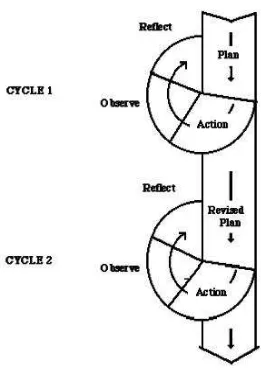
researcher uses a Classroom Action Research (CAR) designed by Kemmis and
Mc Taggart model that consist of four steps namely, planning, acting, observing,
and reflecting. Improvement the problem in this research is brought about by the
series of cycle. The figure is bellow:
25
Figure 3.1: Acti Taggar
The procedure
Each cycle contain
reflection. Before the
the basic knowledge o
26
Rochiati Wi
Meningkatkan Kinerja G
ction Research Spiral, Model from Kem aggart26
dures of research are performs by administrat
n four steps which are planning, action, obse
the cycle I begun, orientation test is administr
e of the students about speaking ability.
Wiriatmadja, (2006), Metode Penelitian Tindaka ja Guru dan Dosen),Bandung: Remaja Rosdakarya, p. 66
emmis and Mc
rating two cycles.
on, observation, and
nistrated to identify
ndakan Kelas (Untuk
3.2.1 Cycle I a. Planning
Planning is arrangement for doing something. In planning the researcher
prepare everything that will be needed in learning process. The following points
are the specification of the planning are first cycle:
- Analyze the students’ problem in speaking
- Conducting the cycle in two meetings.
- Preparing material for speaking skill.
- Conducting pre-test in order to know the students’ basic ability in mastery
speaking.
- Conducting a test of speaking skill with Action Learning strategy in last
meeting.
- Preparing the instrument for collecting data, such as diary notes,
observation, interview sheets and documentation.
b. Action
Action is process doing things, it is implementation of planning. In this step,
the students will be taught how to improve speaking skill with Action Learning
strategy.
- Explain the purpose of action learning strategy in learning English.
- Devide students into eight groups.
- Assign task to each group to memorize the vocabulary associate with the
material and make a conversation.
- Asks the students to practice speaking with the vocabulary that has been
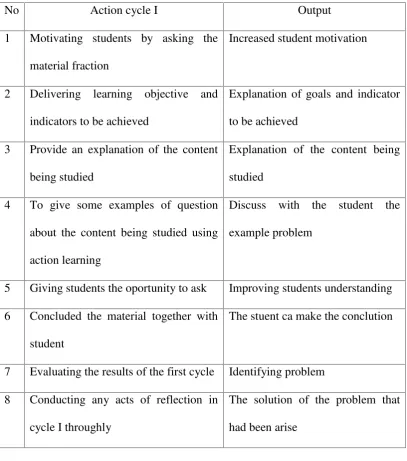
Table 3.1 Activity Cycle I
No Action cycle I Output
1 Motivating students by asking the
material fraction
Increased student motivation
2 Delivering learning objective and
indicators to be achieved
Explanation of goals and indicator
to be achieved
3 Provide an explanation of the content
being studied
Explanation of the content being
studied
5 Giving students the oportunity to ask Improving students understanding
6 Concluded the material together with
student
The stuent ca make the conclution
7 Evaluating the results of the first cycle Identifying problem
8 Conducting any acts of reflection in
cycle I throughly
The solution of the problem that
had been arise
c. Observation
In this stage the researcher conducted several activities as follows:
Observed during the process of learning about students speaking skill and learning
process using observation sheets that had been prepared.
- Make notes suitability study process undertaken based o indicators of
speaking skill
d. Reflection
Reflection implemented based on the analysis of data from observation
and evaluation activities. Reflections conducted to determine the extent to which
media can enhance students speaking skills and to know the advantages and
disadvantages of the implementation of learning process which has been
implemented to avoid recurrence on the second cycle and overcome obstacles that
may be encountered on the second cycle.
3.2.2 Cycle II a. Planning
Activity of which is in the palnning cycle II is the same as planning to
cycle I. The palnning stages on the second cycle based on the result of reflection
of the activity cycle I. Planning is done to avoid the shortage and obstacles that
occur in the first cycle both on students and on the implementation process of
learning to improve students speaking skill. In this cycle consist of two meetings.
The first and second meeting on the second cycle is presented in the material daily
routines.
b. Action
Activities undertaken in this phase is to implement lesson plans that have
been planned and developed from the implementation of the first cycle of the
learning process accordance with lesson plans that have been previously design to
c. Observation and evaluation
As in cycle I, observation and evaluation activities carried out to determine
the changes in students speaking skill.
d. Reflection
At the end of the second cycle, the observation of later researchers to find
weakness and excellence in learning. Reflection include:
- Disclosure of the result of observation about the advantages and
disadvantages of learning in understanding the concept by using action
learning
- Reveal the action that have been conducted during the student learning
progress poses
- Disclose the action taken by the teacher during the learning and teaching
process. The things that reflected the discussion with the class teacher
concerned.
3.3 Subject of the Research
The subject of the research was the students of VIII-A of MTs PAB 1
Helvetia who were in the second semester by the academic year of 2016/2017.
There were 44 students in the classroom, with detail of 22 male students and 22
female students.
Class Students
Total
VIII-A Male Female
3.4 Time of the Research
The research study was conducted in the second semester of the academic
year of 2016/2017. The actions were carried out in March-April 2017. The
observation was done on April 2017.
3.5 Procedure of Observation
The Classroom Action Research (CAR) using Kemmis and Taggart design
consists of four phases, they are planning, acting, observing, and reflecting, after
doing four phases called one cycle. After finishing the first cycle, it might be
found a new problem or the previous unfinished problem yet. Therefore, it is
necessary to continue to the second cycle in line it the same concept of the first
cycle. Here are the explanations about four phases:
1. Planning Phase
A planning phase was done after identifying and diagnosing students’
speaking problem occurred in the class proven by observing and interviewing;
furthermore in this phase the planning is divided into two types. Those are general
planning and specific planning.
The general planning is aimed at organizing whole aspects referred to
Classroom Action research (CAR). Meanwhile the specific planning is aimed at
organizing the plan related to cycle-to-cycle. The organized planning will be
formed into lesson planning based on the current used syllabus. The lesson plan
has been prepared to be implemented in VIII grade at MTs PAB 1. It has been
mentioned some instruction regarding procedures of teaching media, resources,
2. Acting Phases
The acting phase in the principle is a realization from an act which has
been planned before such as hat the strategy used, what material be taught and
others. Acting phase is where both the researcher and the teacher collaborate to
carry out the planned action. The teacher uses the determined strategy as she is
teaching while the research observes the class condition during teaching learning
activity.
In this phase it begins the process of going more deeply into the issue
being researched, it takes two weeks within two cycles in which each cycle
consists of two meetings in action. Wina Sanjaya states that the acting phase
should be implemented at least two cycles continuously and the time period for
each cycle depends on the material needs that existed in the semester or annual
designed by the teacher.27
3. Observing Phase
In this phase, the researcher and the teacher collaboratively to write all
events which is happen in the class, and also carries out observation toward
implementation of the action using field note or unstructured observation sheet.
The researcher observed the outcomes of the intervention and reflecting on its
effectiveness. When observing, the observer should notice and note all of activities in the physical classroom. It may be about the teacher’s performance,
class situation, and students’ response. In this phase, it also collects the data
derived from evaluation or post-test.
27
4. Reflecting Phase
This phase is aimed to reflect or evaluation from three phases before. It is
done based on data that have been collected to hold evaluation for completing the
next cycle. Thus, te reflection is able to be determined after implementing the
action and observation outcomes. If there still might have found some problems, it
needs to move to the next cycle until t solve.
3.6 Instrument of Collecting Data
The instrument of collecting data is used by the researcher to get the data
observation by using:
1. Observations: is a technique for collecting data about researcher and students’
activities in teaching and learning process. Then observation sheet is given
based on reality in the classroom, the type of observation which is used in this
research is direct observation.
2. Interview: used to get data about implementation of Classroom Action
Research (CAR) to the teacher.
3. Questionnaire: it conducted both before and after implementing Classroom
Action Research (CAR).
4. Test: is used for getting data research result and students activities in teaching
learning. There are two tests used in this research as follows:
a. Pre-test is done before implementing the Classroom Action Research
(CAR).
b. Post-test is implemented after implementing the Classroom Action
5. Documentation: To collect all the data, a camera were utilized to record the students’ performance in the teaching and learning process.
3.7 Technique of Collecting Data 3.7.1 The Quantitative Data
In collecting the data, the writer tested the students by asking them to give
a report orally either in individual test or group test based on the topic given. The
time given was ninety minutes. In scoring the data of speaking test, the writer
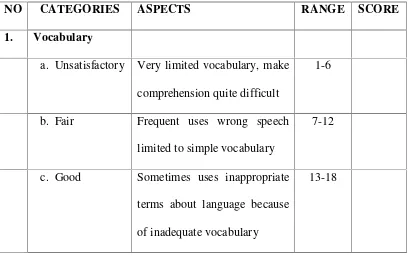
used the catagory that evaluntes for critirions. Each criterion was scored 25 point.
So for all criterions students would get 100 point. Every aspect of speaking was
arranged from 0-25. The catagories are vocabulary, pronunciation, accurancy, and
fluency.28
Table 3.2 English Language Speaking Skills Asssement Collects
NO CATEGORIES ASPECTS RANGE SCORE
1. Vocabulary
a. Unsatisfactory Very limited vocabulary, make
comprehension quite difficult
1-6
b. Fair Frequent uses wrong speech
limited to simple vocabulary
7-12
c. Good Sometimes uses inappropriate
terms about language because
of inadequate vocabulary
13-18
28
d. Very Good Rarely has trouble 19-25
2. Pronunciation
a. Unsatisfactory Had to understand because of
sound, accent, pitch, difficult,
incomprehensible
1-6
b. Fair Error of basic pronunciation 7-12
c. Good Few noticeable errors 13-18
d. Very Good Understandable 19-25
3. Accurancy
a. Unsatisfactory Usage definitely
unsatisfactory, frequently
needs to rephrase construction
or restrict himself to basic
c. Good Occasional grammatical errors
utterances are below noemal,
long pause, utterance left
unfinished
b. Fair Some definite stumbling, but
manage to rephrase and
continue
7-12
c. Good Speech is generally natural 13-18
d. Very Good Understandable 19-25
Total score 100
3.7.2 The Qualitative Data a. Observation
In this case, the researcher uses the unstructured observation to get the real
condition in teaching learning process. During the observation, the researcher
make the observation notes about situation in the class, covers teacher’s performance in teaching speaking and students’ speaking skills (such as;
pronunciation, vocabulary, grammar, and their braveries to speak) and take
photograph and video.
b. Interview
Before implementing the research, the researcher interviewed the teacher about students’ difficulties in the speaking skill, students’ condition in speaking
activity, and the kinds of strategies usually adopted by the teacher in teaching
research to know the teacher’s response toward the idea of implementing the role
play technique in improving students’ ability in speaking.
c. Test
The researcher used the oral test for the students. The test used in this
study is the pre-test and the post-test. The pre-test was done before implementing action learning strategy. It was used to measure students’ speaking ability at first.
Meanwhile, the post-test was implemented after using the action learning strategy.
d. Documentation
The researcher used a camera to collect all the data. Camera were utilized to record the students’ performance in the teaching and learning process.
3.8 Technique of Analysis Data
This study applied the quantitative and qualitative data. The quantitative
data was used to analyze the score of students while the qualitative data was used
to describe the situation during on the tesching process. By applying this data, it
was assumed to get the satisfying result of the improving ability in speaking
through action learning strategy. The qualitative data was analyzed from the
instrument. The quantitative data was analyzed to see the improving of students
speaking ability. The writer searched the mean of each post test from every cycle.
The writer applied the following formula:
X =
Where :
∑X = The total score
N = The member of the students29
In order to categories the member of master students, the writer used the
following formula:
P = x 100 %
Where:
P = The percentage of students who get the point 75
R = The number of students who get point up to 75 above
T = The total of students who do the test
Then, after getting mean of students’ score per actions, the writer
identifies whether or not there might have students’ improvement score on
speaking skill from pre-test and post-test score in cycle 1 and cycle 2. In
analyzing that, the writer uses the formula:
P = 100%
Where:
P = Percentage of students’ improvement
y = Pre-test result
= Post-test I
29Anas Sudijono, (2014),Pengantar Statistik Pendidikan, Jakarta: Raja Grafindo
P = 100%
Where:
P = Percentage of students’ improvement
y = Pre-test result
CHAPTER IV
DATA ANALYSIS AND RESEARCH FINDINGS
4.1 The Data
The data of this study are qualitative and quantitative data. The qualitative
data were taken from interview with teacher and students of MTs PAB 1 Helvetia,
observation sheet and documentation. The quantitative data were tajen from the
mean of students score in some tests. This research was conducted in VIII-A class
with 44 students. This research was accomplished in two cycles. Each cycle
consisted of four steps of action research (planning, action, observation, and
reflection). The first cycle including pretest conducted in three meetings, and the
second cycle was conducted in two meetings. In the last meeting of each cycle,
the students were taken test as the post test consist of post test I for cycle I and
post test II for cycle II.
4.1.1 The Quantitative Data
The Quantitative data were taken from the tests result in the class, which
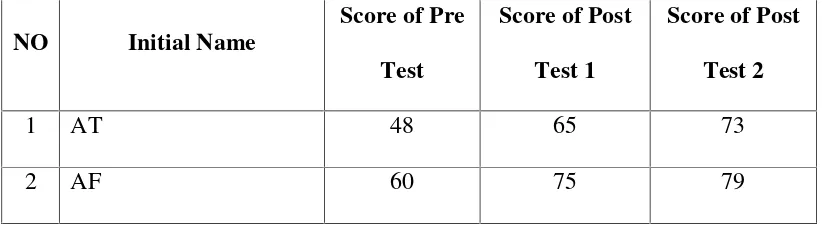
was carried out in two cycles, there was five meetings were conducted. The test
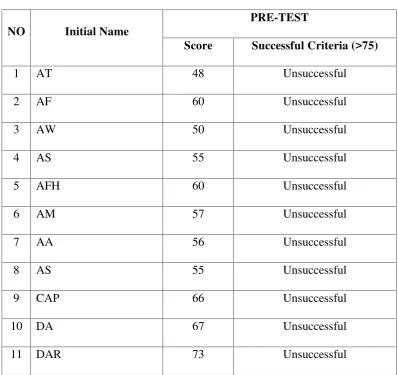
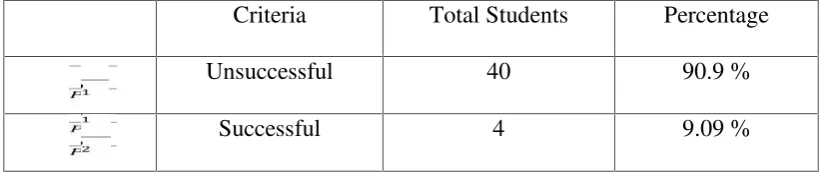
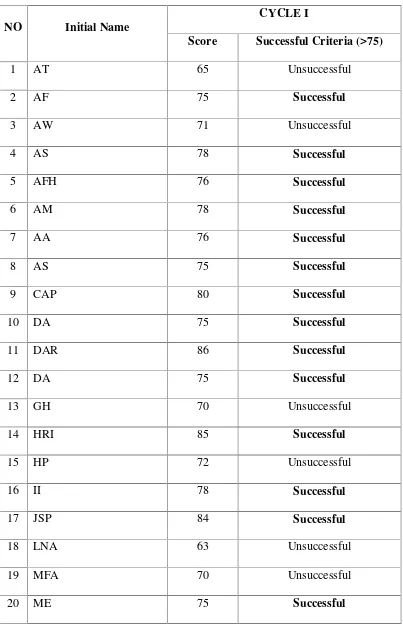
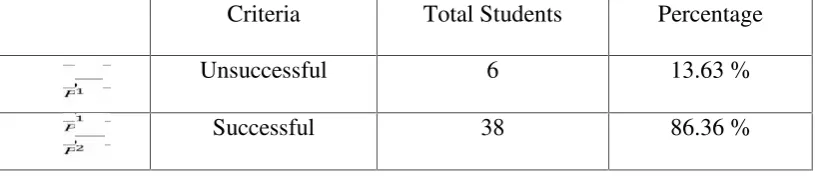
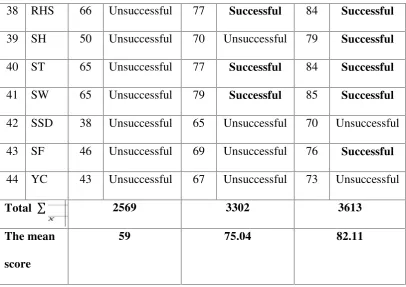
was given to the tudents in forms of pre-test, post test of cycle I and cycle II. The result of the students’ score could be seen in the following tables and charts.
3 AW 50 71 78
4 AS 55 78 83
5 AFH 60 76 81
6 AM 57 78 86
7 AA 56 76 80
8 AS 55 75 80
9 CAP 66 80 88
10 DA 67 75 85
11 DAR 73 86 90
12 DA 60 75 86
13 GH 56 70 79
14 HRI 80 85 90
15 HP 47 72 84
16 II 65 78 87
17 JSP 79 84 90
18 LNA 40 63 71
19 MFA 46 70 78
20 ME 63 75 81
21 MAW 78 82 89
22 MMI 54 69 75
23 MRT 78 83 89
24 MA 49 62 70
26 MRL 65 78 88
27 NS 63 75 87
28 NA 67 79 88
29 NAY 58 75 86
30 ND 71 83 90
31 NOP 69 76 85
32 NI 61 75 83
33 NS 59 79 87
34 PA 48 68 76
35 RRB 57 78 80
36 RP 56 77 85
37 RAL 49 65 71
38 RHS 66 77 84
39 SH 50 70 79
40 ST 65 77 84
41 SW 65 79 85
42 SSD 38 74 70
43 SF 46 69 76
44 YC 43 69 73
Total∑ X 2569 3302 3613