THIS REPORT CONTAINS ASSESSMENTS OF COMMODITY AND TRADE ISSUES MADE BY USDA STAFF AND NOT NECESSARILY STATEMENTS OF OFFICIAL U.S. GOVERNMENT POLICY
-
Date: GAIN Report Number:
Post:
Report Categories:
Approved By:
Prepared By:
Report Highlights:
The agreement in principle between Japan and the European Union (EU) on a free trade deal in July 2017, and a potential Trans-Pacific Partnership (TPP-11) arrangement, could leave U.S. pork exports at a significant tariff disadvantage relative to competitors. The two agreements are likely to contain similar tariff concessions for a wide range of pork products including fresh, chilled, and frozen pork as well as processed products such as ham, bacon, sausage, ground seasoned pork, and canned ham. The Japan-EU agreement could enter into force as early as 2019 while Japan continues to advocate for a TPP-11 arrangement without the United States.
Alexander Blamberg Gary Meyer
Livestock and Products Agricultural Situation
U.S. Pork Faces Tariff Headwinds in Japan
TokyoJapan
JA7135 11/2/2017 Public
General Information:
On July 6, 2017, Japan and the European Union (EU) announced a framework agreement for the Japan-EU Economic Partnership Agreement (EPA). Japan’s Ministry of Agriculture, Forestry, and Fisheries (MAFF) published on its website a summary of the tariff reductions for several EU agricultural products which largely resemble the concessions that Japan made in the Trans-Pacific Partnership agreement. Meanwhile, Japan is advocating for modifications to the Trans-Pacific Partnership (herein referred to as TPP-11) that would allow it to enter into effect without the United States. It can be reasonably expected
that Japan’s concessions for pork will remain largely unchanged in a TPP-11 agreement, meaning that
key pork suppliers to Japan such as Mexico and Canada would enjoy virtually the same treatment as EU suppliers (primarily Denmark and Spain) under the Japan-EU EPA.
Duty Treatment for Fresh, Chilled, and Frozen Pork Cuts
Under World Trade Organization (WTO) most-favored nation (MFN) treatment, Japan applies a variable duty to imported fresh, chilled, and frozen pork up to 482 yen/kg for products valued below a specific price threshold (524 yen/kg) in addition to a 4.3 percent ad valorem tariff on all fresh, chilled, and frozen pork imports. This gate price system is explained in further detail in Pork Policies in Japan by the USDA’s Economic Research Service (March 2003).
Under the Japan-EU EPA, the maximum variable duty levied on imports valued below the gate price will immediately fall from 482 yen/kg to 125 yen/kg in Year 1 of the agreement entering into force. In Year 5, the duty will drop to 70 yen/kg. The duty will continue to decrease annually until it reaches the final level of 50 yen/kg in Year 10. It is not yet publicly known if the annual tariff reductions occur in equal stages. The ad valorem tariff of 4.3 percent will immediately drop to 2.2 percent in Year 1, then decrease annually until the tariff is eliminated in Year 10. TPP-11 will have the same tariff schedule if the terms negotiated in the original Trans-Pacific Partnership remain unchanged. See Table 1.
Table 1: Duties for Fresh, Chilled and Frozen Pork Cuts subject to the Gate Price System
Treatment Variable duty Ad valorem duty
WTO MFN Tariff Up to 482 yen/kg 4.3% Japan-EU EPA Tariff Year 1: 125 yen/kg
↓ decrease annually
Chart 1 below demonstrates how the ad valorem duty in the Japan-EU EPA and TPP-11 is expected to
decrease over time compared to Japan’s MFN commitments and existing trade agreements with Mexico
Note that the above annual phase-out levels for the EU and TPP-11 countries are illustrative and have not been confirmed by the Government of Japan. The current 2.2 percent tariff for Mexico and Chile is applied only to imports coming in under a tariff-rate quota (out of quota imports pay the MFN rate). TPP-11 treatment would likely replace the current FTA treatment for Mexico and Chile.
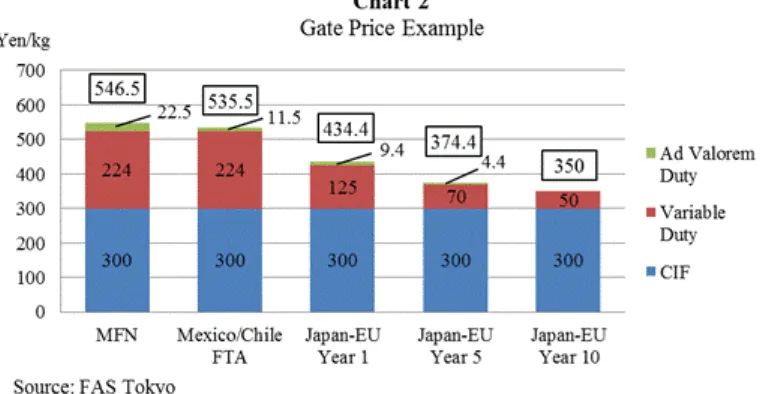
Chart 2 below shows illustratively how the variable duty and ad valorem duty would apply to fresh, chilled, or frozen pork product priced at 300 yen/kg CIF under the current MFN rates and at various stages of implementation of the Japan-EU EPA.
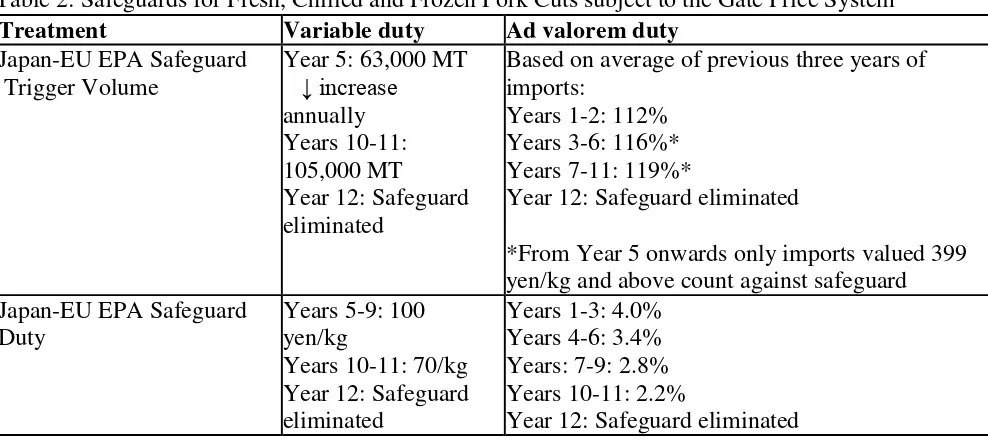
Table 2 below describes the safeguard mechanism for fresh, chilled, and frozen pork imports under the Japan-EU EPA. There are separate volume-based safeguard triggers for the variable duty and ad valorem duty. If one of the safeguards is triggered, the corresponding duty will increase for the
fiscal year basis (April-March). Both safeguards will end in Year 12 of the agreement. TPP-11 is expected to have a similar percentage-based safeguard volume based on the TPP-12 outcome, but the quantity-based safeguard volume could be modified slightly to reflect fewer members of the agreement.
Table 2: Safeguards for Fresh, Chilled and Frozen Pork Cuts subject to the Gate Price System
Treatment Variable duty Ad valorem duty
Japan-EU EPA Safeguard
Based on average of previous three years of imports:
Years 1-2: 112% Years 3-6: 116%* Years 7-11: 119%*
Year 12: Safeguard eliminated
*From Year 5 onwards only imports valued 399 yen/kg and above count against safeguard Japan-EU EPA Safeguard
Year 12: Safeguard eliminated Source: MAFF
Duty Treatment for Processed Pork Products subject to Gate Price (Cured Ham, Bacon, etc.)
Certain processed products, including cured ham and bacon, are also subject to a gate price system under WTO MFN treatment. The gate price is set at 897.59 yen/kg with a maximum variable duty of 614.85 yen/kg and an ad valorem duty of 8.5 percent. Under the Japan-EU EPA, the variable duty will be cut to 307.87 yen/kg and the ad valorem duty will be cut to 4.3 percent in Year 1. The duties will decrease annually, reaching 154.38 yen/kg and 2.2 percent in Year 5. The duties will continue to fall annually until they are eliminated in Year 11, making the corresponding products tariff free. See Table 3.
Table 3: Processed Pork Products (including Ham and Bacon) subject to the Gate Price System
Treatment Variable duty Ad valorem duty
WTO MFN Tariff Up to 614.85 yen/kg 8.5% Japan-EU EPA Tariff Year 1: 307.87 yen/kg
↓ decrease annually Year 5: 154.38 yen/kg
↓ decrease annually
ends in Year 12. See Table 4.
Table 4: Processed Pork Products (including Ham and Bacon) subject to the Gate Price System
Treatment Safeguard Remedy
Japan-EU EPA Safeguard Volume Based on average of previous three years of imports: Years 1-2: 115%
Years 3-6: 118% Years 7-11: 121%
Year 12: Safeguard eliminated Japan-EU EPA Safeguard Duty Years 1-4: 85% of MFN duties
Years 5-9: 60% of MFN duties Years: 9-11: 45% of MFN duties Year 12: Safeguard eliminated Source: MAFF
Duty Treatment for Processed Pork Products not subject to Gate Price (Canned Ham, Sausages, Ground Seasoned Pork, etc.)
Certain processed pork products such as canned ham, sausages, and ground seasoned pork are not subject to the gate price system. Under the Japan-EU EPA, tariffs for these products, which range from 10 to 20 percent, will be reduced in equal annual stages upon entry into force until the tariffs are
eliminated in Year 6. TPP-11 is expected to contain similar, if not identical, tariff treatment for the same products. See Table 5.
Table 5: Processed Pork Products not subject to Gate Price
Product MFN
Other processed pork not subject to gate price (including ground seasoned pork, canned ham)
20% 16.6% 13.3% 10.0% 6.6% 3.3% 0%
Source: MAFF
A safeguard mechanism is not expected to be established for these products under the Japan-EU EPA or the TPP-11 agreement.
Current Market Trends for U.S. Pork Exports to Japan
In 2016, Japan was the leading export market for U.S. pork valued at $1.6 billion. In the fresh and chilled market, the United States was the top exporter to Japan accounting for 58 percent of the market. Canada, which has increased its share in recent years, accounted for 39 percent while Mexico, the third largest importer, accounted for just 3 percent. Both Canada and Mexico are members of the TPP-11 negotiating group. The EU is largely uncompetitive in this sector due to the long transport distance required for fresh/chilled product. See Chart 3.
The EU was the largest frozen pork exporter to Japan with a 62 percent share of the market in 2016. Within the EU, Denmark and Spain were the leading suppliers. Mexico was the second largest exporter, accounting for 13 percent of the market, followed by the United States at 11 percent and Canada at 8 percent. In recent years, both the EU and Mexico have increased their shares relative to the United States and Canada. See Chart 4.
More information on the Japanese pork market can be found in JA7110 (Livestock and Products Annual) dated September 20, 2017.