A REGION AT RISK
THE HUMAN DIMENSIONS
OF CLIMATE CHANGE
IN ASIA AND THE PACIFIC
ASIAN DEVELOPMENT BANK
A REGION AT RISK
THE HUMAN DIMENSIONS
OF CLIMATE CHANGE
Printed on recycled paper
Creative Commons Attribution 3.0 IGO license (CC BY 3.0 IGO)
© 2017 Asian Development Bank
6 ADB Avenue, Mandaluyong City, 1550 Metro Manila, Philippines Tel +63 2 632 4444; Fax +63 2 636 2444
www.adb.org
Some rights reserved. Published in 2017.
ISBN 978-92-9257-851-0 (Print), 978-92-9257-852-7 (e-ISBN) Publication Stock No. TCS178839-2
DOI:http://dx.doi.org/10.22617/TCS178839-2
The views expressed in this publication are those of the authors and do not necessarily relect the views and policies of the Asian Development Bank (ADB) or its Board of Governors or the governments they represent.
ADB does not guarantee the accuracy of the data included in this publication and accepts no responsibility for any consequence of their use. The mention of speciic companies or products of manufacturers does not imply that they are endorsed or recommended by ADB in preference to others of a similar nature that are not mentioned.
By making any designation of or reference to a particular territory or geographic area, or by using the term “country” in this document, ADB does not intend to make any judgments as to the legal or other status of any territory or area.
This work is available under the Creative Commons Attribution 3.0 IGO license (CC BY 3.0 IGO)
https://creativecommons.org/licenses/by/3.0/igo/. By using the content of this publication, you agree to be bound by the terms of this license. For attribution, translations, adaptations, and permissions, please read the provisions and terms of use at https://www.adb.org/terms-use#openaccess
This CC license does not apply to non-ADB copyright materials in this publication. If the material is attributed to another source, please contact the copyright owner or publisher of that source for permission to reproduce it. ADB cannot be held liable for any claims that arise as a result of your use of the material.
Please contact [email protected] if you have questions or comments with respect to content, or if you wish to obtain copyright permission for your intended use that does not fall within these terms, or for permission to use the ADB logo.
Notes:
In this publication, “$” refers to US dollars.
Corrigenda to ADB publications may be found at http://www.adb.org/publications/corrigenda Figures, tables, and boxes without explicit sources are those of the authors.
FOREWORD iv
ACKNOWLEDGMENTS vi
TABLES, FIGURES, AND BOXES vii
ABBREVIATIONS ix
EXECUTIVE SUMMARY x
INTRODUCTION 1
Part 1 ASIA AND THE PACIFIC AT A GLANCE 7
1.1 Asia and the Paciic: Its Geography 9
1.2 Asia and the Paciic: Its People 10
1.3 Asia and the Paciic: Its Economy 12
References—Introduction and Part 1 14
Part 2 CLIMATE CHANGE IN ASIA AND THE PACIFIC: OBSERVATIONS AND PROJECTIONS 17
2.1 Changes in Temperatures and Heat Extremes 19
2.2 Changes in Precipitation and Heavy Rainfall Events 24
2.3 Sea-Level Rise 27
2.4 Tropical Cyclones 33
2.5 Changes in Hydrology 38
2.6 Flooding Risks in Asian River Basins 42
References—Part 2 46
Part 3 CLIMATE CHANGE IMPACTS ON HUMAN SYSTEMS IN ASIA AND THE PACIFIC 53
3.1 Climate Change: Agriculture and Marine Ecosystems 55
3.2 Climate Change and Human Health 62
3.3 Climate Change and Urban Areas 69
3.4 Climate Change and Security 74
3.5 Climate Change and Migration 81
3.6 Climate Change and Trade Networks 95
References—Part 3 100
CONCLUSION 113
T
he historic Paris Agreement of 2015 has acknowledged that the global climate crisis is arguably the greatest challenge human civilization faces in the 21st century. In this context, the role of the Asia and Paciic region is characterized by a double dichotomy that entails simultaneously high risks and signiicant opportunities. Proper analysis guided by adequate information can result in investment and policy choices that will continue to promote sustainable economic development and eradicate poverty in the region.The irst dichotomy relates to the region accounting for an increasing overall share of global emissions of greenhouse gases (GHGs) harming not only the world but the region itself. At the same time however, countries of the region have the unprecedented opportunity to break the GHG-intensive development path by rapidly modifying the historical model of industrial development. The rapidly decreasing costs of wind and solar power generation clearly indicates that consumption and production of the future could be driven by renewable energy sources, though the when and where of this great transition remain uncertain.
The second dichotomy pertains to the already observed and anticipated future impacts of anthropogenic global warming. On the one hand, the rapid economic and human development of the region renders societies less vulnerable to the familiar vagaries of the environment—such as heat waves, heavy precipitation or tropical cyclones. In particular, the shift away from agriculture as the core sector guaranteeing livelihoods and the associated economic diversiication of the countries of the region help to increase resilience to weather extremes such as those experienced historically. Simultaneously however, the same developments have opened up new avenues of exposure and vulnerability. Coastal populations and assets are highly at risk from projected rises in sea level and the intensiication of extreme weather events. Urbanized populations are exposed to heat stress hazards. National and increasingly integrated regional economic systems are vulnerable to disruptions in supply chain networks. Populations are migrating away from areas where climate change impacts represent an increasing threat.
These rapidly emerging new climate vulnerabilities in the Asia and Paciic region need to be addressed with a portfolio of strategies involving capacity building, preparedness programs, urban and rural planning, national and social security schemes, proactive migration and numerous others. Crucial preconditions for success are whole-systems and long-term thinking and planning, based on the best available data, analysis, and modeling.
This report aims to inform developing member countries of the most recent regional climate change projections and to assess the consequences of these changes for human systems. It also highlights gaps in the existing knowledge pertaining to the impacts of climate change, and identiies avenues where research continues to be needed. The information and insights presented in this report will contribute to scaling up the eforts of the Asian Development Bank (ADB) in building climate resilience in its developing member countries in the years and decades to come.
v
ForewordThis report is the outcome of a collaboration of ADB with the Potsdam Institute for Climate Impact Research (PIK).
PIK was founded in 1992. With its team of researchers in the ields of natural and social sciences, PIK generates fundamental knowledge for sustainable development primarily through data analysis and computer simulations of the dynamic processes in the earth system, and through the study of social dynamics. PIK plays an active role in the international research community such as in the Intergovernmental Panel on Climate Change, and has initiated the Nobel Laureate Symposium on questions of global sustainability.
Since the early 1990s, ADB has provided support and assistance to countries of the region in coping with the adverse impacts of climate change. The nature and extent of this support and assistance have considerably evolved and are now multifaceted. With the recent adoption of its Climate Change Operational Framework 2017-2030, and its commitment to achieve $2 billion in adaptation inancing by 2020, ADB has asserted its strong commitment to support developing member countries to achieve climate resilient development outcomes. This initiative further underscores ADB’s commitment to provide appropriate and relevant knowledge to its developing member countries enabling them to design responses to the emerging challenges from climate change. The report also highlights the premium ADB places on its partnerships with knowledge institutions such as this joint work with PIK.
Bambang Susantono
Vice-President for Knowledge Management and Sustainable Development
Asian Development Bank
Professor Hans Joachim Schellnhuber CBE
Executive Summary
vi
T
his report has been written by a team of experts from the Potsdam Institute for Climate Impact Research (PIK) in collaboration with a team of experts from the Asian Development Bank (ADB).The team of authors at PIK includes Kira Vinke, Hans Joachim Schellnhuber, Dim Coumou, Tobias Geiger, Nicole Glanemann, Veronika Huber, Jürgen Kropp, Stefen Kriewald, Jascha Lehmann, Anders Levermann, Anastasia Lobanova, Maria Knaus, Christian Otto, Christopher Reyer, Alexander Robinson, Diego Rybski, Jacob Schewe, Sven Willner, Michel Wortmann, Fang Zhao, and Bin Zhou.
The team of authors at ADB includes Benoit Laplante, Xianfu Lu, and Charles Rodgers. Benoit Laplante and Kira Vinke acted as the overall technical editors of the report.
The writing of this report would not have been possible without the contributions of numerous individuals. We are thankful for the research assistance and technical support of Matthias Büchner, Astrid Gläsel, Dennis Hof, Lennart Lagmöller, David Lowis, Sophia Rottmann, Lisa Murken, Martin Wodinski, Rexel Abrigo (Climate Change Oicer (Adaptation), ADB), Kae Sugawara (editor), and Rommel Marilla (lay-out).
We are especially grateful to the following individuals for their review of an early version of the report: Akm Mahfuzzudin Ahmed (Advisor, Sustainable Development and Climate Change Department, ADB), Maria Pia Ancora (Climate Change Specialist, East Asia Department, ADB), Eduardo Banzon (Principal Health Specialist, Sustainable Development and Climate Change Department, ADB), Edimon Ginting (Director, Economic Analysis and Operational Support Division, Economic Research and Regional Cooperation Department, ADB), Richard Jones (United Kingdom Met Science Fellow, Met Oice Hadley Centre), Soonman Kwon (Technical Advisor [Health], ADB), David Anthony Raitzer (Economist, Economic Research and Regional Cooperation Department, ADB), Jay Roop (Senior Natural Resource Management Specialist, Paciic Department, ADB), Jindra Nuella Samson (Senior Economics Oicer, Economic Analysis and Operations Support Division, Economic Research and Regional Cooperation Department, ADB), Yasmin Siddiqi (Principal Water Resources Specialist, Sustainable Development and Climate Change Department, ADB), and Joel Smith (Principal Associate, Abt Associates).
We would like to sincerely thank Hans Joachim Schellnhuber (Director, PIK) and Preety Bhandari (Director, Climate Change and Disaster Risk Management Division, Sustainable Development and Climate Change Department, ADB) for their overall guidance and direction.
Executive Summary
vii
TABLES
1.1 Population of the Urban Agglomerations with 5 Million Inhabitants or More in 2014 11 1.2 Share of Area and Population of Low-Elevation Coastal Zones in Selected Countries of
Asia, 2000
11
1.3 Projected Population in Low-Elevation Coastal Zones and Flood Plains in Selected Countries of Asia
12
1.4 Countries with Sector Shares of Gross Domestic Product (2012) 13
1.5 Electricity Generation Mix, 2010 13
2.1 Projected Average Temperature Changes for the Land Area of Asia 21
2.2 Percentage of Land Area at Risk of Heat Extremes 24
2.3 Projected Contribution to Future Sea-Level Rise for 2100 Relative to the Reference Period 1986–2005
31
3.1 Relative Changes in Crop Yields under Climate Change in 2050 Relative to 2000 under the A1B Scenario in Selected Countries of the Paciic (Worse-Case Scenarios)
57
3.2 Dam Storage, Storage per Capita, and Storage as a Percentage of Renewable Water Resources
59
3.3 Projected Annual Morbidity and Mortality from Diarrhea by Selected Country (All Ages) under a High Emissions Scenario
65
3.4 Predicted Annual Morbidity and Mortality from Dengue and Malaria by Selected Country under a High Emissions Scenario
68
3.5 Recommendations to Address Climate Change Induced Migration 93
FIGURES
1.1 Number of Cities of Varying Size in Asia and the World—2014 10
2.1 Multimodel Average Temperature Anomaly in June—August 20
2.2 Temperature Projections for the Land Area of Asia 21
2.3 Projected Frequency of Heat Extremes 23
2.4 Projected Percentage of Land Area Afected by Heat Extremes 24
2.5 Projected Change in Precipitation 26
Tables, Figures, and Boxes
viii
2.6 Reconstructed Sea-Level Rise over the Last 2,500 Years 28
2.7 Projected Total Anthropogenic Sea-Level Rise for the 21st Century 29
2.8 Sea-Level Contribution of the Large Ice Sheets 30
2.9 Coastal Regions Most Vulnerable to a Climate Change-Related Sea-Level Rise (Asia and the Paciic)
32
2.10 Tropical Cyclones Frequency in Asia and the Paciic 34
2.11 Projected Population of Asia and the Paciic at Risk Under Diferent Socioeconomic Scenarios
37
3.1 Estimated Future Annual Additional Deaths of Children Attributable to Climate Change 64 3.2 Estimated Future Annual Additional Deaths of Elderly Attributable to Climate Change 67 3.3 Estimated Future Annual Additional Deaths Attributable to Climate Change 67
3.4 Population Density in Asia 70
3.5 Heat Island Efect in Kochi (India) and Baguio City (Philippines) 71 3.6 Urban Heat Island Intensity in Selected Cities of Asia and the Paciic 72
3.7 Potential Impacts of Climate Change on Energy Insecurity 76
3.8 Possible Impacts of Climate Change-Related Resource Shortages on Rural and Urban Populations
79
3.9 Subregional Analysis of Climate Change-Related Migration 84
3.10 Bangladesh—Climate Impacts and Possible Migration Routes 85 3.11 Philippines—Climate Impacts and Possible Migration Routes 87 3.12 People’s Republic of China—Climate Impacts and Possible Migration Routes 88 3.13 Indus Delta—Climate Impacts and Possible Migration Routes 89
3.14 Tuvalu—Climate Impacts and Possible Migration Routes 91
3.15 Mekong Delta—Climate Impacts and Possible Migration Routes 92 3.16 Production Interdependencies Illustrated for India in 2011 97
3.17 Global Consumption Changes 98
BOXES
3.1 Pakistan Floods of 2010 and Diarrheal Diseases 63
3.2 Heat Wave 2015 in India 66
3.3 Large Outbreaks of Dengue in 2015/16 in South Asia and Southeast Asia 69
Executive Summary
ix
°C degrees Celsius
ADB Asian Development Bank
AR5 Fifth Assessment Report of the IPCC ADB Asian Development Bank
CMIP5 Coupled Model Intercomparison Project Phase 5
CO2 carbon dioxide
DEMs digital elevation models
DIVA Dynamic and Interactive Vulnerability Assessment
DJF December–January–February ENSO El Niño Southern Oscillation GCM General Circulation Model GDP gross domestic product GHG greenhouse gas
GLOF glacial lake outburst lood IAM integrated assessment model ICIMOD International Centre for Integrated
Mountain Development
IPCC Intergovernmental Panel on Climate Change ISIMIP Inter-Sectoral Impact Model
Intercomparison Project JJA June–July–August
ABBREVIATIONS
km/h kilometer per hour km² square kilometer
Lao PDR Lao People’s Democratic Republic LECZ low-elevation coastal zones
m meter
mm/year millimeter per year NIO North Indian Ocean PDO Paciic Decadal Oscillation PRC People’s Republic of China
RCP Representative Concentration Pathway SIO Southern Indian Ocean
SLR sea-level rise
SPO Southern Paciic Ocean
SRTM Shuttle Radar Topography Mission SSP shared socioeconomic pathway SST sea surface temperature UHI urban heat island
UNFCCC United Nations Framework Convention on Climate Change
WHO World Health Organization
Executive Summary
x
T
he Asia and Paciic region is extremely vulnerable to the impacts of climate change. Unabated warming could signiicantly undo previous achievements of economic development and improvements of living standards. At the same time, the region has both the economic capacity and weight of inluence to change the present fossil-fuel based development pathway and curb global emissions. This report sheds light on the regional implications of the latest projections of changes in climate conditions over Asia and the Paciic. The assessment concludes that, even under the Paris consensus scenario in which global warming is limited to 1.5°C to 2°C above preindustrial levels, some of the land area, ecosystems, and socioeconomic sectors will be signiicantly afected by climate change impacts, to which policy makers and the investment community need to adapt to. However, under a Business-As-Usual (BAU) scenario, which will cause a global mean temperature rise of over 4°C by the end of this century, the possibilities for adaptation are drastically reduced. Among others, climate change impacts such as the deterioration of the Asian “water towers”, prolonged heat waves, coastal sea-level rise and changes in rainfall patterns could disrupt ecosystem services and lead to severe efects on livelihoods which in turn would afect human health, migration dynamics and the potential for conlicts. This assessment also underlines that, for many areas vital to the region’s economy, research on the efects of climate change is still lacking.Temperature Change
With unabated climate change, mean summer temperatures are expected to increase by more than 6°C above preindustrial levels by the end of the 21st century over some parts of the land of Asia. Locally, temperature changes can deviate signiicantly from mean changes in the global or regional temperature. Climate model projections indicate stronger summertime warming over higher latitudes in Asia where the temperature increase may reach up to 8°C.
Heat Extremes
The occurrence of heat extremes is more heterogeneously spread over the land mass of the region. Under the BAU scenario, summer temperatures considered unusual under current climate conditions might become the new norm from 2070 onward. Some areas, particularly in Southeast Asia, could enter into entirely new climate regimes due to frequent occurrence of unprecedented heat extremes.
Limiting global warming to 2°C would signiicantly lower the risk of severe heat extremes. Moreover, keeping global warming below 1.5°C would halve the percentage of Asian land areas expected to experience heat extremes compared to a 2°C warmer world.
Precipitation
Climate models project a general upward trend in annual mean precipitation over most of the land of the region toward the end of the 21st century. However, the magnitude of change is much larger for the BAU scenario than for the Paris consensus scenario. Both observations and state-of-the-art climate model projections show a pronounced increase in
Executive Summary
xi
the frequency and intensity of heavy rainfall events, particularly over Southeast Asia, which may thus face more severe looding if the global temperature continues to rise.
Sea-Level Rise
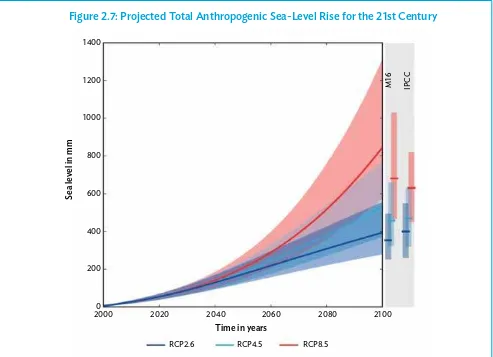
If the Paris Agreement is fully implemented, sea-level rise may be limited to 0.65 meters within the course of this century. Under the BAU scenario however, sea level may rise by 1.4 meters. Under both scenarios, sea level will continue to rise for many centuries to come. For every degree of global warming, the world is committed to an eventual sea-level rise in excess of 2.3 meters. Thus, even if the 2°C guardrail were to be respected, sea level would eventually rise by more than 5 meters over centuries and millennia.
Glaciers and Rivers
The glaciers across the High Mountain regions of Asia have shown measurable signs of recession. However, changes are highly heterogeneous. Available climate change impact assessments have shown an increase of both the risk of looding and water shortages, as the natural storage capacities of glaciers diminish while glacial lake outburst loods become more likely. As a result, the dependency on rainwater increases.
While looding risks will increase in the Asian monsoon region due to heavy precipitation and runof, it is also very likely that the region will face water shortages due not only to projected changes in climate but also to growing water demand from rapid population and economic growth. Options to cope with water scarcity may include integrated river basin management, adaptive management of old reservoirs, construction of new reservoirs, and techniques for eicient water use such as rainwater harvesting and water reuse.
Tropical Cyclones
Tropical cyclone activity by itself is driven by large internal variability that potentially prohibits the attribution of projected losses to diferent levels of global warming. Therefore, a quantiication of the efect diferent degrees of global warming could have on tropical cyclone impacts for the Asia and Paciic region remains challenging. Nevertheless, there is a projected upward trend in damages under a warming climate. However, due to increasing tropical cyclone strength with rising global mean temperature and taking into account the cohazard of sea level rise, it is likely that a BAU climate development will lead to signiicantly higher losses than those under the climate associated with the Paris consensus climate scenario.
Agriculture
Climate change poses large, but regionally difering, threats to agriculture and food security in Asia through higher temperatures, drier conditions, sea-level rise, and looding. Major uncertainties pertaining to the extent of the threat relate to the potential efects of carbon dioxide fertilization.
Both biophysical climate impacts and ensuing impacts on development are likely to be substantial in the region. Currently, declining soil productivity, groundwater depletion, and declining water availability, as well as increased pest incidence and salinity, threaten food security in the region.
Fisheries and Reef Ecosystems
Executive Summary
xii
Security
Energy resources, natural resources and poverty are signiicant variables in the generation of conlicts. Their vulnerability to climate change impacts is likely to be a future driver of instabilities. The threat of energy insecurity emerges from potential grid infrastructure failure, a continued reliance on unsustainable fossil fuels and energy imports, intermittent performance of hydropower plants as a result of uncertain water discharges, and reduced capacities of thermal power plants as a result of an increasing scarcity of cooling water. Investments in fossil fuel production like coal-ired power plants could turn into stranded assets as renewable energy sources achieve market dominance. As energy demand in the Asian region rises, yet supply becomes insecure, conlicts are a potential outcome. All these factors considered, climate change poses signiicant challenges to human security in Asia in the coming decades. Policy makers and investors have the chance to step in and manage risk factors by creating spaces for regional to local mitigation and adaptation strategies in order to prevent potential escalation of conlicts.
Migration
Rising temperatures, reductions in water availability, as well as an increasing frequency and severity of disaster events are already causing human displacement—a trend that could be aggravated by future climate impacts. The depreciation and degradation of natural resources through climate change threatens to lead to an increase in rural poverty and migration to cities, which will in turn add to the growth of informal settlements. Cities, as a result, will be vulnerable to both global climate events, due to their reliance on global supply chains, and local disasters, due to the vulnerability of the makeshift settlements that migrants often inhabit in urban slums. While a 2°C temperature rise will already lead to moderate risks in some regions, a 4°C increase could trigger severe disruptions of ecosystem services vital to the Asian economy. This could lead to humanitarian disasters in many nations and result in unmanageable migration surges, or locked-in populations.
Cities
The challenges confronting the fast-growing Asian cities with regard to climate change are twofold: (i) many of them will be afected by the consequences of global warming, and (ii) they are part of the problem, as they emit a disproportionate amount of greenhouse gases largely due to the concentration of human activities in urban areas. Already today, the number of hot days in cities is twice as high as in the hinterland. By the end of the 21st century, this number could be 10 times higher.
Supply Chains
Disruption in supply chains caused by extreme weather events can propagate through the globalized trade network. Since Asia’s industries are particularly highly interlinked, extreme events in Asia can have strong repercussions within the region as well as in the rest of the world. Conversely, Asia’s production and consumption can sufer from events outside the region.
Tailored adaptation plans need to be developed by both private and public sectors to enhance the resilience to such shock cascades. These plans also necessitate cooperation among many countries in Asia. Further research on adaptation measures to be taken by diferent stakeholders is critically important to support such collective action.
Health
Executive Summary
xiii
52,000 cases by the 2050s. Attributable mortality related to vector-borne diseases (malaria and dengue) are estimated to be on the order of 3,000 annual deaths in the 2030s and 10,000 annual deaths in the 2050s. Yet, these estimates only represent a small portion of the climate impacts on human health to be expected because many known climate-sensitive health outcomes have so far been omitted from existing analysis.
M
ean global surface temperature has risen by approximately 1.1°C since the beginning of the Industrial Revolution. In a press communiqué published on 18 January 2017, the World Meteorological Organization (WMO) conirmed that 2016 was the warmest year since instrumental weather measurements began in 1880—directly following the previous record years 2014 and 2015 (WMO 2016). Indeed, 16 of the 17 warmest years registered in modern times have occurred since 2001. As pointed out by the Intergovernmental Panel on Climate Change (IPCC), this warming is largely the result of greenhouse gas emissions from human activities into the atmosphere (IPCC 2014). Ice caps are melting, oceans are acidifying, and the steadily rising sea level together with ever stronger typhoons are posing existential threats to the coastal regions of Asia and the Paciic (IPCC 2014).The last decade has been characterized by a surge in weather extremes (Rahmstorf and Coumou 2011; Coumou and Rahmstorf 2012). Robust evidence exists for a signiicant increase in the occurrence of heat waves and heavy rainfall events at the global scale (Coumou, Robinson, and Rahmstorf 2013; Lehmann, Coumou, and Frieler 2015). This has also been relected in an exceptional number of unprecedented climate extremes over the Asian continent. For example, in 2010, Pakistan experienced the worst looding in the country’s history. The unusually heavy monsoon rainfall led to approximately 3,000 deaths, left several million people homeless, and afected about half a million hectares of agricultural land (Hong et al. 2011). This inundation event was related to the unusual behavior of the jet stream, a band of strong westerly winds at an altitude of 10–12 kilometers. In late July and early August 2010, the jet stream was forced farther south than usual, dragging moist air to northern Pakistan where it met the advanced tropical monsoon front. This led to the devastating looding of the Indus River basin. Even further south, India sufered severe heat waves in both 2015 and 2016. Among other factors, a weak premonsoon season with little rainfall leading to dry soils and a strong El Niño phase contributed to this heat wave with local temperatures rising well above 50°C. With increasing global warming, such types of heat extremes are expected to intensify and become more frequent in the future—if not the new normal.
Higher ocean surface temperatures will increase the intensity of typhoons (Elsner, Kossin, and Jagger 2008; Knutson et al. 2010; Holland and Bruyère 2014; Kang and Elsner 2015). In November 2013, the Philippines was hit by typhoon Haiyan, the strongest storm ever recorded to strike land with 1-minute sustained wind gusts of 315 kilometers per hour (km/h). It has been shown that a concurrence of high sea surface temperatures, above normal ocean heat content, and elevated sea level considerably exacerbated the strength of the associated devastating storm surge (Trenberth, Fasullo, and Shepherd 2015). Ocean warming is severely impacting coral reefs. In combination with ocean acidiication caused by the increasing atmospheric concentration of carbon dioxide, large fractions of coral ecosystems are expected to face extinction even at 1.5°C global warming (Frieler et al. 2012). Coral bleaching has already been observed in the region of the Coral Triangle.1
This region contains a third of the world’s remaining tropical reefs and is recognized as the reef community with the largest biodiversity. Studies have shown that the most extreme El Niño and La Niña events will occur more often in a scenario with unabated greenhouse gas emissions (Cai et al. 2015). This would have severe consequences for precipitation and temperature extremes over Asia, where the weather is strongly inluenced by the monsoon system dynamics and the El Niño–Southern Oscillation phenomenon. In fact, these phenomena are interacting, yet the precise mechanisms involved still need to be revealed by science.
The Asia and Paciic region is thus exceptionally exposed to climate change impacts. Home to the majority of the world’s poor, the population of the region is also particularly vulnerable to those impacts. Countries of the region top the list of those most afected by extreme weather events. Between 1996 and 2015, six of the world’s ten most afected countries by those events (in terms of both fatalities and economic losses) were in Asia (Myanmar, the Philippines, Bangladesh, Viet Nam, Pakistan, and Thailand) (Kreft, Eckstein, and Melchior 2016). Studies have projected signiicant losses of gross domestic product throughout the region as a result of climate change (ADB 2009a, 2013a, 2013b, 2014). Subsistence-oriented communities around Asia and the Paciic are already observing
A Region at Risk
4
clear-cut impacts of anthropogenic climate change (Savo et al. 2016).
At the 2015 United Nations Climate Change Conference (COP21) in Paris, leaders from 195 nations committed to limit global warming to well below 2.0°C and even to muster strong eforts for limiting the planetary temperature increase to 1.5°C. However, current emissions reduction pledges by Parties to the United Nations Framework Convention on Climate Change (UNFCCC) would most likely result in a global mean temperature increase of approximately 2.7°C above preindustrial levels by 2100 (Gütschow et al. 2015).2 In view of the concrete measures
implemented so far, the planet is on a path to around 3.0°C of warming by the end of the century, even assuming substantial emissions reductions in the future. If nations do not go well beyond their Paris pledges, the world’s carbon budget in line with the Paris Agreement will be exhausted as early as 2032 (Tollefson 2015). In most scenarios, limiting the global temperature increase to 2.0°C requires that world emissions peak around 2020 and then reach negative net emissions in the second half of the century. This will require signiicant and rapid technological and transformational changes (Schellnhuber, Rahmstorf, and Winkelmann 2016; Schleussner et al. 2016).
Regardless of what will be achieved on the mitigation side, a planetary warming of 1.5°C–2.0°C represents one of (if not) the greatest management challenges of the 21st century faced by humankind in general, and by the people of Asia and the Paciic in particular. This challenge must be tackled in spite of the fact that the level of public concern about climate change is lower in Asia than in most other regions (Wike 2016).
Despite the rapidly emerging risks, Asia’s emissions of greenhouse gases are rising, not only creating global negative externalities but also immediately impacting the region’s own local populations in the form of hazardous levels of air pollution. Poor air quality afects the daily lives of citizens of Bangkok, Beijing, Delhi, Karachi, Patna, and many other settlements. Every year of the last decade, there have been 3.3 million deaths on average from the
efects of outdoor air pollution—more fatalities than from HIV and malaria combined (Lelieveld et al. 2015). The top four countries in which these deaths occur are in Asia: the People’s Republic of China (PRC), India, Pakistan, and Bangladesh. Furthermore, many of the great Asian cities contain vast informal settlements extremely vulnerable to changes in the environment. Prolonged heat waves, extreme precipitation, and cyclonic events can place insurmountable burdens on poor populations that have no resources to adapt to these changes (German Advisory Council on Global Change 2016). Moreover, many of the region’s slums are expected to grow without foreseeable improvements in their infrastructures. This trend may be aggravated by climate change impacts on agriculture, annihilating many of the rural population’s livelihoods and precipitating temporary or permanent migration to nearby cities and beyond.
Asia is one of the keys to achieving global development and human progress within planetary boundaries (Rockström et al. 2009). The region will be either transformed by imposed driving forces such as unbridled climate change and transboundary migration, or it will help deliberately shape the sustainability transformation domestically and worldwide. The necessary eforts will mainly revolve around the triangle formed by innovation, infrastructure, and investment. Innovation for sustainable development requires new formats and partnerships, not least between governments, academia, and private businesses. Infrastructure has to be built and refurbished in a way that both avoids a lock-in to unsustainable development paths and is resilient to the projected impacts of climate change. Finally, existing investment institutions including development partners must be invigorated and recalibrated for the unprecedented challenges faced by the region in the next decades.
This report ofers an overview of the projected changes in climate in the Asia and Paciic region based on the best available scientiic evidence, and of the various human dimensions of these impacts. Whereas the focus of the assessment lies on the implications of the global warming target under the Paris Agreement (1.5°C–2.0°C increase
Introduction
5
above preindustrial levels), references are also made to the potential impacts under a business-as-usual scenario (4.0°C increase above preindustrial levels by the end of the century), highlighting the dire consequences of a failure to deliver on the Paris Agreement. This report is meant to serve, in particular, regional policy makers, industries, and the investment community, providing them with a systemic overview of the various consequences arising from climate change in Asia and the Paciic. The assessment especially emphasizes the related challenges for economic development and the risks of exacerbated rural–urban migration and civil conlict in a drastically changing environment. Building on the latest relevant expert literature, the report attempts to inform and incentivize transformative change in the region. Also, recommendations are made on where further research is urgently needed.
Part 1 provides a brief overview of Asia and the Paciic with a focus on the region’s key characteristics of relevance to
the understanding of the climate change challenges and opportunities: its geography, its people, and its economy.
Part 2 focuses on the combined and interacting physical and biophysical climate change impacts, covering future changes in temperature and heat extremes (2.1), precipitation (2.2), sea-level rise (2.3), and tropical storms (2.4). Changes in hydrology (2.5) and the impacts of climate change on looding risks in Asia’s river basins (2.6) are also discussed.
1
C
limate change is a key determinant of the future of the population of the Asia and Paciic region and of its development. This brief section aims to highlight features of the region relevant to the interaction of physical climate impacts with human systems. These characteristics pertain to the region’s geography, from mountains to sea, and from tropical lush to desert; its people, urbanized and coastal; and its economy—both industrialized and rural. This section provides the background and rationale for the study of the selected impacts of climate change presented in Part 3.1.1 Asia and the Paciic: Its Geography
Continental Asia is the largest land mass on Earth, and the Asia and Paciic region is one of the most diverse places in the world with regard to both physical and social geography. It is bounded to the north by the Arctic Ocean, to the east by the Paciic Ocean, and to the south by the Indian Ocean.
The 48 regional members of the Asian Development Bank (ADB) are located in highly distinct climatic zones, containing humid subtropical, cold arid, and subarctic East Asia; cold arid and semiarid Central Asia; hot humid tropical and subtropical, and hot arid South Asia; and the tropical Southeast Asia (Peel, Finlayson, and McMahon 2007). Speciic climatic features are inluenced by the monsoon circulation dominating large areas of southern and eastern Asia (Rohli and Vega 2012). Other areas, including the Southern Indian Ocean and the Southern Paciic Ocean, are heavily inluenced by tropical cyclone activity. The region’s biomes also difer vastly, ranging from rainforests, savannas, and deserts to alpines, grasslands, and temperate deciduous forests (de Blij, Muller, and Williams 2004). Moreover, the continent also contains many of the world’s largest mountains, plateaus, steppes, deserts, rivers, lakes, and deltas.
The Tibetan Plateau is a unique feature of the region and of the world. With an average elevation exceeding 4,500 meters and an area of 2.5 million square kilometers (km²), it is the world’s largest and highest plateau. It covers most of the Tibet Autonomous Region and Qinghai Province
in the PRC as well as parts of India. It is most famously associated with the Himalayan mountain range separating the Indian subcontinent from the Tibetan Plateau and the rest of Asia. This range contains nine of the ten highest peaks in the world, among which the highest peak on Earth, and the third-largest deposit of ice and snow in the world, after Antarctica and the Arctic. The Himalayan constitutes a major source of water for Asia’s largest rivers, including the Indus, the Yangtze, and the Ganges– Brahmaputra (Pomeranz 2013) on which approximately 1.3 billion people depend for their water supply (Blondel 2012; Pomeranz 2013). Simultaneously, Central Asia and parts of East Asia are dominated by a steppe landscape, with Mongolia speciically divided into the mountain forest steppe, the arid steppe, and the desert steppe, including the Gobi Desert and the Taklimakan Desert, among the largest in the world (Man 1999; Sun and Liu 2006).
The Yangtze is the longest river in Asia and the third-longest in the world, moving east from the glaciers of the Tibetan Plateau to the river’s outlet on the East China Sea. It is considered the lifeblood of the PRC as it irrigates 20% of the country’s land area. The river as well as the goods and services that its ecosystem produces form the basis of vital parts of the PRC’s economy. Similarly, the Mekong River running from the Tibetan Plateau through the PRC, Myanmar, the Lao People’s Democratic Republic (Lao PDR), Thailand, Cambodia, and Viet Nam; the Indus River lowing mainly through Pakistan, but also through India and the western Tibet Autonomous Region; and the Ganges River lowing through India and Bangladesh all support ecosystems of temperate forests, plains, and arid countryside and are key contributors to the region’s livelihoods and development (Albinia 2010).
A Region at Risk
10
The 14 Paciic developing member countries of ADB,1
while varying in terms of their culture and economic achievements, share a situation characterized by development constraints due to their limited country and population sizes, their limited resource endowments, as well as their remoteness, causing signiicant exposure to external economic shocks (ADB 2009b). These are conducive to a fragile and vulnerable development environment. This environment is particularly exposed and vulnerable to changes in oceanic and associated atmospheric conditions. The projected rise in sea levels represents a signiicant threat to the long-term viability of many islands of the Paciic.
1.2 Asia and the Paciic: Its People
The people of Asia are characterized by two important features, key to understanding the region’s exposure and vulnerability to climate change impacts: Asia’s population is increasingly urbanized and coastal.
The total population of the developing member countries of ADB increased from approximately 1.23 billion in 1950 to 3.90 billion in 2015. This number is projected to range
between 4.14 billion (low growth) and 5.19 billion (high growth) in 2050 (UN DESA 2015).
Perhaps even more importantly, Asia’s urban population has increased signiicantly over the last decades from approximately 20% of the population being urbanized in 1950 to approximately 50% in 2016. This percentage is expected to reach approximately 64% in 2050. In absolute terms, Asia’s urban population, estimated at approximately 1.689 billion in 2015, is projected to increase to 2.256 billion in 2030 and reach 2.753 billion in 2050. One billion more people of the region are expected to live in Asia’s urban areas in 2050 than there are today (UN DESA 2014). This urbanization dynamic already poses signiicant challenges to city development and administration. In many cities, the urban population increase outpaces the growth in the urban labor market which can further the formation of informal settlements (German Advisory Council on Global Change 2016).
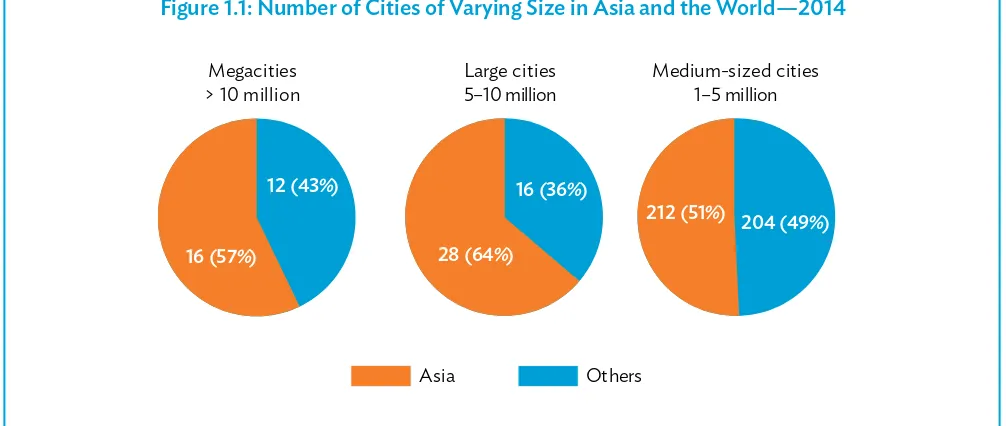
The Asia and Paciic region includes a large number of the largest cities on Earth. In 2014, Asia accommodated 16 of the 28 megacities (with more than 10 million inhabitants) of the world and 28 of the 44 large cities (with 5 million–10 million inhabitants) (Figure 1.1).
1 Comprising the Cook Islands, Fiji, Kiribati, Marshall Islands, the Federated States of Micronesia, Nauru, Palau, Papua New Guinea, Samoa, Solomon Islands, Timor-Leste, Tonga, Tuvalu, and Vanuatu.
Figure 1.1: Number of Cities of Varying Size in Asia and the World—2014
Asia Others
16 (57%)
12 (43%) Megacities > 10 million
28 (64%)
16 (36%) Large cities 5–10 million
212 (51%) 204 (49%) Medium-sized cities
1–5 million
Asia and the Paciic at a Glance
11
Table 1.1: Population of the Urban Agglomerations with 5 Million Inhabitants or More in 2014
(million)
Total 33 of Asiab 151.046 348.714 483.774
Asia’s share (%) 34.8 46.2 50.2
a Total population of the 71 urban agglomerations of the world with 5 million people or more in 2014.
b Total population of the 33 urban agglomerations with 5 million or more of Asia and the Paciic in 2014.
Source: United Nations Department of Economic and Social Afairs Population Division. 2014. World Urbanization Prospects. New York. United Nations.
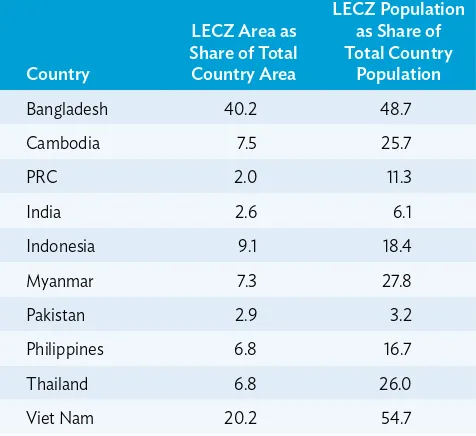
Table 1.2: Share of Area and Population of Low-Elevation Coastal Zones in Selected
Countries of Asia, 2000 (%)
Country
LECZ = low-elevation coastal zone, PRC = People’s Republic of China. Source: Adapted from B. Neumann et al. 2015. Future Coastal Population Growth and Exposure to Sea-Level Rise and Coastal Flooding—A Global Assessment. PLOS One. 10 (6). e0131375.
PRC and India, low-elevation coastal zones represent less than 3% of their total land area. However, approximately 11.3% and 6.1% of the total population of these countries, respectively, is located in such zones (Table 1.2). More than 50% of Viet Nam’s population lives in approximately 20% of the land occupied by LECZs. In the baseline year 2000, approximately 403 million people were located in the LECZs of the 10 countries presented in Table 1.2.
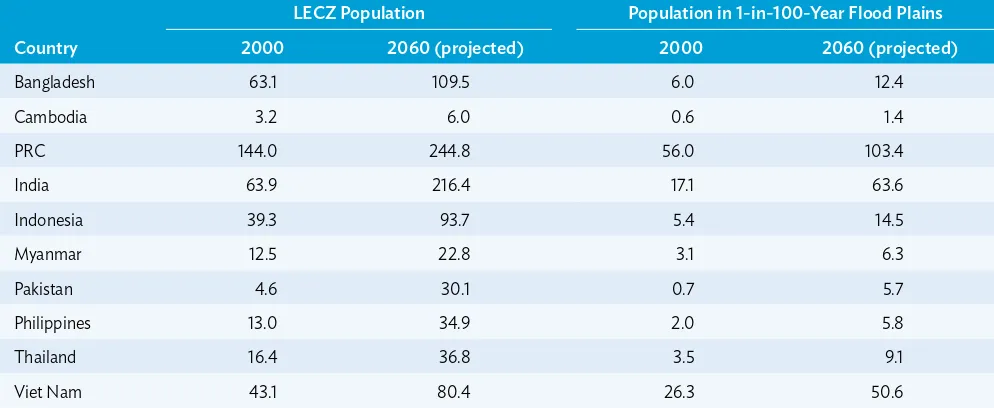
Given that most of Asia’s economic centers are located on coastlines, coastal populations are expected to increase signiicantly and approximately double in countries such as Bangladesh, India, the Philippines and Viet Nam by 2060 (Table 1.3).
These coastal urban areas are strongly exposed to the projected predicaments associated with climate change. In a study of exposed assets and population in 136 port cities of the world, Hallegatte et al. (2013) estimate the bulk of the projected coastal lood damage in 2050 to take place in East Asia and South Asia.
Asia accounts for 33 of all 71 urban agglomerations with more than 5 million inhabitants of the world (as of 1 July 2014). These 33 urban agglomerations had a total population of approximately 348.7 million in 2014. Their population is projected to reach 483.7 billion in 2030, an increase of approximately 40% over a 15-year period (Table 1.1). By 2030, Asia is anticipated to host eight more megacities, four of which in India: Chennai, Bangalore, Hyderabad, and Ahmadabad.
The signiicance of this key characteristic of the Asia and Paciic region is relected in Part 3 in the context of the discussion of the heat island efect associated with the projected increase in temperature.
A Region at Risk
12
1.3 Asia and the Paciic: Its Economy
A key economic development of the last decades has been the rapid increase in income per capita in the Asia and Paciic region. When measured in purchasing power parity terms, average income per capita in the region increased from $1,474 in 1980 to approximately $5,900 in 2000 and to $12,600 in 2015 (based on statistics available in IMF 2016). Over a period of 25 years, average income per capita increased approximately tenfold, with rapid industrialization fueling this increase. At the same time, economic inequality has been widening and the creation of opportunities and stable incomes for the poor remains a signiicant challenge throughout the region (Zhuang, Kanbur, and Maligalig 2014).
In the course of the economic development of the region the structure of the economy has also changed. In many countries, the service sector now contributes more than 50% of gross domestic product (GDP) and industry contributes more than 30% of GDP (Table 1.4). The agriculture sector has seen the share of its contribution to GDP decline over the last decades. In 2015, agriculture contributed approximately 17.5% of the region’s GDP.
While the sector represents a declining share of economic activity when its contribution to GDP is used as an indicator of measure, approximately 2 billion people in the region continue to depend on agriculture for their livelihoods. Adverse disruptions of agricultural productivity could have devastating efects throughout the region, increasing poverty, reducing food security, and incentivizing large migratory movements to urban agglomerations. The performance of all sectors of the economy depend on a well-functioning trade and transport network.
Except for the nations of the Paciic, the rapidly growing and evolving economy of Asia is still heavily dependent on fossil sources of electricity generation including coal, oil, and natural gas, contributing to the greenhouse gas efect. In 2010, coal and oil alone accounted for approximately 72% of the total primary energy demand in the region (ADB and APEC 2015). Approximately 70% of the region’s electricity generation originates from these three fossil fuel sources (Table 1.5). Hydropower generation accounts for the bulk of the remaining sources of electricity. This characteristic of Asia’s energy sector combined with the region’s rapid economic development explains for the most part the region’s increasing share of global emissions of greenhouse gases in general, and of carbon dioxide in particular. Table 1.3: Projected Population in Low-Elevation Coastal Zones and Flood Plains
in Selected Countries of Asia (million)
Country
LECZ Population Population in 1-in-100-Year Flood Plains
2000 2060 (projected) 2000 2060 (projected)
Bangladesh 63.1 109.5 6.0 12.4
Cambodia 3.2 6.0 0.6 1.4
PRC 144.0 244.8 56.0 103.4
India 63.9 216.4 17.1 63.6
Indonesia 39.3 93.7 5.4 14.5
Myanmar 12.5 22.8 3.1 6.3
Pakistan 4.6 30.1 0.7 5.7
Philippines 13.0 34.9 2.0 5.8
Thailand 16.4 36.8 3.5 9.1
Viet Nam 43.1 80.4 26.3 50.6
LECZ = low-elevation coastal zone, PRC = People’s Republic of China.
Asia and the Paciic at a Glance
13
Table 1.4: Countries with Sector Shares of Gross Domestic Product (2012)
Countries Where Industry Represents More Than 30% of Nominal GDP
Countries Where Service Sector Represents More Than 50% of Nominal GDP
Azerbaijan, Bhutan, PRC, Indonesia, Lao PDR, Mongolia, Nauru, Papua New Guinea, Philippines, Sri Lanka, Thailand, Timor-Leste, Turkmenistan, Uzbekistan, Viet Nam
Afghanistan, Armenia, Bangladesh, PRC, Cook Islands, Fiji, Kazakhstan, Kiribati, Kyrgyz Republic, Maldives, Marshall Islands, Federated States of Micronesia, Mongolia, Nauru, Nepal, Pakistan, Palau, Philippines, Samoa, Sri Lanka, Thailand, Tonga, Tuvalu, Vanuatu
GDP = gross domestic product, Lao PDR = Lao People’s Democratic Republic, PRC = People’s Republic of China.
Source: Central Intelligence Agency. 2012. The World Factbook: GDP-Composition, by Sector of Origin. https://www.cia.gov/library/publications/
the-world-factbook/ields/2012.html
Table 1.5: Electricity Generation Mix, 2010 (%)
Coal Oil
Natural
Gas Hydro Nuclear Others
Central and West Asia 22.3 11.3 34.5 29.9 1.9 0.0
East Asia 73.0 0.0 4.9 14.6 5.3 1.3
Paciic 0.0 43.6 14.7 33.4 0.0 8.3
South Asia 63.9 3.3 15.2 12.9 2.6 2.2
Southeast Asia 27.4 8.2 48.9 11.9 0.0 3.6
All Developing Member Countries 65.0 2.4 12.0 14.8 4.2 1.6
Source: Asian Development Bank (ADB) and Asia-Paciic Economic Cooperation (APEC). 2015. Energy Outlook for Asia and the Paciic. Manila: ADB.
Recent technological advancements along with declining prices for renewable energy and energy storage suggest that fossil-fuel dependence is declining. For example, Saxena et al. (2017) indicate that India would not have to build new coal ired power stations to meet future energy demand and suggest that the country could transition out of coal ired power plants by the middle of the century.
Moreover, existing sources of electricity generation in the Asia and Paciic region (except for renewable sources) demand vast quantities of cold water which may not be met as a result of the impacts of climate change. This may
lead to energy insecurity and stand in competition with the use of freshwater supplies for drinking and agricultural purposes. This outlook further incentivizes a transition towards renewable energy sources.
References
14
References—Introduction and Part 1
Albinia, A. 2010. Empires of the Indus: The Story of a River. London: John Murray.
Asian Development Bank (ADB). 2009a. The Economics
of Climate Change in Southeast Asia: A Regional Review.
Manila.
———. 2009b. The Paciic Approach 2010–2014. Manila. ———. 2013a. The Economics of Climate Change in the
Paciic. Manila.
———. 2013b. Economics of Climate Change in East Asia. Manila.
———. 2014. Assessing the Costs of Climate Change and
Adaptation in South Asia. Manila.
Asian Development Bank and Asia-Paciic Economic Cooperation (APEC). 2015. Energy Outlook for Asia and
the Paciic. Manila: ADB.
Blondel, A. 2012. Climate Change Fuelling Resource-Based
Conlicts in the Asia-Paciic. Asia-Paciic Human
Development Report Background Papers Series 2012/12.
Cai, W., et al. 2015. ENSO and Greenhouse Warming.
Nature Climate Change. 5. pp. 849–859.
Coumou, D., and S. Rahmstorf. 2012. A Decade of Weather Extremes. Nature Climate Change. 2. pp. 491–496. Coumou, D., A. Robinson, and S. Rahmstorf. 2013.
Global Increase in Record-Breaking Monthly-Mean Temperatures. Climatic Change. 118. pp. 771–782. de Blij, H. J., P. O. Muller, and R. S. Williams. 2004. Physical
Geography of the Global Environment. Oxford, UK:
Oxford University Press.
Elsner, J. B., J. P. Kossin, and T. H. Jagger. 2008. The Increasing Intensity of the Strongest Tropical Cyclones.
Nature. 455. pp. 92–95.
Frieler, K., et al. 2012. Limiting Global Warming to 2°C Is Unlikely to Save Most Coral Reefs. Nature Climate
Change. 2. pp. 1–6.
German Advisory Council on Global Change (WBGU). 2016. Humanity on the Move: Unlocking the
Transformative Power of Cities. Berlin.
Gütschow, J., et al. 2015. INDCs Lower Projected Warming
to 2.7˚C: Signiicant Progress but Still above 2˚C. Climate
Action Tracker Update.
Hallegatte, S., et al. 2013. Future Flood Losses in Major Coastal Cities. Nature Climate Change. 3. pp. 802–806. Holland, G., and C. L. Bruyère. 2014. Recent Intense
Hurricane Response to Global Climate Change.
Climate Dynamics. 42. pp. 617–627.
Hong, C. C., et al. 2011. Roles of European Blocking and Tropical–Extratropical Interaction in the 2010 Pakistan Flooding. Geophysical Research Letters. 38 (13).
Intergovernmental Panel on Climate Change (IPCC). 2014.
Climate Change 2014: Synthesis Report. Contribution of Working Groups I, II and III to the Fifth Assessment Report
of the Intergovernmental Panel on Climate Change.
Edited by Core Writing Team, R. K. Pachauri, and L. A. Meyer. Geneva, Switzerland.
International Monetary Fund (IMF). 2016. World Economic
Outlook Database. IMF: Washington, D.C.
Kang, N.-Y., and J. B. Elsner. 2015. Trade-Of between Intensity and Frequency of Global Tropical Cyclones.
Nature Climate Change. 5. pp. 661–664.
Knutson, T. R., et al. 2010. Tropical Cyclones and Climate Change. Nature Geoscience. 3. pp. 157–163.
Kreft, S., D. Eckstein, and I. Melchior. 2016. Global Climate Risk Index 2017: Who Sufers Most from Extreme Weather Events? Weather-Related Loss Events in 2015 and 1996 to 2015. Bonn: Germanwatch.
Lehmann, J., D. Coumou, and K. Frieler. 2015. Increased Record-Breaking Precipitation Events under Global Warming. Climatic Change. 132. pp. 501–515.
Lelieveld, J., et al. 2015. The Contribution of Outdoor Air Pollution Sources to Premature Mortality on a Global Scale. Nature. 525. pp. 367–371.
Man, J. 1999. Gobi: Tracking the Desert. New Haven: Yale University Press.
McGranahan, G., D. Balk, and B. Anderson. 2007. The Rising Tide: Assessing the Risks of Climate Change and Human Settlements in Low Elevation Coastal Zones.
Environment and Urbanization. 19. pp. 17–37.
Peel, M. C., B. L. Finlayson, and T. A. McMahon. 2007. Updated World Map of the Köppen-Geiger Climate Classiication. Hydrology and Earth System Sciences. 11(5). pp. 1633–1644.
Pomeranz, K. 2013. Asia’s Unstable Water Tower: The Politics, Economics, and Ecology of Himalayan Water Projects. Asia Policy. 16.
Rahmstorf, S., and D. Coumou. 2011. Increase of Extreme Events in a Warming World. Proceedings of the National
Academy of Sciences. 108. pp. 17905–17909.
Rockström, J., et al. 2009. A Safe Operating Space for Humanity. Nature. 461. pp. 472–475.
References
15
Savo, V., et al. 2016. Observations of Climate Change among Subsistence-Oriented Communities around the World. Nature Climate Change. 6. pp. 462–473. Saxena, A. K., et al. 2017. Transitions in Indian Electricity
Sector. The Energy and Resources Institute: New Delhi.
Schellnhuber, J., S. Rahmstorf, and R. Winkelmann. 2016. Why the Right Climate Target Was Agreed in Paris.
Nature Climate Change. 6. pp. 649–653.
Schleussner, C. F., et al. 2016. Science and Policy Characteristics of the Paris Agreement Temperature Goal. Nature Climate Change. 6. pp. 827–835.
Sun, J., and T. Liu. 2006. The Age of the Taklimakan Desert.
Science. 312(5780). p. 1621.
Tollefson. J. 2015. The 2°C Dream. Nature. 527. pp. 436– 438.
Trenberth, K. E., J. T. Fasullo, and T. G. Shepherd. 2015. Attribution of Climate Extreme Events. Nature Climate
Change. 5. pp. 725–730.
United Nations Department of Economic and Social Afairs Population Division (UN DESA). 2014. World
Urbanization Prospects. New York: United Nations.
———. 2015. World Population Prospects: The 2015 Revision. New York: United Nations.
Van Driel, W., et al. 2015. Vulnerability Assessment of
Deltas in Transboundary River Basins. Delta Alliance
contribution to the Transboundary Water Assessment Program, River Basins Assessment. Delta Alliance Report 9. Delft, The Netherlands: Delta Alliance International, Wageningen.
Wike, R. 2016. What the World Thinks about Climate Change
in 7 Charts. Washington, DC: Pew Research Center.
World Meteorological Organization (WMO). 2016. WMO
Conirms 2016 as Hottest Year on Record. Press release.
Zhuang, J., R. Kanbur, and D. Maligalig. 2014. Asia’s Income Inequalities: Recent Trends. In R. Kanbur, C. Rhee, and J. Zhuang, eds. Inequality in Asia and the Paciic: Trends,
Drivers, and Policy Implications. Manila and New York:
2
P
art 2 contains a review and discussion of the projected climate change in Asia in the 21st century based on current scientiic literature. Global and regional warming will induce changes highly relevant to human and ecological well-being and economic development within the region. These include changes in sea level, precipitation patterns, the intensity of tropical cyclones, and changes in hydrology, including signiicant impacts on Asia’s critically important glacier—and snow —fed river systems and on looding and drought.All projected future climate changes embody assumptions about how society will act to reduce—or fail to reduce— greenhouse gas (GHG) emissions. These, in turn, relect a wide range of potential decisions concerning technological and economic changes. To highlight the inluence of these decisions on the subsequent magnitude and pace of climate change, two diferent scenarios are presented: the irst is broadly consistent with eforts to limit 21st century warming to below 2°C, the target of the Paris consensus and the second with “business as usual.”1
The low-emission scenario of the Representative Concentration Pathways (RCP2.6) presents a future in which GHG mitigation eforts are aggressive and begin early. It assumes the availability and efectiveness of technologies to reduce atmospheric carbon dioxide (CO2) (negative emissions) such as carbon capture and storage. In RCP2.6, global annual CO2 emissions peak around 2020 and decline substantially over the 21st century (Moss et al. 2010). In this report, RCP2.6 is used as a proxy for successful implementation of the Paris Agreement since under RCP2.6 global warming is expected to stay at or below 2°C above preindustrial levels with a probability greater than 67%.2 The
high-emission scenario RCP8.5 is used as a proxy for a future in which international cooperation on climate mitigation
fails and the world economy continues to emit GHG on a business-as-usual pathway. Under this scenario, CO2 emissions increase until the end of the 21st century with global mean temperature expected to rise by around 4°C above preindustrial levels. In the following sections, the terms RCP2.6 and “Paris-consensus” scenario are used interchangeably, as are RCP8.5 and “business-as-usual” scenario.3
The discussion of primary impacts and hazards associated with climate change in Asia—tropical cyclones, sea-level rise, and changes in hydrology—will summarize studies embodying a wider range of climate scenarios and projections, not necessarily limited to Paris consensus and business as usual.
2.1 Changes in Temperatures
and Heat Extremes
In the absence of strenuous eforts to reduce global GHG emissions, global average summer temperatures are expected to increase by more than 6°C above preindustrial levels by the end of the 21st century (IPCC 2013). Regional and local temperature changes can vary signiicantly from the global average. Climate model projections indicate that in Asia summertime warming is stronger over higher latitudes (IPCC 2013). This part presents projections of temperature conditions in Asia, as well as changes in the frequency of severe heat extremes.
The analysis focuses on changes in boreal summer (June– August) because the strongest impacts from temperature changes on society, primarily associated with agricultural losses, are expected during this season (Hansen, Sato, and Ruedy 2012; Coumou, Robinson, and Rahmstorf 2013).
1 The most current global climate modeling eforts, conducted through the Coupled Model Intercomparison Project Phase 5 (CMIP5) (Taylor, Stoufer, and Meehl 2012), simulate the climate impacts of four scenarios called Representative Concentration Pathways (RCP; Moss et al. 2010) that refer to global energy imbalances (forcings) in watts per square meter by 2100 resulting from diferent GHG emissions pathways. The RCP scenarios were developed by the global climate science community to facilitate policy-relevant research into climate change, with results assessed in the Fifth Assessment Report (AR5) of the IPCC, released in 2013 (IPCC 2013).
2 Not all model simulations assuming RCP2.6 result in temperature increases below 2°C.
A Region at Risk
20
In the following discussion, all changes in temperature, including extremes, are reported for the seasonal average and with respect to the climatic baseline period 1951–1980.4
Projected Temperature Changes
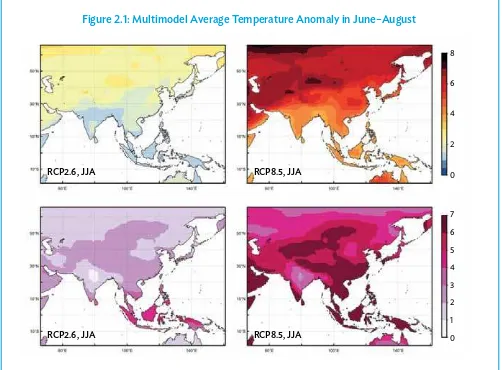
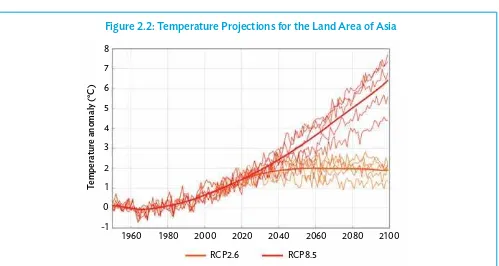
Under the Paris-consensus scenario (RCP2.6), summer warming averaged over all continental land areas depicted in Figure 2.1 is projected to reach 2°C by the 2050s and to remain at or below this level through 2100 (Figure 2.2).
The warming trend then levels of and the global mean temperature remains nearly constant at an increase of around 2°C until the end of the century. Under the business-as-usual scenario (RCP8.5), Asian summer temperatures over land are projected to increase by 6°C by 2100 with no sign of a slowdown in the warming trend. An overview of the range of temperature increases projected by the Coupled Model Intercomparison Project Phase 5 (CMIP5) models at diferent time periods under both scenarios is presented in Table 2.1.
4 The choice of climatic baseline period will inluence the estimated magnitude of temperature change. Many studies use the preindustrial period as a reference (often interpreted as 1881–1910, before which widely distributed direct measurements of temperature were not available), resulting in greater absolute change than if a late 20th century baseline is used.
JJA = June, July, and August; RCP = Representative Concentration Pathway.
Note: Temperature anomalies are averaged over the time period 2071–99 relative to the base period 1951–1980 and given in units of degrees Celsius (upper panels) and in units of the local historical standard deviation (lower panels). Results are shown for RCP2.6 (left) and RCP8.5 (right).
Figure 2.1: Multimodel Average Temperature Anomaly in June–August
RCP2.6, JJA
RCP2.6, JJA
RCP8.5, JJA
RCP8.5, JJA
8
6
4
2
0
Climate Change in Asia and the Paciic: Observations and Projections
21
Table 2.1: Projected Average Temperature Changes for the Land Area of Asia (°C)
2030 2050 2070 2100
RCP2.6 1.6
(1.0–2.4)
1.9 (1.1–2.7)
2.0 (1.1–2.8)
1.9 (1.0–2.6)
RCP8.5 1.7
(0.7–2.4)
2.7 (1.5–3.9)
4.0 (2.5–5.5)
6.0 (3.9–7.7)
RCP = Representative Concentration Pathway.
Note: Numbers within parentheses are ranges of temperature change from diferent models.
Warming is stronger over higher latitudes, including central and northern Asia (Figure 2.1), where temperatures are projected to rise by 2°C–3°C under RCP2.6 and by 5°C–8°C under RCP8.5 by the end of the 21st century. Under RCP8.5, hot spots of intense local temperature increases of up to 8°C are found over the mountain ranges in the triborder region of Tajikistan, Afghanistan, and Pakistan and over the northwestern part of the PRC. Over the tropics, absolute warming is generally lower than the regional mean. This pattern of latitudinal temperature changes is evident in both scenarios.
Estimates of future temperatures in absolute terms are needed to evaluate speciic risks, such as the likelihood and potential timing of exceeding important biophysical thresholds relating, for example, to important agricultural crops or disease. Additional insights can be gained by understanding temperature changes relative to historical variability, since human and environmental systems have adapted to these ranges. To assess relative change, the projected absolute temperature change is divided (normalized) by the local standard deviation (sigma). The normalized temperature change indicates how unusual Figure 2.2: Temperature Projections for the Land Area of Asia
RCP = Representative Concentration Pathway.
Note: Thick lines represent the multimodel average and thin lines individual model projections derived under the RCP2.6 and RCP8.5 scenarios for the months of June, July, and August.
1960 8
T
emper
atur
e anomaly (°C
) 6
4
2
0 7
5
3
1
-1
RCP2.6 RCP8.5
A Region at Risk
22
the projected temperature event would be if it occurred within the context of historical year-to-year variability in the absence of climate change. Natural variability is low in the tropics. Therefore, normalized temperature changes are particularly pronounced over tropical land areas, although absolute temperature changes may be smaller than in temperate regions (Figure 2.1).
The strongest increases in normalized temperatures are found over large parts of the PRC and Mongolia, Southeast Asia, and the southern tip of India. In these regions, projected temperatures will increase by more than six standard deviations under the RCP8.5 scenario (Figure 2.1 lower right). Such strong changes imply a shift to a new climate regime by the end of the century. To provide perspective, a temperature shift of six standard deviations implies that the coldest summer months at the end of the 21st century are projected to be warmer than the warmest summer months during the base period in 1951–1980.
Changes in Heat Extremes
In this study, heat extremes are deined by the exceedance of temperature thresholds calculated on the basis of local historical year-to-year variability, since human societies and ecosystems are adapted to these conditions. The most pronounced heat extremes will occur over regions where the absolute temperature increase is large relative to local natural variability. In the tropics, where natural variability is low, a relatively small absolute temperature increase might lead to severe impacts. For example, coral reefs in the tropics are very sensitive to temperature changes and will already face almost complete extinction at 2°C warming (Frieler et al. 2013). By contrast, over northern Asia, the same amount of absolute warming may have relatively less impact due to the much wider natural temperature variability range.
In some cases, heat extremes must be deined with respect to absolute temperature thresholds. Many of these thresholds relect biophysical processes. For
example, Sherwood and Huber (2010) observe that under global mean warming of 7°C, small regions develop where the wet bulb temperature might exceed 35°C for extended periods, making dissipation of metabolic heat impossible and resulting in hyperthermia in humans and other mammals.5 Under these conditions, survival under
exposed conditions is not possible. While acknowledging the importance of absolute temperature thresholds, this study focuses on relative thresholds to allow for more general discussions on impacts.
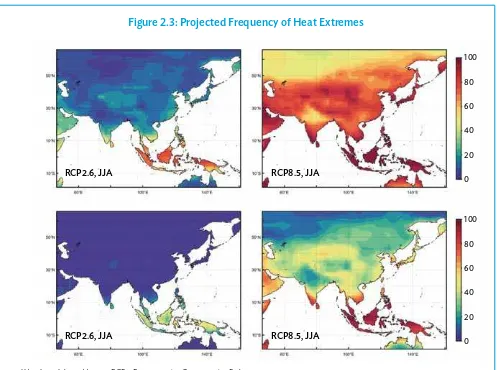
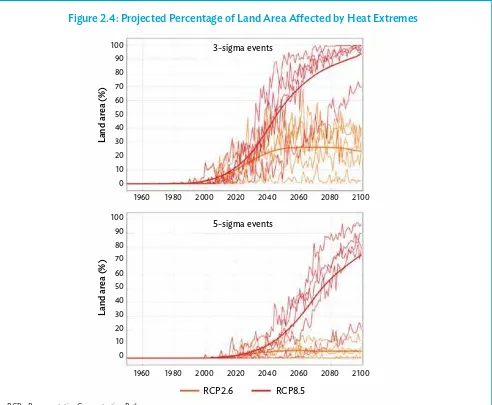
In a stationary climate with no long-term warming, a summer with mean temperatures equal to or greater than three standard deviations above the mean (3-sigma event) would be considered very rare, in general occurring less frequently than once per century.6 A 5-sigma event
would then be signiicantly less frequent, implying that such an event is essentially unprecedented under today’s climate conditions. Model projections show that under the business-as-usual scenario, summers that are 3-sigma events relative to historical climate might be the new normal by the end of this century over nearly all land regions (Figure 2.3). Restated, monthly mean summer temperatures are projected to exceed the 3-sigma threshold every other year on average. Moreover, summer temperatures exceeding the 5-sigma threshold might become common over most continental land areas with 20%–60% of summer months exceeding 5-sigma over the time period 2071–2099, depending on the warming scenario.
Southeast Asia is projected to be the region most afected by heat extremes (Figure 2.3). In this region, unprecedented high summer temperatures are expected to return every year if warming continues to rise as projected under RCP8.5. Limiting global warming to 2°C would reduce the occurrence of heat extremes to a signiicant extent. Under RCP2.6, models project the share of 3-sigma events to be around 70% over Southeast Asia and 0%–40% over continental Asia toward the end of the 21st century.
5 The wet bulb temperature is the temperature that can be maintained through evaporative cooling, such as via perspiration, and depends on both measured (“dry bulb”) air temperature and relative humidity.