ESS
–
Extension of Social Security
Health workforce: A global supply chain approach
New data on the employment effects of health economies
in 185 countries
Xenia Scheil-Adlung
ESS
–
Working Paper No. 55
Social Protection Department
Copyright © International Labour Organization 2016 First published 2016
Publications of the International Labour Office enjoy copyright under Protocol 2 of the Universal Copyright Convention. Nevertheless, short excerpts from them may be reproduced without authorization, on condition that the source is indicated. For rights of reproduction or translation, application should be made to ILO Publications (Rights and Licensing), International Labour Office, CH-1211 Geneva 22, Switzerland, or by email: [email protected]. The International Labour Office welcomes such applications.
Libraries, institutions and other users registered with a reproduction rights organization may make copies in accordance with the licences issued to them for this purpose. Visit www.ifrro.org to find the reproduction rights organization in your country.
ILO Cataloguing in Publication Data
Scheil-Adlung, Xenia.
Health workforce : a global supply chain approach : new data on the employment effects of health economies in 185 countries / Xenia Scheil-Adlung ; International Labour Office, Social Protection Department. - Geneva: ILO, 2016.
(Extension of Social Security series ; No. 55, ISSN: 1020-9581 ; 1020-959X (web))
International Labour Office. Social Protection Dept..
social protection / medical care / care worker / medical personnel / access to care / labour force / employment creation
02.03.1
The editor of the series is the Director of the Social Protection Department, ILO. For more information on the series, or to submit a paper, please contact:
Isabel Ortiz, Director Social Protection Department International Labour Organization concerning the delimitation of its frontiers.
The responsibility for opinions expressed in signed articles, studies and other contributions rests solely with their authors, and publication does not constitute an endorsement by the International Labour Office of the opinions expressed in them.
Reference to names of firms and commercial products and processes does not imply their endorsement by the International Labour Office, and any failure to mention a particular firm, commercial product or process is not a sign of disapproval.
ILO publications and digital products can be obtained through major booksellers and digital distribution platforms, or ordered directly from [email protected]. For more information, visit our website: www.ilo.org/publns or contact [email protected].
Foreword
Moving towards Universal Health Coverage (UHC) in the context of the Sustainable Development Goals (SDGs) requires a sufficient number of workers producing and delivering health care such as doctors and nurses but also workers in other occupations, e.g. those concerned with administration or maintaining health facilities. However, currently there is a significant workforce shortage which is expected to increase given the demographic aging of the population. As a result, in most countries large numbers of unpaid
“care workers”, often women, are indispensable to fill in for the shortages, and provide care,
for example to older family members.
Filling the workforce gaps provides the opportunity to achieve better health outcomes and generate millions of jobs. The jobs required for activities within and across countries to produce goods and services needed are part of the national health economies and global health protection supply chains. Investing in related employment will create significant multiplier employment effects for skilled and unskilled workers within and beyond the health sector and contribute to inclusive and sustainable economic growth.
However, for the time being, these important economic impacts of investing in health protection are largely ignored and returns of investments in UHC in terms of employment have not been sufficiently assessed. Against this background, this paper provides for the first time global estimates on the total employment potential of workers in health and non-health occupations employed in the health economies of 185 countries.
Creating the needed jobs and combining them with decent salaries, social protection and rights at work, will generate important returns of investments specifically in countries with large health coverage deficits and informal labour markets. Further, huge gains of investments can be expected from revealing the economic potential of female workers which withdrew from the labour market to provide care to family members in the absence of skilled health workers. Thus, investments in health protection can be considered as a sustainable domestic source of employment that creates inclusive economic growth.
This paper expands on ILO’s work for the United Nations High-Level Commission on
Health Employment and Economic Growth announced by the UN Secretary General in March 2016, co-chaired by the President of France and the President of South Africa and vice-chaired by the Director General of the WHO and ILO as well as the Secretary General of the OECD.
Isabel Ortiz Director
Contents
Page
Foreword ... iii
Abbreviations and acronyms ... vii
Acknowledgements ... ix
Key messages ... xi
I. The issue: Insufficient investments in health protection result in severe health workforce shortages undermining the SDGs, full employment and inclusive economic growth ... 1
II. Health employment and the economy: Which jobs and economic sectors contribute to producing health care in national health economies? ... 5
III. What is the current size of employment in global and regional health protection supply chains? ... 7
IV. What is the additional employment potential in health economies producing UHC? ... 14
V. Employment effects of investments in health protection ... 18
VI. Policies developing returns of investments in UHC: Unlocking the potential of decent employment in health economies ... 20
Bibliography ... 24
Annexes 1. Methodological remarks ... 27
2. Global estimates of current employment and the employment potential of investments in UHC by 2030 ... 34
A. Estimates of current employment in the health economies of 185 countries: Size of the workforce in 2016 or latest available year ... 34
B. Estimates of the additional employment potential in the global health protection supply chain producing UHC by 2030 (2016 or latest available year, 2030) ... 43
List of tables 1. Typology of the workforce employed in health protection supply chains ... 7
2. Conceptual framework for estimating the workforce in health and non-health occupations .. 27
3. Median ratio of Non-health occupation workers to Health occupation workers in 52 ILOSTAT countries ... 30
4. WHO database categories and their ISCO code equivalents ... 30
Page
List of figures
1. Exclusion from health care due to workforce shortages in the health sector (ILO Staff Access Deficit Indicator by income-level of countries in per cent
of population, 2014) ... 1
2. Rural/urban populations excluded from health care due to workforce shortages
in the health sector (ILO Staff Access Deficit Indicator in per cent of population, 2014)... 2
3. Global health protection coverage rates (proportion of population affiliated to national health services, social, private or micro-insurance schemes in per cent of population,
population weighted, latest available year) ... 3
4. Global unemployment rates (2013 or latest available year, in per cent employment,
latest available year) ... 3
5. Current employment in the global health protection supply chain: Size and composition
of workers (in thousands, 2016 or latest available year) ... 10
6. Current employment in the global health protection supply chain by region ... 11
7. Ratio of workers in non-health occupations to workers in health occupations,
by income group, 2016 or latest available year ... 12
8. Ratio of workers in non-health occupations to workers in health occupations,
by region, 2016 or latest available year ... 12
9. Current numbers of paid workers in health and non-health occupations and employment potential in the public and private sector to produce UHC in global health protection
supply chains (public and private employment, 2016 or latest available year) ... 14
10. Current employment potential to fill gaps of missing workers by income group
(public and private employment, 2016 or latest available year) ... 15
11. Current employment potential to fill gaps of missing workers by region
(public and private employment, 2016 or latest available year) ... 15
12. Additional jobs to be created in health and non-health occupations in the global
health protection supply chain by 2030 ... 16
13. Employment potential for additional workers needed by 2030, by income group ... 16
Abbreviations and acronyms
AAAQ availability, accessibility, acceptability and quality (criteria)
ADB Asian Development Bank
ADL activities of daily living like bathing, eating etc.
BRIICS Brazil, Russian Federation, India, Indonesia, China, South Africa
COMEEHG High Level Commission on Health Employment and Economic Growth
DHS Demographic and Health Surveys
EU European Union
EHCP essential health care package
FD financial deficit
GDP gross domestic product
HC head count (of numbers of LTC workers)
HO (workers in) health occupations
HIC high-income country
FTE hull-time equivalent (of numbers of LTC workers)
GFATM Global Fund to Fight AIDS
GHWA Global Health Workforce Alliance
GHO The WHO Global Health Observatory database
HDI Human Development Index
HPI Human Poverty Index
HRH Human Resource for Health
ILO International labour Organization/ Office
IMF International Monetary Fund
ISSA International Social Security Association
ISSR International Social Security Review
LC legal coverage
LTC long-term care
MDG Millennium Development Goals
MMR maternal mortality ratio
MOH Ministry of Health
NGO non-governmental organization
NHA national health accounts
NHO (workers in) non-health occupations
OECD Organisation for Economic Co-operation and Development
OOP out-of-pocket payments
PPP purchasing power parity
R202 ILO Social Protection Floors Recommendation, 2012 (No. 202)
SDGs Sustainable Development Goals
SPFs social protection floors
UHC universal health coverage
UDHR Universal Declaration of Human Rights, 1948
UN United Nations
WB World Bank
WHO World Health Organization
Acknowledgements
The data presented in this publication benefited from earlier research of the ILO Social Protection Department and ILO Policy Briefs developed for the United Nations High-Level Commission on Health Employment and Economic Growth (ComHEEG). ILO would like to offer thanks to Andrea Nove, Novametrics, UK, who significantly supported the statistical and methodological part of this work.
Further, the ILO is grateful for the very helpful comments received during intensive exchanges, discussions of the data development and assessment in the context of numerous meetings of the experts appointed to the ComHEEG. In particular, we would like to express thanks to Richard Horton, The Lancet; Philippe Aghion, Harvard University; Edson C. Araujo, The World Bank; Haroon Bhorat, University of Cape Town; Saskia Bruysten, Yunus Social Business; Alicia Ely Yamin, Harvard University; Claudia Jacinto, National Council of Scientific Research, Argentina; Barbara McPake, University of Melbourne; Ritva Reinikka, The World Bank; K. Srinath Reddy, Public Health Foundation, India; Jean-Olivier Schmidt, GIZ Competence Center for Health, Social Protection and Inclusion; Lina Song, University of Nottingham; Lawrence H. Summers, Harvard University; Sylvia Trent-Adams, US Public Health Service; Viroj Tangcharoensathien, International Health Policy Program Foundation, Thailand and David Weakliam, Health Service Executive, Ireland.
In addition, our thanks are extended to the World Health Organization (WHO) and the Organization for Economic Co-operation and Development (OECD) for their comments, feedback and peer reviews of data and methodologies in the context of the work of the ComHEEG secretariat. We are specifically thankful for comments received from Marie-Paule Kieny, Assistant Director General, James Campbell, Director, Agnès Soucat, Director, Ibadat Dhillon, Sana de Courcelles, Jeremy Lauer, Ramesh Shademani and Tana Wuliji, all WHO and colleagues from OECD, particularly Mark Pearson, Director, Francesca Colombo, Gaetan Lafortune and Liliane Moreira.
Key messages
This paper provides evidence that investments in health protection not only impact on the achievement of health objectives, but also create an important source of employment across numerous economic sectors by presenting for the first time data on:
(i) current number of workers in the entire global health protection supply chains involving the health economies of 185 countries;
(ii) employment potential created by addressing health workforce shortages and producing universal health coverage (UHC);
(iii) ratio of jobs in health and non-health occupations needed to achieve health objectives;
(iv) number of decent jobs required to allow family care workers filling in for workforce shortages to remain in the labour market.
Against this background the paper calls for significantly increasing investments in decent jobs for the production of UHC, sustainable development and inclusive growth.
Currently, many countries experience a lack of investments in health protection resulting in critical health workforce shortages of millions of jobs. The shortages are expected to increase in future given global demographic ageing and progress towards UHC by 2030 and jeopardize inclusive economic growth and full employment. They impact on health outcomes and global health security as observed in the case of Ebola: Currently due to the absence of health workers, 84 per cent of the population in low income countries is excluded from access to health care and more than half of the population in lower middle income countries. Particularly concerned are older persons and women: In the absence of skilled workers, more than 50 per cent of the global older populations remain without long-term care (LTC). As a result, large numbers of women give up employment to provide LTC to family members. This care involves high economic costs both for families and societies at large.
Addressing the shortages necessitates a comprehensive assessment of national health economies and global health protection supply chains taking into account that health employment is not limited to jobs in health occupations, the public service or a single
economic “health” sector. Thus, in this study we identify the number of all workers
contributing to the production of health protection, regardless of their occupation and employment status in the public or private sector, including the unpaid health workforce providing informal care.
Applying this approach we find that currently health employment in 185 countries amounts to jobs for 234 million workers. At regional level, the current size of health employment amounts to 14 million jobs in the health economies of Africa; 44 million in the Americas; 5 million in the Arab States; 109 million in Asia and the Pacific and 62 million in Europe and Central Asia.
non-health occupations – mostly female workers which gave up formal employment to provide care to older family members in the absence of health workers. Thus, the hidden workforce in non-health occupations needed to achieve health objectives constitutes of more than 60 per cent of all paid workers employed in health economies and amounts to 70 per cent of all paid and unpaid workers.
The supply chain data suggest that economic returns of investments in UHC have an important potential to boost economic growth. Adequate investments will yield high impacts on job creation, including jobs in the broader economy for low paid and unskilled workers in non-health occupations:
– Each investment in the creation of one job in health occupation such as a physician has the potential to result in the creation of 2.3 jobs for workers in non-health occupations in the broader health economy.
– This ratio amounts to 3.42 in low income countries and 2.42 in high income countries. The more important employment effects in low income countries compared to high income countries are due to the higher shortage of workers in health occupations. If considering only paid workers in health and non-health occupations we find that globally each job requiring a health occupation is creating 1.5 paid jobs for workers in non-health occupations, 1.26 in low income countries and 1.67 in high income countries.
The data reveal that jobs in national health economies play an important role in achieving full employment, particularly due to the significant multiplier employment effects of investments in health protection and the role of workers in non-health occupations supporting medical workers in achieving health objectives. The important contribution of multiplier employment effects and jobs in non-health occupations to employment and economic growth was largely overlooked in the past and led to foregone economic growth.
Many global supply chain workers have jobs with low wages and lack decent working conditions in the public and the private sector, both within and beyond the health sector. Working conditions often do not respect human rights, including labour rights, social protection coverage, occupational safety and participatory processes through social dialogue.
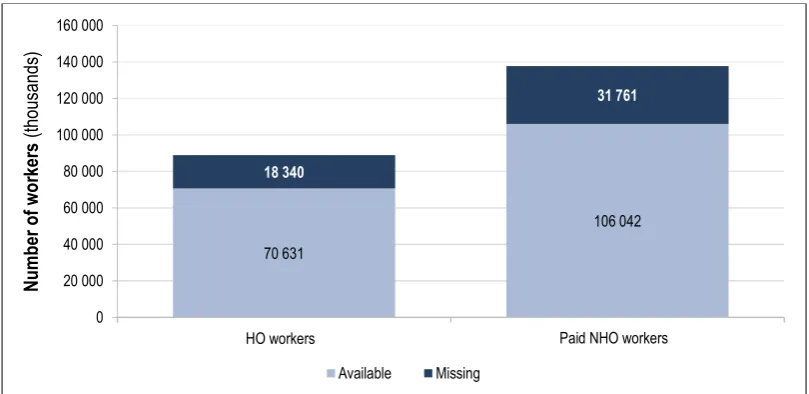
The current shortfall of the health workforce creates an employment potential and is estimated at globally 50 million paid workers in health and non-health occupations in the global health protection supply chain.
The shortages are not equitably distributed around the world: Shortages of paid workers concern 96 countries out of the 185 assessed. In 89 countries 18.3 million workers in health occupations are missing and in 95 countries 31.8 million paid workers in non-health occupations are missing. When including shortages currently filled in by unpaid family workers this figure amounts to 38 million workers.
Addressing the current shortages involves a high employment potential in the most affected lower-middle and low-income countries of Africa and Asia and the Pacific: 91per cent of the missing employment is observed in in lower-middle and low-income countries and 58 per centof jobs are needed in Asia and the Pacific, which reflects the fact that this region contains the most populous countries in the world. However, in relation to population size, the shortages in Africa are the most severe.
workers. The number of needed jobs in low and middle income countries alone the amount to additional jobs for 75 million workersincluding 24 million workers in health occupations and 51 million paid and unpaid workers in non-health occupations. The majority of the employment potential by 2030 will be in Asia, where 43 million additional jobs will be required and in Africa, where 32 million jobs will need to be created.
Addressing the shortages and creating inclusive and sustainable economic growth based on health economy employment will require:
– Focusing on adequate investments in UHC to create demand and generate funding for needed jobs through enabling macroeconomic frameworks providing for fiscal space. This involves applying core principles of social protection in health ensuring equity in access to quality care and solidarity in financing.
– Providing decent working conditions to all supply chain workers, including adequate salaries.
– Transforming unpaid work linked to withdrawals from the labour market due to workforce shortages into paid jobs to accelerate inclusive and sustainable growth and reduce gender issues.
– Considering that creating jobs in low and middle income countries and particularly in rural areas of Africa and Asia will maximise the returns of investments.
I.
The issue: Insufficient investments in health
protection result in severe health workforce
shortages undermining the SDGs, full
employment and inclusive economic growth
Globally, severe health workforce shortages undermine the objective of achieving universal health coverage (UHC) and thus progress towards the Sustainable Development Goals (SDG), particularly SDG 1, 3, and 8 focusing on social protection, good health, decent work and economic growth (ILO, 2014; WHO, 2016). The shortages observed result from insufficient investments in health protection. They impact negatively on both the health status of populations and the economy at large. This is due to the fact that:
– in the absence of an adequate number of health workers morbidity and mortality rates rise and thus the potential for a healthier and more productive workforce as well as increased labour supply is not realized;
– using the full employment potential of the jobs missing towards UHC will produce economic growth that is currently foregone.
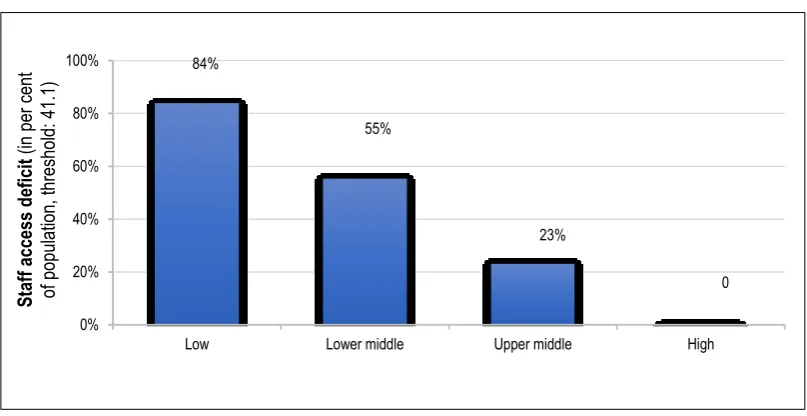
Presently, as much as 84 per cent of the total population in low income countries is excluded from access to health care because of missing investments in jobs for health workers which are needed to deliver essential services. In lower-middle income countries related deficits result in access gaps for more than half of the total population (Figure 1).
Figure 1. Exclusion from health care due to workforce shortages in the health sector
(ILO Staff Access Deficit Indicator by income-level of countries in per cent of population, 2014)
Source: Scheil-Adlung et al., Health sector employment: a tracer indicator for universal health coverage in national Social Protection Floors, in: Human Resources for Health 2015, 13:66 available from: http://www.human-resources-health.com/content/13/1/66.
The global population living in rural areas suffers most significantly from access gaps: The absence of the health workers in rural areas results in the exclusion of 52 per cent of the global rural population as compared to 24 per cent of the global urban population (Figure 2).
84%
Low Lower middle Upper middle High
Figure 2. Rural/urban populations excluded from health care due to workforce shortages in the health sector (ILO Staff Access Deficit Indicator in per centof population, 2014)
Source: X. Scheil-Adlung (ed.): Global evidence on inequities in rural health protection – new data on rural deficits in health coverage for 174 countries, International Labour Organization, Geneva, 2015. Available from: http://www.social-protection.org/gimi/gess/RessourcePDF.action?ressource. ressourceId=51297.
Also older persons are importantly concerned by workforce shortages: ILO estimates that globally more than 50 per cent of older persons do not have access to needed long-term care (LTC) services given the absence of the required workforce (Scheil-Adlung, 2015a). Due to these shortages, the majority of older persons in the world in need of LTC receive services from family members filling the gaps in the health and social care workforce. Thus, a large part of the care work is provided by unpaid, often female workers who are fully or partly pulled out of the labour market to provide LTC to relatives. In the absence of their contribution to the economy, significant impacts on the economy – particularly foregone economic growth – can be assumed. Thus, family care cannot be considered as a “free
service” without a cost to the economy as often assumed.
The negative externalities of excluding large parts of the populations from access to quality care have significant impacts on the economic development in the countries concerned. It is estimated that in the years 2000 to 2011 about 24per cent of global economic growth resulted from years gained due to better health. 1 This percentage does not include
effects related to increased wealth due to better health 2 and reductions in inequities and
global disparities that also contribute to economic growth.
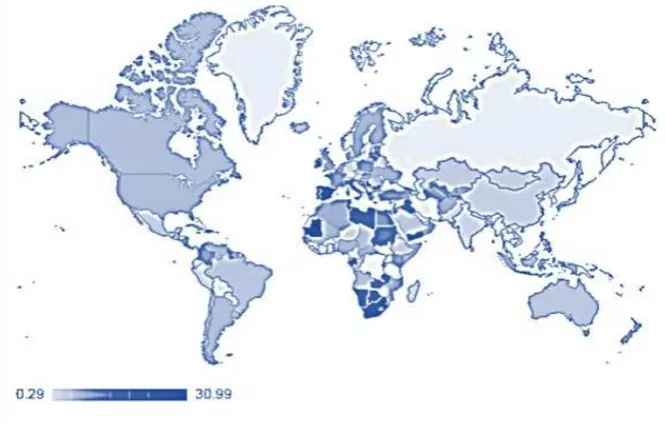
The highest employment potential and economic growth will derive from investments in UHC and related jobs in countries that currently have low health protection coverage rates, significant health workforce shortages and high unemployment rates. This is particularly the case in countries of Africa and Asia (Figures 3 and 4), where health workforce shortages and
1 The Lancet Commission, Global health 2035: a world converging within a generation. The Lancet.
2013; 382(9908): 1898-1955. Available from: http://www.thelancet.com/commissions/global-health-2035.
Africa Middle East Asia and the Pacific (excl
North America Western Europe Central and Eastern Europe
World
coverage rates are among the globally lowest - including countries where more than 80 per centof the population are without health protection coverage and have no access to health workers and unemployment rates are above 30 percent such as in Mauritania.
Figure 3. Global health protection coverage rates (proportion of population affiliated to national health services, social, private or micro-insurance schemes in per cent of population, population weighted, latest available year)
Source: ILO, 2014-15.
Figure 4. Global unemployment rates (2013 or latest available year, in per cent employment, latest available year)
Source: ILO, 2014.
social sector jobs for inclusive economic growth. This study 3 expands on background studies and policy briefs developed for the Commission’s work. It aims to assess the
employment potential of investing in health protection.
The paper provides a comprehensive evaluation of the total employment contributing to the achievement of health objectives taking into account that:
Employment in the production process of health protection spans apart from the health sector to numerous economic sectors and occurs within and across countries. Thus, related employment should be estimated in broader national health economies and global health protection supply chains rather than in the single health sector.
The production of health protection requires jobs in a broad range of occupations that reach far beyond health occupations.
The supply of health protection is currently largely based on a care provider model that
assumes the delivery of “free services” from an unpaid workforce consisting mostly of
female family workers, e.g. providing informal long-term care to older relatives. However, these workers are often fully or partly pulled out of the labour market and
thus left their jobs to “fill” missing jobs of the health workforce. This produces
significant economic costs and results in foregone growth.
Currently, such a broader viewpoint is hardly taken in the existing literature, research and policy debates and related data at global, regional and national level are not available. Rather than covering the health economy including its public and private sectors, most analyses focus on the narrow health sector or limited public service coverage only. As a result, multiplier employment effects and related returns of investments in UHC created in other economic sectors are overlooked. Further, often reference is made to fragmented data
limited to “expenditures” and civil service employment. In such approaches the employment
potential and economic growth as well as decent working conditions of supply chain workers remain in the dark and social upgrading of jobs, e.g. by providing rights at work and social protection, can hardly be addressed. Further, the lack of data negatively impacts on
countries’ ability to distribute investments efficiently and devise evidence-based
employment policies.
This paper focuses particularly on estimating:
– the current number of jobs for workers in health and non-health occupations that are contributing to attaining health objectives in the health economies of 185 countries;
– the employment potential for workers in global health protection supply chains producing UHC by 2030 in the context of the SDGs 1, 3 and 8.
Further, the paper provides policy options for investments in UHC addressing workforce shortages including challenges of the care production by unpaid family workers.
3 The author expands particularly on research (X. Adlung and A. Nove, 2016, and X.
II.
Health employment and the economy:
Which jobs and economic sectors
contribute to producing health care
in national health economies?
Health care goods and services are produced by a workforce that is employed in numerous economic sectors, be they public, private or voluntary: the health economy. It consists of the health sector itself and other service sectors and industries, such as:
– administration;
– information technology;
– cleaning;
– agriculture;
– food;
– transportation;
– retail;
– wholesale;
– research.
Employment in the health economy can best be assessed by focusing on the production and trade of health care in health protection supply chains as they allow an analysis of the impact of interactions of suppliers of health care and related funding. Health protection supply chains refer to various activities within or across countries that are required to produce and provide goods and services for health objectives such as UHC within the health sector and beyond. These activities range from services to supplying and transforming raw materials such as those used for medicines into final products through various phases of development, production, distribution and delivery. 4 Public and private institutions as well
as enterprises involved in the various stages are linked to each other through the supply chain.
Health protection supply chains are affected by labour issues, workforce development and gender issues. Thus, investing in UHC and related health protection supply chains adds to both economic development and to broader socioeconomic values.
The activities performed in health protection supply chains require workers with different educational 5 backgrounds and a broad range of skills in:
(1) health occupations (HO), such as physicians, nurses and laboratory assistants; and
(2) non-health occupations (NHO), such as administrators, IT specialists and workers in cleaning jobs or truck drivers delivering pharmaceuticals.
Both groups together form the workforce of the health economy which is as critical as the workforce in other economic sectors for the production of quality care. Achieving health objectives will not be possible for HOs without the support of NHO workers: An adequate number of both HO and NHO workers working towards attaining health objectives and thus funded by health expenditure is essential, for example to register patients, provide social and long-term care (LTC) services, ensuring clean and sanitized lab coats, producing and packaging medicines, operating computers, delivering financial and legal advice, moving goods such as food in the production line and producing finished products.
Employment in health protection supply chains involves standard and non-standard forms, formal and informal, paid and unpaid work. Non-standard forms of employment, often informal employment, are characterised by high disparities in terms of working conditions, such as rights, working times, and wages e.g. for the large group of workers that are providing unpaid work and informal care such as daughters delivering LTC to their parents, or migrant workers. Their work is unpaid, physically and mentally demanding and carried out irrespective of national regulations on working time, vacation, occupational safety and health. Even if compensated by in kind or cash benefits, family workers risk poverty and ill health at later stages of their life and thereby increase the economic costs of family care.
Based on ILO estimates the group of family members delivering LTC services to their older relatives is estimated to provide as much as 90 per cent of all care work, in low and middle-income countries estimates are even higher due to the nearly complete absence of LTC workers in these countries. Frequently, they step in for the extreme shortages of skilled LTC workers that are estimated at 13.6 million globally (Scheil-Adlung, 2015a).
Often, the LTC work of family members is perceived as “free” without a cost to the
economy serving as an argument not to create adequate numbers of jobs for skilled LTC workers in the public sector. Further, these workers are generally not considered when assessing labour market effects of UHC and health sector employment. However, many family workers are pulled out of the formal labour market to provide informally LTC for older persons as they give up or reduce formal employment or retire early. As a result, they are not available to contribute to the economy. Accepting the lack of formal LTC workers as normal fails to recognize the potential for physical and mental improvements possible by providing quality services of skilled workers. Further, this viewpoint ignores the potential of economic growth possible by creating a sufficient number of LTC jobs. In addition, informal care giving has negative consequences for economic growth as the workers are not paying taxes and contributions to social protection systems and schemes.
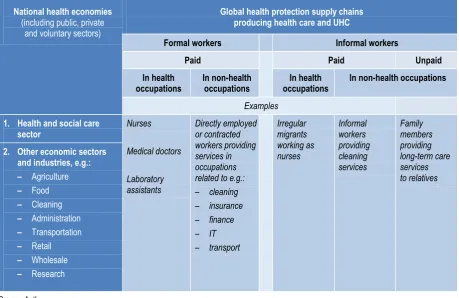
Table 1 provides a rough typology of the workforce employed in the health protection supply chains covering skilled and unskilled as well as public, private and voluntary workers employed in numerous economic sectors.
5 The International Standard Classification of Education (ISCED), International Standard
Table 1. Typology of the workforce employed in health protection supply chains
National health economies
(including public, private and voluntary sectors)
Global health protection supply chains producing health care and UHC
Formal workers Informal workers
Paid Paid Unpaid
III.
What is the current size of employment
in global and regional health protection
supply chains?
Today’s production and distribution of health care is characterised by large gaps in the
size of the health workforce in health and non-health occupations as observed in access deficits for large parts of the global population. These shortages are not equally distributed across the world. This often results in negative implications for the population, particularly in low and middle income countries: exclusion from and inequities in access to health care contributing to loss of health and social gains including social cohesion. (ILO, 2014-15).
Filling the current workforce gaps has the potential to stimulate additional – so far forgone – economic growth as it can be assumed that:
(1) each additionally employed worker supporting the attainment of health objectives will contribute to GDP growth and economic development. However, a precondition for inclusive growth relates to quality products and services that require jobs with decent working conditions, such as adequate wages as highlighted in SDG 8 on the promotion of economic growth and decent work;
(2) multiplier employment effects in numerous economic sectors beyond the health sector will occur as employment is generated in the health protection supply chain to produce goods and services to the health sector. When the incomes generated from these jobs are spent and re-spent on a variety of items in the broader economy (e.g. food and clothing), further employment effects will occur. Also taxes and contributions paid from these incomes will increase the countries’ tax bases and social protection schemes and systems.
Given the extreme workforce shortages in rural areas that frequently consist of informal economies, additional employment will reveal opportunities for rural development, growing formal labour markets and increased formal employment.
Against this background, we aim at estimating the current size of employment in health protection supply chains. Unfortunately, global and regional estimates of the total size of the workforce producing health protection are constrained by incomplete data. Further, the existing data is hardly internationally comparable given divers definitions, categories of workers and limitations to paid and public employment. In addition, data on the number of NHO workers working in the broader health economy are largely absent.
Given these constraints, we are using a specific methodology that takes into account all workers in the health sector as well as in other sectors that contribute to the health sector in public and private employment and on a voluntary basis, particularly unpaid family members providing long-term care to relatives. We also consider workers in both health occupations and non-health occupations working in the health economy.
Thus, we define workers in occupations that require higher or vocational education in a health field (HO) based on the International Standard Classification of Occupations (ILO, ISCO). This framework includes particularly “health professionals” such as doctors, nurses, midwives, dentists, pharmacists, “health associate professionals”, such as medical and
pharmaceutical technicians, traditional practitioners without formal training and “personal
care workers in health services” such as health care assistants and home-based personal care
Workers who are not employed in heath occupations and contributing through the delivery of goods and services to HO workers within the health sector or in other sectors – paid or unpaid, providing formal or informal care – are defined as non-health occupational workers (NHO). They include employees providing administrative support, laundry and food services, financial and insurance services, real estate activities, research, education and also LTC workers such as family members, friends or neighbours delivering unpaid informal services.
The size of this workforce is estimated for 185 countries based on most recent data from the ILOSTAT database, 6 WHO Global Health Observatory database 7 and where
available and comparable national databases. To overcome the limitations of these databases on formal employment and the underestimation of informal workers as well as the workers in other economic sectors than the health sector, we include further data and assumptions as detailed in the annexes that allow the quantification of related employment.
Based on these data we estimate numbers of workers in all service industries and estimate the proportion of these who are paid NHO workersbased on a proxy indicator of total health expenditure as a percentage of GDP. Numbers of unpaid NHO workers are estimated with a view to the needs of the population aged 65 and over and based on recent ILO estimates (Scheil-Adlung 2015a). We assume that the majority of such work is carried out by family members and consider that these workers are required to provide their services
“for free” given the shortage of the paid formal LTC workforce if the following conditions
are given:
– formerly paid employment has been given up;
– working hours of paid work have been reduced; or
– early retirement from paid work has been taken.
We assume that unpaid care work meeting these criteria should be converted into formal paid jobs. More details on the methodology and related data are provided in the annex.
This approach allows the estimation of the total number of workers employed in national health economies contributing to global health protection supply chains. For estimates of additional employment required to deliver services to all in need and achieve particularly SDG 3 on UHC and SDG 8 on economic growth and decent work we follow established ILO methodologies which set a threshold based on workforce-to-population
ratios and compare each country’s situation against this threshold. (Scheil-Adlung, 2013).
Given limited data availability, it was necessary to apply proxy variables, e.g. to estimate the number of HO workers in non-health sectors and assumptions, such as that the
ratio of workers’ wages to material costs is similar for all service industry sectors. Further,
the estimates are based on a limited number of countries that is used to apply workforce weighted average ratios to others. This is likely to introduce inaccuracies at individual country level for countries without data, but should not greatly affect the global total.
6ILO’s database of labour statistics: www.ilo.org/global/statistics-and-databases.
As a result, in comparison with most frequently used standard counts of health workers, this method extends the range of workers counted to the health economy and the broader health protection supply chain, by:
– identifying the number of all workers within the health sector, regardless of their occupation and employment status in the public or private sector;
– counting in all health professionals and associate professionals, even if they do not work within the health sector;
– using a proxy variable to estimate the number of workers in non-health occupations which contribute to the health sector but are employed beyond the health sector;
– estimating the size of the unpaid informal health workforce.
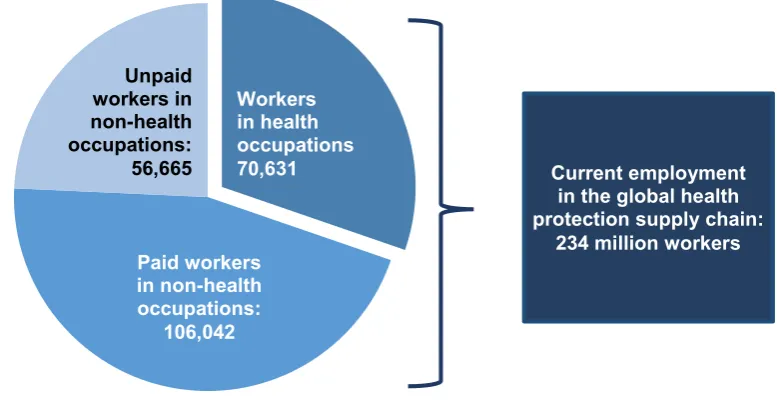
Based on the above methodology, the global estimates of the size of the workforce in the health economy of 185 countries indicate an availability of currently 234 million workers in the global health protection supply chain (Figure 5).
Figure 5. Current employment in the global health protection supply chain: Size and composition of workers (in thousands, 2016 or latest available year)
Source: ILO calculations 2016
The global employment is composed of employment in the health economies of Africa amounting to 14 million jobs, in the Americas to 44 million, in the Arab States to 5 million, in Asia and the Pacific to 109 million and in Europe and Central Asia to 62 million (Figure 6).
Workers in health occupations 70,631 Unpaid
workers in non-health occupations: 56,665
Paid workers in non-health occupations:
106,042
Current employment in the global health protection supply chain:
Figure 6. Current employment in the global health protection supply chain by region
Source: ILO calculations.
When breaking down the total number of workers into HO and NHO workers, we find globally:
– 71 million workers in health occupations;
– 106 million paid workers in non-health occupations, mostly formal workers; and
– 57 million unpaid (“voluntary”) workers in non-health occupations, mostly female LTC
workers providing care to older relatives, who were pulled out of the formal labour
market to provide “free” services.
NHO workers account for 70 per cent of all paid and unpaid workers, including informal LTC workers in the health economy and 60 per cent of the paid workforce in global health economies.
Based on the total size and composition of the workforce, the global ratio of NHO workers to HO workers is 2.3. Thus, globally each HO worker is supported by 2.3 paid or unpaid, formal or informal NHO workers to achieve health objectives.
Excluding unpaid NHO workers – and their work that would need to be transformed into paid LTC jobs – brings the ratio to 1.5, meaning that each HO worker is supported by 1.5 paid NHO workers.
The ratio of NHO workers to HO workers varies by income group. If we consider just paid NHO workers, high-income countries have a ratio of 1.7 NHOs for every HO, compared with 1.4 for middle-income countries and 1.3 for low-income countries (Figure 7).
14
44
5
109
62
0 20 40 60 80 100 120
Figure 7. Ratio of workers in non-health occupations to workers in health occupations, by income group, 2016 or latest available year
Source: ILO calculations 2016.
Taking paid and unpaid, formal and informal workers into account, however, we see a much higher ratio in low-income countries, because these countries tend to have small numbers of HO workers relative to the size of their populations. The relatively high ratio in high-income countries, on the other hand, is likely a reflection of the higher proportion of older persons among the populations and therefore greater numbers of LTC workers.
This analysis also suggests that countries in the Americas, Arab States and Europe/Central Asia regions tend to have more formal NHOs per HO (1.6 in these three regions, compared with 1.4 in Africa and Asia & the Pacific). Americas and Europe/Central Asia also have the highest ratios when unpaid NHOs are taken into account, along with Asia and the Pacific (2.3 NHOs per HO), whereas the Arab States region has only 2.0, suggesting a lower reliance on unpaid LTC workers in this region (Figure 8).
Figure 8. Ratio of workers in non-health occupations to workers in health occupations, by region, 2016 or latest available year
Source: ILO calculations 2016.
All (n=185) High (n=57) Upper middle (n=50) Lower middle (n=49) Low (n=27)
N
Including informal non-medical workersIncluding unpaid NHO workers Excluding informal non-medical workers
2.3
All (n=185) Africa (n=52) Americas (n=32) Arab States (n=11) Asia & the Pacific (n=32)
Including informal non-medical workers Excluding informal non-medical workers Excluding paid NHO workers
This is the first time that there has been an attempt to estimate employment in the entire health economy and thus the important impact on economic growth from the workforce contributing to the achievement of health objectives. The estimates exceed by far related assessments from other sources given the broader approach applied and differing definitions and data sources. 8 They reveal the important role of workers that are supporting physicians,
nurses and others in achieving health objectives through services related to e.g. cleaning and administration. Whether or not unpaid workers in non-health occupations are included, the number of jobs for this group is estimated to be much higher than the number of workers in health occupations.
8 The estimates of HO workers are thus different from and larger than estimates e.g. from WHO. The
IV. What is the additional employment potential
in health economies producing UHC?
The above evidence is based on the current situation and does not take into account the fact that many countries currently do not have sufficient numbers of workers in HOs and NHOs to produce UHC and provide adequate services to all: Thus, it is necessary to identify the employment potential to meet current and future needs. This requires to estimate the number of:
(1) currently needed workers required to attain the health objective of UHC;
(2) number of workers needed by 2030 to produce UHC in the context of the SDGs given the demographic developments.
Our estimates are based on a threshold of a minimum number of workers in health and non-health occupations in the global health protection supply chain and related national health economies to provide over the life cycle access to goods and services. 9
The estimates suggest currently a global employment potential of about 50 million missing paid workers in health and non-health occupations in the global health protection supply chain (Figure 9).
Figure 9. Current numbers of paid workers in health and non-health occupations and employment potential in the public and private sector to produce UHC in global health protection supply chains (public and private employment, 2016 or latest available year)
Source: ILO calculations 2016.
Globally, shortages concern currently 96 countries out of the 185 assessed. While some countries have a surplus of jobs for HO workers and NHO workers – particularly high-income countries – others show gaps:
– shortages of workers in health occupations exist in 89 countries and add up to 18.3 million HO workers;
– shortages of workers in non-health occupations exist in 95 countries amounting to 31.8 million NHO workers.
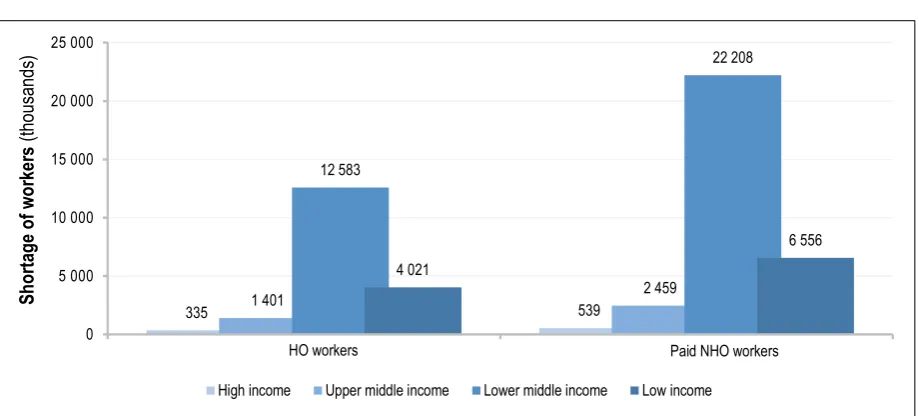
Thus, the missing workers and their jobs are not equitably distributed around the world. The shortages of HOs and NHOs predominantly affect lower-middle and low-income countries (Figure 10) in Africa and in Asia and the Pacific (Figure 11).
Figure 10. Current employment potential to fill gaps of missing workers by income group (public and private employment, 2016 or latest available year)
Source: ILO calculations 2016.
Figure 11. Current employment potential to fill gaps of missing workers by region (public and private employment, 2016 or latest available year)
Source: ILO calculations 2016.
The vast majority (91 per cent) of the missing HOs and NHOs are needed in lower-middle and low-income countries, and over half (56 per cent of missing HOs and 58 per cent of missing NHOs) are needed in Asia and the Pacific, which reflects the fact that this region contains the most populous countries in the world. However, in relation to population size, the shortages in Africa are the most severe.
In addition to addressing current shortages in the workforce required to provide quality services, it is important to acknowledge that based on the current trajectory, this situation
335 1 401 539
High income Upper middle income Lower middle income Low income
10 347
Asia & Pacific Africa Americas Arab States Europe & Central Asia
HO workers Paid NHO workers
HO workers Paid NHO workers
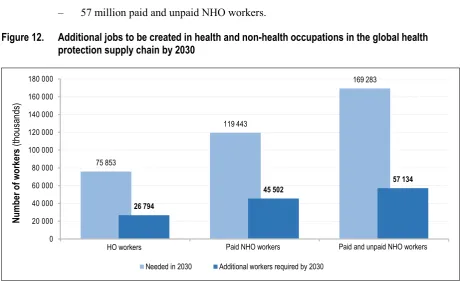
will be even worse in the future: By 2030, population growth means that the world will have to create even more additional jobs to produce UHC (Figure 12). This implies the need to create over the next 15 years jobs in the global health protection supply chain for:
– 27 million HO workers;
– 45.5 million paid NHO workers; and
– 57 million paid and unpaid NHO workers.
Figure 12. Additional jobs to be created in health and non-health occupations in the global health protection supply chain by 2030
Source: ILO calculations 2016.
As with current need, the vast majority of the additional need for HOs and paid NHOs will be in lower-middle income and low-income countries (Figure 13).
Figure 13. Employment potential for additional workers needed by 2030, by income group
Source: ILO calculations 2016.
Medical workers Formal non-medical workers Formal + informal non-medical workers
N
Needed in 2030 Additional workers required by 2030
437 2 201 784 1 099
Medical workers Formal non-medical workers Formal + informal non-medical workers
N
High income Upper middle income Lower middle income Low income
HO workers Paid NHO workers Paid and unpaid NHO workers
Paid and unpaid NHO workers Paid NHO workers
In low and middle income countries, the employment potential of the global health protection supply chain producing UHC by 2030 amounts to additional jobs for 82 million workers, comprising:
– 26 million HO workers;
– 56 million paid and unpaid NHO workers.
The majority of jobs will need to be created in:
– Asia, where 43 million additional jobs will be required;
– Africa, with 32 million jobs additional will be needed (Figure 14).
Figure 14. Jobs to be created for the production of UHC by 2030, by region
Source: ILO calculations 2016.
Medical workers Formal non-medical workers Formal + informal non-medical workers
N
Asia & Pacific Africa Americas Arab States Europe & Central Asia
V.
Employment effects of investments
in health protection
When assessing the evidence provided on current and future employment opportunities in national health economies and more broadly in the global health protection supply chain we find that investments in UHC and the related workforce can stimulate significant economic returns of investments besides the positive impacts on the health status of labour and populations at large:
Applying a health economy and global supply chain perspective allows to conclude that the total number of the workers producing health objectives such as UHC is significantly higher than previously estimated: It amounts to 234 million workers employed in the global health protection supply chain. This includes 14 million jobs in Africa, 44 million jobs in the Americas, 5 million jobs in the Arab States, 109 million jobs in Asia and the Pacific and 62 million jobs in Europe and Central Asia. Thus, investing in health protection has an important potential to boost economic growth due to the high number of jobs needed in numerous economic sectors for the delivery of health care.
The data suggest that economic returns of investments in UHC resulting in jobs for HO workers will yield high impacts on job creation for NHO workers. The current employment potential of addressing existing workforce shortages amounts to globally:
– 18.3 million jobs for workers in health occupations;
– 31.8 million jobs for workers in non-health occupations, particularly in low and middle income countries.
Each investments in the creation of one HO job has the potential to result in 2.3jobs for NHO workers. If only paid NHO work is considered, the ratio is still 1.5 meaning that each HO job could result in the creation of 1.5 NHO jobs. Thus, a direct effect of additional HO jobs is the generation and creation of NHO employment, from which the resultant incomes are used and re-used to contribute to the broader economy, leading to further employment and economic growth.
Given demographic growth by 2030, the employment potential in the global health protection supply chain will further increase and involve additional jobs to address workforce shortages towards UHC for:
– 27 million HO workers;
– 45.5 million paid NHO workers; and
– 57 million paid and unpaid NHO workers.
Many unpaid workers are currently used to fill the workforce shortages. The
assumption that these workers provide services for “free” does not hold true when
taking into account that a large group of these workers gave up jobs or reduced working time. Thus, they are not contributing to the larger economy and might incur themselves economic costs if impoverished or sick.
to result in a deterioration of the health status and thus higher health care costs for care receivers at a later point in time.
As the current employment to produce health objectives involves more than twice as many workers in non-health occupations than those in health occupations we conclude that the contribution of NHOs to economic growth and meeting health needs was largely overlooked in the past.
Related investments in UHC and the needed workforce have important employment effects not only in the health sector, but particularly in other economic sectors constituting the broader health economy.
The current shortages of jobs observed in the national health economies of 185 countries suggest that in the past due to insufficient investments in the health workforce much potential for economic growth has been lost and unemployment for a large range of high and low skilled workers within the health sector and many other economic sectors might have been reduced, particularly in Asia and Africa as well as in rural areas.
VI. Policies developing returns of investments
in UHC: Unlocking the potential of decent
employment in health economies
Given the fact that over 200 million people are employed in health economies to achieve health objectives and millions of additional jobs particularly in low and middle income countries are needed, a rethinking of current policies in terms of investments in UHC is required: This is due to the fact that investments will not only contribute to global health security and better health outcomes of populations at large and on labour. They will also develop returns of investments in the large health economies given the creation of millions of jobs for workers in health occupations and non-health occupations, the transformation of informal into formal employment and the reduction of unemployment as well as indirect savings e.g. due to reduced expenditure for poverty alleviation due to the close link between health access deficits and poverty (ILO, 2014-15). On the other hand, the ignorance of growing health protection needs, the ageing of populations and poor working conditions for health worker will result in foregone returns of investment.
Thus, it is indispensable to unlock the potential of decent employment in producing UHC and to realize inclusive and sustainable growth based on investments in related employment. This requires to invest in the creation of decent employment opportunities with a view to achieving progress towards the SDGs 1, 3 and 8. Core activities to maximise returns on investments in UHC include:
1. Developing a sufficient number of jobs for workers required in global health protection supply chains to achieve UHC.
2. Creating decent working conditions for all global supply chain workers producing UHC.
3. Providing adequate support and decent working conditions for unpaid family members providing LTC.
Developing a sufficient number of jobs for workers
required in global health protection supply chains
to achieve UHC
Maximizing returns of investments to progress towards the SDGs and UHC 10
necessitates the development of a sufficient number of decent jobs for HO and NHO workers with due respect to gender issues both in the public and private sector.
The creation of employment opportunities should be linked to meeting national health objectives such as UHC. This involves thresholds estimating the number of workers needed per population respectively older persons. Such thresholds can serve as a reference for adequate service delivery and range at global level between 4.1 11 and 4.5 full time paid
10 Global Health Workforce Alliance, World Health Organization: A universal truth: No health
without a workforce. Geneva, 2014. Available from: http://www.who.int/workforcealliance/ knowledge/resources/hrhreport2013/en/.
11 International Labour Organization: World Social Protection Report 2014/15, Geneva, 2014.
workers per 100 persons and for LTC per 100 persons aged 65 12 and over. This includes an
adequate skill mix and training opportunities for health workers.
Areas with highest returns of investments are those that are underserved, mainly in low and middle income countries of Asia and Africa and in rural areas. Thus, job investments should be distributed with a view to meet needs in both rural and urban areas and allow for equitable access to quality health care for all in need. Further, when implementing investments to create jobs it is important to consider multiplier employment effects as each investment in jobs for HO workers will generate more than two additional jobs for NHO workers in global health protection supply chains. Finally, a focus should be set on developing national and local personnel rather than relying on migration and recruiting health workers from other countries.
Most promising investment policies in HO and NHO workers relate to efficient and effective labour and market and employment policies. They are important tools to trigger economic growth through the health economy and to provide incentives for private sector investments if embedded in enabling macroeconomic policies.
Such policies reverse the prioritization of fiscal policies aiming at reducing debts and financial deficits only. By using macro-economic frameworks that allow for higher budget deficits and inflation they have the potential to create inclusive growth by reducing unemployment, providing education, training, skill development, focusing on poverty alleviation and investments in social protection in health. If well designed, these objectives can be achieved without jeopardizing macro-economic stability as they are linked to employment generating growth. Thus, major efforts are needed to integrate macro-economic, employment and labour market policies with a view to stimulate inclusive economic growth based on investments in decent employment in the health economy.
The implementation of related policies requires sufficient funds. For public investments funds should be generated from efficient and effective social protection financing mechanisms and guarantee an equitable delivery of goods and services ensuring social justice. An enabling framework taking into account the above as well as the need to strive towards the SDGs and achieving inclusive growth relates to ILO Recommendation No. 202 on national social protection floors (R.202). It also provides guidance on achieving coherence with social, economic and labour market policies and highlights the need to coordinate related policies with development policies such as rural development plans.
Efficient and effective social protection financing mechanisms consist of sources from taxes and contributions. If well designed they can generate sufficient domestic funds for inclusive health and long-term care protection systems and the delivery of services through paid care workers enjoying decent working conditions. It is important to ensure that out-of-pocket payments (OOP) are not considered as a health financing mechanism as they have the potential of impoverishment and often constitute barriers to access health services.
Further, fiscal space should be created to ensure adequate funds for investing in UHC. There are numerous ways to create fiscal space. They include particularly:
– addressing the evasion of tax and contribution payments;
– increasing the efficiency of resource utilization e.g. by fair distribution between rural and urban areas;
– broadening the revenue base for health protection and increasing contributions to social health insurance;
– governing health funds more effectively;
– strengthening institutional effectiveness and efficiency.
In addition, fiscal space can be created in the context of existing budgets lines, e.g. by reallocating government budgets. It is also possible to introduce new sources and revised economic frameworks: This includes increasing tax revenues, developing innovative financing strategies such as earmarked tobacco taxes or adopting a more accommodating macroeconomic framework entailing higher budget deficits and levels of inflation while keeping macroeconomic stability e.g. due to reduced unemployment and poverty. Finally, fiscal space can be created by drawing on increased international aid and transfers. These strategies can also be combined to increase resource mobilization for expanding health sector employment.
Creating decent working conditions for all global
supply chain workers producing UHC
Currently, many HO and NHO workers in the global health protection supply chain and related national health economies are suppressed from adequate wages, rights, and social protection such as the large group of unpaid LTC workers. However, poor working conditions lead to difficulties result in limitation in the delivery of quality care 13 and fail to
attract and retaining skilled personnel.
Only if all workers in the health economy enjoy decent working conditions can inclusive and sustainable growth be developed and the delivery of quality services ensured: Jobs providing decent working conditions such as social protection and decent incomes have immediate beneficial effects for the economy e.g. due to improved health and the related productive potential, and in the longer term stabilized consumption based on regular income. Thus, creating returns of investments in health economy workers will not be possible without decent working conditions for health workers in areas where they are needed most.
Against this background, investments should not be limited to achieving solely higher numbers of jobs, but should also consider decent working conditions for both HO and NHO workers as an integral part of health employment. Decent working conditions include particularly adequate wages and are underpinned by rights at work such as freedom of association, but also equal remuneration, non-discrimination, social protection and social dialogue. Decent working conditions are anchored in numerous ILO Conventions and Recommendations. 14
13 C. Wiskow, T. Albreht, C. de Pietro: How to create an attractive and supportive working environment
for health professionals. World Health Organization Euro. Copenhagen, 2010. Available from: http://www.euro.who.int/__data/assets/pdf_file/0018/124416/e94293.pdf.
14 Among others relevant ILO Conventions and Recommendations include: Freedom of Association
In this context, it is also important to setting policy priorities on transforming unpaid and informal services into formal LTC jobs where such work is obliged by the absence of formal LTC workers. Further, adequate cash benefits and social protection coverage should be provided to unpaid care workers such as family members to alleviate their burden.
In addition, measures should be taken to ensure retention and full participation of health workers at all ages for women and men. Given the high proportion of women working in national health economies, part time work, special leave and other arrangements allowing to combine formal work with work in families should be foreseen.
It is also important to ensure a sufficient and adequate infrastructure that allows developing the full potential and quality of the workforce employed.
An essential foundation for ensuring that investments in UHC contribute fully to and benefit from progress towards decent work for related workers is improved national data on the size and composition of NHO workers. It should be closely monitored using adequate indicators, such as deficits in health workforce density. Results should be discussed and feedback given to governments through national and social dialogue that strengthens the voice of key stakeholders, such as workers, employers, women, the rural population, young and older persons.
Providing adequate support and decent working
conditions for unpaid family members providing LTC
Currently, many policy and decision makers do not anticipate the need to transform informal LTC work into formal jobs due to “free” services being expected – mainly from female family members. The reliance on LTC being provided informally is unsustainable in the context of global ageing, particularly given that many are not trained for care giving, yet the work can be very demanding, e.g. caring for persons with mental disorders. Further, informal care giving has the potential to aggravate gender inequality as it is often provided without any remuneration or social protection coverage.